
Anyone selling charging products in the US and Canadian markets will almost always encounter these two certification thresholds: FCC and ISED. Many people get confused when they first come across them: aren’t they both certifications for North American countries? Are they mutually recognized? Do I need to get them for the ordinary charging cables I sell? What process should I follow for a Bluetooth-enabled charging stand?
This article explains the differences, scope of application, processes, costs, and common pitfalls of the two certifications from basic fundamentals to practical decision-making. Whether you are a new seller just entering the industry or an operator looking to optimize compliance costs, you can find corresponding answers.
Basic Fundamentals: Core Positioning and Applicable Boundaries
Before discussing specific rules, we must first clarify the most core boundaries to avoid misunderstandings that 90% of novices have:
What They Regulate and What They Do Not
The FCC and ISED respectively impose electromagnetic compatibility (EMC) or radio frequency (RF) requirements on unintentional radiators, intentional radiators, and some industrial, scientific, and medical (ISM) equipment covered by their rules. Whether they apply and which authorization path to adopt must be judged based on the product’s circuit, transmission function, operating frequency, and equipment category. Not all charging products are automatically subject to the same set of mandatory requirements.
They are not safety or quality certifications — they do not address whether a charger poses an electric shock risk, fire risk, or whether its charging speed is sufficient, nor can they replace other compliance requirements such as UL/CSA safety certifications, energy efficiency certifications, USB-IF certification, and battery transportation regulations.
The scope of this discussion is limited to the electromagnetic/RF market access of the US FCC and Canadian ISED, and the applicable objects are mainly charging products such as chargers, charging cables, wireless chargers, and power adapters.
Who Are the Two Agencies?
- FCC: Full name is the Federal Communications Commission of the United States, the official agency responsible for electromagnetic and RF access in the US. Whether related products need to meet FCC requirements shall be judged based on applicable equipment categories and rules.
- ISED: Full name is Innovation, Science and Economic Development Canada, formerly the Department of Industry — the governing body for the commonly referred to “IC certification”. It is the official agency responsible for electromagnetic and RF access in Canada, legally completely independent of the FCC, and the two sets of rules are not interchangeable.
Several Basic Terms You Must Understand (In the Context of Charging Products)
No need to memorize them by rote, just understand:
- Electromagnetic Compatibility (EMC): Simply put, it is the ability of a product and surrounding radio waves to “not interfere with each other” — it neither emits excess radio waves to interfere with others, nor is it easily interfered with by others’ radio waves. For most chargers and digital devices discussed in this article, FCC Part 15 Subpart B and ISED ICES-003 mainly specify conducted and radiated emission limits, and immunity is generally not a general mandatory test item for this type of equipment; however, specific products still need to check other applicable standards, wireless equipment rules, and customer requirements.
- Unintentional Radiation: Radio waves that are not intentionally transmitted by the product but accidentally leak out during operation. For example, when the switching power supply in a wired fast charger operates, it leaks some electromagnetic noise that may interfere with a nearby radio. This is classified as unintentional radiation.
- Intentional Radiation: Radio waves actively transmitted by the product to achieve its functions. For example, a Bluetooth-enabled charging stand needs to transmit Bluetooth signals to pair with a mobile phone, which is intentional radiation.
- Official Certification Number: Only products that go through the official certification path will receive a unique official number — the FCC’s is called FCC ID, and ISED’s is called ISED Certification Number (formerly IC ID). Products under the self-declaration path do not have such an official unified number.
Why Do Charging Products Need These Certifications?
Many people think, “My charger doesn’t transmit signals, why do I need this?” In fact, charging products may involve electromagnetic radiation:
- Chargers and power adapters may contain switching power supplies, which generate unintentional radiation during operation; however, the presence of a switching power supply alone cannot determine that a product definitely falls under FCC Part 15 Subpart B, ISED ICES-003, or any other equipment category. It still needs to be judged in combination with the product structure and applicable rules;
- USB-C cables with digital circuits (such as those with conversion or Hub chips) may also leak radio waves during operation;
- Wireless chargers and charging devices with Bluetooth/Wi-Fi inherently have active RF transmission;
- When listing on mainstream e-commerce platforms in the US and Canada, corresponding compliance certificates may be required, and products that do not meet platform requirements may be removed from the shelves.
To help everyone quickly grasp the core differences, we have first compiled a quick reference table of core comparisons, and the detailed rules will be broken down one by one later:
| Comparison Dimension | FCC (United States) | ISED (Canada) |
|---|---|---|
| Governing Body | Federal Communications Commission of the United States | Innovation, Science and Economic Development Canada (formerly IC) |
| Core Regulation | Electromagnetic compatibility, RF market access | Electromagnetic compatibility, RF market access |
| Compliance Path for Unintentional Radiation | SDoC (Supplier’s Declaration of Conformity) | DoC (Declaration of Conformity) |
| Compliance Path for Intentional Radiation | Certification (FCC ID issued) | Certification (ISED Certification Number issued) |
| Core Standard for Unintentional Radiation | FCC Part 15 Subpart B | ICES-003 (subject to the currently valid version) |
| Local Entity Requirement | SDoC is the responsibility of a responsible party located in the United States | Representatives, importers, or other responsibility arrangements shall be confirmed according to equipment category and applicable rules |
| Labeling Language Requirement | No mandatory bilingual requirement | Bilingual (English and French) required at the federal level, with additional French requirements in Quebec |
Scope of Application Judgment: Does Your Product Need Certification?
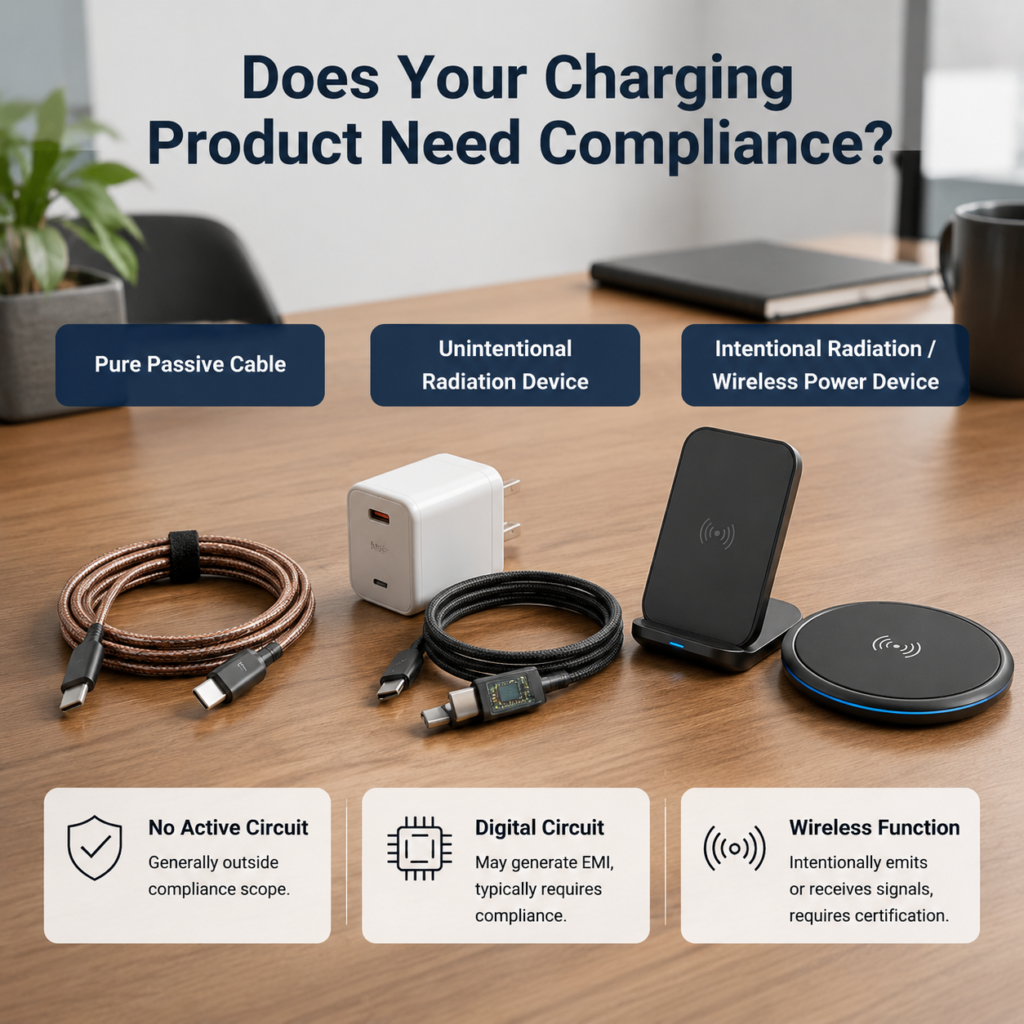
After clarifying the basic concepts, let’s solve the most practical problem: how to judge whether my charging product needs these two certifications?
Core Judgment Logic
According to the radio wave transmission characteristics of products, they can be initially divided into four categories, but the final judgment still needs to be combined with specific rules:
- Pure Passive Accessories: Products without any electronic circuits are usually exempt from compliance requirements, such as ordinary pure copper charging cables.
- Unintentional Radiation Digital Devices or Other Regulated Devices: Products that contain digital circuits or switching power supplies but do not actively transmit communication signals, such as wired chargers and chip-enabled charging cables, require confirmation of applicable unintentional radiation rules and authorization methods first. You cannot directly determine that a product belongs to a certain category of digital devices solely based on the fact that it “has a switching power supply”.
- Intentional Radiation Communication Devices: Products that actively transmit communication signals such as Bluetooth and Wi-Fi usually require official certification, but the applicable path should still be confirmed in combination with the operating frequency band, wireless module status, and specific configuration, such as Bluetooth-enabled charging stands.
- Wireless Power Transmission Devices: For example, wireless chargers are subject to exclusive power transmission rules, and the requirements for ordinary intentional radiation devices cannot be directly applied; separate evaluation is required.
Common Charging Products That Require Compliance
The following products usually require applicable EMC or RF compliance evaluation, but the final applicable rules and authorization paths shall be confirmed based on specific circuits, ports, power supply methods, and wireless functions:
- Mobile phone/tablet chargers, laptop power adapters, multi-port fast charging power strips;
- USB/USB-C cables with signal conditioning, conversion, or Hub chips;
- Charging devices with Bluetooth/Wi-Fi, wireless chargers, car chargers.
Passive/Active Boundary of Charging Cables (Most Common Pitfall)
Many people are confused about whether charging cables need certification. The core is to check whether there is an active circuit in the cable, not the length:
- Ordinary passive USB cables (only copper wires inside, no electronic components): usually exempt at the regulatory level;
- Cables with only E-Marker chips: need to be judged in combination with the specific functions of the chip, and are not directly mandatory;
- Cables with Hub, conversion chips, LED indicators, or signal amplification functions: belong to active digital devices and usually require compliance evaluation;
- Special reminder: Length is not the only criterion for judging whether compliance is required; the final check is whether there is an active circuit. In addition, some e-commerce platforms may have additional requirements, and even if the product is exempt from regulations, the platform may require a test report.
What Situations Will Change the Judgment Conclusion?
If your product has the following changes, the original judgment may no longer be valid and re-evaluation is required:
- Adding chips, wireless functions, or wireless power transmission functions: the regulatory path may be upgraded. For example, a product originally under self-declaration may require wireless device Certification;
- Changes in circuit topology or switching frequency: may change applicable standards and test requirements;
- Changes in sales market: if only selling in the US, only FCC requirements need to be evaluated; if entering Canada, ISED requirements must be supplemented;
- Bundled sales: if sold as a set with other digital devices (such as bundled with mobile phones or tablets), evaluation must be based on the complete configuration, and only the charger’s compliance certificate cannot be used.
Comparison of Certification Paths and Application Processes
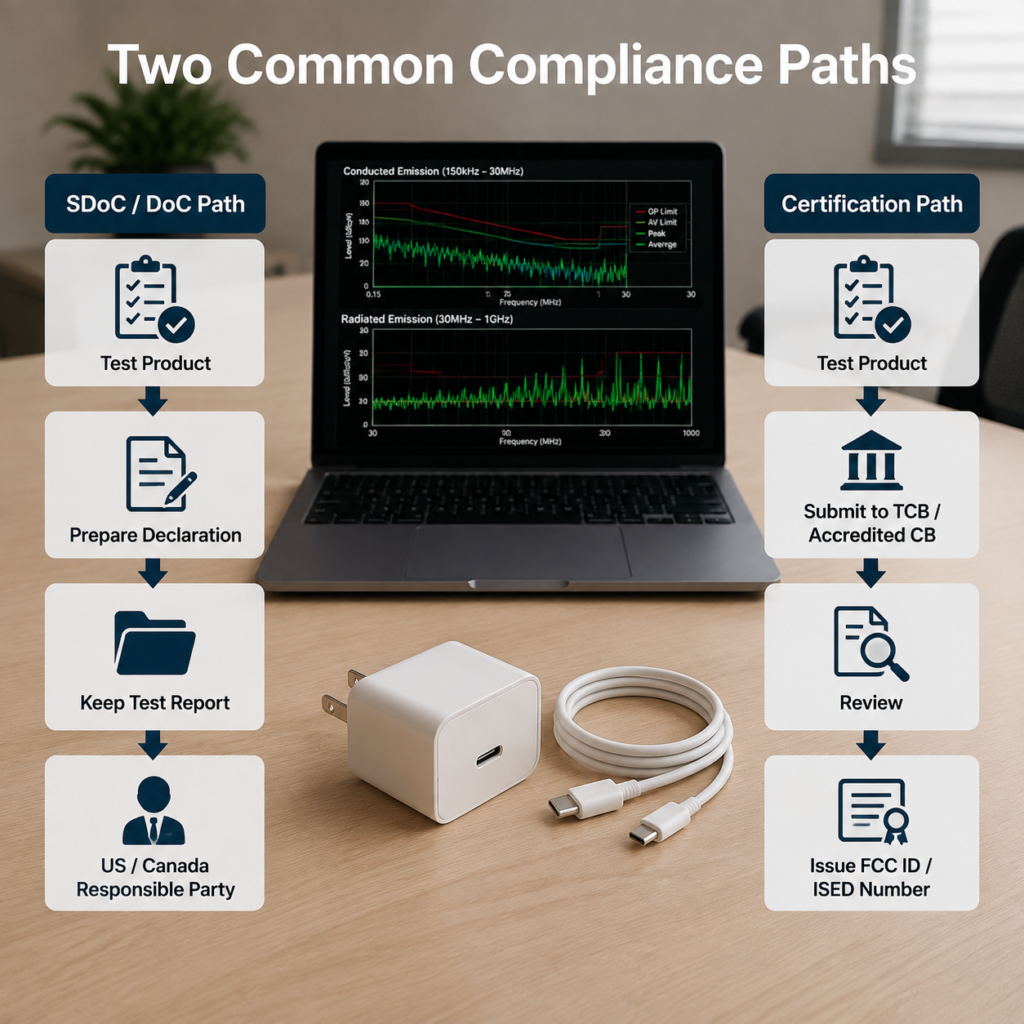
After confirming that compliance is required, the next step is to choose the right certification path. Both certifications can be divided into two categories: “self-declaration” and “official certification”, but the detailed requirements are different. We first compare based on the most common regular consumer-grade wired fast charger (unintentional radiation type), and products with wireless functions will have their differences explained separately.
The premise of the comparison is: first application, regular process, tested by a third-party laboratory with corresponding capabilities and meeting the requirements of the rules, and the whole machine is compliant.
Two FCC Compliance Paths
1. SDoC (Supplier’s Declaration of Conformity)
- Applicable Products: Unintentional radiation devices such as ordinary wired chargers and active charging cables without wireless functions, but still need to be confirmed according to specific circuits and applicable rules.
- Process: Complete testing in accordance with applicable FCC rules. After passing the test, the responsible party in the United States shall bear the responsibility for the declaration of conformity, and retain the test report and related compliance documents.
- Features: No official case-by-case review is required, and the responsible entity is responsible for compliance. Manufacturers outside the US usually need a US-based manufacturer, importer, or other eligible entity to assume SDoC responsibility. The responsible party here cannot be simply equated with a “US Agent” that must be designated under all circumstances.
The testing laboratory shall have corresponding technical capabilities and meet the requirements of FCC rules, and it should not be generally stated that accredited laboratories under the FCC Certification path must be used.
2. Certification (Official Certification)
- Applicable Products: Intentional communication charging devices with Bluetooth/Wi-Fi, which shall be confirmed in combination with frequency bands, module status, and configuration; wireless chargers shall be evaluated separately in accordance with the exclusive power transmission rules of FCC Part 18.
- Process: First find a qualified laboratory for testing. After passing the test, submit it to the FCC-authorized third-party certification body (TCB) for review. After passing the review, a unique FCC ID will be issued.
- Features: The certificate is reviewed and issued by an authorized certification body, and relevant information can usually be queried in the FCC database.
Two ISED Compliance Paths
1. DoC (Declaration of Conformity)
- Applicable Products: Ordinary wired chargers, active charging cables without wireless functions, etc. may be unintentional radiation devices, but shall be confirmed in accordance with ICES-003 and other applicable rules.
- Process: Complete testing in accordance with applicable Canadian standards. After passing, the relevant responsible entity shall prepare and retain documents such as test reports and declarations of conformity.
- Features: No official item-by-item certification is required, and compliance with applicable Canadian ICES standards is required, such as ICES-003, which is common for unintentional radiation types.
The responsibilities of manufacturers, importers, and document holders for ICES-003 self-declaration devices shall be confirmed in accordance with the standard and specific product conditions, and the requirements for Canadian local representatives or importers cannot be unconditionally applied to all DoC products.
2. Certification (Official Certification)
- Applicable Products: Intentional communication charging devices with Bluetooth/Wi-Fi, which shall be confirmed in combination with frequency bands, module status, and device configuration.
- Process: Find a laboratory with accreditation for applicable test items or accepted by ISED for testing. After passing, submit it to the certification body accredited by ISED for review. After passing the review, a unique ISED Certification Number (formerly IC ID) will be issued.
- Features: The certificate is reviewed and issued by an accredited certification body, and relevant information can be queried in the ISED database.
For Canadian wireless power transmission devices, priority shall be given to checking ISED RSS-216 and the related RSS/ICES requirements it references, and the test and certification path shall be determined in combination with operating frequency, power, transmission method, and device type.
Responsible Entity and Laboratory Qualification Requirements
These two are requirements that are easily overlooked during application:
- Responsible Entity: FCC SDoC shall be the responsibility of a responsible party located in the United States, usually including US manufacturers, importers, or other eligible entities. Overseas applicants requiring ISED Certification shall confirm the Canadian representative and other responsibility arrangements in accordance with rules such as RSP-100; the responsibility requirements for ICES-003 self-declaration devices shall be confirmed in accordance with the standard.
- Laboratory Qualification: The testing laboratory must have accreditation for applicable test items or be accepted by ISED, and meet the acceptance conditions of specific standards, accreditation scopes, and regulatory authorities. The validity of the report cannot be judged solely by whether the laboratory advertises “dual FCC/ISED qualifications”.
Can Module Certification Be Reused?
Many people use already certified wireless modules to make complete machines, thinking that they can directly use the module’s certification without testing the whole machine. That’s not actually the case:
- Eligible certified wireless modules can indeed reduce repeated testing of the wireless part of the whole machine under certain conditions;
- The prerequisite for reuse is that the antenna, installation method, RF parameters, shielding conditions, operating power, etc. meet the limited scope of the module certification;
- The whole machine still needs to complete applicable digital device, emission, RF exposure, and labeling evaluations, and cannot directly inherit all certifications of the module;
- Ordinary power modules or safety certification documents cannot automatically replace the FCC/ISED compliance evaluation of the whole machine.
If the module’s usage conditions are not met, for example, if a higher-power antenna is replaced, the module certification cannot directly cover the whole machine, and the whole machine still needs to be evaluated accordingly in accordance with the rules.
Comparison of Test Requirements
Many people ask: how much do the test requirements of the two certifications differ? Can I get two certificates with one test? We still take regular consumer-grade wired fast chargers (unintentional radiation type) as the benchmark, and break it down from three dimensions: test items, standards, and limits.
Comparison of Core Test Items
- Common Mandatory Test Items (Unintentional Radiation Type): Conducted disturbance (interference leaking from the power cord) and radiated disturbance (interference leaking from space). These two are usually the key items that need to be evaluated for this type of product.
- Non-Mandatory General Items: Immunity (the ability of a product to resist external interference) only needs to be tested when specified by other standards, customer requirements, or specific product categories, and is generally not required for ordinary consumer-grade chargers.
- Additional Tests for Wireless Devices: If it is a product with Bluetooth/Wi-Fi, additional tests such as RF power, spurious emissions, and frequency band compliance are required; wireless chargers also require exclusive power transmission tests.
During testing, the charger is placed on a turntable in a semi-anechoic chamber to comprehensively detect radiated disturbance values at different angles, ensuring that interference in all directions is within the limits.
Differences in Standard Basis
Different types of products are subject to different standards:
- Unintentional radiation devices: FCC is based on “FCC Part 15 Subpart B”, and ISED is based on “ICES-003”. The specific version shall be subject to the currently valid version of ISED, equipment category, and transition period. Do not memorize fixed versions by rote;
- Intentional communication devices: FCC is based on “FCC Part 15 Subpart C”;
- Wireless power transmission devices: FCC is based on “FCC Part 18”; for Canada, ISED “RSS-216” and the related RSS/ICES requirements it references shall be checked, and judgment shall be made in combination with operating frequency, power, transmission method, and device type.
Limit Comparison Logic
People often ask “Which has stricter limits, FCC or ISED?” This question cannot be answered generally and must be compared dimension by dimension: multiple factors such as frequency band, Class (Class A is industrial grade, Class B is consumer grade), test port, detector type, test site, and standard version must be considered.
Overall, the limit systems of the two certifications are similar, but there are differences in the limits of a specific frequency band or port, so it cannot be directly said which is stricter. As for whether test data can be reused: FCC reports cannot automatically replace ISED, but if the test method, standard adaptation, sample status, and laboratory qualifications all meet the requirements, part of the test data can be reused to save costs.
Special Test Considerations for Charging Products
Charging products have their own characteristics, and these points may directly affect the pass rate during testing:
- The electromagnetic noise of different fast charging power levels may be different. For example, the interference levels of 20W and 65W levels may be different. According to applicable standards and laboratory engineering judgment, the operating mode and load that can represent normal use and may generate maximum emissions shall be selected;
- When a multi-port charger outputs simultaneously, interference from multiple ports may be superimposed. Representative port combinations and load conditions shall be selected according to the normal usage of the product and test rules, and the most unfavorable possible configuration shall be evaluated if necessary;
- Test results may vary when paired with different USB-C cables (especially chip-enabled cables). Representative cable configurations that can support compliance conclusions shall be selected according to the test plan, rather than naturally requiring all cables to be tested separately;
- Power chip selection, shielding design, and grounding design have a great impact on the pass rate. For example, using a transformer with better shielding and optimizing PCB layout can reduce radiated disturbance values.
What Situations Will Trigger Changes in Test Requirements?
If the product has the following adjustments, the original test plan may no longer be applicable, and a change impact assessment must be carried out first:
- Adding wireless communication or power transmission functions: corresponding special RF tests shall be added;
- Changes in circuit topology or switching frequency: may require adjustment of the frequency band and test configuration of radiated tests;
- Changes in output ports or cable configuration: the impact on conducted and radiated emissions shall be evaluated first, and supplementary testing or re-testing shall be carried out if necessary. For example, changing from one port to three ports does not mean that re-testing must be carried out according to a fixed plan, but shall be judged based on the changed circuit and usage configuration.
Labeling, Documentation, and Authenticity Verification
After passing the test and obtaining the compliance certificate, there is another easy pitfall: labeling and documentation. Many sellers have their products removed from platforms or detained at the border due to non-compliant labeling, but in fact, there is no problem as long as they follow the rules.
We compare the two categories of “self-declaration path” and “official certification path”, covering three aspects: product/packaging/manual labeling, document retention, and authenticity verification.
FCC Labeling and Documentation Requirements
SDoC Path
- Labeling Requirements: SDoC devices shall provide the required compliance statement and product identification information in accordance with FCC rules, and provide information such as the name and address of the US responsible party in the user manual or accompanying compliance documents. The specific labeling location and exceptions for small devices shall be implemented in accordance with 47 CFR §15.19 and related clauses, and it cannot be generally required that all information be engraved on the product body or packaging.
- Documentation Requirements: Test reports and declarations of conformity shall be retained in accordance with the rules, and must be available when regulatory authorities conduct random inspections; they cannot be lost.
Certification Path
- Labeling Requirements: The FCC ID (composed of grantee code + product code) must be permanently marked; the specific labeling location and exceptions for small devices shall be implemented in accordance with applicable FCC clauses. You can find the laser-engraved FCC ID on the bottom of the casing of many chargers.
- Documentation Requirements: In addition to the test report and declaration of conformity required by SDoC, official certification documents must also be retained.
ISED Labeling and Documentation Requirements
DoC Path
- Labeling Requirements: An ICES compliance statement is required, such as the common “CAN ICES-3(B)/NMB-3(B)”; in terms of language, bilingual (English and French) is required at the federal level. If the product is mainly sold in Quebec, it must also meet the additional French requirements of the local packaging language law.
- Documentation Requirements: Test reports and declarations of conformity shall be retained for inspection in accordance with the rules.
Certification Path
- Labeling Requirements: The ISED Certification Number shall be marked on the device in accordance with RSS-Gen, RSP-100, and applicable device rules. Only products that meet the specified conditions such as small devices or electronic labels can be placed in the user manual, packaging, or electronic interface in the permitted manner. Requirements such as the format, permanence, and visibility of the certification number shall be checked against specific rules item by item, and “small size” alone cannot be used as a condition for placing it on the packaging or manual.
- Documentation Requirements: In addition to the documents required by DoC, official certification documents must also be retained.
- Language Requirements: Consistent with the DoC path.
How to Verify Authenticity?
- Official Certification Path: Just go to the corresponding official website to check the number — check the FCC ID on the FCC official website, and the ISED Certification Number on the ISED official website. You can find the corresponding product model, manufacturer, and authorization information, and fake numbers usually cannot be found.
- Self-Declaration Path: There is no official unified query portal, because the reports are retained by the enterprise itself. So if you need to verify, you can ask the supplier to provide the test report and declaration of conformity, and check whether the laboratory qualification, product model, and test data of the report meet the requirements.
Costs, Cycles, and Maintenance Rules
We have compiled conventional market references for the cost and time issues that everyone is most concerned about — note that all costs and cycles are non-committal references provided by mainland third-party laboratories based on the premise of “regular wired fast charger, first application, no rectification, no expedited processing, excluding official review fees”. The actual situation will vary due to product complexity and laboratory selection, and the specific quotation shall prevail.
Cost Reference and Cost-Saving Tips
- Self-Declaration Path (SDoC/DoC): The cost is approximately between several thousand and 15,000 RMB, mainly testing fees.
- Official Certification Path (Certification): The cost will increase significantly, because RF testing and official review fees are added. The specific amount depends on the complexity of the product’s wireless functions.
- Cost-Saving Tip: Find a laboratory with both FCC and ISED qualifications, and obtain compatible data for both standards in one test, instead of testing twice separately, which can save a lot of money. If you already have an FCC report, you can also reuse part of the data under eligible conditions to reduce the testing cost of ISED.
Cycle Reference and Speed-Up Tips
Costs and cycles can only be used as a reference for unofficial commercial quotations under specific laboratories, product categories, and project configurations, and cannot be regarded as the general processing time limit for FCC or ISED. Actual projects should also account for laboratory scheduling, product rectification, supplementary testing, document review, and certification body processing time.
- Self-Declaration Path: FCC takes approximately 1-2 weeks, and ISED takes approximately 2-3 weeks. Both are the time for regular testing + report issuance, excluding product rectification time;
- Official Certification Path: Approximately 4-8 weeks, because it includes the review time of the official agency, also excluding rectification time;
- Speed-Up Tip: Find a dual-qualification laboratory to do dual certifications jointly. Under the condition of high overlap of test items and sufficient preparation of samples and materials, repeated scheduling may be reduced, but a fixed reduction in duration cannot be guaranteed.
Validity Period and Maintenance Rules
Many people ask whether the certification has a validity period. The answer is:
- Common Rules: There is usually no universally fixed validity period, but if the product design, core components change, or the applicable standards are updated, compliance needs to be re-evaluated, and old certificates cannot be used indefinitely;
- Standard Updates: After the standard is updated, you should check the transition clauses of the new version and the notice of the competent authority to confirm whether the original certification or compliance documents can still be used, and whether supplementary testing, change submission, or re-certification is required. It cannot be simply understood as automatically invalid after expiration;
- Special Reminder: If the power chip of a charging product is replaced or the circuit design is adjusted, a change impact assessment shall be carried out. Only when the change affects applicable limits, emission characteristics, RF parameters, or certification conditions, supplementary testing, change submission, or re-certification is required in accordance with the rules.
Common Misconceptions and Violation Risks
After talking about the formal process, let’s sort out a few misconceptions that 90% of novices will fall into, to help you avoid compliance risks.
Misconceptions About Mutual Recognition
- Misconception: FCC certification can be directly used in Canada Wrong. The regulations of the United States and Canada are completely independent and do not have mutual recognition legally. Only test data can be reused under eligible conditions, and you cannot directly sell products with FCC certification in the Canadian market.
- Misconception: CE/UL/CSA can replace FCC/ISED Wrong. The regulatory directions of different certifications are completely different: CE is the compliance requirement of the European Union, UL/CSA are safety certifications, and FCC/ISED are electromagnetic/RF access. They cannot replace each other.
- Misconception: Certifications can be shared between US and Canadian cross-border e-commerce sites Wrong. The platform will verify the compliance certificates of the corresponding markets separately — the US site checks FCC, and the Canadian site checks ISED. They cannot be mixed.
Misconceptions About the Application Process
- Misconception: SDoC/DoC is just sticking a label by yourself, no testing needed Completely wrong. The self-declaration path still requires testing to be completed in accordance with applicable rules, and test reports must be retained for inspection. Fraud is false compliance, and penalties are severe if caught.
- Misconception: Having an official certification number equals full compliance Wrong. The official number only corresponds to specific models, hardware versions, and configurations. If the casing, antenna, chip are replaced, or the circuit is adjusted, a change impact assessment must be carried out first, and then it shall be determined according to the rules whether supplementary testing, change submission, or re-certification is required. You cannot use the number of another model.
- Misconception: A complete machine using a certified module does not need to be tested again Wrong. Eligible wireless modules can reduce some repeated tests of the wireless part of the whole machine, but the whole machine still needs to complete applicable digital device, emission, RF exposure, and labeling evaluations. Ordinary power modules or safety certification documents cannot automatically replace the FCC/ISED evaluation of the whole machine; if the usage conditions of the wireless module are not met, the whole machine must also undergo corresponding testing or certification in accordance with the rules.
Misconceptions About Labeling
- Misconception: FCC SDoC has a mandatory unified label Wrong. The FCC does not specify a unified label style for the SDoC path, but product identification information, compliance statements, and US responsible party information still need to be provided according to different clauses. It cannot be simply understood that all information must be printed on the product with the same sticker.
- Misconception: The ISED certification number can be printed on the packaging casually Wrong. The certification number must correspond one-to-one with the product model, and must also meet the requirements of RSS-Gen, RSP-100, and applicable device rules regarding location, permanence, visibility, or electronic labels. You cannot arbitrarily place it on the packaging just because the product is small in size.
- Misconception: The bigger the certification label, the more formal it is Wrong. As long as the label is clear and legible and meets the size requirements, it is fine; there is no need to print it very large.
What Are the Consequences of Violations?
The regulatory measures for violations in the two countries are roughly the same, including: stopping sales, detaining goods at the border, product recall, fines, removal from e-commerce platforms, and even account restrictions. The severity of penalties depends on the nature of the violation, the entity, and the law enforcement agency. There is no unified conclusion on “which is stricter”, so don’t take chances.
Quick Decision Tree and Self-Check List
To help everyone make quick judgments, we have compiled a set of certification selection decision trees exclusive to charging products, as well as a pre-application self-check list. Following them can reduce judgment errors.
Charging Product Certification Selection Decision Tree
Step by step:
- Determine the sales market: Only sell in the US → evaluate FCC requirements; only sell in Canada → evaluate ISED requirements; sell in both → meet the applicable requirements of both countries respectively.
- Judge the product type: Pure passive accessories (such as ordinary copper charging cables) → usually exempt; contains digital circuits or switching power supplies → first confirm applicable unintentional radiation rules, other special rules, and authorization methods, and cannot be automatically classified into the same self-declaration path.
- Check for wireless functions: Devices with Bluetooth/Wi-Fi usually require wireless device Certification, but still need to be confirmed in combination with specific frequency bands, module status, and configuration; with wireless power transmission (such as wireless chargers) → evaluated separately in accordance with FCC Part 18, Canadian RSS-216, and related rules.
- Check for certified modules: If the conditions for wireless module reuse are met → corresponding test items can be reduced, saving cost and time; ordinary power module documents cannot automatically replace the whole machine evaluation.
- Check responsible entity and labeling requirements: Prepare materials and design labels according to the corresponding path. For example, the Canadian market requires bilingual labels, and local representatives, importers, or other responsibility arrangements shall be confirmed according to the equipment category.
Pre-Application Self-Check List
Before submitting the application, check these items first to avoid back-and-forth rework:
- Product attributes: whether it is active, whether it has digital circuits, whether it has wireless/power transmission functions, and whether the core configuration is clear;
- Laboratory qualification: confirm that the laboratory has accreditation for applicable test items or is accepted by the regulatory authority, don’t just look at the “dual qualification” in the promotion;
- Application materials: prepare product specifications, simplified circuit schematics, and core component lists in advance;
- Check after obtaining the certificate: the model and hardware version on the compliance documents must be completely consistent with the actually sold product;
- Additional for Canadian market: confirm that bilingual labels meet the requirements, and confirm local representatives, importers, or other responsibility information according to specific device rules.
Core Variables That Will Change the Conclusion
If your product has the following situations, the previous judgment may need to be adjusted:
- Adding wireless communication/power transmission functions: test items, costs, cycles, and certification paths will all change significantly;
- Industrial-grade charging equipment: Class A or Class B shall be judged based on the equipment’s purpose, use environment, and applicable standards, and Class A cannot be determined solely by the “industrial-grade” label;
- Expedited application: the cycle will be shortened, but the cost will increase, and the expedited rules for the two certifications are different;
- Changes in core components/circuit design: a change impact assessment shall be carried out first, and then based on the impact of the change on applicable limits, emission characteristics, or certification conditions, decide whether to conduct supplementary testing, submit a change, or re-certify.
Summary: Core Judgment Abilities You Need to Master
At this point, the core content of FCC and ISED certification is finished. You don’t have to memorize all the details. As long as you master these core judgment abilities, you can handle most compliance scenarios:
- Distinguish that FCC is for the US and ISED is for Canada. Both only regulate electromagnetic/RF access covered by the rules, do not address safety, quality, or charging speed, and cannot replace each other;
- Be able to judge whether charging products need compliance, distinguish the differences between passive, active, and wireless types, and especially avoid pitfalls at the boundary of charging cables;
- Understand the labels of the two certifications, know how to check the authenticity of official certifications on the official website, and avoid being fooled by suppliers;
- Be able to choose the appropriate compliance path according to the sales market and product type, and avoid common misconceptions;
- Know the cost-saving methods for dual US-Canada compliance, such as finding laboratories with corresponding accreditation or acceptance qualifications, reusing test data when conditions are met, and conducting change evaluations in advance.
Compliance is not a hassle. Planning well in advance can instead avoid greater losses such as later removal from shelves and goods detention.