
For those in the charging product export business who deal with the European and CIS markets, they will most likely come across the two certification terms: CE and EAC. Many people, when first encountering them, think both are just “regional market access permits”, and even believe that having one of them allows access to both markets — in reality, these two certifications have obvious differences in terms of rule systems, compliance responsibilities, and market access methods. Today, we will use the most familiar ordinary consumer-grade charging products (such as USB chargers, power adapters, USB-C charging cables) as examples to clearly explain CE and EAC from basic knowledge to pitfall-avoidance decision-making. After reading this, you will not only be able to distinguish the differences between the two, but also judge for yourself whether your product needs certification and how to do it without falling into pitfalls.
Basic Knowledge: First Understand What These Two Certifications Actually Are
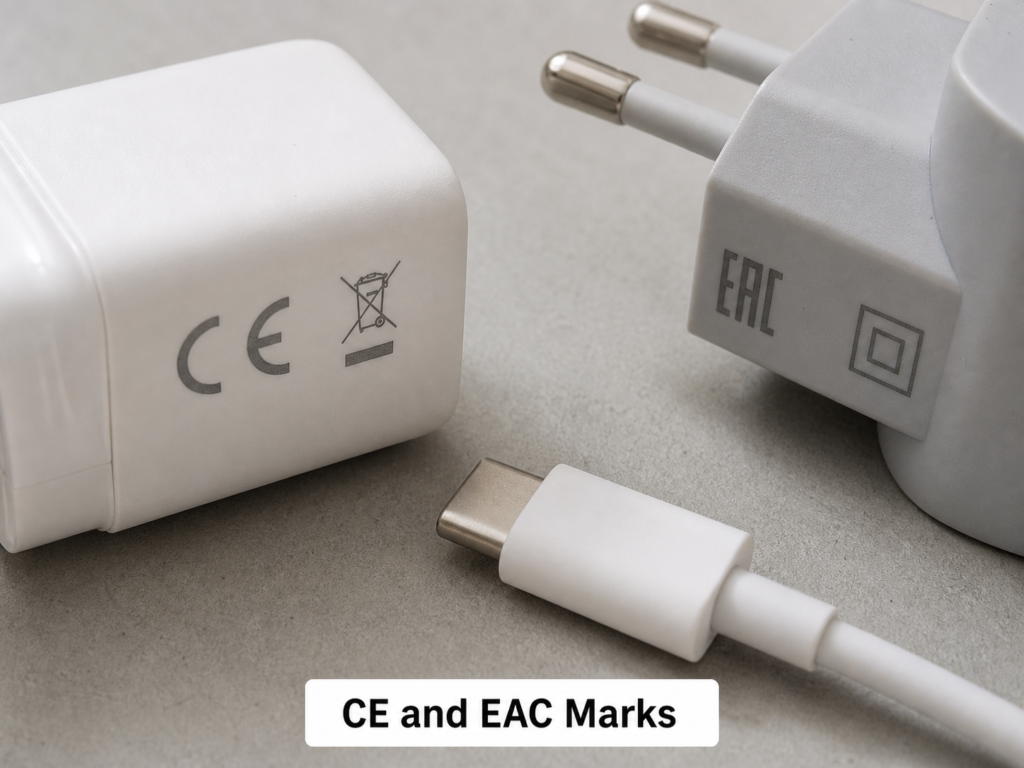
First, let’s talk about the CE marking. It is not a unified “CE certificate” applicable to all products, but a market compliance mark indicating that the product complies with one or more applicable EU harmonized legislations. For ordinary chargers, power adapters, USB/USB-C charging cables and other products, it is usually necessary to complete conformity assessment according to the product’s electrical safety, electromagnetic compatibility (EMC), restriction of hazardous substances, energy efficiency and other requirements, prepare technical documentation, and sign the EU Declaration of Conformity (DoC, simply put, a formal commitment by the enterprise to product compliance), and affix the CE marking before placing the product on the market where applicable.
Many people think CE is a certificate issued by the EU official. In fact, for many ordinary charging products, the core logic is that the manufacturer bears the main responsibility, and it is not necessarily required to have a certificate issued by an EU official body. Such third-party participation is only required when the conformity assessment procedure specified in the specific applicable legislation includes a Notified Body (also called NB). Whether a Notified Body is required must be judged item by item based on the product’s end use, function and applicable legislation, and conclusions cannot be drawn solely based on labels such as “high risk”, “medical” or “industrial”.
Next, let’s talk about the EAC marking, which is used to indicate that the product complies with the requirements of relevant technical regulations of the Eurasian Economic Union (EAEU). The Eurasian Economic Union consists of 5 countries: Russia, Kazakhstan, Belarus, Armenia, and Kyrgyzstan, which is commonly referred to as the “five Eurasian countries”. Its predecessor was the former Russia-Belarus-Kazakhstan Customs Union.
There is not only one specific form of conformity assessment for EAC. For a product, it is necessary to first determine the applicable EAEU technical regulations and product classification, and then confirm whether the procedure to be handled is Declaration of Conformity, Certificate of Conformity, State Registration, or exemption. Whether a third-party certification body, factory audit or sample testing is required depends on the specific technical regulations, product parameters and corresponding lists, and it cannot be generalized that all live charging products must have a certificate issued by a third party.
The commonalities between the two are relatively clear: both are related to product compliance and legal circulation in the target market, and they usually apply to products finally placed on the market, not just to a certain component. But the core difference is also crucial: their jurisdictions and legislative systems are independent of each other, do not recognize each other, and cannot replace each other. In other words, if the same charging product is to be sold in both the EU and the EAEU, it is necessary to verify and complete the two sets of compliance requirements separately. CE documents cannot directly replace EAC requirements for customs clearance in Russia, and vice versa.
Beginners are most likely to fall into these basic misconceptions, which are clarified in advance here:
First, CE certification is issued by the EU official. Ordinary charging products may adopt a conformity assessment model where the manufacturer is self-responsible. Whether a Notified Body is required depends on specific legislation and cannot be generalized.
Second, EAC is Russian certification. EAC is for the five Eurasian countries, and the specific rules are determined by the Union’s technical regulation system, not a separate certification of Russia. Products sold to member states such as Kazakhstan and Belarus also need to be handled in accordance with applicable requirements.
Third, having a test report equals completing certification. A test report is only supporting material to prove that the product meets certain requirements. Full compliance also requires applicable legislation analysis, technical documentation, declaration of conformity or certificate, as well as correct marking and instruction documents.
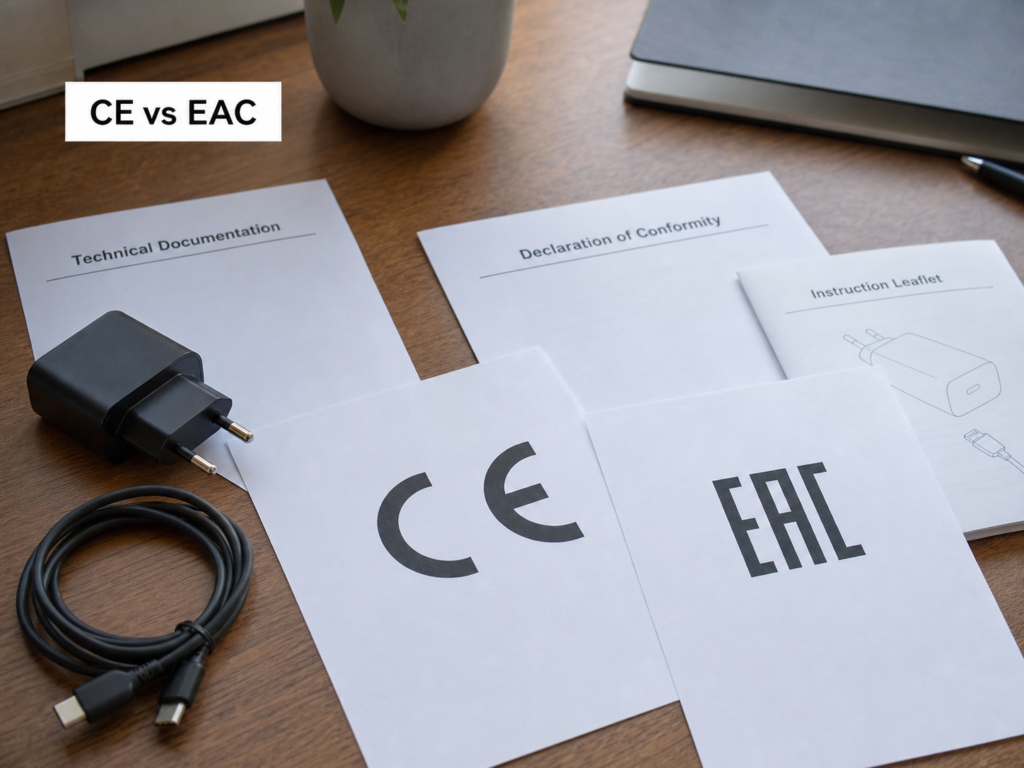
Fourth, products with certification marks are of better quality. Certification or compliance marks mainly indicate that the product meets the legal requirements of the relevant market, and do not evaluate charging speed, durability, workmanship or overall performance. Do not equate “having certification” with “high quality”.
Consequences of No Certification, and Why Charging Products Are a Regulatory Focus
Some people may think, since it’s just a market access requirement, can I sell without certification secretly? Let’s first clearly calculate the cost of not having certification.
For exporters and sellers, if a product is found to lack the required CE marking in the EU market, or the product does not comply with applicable legislation, it may be refused entry, prohibited from sale, removed from shelves, recalled, and subject to fines; in serious cases, criminal or civil liability may also be borne. The specific form and amount of punishment will be determined by the laws of the relevant member states, product category and illegal act. There is no unified fine standard applicable to all CE products, calculated at 1% to 10% of the goods value.
In the EAEU market, if a product does not meet the applicable EAC compliance requirements, it may also be refused customs clearance, prohibited from circulation, returned, recalled, or subject to administrative penalties. The specific consequences are determined by the customs, market supervision and administrative laws of EAEU member states, and cannot be simply summarized as a unified “regulatory dishonesty list” system.
For ordinary consumers, the lack of the required CE or EAC compliance mark means that the product may not have completed the statutory conformity assessment, and safety risks and recall risks need to be focused on verification. But the absence of a mark does not directly prove that the product “most likely” has specific defects such as electric leakage, overheating or fire. In the event of an accident, consumers can still seek remedies in accordance with local consumer protection laws, product liability laws and market supervision procedures, but the illegal placement of the product on the market may increase the complexity of evidence collection and handling.
As for why charging products are the focus of supervision in both regions? The reasons are very practical: First, chargers and power adapters are usually directly connected to the mains supply. If there are problems with insulation, temperature rise or structural design, they may cause electric shock, overheating or fire; second, unqualified USB-C fast charging cables may affect terminal devices such as mobile phones, tablets and laptops due to problems with the cable, interface or identification circuit; third, products such as fast charging heads, multi-port chargers and gallium nitride (GaN) chargers have increasingly complex functions, and market supervision needs to focus on their safety, electromagnetic compatibility, energy efficiency and parameter marking.
First Clarify the Premise of Comparison: To Avoid Inaccurate Conclusions
Many people get more confused the more they read certification comparison articles. The core reason is that the benchmark for comparison is not clearly stated — different products, different voltages, different functions and sales methods may have completely different requirements. Our comparison today uniformly uses the currently effective legislations in 2024, and compares ordinary consumer-grade charging products (USB chargers, power adapters, USB/USB-C charging cables), excluding charging products for special scenarios such as industrial, medical, and explosion-proof. The requirements for these special products are much stricter and are not within the scope of today’s discussion.
In addition, there are several core variables that will directly affect the comparison conclusion. You can first correspond to your own products:
First, product power, input and output voltage and current: these parameters will affect applicable standards, test items and thermal design, but 250W or 10W cannot be used as a universal dividing line for CE/EAC certification. Higher power does not mean that a stricter certification model will automatically be triggered.
Second, product functions: products with PD fast charging, multi-port output, wireless power supply, Bluetooth or other communication functions may need to add corresponding safety, EMC, energy efficiency or wireless communication assessments.
Third, sales method: set sales may change the handling methods of labels, instructions, technical documentation and responsible entities, but it cannot automatically exempt the compliance obligations of each product in the set. Each electrical product covered by legislation in the set may still need to complete compliance assessment separately.
Fourth, conformity assessment model: the applicable conditions for self-declaration, Declaration of Conformity, Certificate of Conformity, State Registration and exemption are different, and the cost and cycle will also vary greatly.
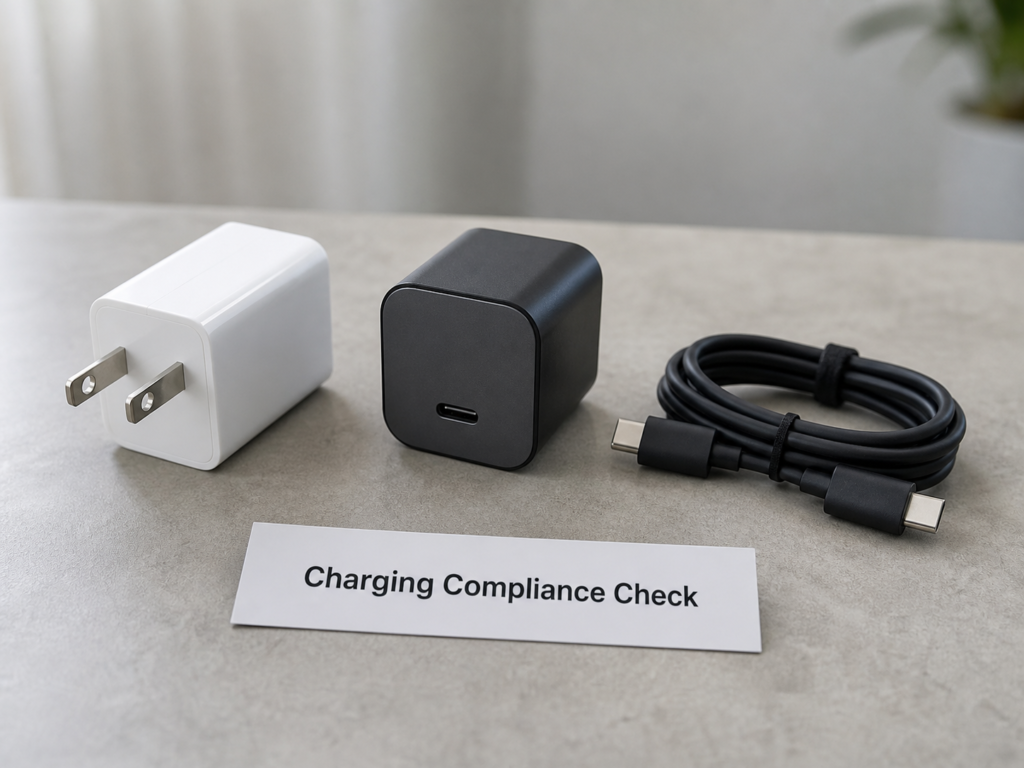
To make it easier for everyone to understand, we will use three typical charging products as samples in the subsequent comparison:
Sample 1: 5V2A USB-A ordinary wall charger (low power, low risk)
Sample 2: 65W PD USB-C GaN charger (medium power, with fast charging function)
Sample 3: 60W USB-C to USB-C passive charging cable (low risk, no electronic components)
Item-by-Item Comparison of Core Dimensions: Exclusive Differences for Charging Products
We will break down the differences between CE and EAC from several dimensions that everyone is most concerned about, and each dimension will correspond to the situation of the three samples.
Applicable Regions and Regulatory Systems
The CE marking applies to products covered by EU harmonized legislations that require the affixing of the CE marking. Relevant legislations are formulated by the EU legislative body and implemented by each member state; Norway, Iceland and Liechtenstein, which are included in the relevant European Economic Area (EEA) rules, usually also apply the corresponding requirements. CE is not a set of unified certification rules formulated solely by the European Commission, but is jointly composed of multiple legislations, directives and their implementation rules in member states.
It should be noted that after Brexit, the UK uses its own UK market compliance system, commonly known as UKCA, and the UK market cannot be simply equated with the CE scope.
The EAC marking applies to products that comply with the relevant technical regulations of the Eurasian Economic Union, covering 5 countries: Russia, Kazakhstan, Belarus, Armenia, and Kyrgyzstan. Some neighboring countries of the EAEU may also voluntarily adopt EAC or refer to relevant requirements, but this does not mean that EAC automatically becomes a mandatory access condition in these countries.
Mandatory Control Scope
On the CE side, products such as chargers and power adapters usually need to complete conformity assessment in accordance with applicable EU harmonized legislations. Charging cables with electronic components may involve requirements such as electrical safety, EMC, RoHS, etc.; although passive ordinary charging cables may not fall within the scope of all electrical safety legislations, they may still be subject to restriction of hazardous substances, general product safety or other applicable requirements, and cannot be simply understood as “no compliance required at all”.
On the EAC side, it is not possible to judge whether a product is subject to control only by “rated input voltage reaching 50V” or “whether it has a protection circuit”. It is usually necessary to check the product’s rated AC or DC voltage range, product category, intended use, and the annex lists of technical regulations such as TR CU 004/2011; at the same time, it is also necessary to judge whether other regulations such as TR CU 020/2011 are applicable. The AC and DC voltage ranges are not exactly the same, and the regulations may also include exclusions.
Take the three samples as examples: Sample 1, the 5V2A wall charger, although its output is only 5V, its input end is usually connected to the mains supply, so it cannot be judged whether it is subject to EAC control only by the output voltage; Sample 2, the 65W GaN charger, also needs to be confirmed in combination with input parameters, product category and applicable lists; Sample 3, the passive USB-C cable, should be checked separately for its specific legislative scope in the EU and EAEU markets, and it cannot be directly asserted that it is definitely exempt just because it is “passive”.
Of course, if it is a charging product for medical or industrial use, the scope of application and conformity assessment requirements of both types of legislations may change, and should be re-judged according to the product’s end use, function and specific legislation.
Compliance Responsibilities and Certification Models (Including Local Representatives)
This is an area where the two differ greatly, directly affecting document preparation, responsibility allocation and market launch arrangements.
First, let’s look at the CE rules:
The manufacturer bears the main responsibility for conformity assessment, technical documentation and the EU Declaration of Conformity. Non-EU manufacturers should arrange economic operators within the EU to bear corresponding responsibilities, such as importers, distributors or authorized representatives, in accordance with applicable legislation and sales methods. Authorized representatives are not mandatory for all ordinary charging products, but if the applicable legislation clearly requires it, the manufacturer must designate an authorized representative within the EU through written authorization.
In terms of certification models, whether ordinary charging products can be self-declared by the manufacturer depends on the conformity assessment procedure specified in the applicable legislation. Conformity assessment is not automatically completed with a test report; it must cover all applicable legislations, prepare technical documentation, sign the correct EU Declaration of Conformity, and meet marking, instruction and traceability requirements. Notified Body participation is only required when the procedure specified in the specific legislation includes a Notified Body.
Next, let’s look at the EAC rules:
For EAC products, it is necessary to first determine the applicable EAEU technical regulations and product classification, and then confirm whether to handle Declaration of Conformity, Certificate of Conformity, State Registration or exemption. Whether a Union-accredited certification body, testing laboratory, factory audit or supervision procedure is required depends on the corresponding regulations and product lists. Overseas enterprises usually also need to arrange applicants, certificate holders or other responsible entities within the Union in accordance with EAEU rules. The specific responsibility allocation shall be subject to the actual assessment plan and the requirements of member states.
Still use the three samples for correspondence:
Passive ordinary charging cable (Sample 3): in the CE market, it may mainly involve requirements such as RoHS; whether it is exempt in the EAC market shall be subject to the product category and the latest applicable list.
65W PD charger (Sample 2): for CE, conformity assessment under all applicable legislations needs to be completed, not just with a test report; for EAC, it is necessary to first confirm the applicability of regulations such as TR CU 004/2011 and TR CU 020/2011, and whether to finally adopt Declaration of Conformity or Certificate of Conformity.
For charging products for medical or industrial use, it cannot be simply assumed that both CE and EAC necessarily require third-party participation. Third-party mandatory participation is only required when the conformity assessment procedure of the specific applicable legislation clearly requires a Notified Body or an EAEU certification body.
Technical Requirements and Testing Focus
The core requirements of the two have a lot of overlap, but the details and legislative sources are different.
CE-related assessment may involve requirements such as electrical safety, electromagnetic compatibility, restriction of hazardous substances, and energy efficiency of external power supplies. Which specific legislations need to be applied shall be judged in combination with the product’s input and output parameters, intended use, function and sales configuration.
EAC-related requirements may also include electrical safety, electromagnetic compatibility, restriction of hazardous substances and energy efficiency requirements for some products; if the product is used in special environments, it may also involve additional legislations such as explosion protection. Specific test items cannot be determined solely by the name “charging product”.
In terms of laboratory capability, for CE self-declaration products, laboratories with corresponding capabilities and testing scopes can be used. ISO/IEC 17025 accreditation is a common proof of laboratory capability, but not all ordinary CE self-declaration products must be tested by ISO/IEC 17025 accredited laboratories. The key is whether the laboratory’s capability and scope cover the applicable standards, and whether the manufacturer can fully prove conformity with technical documentation.
For EAC testing, it is necessary to confirm whether the laboratory is accepted by the relevant EAEU rules or assessment plans. If domestic laboratories do not have the corresponding accreditation or acceptance qualification, the reports they issue may not be directly used for EAC conformity assessment.
If the product has wireless communication functions such as Bluetooth and Wi-Fi, it usually needs to be assessed in accordance with the EU Radio Equipment Directive (RED) and the corresponding EAEU radio regulations. Products with only wireless power supply function are not necessarily radio equipment, and should be judged according to operating frequency, emission characteristics and specific structure, and radio testing cannot be required for all cases.
Marking, Technical Documentation and Validity Period
In terms of marking requirements, the CE marking is usually required to have a height of not less than 5mm; the unified EAC marking is also usually required to have an overall height of not less than 5mm. The specific proportion, position and alternative positions shall be implemented in accordance with applicable legislations and relevant regulations of the Eurasian Economic Commission, and cannot be simply summarized as that EAC must reach 10mm and can only be printed on the product or nameplate.
In terms of technical documentation, the manufacturer or the economic operator that is legally obliged to keep documents usually needs to keep the technical documentation for at least 10 years from the date the product is placed on the market, and provide it when required by the regulatory authority. The documents do not necessarily have to be stored within the EU, nor are they all kept with the EU Authorized Representative. The language of the documents shall be determined in accordance with applicable legislations and the requirements of the regulatory authority, and cannot be simply stated as uniformly using English; instructions and declarations of conformity may also need to be in the language specified by the member state of sale.
In terms of validity period, there is no unified fixed term for CE self-declaration applicable to all products, but if the product design, materials, production methods, applicable legislations or standards change, it shall be re-assessed and the documents updated if necessary. When a Notified Body is involved, the validity period and review requirements of the certificate shall be subject to the applicable legislation, conformity assessment module and the terms of the Notified Body’s certificate, and cannot be uniformly calculated as 5 years.
The parameter marking of charging products also cannot be generalized. Rated input, output, voltage, current, power and other necessary information shall be marked in accordance with applicable legislations and product categories; specific items and whether they should be marked on the product, packaging or instructions shall be confirmed in accordance with the corresponding legislations. Some USB chargers may also be affected by the common charger regulation, but this requirement cannot be extended to all charging products and passive cables.
Compliance Process and Reference for Cost and Cycle
What many people are most concerned about is “how long does it take to get a certification and how much does it cost”. It needs to be explained first: neither CE nor EAC has a unified price and cycle applicable to all ordinary charging products. Product complexity, applicable legislations, test items, number of rectifications, document workload, whether third-party participation is required, and whether the product requires a factory audit will all affect the final result.
First, let’s look at the conventional CE process:
The first step is product and legislation analysis: confirm which EU harmonized legislations, standards and other market requirements the product involves;
The second step is conformity assessment: complete necessary safety, EMC, energy efficiency, RoHS or other tests according to applicable requirements, and address problems found in the tests;
The third step is document preparation: prepare technical documentation, labels, instructions and traceability information;
The fourth step is signing the EU Declaration of Conformity: the manufacturer confirms that the product complies with all applicable legislations;
The fifth step is marking and market launch: after completing the conformity assessment and document preparation for all applicable legislations, the CE marking can be affixed and the product placed on the market where applicable.
The cycle and cost depend on applicable legislations, standards, product complexity, test items, rectification and document workload, and a unified price and cycle applicable to ordinary charging products cannot be given. For projects with low product complexity, complete data and no need for rectification, it is usually simpler than multi-port, high-power or wireless communication products, but the specific situation shall still be subject to the actual assessment plan.
Next, let’s look at the conventional EAC process:
The first step is product classification: confirm the applicable EAEU technical regulations, product scope and exclusions;
The second step is determining the form of assessment: confirm whether to handle Declaration of Conformity, Certificate of Conformity, State Registration or exemption;
The third step is preparing materials and samples: submit product materials, technical documentation and samples according to the assessment plan;
The fourth step is testing, document review or factory audit: whether these links are required depends on the specific technical regulations and assessment plan;
The fifth step is registration, certificate collection and marking: after completing the corresponding procedures, use the EAC marking as required and meet customs clearance, instruction and traceability requirements.
Therefore, the cost and cycle of EAC also cannot be uniformly calculated as “4 to 8 weeks” or “5,000 to 20,000 yuan”. The required Declaration of Conformity or Certificate of Conformity should first be confirmed according to product classification, and then the corresponding certification body will quote and determine the cycle based on testing, document review, factory audit and supervision requirements.
For high-power, multi-port, wireless communication function or structurally complex products, the test items and document workload may increase; if the test fails and rectification is required, the cost and time will continue to rise. These factors should be reserved in advance in the market launch plan.
Common Misconceptions and Pitfall Avoidance Guide
After finishing the basic rules, let’s sort out the most common pitfalls in actual operation, divided into three categories: CE-specific, EAC-specific, and common pitfall avoidance points.
CE Certification-Specific Pitfalls
First, insisting on getting a Notified Body certificate for ordinary charging products. Whether a Notified Body is required is not determined by a sales agency or service provider saying “it’s more authoritative”, but by the specific applicable legislation and conformity assessment procedure. For products that do not require Notified Body participation, the manufacturer can complete the self-responsible conformity assessment in accordance with regulations, and does not need to spend extra money just to “have a certificate”.
Second, thinking that a product with the CE marking is a qualified product. The CE marking itself cannot replace complete compliance documents. It is necessary to verify the EU Declaration of Conformity, test and assessment evidence in the technical documentation, the correspondence of product models, labels and instructions, and, where applicable, the information of the economic operator within the EU.
Third, thinking you can just pick any EU Authorized Representative. If the applicable legislation requires or the enterprise chooses to designate an authorized representative, the authorized representative must be a legal entity within the EU that can perform the corresponding duties, and there must be a clear written authorization. You cannot just look at a contact information, nor can you treat a shell entity with no actual responsibility capacity as a compliance arrangement.
EAC Certification-Specific Pitfalls
First, thinking EAC certificates are globally valid. No, EAC mainly corresponds to the EAEU market. The EU will not recognize a product’s CE compliance just because it has the EAC marking, and other countries cannot automatically apply it either.
Second, thinking all charging products need an EAC certificate. The form of EAC may be Declaration of Conformity, Certificate of Conformity, State Registration or exemption. Whether passive low-voltage charging cables are exempt must also be confirmed in combination with product categories and the latest lists, and cannot be directly judged based on experience.
Third, thinking domestic institutions can directly issue EAC certificates. It is necessary to verify whether the actual issuing or registration entity meets the relevant EAEU assessment requirements. Domestic institutions may provide agency, testing or document services, but the agency service provider itself cannot be equated with a certification body with corresponding authority.
Fourth, thinking EAC is only for Russia. EAC is for member states of the Eurasian Economic Union. When selling to Kazakhstan, Belarus, Armenia, and Kyrgyzstan, it is also necessary to handle it in accordance with the locally applicable EAEU technical regulations.
Common Pitfall Avoidance Points
First, do not choose low-price certifications that “guarantee passage”. Especially services whose quotes are far below the reasonable range but promise 100% passage may not have actually completed the product assessment, or even use documents that cannot be verified. If problems are found during customs clearance or market spot checks, the loss will not just be the certification fee.
Second, component compliance does not equal whole-product compliance. For example, using a PD chip with the CE marking does not mean that the entire charger automatically meets CE requirements. The electrical safety, EMC, energy efficiency, structure and labeling of the whole machine still need to be assessed separately.
Third, product changes must be assessed in a timely manner. When changing chips, modifying shells, adding functions, modifying software, changing production locations or supply chains, a change assessment should be conducted first. If the change affects safety, EMC, energy efficiency, wireless functions, manufacturing consistency or certificate scope, it is necessary to update tests, technical documentation, EU Declaration of Conformity or EAC certificate, and re-conduct conformity assessment if necessary. Product changes do not automatically mean that the original documents become invalid immediately, nor do they mean that all certifications must be completely redone for every change.
Fourth, set sales cannot automatically replace single-product compliance. Sets may change the handling methods of labels, instructions, technical documentation and responsible entities, but each electrical product covered by legislation in the set may still need to complete compliance assessment separately. If the product will be sold separately later, it should be ensured that its separate sales configuration also has corresponding compliance documents and markings.
Quick Decision-Making and Authenticity Identification Methods
After talking so much, some people may still feel confused. Below are several quick judgment methods sorted out, but in actual use, they shall still be subject to specific legislations and product materials.
3-Step Decision-Making Method for Choosing CE or EAC
The first step is to look at the target sales market:
If the product is sold to the EU or markets included in the relevant EEA rules, the applicable CE legislations shall be verified;
If the product is sold to member states of the Eurasian Economic Union, the applicable EAC technical regulations shall be verified;
If selling to both regions, it is necessary to confirm the two sets of requirements separately, and one marking cannot be used as a substitute for the other.
The second step is to look at the actual risk and technical characteristics of the product:
Passive cables, ordinary chargers, PD chargers and wireless communication products may have different applicable legislations, test items and document requirements. Do not judge risk only by “power level”, nor directly equate high power, fast charging or wireless functions with a certain fixed certification model.
The third step is to look at budget and market launch rhythm:
Both CE and EAC should complete the applicable compliance assessment before the product is placed on the market or shipped. When the budget is limited, first confirm which requirements are truly applicable to avoid purchasing unnecessary certificates; if you want to lay out the Eurasian market for a long time, you should confirm in advance the declarations, certificates, registrations or exemptions required for EAC, and reserve time for testing, documentation and customs clearance.
Quick Judgment on Whether Charging Products Need Certification
CE Judgment:
- First confirm whether the product is placed in a market where the CE marking is applicable;
- Judge whether the product falls under one or more EU harmonized legislations;
- According to product parameters, functions and intended use, confirm which requirements are involved, such as low-voltage electrical safety, EMC, RoHS, ecodesign or radio equipment legislation;
- Complete conformity assessment in accordance with specific legislations, and confirm whether Notified Body participation is required;
- Prepare technical documentation and EU Declaration of Conformity, and use the CE marking after meeting the requirements.
Chargers, power adapters and some cables may usually involve requirements such as LVD, EMC, RoHS, ecodesign, etc., but the specific scope of application shall be confirmed according to product parameters and functions. Ordinary cables also cannot be simply cut across the board by “active” or “passive”, and relevant legislations still need to be verified.
EAC Judgment:
- Confirm whether the product is placed in member states of the Eurasian Economic Union;
- According to the rated AC/DC voltage, product structure, intended use and function, verify item by item TR CU 004/2011, TR CU 020/2011 and other possibly applicable EAEU technical regulations;
- Check the product scope, exclusions and annex lists of the corresponding regulations;
- Confirm whether the final procedure to be handled is Certificate of Conformity, Declaration of Conformity, State Registration or exemption;
- If it has wireless communication functions such as Bluetooth and Wi-Fi, then separately assess the radio regulations.
The EAC form cannot be determined solely by “input voltage reaching 50V”, “with protection circuit” or “supports fast charging”.
Quick Identification Method for Authentic and Fake Certifications
For CE, do not just look at the marking, but verify the following documents:
- Whether the EU Declaration of Conformity is complete;
- Whether the manufacturer, model and product configuration in the documents are consistent with the actual product;
- Whether the test and assessment evidence covers all applicable legislations;
- Whether the labels, instructions and traceability information are complete;
- Where applicable, whether the information of the economic operator or authorized representative within the EU is true and valid.
For EAC, the certificate or declaration number, product model, manufacturer, applicant, applicable legislation and validity period shall be checked, and verified through the EAEU unified registration system or the official registration system of the relevant member state. If the information cannot be queried, it cannot be immediately concluded that it is a fake certificate; it may also be a problem with the number, database, public scope or update time; if the information is inconsistent or cannot be verified, further confirmation shall be made with the issuing body and the competent authority.
For charging products, it is also necessary to additionally check relevant evidence such as electrical safety, temperature rise, overheating protection, and whether the product parameter marking complies with applicable legislations. Incomplete parameters, mismatched models, or documents that only state “complies with international standards” without specifying specific legislations and standards are all signals that require further verification.
Decision-Making Tips for Special Scenarios
For small-batch trial sales, whether it is CE or EAC, compliance requirements cannot be automatically exempted just because the quantity is small. For CE products, the conformity assessment and document preparation required by applicable legislations shall be completed before being placed on the market; for EAC products, the required certificates, declarations or exemptions shall be confirmed before shipment, and the corresponding customs clearance and marking requirements shall be met.
For OEM/ODM products, it is necessary to clarify the responsibility relationship between the manufacturer, applicant, certificate holder and actual production enterprise, to ensure that the certificates, declarations and technical documentation cover the actually produced models, configurations and factories. If the brand, model or product configuration changes later, it is also necessary to reconfirm whether the documents are still applicable.
For series products, similar models can be subject to series assessment or share part of the test data on the premise of meeting the legislations and the series rules of the certification body. However, when there are differences in power, structure, key components, topology, rated parameters or functions, it shall be confirmed whether supplementary testing is required, or they shall be listed in the certificate and declaration separately. It is not guaranteed that all models can directly share a set of documents.
Overall, both CE and EAC look like “regional access marks”, but their underlying logics are different: CE emphasizes more that the manufacturer bears conformity responsibility in accordance with applicable EU legislations; EAC requires first determining the specific form of Declaration of Conformity, Certificate of Conformity, registration or exemption based on EAEU technical regulations. For beginners, as long as they can distinguish the markets corresponding to the two marks, know that one cannot replace the other, and can verify the applicable legislations according to product parameters and functions, they have mastered the most core judgment method. Further mastering document verification, product change assessment and series model management can truly reduce compliance risks in cross-border sales.