
Friends engaged in cross-border business of charging products often confuse the US FCC and Japan PSE: either they assume both are safety certifications and one can be used universally; or they cannot figure out whether their USB cables and chargers need certification, and fall into the trap of having goods detained and listings removed. In fact, the two are completely independent in terms of regulatory objectives and applicable rules. Today, we take chargers, power adapters, USB/USB-C charging cables, and wireless charging devices as benchmark samples to thoroughly explain the differences between the two — from entry-level judgment to pit-avoidance decision-making, you can apply what you learn right after reading.
First, Understand the Basics: What Exactly Are the Two
Before the comparison, let’s clarify the scope: all rules below apply to common charging products. Other categories (such as large home appliances, medical equipment) require separate judgment and cannot be directly applied.
Core Definitions and Common Attributes
FCC compliance is the access requirement for electromagnetic/radio frequency equipment set by the US Federal Communications Commission. To put it simply, it regulates “whether a product emits excessive electromagnetic signals that interfere with the normal operation of other devices such as routers, mobile phones, radio and television”. For applicable products, it may also involve radio frequency transmission and radio frequency exposure requirements. It has two compliance paths: one is SDoC (Supplier’s Declaration of Conformity, where the enterprise takes responsibility itself, keeps test reports on file for inspection, and does not require prior official approval); the other is FCC ID (for products with wireless functions, which require certification and a unique identification number).
PSE compliance is the electrical safety access requirement under Japan’s Electrical Appliance and Material Safety Law, which regulates “whether a product will leak electricity, catch fire, or injure users”. It is also divided into two categories: diamond PSE corresponds to high-risk “specified electrical appliances and materials” with stricter control; circular PSE corresponds to low-risk “non-specified electrical appliances and materials” with relatively looser control.
The compliance methods of the two cannot be simply summarized as “both require official certificates”. Equipment subject to rules such as FCC Part 15 must complete the applicable equipment authorization procedures before being marketed in the United States: SDoC products usually require a responsible party that meets FCC rules to sign a declaration of conformity and retain test materials, while FCC ID products must obtain certification. Products within the PSE catalog must complete corresponding PSE compliance and labeling requirements.
Core Difference: Completely Non-Interchangeable
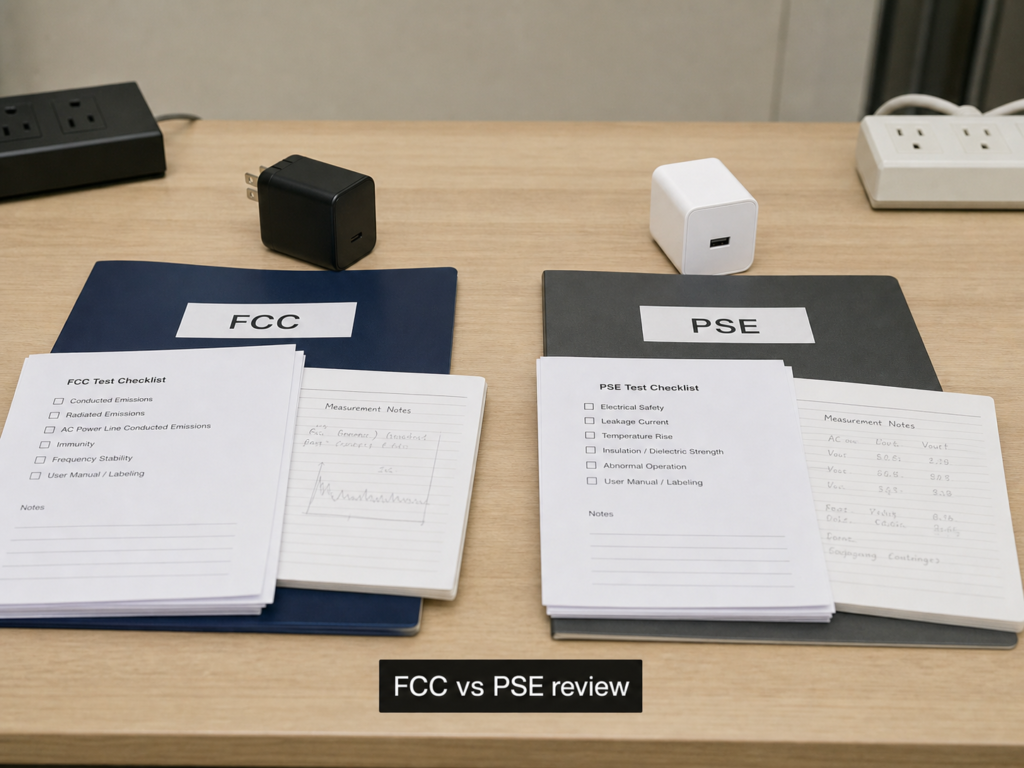
The root cause of many people’s pitfalls is failing to understand that the regulatory objectives of the two are completely different:
- FCC mainly regulates electromagnetic compatibility, radio frequency transmission and applicable radio frequency exposure requirements, and does not replace the electrical safety assessment required for the US market;
- PSE mainly manages electrical safety and is not responsible for wireless radio frequency compliance in the Japanese market.
The regulatory systems and test logics of the two are independent. Only some basic input conditions (such as input voltage, output power) can be reused, but they must be tested and judged separately according to their respective standards. Obtaining one certification absolutely does not eliminate the need for the other.
Clarification of the 6 Most Common Misconceptions
We have sorted out 6 questions that beginners are most likely to get wrong, and explain them clearly at once:
- “FCC is a safety certification”: Wrong. FCC mainly manages electromagnetic, radio frequency transmission and applicable radio frequency exposure requirements. Electrical safety for the US market requires separate assessment (for example, the common UL test report is a voluntary safety certification and does not fall within the scope of FCC).
- “PSE is a wireless certification”: Wrong. PSE only manages electrical safety. Compliance of wireless products in Japan is handled by Giteki (Technical Standards Conformity Certification), which is a separate system from PSE.
- “Supporting 100V input means complying with PSE”: Wrong. Voltage compatibility is only a parameter prerequisite. Only after passing a full set of safety tests such as insulation, flame retardancy, and abnormal operation can a product be considered truly compliant.
- “All charging products require both types of compliance”: Wrong. For example, pure passive low-voltage USB charging cables, which have no circuit board and are not connected to mains power, generally do not require mandatory certification in both the US and Japan.
- “A compliance mark can be used globally”: Wrong. FCC is only valid in the United States, and PSE is only valid in Japan. They cannot be used across regions.
- “USB-C cables with chips must require FCC”: Wrong. Ordinary passive USB/USB-C data cables usually do not undergo separate FCC equipment authorization. Products with active signal conversion, hubs, retimers or other digital circuits require evaluation of FCC requirements in combination with specific functions, structures and combinations with hosts, and cannot be automatically classified as SDoC just because they have data transmission functions. Cables that only have an E-Marker fast charging identification chip and no data transmission function also fall into the category of products requiring specific judgment in most cases.
Does Your Product Need It? Applicable Scope Judgment
After understanding the basic definitions, what everyone is most concerned about is definitely “whether the product I sell needs certification”. We will explain the judgment logic for the US and Japan respectively.
US FCC: Depends on Radio Frequency Energy, Digital Circuits and Specific Product Classification
The core of FCC judgment is: whether the product generates or uses radio frequency energy, whether it is a regulated digital device, and judgment must be made in combination with specific functions, structures and applicable rules.
- Common scenarios requiring assessment:
AC input chargers and power adapters with switching power supplies or digital circuits may be subject to FCC Part 15 Subpart B, with SDoC as the common path, but product classification, applicable rules and whether exemptions apply must be confirmed first;
Charging equipment with wireless modules such as Bluetooth and Wi-Fi are products that actively transmit wireless signals, and usually require certification and an FCC ID;
USB/USB-C cables or accessories with active signal conversion, hubs, retimers or other digital circuits require evaluation of FCC requirements in combination with their functions, structures and combinations with hosts. - Exemption/case-by-case assessment scenarios:
Completely passive low-voltage charging cables (without any electronic components, do not generate radio frequency, and usually do not undergo separate FCC equipment authorization);
USB-C cables with only E-Marker/fast charging chips and no data transmission (exempt in most cases, but should still be confirmed in combination with specific designs);
Wireless chargers that only supply power wirelessly and have no communication function (require case-by-case assessment of whether radio frequency energy falls within the exemption range).
Japan PSE: First Check the METI Catalog, Then Check Input Type
The core of PSE judgment is: first check the electrical appliance and material catalog issued by Japan’s Ministry of Economy, Trade and Industry (METI), then make a judgment based on product structure, rated input, and intended use. Only products listed in the catalog require PSE.
- Mandatory application scenarios:
Chargers/power adapters connected to Japanese AC mains and listed in the catalog (most are high-risk specified electrical appliances and materials, requiring diamond PSE);
Wireless chargers with AC input and listed in the catalog (require PSE; those with communication functions also require additional Giteki);
Power cords with mains plugs and listed in the catalog. - Exemption/case-by-case assessment scenarios:
USB/USB-C cables that only transmit low-voltage DC (not connected to mains, only transmit low-voltage electricity, usually not within the PSE catalog);
Car chargers that only connect to vehicle low-voltage power supplies (use vehicle 12V/24V low voltage, not mains, usually not within the PSE catalog; dual-use models with AC input require separate judgment);
Low-voltage charging equipment directly powered by batteries (such as small devices powered by power banks, not connected to mains, usually not within the PSE catalog).
When Do You Need to Reassess Compliance Requirements?
If a product undergoes the following changes, be sure to re-judge compliance requirements to avoid original materials no longer being applicable:
- Adding wireless communication functions such as Bluetooth/Wi-Fi: US FCC usually requires reassessment according to the certification path, and Japan requires additional Giteki;
- Changing from low-voltage power supply to AC mains power supply: Japan PSE requires assessment of mandatory attributes, and US FCC also requires corresponding adjustment of rules, which may change from exemption to requiring equipment authorization;
- Adding active circuits/data transmission functions: US FCC requires assessment of whether the product constitutes a regulated digital device, while Japan PSE may still be exempt (as long as it remains low-voltage powered).
For your quick reference, we have compiled a compliance requirement table for common charging products:
| Product Type | US FCC Requirements | Japan PSE Requirements |
|---|---|---|
| Ordinary wired chargers/power adapters | Many products may be eligible for SDoC, which must first be confirmed according to specific classification and rules | Most require diamond PSE (subject to the METI catalog) |
| Wireless chargers with only wireless power supply | Assessed case by case according to rules | Those connected to AC mains require PSE (subject to the catalog) |
| Smart charging devices with Bluetooth/Wi-Fi | Usually require FCC certification and obtain an FCC ID | Those connected to AC require PSE + Giteki |
| Pure passive USB/USB-C charging cables | No mandatory requirement | No mandatory requirement |
| Fast charging USB-C cables with E-Marker | In most cases, separate FCC equipment authorization is not required | No PSE required |
| Ordinary passive USB/USB-C data cables | Usually do not undergo separate FCC equipment authorization; models with active circuits require assessment | No PSE required |
| Pure low-voltage car chargers | Assessed according to specific digital circuits and product classification | No PSE required |
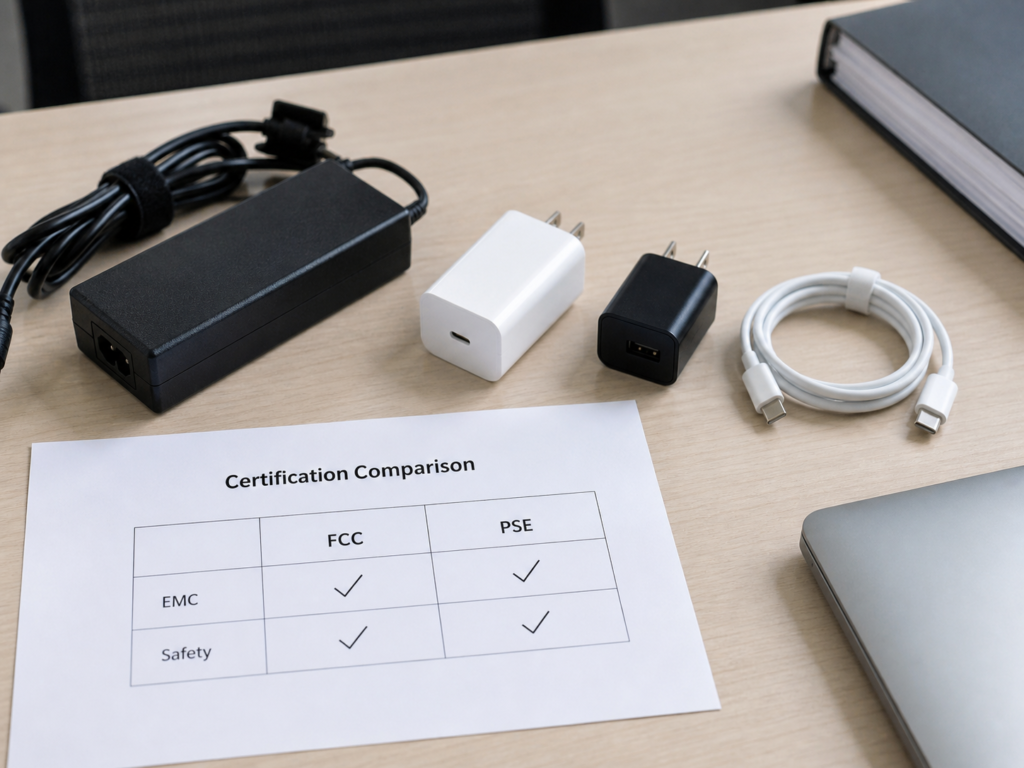
Compliance Classification and Responsibility Rules: Don’t Misidentify the Responsible Party
Many sellers are prone to pitfalls regarding the responsible subject, for example, thinking that as a Chinese company they can directly apply for PSE, which is completely incorrect.
Two Types of FCC Compliance Paths
The two FCC paths correspond to different product types, with different responsibility requirements:
- SDoC: Applicable to eligible unintentional radiator products. Usually no prior official review is required. After the enterprise arranges testing at a qualified laboratory, the responsible party that complies with FCC rules signs the declaration of conformity, and retains the test report and related materials for inspection. The responsible party must generally be located in the United States and be able to provide compliance materials; whether a manufacturer, importer or other entity may serve as the responsible party depends on whether it meets the conditions for the responsible party specified in FCC rules. Overseas manufacturers should generally have a qualified US importer, authorized responsible party or other US-based responsible party assume corresponding responsibilities.
- FCC ID: Applicable to intentional radiator wireless products that require certification. Usually, a Telecommunication Certification Body (TCB) recognized by the FCC completes certification and issues a unique FCC ID in accordance with FCC rules. The FCC database generally allows query of applicant, model and some certification materials, but test attachments approved for confidentiality by law may not be disclosed. Such products usually also require designation of a qualified US agent, and overseas applicants must first apply for a Grantee Code before submission.
Regardless of the category, products subject to FCC rules must complete applicable equipment authorization and compliance responsibility requirements, and cannot be sold in the United States without completing corresponding procedures. FCC supervision usually emphasizes that enterprises retain materials and bear ongoing compliance responsibilities, and violations may face consequences such as fines, goods detention, and recalls.
Two Types of PSE Marking Rules
The two types of PSE marks correspond to products of different risk levels, with the core requirement that a domestic Japanese entity must be responsible:
- Diamond PSE (Specified Electrical Appliances and Materials): High-risk plug-in products must pass conformity inspection by a registered inspection body and obtain the corresponding qualification certificate. The Japanese domestic notifying business operator must also perform subsequent obligations such as statutory notification, inspection and labeling.
- Circular PSE (Non-Specified Electrical Appliances and Materials): Low-risk regulated products can complete self-inspection, testing and retain materials in accordance with applicable requirements. The Japanese domestic notifying business operator assumes corresponding statutory obligations and affixes the circular PSE mark.
The regulatory logic of PSE is “pre-control and domestic traceability”. Products within the PSE catalog shall have their statutory responsibilities such as notification, compliance with technical requirements, inspection records and labeling borne by a notifying business operator as defined in the Electrical Appliance and Material Safety Law based in Japan, usually a Japanese manufacturer or importer. Ordinary sellers cannot automatically replace the notifying business operator solely by virtue of their status as sellers. Overseas manufacturers usually need to perform relevant obligations through domestic entities such as Japanese importers. Products that have not completed corresponding compliance requirements are prohibited from being sold in Japan, and violators will face sales bans, penalties, and recalls.
Validity Period and Renewal Rules
- FCC: There is no unified fixed validity period, but when products, applicable rules, software/hardware, antennas or responsible parties change, reassessment, supplementary testing or change processing may be required.
- PSE:
Conformity inspection certificates for specified electrical appliances and materials have a statutory period, which is specified according to product category. Upon expiration, it is usually necessary to re-conduct or update the conformity inspection as required;
The PSE mark itself is not a government certification certificate with a unified period. Compliance materials for non-specified electrical appliances and materials cannot be interpreted independently of specific products, applicable technical requirements and change circumstances. When products or standards change, reassessment is required.
Core Test Requirements: What Exactly Is Tested?
Many people assume test content is similar, but in fact the test directions of the two are completely different. We will explain them clearly in plain language.
Core Differences in Test Logic
The core of FCC testing is “do not interfere with others”: verify that the product’s electromagnetic disturbance, radio frequency transmission and applicable radio frequency exposure meet limit requirements, will not affect the normal operation of other electronic equipment, and will not produce non-compliant wireless transmissions.
The core of PSE testing is “do not harm people”: verify the product’s electrical safety performance, and ensure no risks of electric leakage, overheating, fire, etc.
A special reminder here: although some basic test conditions (such as input voltage, output power) can be reused, the test standards and judgment logic of the two are completely independent, absolutely not mutually recognized, and must be tested and judged separately.
Typical FCC Test Items (Charging Category)
- Conducted disturbance test: Tests the intensity of interference signals transmitted through the power cord by products with AC input. Exceeding the standard may interfere with other equipment on the same circuit.
- Radiated disturbance test: Tests the intensity of interference signals emitted into the air by digital products with circuit boards, such as whether a charger will interfere with a nearby radio.
- Radio frequency transmission test: Required for products with communication functions, to verify that the power and frequency of the wireless module meet requirements and do not transmit signals indiscriminately.
- Wireless power supply radio frequency test: Wireless charger products require evaluation of radio frequency energy in combination with applicable rules to confirm they do not exceed corresponding limits.
Typical PSE Test Items (Charging Category)
PSE testing checks items such as temperature rise, insulation, withstand voltage, abnormal protection, and flame resistance under specified normal and abnormal operating conditions according to product categories and applicable technical requirements. Specific items, load conditions and material grades are subject to applicable standards. Common concerns include:
- Insulation and withstand voltage test: Tests the insulation performance between live parts and the enclosure of mains-connected products. Simply put, it reduces the risk of users being exposed to dangerous voltage.
- Temperature rise test: Under normal operation and load conditions specified in applicable standards, checks whether the temperature of various parts of power conversion products such as chargers exceeds safety limits.
- Abnormal operation test: Simulates abnormal conditions such as short circuit and overload according to applicable requirements, and verifies whether the product’s protection measures and structure can control risks of electric shock, overheating or fire.
- Material flame resistance test: Checks the flame resistance performance of specified parts and materials according to applicable technical requirements. Specific material grades and judgment methods are subject to applicable standards.
What Situations Are Prone to Test Failure?
- Common reasons for FCC failure: Replacing power chips, modifying PCB layout, adding wireless modules, increasing power — these changes may cause electromagnetic disturbance to exceed standards.
- Common reasons for PSE failure: Replacing enclosure/insulation materials, increasing output power, modifying circuit structure — these may affect safety performance.
In addition, the regulatory standards of both regions are updated regularly. After standards or regulations are updated, the applicability of existing test reports, certificates or authorizations should be evaluated based on specific revised clauses, effective dates and transition arrangements; supplementary testing, change applications or re-certification should be carried out when necessary, and it cannot be generally assumed that old materials will automatically become invalid after the transition period ends.
Full Element Comparison of Processing: Process, Cycle, Cost, Materials
Typical Processing Flow (Charging Category)
- FCC SDoC (Ordinary wired charger): Confirm product classification and applicable rules → send samples and submit materials → laboratory testing → issue report after passing test → eligible US-based responsible party signs declaration of conformity and retains full set of materials for inspection.
- FCC ID (Charging equipment with communication function): Confirm applicable certification rules → sample test passed → FCC-recognized TCB completes certification review → obtain unique FCC ID → disclose or retain certification materials as required.
- Diamond PSE (Specified electrical appliances and materials): Sample testing and conformity inspection → obtain qualification certificate issued by registered inspection body → Japanese domestic notifying business operator performs statutory notification to the competent authority and other subsequent obligations → affix diamond mark after confirming relevant requirements are met.
- Circular PSE (Non-specified electrical appliances and materials): Sample testing → issue test report → Japanese domestic notifying business operator completes required inspections and retains materials → affix circular mark after confirming requirements are met.
Cycle and Cost Reference
There is no unified statutory standard for processing cycle and cost, and a fixed number of weeks cannot be used as a general commitment. Actual arrangements need to be confirmed with the specific laboratory, FCC-recognized TCB or PSE registered inspection body.
The time for FCC SDoC usually depends on product test items, laboratory scheduling and data completeness; FCC ID also requires consideration of the TCB’s certification review. In addition to testing, diamond PSE also requires consideration of registered inspection body scheduling, conformity inspection and possible factory inspections. Product complexity, number of rectifications, data completeness and whether factory inspection is required will all affect the final cycle and cost.
Comparison of Required Materials
- Basic general materials (required for both): Circuit diagram, BOM (Bill of Materials), input and output specifications, structure diagram.
- FCC additional materials: Wireless models require provision of radio frequency parameters and antenna specifications.
- PSE additional materials: Insulation material specifications, fast charging protocol parameters, and information of the Japanese domestic notifying business operator.
In addition, note that materials need to be prepared in the corresponding language version as required to ensure regulatory authorities can review them.
Label Identification and Authenticity Verification: Avoid the Trap of Fake Compliance
Many sellers obtain certificates from suppliers, only to find they are fake, resulting in listings being removed by platforms after launch. So you must learn to identify and verify compliance.
FCC Label Identification Points
- SDoC products: Require marking with declaration of conformity text. There is no mandatory requirement to affix the FCC Logo, so printing only the word “FCC” does not mean compliance — corresponding test reports and declarations must exist.
- FCC ID products: Usually should be marked with the FCC ID on the device in accordance with FCC labeling rules. Eligible products can use electronic labels; when the device is too small or cannot be directly marked, it can also be displayed in alternative ways permitted by the FCC, while meeting relevant requirements for manuals, packaging, etc.
PSE Label Identification Points
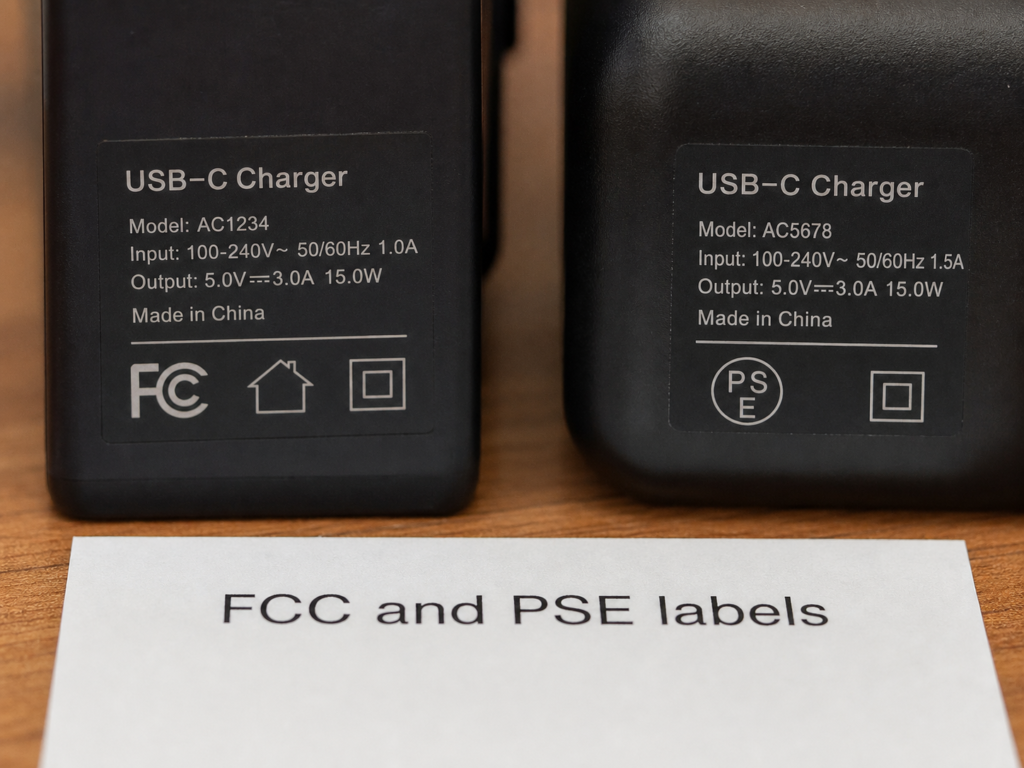
- Diamond PSE: Must be marked with the diamond PSE mark, name of the registered inspection body, and relevant information of the notifying business operator.
- Circular PSE: Must be marked with the circular PSE mark, name of the Japanese domestic notifying business operator or specified information.
Common requirements for both: Must be marked with rated voltage/power and product model; labels must be durable and clear, located on the product body or nameplate, and cannot only be affixed to the outer packaging.
Compliance Authenticity Verification Methods
- FCC verification:
For FCC ID products, directly enter the ID into the official FCC database to check whether the model and applicant information are consistent;
For SDoC products, require the supplier to provide the test report and declaration of conformity, and check whether the model, applicable standards, and responsible party match. - PSE verification:
Check mark shape, model, rated parameters, notifying party information, inspection body qualification, report/certificate, and mass production consistency;
Official channels include confirmation through the METI electrical appliance and material catalog, competent authorities or the notifying business operator.
There are several quick identification features of fake compliance that should trigger immediate alert: FCC products with only a printed logo but no ID and no available report, PSE products with no Japanese notifying party information, label model inconsistent with the actual sales model.
Compliance Invalidation and Change Assessment: Notes for Product Modifications
Many sellers assume one certification is permanent, but after product modifications, previous compliance may no longer apply.
Common Compliance Invalidation Scenarios
- Situations requiring FCC reassessment: Changes to product hardware, software, antenna, function, responsible party or US agent information that may affect original authorization or compliance materials; specific actions may include supplementary testing, change records, authorization information updates or re-certification.
- Situations requiring PSE reassessment: Changes to product structure, materials, rated parameters, notifying business operator, production conditions or certificate status, or expiration of the conformity inspection certificate for specified electrical appliances and materials.
The three most frequent causes must be noted: failure to re-evaluate after replacing fast charging chips, failure to retest relevant safety items after changing enclosure plastic, failure to retest after increasing output power — these are also details most easily overlooked by sellers.
For your convenience in judging whether compliance needs to be re-processed after product modification, we have compiled a change assessment matrix:
| Change Item | FCC Compliance Action | PSE Compliance Action |
|---|---|---|
| Replace power/fast charging protocol chip | Evaluate whether supplementary testing of conducted, radiated disturbance and other items is required | Evaluate related items such as temperature rise and abnormal operation |
| Modify PCB layout/core circuit | Evaluate disturbance items based on the impact of changes | Evaluate insulation, temperature rise, abnormal operation and other items based on the impact of changes |
| Increase input/output power | Evaluate disturbance and other authorization requirements according to applicable rules | Evaluate relevant safety items according to applicable technical requirements |
| Replace enclosure/insulation material | Generally require evaluation of whether it affects radio frequency or electromagnetic compatibility | Evaluate flame retardancy, insulation and other related safety items |
| Replace input plug/interface | Evaluate whether it affects conducted disturbance and original authorization | Evaluate structural safety, insulation and other related requirements |
| Add wireless communication module | According to rules for wireless module authorization, whole machine combination and radio frequency exposure, etc., supplementary testing, change application or new FCC certification may be required | When structure and input conditions remain unchanged, PSE impact still needs confirmation; the Japanese market usually also requires additional Giteki |
| Replace production factory | Verify product consistency, authorization records and responsible party information, and handle changes if necessary | Whether factory re-inspection or record update is required depends on product category, certificate conditions and change content |
When products, antennas, software, factories or responsible parties change, item-by-item evaluation should be carried out in accordance with FCC change rules, agent or authorization record update requirements, as well as PSE certificate and notification requirements. Possible handling methods include supplementary testing, change filing, re-application or factory re-inspection, which cannot be generalized.
Practical Notes for Cross-Border E-Commerce
Finally, we add a few details regarding platform operations:
- Many platforms require publicly queryable compliance numbers (such as FCC ID). Products with wireless functions must be processed in advance, otherwise they may not be listed.
- Some category platforms may require additional safety testing (such as US UL test reports), which shall be subject to the latest platform rules.
- The language and responsible party information of product labels and manuals must meet the requirements of the target market. For example, PSE labels must have corresponding Japanese information, and FCC declarations must be in English.
Summary
Finally, we condense the core content into 3 must-remember conclusions, as well as tasks you can complete independently after reading:
3 Core Conclusions for Beginners to Remember
- Completely different regulatory objectives: FCC mainly manages electromagnetic compatibility, radio frequency transmission and applicable radio frequency exposure requirements, while PSE manages electrical safety. The two cannot replace each other.
- Different mandatory market requirements: Equipment subject to FCC rules in the US market must complete applicable equipment authorization and compliance procedures; charging products connected to mains in the Japanese market require judgment according to the METI catalog as to whether mandatory PSE compliance is required.
- No mutual recognition or certification transfer: Obtaining one certification does not eliminate the need for the other. If targeting both markets, separate evaluation and separate processing are required.
After reading this article, you should be able to independently complete the following judgments: distinguish the meaning of marks and regulatory scope of FCC and PSE, quickly judge US and Japan compliance requirements for common USB-C cables, chargers, and wireless chargers, avoid 6 common misunderstandings, identify fake compliance, and judge whether compliance reassessment is needed after product adjustment through the change matrix.