
Many sellers of cross-border electronic accessories are always confused about the certification requirements for the UK market after Brexit—now UKCA, now CE, and Northern Ireland follows different rules; a little inattention can lead to goods being detained or listings taken down. In fact, as long as you clarify the boundaries and match them to your products, it is not that complicated. In this article, we will explain the main compliance requirements for charging products entering the UK market, from entry-level boundaries to practical self-inspection, which new sellers can use directly, and experienced sellers can also avoid common pitfalls.
First Understand 3 Entry-Level Boundaries to Avoid 90% of Detours
Many people step into boundary misunderstandings at the very beginning, for example, thinking that the UK is a unified access market, or that passing platform review equals compliance. Let’s clarify these issues first, so that the subsequent rules are easier to understand.
Geographical Boundary: The UK Is Not a Unified Access Market
In fact, there are two main compliance paths in the UK, and there is no “UK-wide universal certification” applicable to all products and all regions:
• **Great Britain (GB)**: Includes England, Scotland, and Wales, and applies local UK compliance rules. Some product categories can still use CE when conditions are met, depending on the current UK government recognition list and product requirements.
• **Northern Ireland (NI)**: Continues to apply relevant EU rules in many product access areas, and there are differences from GB requirements.
Simply put, products that are compliant for sale in England may not be directly applicable to Northern Ireland; you must check separately according to the sales region and product regulations.
Applicable Product Scope
This checklist is mainly for accessories related to electronic device charging and data transmission, covering chargers, power adapters, charging cables/data cables, interface connectors, wireless charging devices, and power banks; it applies to all accessories related to charging and data transmission, and does not involve toys, children’s products, or unrelated home appliances.
Basic Logic of Compliance Responsibility
First, it must be clarified: **Overseas sellers and manufacturers cannot be exempted from compliance responsibilities just because they sell through platforms**. Specific responsibilities are usually jointly borne by economic operators such as manufacturers, importers, authorized representatives, and fulfillment service providers, depending on the applicable regulations, the location of the manufacturer, the conformity assessment path adopted, and the sales method of the product.
Therefore, it cannot be simply summarized as “all products must have a UK or EU authorized representative”. Overseas manufacturers should confirm whether the following are required according to the applicable product regulations:
• Importers, authorized representatives, or other UK economic operators within the UK;
• Importers, authorized representatives, or other EU responsible persons within the EU;
• Provide the corresponding enterprise name and address information on the product, packaging, accompanying documents, or online product pages.
Different regulations have different requirements for the definition of responsible persons, whether they must be designated, the location of information placement, and the documents to be kept, which should be checked item by item.
Finally, a reminder: Platform entry review requirements are not the same as mandatory legal requirements. Passing the platform review does not mean regulatory approval; ultimately, you must follow the legal provisions.
How to Choose the Core Conformity Mark? Just Match It Directly
The question everyone cares about most, “what mark to put on the product”, essentially means first determining the sales region, applicable regulations, and conformity assessment method, then deciding which mark to use.
Core Definitions of Three Types of Marks
• **UKCA**: A conformity mark mainly used to indicate that a product complies with applicable UK regulations. Note that it is only a mark, not a certificate issued by the government. For products that allow manufacturer self-declaration, the mark can be affixed after the manufacturer completes the corresponding assessment and document preparation; if specific regulations require the participation of an approved body, self-declaration alone is not sufficient.
• **CE**: The statutory conformity mark of the EU. Whether GB continues to recognize CE depends on the current UK government’s product category list, applicable regulations, and specific conditions. For relevant electrical products whose CE is still recognized by the UK, CE products that meet the corresponding EU requirements can continue to be sold in GB, and it cannot be uniformly stated that all will expire on a fixed date. Northern Ireland continues to use CE in areas where EU product rules apply.
• **UKNI**: A supplementary mark exclusive to Northern Ireland, which cannot be used alone and must be affixed together with CE. UKNI only needs to be affixed when the product has completed the mandatory conformity assessment required by law by a UK body; not all products in the NI market need it.
Mark Combinations for Different Sales Regions
No need to memorize by rote, just choose directly according to your sales region:
• **Sold only in GB**: UKCA can be used; for product categories whose CE is currently recognized by the UK government, CE that meets the corresponding EU requirements can also continue to be used. Specific product categories, conditions, and exceptions shall be subject to the latest list on gov.uk.
• **Sold only in NI**: Use CE when EU product regulations apply; if mandatory conformity assessment is completed by a UK body, affix UKNI additionally.
• **Sold in multiple regions simultaneously**: If test data and technical documents cover both UK and EU applicable requirements, the same technical evidence can be used without repeated testing, but the mark, economic operator, document, and producer responsibility requirements of GB and NI must still be checked separately.
Can CE Documentation Be Used for UKCA?
Many sellers do not know that EU test data can be used as evidence for UKCA technical documents under certain conditions, thereby avoiding unnecessary repeated testing. But this does not mean that “CE certificates are automatically converted to UKCA”.
Usually, the following need to be confirmed at the same time:
1. The product complies with applicable UK regulations and designated standards;
2. EU test data covers the currently sold products;
3. The model, structure, key components, and test samples are consistent;
4. The manufacturer has completed the UK-required declaration of conformity and other conformity assessment procedures;
5. Specific regulations do not require the participation of a UK approved body.
If the product category or assessment procedure requires the participation of a third-party body, all UKCA compliance cannot be completed solely on the basis of EU reports.
Mandatory Compliance Checklist for Great Britain (GB)
There seem to be many mandatory regulations in the GB region, but in fact each regulation has a clear scope of control. Just check against the product type, no need to apply all of them.
Low Voltage Regulations (LVR)
To put it simply, these are safety rules governing whether products plugged into the mains will cause electric shock, fire, or insulation failure. The applicable voltage range is 50-1000V AC and 75-1500V DC, corresponding to products such as chargers and power adapters that are directly plugged into the mains; passive ordinary charging cables and connectors are usually not within the scope of LVR because they are not directly connected to the mains.
There is a little trick for judgment: look at the **input mains side voltage** of the product, not the output voltage. For example, a mobile phone charger has an output of only 5V but an input of 220V mains, so it needs to be judged according to relevant electrical safety regulations, and usually falls within the voltage range of LVR.
Electromagnetic Compatibility Regulations (EMCR)
These regulate the electromagnetic interference and anti-interference ability of products—simply put, your product must not interfere with the normal operation of other electrical appliances, nor can it be easily interfered with by other electrical appliances. Charging products with electronic circuits need to comply, such as fast charging cables with E-Marker chips and wireless chargers.
Passive cables without electronic components usually do not actively generate electromagnetic interference, and generally do not need to be separately assessed under EMCR, but they still need to meet other applicable product safety and material requirements.
UK RoHS
UK RoHS currently restricts 10 categories of substances, including lead, mercury, cadmium, hexavalent chromium, PBB, PBDE, and 4 phthalates. Specific limits and exemptions shall be subject to the schedule of the current regulations.
All electronic and electrical charging products may involve UK RoHS, including cables, connectors, solder, cable sheaths, etc. The compliance method is usually an enterprise declaration of conformity plus supply chain material certification, and no government-issued certificate is required; but note that all components in the entire supply chain must be covered, not just finished product testing. For example, the material of the cable sheath and the composition of the solder must have corresponding certificates.
UK REACH
UK REACH regulates the use of chemical substances, mainly involving substances of very high concern (SVHC for short) in cable sheaths, solder, and coatings.
If an article contains SVHC from the candidate list exceeding 0.1%, it usually triggers the obligation to provide information to the recipient or consumer, such as information required for safe use and disposal. Only when the conditions of Article 7(2) of UK REACH regarding total substance volume, exposure conditions, and other applicable conditions are met at the same time is it necessary to submit an article notification to the UK Health and Safety Executive (HSE).
Therefore, it cannot be simply understood as “if it exceeds 0.1%, it must be notified to the regulatory authority”, nor can the verification be permanently ended based on a single supplier declaration. Sellers should continuously pay attention to the updated UK candidate list, and keep supply chain material declarations, test data, and communication records.
Radio Equipment Regulations (RER)
RER regulates requirements such as spectrum use, electrical safety, and electromagnetic compatibility of wireless devices. Smart charging devices with communication functions such as Bluetooth, Wi-Fi, and NFC usually need to be judged according to RER.
Ordinary induction chargers that do not have intentional radio communication or radio transmission/reception functions are usually not subject to RER, but still need to meet other applicable requirements such as electrical safety, EMC, and RoHS. It cannot be judged solely by the product name; if the device uses radio spectrum, has a communication module, or has other intentional radio transmission functions, it should be specifically evaluated according to RER.
Ecodesign Regulations (Energy Efficiency)
Ecodesign requirements are mainly used to reduce standby power consumption and improve electricity efficiency. Independently sold AC/DC external power supplies usually need to be checked against UK ecodesign regulations and external power supply energy efficiency requirements.
However, whether it applies and which technical requirements apply still need to be confirmed according to the rated power, output form, product use, and regulatory exceptions, and cannot be judged solely by the product name “power adapter” or “fast charger”. For example, GaN fast chargers still need to be checked according to their actual electrical characteristics and uses, rather than automatically applying or not applying a certain requirement just because they use GaN materials.
UK Plug Standard (BS 1363)
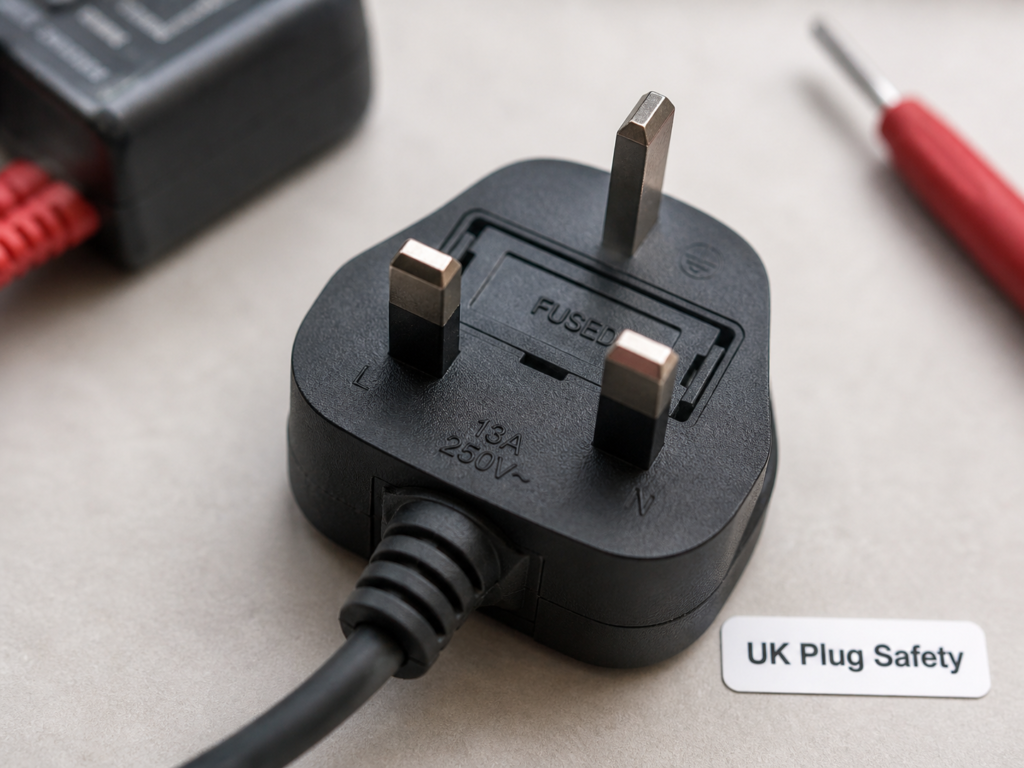
This is the exclusive safety standard for UK three-pin plugs, and it is also a major area where customs detains goods. Chargers and power adapters with integrated UK plugs need to be checked against BS 1363 and relevant electrical safety requirements, the core of which usually includes:
• Fitted with a fuse of matching specification;
• Pins have the required insulation protection;
• Pin dimensions and overall structure comply with the standard.
The most common problems are no fuse, insufficient pin insulation, or using a European plug with an adapter to pass off as a UK plug. Adapters do not automatically turn the original product into an integrated UK plug product that complies with BS 1363.
UK Product Safety Requirements
GB should not directly apply the name of the EU General Product Safety Regulation (GPSR). For consumer goods that are not fully covered by specific product regulations, the UK’s shall apply according to the product situation; for products such as chargers and power adapters, priority should also be given to checking the applicable specific electrical safety, EMC, RoHS, radio, and energy efficiency regulations.
Even if a product does not require mandatory UKCA or CE marking, it does not mean that safety requirements can be ignored. For example, too thin wire diameter leading to overheating, loose interfaces prone to short circuits, and insulating materials not suitable for the intended use environment may all cause product safety problems.
Special Access Rules for Northern Ireland (NI)
Product access in Northern Ireland cannot be simply summarized as “all rules are exactly the same as the EU”. In the areas of product safety, CE marking, and some market access, it is still necessary to judge according to applicable EU rules; but producer responsibility obligations such as WEEE, batteries, and packaging may also involve the respective registration, declaration, recycling, and labeling requirements of NI, the UK, and the EU.
Core Reason for Special Rules
According to the relevant arrangements for Northern Ireland, NI continues to apply EU single market rules in many product access areas. Therefore, charging products with valid CE conformity assessment can usually enter Northern Ireland in accordance with applicable EU product regulations.
But “having CE” does not mean that all obligations are automatically fulfilled. It also depends on whether the product requires an EU importer, authorized representative, or other responsible person, and whether it involves separate producer responsibility systems such as WEEE, batteries, and packaging.
Mandatory Marks and Supporting Requirements
• **Mark requirements**: When EU product regulations apply, the core mark is CE, and UKCA is not required. UKNI only needs to be affixed when a UK body completes the mandatory conformity assessment, and must be used together with CE.
• **Responsible person requirements**: Whether an EU importer, authorized representative, or other responsible person is required within the EU shall be judged according to specific EU regulations, and it cannot be assumed that all products must have an EU authorized representative.
• **Technical documents**: Products shall have technical documents, declarations of conformity, and test evidence that comply with applicable EU regulations; whether other UK documents are required depends on the product category, sales method, and relevant producer responsibility rules.
• **Extended obligations**: Obligations such as WEEE, batteries, and packaging shall be checked separately against the registration, declaration, recycling, and labeling requirements of NI, the UK, and the EU, and cannot be generally stated as only requiring EU requirements or not requiring UK-related obligations at all.
For easy comparison, here is a summary of the core rule differences between GB and NI:
| Comparison Item | Great Britain (GB) | Northern Ireland (NI) |
| Applicable rule system | Local UK regulations; some product categories may still recognize CE that meets conditions | Applies EU rules in relevant product access areas |
| Core conformity mark | UKCA; products that meet current recognition conditions may also use CE | CE |
| Local economic operator | Confirm UK importer, authorized representative, or other responsible person according to specific regulations | Confirm EU importer, authorized representative, or other responsible person according to specific EU regulations |
| Technical document requirements | Comply with applicable UK regulations and standards | Comply with applicable EU regulations and standards |
| Extended obligations | Judged according to UK WEEE, battery, packaging and other rules | Check WEEE, battery, packaging and other obligations of NI, the UK, and the EU separately |
| UKNI mark | Not applicable | Required to be paired with CE when mandatory assessment is conducted by a UK body |
Quick Compliance Judgment for Segmented Products, Check Directly Against Your Product
No need to look through regulations one by one by yourself. Below is the compliance checklist for common charging products, just match them directly. Before actual sales, it still needs to be confirmed in combination with the product structure, rated parameters, and functions.
Passive Ordinary Charging Cables/Data Cables
These are ordinary charging cables without chips or indicator lights, usually involving UK RoHS, UK REACH, and applicable product safety requirements such as the UK’s ; in NI, they shall be judged according to applicable EU product safety rules.
Such passive cables usually do not require mandatory UKCA or CE marking, but “no need for marking” does not mean no need for safety and material compliance. The flame retardant performance of the cable sheath, conductor cross-sectional area, interface structure, and insulation protection must still meet the intended use and relevant requirements of the product.
Charging Cables with Chips/Active Functions
For example, fast charging cables with E-Marker chips and charging cables with indicator lights usually involve UK RoHS, UK REACH, EMC, and UK general product safety requirements; if the voltage and structure carried by the product reach the scope of the Low Voltage Regulations, LVR needs to be further checked.
Whether such products need to be affixed with UKCA or CE shall be judged according to the sales region and applicable product regulations. As long as there are electronic components inside the cable, it can no longer be treated entirely as an ordinary passive cable, and the requirements for electromagnetic compatibility, electrical safety, and technical documents should be reconfirmed.
Ordinary Wall Chargers/Power Adapters/Multi-Port Chargers
Usually need to check LVR, EMC, UK RoHS, UK REACH, ecodesign energy efficiency requirements, and UK specific product safety regulations; those with integrated UK plugs also need to check BS 1363. Whether to use UKCA or CE depends on the sales region, applicable regulations, and the UK’s current recognition conditions for CE.
Pay attention to two details: products with multi-port output should clearly mark the total power and output conditions of each port, not just the maximum power of a single port; the product should also have overload, short circuit, and over-temperature protection matching the design. In addition, whether it is GaN material or PD fast charging, the compliance logic must be judged according to the actual structure and parameters of the product, and will not change due to the promotional name.
Wireless Charging Devices
Divided into two situations:
• **Pure induction ordinary wireless chargers**: Usually need to check LVR, EMC, RoHS, REACH, and applicable product safety requirements. Since they have no intentional radio communication or radio transmission/reception functions, RER is usually not applicable.
• **Smart wireless chargers**: If they have Bluetooth, Wi-Fi, NFC, or other intentional radio functions, they also need to be evaluated according to RER.
Also note: wireless chargers and their matching power adapters are two independent products that need to be compliant separately. You cannot only comply with the requirements for the wireless charger and ignore the matching charger.
Charging Products with Lithium Batteries
For example, power banks and wireless chargers with built-in batteries have the same basic compliance as corresponding types of electronic products. Power banks are judged according to their power supply and battery product characteristics, while wireless chargers with batteries are judged according to wireless charger and battery-related requirements, and battery producer responsibility also needs to be checked additionally.
A reminder here: battery transportation compliance, such as the UN 38.3 documentation common in air transportation, and the battery, product safety, and producer responsibility requirements in market access are two completely independent matters. The responsibility requirements for built-in batteries, removable batteries, and separately sold batteries may also be different. For complex products, it is recommended to consult a professional institution for confirmation.
Required Documents and Economic Operators, Don’t Wait for Spot Checks to Make Up
Many people think that putting a mark on the product is the end of the matter. In fact, the mark is just the surface; during real spot checks, the underlying documents, producer information, and responsibility chain will also be checked. If this part is missing, having the mark does not mean full compliance.
Local Economic Operators and Responsible Persons
Overseas manufacturers shall confirm the corresponding economic operator requirements according to specific regulations and sales models, such as UK importers, UK authorized representatives, EU importers, EU authorized representatives, or other responsible persons stipulated by regulations.
Relevant enterprise information shall be placed in the specified position according to specific regulations, which may involve the product itself, packaging, accompanying documents, or online product pages. The requirements of different regulations are not the same, and it cannot be generally required that they must be printed on the product, packaging, and manual at the same time.
Pitfall avoidance reminder: Do not use private, false, or addresses that cannot actually perform duties as the contact address of the responsible person or enterprise. It should be confirmed that the relevant enterprise actually exists and can keep documents, handle complaints, and cooperate with supervision.
Declaration of Conformity (DoC)
Many people think that the DoC is a certificate issued by a third party, but it is not—it is a legal compliance declaration signed by the manufacturer or a legally authorized representative, which is equivalent to a formal commitment that the product complies with applicable regulations.
A DoC usually needs to include:
• Product model;
• List of applicable regulations;
• Adopted standards;
• Information of the manufacturer and relevant economic operators required by law;
• Signatory;
• Date of signing.
The content and retention period of the DoC shall be confirmed according to specific applicable regulations. Many electrical product regulations require retention for 10 years from the date the last product is placed on the market, but this period cannot be automatically applied to all products and all regulations. The signing entity is usually the manufacturer or a legally authorized representative, and the UK responsible person is not generally equivalent to the signatory of the DoC.
Only models with the same design and consistent compliance basis can share one DoC; products of different models and different structures cannot be used indiscriminately.
Technical Construction File (TCF)

The technical file is the full set of technical data proving product compliance, that is, the “compliance evidence package”. Many people think that a test report is enough, but in fact the test report is only part of the technical file.
The technical file of charging products usually includes:
• Circuit diagrams;
• BOM (Bill of Materials);
• Test reports;
• Risk assessment data;
• Drafts of labels and manuals;
• Data on product structure, key components, and production consistency.
The technical file shall be continuously available within the retention period specified by applicable regulations, and shall be provided within the period required by the regulatory authority. The specific provision period shall be subject to applicable regulations, regulatory notices, or requirements of law enforcement agencies; there is no unified “48-hour statutory period” applicable to all charging products.
Judgment of Test Report Validity
You can’t just take any test report and use it; it is valid only if it meets the following conditions:
1. The model, brand, specification, and sample on the report shall be consistent with the sold product, and differences such as shell, interface, and rated power cannot be ignored.
2. Test reports for European plugs usually do not cover the UK plug version; if the plug is changed, the relevant safety requirements must be re-evaluated.
3. Reports for low-power versions usually cannot directly cover high-power versions; for example, a report for a 20W charger cannot be directly used on a 65W product.
4. After replacing core components, key materials, or production factories, a change impact assessment must be conducted and the technical file must be updated; whether re-testing or re-conformity assessment is required depends on the actual impact of the change on safety, EMC, RoHS, energy efficiency, wireless performance, and production consistency.
Easily Overlooked Extended Compliance Obligations, Don’t Trip Over Small Details
Many sellers pass product safety assessments but trip over producer responsibility. Although these requirements are not the core certification marks, they still need to be dealt with if found.
E-Waste Recycling Responsibility (WEEE)
UK WEEE obligations depend on conditions such as producer identity, sales method, enterprise size, product category, and annual sales volume. Enterprises that meet the UK’s definition of a producer may need to fulfill obligations such as registration, declaration, recycling, bearing treatment costs, or joining a compliance scheme. Overseas distance sellers should also check the requirements for UK authorized representatives.
The crossed-out wheeled bin mark should mainly be affixed to the body of electrical and electronic equipment products according to applicable rules; if the product is too small or the nature of the product is not suitable for direct marking, it can be placed on packaging, manuals, or other specified carriers in alternative positions allowed by regulations, and it cannot be generally stated that it must be printed on both the product and packaging.
Small sellers can entrust compliance service providers to handle registration, declaration, and recycling arrangements, but they should still confirm whether the service provider covers your sales method and product category.
Battery Producer Responsibility
Only products with batteries need to comply, such as power banks and wireless chargers with built-in batteries. Core obligations may include battery registration, recycling arrangements, marking capacity and chemical composition, and using applicable battery recycling marks.
Emphasized again: battery transportation compliance and battery compliance for market access are two different things. UN 38.3 documentation for transportation cannot replace battery registration, recycling, and product safety obligations in market access.
Packaging Environmental Protection Requirements
Packaging materials shall meet applicable environmental protection and producer responsibility requirements. Recycling marks must be truthful, and environmental claims such as “biodegradable” and “plastic-free” must not be exaggerated. Certification icons on packaging must be consistent with applicable regulations, and non-existent environmental certifications must not be printed arbitrarily.
Common Misconceptions and Shipping Practical Guide
Inventory of High-Frequency Misconceptions, See If You Have Fallen for Them
Mark-Related Misconceptions
1. **CE has completely expired in the UK**: Wrong. Whether GB recognizes CE depends on the current UK government’s product category list and specific conditions. For relevant electrical products whose CE is still recognized, CE products that meet the requirements can continue to be sold in GB, and it cannot be uniformly stated that all will expire at the end of 2025.
2. **UKCA is a certificate issued by the UK government**: Wrong. UKCA is just a conformity mark. For products that allow self-declaration, no certificate issued by the government or a third party is required; but when specific regulations require the participation of an approved body, the corresponding third-party assessment must still be completed.
3. **Having a mark equals compliance**: Wrong. The mark is just the surface; it must be accompanied by technical documents, DoC, applicable economic operator information, and other producer responsibility requirements to count as a relatively complete compliance system.
4. **UKNI can be used throughout the UK**: Wrong. UKNI only applies to relevant scenarios in Northern Ireland, and must be used together with CE; it cannot be used alone, nor can it be used in the GB market.
Product-Related Misconceptions
1. **All charging cables need UKCA**: Wrong. Passive ordinary cables usually do not require mandatory UKCA or CE marking, but still need to meet material, product safety, and other applicable requirements; cables with chips or other active functions need to be re-judged.
2. **Ordinary wireless chargers are radio equipment**: It cannot be judged solely by the name “wireless charger”. Ordinary induction chargers without intentional radio communication or radio transmission/reception functions are usually not subject to RER; products with communication modules or other intentional transmission functions need further evaluation.
3. **You must retest with a CE report to get UKCA**: Wrong, nor can it be reversed to mean that CE reports can definitely be converted automatically. EU test data that meets applicable UK regulations and standards may be used as part of the UKCA technical file without repeated testing, but the UK DoC and applicable assessment procedures must still be completed, and it must be confirmed that the data covers the current product.
4. **European plugs with adapters can be sold in the UK**: Simple adapters cannot be regarded as integrated UK plugs. Products with integrated UK plugs must be checked against BS 1363 and relevant safety requirements.
Common Supply Chain Pitfalls
1. Suppliers only provide the first page of the certificate, without complete reports and technical files: You must require suppliers to provide complete test data, material evidence, and technical files sufficient to support compliance judgment, otherwise you may not be able to prove compliance during spot checks.
2. The test report is inconsistent with the sold product: It cannot be used directly; difference and change assessment must be conducted, and supplementary testing or re-conformity assessment shall be carried out if necessary.
3. Certifications such as CCC, FCC, and UL can replace UK compliance: No. These data can be used as quality or technical references, but cannot automatically replace the mandatory compliance requirements applicable to the UK or EU.
4. Using a false UK authorized representative or filling in a random UK address: Absolutely not. The responsible person or economic operator shall actually exist and be able to perform corresponding duties.
5. Passing platform review equals compliance: Wrong. Platform entry requirements may be higher or lower than legal requirements. Passing the platform review does not mean regulatory approval, and the ultimate compliance responsibility is still borne by the relevant enterprise.
How to Choose Between Self-Declaration and Third-Party Certification?
Many people are tricked by bad institutions into buying high-priced “UKCA certificates”. In fact, most relevant electrical products can be self-declared by the manufacturer under applicable conditions, and mandatory third-party certification is not required.
However, whether a third-party body is required to participate cannot be judged solely by platform, customs, or customer requirements, but should be based on specific product regulations, product categories, and conformity assessment procedures. Certain regulations or assessment modules may require the participation of UK approved bodies, EU notified bodies, or other statutory third parties.
Requirements from platforms, customs, or major customers to upload test reports, DoCs, or third-party certificates are additional transaction, entry, or review conditions, and do not automatically mean that third-party certification is required by law. Before doing certification, first confirm which regulation it corresponds to, which assessment procedure, and whether it truly covers your product.
5-Step Quick Self-Inspection Before Shipping
Follow these 5 steps to avoid the vast majority of goods detention and listing removal risks:
1. First confirm your sales region: GB, NI, or both, and choose the corresponding compliance path and mark.
2. Against your product type, check all applicable mandatory regulations, do not miss any items.
3. Confirm the requirements for UK or EU importers, authorized representatives, and other economic operators according to specific regulations, and prepare the information on the product, packaging, manual, or online page as required.
4. Prepare the Declaration of Conformity (DoC) and the full set of technical files, keep them in accordance with applicable regulations, and provide them within the period required by the regulatory authority.
5. If it is a product with a UK plug, check whether the fuse, pin insulation, and dimensions comply with BS 1363 and relevant safety requirements.
Consequences of Non-Compliance and Emergency Handling
Non-compliance may lead to suspension of sales, platform listing removal, rectification within a time limit, border interception, product recall, destruction, and administrative or criminal penalties. Specific measures, penalty amounts, and whether criminal liability is involved shall be determined according to applicable regulations, illegal acts, competent authorities, and case facts, and cannot be simply classified into fixed levels of “mild, moderate, severe”.
If a problem really occurs, the first step is to suspend shipping, take down relevant products, keep sales and batch records, confirm the missing regulations, documents, or product problems as soon as possible, then carry out rectification and appeal according to the requirements of the regulatory authority or platform. Do not continue shipping with a fluke mentality.
Overall, the compliance of charging products in the UK after Brexit seems to have numerous items, but in fact the core logic is very clear: first distinguish whether the sales region is GB or NI, then match the applicable regulations according to the product type, confirm the correct conformity mark and economic operator requirements, prepare technical files and declarations of conformity, and finally conduct a self-inspection before shipping. CE, UKCA, WEEE, battery, and packaging responsibilities shall be subject to currently applicable regulations and official lists; if you encounter products with wireless functions, built-in lithium batteries, or complex sales regions, it is far safer to consult a professional compliance institution for confirmation when you are unsure than to ship with a fluke mentality.