
Sellers of cross-border charging products entering the Japanese market for the first time easily fall into the trap of “I can sell as long as I have CE/UL certification” — either goods are detained by customs upon arrival at the port, removed from platforms after listing, or even face regulatory penalties. Japan’s electronic product access system is independent and detailed, and it is not complicated as long as you check step by step logically. This checklist covers full-process compliance requirements for common charging products such as chargers, USB cables, wireless charging docks, and power banks, from basic cognition to practical pitfall avoidance, to help identify common compliance issues.
First, Clarify: Whether Your Products and Scenarios Are Within the Regulatory Scope
Boundaries of Applicability and Non-Applicability
The core categories covered by this checklist are chargers/power adapters, USB charging cables, wireless charging docks, power banks, and charging kit accessories. Applicable scenarios include cross-border B2C direct mail, bulk foreign trade import, overseas warehouse stocking, and commercial sample import. Items for personal carry-on use, large home appliances, medical devices, toys, and pure digital products (such as virtual recharge cards) are not the focus of this discussion.
It should be noted that personal use is not the focus of this article; samples for specific purposes such as testing, inspection, and repair may be subject to statutory exceptions or temporary import procedures, which must be confirmed with the competent authority in advance, and shall not be sold or transferred without authorization. Commercial gifts distributed to consumers usually still need to fulfill applicable obligations according to their product categories, and cannot be automatically exempted just because they are “provided for free”.
Core Logic of Japanese Regulation
Many people think import compliance is just passing through customs. In fact, Japan’s regulation has a division of labor: customs is only responsible for declaration, tariff collection, and port spot checks. Real market access is managed by professional departments such as the Ministry of Economy, Trade and Industry (abbreviated as METI, in charge of electrical safety) and the Ministry of Internal Affairs and Communications (abbreviated as MIC, in charge of radio).
For products subject to the control of the , importers must fulfill corresponding obligations of notification, inspection, labeling, and record-keeping; for radio equipment, certification and business entity requirements shall be confirmed in accordance with the Radio Law. The specific responsible entity shall be determined in combination with sales, direct mail, warehousing, and agency models.
The core goal of regulation is clear: to prevent electric shock, overheating and fire, and radio frequency interference, while ensuring products adapt to Japan’s 100V/50-60Hz mains standard — it is not that everything is fine if the product is marked “100-240V global universal”; safety performance is the focus of verification.
4 Misconceptions Most Common for Beginners
Let’s first clarify the most common pitfalls to avoid taking detours at the very beginning:
1. **CE/FCC/3C/UL cannot replace Japanese compliance**: The regulatory systems of each country are independent and do not recognize each other. Even if you have the strictest certification in the world, you must follow Japanese rules when entering Japan.
2. **Commercial gifts are not automatically exempted because they are free**: Commercial gifts distributed to consumers usually still need to fulfill applicable obligations according to product categories. Samples for specific purposes such as testing, inspection, and repair may be subject to statutory exceptions or temporary import procedures, but must be confirmed in advance, and shall not be sold or transferred without authorization.
3. **PSE is not a quality award**: It is a mandatory conformity mark required by Japan’s , equivalent to the role of China’s 3C certification. It is an access threshold, not an optional honor.
4. **Passing platform review ≠ full compliance**: The review requirements of mainstream Japanese platforms such as Amazon and Rakuten may be higher than legal standards. Even if the platform allows you to list products, regulatory authorities will still impose penalties if non-compliance is found in spot checks.
Official Inquiry Channels (Don’t Trust Unofficial Sources)
When in doubt, prioritize checking information from official channels, and do not easily believe scattered statements on the Internet:
• METI Electrical Appliance and Material Catalog: Check whether your product is subject to PSE control and which category it belongs to;
• List of Japan Registered Inspection Bodies: Verify whether the institution conducting PSE testing for you has official qualifications;
• MIC Technical Conformity Certification Inquiry: Confirm certification requirements and certificate validity for wireless products;
• Japan Customs Tariff: Check HS codes and the latest tariff rates;
• Transportation rules: Use the official IATA DGR document for air transport, and the IMDG Code for sea transport. Don’t just listen to what the freight forwarder says.
If you are looking for a commercial compliance agent, you must choose one with cooperation qualifications with Japanese inspection institutions and experience serving charging products. Anyone who says “guaranteed pass” or “low-cost fast certification” is basically a trap.
Core Compliance Framework: Judge Step by Step Without Random Guessing
Three Core Departments and Corresponding Regulations
First, clarify the corresponding regulatory entities. You don’t need to memorize full names, just know which type of rules to look for:
• **METI (Ministry of Economy, Trade and Industry)**: In charge of electrical safety, the corresponding regulation is the , and the core mark is PSE;
• **MIC (Ministry of Internal Affairs and Communications)**: In charge of radio equipment, the corresponding regulation is the , and the core mark is Technical Conformity;
• **Ministry of Finance/Customs**: In charge of import declaration, tariff collection, and port inspection, it is the first checkpoint for goods entering Japan.
5-Step Decision Tree: Quickly Determine What Compliance Your Product Needs
You don’t have to do everything at once. Checking step by step according to priority can save a lot of time and cost:
1. **Step 1: Product catalog determination**: First confirm whether the product is in the catalog of the , subject to METI’s official classification or confirmation by a professional institution. Don’t guess randomly based on the name;
2. **Step 2: Check specific classification conditions**: After confirming the catalog item, check rated voltage, input method, structure, purpose, and whether it belongs to specific categories such as power supply devices, wires, or lithium-ion batteries; PSE cannot be judged solely by whether the product plugs into the wall;
3. **Step 3: Confirm whether it has a portable lithium-ion battery**: If it has a battery, further check the battery’s definition, purpose, installation method, and transportation requirements;
4. **Step 4: Confirm whether it has radio transmission functions**: Such as Bluetooth, Wi-Fi, NFC, remote control, etc.;
5. **Step 5: Match final obligations with business scenarios**: According to scenarios such as commercial sales, test samples, or personal use, confirm whether there are applicable exceptions, notifications, or other procedures.
Quick Overview of Compliance Paths for Common Charging Products
For your quick comparison, we have organized the core paths of the 4 most common charging products into a table:
| Product Type | Core Compliance Steps | Key Reminder |
| Ordinary passive USB cable | Confirm no active circuit → no PSE required → check labeling → customs clearance | Only pure wires without power conversion/control chips are passive cables |
| Wall plug charger | Specified electrical appliance inspection + import notification → check labeling → customs clearance | Most are high-risk specified electrical appliances, and must be certified by official institutions |
| Mains-connected wireless charging dock | PSE for the power supply part → judge whether technical conformity is required for wireless function → customs clearance | Power supply and wireless are two sets of compliance requirements, don’t miss either |
| Power bank | Confirm PSE type by capacity/form/AC input → transportation compliance → customs clearance | PSE requirements differ for models with AC pins and pure battery models |
PSE Electrical Safety Compliance Inspection (The Core Access Requirement)
PSE is the first threshold for most charging products to enter Japan, and it is also the part where errors are most likely to occur.
First Judge: Whether Your Product Needs PSE
Judgment cannot be based solely on the product name, but must be comprehensively determined in combination with the METI catalog, product structure, rated parameters, and purpose:
• **Products requiring key PSE verification**: AC input chargers, power banks with AC input, and the power supply part of mains-connected wireless chargers;
• **Independently sold portable lithium-ion batteries**: PSE shall be confirmed according to conditions such as the definition in the Japanese catalog, rated capacity/voltage, purpose, and whether they are installed in equipment; for power banks, it is also necessary to separately judge whether their power supply devices, batteries, and other components are subject to control;
• **Products that do not need PSE**: Ordinary passive USB charging cables (pure wires without power conversion or control circuits);
• **Products requiring separate evaluation**: Charging cables with active conversion, control, and communication chips (such as high-power cables with E-Marker chips) cannot be directly assumed to not need PSE.
No matter which category it belongs to, you must keep a classification evidence package, including circuit diagrams, BOM lists, rated parameter descriptions, and structural descriptions. In case of customs or regulatory spot checks, you can produce them to prove your classification basis.
Don’t Confuse Diamond-shaped and Round PSE
There are two types of PSE, corresponding to products with different risk levels, with completely different mark shapes and requirements:
• **Specified electrical appliances (high risk)**: Affixed with the **diamond-shaped PSE** mark, which must be tested and certified by a Japanese officially registered inspection body, and cannot be self-tested;
• **Non-specified electrical appliances (medium and low risk)**: Affixed with the **round PSE** mark. Enterprises can test by themselves or entrust a third party, and only need to keep a full set of records. There is no mandatory certificate requirement.
Among charging products, the vast majority of wall-plug AC/DC adapters are specified electrical appliances, and must obtain a diamond-shaped PSE certificate from a Japanese registered institution. Don’t try to save money by making a round one yourself to muddle through.
Don’t Miss the Import Notification Obligation
PSE testing alone is not enough. The importer in Japan (that is, the responsible entity) must submit an **Import Business Notification** to METI — simply put, it is filing with the regulatory department to inform them that “I want to import this type of electrical product”. If the importer changes, the notification obligation must be fulfilled again.
Technical Requirements and Validity Rules
Testing of specified electrical appliances is carried out in accordance with the standards of the Electrical Safety Law, including insulation performance, withstand voltage, temperature rise, abnormal working conditions, etc. Overseas CE, UL, and 3C reports cannot directly replace them. Although non-specified electrical appliances do not require mandatory certification, they must also be tested according to the same technical standards and a full set of records must be kept.
PSE does not have a fixed validity period, but if the product’s circuit, core materials, structure, or rated parameters change, it must be re-evaluated or additional testing must be carried out; if official standards are updated, it is also necessary to confirm whether it is still compliant in accordance with METI’s transition requirements. Common invalid situations include: specified electrical appliances without a certificate from a Japanese registered institution, using overseas certification to replace PSE, and detachable power cords imported separately without compliance certificates.
Labeling Requirements
If the mark is not affixed correctly, it will be detained even if it has passed the test:
• The diamond-shaped PSE must be accompanied by the code of the registered inspection body (a string of numbers or letters);
• The round PSE must be accompanied by the name or code of the Japanese business operator;
• PSE and related statutory labels shall in principle be displayed on the product body or nameplate and other specified positions in accordance with regulations; only in applicable special circumstances can packaging, labels, etc. be used. The position, size, font, and durability shall be checked according to specific items and implementation rules.
Radio Law and Technical Conformity Compliance Inspection
If your charging product has wireless functions, it must also pass the technical conformity certification of the Ministry of Internal Affairs and Communications, otherwise it will be punished for interfering with public communications.
Which Products Need Technical Conformity Certification
The core goal of regulation is to prevent radio frequency signals from interfering with public communications. All charging products with wireless transmission functions such as Bluetooth, Wi-Fi, NFC, and remote control need to be checked whether they require technical conformity certification. Here are two common misconceptions to note:
• Wireless charging (inductive power supply) does not necessarily require technical conformity certification. It must be comprehensively judged in combination with operating frequency, power, and product category. Not all wireless chargers are subject to control;
• Turning off the wireless function with software cannot exempt certification. As long as the hardware has transmission capability, it is within the scope of regulation; conversely, having only a USB port does not mean it is a wireless product, so there is no need to force certification.
Certification Basis and Modes
Like PSE, Japan does not directly recognize overseas wireless certifications such as FCC and CE RED, so don’t use them directly.
Japan mainly confirms through systems such as **Technical Conformity Certification** or **Certification of Construction Design**. Certification of Construction Design is usually for products that conform to the certified construction design, but mass-produced products must still remain consistent with the certified design. The certificate cannot be understood as unconditional coverage for any changes or all products.
Key Points of Compliance Inspection
• **Certificates must match**: The model, wireless module model, frequency band, and transmission power must be completely consistent with the actual product, and certificates of other models cannot be used to make up the number;
• **Module certification cannot directly cover the whole machine**: The module certification scope, antenna and installation conditions, radio frequency parameters, shielding, and firmware settings shall be checked; when conditions are met, module certification can be used in accordance with the system, and additional evaluation or re-certification shall be carried out when changes occur;
• **Labeling requirements**: The technical conformity mark shall be affixed in accordance with regulations, and can be affixed to the body, system menu, packaging, etc.;
• **Keep evidence**: Module specifications, antenna parameters, firmware versions, and radio frequency test reports must all be kept for spot checks.
If the antenna is modified later, the frequency band is adjusted, the wireless module is replaced, or the radio frequency parameters in the firmware are modified, the original technical conformity certification may require additional confirmation or re-processing. The consequences of violations range from platform removal and regulatory fines to criminal liability in serious cases, so don’t modify randomly.
Labeling, Instruction and Promotion Compliance Inspection
Many sellers pass the test, but fail on labeling and promotion. This part has low cost, but is particularly easy to miss.
Product Labels Must Be Fully Consistent
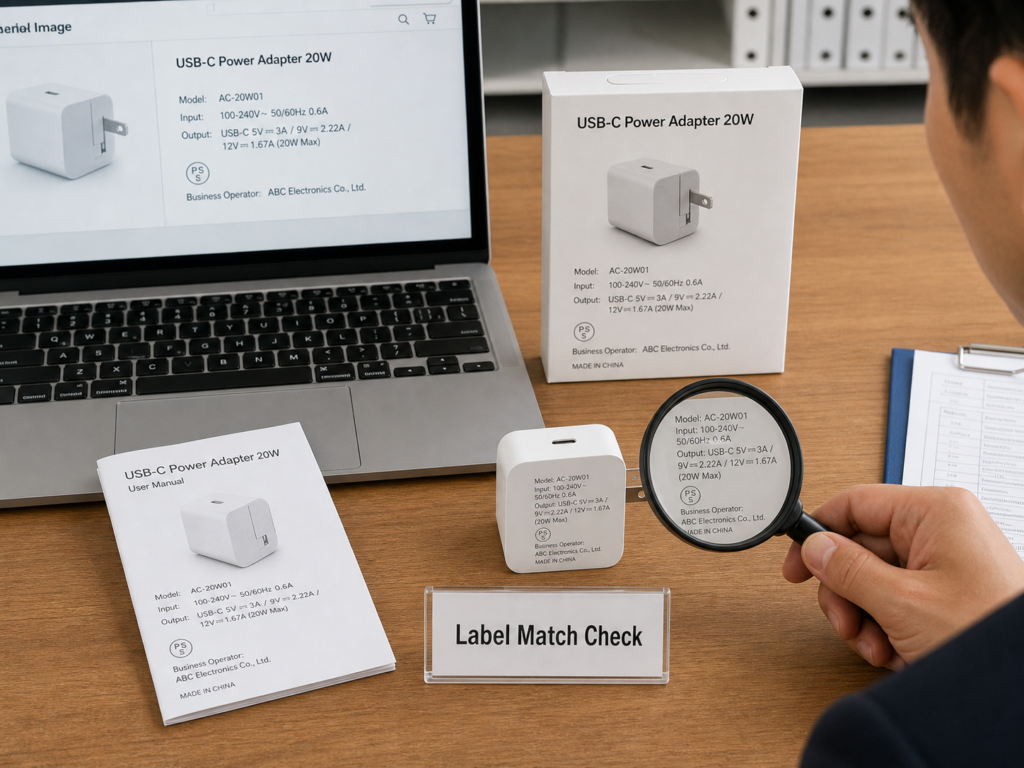
The information on the product body, nameplate, packaging, manual, and e-commerce sales page must be completely consistent. Necessary information includes: compliance mark (PSE/technical conformity), model, rated parameters, and Japanese business operator information. Low-level mistakes such as 65W written on the packaging and 45W marked on the product body are not allowed. The font and durability of the label must also meet the requirements, and cannot be wiped off by hand.
Japanese Instructions and Safety Information
When selling to Japanese consumers, Japanese rated information, safety warnings, and instructions for use shall be provided in accordance with applicable regulations, product items, and platform rules; the specific content and form shall be confirmed item by item, and cannot be presumed as unified legal obligations solely based on platform requirements.
When actually preparing materials, checks shall be carried out around the product’s usage methods, safety taboos, troubleshooting, hazard warnings, adaptation range, and fast charging conditions. Having only Chinese and English manuals may bring compliance, understanding, and complaint risks, and mainstream Japanese e-commerce platforms may also require Japanese manuals.
Packaging and Promotion Cannot Be Exaggerated
When listing on platforms, compliance documents are usually required to be uploaded, and the requirements of some platforms may be higher than legal standards. When promoting, you must never make false promises: if you have not obtained certification, you cannot mark words such as “Japanese official certification” or “full device compatibility”; if you promote fast charging, you must specify the port applicable to the maximum power, the matching cable required, and the device’s negotiation conditions, for example, “65W fast charging requires devices supporting PD3.0 and E-Marker cables”, you can’t just write “65W fast charging” and be done.
Import Customs Clearance and Tax Compliance Inspection
After all pre-compliance is completed, you still have to pass the customs clearance level in the end. Don’t drop the ball at the last step.
First Clarify the Domestic Responsible Entity
Under the Electrical Safety Law, domestic business operators must fulfill obligations such as import notification, record keeping, and accident response; under the Radio Law, the requirements for domestic entities must also be confirmed according to equipment type and certification method. If you entrust an agency company as the responsible entity, you must sign a written agreement to clarify the division of compliance responsibilities and the sharing of recall costs, so as not to shirk responsibility when problems arise.
List of Required Documents for Customs Clearance
For customs declaration, invoices, packing lists, transport documents, and information such as classification, valuation, and origin are usually prepared. PSE/technical conformity certificates, test records, notification materials, and product instructions shall be used as market access and regulatory verification documents. Whether to submit them during customs clearance depends on the specific requirements of the goods, customs, or other competent authorities.
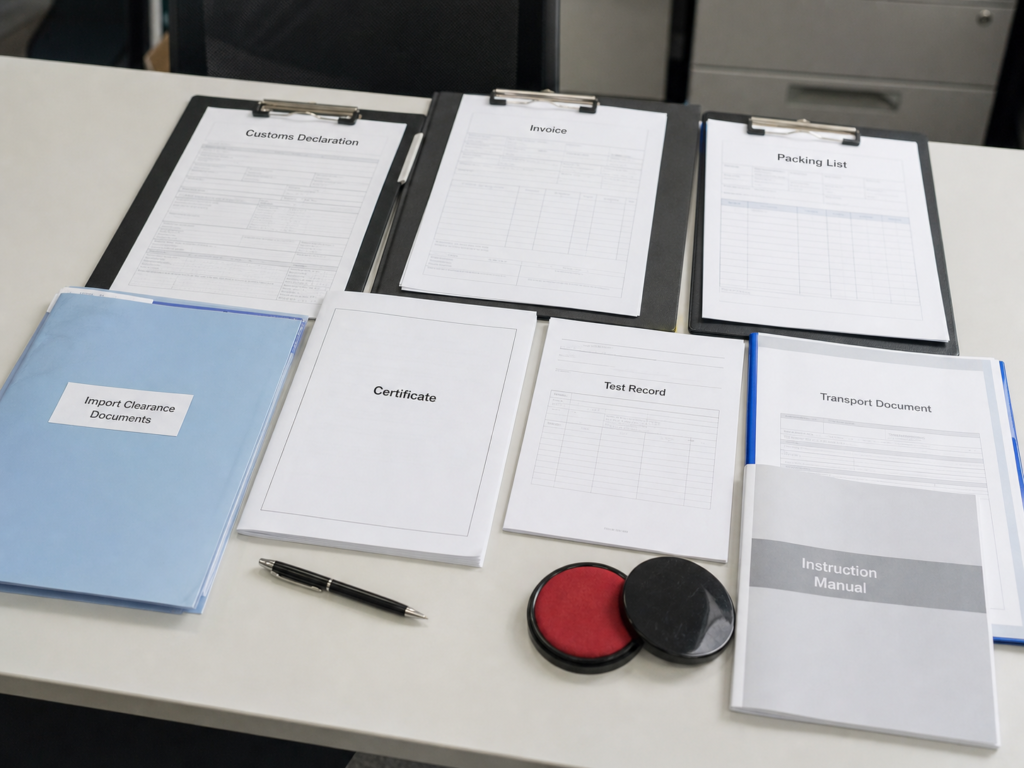
In actual preparation, materials can be organized into the following four categories:
1. Basic logistics documents: commercial invoice, packing list, bill of lading/air waybill;
2. Market access and compliance documents: PSE certificate or test records, technical conformity certificate (if applicable), declaration of conformity, import notification materials;
3. Product documents: Japanese manual, label photos, certificate of origin (if preferential tariff is to be enjoyed);
4. Special documents for lithium batteries: UN38.3 report, transport appraisal, SDS, etc. (provided according to the requirements of the transport mode).
HS Code and Tax Calculation
HS code classification shall be based on the actual function of the product. It is recommended to confirm with a professional customs broker or customs in advance. Don’t classify randomly by yourself, otherwise it is easy to be subject to tax supplementation and fines. Japan’s import consumption tax is currently 10%, and taxation rules are subject to the latest requirements of customs; tariffs vary according to HS code, origin, and trade agreements (such as RCEP, CPTPP). To enjoy preferential tariffs, you must meet the rules of origin and provide valid supporting documents. Underreporting prices and incorrect classification are the most common risks, ranging from tax supplementation and fines to direct detention of goods.
Lithium Battery Transportation Compliance
Special reminder here: **UN38.3 is a transportation safety test requirement, not a Japanese market access certification** — passing UN38.3 only means your battery can be transported, not that it can be sold legally in Japan. For built-in batteries, supporting batteries, and separately sold batteries, requirements for packaging, labeling, declaration, and state of charge are different. For specific rules, refer to IATA DGR for air transport and IMDG Code for sea transport, and also meet the additional requirements of the carrier.
Response to Regulatory Inspection
Chargers and power banks may be inspected due to safety, lithium battery transportation, declaration information, or market regulatory requirements; the scope and probability of inspection depend on the goods and individual cases, and a fixed spot check probability cannot be preset. The focus of inspection may include PSE/technical conformity labels and related documents, whether product parameters are consistent with declaration information, and whether lithium battery transportation materials are complete.
If non-compliance is found, you may face detention, rectification, return, or regulatory penalties. It is recommended to send samples for pre-inspection before bulk import, and ship the whole batch only after there is no problem, to avoid high costs caused by the detention of the whole batch of goods at the port.
Other Easily Overlooked Supplementary Compliance Requirements
In addition to the core requirements mentioned above, there are several detailed rules. Don’t wait until you are inspected to find out.
Hazardous Substances and Supply Chain
Japan does not have a unified mandatory RoHS system covering all charging products. J-MOSS (Japanese version of RoHS) only applies to specified categories. For charging products, it is necessary to confirm whether hazardous substance labeling is required according to specific items. However, some platforms or major customers may require reference to the higher standards of EU RoHS. It is recommended to ask suppliers to provide material declarations or test reports in advance to verify the content of hazardous substances in plastics, cables, solder, and batteries. Note: EU RoHS is not a legal obligation in Japan, so don’t let unnecessary requirements increase costs.
External Power Supply Energy Efficiency Requirements
Some external power adapters need to meet the energy efficiency standards of Japan’s Energy Conservation Law (Top Runner), and energy efficiency test reports must be kept. As for whether to affix an energy efficiency label, it must be confirmed according to the product’s power and category. Not all chargers require it.
Packaging and Recycling Requirements
In terms of container and packaging recycling, only business operators of a certain scale need to bear the recycling obligation for paper and plastic packaging, not all small sellers need to do it; small electronic waste recycling is currently mainly promoted by local governments, and there is no unified mandatory requirement for importers to bear recycling obligations. Don’t be fooled by the claim that “all charging products are subject to mandatory recycling”.
Compliance of Combination Sets and Gifts
If you are selling a charging set, all electrical accessories in the set must meet the corresponding compliance requirements respectively. You can’t say “it’s fine as long as the set passes”. Commercial gifts and accessories are not automatically exempted. For example, the charging cable given as a gift when buying a charger must also be judged and fulfill applicable obligations according to its own product category.
Core Self-Inspection Checklist by Product
You can directly check item by item against the list below, and ship only after each item is completed:
Wall Plug Charger/Power Adapter (Usually Specified Electrical Appliance)
□ Confirm that it is within the scope of METI’s specified electrical appliance catalog (responsible person: compliance post)
□ Hold a valid conformity inspection certificate from a Japanese registered inspection body, with consistent model parameters (responsible person: compliance post)
□ The Japanese importer has completed METI import notification (responsible person: importer)
□ Confirm whether it meets the energy efficiency requirements of the Energy Conservation Law (responsible person: compliance post)
□ Complete product classification evidence package and compliance documents (responsible person: compliance post)
Ordinary Passive USB/USB-C Charging Cable
□ Confirm that there is no power conversion/control circuit and it is not within the scope of PSE control (responsible person: compliance post)
□ Keep hazardous substance material declarations for future reference (responsible person: supply chain post)
□ Customs declaration information is consistent with the actual goods (responsible person: logistics post)
Charging Products with Wireless Functions (Wireless Charging Docks, Smart Chargers)
□ PSE compliance confirmation for the power supply part has been completed (responsible person: compliance post)
□ It has been confirmed whether the wireless function requires technical conformity, and valid certificates have been obtained for those requiring certification (responsible person: compliance post)
□ Complete wireless compliance evidence package (module/antenna/firmware) is kept (responsible person: compliance post)
Power Bank/Portable Lithium-ion Battery
□ Confirm the applicable type of PSE according to conditions such as catalog definition, rated capacity/voltage, purpose, installation method, and whether it has AC input (responsible person: compliance post)
□ Complete lithium battery transportation documents (UN38.3, etc.) that meet transportation requirements (responsible person: logistics post)
□ Japanese instructions include battery safety warnings (responsible person: operation post)
Practical Operation Process and Risk Control Pitfall Avoidance
5-Step Self-Inspection Process Before Import (In Order)
You don’t have to do things in a disorganized way. Following this order is the most efficient:
1. **Product classification determination**: First confirm which category the product belongs to and which regulations apply, keep the classification evidence package well, and don’t rush to do certification at the beginning;
2. **Implement the responsible entity**: Find a Japanese importer or compliance agent, and clarify the division of obligations and responsibilities;
3. **Go through compliance procedures**: Do PSE, technical conformity and other certifications as required, and keep a full set of supporting documents;
4. **Check front-end information**: Check all information on product labels, Japanese instructions, packaging, and promotion pages to be consistent. Don’t wait until the goods are produced to find mistakes;
5. **Prepare customs clearance documents**: Confirm the HS code and taxes in advance, conduct pre-inspection if necessary, and ship only after there is no problem.
Compliance Management After Listing
It’s not over once the products are sold. Post-market compliance management is also very important:
• **Batch traceability**: Establish a corresponding mechanism between product batches and compliance documents, suppliers, and shipment records, so that problems in any batch can be located immediately;
• **Change control**: Before changing core components or firmware, first evaluate the impact on compliance, and re-test if necessary. Don’t just change a chip and continue selling;
• **Complaint and accident records**: All complaints and safety accidents must be kept on record, and reported to the regulatory authorities in accordance with legal requirements. Concealment is not allowed;
• **Recall plan**: Formulate a recall process in advance, clarify the responsibilities of domestic business operators, brand owners, and platforms, so that there will be no chaos when problems really occur;
• **Evidence retention**: Confirm the retention period separately according to each applicable regulation; relevant inspection records required by the Electrical Safety Law shall be kept for at least three years, and other certification, accident, recall, transportation, and tax documents shall be kept in accordance with corresponding regulations and risk management requirements;
• **Risk transfer**: You can purchase product liability insurance as needed to reduce losses in case of problems.
7 Common Pitfalls and Avoidance Methods
We have sorted out 7 pitfalls that beginners are most likely to fall into. Avoiding them in advance can save hundreds of thousands of yuan:
1. **Qualification pit**: Using overseas certification to replace PSE/technical conformity, or finding an unqualified institution for testing. Avoidance method: Choose a Japanese officially registered inspection body or regular service provider, verify qualifications in advance, and don’t believe “low-cost guaranteed pass”.
2. **Entity pit**: No domestic responsible entity in Japan, unable to do import notification. Avoidance method: Screen qualified import agents in advance, and sign a written agreement to clarify responsibilities.
3. **Documentation pit**: The certificate model does not match the actual product, and the Japanese manual is missing. Avoidance method: Check the certificate, actual product, and promotion page one by one before shipment to ensure complete consistency.
4. **Labeling pit**: Wrong PSE shape, missing printed institution code or business operator information. Avoidance method: Design labels in accordance with regulations, and make samples for verification in advance. Don’t rework after mass printing errors.
5. **Classification pit**: Incorrect HS code declaration leads to tax supplementation and goods detention. Avoidance method: Confirm the classification with a professional customs broker or customs in advance, don’t guess randomly by yourself.
6. **Scenario pit**: Thinking that direct mail, samples, and gifts do not need compliance. Avoidance method: Samples for purposes such as testing and inspection shall be confirmed in advance whether they meet the exception conditions of the Electrical Safety Law, and required notification, license, or customs procedures shall be handled; ordinary commercial samples shall not be directly regarded as compliance-free goods. Gifts distributed to consumers usually still need to fulfill applicable obligations according to product categories.
7. **Change pit**: Modifying circuits or replacing modules without re-evaluating compliance. Avoidance method: Consult a compliance agency before core changes, keep evaluation records, and make changes only after there is no problem.
Compliance Cost and Cycle Reference (2024 Market Range, For Inquiry Only)
There is no fixed price for compliance costs, which are greatly affected by product type, number of models, test items, rectification situation, and service provider qualifications. The range below is only a rough reference for your budget preparation:
• Specified electrical appliance inspection (such as wall plug chargers): cycle 4-8 weeks, cost calculated based on power and number of models;
• Non-specified electrical appliance testing: cycle 1-2 weeks, cost lower than specified electrical appliances;
• Technical conformity certification: cycle 4-6 weeks, cost calculated based on the number of wireless functions (for example, the price of single Bluetooth is different from that of Bluetooth + Wi-Fi);
• Import agency service fee: charged annually or per batch, depending on the service content.
When asking for quotations from service providers, it is best to prepare product specifications, circuit diagrams, BOM lists, wireless module models (if any), and battery specifications (if any) in advance, so that the quoted price will be accurate.
Final Remarks
The compliance of electronic products in the Japanese market seems to have many items, but the logic is very clear: first classify, find the correct responsible entity, go through corresponding certifications, check labeling and promotion, and prepare for customs clearance. As long as you follow the steps step by step, you can enter the market smoothly without relying on luck. The worst thing is to take it for granted to use certifications from other countries to make up the number, or skip necessary steps to save some money, resulting in detained goods and removal from the shelf, which leads to greater losses. Checking item by item with this checklist can basically cover all core compliance requirements for charging products entering Japan.