
For those selling consumer charging products overseas, whether they sell chargers, USB-C charging cables, or power adapters, the first threshold they encounter when entering the EU or South Korean market is mandatory compliance requirements. Many people easily confuse CE and KC: either they think both are official “quality certificates”, or they think sticking a label can get them through. In the end, the lightest consequence is goods being detained and fines, and the heaviest is being directly banned from the market.
In fact, the institutional logic behind these two marks is different: the CE mark mainly indicates that the manufacturer declares the product complies with the applicable EU harmonized regulations; KC is a mark used by multiple mandatory compliance systems in South Korea, and the specific path depends on the product category. To make the comparison clearer, we will first thoroughly explain the basic definitions, then unify the product scope for comparison to avoid talking past each other.
Preliminary Basics: Basic Definitions and Unified Comparison Caliber
First, let’s talk about the core definitions in plain language to help you build a basic understanding:
The CE mark indicates that the manufacturer declares the product complies with the applicable EU harmonized regulations. Manufacturers usually need to complete conformity assessment, compile technical documentation, and sign the EU Declaration of Conformity (EU DoC for short), then affix the CE mark as required. Whether the manufacturer can complete the assessment on its own depends on the applicable regulations and product risk classification.
Many people think CE is an official “high-quality certificate” issued by the EU, which is the biggest misunderstanding: the EU does not have a unified official CE certificate applicable to all products. The CE mark represents the compliance status of the product meeting the requirements of relevant regulations, not a quality ranking, nor a full endorsement of product performance by the EU.
KC is a mark used by multiple mandatory compliance systems in South Korea. Electrical products need to apply different systems such as safety certification, safety confirmation, or supplier’s declaration of conformity according to product category; only when the corresponding certification system applies, a certificate issued by a designated body is required, and certification information must be marked as required. Therefore, it cannot be generalized that all KC products must be certified by a third party, nor can it be assumed that all KC marks must be accompanied by the same unique number. Specific mark, certificate, and number requirements shall be subject to the applicable system.
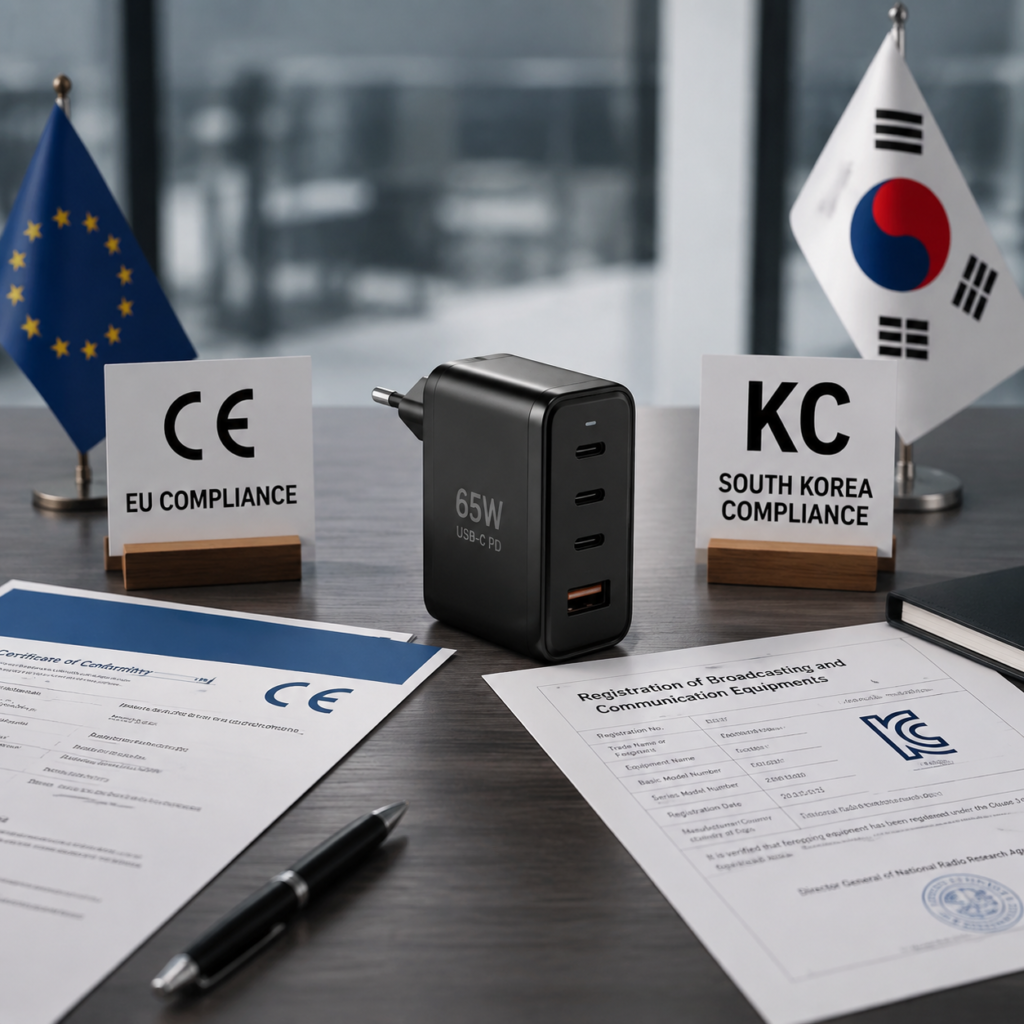
To make the comparison more referential, we first unify the caliber: all comparisons in this article revolve around the most commonly sold ordinary consumer-grade 20–65W wired chargers, USB-C charging cables, and power adapters, and will also cover wireless chargers and multi-port PD fast charging products; charging products for special scenarios such as industrial, medical, automotive, and military are not within the comparison scope.
If you are unsure whether your product needs to be certified, there is a preliminary judgment method: 100–240V AC input usually means the product needs to focus on evaluating requirements such as electrical safety, EMC, environmental protection, and energy efficiency. However, whether a specific KC certificate must be obtained and which CE regulations apply still need to be determined item by item based on product category, function, and sales method, and cannot be judged solely by input voltage.
Core Basic Attribute Comparison
After clarifying the basic definitions, let’s look at the core differences between the two systems from basic dimensions such as mandatory attribute, scope of application, and validity period. For easy memorization, the core information is organized as follows:
| Comparison Item | CE Mark and EU Compliance | KC Mark and South Korea Compliance |
|---|---|---|
| Mandatory Scope | 27 EU member states and the European Economic Area, including Norway, Iceland, and Liechtenstein, but judgment must be made based on applicable EU regulations | Within South Korea, specific requirements depend on product category and applicable system |
| Responsible Entity | The manufacturer is always the main responsible entity; non-EU manufacturers must ensure the existence of a corresponding economic operator in the EU according to applicable regulations | The manufacturer still bears responsibility for product conformity; whether a local South Korean applicant, representative, or importer is required depends on the specific system and application method |
| Compliance Model | For most common low-voltage power adapters, where permitted by applicable regulations, the manufacturer can complete internal conformity assessment, but sufficient technical evidence must still be retained; except for cases requiring a notified body | Different paths such as safety certification, safety confirmation, or supplier’s declaration of conformity may apply, and not all products are certified by a third party |
| Validity Period | The CE mark does not have a unified fixed validity period, but the manufacturer must continuously maintain the product’s compliance with applicable regulations | Validity period, renewal, and change requirements depend on product category and applicable system, and shall be subject to specific certificates and current rules |
| Classification Logic | Classified according to applicable EU harmonized regulations; charging products may involve different requirements such as safety, EMC, environmental protection, energy efficiency, and radio | Judged separately according to different South Korean systems such as electrical safety, radio, environmental protection, and energy efficiency, and cannot be collectively referred to as a single KC certificate |
Here we must specifically mention the difference in responsible entities: the main responsible person for CE compliance is always the manufacturer. An EU authorized representative can keep documents, cooperate with supervision, or perform other specified tasks within the scope of authorization, but cannot replace the manufacturer to bear core legal obligations such as product conformity, technical documentation, and EU DoC. Non-EU manufacturers also need to ensure the existence of a corresponding economic operator in the EU according to applicable regulations.
Whether a local applicant, representative, or importer is required in South Korea must be confirmed according to the specific KC system and application method, and the concept of “EU Authorized Representative” cannot be simply copied.
In terms of product classification logic, CE must be judged separately according to applicable regulations. For example, electrical safety may involve the Low Voltage Directive, electromagnetic compatibility may involve the EMC Directive, products with radio transmission or reception functions may involve the Radio Equipment Directive (RED), and may also involve requirements such as RoHS and Ecodesign. South Korea’s safety, EMC, radio, environmental protection, and energy efficiency may also apply different systems respectively, and they cannot be mixed into a unified KC certification.
Exclusive Technical Requirement Comparison for Charging Products
What many people care about most is: how different are the technical requirements of the two markets? Will completing one mean having to redo everything for the other? In fact, both regions usually focus on basic risks such as electric shock, temperature rise, insulation, and mechanical safety, but specific test items, standard versions, rated input conditions, and judgment limits are not necessarily the same, and must be confirmed separately according to the applicable standards of the EU and South Korea.
Electrical Safety Requirements
Both markets usually focus on issues such as electric shock protection, temperature rise, mechanical strength, and insulation — simply put, it must not electrocute people, must not overheat during normal use, the enclosure and structure must be sufficiently reliable, and the insulation system must withstand the specified electrical stress.
But it cannot be said that the core test items of the two regions are “exactly the same”. Different regulations and standards may stipulate different test conditions, test procedures, and judgment limits, and the product’s rated power, structure, input method, and use environment will also affect the test scope.
The common grid rated value in the EU is 230V/50Hz, and the common rated value in South Korea is 220V/60Hz. Products should be tested according to the rated input, plug, and applicable standards of the target market, and specific durability, temperature rise, and insulation tests shall be subject to the corresponding standards. It cannot be simply generalized that CE focuses more on long-term stability and KC focuses more on 60Hz performance.
Electromagnetic Compatibility (EMC) Requirements
First, let’s explain what EMC is: simply put, your product must not interfere with the operation of other electrical appliances. For example, when the charger is plugged in, the nearby radio will not have obvious noise; at the same time, the product must not lose control, be damaged, or have abnormal output due to normal external electromagnetic interference.
Both CE and South Korea’s applicable EMC systems usually may involve emissions and immunity. Emission tests focus on whether the conduction or radiation interference generated by the product exceeds the standard; immunity tests focus on whether the product can maintain specified functions when subjected to static electricity, electrical fast transients, radio frequency fields, or grid disturbances.
Specific items and limits are determined by product category, ports, use environment level, and the standards adopted. It cannot be generally stated that KC mainly tests interference emissions and has lower immunity requirements than CE.
Wireless Function Requirements
If your product has radio transmission or reception functions, such as charging devices with Bluetooth, Wi-Fi, or other wireless communication functions, it is usually necessary to evaluate the EU RED or South Korea’s radio and broadcasting communication equipment systems separately.
But “wireless charging” is not automatically equivalent to radio equipment in all senses. Whether the radio equipment system applies depends on whether the product has radio transmission or reception functions as defined by regulations, the operating frequency band used, and the specific technical structure.
Radio spectrum, EMC, human exposure, and electrical safety are different compliance considerations, and are not a unified “radio frequency safety” test item. Products with radio functions in the EU may need to meet RED requirements; in South Korea, it is necessary to judge whether relevant South Korean radio or broadcasting communication equipment systems apply based on product functions and frequency bands.
Environmental Protection and Energy Efficiency Requirements
In terms of environmental protection, EU RoHS currently restricts 10 categories of substances, including lead, mercury, cadmium, hexavalent chromium, PBB, PBDE, and 4 phthalates. Enterprises need to prepare material declarations, supply chain materials, or test evidence according to product categories and applicable requirements.
South Korea also has its own requirements related to hazardous substances and resource recycling, which should be checked separately according to applicable South Korean regulations. They cannot be simply equated with EU RoHS, nor can environmental compliance be uniformly classified into KC electrical safety certification.
South Korea may impose requirements on hazardous substances, recycling, producer responsibility, or related labeling for applicable electrical and electronic products, but these requirements should be judged separately from the KC electrical safety mark. It cannot be generalized that all charging products must affix the same recycling label.
In terms of energy efficiency, EU power adapters may involve regulatory requirements such as Ecodesign, usually focusing on standby power consumption and conversion efficiency; South Korea may also apply its own energy efficiency or minimum energy performance requirements. The specific scope of application and limits must be confirmed according to product type, rated power, and current rules of the target market.
Technical Requirement Upgrade Conditions
Not all charging products have the same test requirements. When power, number of ports, output strategy, components, and cable capabilities change, the risk assessment and applicable test conditions may change, but there is no unified 65W upgrade threshold.
- Changes in power and output strategy: High-power products, products with simultaneous multi-port output, or products with complex power distribution strategies may need to re-evaluate risks such as temperature rise, overload, short circuit, insulation, and abnormal operation;
- Changes in USB-C and USB PD functions: Relevant requirements should be confirmed separately based on USB specifications, product design, and target market regulations. Whether specific protocol or interoperability testing is required depends on applicable standards and the product’s claimed functions. Not all CE or KC projects automatically include the same “fast charging protocol compatibility test”;
- Changes in cables and E-Marker: E-Marker cables are not equivalent to “active cables”, nor do they automatically support 5A. The current capacity of the cable should be jointly supported by conditions such as cable design, conductor specifications, connectors, labeling, and electronic markers. Specific requirements need to be confirmed in combination with USB specifications and product design.
Comparison of Application Process, Cost, and Cycle
After talking about technical requirements, what everyone cares about most is definitely how to apply, how long it takes, and how much it costs. We take the most common wired chargers under 65W as an example to compare the common application ideas of the two markets.
The CE compliance process is usually: first determine the EU regulations and standards applicable to the product → complete necessary conformity assessment → organize a full set of technical documentation, including test evidence, risk assessment, manuals, etc. → the enterprise signs the EU DoC → affix the CE mark as required and launch the product on the market.
Manufacturers can test by themselves, or entrust laboratories with corresponding capabilities. The CE system does not have a unified “CE recognized laboratory” category; only when applicable regulations require the participation of a notified body must the corresponding EU notified body be used.
Therefore, self-conformity assessment is not “just say you are compliant”. Manufacturers still need sufficient technical evidence to support the conclusion and continuously maintain technical documentation. If applicable regulations require the participation of a notified body, internal enterprise declarations alone cannot be relied upon.
The KC compliance process requires first determining which South Korean system the product belongs to, then preparing materials according to the system requirements: determine product classification → confirm whether safety certification, safety confirmation, or supplier’s declaration of conformity applies → conduct tests or submit materials as required → accept factory inspection or document review if necessary → obtain corresponding results and mark KC information as required.
For the convenience of comparison, conventional application costs and cycles require special explanation: neither the official CE nor KC systems have unified regulations on fixed application cycles or fees. The actual price and cycle will vary greatly depending on product category, standard version, test scope, report reuse, certification body, factory inspection, and rectification situation.
| Comparison Item | CE Compliance | KC Compliance |
|---|---|---|
| Application Cycle | No unified official cycle, depends on applicable regulations, test scope, material preparation, and whether a notified body is required | No unified official cycle, depends on product system, test items, material review, factory inspection, and rectification |
| Application Cost | No unified official fee, quotation should be based on the scope of testing, assessment, documentation, and third-party services | No unified official fee, quotation should be made by project to specific designated bodies or service agencies |
| Main Fluctuation Factors | Power, number of interfaces, wireless functions, standard version, test failure, and rectification will all affect time and cost | Product category, applicable system, test scope, factory inspection, material review, rectification, and the recognition degree of existing reports will all affect time and cost |
Differences in Subsequent Maintenance Obligations
The CE mark does not have a unified fixed validity period, but the manufacturer must continuously maintain the product’s compliance with applicable regulations. When products, key components, software, manufacturing locations, regulations, or standards change, re-evaluation should be carried out according to applicable regulations and transition arrangements, and technical documentation and EU DoC should be updated if necessary.
Standard updates do not necessarily automatically invalidate products immediately, but may trigger re-evaluation. Whether re-testing, report updating, or product adjustment is required depends on applicable regulations, standard transition periods, and specific product changes.
KC’s validity period, renewal, and change requirements depend on the specific product category and applicable system. Safety certification, safety confirmation, and supplier’s declaration of conformity may have different management requirements, and it cannot be generalized that all charging products are valid for 5 years. It shall be subject to the current rules of Safety Korea, specific certificates, and designated certification bodies.
Common Pitfalls to Avoid in Application
These are pitfalls that many people easily fall into, so be sure to pay attention:
- CE pitfalls to avoid: Do not treat the so-called “CE certificate” as compliance itself. During EU regulatory spot checks, the core is usually whether the product complies with applicable regulations, whether technical documentation is complete, whether the EU DoC is correct, and whether the actual product is consistent with the assessment materials. Third-party reports can be used as technical evidence, but a “CE certificate” issued by a commercial institution cannot replace the manufacturer’s legal obligations.
- KC pitfalls to avoid: First confirm whether the product is subject to safety certification, safety confirmation, or supplier’s declaration of conformity, then confirm the testing body, applicant entity, and labeling requirements. It cannot be concluded that the product has completed KC compliance solely based on ordinary laboratory reports, nor can all KC products be required to go through the same third-party certification process.
- Common pitfalls to avoid: Whether models of the same series can share assessments, reports, or certificates must be confirmed based on structure, circuit, rated parameters, key components, and the series model rules of the corresponding system. If the difference is sufficient to affect safety or EMC, testing should be extended or applications should be made separately, and they cannot be used unconditionally interchangeably.
Comparison of Mark Usage and Market Supervision
Mark Posting Requirements
The CE mark should usually be affixed to the product or nameplate as required, usually with a height of not less than 5mm, but regulations may stipulate exceptions or alternative labeling conditions. Whether packaging, manuals, or accompanying documents can be used to replace the product body labeling must be judged based on applicable regulations, and cannot be automatically transferred just because the product is too small to fit the mark.
For USB charging cables, it is also necessary to first determine whether the product is a product subject to EU harmonized regulations that require the CE mark. The labeling rules for chargers cannot be directly applied without confirming the applicability of regulations.
The KC mark and related certification information shall be strictly implemented in accordance with the corresponding South Korean system, certificate, and labeling requirements. KC’s size, position, certification information, and alternative labeling rules are stipulated by specific systems, and the CE 5mm rule cannot be directly applied, nor can it be assumed that the posting methods of the two are basically the same.
The common principle for both marks is: the mark and certification information should be clear, legible, non-alterable, and must not be used in a way that is likely to cause misunderstanding. Applicable labeling should be completed before the product is launched on the market, and should not be randomly affixed after sale.
Market Supervision and Spot Check Focus
In the EU, inspections are carried out by member state market surveillance authorities based on national plans and risk assessments, while in South Korea, inspections are carried out by relevant competent authorities in accordance with national market surveillance plans. The actual focus will change with accidents, complaints, product risks, and special actions. It cannot be simply asserted that certain countries are always stricter, nor can high-power products or hot-selling products be described as fixed priority spot check objects in all markets.
For charging products, supervision usually focuses on whether the product is consistent with technical materials or certificates, whether the mark and model information are authentic, and whether risks such as electric shock protection, temperature rise, insulation, EMC, and abnormal operation are controlled.
Differences in Violation Consequences
Penalties for CE violations are determined by the laws of the relevant member states and the nature of the violation, and may include fines, sales bans, removal from shelves, recalls, corrective measures, and criminal liability in specific cases; there is no unified “10% of sales” cap applicable to the entire EU.
KC violations may also lead to product removal from shelves, recalls, fines, rectification, or other administrative and legal consequences, depending on which South Korean system is violated, the nature of the illegal act, and the handling decision of the competent authority.
Quick Judgment by Product
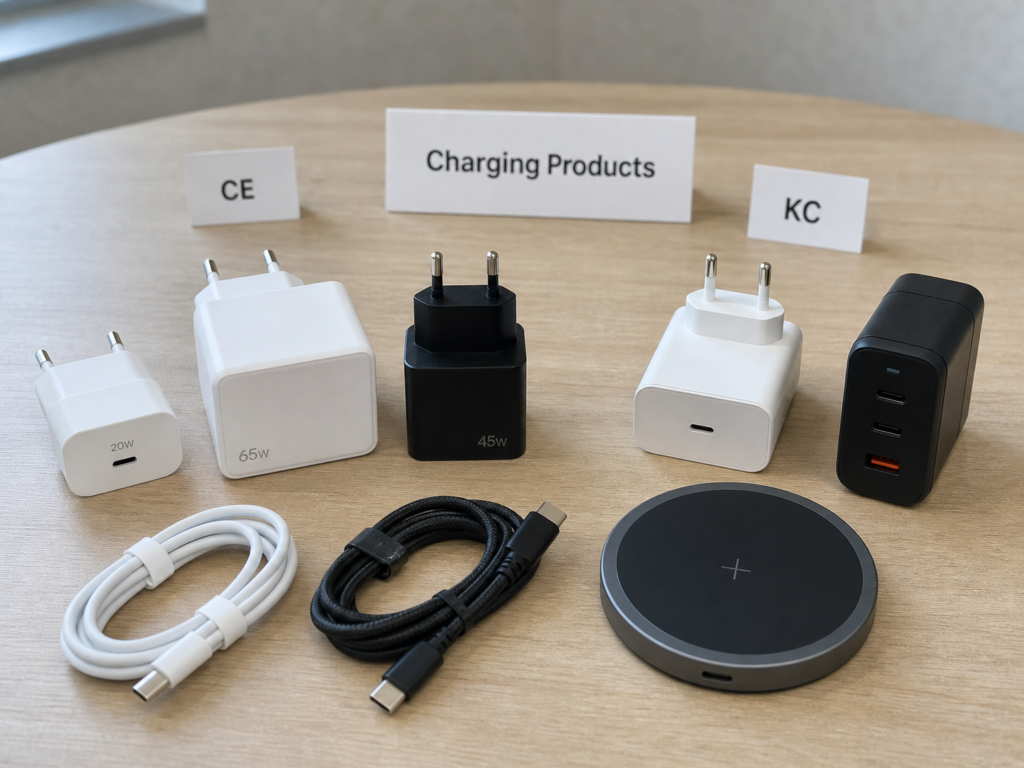
What was discussed earlier are all general requirements. There are subtle differences in certification requirements for different charging products. We will quickly sort them out by four common types of products.
Wired Chargers/Power Adapters
In terms of CE, chargers and power adapters with mains input usually need to focus on evaluating applicable requirements such as electrical safety, EMC, RoHS, Ecodesign, or energy efficiency, but the specific combination of regulations must be judged based on product structure, rated input and output, and sales method. For most common low-voltage power adapters, where permitted by applicable regulations, the manufacturer can complete internal conformity assessment; if a certain regulation requires third-party participation, it must be implemented as required.
In terms of KC, it is first necessary to determine which South Korean electrical product safety management system the product belongs to, and then confirm whether safety certification, safety confirmation, or supplier’s declaration of conformity is required. Safety, EMC, environmental protection, and energy efficiency are not necessarily all managed through the same KC certificate.
Here is an important reminder: whether the EU Low Voltage Directive applies should be judged based on the rated input/output voltage of the equipment and regulatory definitions, and 5V/1A cannot be used as a general exemption threshold. 5V USB adapters with mains input still need to be evaluated separately for the Low Voltage Directive and other applicable regulations.
USB/USB-C Charging Cables
Ordinary cables that do not have active electronic functions and are not covered by other EU harmonized regulations requiring the CE mark usually do not have CE affixed separately, but RoHS and other applicable obligations still need to be evaluated. When sold with a charger, the cable should also be evaluated separately as part of the product configuration and technical documentation, and cannot be automatically exempted just because it is sold with the whole machine.
USB-C cables with E-Marker, signal conversion, or other electronic functions must be re-judged based on specific design and applicable regulations, and cannot be directly treated as ordinary passive cables.
In terms of KC, USB or USB-C cables should first be judged whether they fall within the scope of KC safety management based on the South Korean designated product catalog and specific structure; if they do, they should be processed according to the corresponding system, and cannot be judged solely by whether they are sold separately or with the whole machine.
Wireless Chargers
In terms of CE, in addition to potentially applicable requirements such as electrical safety, EMC, and RoHS, it is also necessary to determine whether the product has radio transmission or reception functions as defined by regulations. If it is a radio device, it is usually necessary to further evaluate RED requirements; if it is only near-field energy transmission, it must also be judged based on the specific technical structure, frequency band, and applicable regulations, and cannot be generalized.
In terms of KC, it is also necessary to separately judge the requirements of systems such as electrical safety, EMC, radio or broadcasting communication equipment, environmental protection, and energy efficiency. Products with radio functions may have additional evaluation content such as radio spectrum, EMC, or human exposure compared to ordinary wired chargers.
Multi-Port PD Fast Charging Chargers
Both markets need to evaluate risks such as single-port operation, simultaneous multi-port operation, power distribution, temperature rise, overload, and abnormal states based on the product’s actual output capability. The test scope of multi-port products will change with power, number of interfaces, and output strategy, but there is no fixed upgrade threshold applicable to all products.
For multi-port products, the rated output of each port and combined output conditions should be accurately listed on the nameplate, manual, and application materials. Whether the KC certificate lists all output parameters channel by channel shall be subject to the specific KC system and certification body template, and cannot be used as a unified rule for all KC multi-port chargers.
Cross-Region Compliance Decision-Making and Pitfall Avoidance
If you are operating in both the EU and South Korean markets, or are still hesitating which market to enter, this part of the content can help you avoid detours.
Quick Certification Selection Logic
The rules cannot be simply understood as “one mark is enough”:
- When selling only in the EU or the European Economic Area, all applicable EU product regulations and related market obligations shall be fulfilled, and the CE mark shall be used after complying with applicable regulations;
- When selling only in South Korea, applicable KC and other South Korean regulatory requirements shall be completed according to product function and category;
- When selling in both regions, separate lists of EU and South Korean regulations shall be established. Some technical materials can be used as the basis for evaluation in the other market, but CE cannot be directly regarded as KC, nor can KC be directly regarded as CE.
In addition to CE-related regulations, the EU may also involve requirements such as REACH, WEEE, packaging, producer responsibility, and Ecodesign. South Korea may also involve independent systems such as radio, energy efficiency, resource recycling, labeling, and importer responsibility.
Cross-Certification Test Data Reuse Rules (Cost-Saving Tips)
Existing reports that meet South Korea’s applicable standards, versions, and test conditions can be submitted to South Korean designated bodies to apply for technical material evaluation or partial project recognition. However, whether to accept, which projects to accept, and how much fees will be incurred shall be determined by the review of the specific system and body.
Factors affecting reuse results include:
- Whether the standards and versions used in the report correspond to South Korean requirements;
- Whether test conditions, rated input, and product models are consistent;
- Whether the laboratory qualification meets the requirements of South Korean bodies;
- Which South Korean system applies to the product category;
- Whether the report covers all key items required by South Korea.
South Korea’s local plug specifications and South Korea’s exclusive EMC or radio requirements usually need to be reconfirmed according to South Korean rules. Existing CE reports can be used as a material basis, but a fixed test cost savings ratio cannot be promised, nor can it be assumed that as long as the laboratory has international accreditation qualifications, the report will be automatically accepted by the KC body.
Common Decision-Making Misconceptions to Avoid
These misconceptions are the easiest to fall into, so be sure to avoid them:
- Can you sell directly in South Korea after getting CE? No. KC and other South Korean systems do not automatically mutually recognize with the EU CE system, and applicable requirements must be completed according to South Korean product categories and functions. Existing CE materials can sometimes be used for technical evaluation, but CE cannot be used directly to enter the South Korean market.
- Can small-batch, online private domain sales skip certification? This cannot be generalized. When providing products to the local market, applicable mandatory regulations must be met. Sales volume and channels usually do not automatically exempt, but samples, R&D, exhibitions, specific B2B uses, or cases explicitly exempted by regulations shall be judged according to specific rules.
- Is a product with a certification mark definitely compliant? No. The mark is only a form; the core is that the product is consistent with the model, structure, parameters, and key components in the test report, technical documentation, or certificate. For example, if the evaluated product is a 20W charger but the actual sold version is 65W, it cannot be considered compliant just because it has a mark.
- Do wireless chargers and ordinary chargers have the same certification path? No. Products with radio transmission or reception functions may need to additionally meet radio, spectrum, EMC, or human exposure requirements; the specifics shall be judged based on technical structure and operating frequency band.
- Does a cable printed with the USB mark meet CE/KC safety requirements? No. USB-IF compliance programs, certification marks, or trademark authorizations are industry compliance matters of the USB ecosystem, and are not equivalent to CE or KC. Using the USB-IF mark must comply with USB-IF’s trademark and program requirements, and at the same time, the legal requirements of the target market must still be met separately.
Compliance Authenticity Verification Methods
Whether you handle compliance yourself or source goods from suppliers, you can check from the following aspects:
Key points for CE compliance verification include:
- Whether the EU DoC signed by the enterprise is complete;
- Whether the regulations, standards, and product models listed in the DoC are consistent with the actual product;
- Whether technical documentation and risk assessment can support the conformity conclusion;
- Whether the laboratory of the test report has the capability matching the test items;
- If regulations require the participation of a notified body, whether the relevant notified body can be found in the EU NANDO database;
- Whether the model, manufacturer information, and marks on the product nameplate, packaging, and manual are accurate.
Key points for KC compliance verification include:
- Verify applicable KC product safety certification, models, and applicant entities through South Korea’s Safety Korea;
- Check whether the certification information on the product is consistent with the actual product;
- Confirm whether the applicant body or testing body meets the requirements of the corresponding system;
- Products with wireless or broadcasting communication functions should also be verified in corresponding systems such as South Korea’s RRA according to the system;
- Check whether the product simultaneously meets applicable South Korean requirements such as labeling, energy efficiency, resource recycling, and importer responsibility.
Core Summary
At this point, the core content of CE and KC is finished. Let’s quickly summarize the core differences in three sentences:
First, Attribute difference: The CE mark indicates that the manufacturer declares the product complies with applicable EU harmonized regulations, usually requiring an EU DoC and technical documentation, but it is not equivalent to a unified official quality certificate; KC corresponds to multiple mandatory compliance systems in South Korea, and whether to adopt safety certification, safety confirmation, or supplier’s declaration of conformity depends on the product category.
Second, Technical difference: Both markets usually focus on basic risks such as electrical safety and EMC, but the regulatory system, standard versions, test conditions, and labeling requirements are not completely the same. Products with wireless functions, USB PD, multi-port output, or complex cable structures need to be evaluated separately based on specific design.
Third, Application and maintenance difference: Neither CE nor KC has a set of fixed fees, cycles, or certification models applicable to all charging products. CE requires continuous maintenance of compliance with EU regulations; KC manages certificates, declarations, changes, and labeling requirements according to specific South Korean systems.
After reading this article, you should be able to initially judge which CE or KC requirements need to be evaluated for charging products, understand why you can’t just look at one mark, and also be able to judge which materials may be reused and which content must be reconfirmed when entering both markets at the same time.
For cross-border compliance, the core is not “just sticking a mark”, but making the product, technical documentation, test evidence, labeling, and sales materials truly consistent with the requirements of the target market, so that the product can enter and remain in the local market more stably.