
If you plan to sell electronic products such as chargers, USB-C cables, and power banks to Japan, the first pitfall you may encounter is probably not sales volume, but compliance. Many sellers ship products directly to Japan with CE and FCC certificates for the European and American markets, only to find that their goods are detained at customs and their stores are removed from platforms, before realizing that Japan has a completely independent set of market access rules.
In this article, we will clearly explain all mandatory certifications, additional requirements, import rules, and common pitfalls for charging electronic products in the Japanese market at one go, covering everything from preliminary judgment to on-site self-inspection. After reading it, you will be able to sort out the compliance checklist for your products by yourself.
I. Basic Understanding of Market Access
First, understand the most fundamental rules, so that the subsequent certification requirements will not be confusing.
Who is in charge? Who is responsible?
Japan’s Electrical Appliance and Material Safety Law and related energy efficiency systems are mainly under the jurisdiction of the Ministry of Economy, Trade and Industry (METI for short); wireless devices are regulated by the Ministry of Internal Affairs and Communications (MIC for short) in accordance with the Radio Law; the Consumer Affairs Agency is mainly responsible for consumer policies, product accident information, and labeling regulation of some consumer products. Specific responsibilities shall be confirmed according to the product and applicable laws and regulations.
Compliance responsibilities are not borne by the same entity for all products and all sales models. When regulations such as the Electrical Appliance and Material Safety Law are involved, import or sales operators usually need to be able to perform obligations such as declaration, labeling, record keeping, and regulatory liaison. For models such as cross-border e-commerce, overseas warehouses, and platform delivery, the responsible entity shall also be confirmed in combination with the specific sales process and applicable laws and regulations.
Contrary to what many people think, Japanese customs does not inspect the certification of each batch of goods ticket by ticket, but regulates through methods such as operators performing compliance obligations in advance and post-market inspections by competent authorities. You must first fully ensure compliance on your own; after the product is launched, regulatory authorities may still conduct random inspections. If non-compliance is found, you will face rectification, sales suspension, recall, or penalties. Risks cannot be judged solely by whether you are inspected during customs clearance.
Which products are within the scope of regulation?
For the charging products we commonly sell, the vast majority require a judgment on regulatory applicability: wall chargers, AC-DC adapters, USB/USB-C charging cables, power banks, and wireless chargers are all core applicable categories; extended products such as car charging accessories, smart charging docks, and passive interface connectors also need to confirm applicable requirements according to their input methods, functions, and sales forms.
There are two types of products for which the judgment logic for ordinary consumer electronics cannot be simply applied: one is charging equipment dedicated to industrial and medical use, which may apply to special regulatory channels; the other is built-in accessories that are supplied with the main unit and not sold separately. Whether the latter can be exempted from a certain DENAN obligation separately depends on whether the component is a designated electrical appliance, whether it can be used or sold independently, the installation method, as well as specific items and exclusion clauses. It cannot be deemed that no separate compliance is required just because it is supplied with the main unit.
Hard Requirements of Japan’s Local Electrical Environment
When entering the Japanese market, first remember the basic parameters: Japan’s household mains is 100V AC, and the eastern part (Tokyo, Kanto area) is 50Hz, while the western part (Osaka, Kansai area) is 60Hz. If your product only supports a single frequency, problems may occur when sold to another region, ranging from failure to work normally to overheating and fire.
In terms of plugs, Japan commonly uses two flat parallel plugs, and plugs and sockets shall comply with applicable JIS standards. Whether a grounding pole must be installed shall be confirmed according to the product structure, protection level, rated conditions, and applicable technical standards, and cannot be judged solely by power. Any mismatch in voltage, frequency, or plug may bring safety hazards, and is also a key content to be confirmed during compliance inspections.
The Real Cost of Non-Compliance
The losses from non-compliance are real: if problems are found in random inspections during customs clearance, goods may be detained or returned, and additional costs such as port demurrage and return freight will be incurred; in the sales link, if non-compliance is found on mainstream platforms such as Amazon Japan, Rakuten, and Yahoo Shopping, products may be removed from shelves, sales may be restricted, and related funds may even be frozen; more seriously, it will trigger legal liabilities, such as fines and mandatory recalls, and in extreme cases, criminal liability may even be pursued.
Here we must first correct a most common misunderstanding: overseas certifications such as CE, FCC, UL, and CB are not directly recognized by Japanese regulations, and can only be used as test references when handling Japanese compliance at most. All products must be re-evaluated according to Japan’s voltage, frequency band, and classification rules; do not think that certificates from other markets can directly replace Japanese requirements.
1-Minute Quick Judgment: What Certifications Does Your Product Need?
You don’t need to memorize all rules by rote; you can first sort out the general direction using the following judgment logic:
1. **Connected to Japanese mains**: First check whether it is an electrical appliance designated by the Electrical Appliance and Material Safety Law; only if it is a designated item, PSE compliance requirements shall be fulfilled according to the corresponding category;
2. **Containing lithium-ion storage batteries**: If the product is a lithium-ion storage battery within the scope stipulated by law, especially a separately sold portable battery pack, further check conditions such as energy density, purpose, and whether it is installed inside the equipment to confirm whether PSE is required;
3. **With wireless function**: Confirm whether Technical Conformity Certification, construction design certification, license, declaration, or other requirements under the Radio Law apply according to the type, frequency, output, and device category of the wireless equipment;
4. **Independently sold finished products**: Compliance requirements need to be evaluated separately in combination with whether the product is a designated item, its purpose, structure, and sales method;
5. **Components supplied with the main unit**: Cannot be directly deemed as exempt; shall be confirmed item by item in combination with whether they are designated electrical appliances, whether they can be used or sold independently, as well as applicable items and exclusion clauses.
These points can only help you form a preliminary judgment, and cannot replace the verification of the METI Electrical Appliance Item List, DENAN technical standards, MIC Radio Law device classification, and other applicable laws and regulations.
II. PSE Electrical Safety Certification (Mandatory)
PSE is Japan’s core mandatory electrical safety system, derived from the Electrical Appliance and Material Safety Law (abbreviated as DENAN). It mainly prevents safety risks such as electric shock, overheating, short circuit, and fire, covering items such as insulation performance, overcurrent, over-temperature, and short circuit protection. PSE is only valid within Japan, but not all electrical products automatically require PSE; it is necessary to first confirm whether the product is an electrical appliance designated by the law.
Core Differences Between Diamond PSE and Circular PSE
Many people can’t distinguish between the two types of PSE; in fact, the core difference lies in product classification and compliance procedures:
| Type | Corresponding Classification | Risk Level | Main Procedures | Consequences of Violation |
| Diamond PSE | Specified electrical appliances | Higher risk | Conformity inspection is carried out by a METI-registered conformity inspection body, and operators perform obligations such as declaration, inspection, and labeling | Incorrect use of the circular mark on high-risk products may constitute a serious violation |
| Circular PSE | Non-specified electrical appliances | Relatively lower risk | Usually, operators self-confirm compliance with technical standards, implement and retain statutory inspection records, no need to obtain a third-party certification certificate | Cannot be replaced by the diamond mark |
The specific judgment shall be based on the latest issued by METI, rated conditions, product structure, and applicable technical standards, and cannot be concluded based on feeling or product name.
Specific Judgment Rules for Charging Products
For the charging products we commonly sell, the general judgment logic is as follows:
• **Wall chargers/AC-DC adapters**: If an AC adapter falls under designated items such as “DC power supply devices”, it shall be confirmed as a specified or non-specified electrical appliance according to the item list and rated conditions, and then diamond or circular PSE and corresponding procedures shall be determined. Cannot be directly judged solely by the name “charger” or common practices.
• **USB/USB-C charging cables, passive connectors**: Ordinary low-voltage cables cannot be judged as statutory wires solely by the name “charging cable”; the list shall be checked in combination with rated voltage, conductor structure, connector type, and sales form. Even fast-charging cables with E-Marker chips do not automatically trigger PSE requirements.
• **Car chargers**: Those that only connect to 12V/24V DC of cars and do not touch mains power at all usually do not fall within the PSE scope triggered by AC input; dual-purpose chargers with mains input shall be evaluated as AC input products.
• **Wireless chargers (AC input part)**: For those with 100V mains input, first confirm whether the power supply part is a designated electrical appliance and the PSE type according to the DENAN item list; the wireless power transmission part also needs to confirm technical, licensing, or declaration requirements under the Radio Law according to frequency, output, and device category.
• **Power banks with built-in lithium batteries**: Cannot be deemed as falling within the PSE scope solely because of “built-in lithium batteries”. If the product involves lithium-ion storage batteries within the scope stipulated by law, further judgment shall be made in combination with purpose, energy density, structure, whether it is installed inside the equipment, and sales method.
Labeling Requirements and Change Rules
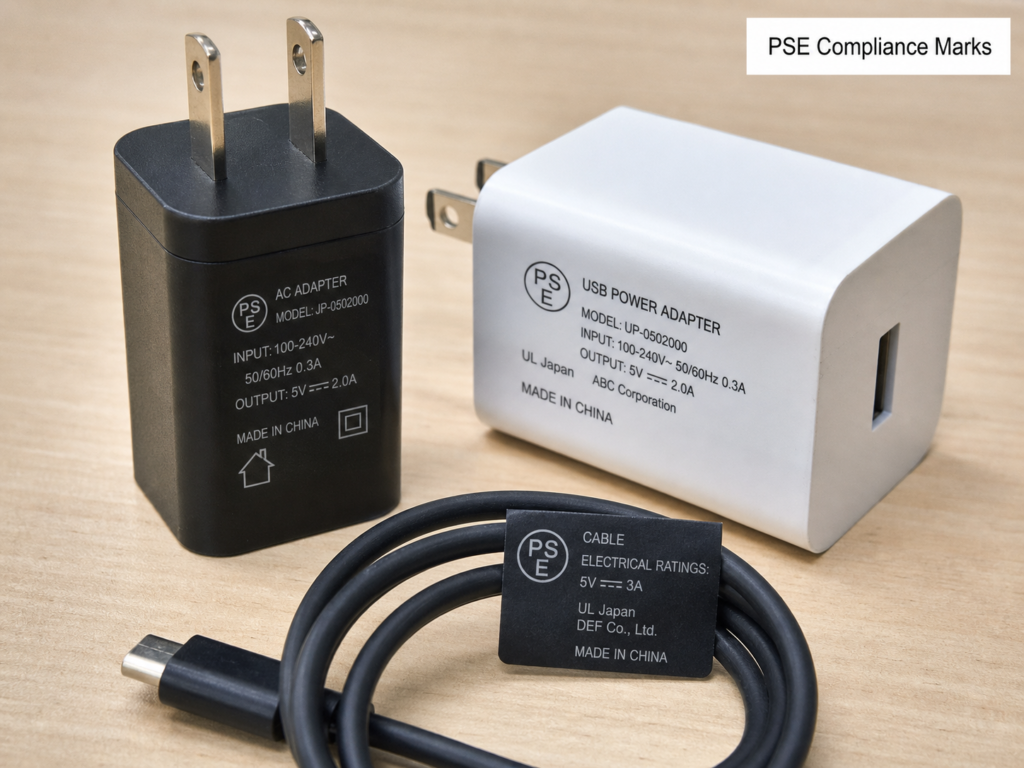
There are clear requirements for PSE labeling, but the specific location and content shall be confirmed according to DENAN and applicable technical standards. The PSE mark, operator name, and rated parameters shall be marked on the product body, nameplate, or other locations permitted by regulations; the mark on the minimum sales package cannot replace the required labeling on the body. The labeling shall be clear and durable, and cannot be scraped off easily.
Specified electrical appliances shall be marked with the name or abbreviation of the METI-registered conformity inspection body that carried out the conformity inspection as required; the specific format shall be subject to the requirements of applicable items and the registered body. Non-specified electrical appliances shall be marked with information such as the operator’s name as required. The parameters on the label must be consistent with the inspection records, conformity inspection certificate (if applicable), and the actually sold product; neither the model nor the rated value can be changed arbitrarily.
Whether there is an exemption also depends on the specific item, purpose, structure, and exclusion clauses. Accessories that are only used in DC low-voltage scenarios and are not sold separately cannot be generally deemed as automatically exempt. If the product replaces the plug, changes the power supply scheme, modifies the rated power or output parameters, it is necessary to re-evaluate whether the original compliance procedures are still applicable. Relevant inspection records, certificates, and other documents shall be kept by the obligated operator in accordance with DENAN requirements to cooperate with regulatory random inspections.
III. Special Section on Power Banks and Lithium Batteries
Compliance of power banks is another high-risk area. Many people think that power banks need PSC certification, but this has not been the case for a long time. Since 2019, power banks within the stipulated scope have been included in the PSE management scope of the Electrical Appliance and Material Safety Law, and do not fall under the default PSC certification category.
It should also be noted that the compliance requirements for cells and battery cells are different from those for finished power banks; the data or certificates of cells cannot be directly used as compliance certificates for finished power banks.
Judgment Rules for Lithium Battery PSE
Whether lithium battery PSE is required cannot be simply judged by the total Wh value of the power bank, but depends on the following conditions:
1. For separately sold portable lithium-ion storage batteries, whether they fall within the PSE scope shall be judged based on applicable statutory conditions such as energy density, purpose, structure, and installation state;
2. For power banks with AC input, in addition to the lithium battery part needing to be judged according to applicable rules, if the AC power supply part is a DENAN-specified electrical appliance, its PSE category and procedures shall also be confirmed separately;
3. Built-in batteries that are supplied with the main unit and not sold separately also cannot be deemed exempt solely because they are “sold with the main unit”; they shall be confirmed in combination with whether they are designated items, whether they can be used or sold independently, and exclusion clauses;
4. A smaller rated energy does not automatically mean that PSE is not required, and exemption cannot be judged solely by the total Wh value.
Labeling and Transportation Requirements
If a power bank falls within the PSE scope, in addition to marking the PSE mark according to the corresponding category, it shall also be marked with parameters such as rated capacity, voltage, and Wh value according to applicable regulations. These parameters must be consistent with the actual product, inspection records, or conformity certificate; the specific labeling location and items shall be subject to applicable laws, regulations, and technical standards.
Special reminder: Transportation compliance of lithium batteries is a separate matter from product certification. The transportation of lithium batteries must meet applicable UN Dangerous Goods Transport Regulations, IATA Air Dangerous Goods Regulations, IMDG Maritime Dangerous Goods Regulations, and carrier requirements. Operators shall prepare UN 38.3 test summaries or relevant certificates, and provide SDS and other dangerous goods transport documents according to the mode of transport, lithium battery type, packaging, and carrier requirements.
IV. Special Section on Wireless Products (Giteki/Radio Law)
If your product has wireless functions, such as a smart charging dock with Wi-Fi, a charging accessory with Bluetooth, or the product uses wireless power transmission function, you also need to evaluate the requirements of Japan’s Radio Law. The Technical Conformity Certification is usually called “Giteki”, and its function is to reduce interference of wireless signals to public communications, broadcasting, and other legal radio wave uses.
Under the Radio Law, the requirements for Technical Conformity Certification, construction design certification, and radio station licenses shall be distinguished. Although some devices are license-free, they may still need to comply with technical standards, carry out corresponding labeling, or perform declaration obligations; “license-free” cannot be understood as requiring no compliance at all.
Compliance Judgment for Different Wireless Functions
For the wireless functions we commonly encounter, the general judgment can be made as follows:
• **Communication modules such as Bluetooth/Wi-Fi/Zigbee**: These are typical wireless devices that require Radio Law compliance assessment, such as smart charging docks with App control and charging accessories with wireless communication modules. Whether it is Technical Conformity Certification or construction design certification depends on the device category and application path. Pure wired charging products and passive accessories that have no wireless transceiver function at all usually do not involve such requirements.
• **Short-range wireless power transmission devices such as Qi**: Cannot be uniformly judged according to the “Giteki exemption list”. First confirm whether they are radio stations, low-power radio stations, or high-frequency utilization devices, and then confirm whether Technical Conformity Certification, license, declaration, or other Radio Law procedures are required based on frequency, output, purpose, and device category.
• **NFC/other radio frequency functions**: Low-power short-range NFC may meet license-free conditions, but license-free does not mean automatic exemption from technical requirements or labeling obligations. The final confirmation still needs to be combined with operating frequency, transmit power, device category, and actual usage method.
Module Certification ≠ Whole Device Compliance
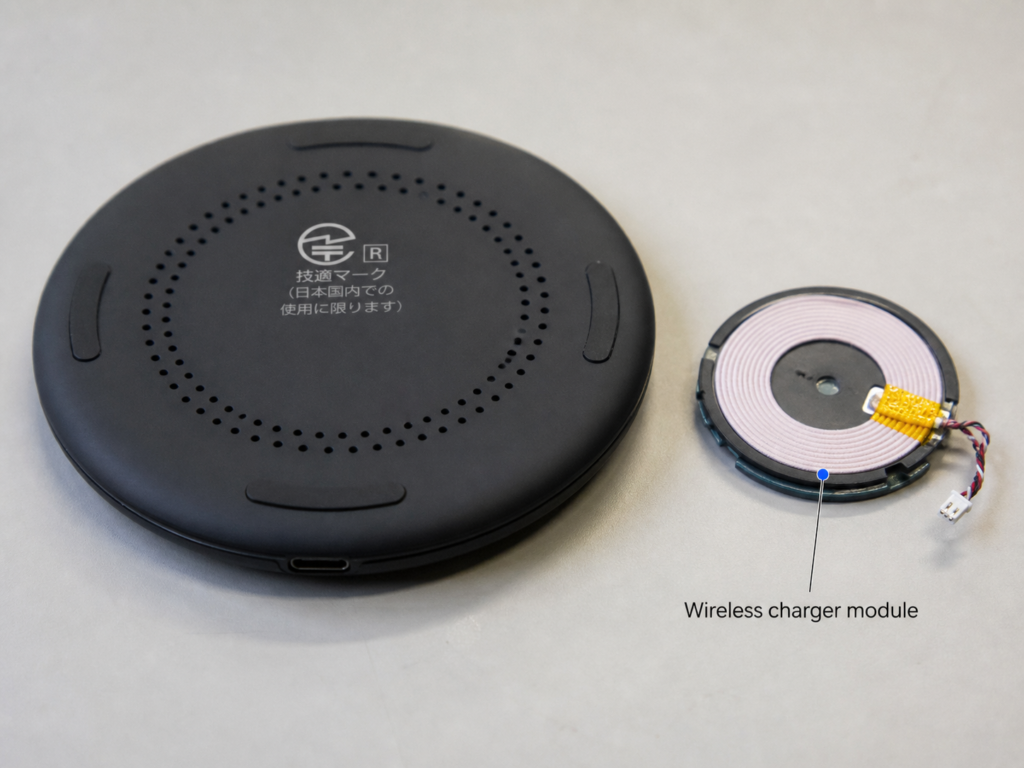
This is the most common pitfall for wireless products: many people think that since the wireless module already has Giteki certification, the whole device doesn’t need to be taken care of. In fact, the scope of application of module certification usually depends on the antenna, gain, radio frequency parameters, housing, installation conditions, and manufacturer’s regulations.
If the antenna, gain, radio frequency parameters, or housing are changed, or the installation conditions specified in the module certification are exceeded, the applicability of the original certification may be affected. Even if only the module installation position is changed, confirmation shall be made based on certification conditions, antenna environment, coexistence status, and the whole device’s radio frequency performance; it cannot be directly concluded that the certification is necessarily invalid, nor can it be directly deemed that the whole device is necessarily compliant.
In addition, European and American version wireless products cannot be sold directly in Japan just by changing to Japanese packaging. Japan’s 2.4GHz and 5GHz frequency bands have exclusive restrictions in terms of channel division, transmit power, etc., which are not necessarily the same as those in the European and American markets, and must be re-confirmed according to Japanese rules.
Labeling Requirements
Devices that require Technical Conformity Certification or construction design certification shall be marked with the Giteki mark and required identification information in accordance with the Radio Law. The specific labeling location, number content, and whether electronic labeling is available shall be confirmed according to the device category and MIC regulations; it cannot be generally required that all products have the same “certification number” physically marked on the body.
Japanese instruction manuals or sales materials shall also accurately explain supported frequency bands, power, usage restrictions, and necessary precautions according to applicable laws, regulations, and device categories.
V. Additional Compliance Requirements (Environmental/Energy Efficiency/Voluntary)
After talking about the two core mandatory areas, let’s talk about additional compliance requirements — some of these are catalog-based requirements, and some are voluntary. Don’t get confused and waste money for nothing.
J-MOSS (Hazardous Substance Labeling System)
Many people think J-MOSS is Japan’s RoHS and all electronic products need it, but that’s not the case. It is a catalog-based system, and its scope of application depends on the statutory catalog and product category.
For designated products applicable to J-MOSS, it is necessary to mark whether substances such as lead, mercury, cadmium, hexavalent chromium, PBB, and PBDE exceed the specified thresholds as required, and provide relevant information according to the system requirements; it should not be stated that all products must announce the actual content of each substance. Products not in the applicable catalog usually do not bear the same mandatory labeling obligations under J-MOSS. Of course, you can also voluntarily make a supply chain RoHS declaration to improve recognition, but this is not a unified statutory requirement.
Top Runner System
This is a system under Japan’s Energy Conservation Law, and it is also a catalog-based requirement, not mandatory for all categories. Only products listed in the scope of designated equipment under the Energy Conservation Law and related manufacturing and import operators need to perform obligations according to the corresponding energy efficiency standards.
Whether AC adapters are applicable, the applicable power range, test methods, and reporting or labeling requirements shall all be confirmed based on the current designated equipment list and supporting rules. Different products may involve different requirements such as energy efficiency standards, measurement, reporting, or energy-saving labeling, and cannot be generalized as all applicable products must be labeled in the same way. This system is completely independent of PSE and cannot replace each other.
VCCI EMC Registration
VCCI is a voluntary electromagnetic interference conformity system for information technology equipment and other products within the applicable scope, usually called VCCI conformity or voluntary declaration. Not all charging products with switching power supplies automatically fall under VCCI’s scope.
Whether it applies to a certain charging product shall be confirmed according to VCCI’s current technical requirements and device definitions, and cannot be judged applicable solely because the product contains a switching power supply or digital circuit. Although it is not a universal statutory mandatory requirement, some offline channels and e-commerce platforms may use it as an access reference. VCCI, PSE, and the Radio Law are requirements of different dimensions and cannot replace each other.
Packaging Recycling Requirements
Relevant Japanese systems need to distinguish two types of obligations: one is the packaging identification labeling obligation, and the other is the recycling obligation under the .
Operators shall separately judge the packaging identification labeling obligation and the container and packaging recycling obligation. Small-scale operators may be eligible for exemption or relaxation of the recycling obligation, but this does not mean that all packaging identification labeling requirements can be generally exempted. Whether packaging labeling is required still needs to be confirmed according to packaging materials, sales methods, and applicable laws and regulations.
Voluntary Quality/Industry Certifications
There are also some certifications that are voluntary, which can only improve competitiveness and cannot replace statutory mandatory certifications:
• **JIS (Japanese Industrial Standards)**: Japan’s national-level standard system. If requirements are met, you can apply for the JIS mark, which is suitable for products sold through mid-to-high-end offline or industrial channels;
• **WPC Qi Wireless Charging Certification**: A voluntary standard of the Wireless Power Consortium, with high recognition in the Japanese market.
VI. Import and Sales Implementation Requirements
After certification or compliance assessment is completed, you still need to handle the import and sales links before the product can be normally listed.
Domestic Responsible Entity and Import Models
The operator bearing obligations such as declaration, labeling, record keeping, and recall shall be determined according to applicable laws and regulations and sales models. When regulations such as DENAN are involved, an import or sales operating entity that can perform regulatory liaison and responsibility obligations within Japan is usually required, but it cannot be generally stated that all products must be imported by a Japanese registered legal person.
There are four common import models:
1. **General trade import**: The relevant declaration, record keeping, and compliance responsibilities can be borne by an import or sales operating entity within Japan; the specific responsibilities depend on product regulations and transaction arrangements;
2. **Entrusted import**: You can entrust a Japanese importer or service agency to handle import and related matters, but both parties shall clarify the responsibilities for product materials, labeling, record keeping, accident handling, and recall;
3. **Cross-border direct mail**: A small number of items for personal use may be subject to different import processing methods, but commercial sales, even if by direct mail, cannot of course be exempted from product compliance obligations;
4. **Overseas warehouse/platform delivery**: Even if the goods are stored in a third-party overseas warehouse and delivered by the platform, the operator bearing regulatory obligations shall be clarified according to the actual sales model; compliance cannot be exempted solely because the platform participates in delivery.
Product Label and Japanese Instruction Manual Requirements
Product labels and Japanese instruction manuals are an important part of compliance inspections, but the specific items are not a fixed list uniformly applicable to all electronic products. Labeling items shall be confirmed separately according to applicable PSE, wireless, battery, consumer safety, and energy efficiency regulations.
Usually, it is necessary to check applicable certification marks, rated parameters, models, and operator information, but the specific location, whether an address needs to be marked, and what items are included in the Japanese instruction manual shall all be subject to the corresponding laws, regulations, and technical standards. The PSE mark, operator name, and rated parameters shall also comply with DENAN’s regulations on specific items; for wireless products, the Giteki mark and related identification information shall be confirmed.
The content of the Japanese instruction manual also depends on the product and applicable laws and regulations. Generally, it shall accurately explain the scope of applicable devices, usage methods, prohibited usage scenarios, safety warnings, and fault contact channels. For products connected to the Japanese power grid, the supported input voltage and frequency shall also be clearly stated, and vague promotional language cannot replace technical parameters.
The most critical point is **consistency**: the parameters, models, and certification information on product labels, instruction manuals, and e-commerce sales pages must be consistent with the actual product. Even if the output current is written wrong by 0.1A, it may cause platform review, consumer complaints, or regulatory issues.
Import Customs Clearance Documents
Commercial invoices, packing lists, transportation and customs declaration materials are usually prepared according to the requirements of Japanese customs and carriers. PSE, wireless, battery, and environmental documents shall be kept by the operator in accordance with applicable laws and regulations, and provided when required by customs, competent authorities, platforms, or carriers.
Therefore, “PSE certificates, test reports, and J-MOSS public disclosure certificates must be submitted for each customs clearance” cannot be regarded as a unified rule. PSE is usually a product compliance obligation performed by the operator before listing, which does not mean that a PSE certificate must be submitted to customs for each import; J-MOSS also does not have a unified “public disclosure certificate” applicable to all products.
It is recommended to prepare the following materials according to the product situation:
• **Compliance materials**: Applicable conformity inspection certificates, inspection records, test reports, wireless compliance materials, environmental information, Japanese instruction manuals, etc.;
• **Commercial materials**: Commercial invoices, packing lists, product models, quantities, amounts, and HS code declaration information;
• **Lithium battery materials**: UN 38.3 test summaries or relevant certificates, as well as SDS, packaging materials, and other dangerous goods transport documents prepared according to the mode of transport and carrier requirements.
If the HS code is declared incorrectly, it may lead to customs clearance delays, additional inspections, or misjudgment of compliance requirements, so be sure to declare accurately.
Platform Review and Post-Market Compliance
Mainstream e-commerce platforms usually may require uploading certification materials, product test materials, or operator information before listing, but note that platform review approval does not mean full compliance, platform rules do not equal Japanese laws and regulations, and regulatory authorities may still conduct random inspections afterwards.
After listing, you must also maintain continuous compliance:
• **Document retention**: Corresponding documents shall be kept in accordance with DENAN, wireless, battery transportation, environmental protection, customs, and platform rules respectively; the retention period shall be subject to the provisions of specific regulations, and cannot be generally summarized as 3-5 years;
• **Change assessment**: For product revisions (changing plugs, batteries, wireless modules, firmware, power supply schemes, etc.), re-evaluate whether the original compliance procedures are still applicable;
• **Accident handling**: When safety or interference problems occur, suspend sales in a timely manner and cooperate with regulatory investigations, and take the initiative to recall if necessary;
• It is recommended to purchase product liability insurance for the Japanese market to reduce operational risks.
VII. Certification Application Guide
After knowing what compliance assessments to do, how to handle them specifically? Here we talk about the general process and precautions.
Pre-Application Preparation
First do three things well:
1. Use the previous judgment logic to sort out all compliance requirements for the product, and do not miss product classification, rated conditions, purpose, structure, and sales model;
2. Prepare basic product materials: specifications, input and output parameters, material list; if there are wireless modules or lithium batteries, also prepare corresponding materials;
3. Confirm the import or sales operating entity that bears the obligations of declaration, labeling, record keeping, and regulatory liaison, and clarify the responsibilities of all parties.
General Application Process
1. **First confirm product classification**: Check the METI Electrical Appliance Item List, DENAN technical standards, and device classification under the MIC Radio Law;
2. **Non-specified electrical appliances**: Usually, the operator self-confirms compliance with technical standards, implements the required inspections, and retains statutory records;
3. **Specified electrical appliances**: Apply for conformity inspection to a METI-registered conformity inspection body, and the operator shall perform corresponding obligations such as declaration, inspection, and labeling;
4. **Wireless devices**: Apply for Technical Conformity Certification or construction design certification to the corresponding registered body; if it involves licenses, declarations, or requirements for high-frequency utilization devices, handle them according to the corresponding path;
5. **Complete labeling and material preparation**: Produce labels, instruction manuals, and sales materials according to applicable laws and regulations to ensure consistency with the actual mass-produced version.
The institutions, documents, and procedures required for different products are not the same, and it cannot be generalized that all products follow the process of “submitting for inspection — submitting to regulatory authorities for review — obtaining a certificate”.
Reference for Cycle and Cost
There is no unified statutory standard for the application cycle and fees, which will vary depending on the product category, sample status, number of rectifications, wireless parameters, application path, and the selected registered body or testing institution.
Circular PSE, diamond PSE, and wireless compliance also cannot be simply sorted by fixed weeks or fixed costs. The specific cycle and fees shall be quoted and confirmed by the corresponding registered body or testing institution based on product materials, samples, and application path.
Compliance Validity Verification Method
If you hire a service provider to handle it, or want to verify the supplier’s materials, you can check from three aspects:
1. Check whether the applicable laws and regulations, product classification, rated conditions, purpose, and structure are consistent with the actually sold product;
2. Check whether self-inspection records, conformity inspection certificates (if applicable), wireless certification materials, product labels, and sales page information match;
3. Query through official channels: METI Electrical Appliance List, MIC Radio Law related databases and system materials, official websites of registered conformity inspection bodies or registered certification bodies.
Not all categories of PSE have a unified “certificate validity period”, and circular PSE usually does not have a third-party certificate. Focus on checking product classification, declaration and inspection records, conformity inspection certificates (if applicable), labeling, and product change status. All regulatory requirements shall be subject to the latest official public documents of Japan; do not trust outdated information.
VIII. Common Misconceptions and Pitfall Avoidance Checklist
We have compiled the most common pitfalls, which you can check against to avoid stepping on them.
Certification Cognition Category
❌ Having CE/FCC/UL certification means you can enter Japan — Wrong, overseas certifications are only for reference, and must be re-evaluated according to Japanese rules;
❌ All chargers connected to mains are diamond PSE — Wrong, first confirm whether they are DENAN-specified electrical appliances, and then confirm the PSE type in combination with rated conditions, structure, and item list;
❌ All USB-C charging cables need circular PSE — Wrong, ordinary low-voltage cables need to check statutory items, and cannot be judged solely by name;
❌ Power banks must have PSC certification — Wrong, power banks within the stipulated scope have been mainly included in PSE management since 2019;
❌ As long as there is a lithium battery, PSE is required — Wrong, it shall be judged in combination with whether it is a lithium-ion storage battery within the statutory scope, energy density, purpose, structure, installation state, and sales method;
❌ With PSE certification, you can directly transport lithium battery products — Wrong, transportation compliance and product certification are independent requirements.
Wireless Product Category
❌ All products with wireless functions must have the same Giteki certification — Wrong, it shall be judged according to wireless type, frequency, power, device category, and license or declaration requirements;
❌ If the wireless module has Giteki, the whole device doesn’t need to be taken care of — Wrong, changes in antenna, gain, radio frequency parameters, housing, and installation conditions may affect the applicability of module certification;
❌ European and American version wireless products can be sold just by changing to Japanese packaging — Wrong, Japanese frequency bands, channels, and power restrictions may be different from those in Europe and America;
❌ Low-power wireless chargers definitely do not need Radio Law procedures — Wrong, wireless power transmission devices may involve different paths such as radio stations, low-power radio stations, or high-frequency utilization devices, which shall be confirmed according to frequency, power, purpose, and device category.
Import and Labeling Category
❌ All products must be imported by a self-owned Japanese legal person — Wrong, the operator bearing the obligations of declaration, labeling, record keeping, and regulatory liaison shall be determined according to applicable laws and regulations and sales models, and the requirement of a Japanese legal person cannot be absolutized;
❌ Diamond and circular PSE marks can be mixed — Wrong, the corresponding marks must be used according to product classification;
❌ Parameters on certification marks, products, packaging, and sales pages can be inconsistent — Wrong, consistency is the core requirement of compliance;
❌ Small-scale enterprises can be exempted from all packaging recycling labels — Wrong, the recycling obligation and the packaging identification labeling obligation are two different things, which must be judged separately;
❌ Certification documents must be submitted for each customs clearance — Wrong, PSE, wireless, battery, and environmental materials are usually kept by the operator in accordance with applicable laws and regulations, and provided when required by competent authorities, customs, platforms, or carriers.
Platform and Compliance Category
❌ Passing customs/platform review equals passing statutory certification — Wrong, platform and customs rules do not equal laws and regulations, and regulatory authorities may still conduct random inspections afterwards;
❌ Small-batch self-shipping can be exempted from compliance — Wrong, commercial sales, regardless of batch size, must fulfill applicable requirements according to the product and sales model;
❌ Voluntary certification can replace mandatory certification — Wrong, voluntary certification only improves competitiveness and cannot replace statutory requirements;
❌ J-MOSS is a mandatory requirement for all charging products — Wrong, first check the applicable catalog and product category;
❌ Completing a self-checklist can guarantee legal sales — Wrong, self-inspection can only be used as a preliminary check, and all applicable product safety, wireless, transportation, environmental protection, energy efficiency, consumer protection, and platform requirements still need to be confirmed.
IX. Quick Self-Checklist
If you already have a specific product, you can directly conduct a preliminary check against the table below to see if there are any missing items.
Mandatory Compliance Self-Checklist for Charging Products
| Product Type | Core Mandatory Compliance Requirements |
| Wall chargers/AC-DC adapters | 1. Check whether they are DENAN-specified electrical appliances; 2. If they are designated items, confirm the PSE type and corresponding procedures; 3. Affix labels as required; 4. Clarify the import or sales operating entity bearing relevant obligations |
| Separately sold USB/USB-C cables | 1. Check the METI item list to confirm whether PSE is required; 2. Confirm relevant operator obligations according to the sales model |
| Wireless chargers | 1. If they contain AC input, first confirm whether the power supply part is a designated electrical appliance and the PSE type according to the DENAN item list; 2. For the wireless power transmission part, confirm technical, licensing, or declaration requirements under the Radio Law according to frequency, power, and device category; 3. Affix labels as required |
| Independently sold power banks | 1. Confirm whether they fall within the PSE scope according to the purpose, energy density, structure, installation state, and sales method of the lithium-ion storage battery; 2. For those with AC input, additionally confirm whether the power supply part is a designated electrical appliance; 3. Prepare labeling and transportation materials as required |
| Car DC chargers (only connected to 12V/24V) | 1. Usually do not trigger PSE due to AC input; 2. Still need to confirm other applicable requirements according to product functions, consumer safety, labeling, and sales model |
General Implementation Self-Check Items
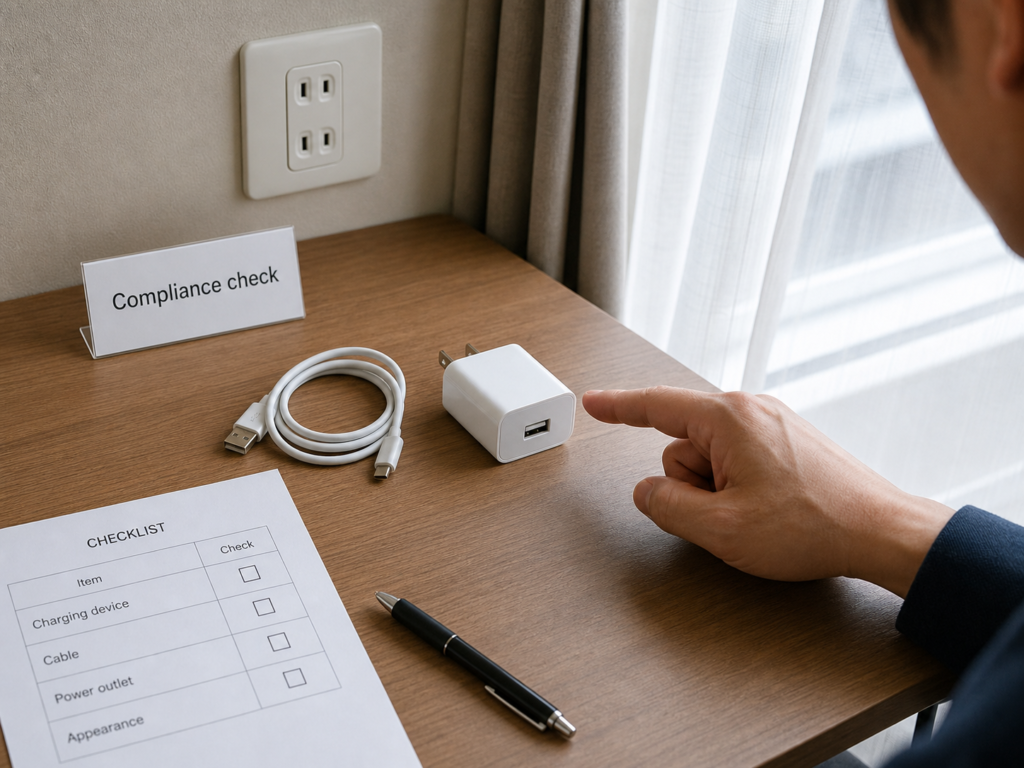
✅ The operating entity bearing the obligations of declaration, labeling, record keeping, and regulatory liaison has been clarified according to the sales model;
✅ Whether it is a DENAN-specified electrical appliance has been confirmed according to product classification;
✅ Certification marks, rated parameters, and operator information have been marked on the product body, nameplate, or locations permitted by regulations as required;
✅ The Japanese instruction manual and sales page content are complete and consistent with product parameters;
✅ Self-inspection records, conformity inspection certificates, or wireless compliance materials (if applicable) have been retained;
✅ E-commerce page parameters and certification information are completely consistent with the physical product;
✅ For lithium battery products, transportation compliance materials such as UN 38.3 and SDS have been prepared according to the mode of transport and carrier requirements;
✅ Whether the original compliance procedures are still applicable after product revisions, plug replacement, battery replacement, wireless module replacement, firmware changes, or power supply scheme changes has been checked.
If all the above items are completed, it only means that the product has completed a relatively complete preliminary self-inspection; whether it can be sold legally still requires confirmation of all applicable laws and regulations and the actual sales model. If there are missing items, corresponding compliance materials shall be supplemented and regulatory confirmation shall be completed before entering the Japanese market.
Summary
Compliance of electronic products in the Japanese market may seem to have many items, but the judgment logic is actually very clear: start from the attributes of the product itself, such as whether it is connected to mains, whether it contains lithium-ion storage batteries within the statutory scope, whether it has wireless functions, and whether it is sold independently, then respectively check the METI Electrical Appliance Item List, DENAN technical standards, MIC Radio Law device classification, lithium battery transportation rules, and applicable environmental and energy efficiency systems.
After that, you must also implement the responsibilities of declaration, labeling, record keeping, and regulatory liaison, check the consistency of labels, instruction manuals, sales pages with the physical product, and finally check product changes, transportation, and platform requirements. Do not directly draw certification conclusions solely based on labels such as “connected to mains”, “has lithium battery”, or “has wireless function”, nor treat overseas certifications, platform reviews, or a test report as an automatic substitute for Japanese laws and regulations.
As long as you check item by item according to product items, rated conditions, purpose, structure, and sales model, and confirm the latest requirements through official channels such as METI and MIC, you can more steadily complete the preliminary judgment before entering the Japanese market, and reduce operational risks during customs clearance, listing, and post-market.