
Many friends who export charging products, when they first hear about the CB system, regard it as a “global sales pass” — thinking that with a CB certificate, they can sell freely in all countries. In fact, this is the biggest misunderstanding. The CB system is more like a set of multi-country mutually recognized safety test transcripts: within the scope of relevant product categories and rules, participating countries and certification bodies can usually use these test results to reduce duplicate testing; but this does not mean that all countries automatically recognize all products, all standards, and all reports. To legally launch a product on the market, it is usually necessary to use these technical results to apply for or support local conformity assessment according to the requirements of the target country.
Whether you make USB chargers, laptop power adapters, or charging cables, as long as you plan to expand into multiple overseas markets, the CB system can be a tool to reduce duplicate testing. If multiple target markets accept the corresponding CB results, and the product standards and model ranges are relatively stable, CB is usually more valuable; but whether it is cost-effective still needs to be calculated country by country in combination with target country regulations, product categories, national differences, report acceptability, and model ranges. In this article, we will thoroughly explain the CB multi-country conversion for charging products from basic cognition to practical details. After reading it, you will be able to judge by yourself whether it can be converted, how to convert, and whether it is cost-effective.
First, Understand What the CB System Really Is
The governing body of the CB system is IECEE, which is subordinate to the International Electrotechnical Commission (IEC). IECEE is responsible for the rules of the CB system and the qualification framework for participating institutions; but national regulations, market access rules, and the conditions for each country to accept CB documents are not uniformly determined by IECEE. Whether a specific market can use a certain CB document also depends on the regulations of the target country, the competent authority, and the requirements of the accepting certification body.
Its core logic can be simply understood as: on the premise of complying with applicable IEC standards and completing testing by an accredited body, the certification body of the target country can usually use the existing CB test results, and evaluate or retest national differences if necessary. The so-called “CB conversion” essentially uses the completed test results as a technical basis to apply for local certification or conformity assessment in the target country, rather than directly using the CB certificate as a local sales permit.
Compared with doing certification country by country directly, the advantage of CB is mainly reflected in reducing duplicate work: if the target country accepts the relevant CB documents, and the product, standard version, and national differences are well matched, it may reduce duplicate testing and audit time; but there is no unified ratio applicable to all countries and products for how much cost can be saved and how much time can be shortened, which must be confirmed by the target certification body on a project basis. When you want to enter new markets in the future, the existing CB report can also be used as the technical basis for the application, but the target country may still require national difference testing, re-evaluation of the model range, adoption of a new standard version, or local factory inspection. It cannot be simply understood that you will definitely not need to retest with the original report.
However, not all charging products can directly apply the same CB solution. Chargers and laptop power adapters usually need to confirm the CB scope according to applicable equipment safety standards; USB-C cables need to confirm whether there is an applicable product safety assessment method according to the specific structure, rated parameters, connectors, and target country requirements. IEC 62680-1-2 mainly specifies the interface, connection, and protocol requirements related to USB Type-C and USB Power Delivery, and cannot directly replace the product safety certification of the entire USB-C cable.
For smart charging products with wireless charging, Bluetooth, or Wi-Fi, such as wireless chargers with Bluetooth, CB usually only covers the applicable safety part, and additional confirmation of wireless, electromagnetic compatibility, and radio frequency related requirements is needed. As for pure passive ordinary charging cables without electronic components, you cannot just judge that certification is definitely not required, or that no test results can be used, just because there is “no E-Marker”. Passive cables may involve connector, cord, wire assembly, or complete set supporting requirements, and whether separate assessment is required shall be judged according to the cable structure, connectors, rated parameters, and target country regulations.
It should also be noted that if a charger and cable set is sold, the two components must be confirmed separately whether they are within the relevant certification or assessment scope. You cannot just assume that the entire set is covered because the charger has CB.
Novices who are new to CB are most likely to fall into four cognitive pitfalls, which are thoroughly explained here in advance:
First, CB certificates cannot be directly used for sales in all countries. Whether local certification, registration, or other conformity assessment is required shall be handled in accordance with the system of the target country.
Second, not all IECEE participants accept CB documents for all product categories. Each country or certification body may have its own product categories, standard versions, national differences, and document acceptance scopes, which should be confirmed in advance.
Third, a CB document can only support the product categories and standard scopes it actually covers. Safety CB cannot automatically replace EMC, energy efficiency, wireless, or other regulatory requirements; these items shall be confirmed separately according to the target market.
Fourth, CB reports and certificates do not have a unified global validity period. Whether they are still accepted shall be confirmed case by case by the target country authority based on the report date, standard version, certificate status, product changes, and local application rules, and cannot be simply judged as “2–3 years”.
Understand the Core Documents and Participating Roles of CB
To do CB conversion, you must first understand the three key roles in the system and the two core documents you have.
The three roles have clear division of labor:
- IECEE is the management organization of the entire system, responsible for the CB system rules and the qualification framework of participating institutions.
- National Certification Body (NCB) is an institution that has the right to issue CB test certificates within the corresponding qualification scope. It must be accredited by IECEE and can only carry out relevant work within the product categories for which it has qualifications.
- CB Testing Laboratory (CBTL) is a laboratory authorized to issue CB test reports, and also needs to have IECEE qualifications for the corresponding product categories.
Many people confuse CB certificates with test reports, but in fact these are two different documents. For conversion, you should usually prepare both the CB certificate and the complete CB test report, and submit them in accordance with the requirements of the target certification body; some institutions can obtain the report through the CB certificate number or system, while some applications require the applicant to provide all documents directly. Whether both must be submitted at the same time shall be subject to the requirements of the accepting institution.
CB Test Certificate (CBTC) is an IEC standard test result document issued by an accredited NCB and matched with the corresponding CB test report. It will list information such as product model, applicable standards, manufacturer or production location, and issuing institution. But it is not a market access certificate for the target country, nor is it a comprehensive compliance certificate for all regulatory requirements.
CB Test Report (CBTR) is the supporting technical document, which usually includes test data, sample photos, circuit diagrams, key component information, test conclusions, etc. The report must comply with the corresponding report format specified by IEC, such as TRF format, so that the target certification body can conduct technical review more easily.
If you already have CB documents for charging products, don’t rush to submit the conversion. Be sure to check 6 key information first:
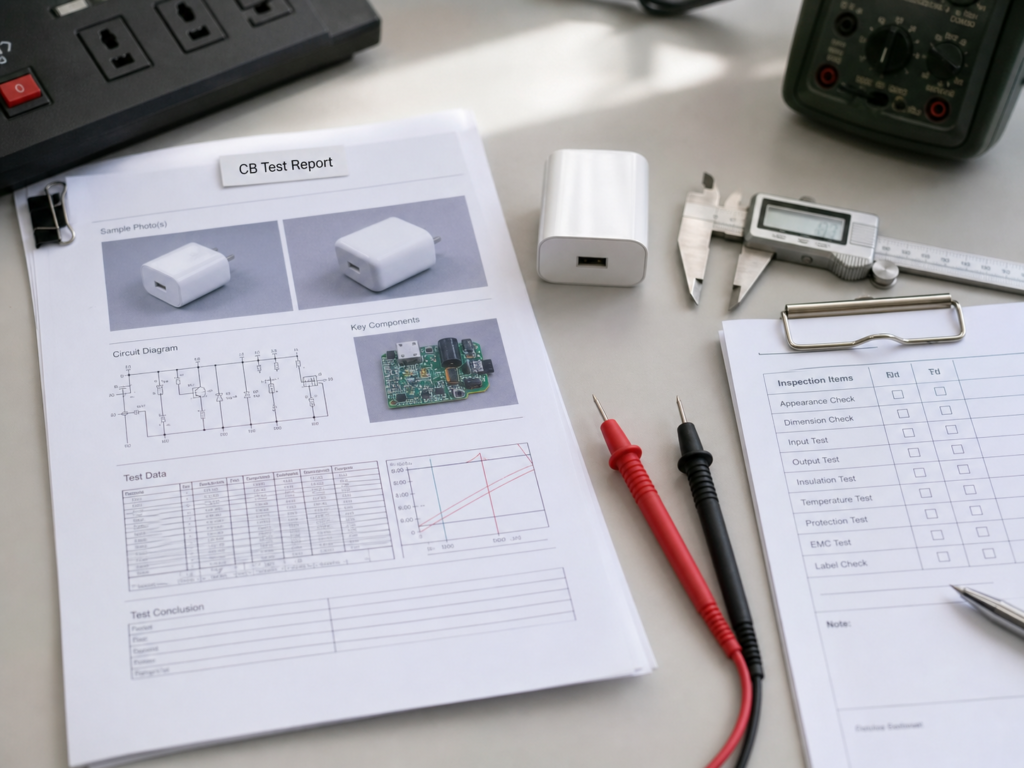
- Subject information: The information of the manufacturer, factory address, applicant or certificate holder must be consistent with the actual product and application relationship.
- Product information: Parameters such as model, series model, input and output voltage, current and power on the nameplate must match the actual product.
- Standard information: Confirm the applicable IEC standard and its version, and also separately check whether the target country accepts this version.
- Charging-related information: Including fast charging protocol (PD, QC, etc.) description, cable gauge and current carrying capacity, E-Marker chip, etc. It should be noted that the role of these materials depends on the specific product standard and certification scope, and cannot replace the safety assessment of the complete machine or cable.
- Test conclusion: Relevant test items should have clear conclusions, and there should be no unfinished or unexplained missing items.
- Sample information: The photos, structure diagrams, and key designs in the report must be consistent with the current mass-produced version. You cannot have one design during testing and change the design during mass production.
For your convenience, here is a table of common relevant standards and judgment methods for charging products:
| Product Type | Common Judgment Method |
|---|---|
| USB/USB-C chargers, laptop power adapters | Usually need to be confirmed according to applicable safety standards for audio/video, information and communication technology equipment, such as whether IEC 62368-1 is applicable |
| USB-C cables and E-Marker related products | IEC 62680-1-2 can be used as one of the technical bases for USB Type-C/USB PD interfaces and protocols; whether there is an applicable CB safety standard for the entire cable shall be separately confirmed according to the structure, rated values, and target country requirements |
| Charging connectors or plugs | Need to be confirmed according to specific structure and application; IEC 60998 cannot be used as a universal standard for all charging plugs; some products may also involve standards such as IEC 60884 and IEC 60320 |
Self-Check Before Conversion: Can Your CB Certificate Be Used?
Not all CB certificates and reports can be used for conversion. Be sure to check by yourself before submitting the application, otherwise it is easy to be rejected at the material acceptance stage.
First check the basic status of the CB certificate, in three steps:
The first step is to check the issuing institution, confirm that the NCB that issued the document is an IECEE accredited institution and has qualifications for the corresponding product category.
The second step is to check the certificate status, confirm that the document has not been suspended, revoked, or lost applicability due to product changes. Don’t just look at the date on the certificate, but also confirm the relevant status and revision information.
The third step is to check the coverage scope. Your product model, manufacturer, production address, product category, and key parameters must all be within the scope listed or accredited in the certificate. Models beyond the scope cannot directly apply the original certificate.
Then check the applicability of the CB report, focusing on the following points:
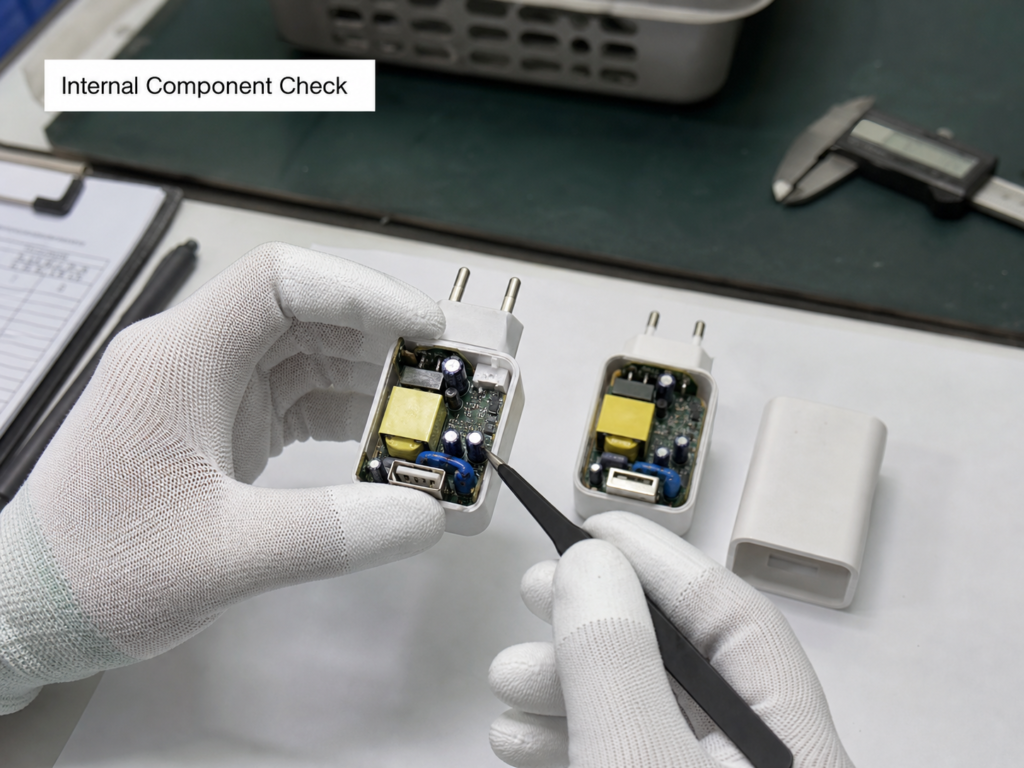
- Whether the IEC standard version used for testing is still accepted by the target country or the accepting institution;
- Whether the report includes complete TRF content, test data, sample photos, key component information, and revision records;
- Whether the CBTL that issued the report has IECEE qualifications for the corresponding product category;
- Whether all relevant test items have clear and complete pass conclusions;
- Whether the test sample is consistent with the current mass-produced product, especially check the circuit, transformer, PCB, housing, pins, and key safety components.
If the following 5 situations occur, CB documents usually cannot be directly used for conversion, or must be supplemented first:
- The issuing NCB or the CBTL that issued the report is not within the relevant accreditation scope, or the target country authority does not accept its documents;
- The product model, manufacturer, production address, or key parameters are inconsistent with the CB documents;
- The standard version is too old, the target country no longer accepts it, or there are major changes between the old and new versions that require re-evaluation;
- Key test items are missing, such as charger temperature rise, insulation, or other applicable items not completed;
- The product has undergone design or component changes that affect safety, resulting in the original report not being representative of the current mass-produced version.
Before conversion, you can quickly self-check along these key points:
- The CB certificate is in normal status, and the issuing institution is an IECEE accredited NCB;
- The product model, manufacturer, production address, and key parameters are within the CB coverage scope;
- The competent authority or accepting institution of the target country accepts CB documents for this product category;
- The applicable regulations, standard versions, and national differences of the target market have been confirmed;
- The CB report is complete without missing items, and the test sample is consistent with the mass-produced product;
- The product plug, input voltage, and other electrical parameters match the power grid and use conditions of the target country.
General Practical Process: From CB to Target Country Certification
After confirming that the CB documents have the possibility of use, you can proceed with the formal conversion process. The details vary from country to country, but the core steps can usually be divided into five steps.
Step 1: Sort Out Target Markets and Certification Requirements
First, confirm whether the competent authority of the target country or the accepting certification body accepts the corresponding product category documents issued by the NCB and CBTL. You cannot just look at whether the target country is an IECEE participant, because participant status does not mean that it will automatically accept CB results for all products, standards, and application methods.
Then clarify the type of compliance you need to handle, such as CE-related regulatory compliance in the EU, NRTL certification in the US, PSE in Japan, KC in South Korea, etc. It is also necessary to distinguish between different requirements such as safety, EMC, energy efficiency, and wireless. Whether safety CB can support the safety assessment of the target country, and whether EMC can use corresponding test materials, depends on the target country system and the accepting institution, and cannot be simply judged by the names of “safety CB” or “EMC CB”.
For charging products, it is also necessary to additionally confirm whether the target country requires energy efficiency, radio frequency, market registration, importer information, or other compliance matters not covered by CB. For example, EU energy efficiency and radio equipment requirements, US FCC requirements, all need to be planned separately.
Step 2: Prepare Application Materials
The core documents usually include a scanned copy of the CB test certificate, the complete CB test report, and all attachments and revision records. Some institutions can obtain the report through the certificate number, but the applicant should still prepare complete documents for checking the product scope and technical details.
Basic product information includes:
- Product nameplate;
- User manual and the language version required by the target country;
- Circuit diagram;
- List of key components;
- Product photos and structural materials;
- Description of applicable input, output, and fast charging parameters.
For charging products, you can also prepare the charger output parameter table, fast charging protocol description, as well as the cable gauge, rated current, and structural materials of the charging cable. For USB-C products, interface, cable, and protocol materials should be distinguished from the real product safety scope, and protocol materials cannot be used as a substitute for safety test basis.
Subject information includes the business licenses of the applicant and manufacturer, as well as importer, authorized representative, or other responsible subject information required by the target country. It should be noted here that the manufacturer is the party that actually produces the product, and the applicant or certificate holder may be the brand owner, trader, or other subject. The specific relationship shall be handled in accordance with the target country system and NCB document rules.
For OEM/ODM products, it is necessary to confirm in advance whether the CB certificate holder authorizes the brand owner or applicant to use the relevant documents, and whether the target country allows the applicant, importer, or brand owner to bear the application responsibility. If necessary, handle NCB-accredited changes, authorizations, or certificate transfers, instead of defaulting that “you can use the factory certificate directly after getting it”.
After sorting out the materials, check them by yourself first:
- Whether the report has missing pages;
- Whether the nameplate parameters are consistent with the CB report;
- Whether the model naming is unified;
- Whether the mass-produced sample is consistent with the test sample;
- Whether the manual and label meet the requirements of the target country;
- Whether the authorization relationship between the applicant subject and the manufacturer is clear.
Step 3: Submit Application and Determine Difference Items
The submission channel can be directly to the certification body of the target country, or a regular authorized agent. But no matter which channel you use, you must verify the qualifications, authorization scope, and actual service content of the accepting institution or agent, to avoid mistaking “can handle on behalf” for “has the right to issue or accredit”.
After submission, the institution will evaluate according to the target country regulations, applicable standards, national differences, product category, and the content of the original CB report, and list the items that need to be supplemented.
The so-called “national differences” are the local requirements put forward by the target country on plugs, markings, grounding, parameters, structure, or use conditions in addition to the general IEC requirements. For charging products, common differences may include plug size and structure, nameplate marking, grounding method, input conditions, and some safety parameters.
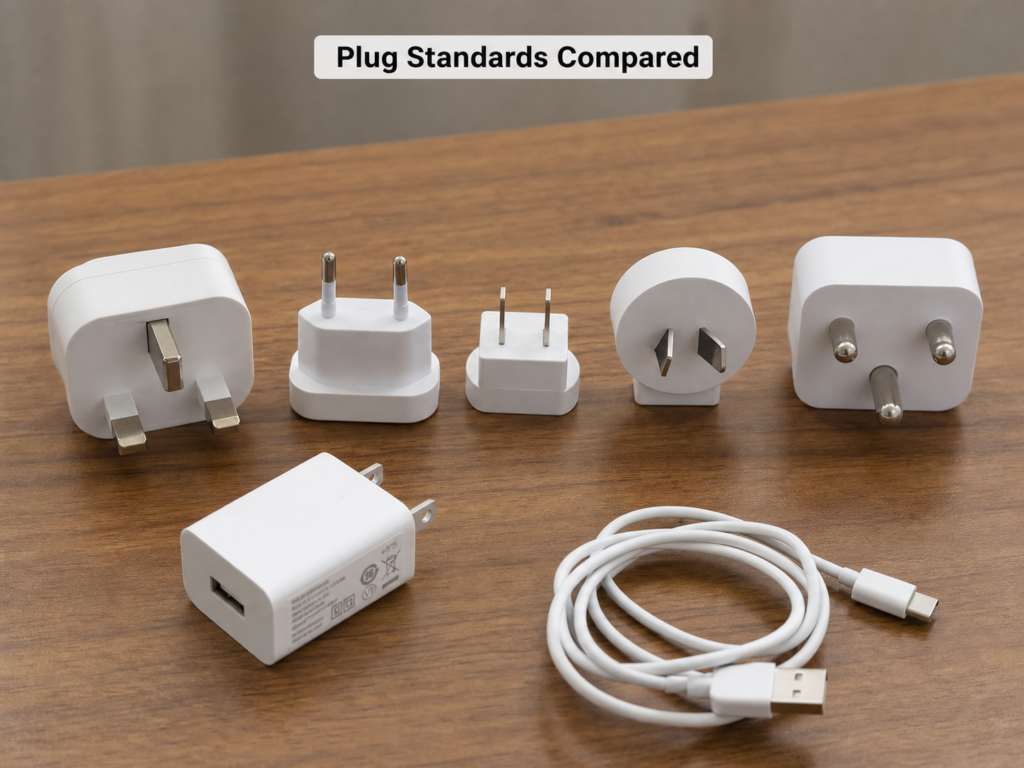
If the original report, product status, and standard version are all recognized by the institution, and there are no differences that need to be supplemented, you may directly enter the document review; if there are differences, you need to supplement testing or materials according to the institution’s opinion. Whether safety and EMC need to be submitted separately also depends on the specific system of the target country, and cannot be generalized.
Step 4: Supplementary Testing for Difference Items (If Any)
One of the values of the CB system is to reduce duplicate testing when conditions are met. But “supplementary testing of difference items” is not an absolute rule. Only when the accepting institution recognizes the original report, the product and standard conditions are consistent, and the difference scope is clear, can supplementary testing usually be carried out for national differences.
If the differences involve basic design, key components, standard version upgrades, insufficient report scope, or replacing the plug affects the structure of the complete machine, it may be necessary to expand the test scope, or even re-conduct a complete assessment.
The supplementary test sample shall be consistent with the original CB test sample in core design, and only adjust the parts related to the difference. For example, when only replacing the plug, it is still necessary to confirm whether the replaced plug affects creepage distance, temperature rise, mechanical strength, housing structure, and complete machine safety. You cannot just conclude that only the plug needs to be tested because “the circuit board has not changed”.
The supplementary test cycle and cost depend on the specific project, sample preparation, institutional review, and local processes. Items such as plugs and markings are sometimes relatively simple, but a unified 1–2 weeks cannot be promised in advance; if it involves structure, parameters, or complete machine safety, the cycle may be significantly extended.
After the supplementary test is completed, check:
- Whether all the difference items listed by the institution have been handled;
- Whether the core design relationship between the sample and the original version is clear;
- Whether the supplementary test report is issued by a laboratory or institution recognized by the accepting institution;
- Whether it is necessary to update the certificate, report, or product materials.
Step 5: Obtain Certification and Prepare for Market Launch
The forms of conformity assessment vary from country to country.
In the EU, if applicable regulations allow manufacturers to conduct self-conformity assessment, the manufacturer shall complete the corresponding tests and technical documents, assess whether the product complies with applicable regulations and harmonized standards, sign the EU Declaration of Conformity, and fulfill the CE marking and ongoing conformity obligations. The CB report can be used as one of the technical evidences, but it is not a CE certificate, nor can it automatically complete CE compliance.
US NRTL certification is handled by the corresponding NRTL institution in accordance with US requirements. Japan involves the PSE system, and South Korea involves local compliance systems such as KC. The specific certificate, mark, factory inspection, and supervision requirements shall be confirmed in accordance with the target country system.
The validity period, supervision, and renewal rules of the target country certificate are determined by the target country system, and there is no unified rule for all countries that “follows the expiration of the original CB certificate”. However, the status of the CB certificate, standard version, and product changes may affect the target country’s subsequent judgment on maintaining certification, so it is necessary to manage CB documents and product changes in a timely manner.
After obtaining the required documents for the target country, you also need to handle the product nameplate, packaging, manual, and certification marks in accordance with local requirements. Some countries or product categories may also require factory inspection, annual supervision, change filing, or ongoing spot checks, which should be confirmed before going on the market, rather than being dealt with after there is a problem with the certificate.
Key Points for Conversion in Popular Markets (Exclusive for Charging Products)
Different markets have different systems and differences. Here are the practical key points for several common markets for charging products. The following cycles can only be used as a rough reference for project planning, and the final shall be subject to the written confirmation or quotation of the target institution.
European Union (CE-LVD/EMC)
The CB report can be used as one of the technical materials for relevant EU safety assessments, but EU CE is not a certificate obtained directly through “CB conversion”. The manufacturer still needs to complete conformity assessment, technical documents, EU Declaration of Conformity, CE marking, and ongoing conformity management according to applicable regulations.
Common concerns for charging products include EU plugs, markings, input and output parameters, and EMC. EMC standards shall be selected according to the product classification, function, and applicable regulations of the charger, which may involve EN 55032, EN 55035, or other product standards or general EMC standards, and cannot be applied to all chargers uniformly.
Special attention should also be paid to the unified charger rule in the EU Radio Equipment Directive. This rule puts forward USB-C, charging communication protocol, and related requirements for the radio equipment categories listed in the regulation and the corresponding applicable dates. The applicable scope and dates of products such as mobile phones, tablets, and laptops are not exactly the same, and shall be confirmed according to the specific product category and sales date.
Energy efficiency requirements shall also be confirmed according to the product type and applicable regulations, and cannot be judged as satisfied solely by the CB safety report.
United States (NRTL Certification, e.g. UL/ETL)
US NRTL certification usually needs to be handled in accordance with the corresponding US safety standards and certification body requirements. Whether an existing CB report can be used as a technical basis depends on whether the US accepting institution recognizes the report, the relevant NCB, and the product category, and evaluates according to US national differences.
Common concerns for charging products include US pins, grounding reliability, English nameplates, product structure, and NRTL marks. Specific requirements shall be confirmed by the accepting NRTL institution.
FCC compliance cannot be simply understood as “converted with EMC CB”. Supplier’s Declaration of Conformity (SDoC) or Certification shall be handled according to the specific equipment and FCC rules. EMC CB reports may at most be used as part of the technical materials, and cannot automatically replace FCC authorization.
Energy Star is a voluntary energy efficiency program within the scope of applicable products, and not all chargers are required to apply. Whether it is necessary to handle shall be confirmed according to customers, channels, and product categories.
Japan (PSE Certification)
Japan PSE conversion or application shall be handled according to the specific classification, structure of electrical appliances and the requirements of Japan’s Electrical Appliance and Material Safety Law. Common differences for charging products include Japanese plugs, Japanese nameplates, input conditions, and some insulation requirements.
AC power adapters usually belong to specified electrical appliances stipulated in Japan’s Electrical Appliance and Material Safety Law, and involve diamond PSE requirements. However, whether USB data cables or charging cables are subject to PSE supervision shall be judged according to the specific structure, whether they involve AC power connection, connector type, and regulatory catalog. You cannot generally call them general electrical appliances just because they are “charging cables”, nor can you generally say that circular PSE is voluntary.
South Korea (KC Certification)
The South Korean market needs to confirm KC safety requirements according to product categories, as well as corresponding EMC and radio compliance requirements. The specific competent system and technical standards shall be subject to the current South Korean certification system, and cannot be uniformly summarized as “KCC standards”.
Common concerns for charging products include Korean plugs, Korean nameplates, input and output parameters, EMC testing, and safety requirements corresponding to product categories. Whether a local responsible subject in South Korea, factory inspection, or other registration procedures are required shall be confirmed according to the specific certification category, and cannot be generalized for all products.
In addition to these mainstream markets, the conversion rules in other regions are also different. The specific requirements in the Middle East, Southeast Asia, Latin America and other regions vary greatly. Some markets may accept document review and a small number of difference assessments, while others require local testing, registration, importer information, or factory inspection. Systems such as India’s BIS and China’s CCC also have their own local testing, registration, or certification issuance processes, and it cannot be directly assumed that CB can replace all local requirements.
How to Calculate Cost and Cycle? How to Judge If It’s Cost-Effective?
Many people are most concerned about how much money can be saved and how long it will take to use CB conversion, and when it is cost-effective to use CB. The most important thing here is not to remember a fixed ratio, but to learn to break down the project.
Conversion costs mainly include:
- Fixed fees: application fee, certificate fee, institutional review fee;
- Variable fees: difference test fee, sample fee, agency fee, factory inspection fee, and necessary translation or material sorting fees;
- Subsequent fees: supervision audit, certificate maintenance, change filing, or re-evaluation fees.
CB may reduce the cost of duplicate testing, but there is no unified savings ratio applicable to all types of products in all countries. The actual cost may be affected by the type of certification, number of products, difference items, number of samples, factory inspection, and certificate maintenance methods. Therefore, it is best to ask the target certification body for two options at the same time: the cost of direct local certification, and the cost of applying based on CB documents, and then compare them.
There are three key factors affecting the cycle:
The first is the number and complexity of difference items. Plug or label differences are sometimes easy to handle, but if they affect structure, insulation, temperature rise, mechanical strength, or complete machine safety, the cycle may be significantly extended.
The second is material integrity. Missing pages in the report, inconsistent models, insufficient key component information, and inconsistent samples with mass-produced versions may lead to supplementary materials, re-evaluation, or supplementary testing.
The third is the institution and local processes. Different institutions may have different arrangements for technical review, factory inspection, certificate issuance, and market registration, and a fixed “2–4 weeks” or “3–6 weeks” cannot cover all projects.
Here are three practical tips for saving money and time:
The first is pre-difference testing. If you have clearly planned which markets to enter, you can ask whether you can simultaneously evaluate or test the relevant national differences when applying for CB. This may reduce supplementary testing during subsequent conversion, but whether it can be handled jointly shall be confirmed by the NCB, CBTL, and the target country accepting institution.
The second is series application. When multiple models of the same platform and same core design are included in the same application, the series scope, power level, key components, and structural differences must be accurately defined. More series models are not always better. Exceeding the actual coverage scope may instead lead to splitting, supplementary testing, or re-evaluation.
The third is package application. When applying for multiple markets at the same time, you can ask the institution whether there is a batch processing arrangement. However, whether there is a discount and whether materials and test results can be shared shall be subject to the institution’s quotation and project conditions.
So how to quickly judge whether CB conversion is cost-effective? You can follow this logic:
First, check whether the standard version and product scope match. If the version does not match or the product exceeds the report scope, large-scale testing may be required, and the advantages brought by CB will be reduced.
Then look at the number and complexity of national differences. If there are only a few label or plug differences confirmed by the institution, it is usually more suitable to compare the CB conversion solution; if there are many differences in structure, parameters, or key components, you need to compare the cost of supplementary testing and re-evaluation with the cost of direct local certification.
Finally, look at the number of markets and product stability. When planning to enter multiple markets and the same platform will be sold for a long time, the reuse value of CB may be higher; if you only enter one market, or the product is about to be revised frequently, direct local certification is sometimes simpler.
Most Common Pitfalls in CB Conversion for Charging Products and How to Avoid Them
When doing CB conversion for charging products, there are many pitfalls that novices are prone to fall into. We have sorted out the most common situations by link, and avoiding them in advance can reduce rework.
First are the pitfalls of the CB report and certificate itself.
The first pitfall is that the relationship between the applicant, manufacturer, certificate holder, and brand owner is unclear. Traders are not absolutely unable to use the manufacturer’s CB documents under all systems, but it must be confirmed whether the certificate holder authorizes the applicant or brand owner to use them, as well as the target country’s requirements for the identities of the manufacturer, applicant, and importer. If necessary, handle NCB-accredited changes, authorizations, or certificate transfers.
The second pitfall is insufficient key component information. Key safety components such as transformers, optocouplers, and fuses do not necessarily have to each hold a CB certificate, but they should have applicable accreditation materials, specifications, and traceable information. If the information is insufficient, or the components are changed, the certification body may require supplementary evaluation or complete machine testing.
The third pitfall is that the series model coverage is too wide. For example, putting products from 20W to 100W, single-port to multi-port, and different circuit platforms in the same series, the target country institution may require splitting models or expanding the assessment scope. When applying for a series, it is necessary to confirm that the core design, power range, key components, and structural differences are indeed within an acceptable range.
Then are the pitfalls in the difference testing link.
The first pitfall is ignoring plug differences. For charging products with fixed pins, whether supplementary testing is required depends on whether the original CB report covers the target plug, the national differences of the target country, whether the plug is replaceable, and the evaluation of the accepting institution. Replacing the plug may also affect creepage distance, temperature rise, mechanical strength, housing, and complete machine structure. It cannot be generally considered that only testing the plug is enough.
The second pitfall is mismatched standard versions. If the target country has implemented a new version of the standard, and the CB report you have uses the old version, you need to confirm whether the old version is still accepted, and whether the differences between the old and new versions trigger expanded testing or re-evaluation.
The third pitfall is missing EMC, energy efficiency, or wireless requirements. CB documents only cover the product and standard scope listed in them, and cannot automatically cover all compliance items. Safety, EMC, energy efficiency, and wireless requirements shall be confirmed separately according to the target market.
Next are the pitfalls in the application process.
The first pitfall is finding an unqualified agent. Agents can assist in sorting out materials and communication, but it does not mean that they have the right to issue certification. When choosing a service provider, verify its actual authorization scope, cooperative institutions, project nodes, and cost composition, to avoid taking verbal promises as official recognition.
The second pitfall is that product materials are inconsistent with the CB report. For example, different nameplate parameters, model naming, manufacturer names from the content on the report will increase the difficulty of review. Check item by item before submission.
The third pitfall is ignoring the requirements of local responsible subjects. The subject rules in Japan, South Korea, the EU, and other markets are not the same, and shall be confirmed country by country. The EU usually needs to meet the EU economic operator requirements under applicable regulations, but not all cases must designate a “local agent”; manufacturer authorized representatives, importers, or other compliant economic operators may bear different responsibilities.
Finally are the pitfalls caused by product changes.
The first pitfall is replacing key components during mass production. For example, replacing transformers, PCB boards, housing materials, or pins may affect the original test conclusions. You should confirm with the certification body whether change filing or supplementary testing is required, and you cannot continue to use the original document after replacing without permission.
The second pitfall is that new models exceed the original CB coverage scope. For example, the original CB is a 20W single-port charger, and now a 65W dual-port product is added. You cannot default that they can be reused just because they all belong to “USB chargers”. It is necessary to compare the circuit, power, number of ports, key components, and structural changes, and if necessary, test separately.
The third pitfall is mismatched components in set sales. When a charger and data cable are sold as a set, the specification, rated current, connector, and safety assessment scope of the data cable must be confirmed. Each component in the set shall meet the requirements of the target country for that component.
Practical Judgment Methods and Competency Summary
Finally, the previous content is condensed into several practical judgment methods, which you can directly compare with in daily work.
First are three check ideas that can be used directly:
- Ask yourself before starting conversion: What category of charging product does the product belong to? Is there an applicable CB solution or safety test path? Does the competent authority or accepting institution of the target country accept the corresponding CB documents?
- CB report check: Are the standard version, model, parameters, manufacturer, and production address consistent with the actual situation? Is the report complete? Has the product undergone changes that affect safety?
- Service provider selection: Can it explain the accepting institution and applicable rules of the target country? Does it have experience in CB conversion for charging products? Are there hidden fees in the quotation? Are there clear nodes for the cycle commitment? Can it distinguish between safety, EMC, energy efficiency, and wireless requirements?
Then are the quick judgments for three typical scenarios.
The first scenario: a single-port USB charger expands from 1 market to 5. At this time, you can compare the two solutions of CB conversion and direct country-by-country certification. If multiple markets accept the corresponding CB documents and the product platform is stable, CB may be more valuable; when applying for CB, you can also ask in advance whether the national differences of popular markets can be evaluated simultaneously.
The second scenario: adding a high-power multi-port charger on the same platform. At this time, it is necessary to compare the core components and structural changes. If the power, number of ports, circuit, heat dissipation, transformer, or protection design change greatly, the original CB cannot be directly reused, and the institution needs to judge whether to test separately or expand the assessment.
The third scenario: multi-country plug versions share the same charger platform. Even if the internal circuit is the same, it cannot be directly concluded that only the plug needs to be tested additionally. You should first confirm whether the original report covers the target plug and relevant national differences, and then the accepting institution will judge whether only the corresponding items need to be tested additionally, or whether a complete machine assessment is required.
There is also a quick method to judge the conversion type:
- Standards, product scope, and documents all match, and the institution confirms no additional differences: Can apply through the document review path;
- Standards and product scope match, but there are clear national differences: May be converted after supplementary materials or supplementary testing;
- Standards do not match, products exceed the scope, key designs have changed, or the target country does not accept relevant CB documents: Cannot directly rely on CB conversion, and should re-plan local certification or test solutions.
After learning this, you can already independently complete four things:
First, judge whether the CB report and certificate you have have the possibility of being converted to the target market;
Second, prepare the basic application materials for CB conversion step by step, and be clear about the key checkpoints of each link;
Third, estimate the approximate cost and cycle of conversion based on the quotation and project conditions of the target country institution;
Fourth, identify common risks of charging products in terms of model, plug, components, standard version, EMC, and subject responsibility.
The CB system is not a universal “global pass”, but it can be an important technical basis for charging products when expanding into multiple markets. As long as you check the document status, product scope, target country regulations, and national differences in advance, and confirm the actual acceptance conditions with the target certification body, you can more accurately judge whether CB is suitable for your products, and reduce duplicate testing and application rework.