
Charging product sellers operating in the European market have most likely heard of the “RED Directive” — some say wireless chargers must comply, some say charging heads with Bluetooth must comply, and others say a CE mark is enough. With so much conflicting information, the lightest consequence is having an entire batch of goods detained at customs, and the heaviest is having store listings delisted, facing fines or even product recalls. This article starts from the actual needs of charging product sellers, and thoroughly explains the RED Directive from basic judgment to pitfall avoidance. The content ranges from beginner to intermediate level, and can be directly applied to procurement, listing and daily operation after reading.
First, Understand: What Exactly Is the RED Directive
The RED Directive is a mandatory access rule for radio equipment in the European Union, with the full name of . It is a specialized directive under the CE compliance system — simply put, all radio equipment as defined by RED, i.e., equipment that intentionally emits and/or receives radio waves for radio communication and/or radio determination, must comply with RED before being placed on the EU market. Applicability shall be judged based on the product’s actual wireless functions and intended use, not solely on whether there is an “active wireless module”.
It has three core regulatory directions: first, the health and safety of the product, which must not cause dangers due to the product itself or its wireless functions; second, electromagnetic compatibility, meaning the product must not interfere with other electrical appliances and shall have reasonable anti-interference capability; third, radio spectrum regulation, which prohibits the use of radio spectrum in a manner that does not comply with the rules.
Applicable Regions and Boundaries
The scope of the RED Directive covers the 27 EU member states, plus Norway, Iceland and Liechtenstein in the European Economic Area; markets in these regions all recognize RED compliance.
It is particularly important to note that the UK requires a distinction between Great Britain and Northern Ireland. Great Britain applies the UK ; the UK currently recognizes CE marks that meet the conditions under this regulation indefinitely, so not all products must switch to UKCA. Northern Ireland follows separate arrangements, and it is necessary to specifically judge whether to use CE or CE+UKNI and whether a UK notified body is involved.
In addition, RED only governs radio equipment that falls under its definition; pure wired charging products such as ordinary USB-C charging heads and data cables are usually not within the scope of RED.
Why Charging Product Sellers Should Pay Special Attention
Nowadays, there are more and more charging products with wireless functions, from wireless chargers to charging cables with Bluetooth tracking, to smart charging heads that can connect to WiFi, all of which may fall within the scope of RED. EU customs, e-commerce platforms and market regulatory authorities will all check RED compliance. Non-compliant products may be detained or delisted in mild cases, and recalled in severe cases, with the amount of fines determined by the local regulations of each member state.
A common pitfall for many sellers is thinking that a CE mark is enough. However, CE compliance for ordinary wired chargers shall identify applicable regulations according to actual voltage and product attributes, and common ones may include LVD, EMC and RoHS, etc.; CE is not an independent “certification”. Products with wireless functions that fall within the RED scope must complete the corresponding conformity assessment according to RED, and cannot only rely on whether there is a CE mark.
Quick Judgment: Does Your Charging Product Need RED Compliance?
This part is the core beginner content. After reading it, you can judge by yourself whether the products in hand need RED compliance.
General Judgment Criteria
A preliminary judgment can be made in one sentence: if the product intentionally emits and/or receives radio waves for radio communication and/or radio determination, whether this function is a primary or auxiliary function, it usually needs to comply with RED requirements.
Common wireless types in charging products include Bluetooth, WiFi, NFC, RF remote control, etc. Whether wireless charging products are subject to RED cannot be judged solely because they use electromagnetic induction or radio frequency to transmit power; it is also necessary to confirm whether they have wireless functions for radio communication and/or radio determination.
It is important to distinguish between “pure passive structure” and “intentional radio communication or determination”: if the product has no such wireless functions at all and is only a pure passive structure, it usually does not need to comply with RED; but if the device intentionally receives radio waves for radio communication or radio determination, even if it does not emit, it may fall within the scope of RED — many people mistakenly think that “only those that emit signals need to comply”, which is wrong.
Typical Charging Products That Require RED Compliance
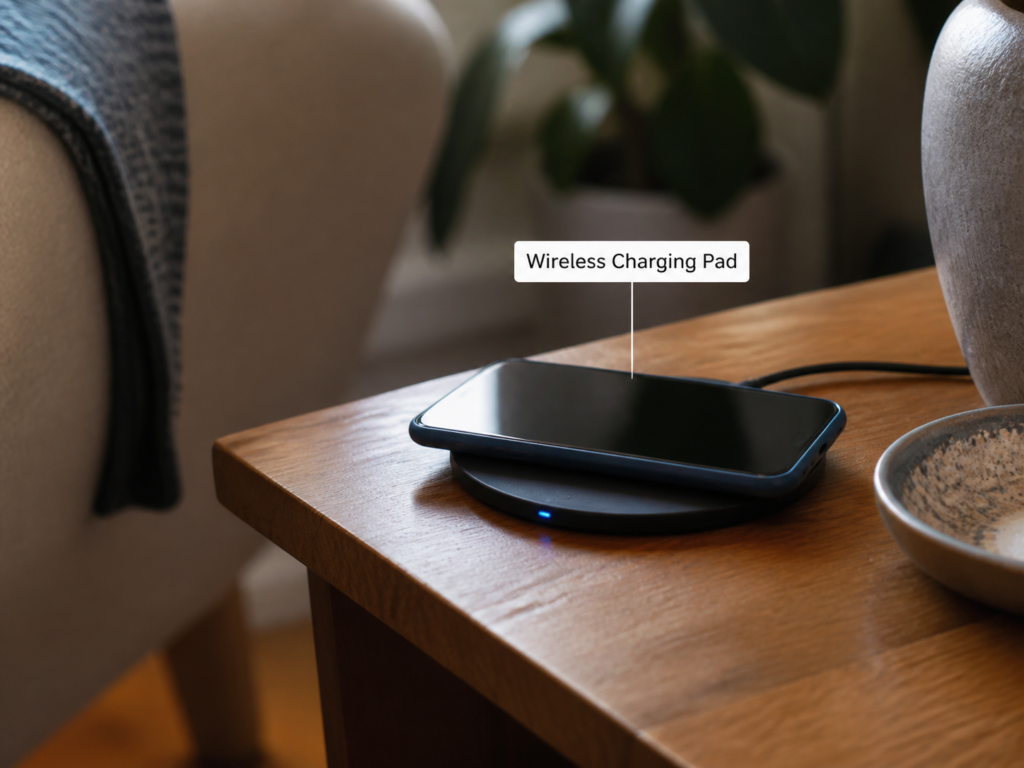
• Wireless charging products with functions for radio communication or radio determination: e.g., desktop wireless chargers, car wireless chargers, magnetic wireless chargers with Bluetooth, WiFi, NFC or other wireless communication functions
• Chargers/adapters with wireless functions: e.g., Bluetooth smart chargers, charging heads with WiFi networking function
• Accessories with wireless auxiliary functions: e.g., charging cables with Bluetooth tracking function, charging adapters with NFC function
Common Charging Products That Do Not Require RED Compliance
• Pure wired USB/USB-C chargers, charging cables, power adapters (no wireless modules at all)
• Pure passive accessories without active wireless transceivers: e.g., ordinary adapters, data cable protective sleeves
Boundary Cases Prone to Misjudgment
There are several situations that are most easy to judge wrong, and you must pay attention:
First, products with wireless functions locked or hidden by software — for example, some charging heads use a universal motherboard with a WiFi module, but the manufacturer says the WiFi function is turned off via software. In this case, it cannot be judged solely by whether there is a wireless module on the hardware, but shall be combined with the product’s actual wireless functions and intended use to determine whether it is a RED device; if the product is expected to enable the relevant wireless communication function through firmware or settings, careful assessment is also required.
Second, devices that only receive wireless signals — for example, some charging accessories with NFC receiving function, as long as they intentionally receive radio waves for radio communication or radio determination, even if they do not actively emit signals, they may fall within the scope of RED.
Third, wireless charging modules sold separately — whether wireless charging products or modules are subject to RED shall be confirmed by whether they have wireless functions for radio communication and/or radio determination; it cannot be judged solely because they transmit power through electromagnetic induction or radio frequency. If the module or the whole machine is a RED radio device, the corresponding conformity assessment shall be completed for the final product to be placed on the market; the test and technical data of the module can be used as input for the whole machine assessment, but cannot automatically replace the whole machine assessment.
1-Minute Quick Self-Check Method
If you are unsure, follow these three steps to check quickly:
1. First check the product’s parameter page and manual for labels of wireless functions such as Bluetooth, WiFi, wireless charging, NFC;
2. Ask the supplier for the model and specification description of the wireless module to confirm whether the product has functions for radio communication or radio determination;
3. If you are still unsure, you can find a formal third-party testing institution for free pre-assessment. Most institutions are willing to provide such basic services for free.
What Does RED Regulate? 5 Points for Charging Products to Note
Many sellers think RED is just testing wireless signals, but its requirements cover several aspects. We will explain them combined with the characteristics of charging products, and you don’t need to remember complex terms.
Wireless Health and Safety Requirements
Simply put, the risks brought by the product cannot exceed safety requirements, including electrical safety, thermal safety, radiation safety, etc.
Charging products should pay special attention to two points: first, whether the near-field radiation of wireless chargers exceeds the standard; second, whether the temperature rise of the wireless charging module during operation is too high to cause danger.
It should be noted that for the whole machine that falls under RED, Article 3(1)(a) of RED requires it to meet the same health and safety objectives as Article 3 of the LVD, but is not limited by the LVD voltage range. The LVD itself does not apply to radio equipment covered by RED; the safety of the whole machine shall be considered as a whole in the RED conformity assessment.
Electromagnetic Compatibility (EMC) Requirements
Electromagnetic compatibility has two directions: your product must not interfere with the normal operation of other electrical appliances, and at the same time, interference from other electrical appliances must not cause your product to fail.
Common concerns for charging products are: will wireless chargers interfere with home WiFi and Bluetooth devices? Or when there are interference sources such as microwave ovens and hair dryers nearby, will the wireless charger frequently stop charging? These are all covered by the EMC requirements in RED.
For the whole machine that falls under RED, Article 3(1)(b) of RED incorporates the electromagnetic compatibility requirements of the EMC Directive; the EMC Directive itself does not separately apply to this radio equipment. The assessment shall cover the emission and immunity performance related to the whole machine, not just the wireless part.
Radio Spectrum Use Requirements
This is easy to understand: the frequency bands used by the product and their technical parameters must comply with applicable EU and member state spectrum rules, and frequency bands that do not meet local spectrum management requirements cannot be used arbitrarily.
The common 2.4GHz Bluetooth/WiFi frequency band for charging products, as well as some near-field induction frequency bands for wireless charging, may be subject to license-exempt or general authorization conditions; but the specifics still depend on frequency, power, purpose, equipment category and requirements of the selling country. Some frequency bands may be subject to member state restrictions, conditions of use or individual authorization requirements, and compliance cannot be judged solely by “whether it is license-exempt”.
Human Radiation Safety (SAR) Requirements
SAR stands for Specific Absorption Rate. Simply put, it is the amount of wireless radiation absorbed by the human body, and this value must not exceed the standard.
Whether SAR testing is required and what human exposure assessment method to use shall be determined based on frequency, expected use distance, use method and applicable harmonized standards. Devices used near the human body may be subject to SAR assessment, but near-field devices such as wireless chargers may also require other EMF exposure assessments.
Desktop wireless chargers and wall-mounted wireless chargers are not automatically exempt from human exposure conformity assessment, but appropriate assessment methods shall be selected according to actual use methods and applicable standards.
Cybersecurity Requirements
This requirement does not apply to all products. The cybersecurity, privacy and anti-fraud requirements under Article 3(3)(d), (e), (f) of RED have been applicable to the categories of devices listed therein since August 1, 2025, through Delegated Regulation (EU) 2022/30.
Charging products shall be judged item by item according to whether the product can communicate via the Internet, whether it is a child care or wearable device, and whether it processes relevant personal, traffic or location data; it cannot be assumed that all requirements apply just because there is WiFi, Bluetooth or APP function. For products that actually fall within the scope of application, the core requirements are to prevent unauthorized access and protect user data, for example, they cannot be cracked and controlled by strangers, and cannot leak users’ WiFi passwords.
How to Achieve RED Compliance? From Procurement Self-Check to Formal Process
This part covers from beginner procurement self-check to intermediate process and document judgment, covering the most commonly used scenarios for sellers.
3-Step Quick Self-Check Before Procurement
If you source goods from suppliers, do these three steps before procurement to avoid most pitfalls:
1. First judge whether the product requires RED compliance according to the applicable scope criteria mentioned above;
2. Require the supplier to provide the EU Declaration of Conformity (DoC, equivalent to the manufacturer’s compliance guarantee) and the corresponding test report;
3. Verify that the product model and wireless frequency band on the documents are completely consistent with the actual product you are purchasing, and do not have a certificate for model A matched with goods of model B.
Core Formal Compliance Process
If you open molds to make products yourself, the complete RED compliance process is as follows:
1. First identify the applicable EU harmonized standards — harmonized standards are standards officially published by the EU to prove compliance with directive requirements, and products tested according to harmonized standards are directly presumed by the EU to meet RED requirements;
2. The manufacturer shall complete the conformity assessment and form technical evidence according to applicable harmonized standards or other appropriate technical solutions. A laboratory with corresponding capabilities can be entrusted for testing; but when the internal production control procedure is applicable, RED does not uniformly require the participation of third-party or accredited laboratories;
3. Organize a full set of technical documents and sign the EU Declaration of Conformity (DoC);
4. Affix the CE mark and required wireless parameter information on the product.
How to Choose the Conformity Assessment Route (Intermediate Level)
RED conformity assessment does not have only two routes, nor do all products require the participation of a Notified Body (NB, a qualified third-party institution designated by the EU):
• **Annex II Internal Production Control**: If the manufacturer fully adopts harmonized standards covering all applicable essential requirements, this procedure can be used. Ordinary wireless charging products, when meeting the conditions, can usually have the manufacturer complete the conformity assessment and sign the DoC on their own, without NB participation.
• **Annex III EU Type Examination plus Conformity to Type**: If harmonized standards covering all applicable essential requirements are not adopted or not fully adopted, the manufacturer can choose this procedure, with an NB participating in the EU type examination.
• **Annex IV Conformity based on Full Quality Assurance**: The manufacturer can also choose this procedure, where an NB assesses and supervises the quality system, etc.
The key to judgment is the selected assessment procedure and the adoption of harmonized standards, rather than a general “product risk level”. Ordinary wireless charging products, if they can fully adopt relevant harmonized standards, can usually follow the Annex II Internal Production Control route.
Key Points for Judging the Validity of Test Reports (Intermediate Level)
Many sellers don’t know if the test report is real or useful when they get it. Just check these four points:
1. Verify whether the model, hardware and wireless configuration are clearly covered by the report and technical documents; if there are differences, the manufacturer shall prove their applicability through difference analysis, basis for same-series coverage or supplementary testing;
2. The wireless frequency bands, working modes and maximum transmit power covered by the report must match the parameters of the actual product. For example, if the product is 2.4GHz Bluetooth but the report tests 5GHz WiFi, it is definitely invalid;
3. After the version of the harmonized standard is changed, its citation and transition arrangements in the Official Journal of the European Union shall be checked, and whether supplementary testing or updating of technical documents is required shall be assessed; the report cannot be directly judged invalid solely based on the report date or standard version;
4. Distinguish between “all items passed the test” and “only some items are covered/technical document demonstration”. The latter has higher compliance risks and requires additional confirmation.
Compliance Essentials: Markings, Documents and Who Is Responsible
Correct Use Requirements for the CE Mark

The CE mark is a mandatory mark for RED compliance, and it must be affixed in accordance with requirements, otherwise it will be judged non-compliant during spot checks:
• The mark must be clear and not easy to wear, and should be affixed to the product body first;
• The minimum height must not be less than 5mm. If the product is too small to affix the mark, it can be affixed to the packaging and manual;
• The mark must not be deformed, and must not be confused with other certification marks; only when the Annex IV full quality assurance procedure of RED is adopted, the identification number of the notified body participating in the production control stage shall be added after the CE mark. Adoption of Annex III EU Type Examination does not automatically require the NB number to be added after the CE mark.
Core Content of Mandatory Compliance Documents
There are three types of documents required for RED compliance, all indispensable:
1. **EU Declaration of Conformity (DoC)**: This is a formal declaration signed by the manufacturer, which shall list the manufacturer, product, applicable regulations and standards and other information according to Annex VI of RED, equivalent to the product’s compliance guarantee.
2. **Technical Documents**: The content is more comprehensive, including product description, wireless module specifications, test reports, manuals, change records, etc. These documents must be kept for at least 10 years after the product is launched, and must be provided when required by regulatory authorities.
3. **Manual and Label**: The manual shall provide the wireless working frequency band and maximum transmit power; if there are spectrum use restrictions or authorization requirements, relevant information shall also be provided in the packaging and manual. Importer information shall be marked on the product according to Article 12, and if it cannot be marked, it can be marked on the packaging or accompanying documents. The manual and safety information shall be in a language prescribed by the member state of sale that is easy for consumers and other end users to understand, and local language requirements shall be verified country by country; whether English alone is sufficient depends on the regulations of that member state.
Division of Compliance Responsibilities of All Parties in the Supply Chain (Intermediate Level)
Many sellers are confused about what responsibilities they have. In fact, the RED Directive has clear responsibility requirements for each role in the supply chain:
• **Manufacturer**: That is, the producer of the product, responsible for product design compliance, completing testing, compiling technical documents, affixing the CE mark, and also monitoring the impact of product changes on compliance.
• **EU Importer**: A company that imports products into the EU territory, needs to verify whether the manufacturer’s documents are complete, mark its own name and address on the product, keep a copy of the DoC, and suspend sales if non-compliance is found.
• **Distributor/E-commerce Seller**: That is, the party selling goods, shall check whether the product’s markings and documents are compliant before listing, cannot sell known non-compliant products, and shall cooperate with the investigation of regulatory authorities.
• **Non-EU Seller**: For example, Chinese cross-border sellers, for products placed on the EU market by non-EU manufacturers and subject to this rule, shall ensure that there is an economic operator in the EU territory as required by Article 4 of Regulation (EU) 2019/1020, such as an EU manufacturer, importer, authorized representative with written authorization or fulfillment service provider. The responsibilities of each role are different, and the core design and conformity responsibilities of the manufacturer cannot be transferred in general.
4 Most Common Pitfalls and Pitfall Avoidance Checklist
Common Misconceptions and Truths
Many sellers have deviations in their understanding of RED. These four are the most common:
1. **Misconception: Having a CE mark equals complying with RED**
Truth: CE compliance for wired charging products shall identify applicable regulations according to actual voltage and product attributes, and common ones may include LVD, EMC and RoHS, etc.; CE is not an independent “certification”. For products with wireless functions that fall within the RED scope, the CE mark must cover the RED Directive to be valid, and you cannot only rely on whether there is a CE mark.
2. **Misconception: If the wireless module has RED certification, the whole machine does not need to do it**
Truth: The test and technical data of the module can only be used as input for the whole machine assessment. After being installed in the whole machine, the shell material, antenna position, and internal metal structure of the whole machine will change the wireless performance, so if the whole machine is a RED device, the RED compliance assessment of the whole machine must still be completed, and the module data cannot automatically replace it.
3. **Misconception: FCC/UKCA can replace RED**
Truth: The FCC mark or UKCA mark itself cannot replace the conformity assessment, EU DoC and CE mark required by EU RED. UK technical requirements may be highly consistent with RED in some areas, and whether existing test evidence can be reused must still be assessed item by item according to applicable standards, markets and products.
4. **Misconception: Niche private wireless frequency bands can also be compliant**
Truth: The frequency bands and technical parameters used by the product must comply with the spectrum rules of the EU and the selling member state. Many short-range devices can operate in license-exempt or generally authorized frequency bands, but some frequency bands may be subject to conditions of use or individual authorization requirements, and verification cannot be ignored just because the supplier says “no one uses it so it’s fine”.
Quick Pitfall Avoidance Checklist
When listing products or conducting procurement audits, check against these five points to avoid 90% of pitfalls:
• Check the type of wireless function of the product to confirm whether it falls within the applicable scope of RED
• Verify that the DoC, test report and the actual product’s model and hardware version are completely consistent
• Confirm that the frequency band, power, purpose and selling country requirements of the product comply with applicable EU and member state spectrum rules
• Confirm that the manual contains the required wireless parameter information; if there are spectrum use restrictions or authorization requirements, the packaging and manual shall provide relevant information, and confirm that the importer information is marked as required
• Confirm that the whole machine has completed the RED compliance assessment, rather than only the wireless module having certification
Post-Marketing Spot Checks and Problem Response
Many sellers think it’s fine after passing customs, but in fact, post-market spot checks in the EU market are also very strict, so it’s important to know how to respond in advance.
Common Inspection Items in EU Market Spot Checks
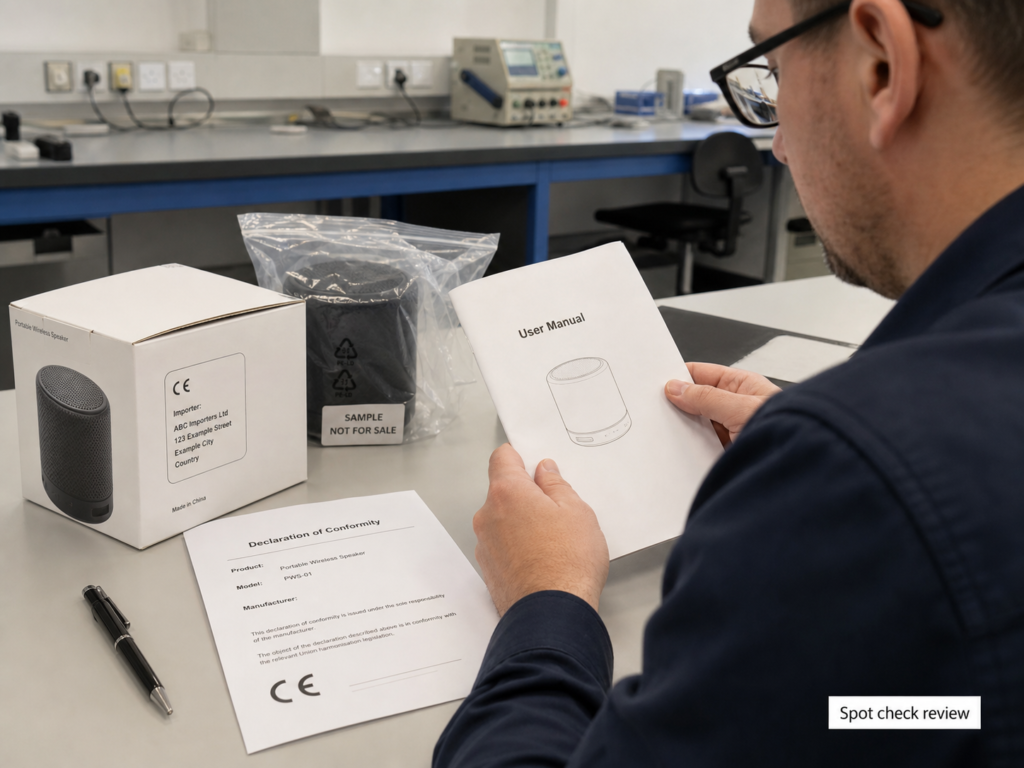
When regulatory authorities conduct spot checks, they usually check these three aspects:
1. **Product Marking Inspection**: Check whether the CE mark is standardized, whether importer information is marked, and whether the legal information on the product, packaging and manual is complete;
2. **Document Inspection**: Require the Declaration of Conformity to be provided on the spot, and if necessary, the complete technical documents;
3. **Sampling Test**: Send samples to the laboratory for testing to verify whether wireless power, frequency band, radiation safety, EMC, etc. meet the requirements.
Whether Re-Assessment Is Required After Product Changes
It is inevitable that there will be changes during the sale of products, and whether to re-test RED cannot be judged simply by the name of the change:
• **Changes that may require supplementary assessment or testing**: Wireless module, antenna, power amplifier, or firmware that adjusts transmit parameters, frequency bands, protocols — these usually directly affect wireless performance, require supplementary assessment, and may require targeted or full re-testing. The most common change in charging products is replacing the wireless module of a wireless charger with a different power, which shall be re-assessed, and cannot be perfunctory.
• **Changes in appearance, materials, packaging and manuals**: Replacing packaging, adjusting appearance color, modifying manual text shall also confirm that they will not affect radio frequency, EMC, safety or legal information before deciding whether to only update technical documents. For example, changes in shell color, coating, material or structure may affect antenna, EMC or thermal performance; changes in manuals and packaging may also affect legal information and use restrictions.
Consequences of Non-Compliance and Handling Steps
If you really encounter non-compliance, common consequences include customs detention, e-commerce platform delisting, sales ban, and in serious cases, fines and product recalls.
Don’t panic when encountering problems, follow these three steps to handle:
Step 1: First suspend the shipment and sale of high-risk models to avoid further expansion of losses;
Step 2: Verify the product’s version, batch, wireless configuration, and locate the specific cause of non-compliance, whether it is a document error or the product itself does not meet the requirements;
Step 3: Require the supplier to provide rectification evidence, and take corresponding measures according to the risk level: if it is only missing or wrong documents, just complete the documents; if the product itself does not meet the requirements, it is necessary to rectify and re-test, and those with high risks should be delisted or even recalled in time.
After reading this article, you should be able to independently complete these judgments: quickly distinguish whether your charging products need to comply with the RED Directive, understand the core requirements of RED and the applicable boundaries of different products, verify the validity of DoC and test reports, avoid the four most common compliance pitfalls, master the key points of material verification during procurement and post-marketing spot check response methods, and also be able to distinguish different wireless compliance requirements between the EU and UK markets.
RED compliance seems complicated, but in fact the core is “the product’s wireless performance meets EU requirements, and the documents are complete and traceable”. As long as you check well in advance, you can completely avoid most unnecessary losses.