
If you run a cross-border business selling power supply products in the European market, have you ever encountered this situation: your charger has clearly obtained CE safety certification, but it is still detained by customs, or the e-commerce platform suddenly removes your product from the shelf, citing “non-compliance with ErP energy efficiency requirements”?
Many people’s impression of ErP stays at “another European certification”, and they even cannot distinguish it from CE and energy labels. They either waste money on useless certificates, or suffer heavy losses from detained goods and fines due to non-compliance. In this article, we start from the most basic concepts, and explain in one go the ErP energy efficiency requirements, compliance credentials, procurement audit methods, and common pitfalls for external power supply products entering the European market. It is suitable for new procurement staff, e-commerce sellers, and practitioners who want to understand European energy efficiency rules.
1. First, Understand the Basics: What Exactly is ErP, and Which Markets Must Comply
1.1 ErP is not a standalone certification, nor is it a CE directive
The EU’s Ecodesign Regulation for Energy-related Products (abbreviated as ErP) is essentially a set of mandatory energy consumption control rules, with its core framework being **EU 2009/125/EC**. It covers all energy-related products within the scope of control that are placed on the EU market, with the core goal of reducing energy waste and carbon emissions.
For external power supplies such as chargers and power adapters that we commonly contact, the EU has a special implementing regulation **EU 2019/1782**. It is an implementing regulation for the ecodesign of external power supplies formulated based on 2009/125/EC, not a standalone CE directive. Applicable products need to meet this regulation and other applicable laws and regulations, affix the CE mark and draw up an EU Declaration of Conformity in accordance with the corresponding conformity assessment requirements.
In short, as long as your external power supply is to be sold in the EU, it must simultaneously meet applicable requirements such as safety, electromagnetic compatibility, restriction of hazardous substances, and energy efficiency. ErP and these requirements are independent of each other, and one cannot replace the other.
1.2 Not all European countries use the same set of ErP rules
Many people default to “Europe = EU”, but in fact, the applicable ErP rules vary greatly across different European markets. Before shipping, you must first confirm the requirements of the corresponding market:
| Market Region | Applicable Rules | Core Compliance Requirements |
| EU Member States | Unified EU ErP regulations | CE mark, EU DoC, responsible entity within the EU |
| European Economic Area (EEA) | Need to verify whether it is included in the EEA Agreement and its local entry into force | Subject to local official announcements |
| UK GB market | UK local ecodesign regulations and related product regulations | The acceptability of UKCA and CE, declaration format, labeling, and UK responsible entity requirements shall be verified according to the time of sale and product category |
| Northern Ireland market | Need to be verified separately; some EU requirements are still followed | Confirm marking and document requirements according to specific scenarios |
| Other European countries such as Switzerland | EU ErP is not directly applicable | Need to confirm local energy efficiency rules |
For example, Norway and Iceland belong to the EEA but are not EU member states, so it is necessary to first confirm whether the ErP regulation is included in the local EEA Agreement. After Brexit, the UK has established its own ecodesign system, but the UK government currently continues to recognize the CE mark in multiple product areas including some product regulations. The specific situation shall be subject to the time of sale, product category, and current UK regulations. EU 2019/1782 and EU DoC cannot automatically replace UK regulatory requirements, but technical documentation that meets EU requirements can be used as evidence in UK compliance assessments.
Due to special arrangements, EU rules still apply in some scenarios in Northern Ireland, which requires separate verification before shipping.
1.3 Does your product need to comply with ErP? First check if it is an external power supply within the scope of control
ErP has special control rules for external power supplies (abbreviated as EPS, which are commonly referred to as chargers and power adapters). Simply put, they are usually **independent external power supplies that convert mains electricity into low-voltage AC/DC**.
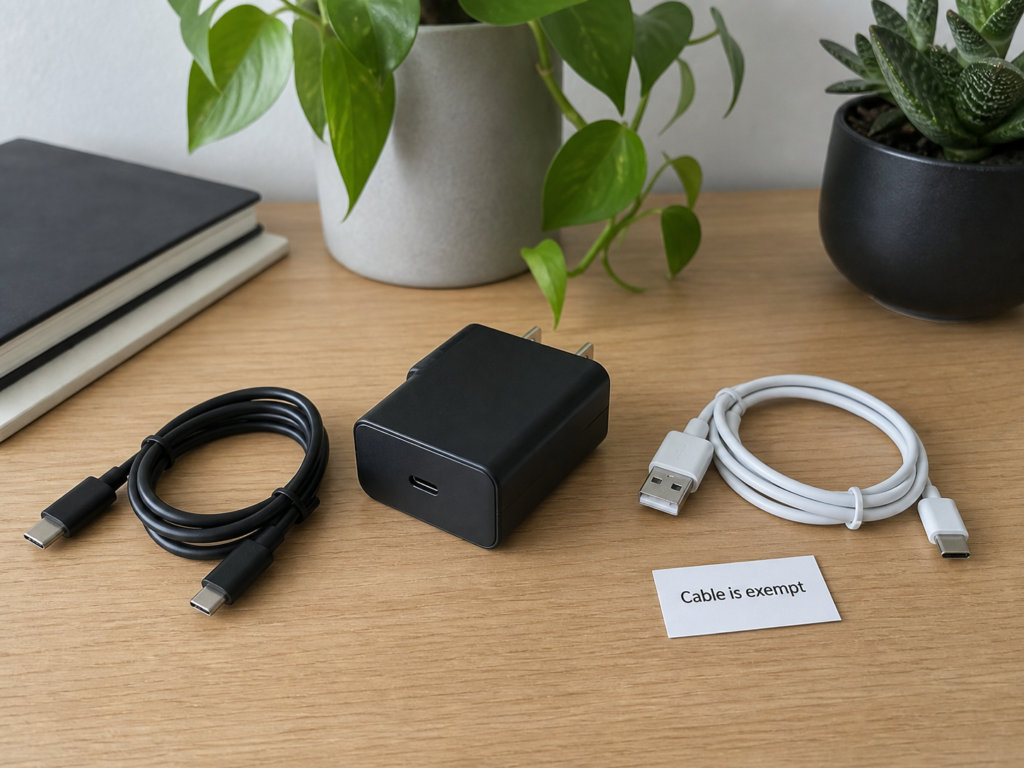
To determine whether a product is within the scope of control, you cannot only look at the rated output power. You should first confirm whether the product is an external power supply as defined by the regulation, and then verify its **rated output power not exceeding 250 W**, input and output characteristics, intended use, and statutory exclusions. The rated output power is mainly used to determine the applicable energy efficiency limits and test tiers, and can usually be read from the output column of the product nameplate.
Products explicitly excluded by the regulation include:
• Power modules built into equipment (such as power boards inside TVs and mainframes);
• Voltage converters;
• Uninterruptible power supplies (UPS);
• Battery chargers without power supply function;
• Lighting converters;
• Specific external power supplies for medical devices.
Industrial-use products cannot be excluded solely based on the words “for industrial use”, and external power supplies for medical devices cannot be generalized. They must be judged item by item against Article 1 and the definitions of EU 2019/1782.
Many people are unclear about the boundary of charging cables: ordinary passive USB/USB-C cables (even those with E-Marker chips and supporting high-power transmission) do not belong to EPS, because they only transmit electricity and do not perform voltage and current conversion themselves. Only active charging cables with independent AC-DC conversion function (such as charging cables with a built-in conversion circuit in the cable body that can supply power directly when plugged into a wall socket) need to be judged whether they are included in the scope of control based on rated power, input and output characteristics, and other conditions.
Common controlled products include mobile phone chargers, USB-C fast chargers, laptop power adapters, and active charging accessories. For products with blurred boundaries such as power banks with batteries and multi-functional power supply equipment, a comprehensive judgment needs to be made based on core functions and exclusions. For example, a 2-in-1 power bank whose core function is external power supply may fall within the scope of control; for ordinary power banks whose core function is energy storage, it is necessary to further compare with the regulatory definitions and exclusion clauses. If you are unsure, it is recommended to consult a professional institution for confirmation.
1.4 What are the consequences of non-compliance? These three risks are the most common
Many people think that energy efficiency requirements are “soft regulations” and will not be really inspected. In fact, the EU’s enforcement of ErP is already very mature, and the consequences of non-compliance are very direct:
• **Customs detention**: If it is found that there are no compliance documents during customs clearance, the goods will be directly detained or even returned, resulting in high port demurrage fees;
• **Platform removal**: Mainstream European e-commerce platforms such as Amazon and AliExpress may require energy efficiency-related documents when listing or spot-checking power supply products. If the audit fails, the listing may be rejected, and already listed products may also be removed due to spot checks;
• **Fines and recalls**: Market regulatory authorities in EU countries regularly spot-check products on sale. Non-compliant products will face fines, and even require the recall of all sold products, with losses far greater than compliance costs.
2. Core Requirements of EU 2019/1782: Two Key Indicators Must Meet the Standards
After clarifying the applicable scope, let’s look at the specific requirements of EU 2019/1782, the special regulation for external power supplies. First, confirm the version, and do not use the expired old rules as the basis.
2.1 First check the version: the old Lot 6 has expired
EU 2019/1782 was announced in 2019 and has been applicable since **April 1, 2020**. The current valid version is subject to the latest revision in EUR-Lex, the EU’s official legal database.
The previous old Lot 6 rule was **Commission Regulation (EC) No 278/2009**, which has been repealed by EU 2019/1782 since April 1, 2020, and cannot be used as the current basis for newly placed products.
In principle, related products first placed on the EU market or put into use on or after April 1, 2020 shall comply with 2019/1782. The key legal node here is the time when each individual product is first placed on the market or put into use, not simply the production time. Individual products that have been legally placed on the market before that time will usually not be automatically retested due to the new regulation; however, if the regulatory authority determines that the product is non-compliant, it may still take measures such as correction and recall.
2.2 The first core indicator: no-load power consumption, which is the “phantom power draw” when plugged in but not in use
No-load power consumption refers to the invalid power consumed when the power supply is connected to the mains and has no load connected (or the device is fully charged) — that is what we commonly call “standby phantom power”. This power is completely wasted, so it is the focus of regulatory control.
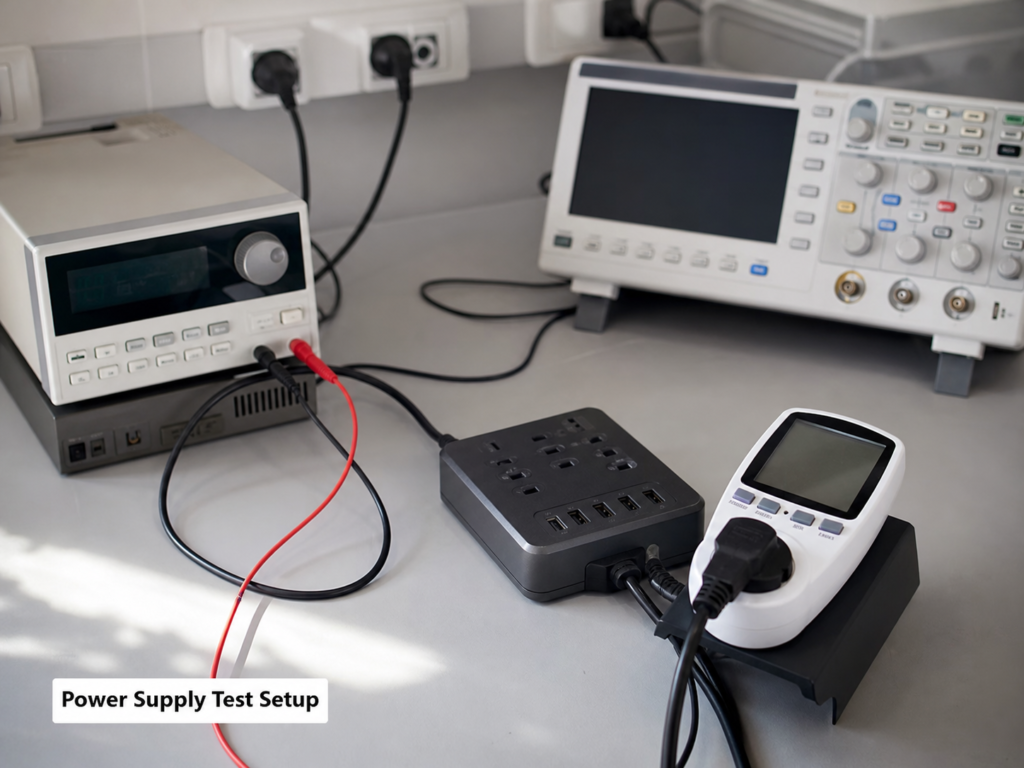
Two conditions must be met during testing: connected to the rated input voltage, and all output ports are vacant and not in a charging-activated state (for example, the standby state of a PD charger when no device is plugged in will not activate fast charging output). Here we need to correct a very common misconception: **there is no unified 0.1W limit for no-load power consumption**. Instead, it is divided into different tiers according to low-voltage/high-voltage EPS and rated output power. The specific determination must be made against the annexes of the regulation, and cannot be generalized.
For multi-port power supplies, no-load power consumption and other applicable indicators shall be determined in accordance with the multi-output test configuration specified in 2019/1782. You cannot only test the no-load power consumption of a certain port, nor can you simply apply the test conditions of single-port products.
2.3 The second core indicator: average active efficiency, which determines how much electricity is wasted during charging
Average active efficiency refers to the proportion of electrical energy actually output to the device to the input electrical energy when the power supply works with a load. The higher the value, the less electricity is wasted and the more energy-efficient it is.
Note that this indicator is not the “full-load efficiency” we commonly refer to. Instead, it must be tested at **four specified load points: 25%, 50%, 75%, and 100% of the rated output power**, and the average active efficiency is calculated in accordance with the regulation, which is usually the arithmetic average of the efficiencies of the four test points. After all, when we charge devices daily, most of the time they do not operate at full power. For example, a mobile phone will switch to a small current after being charged to 80%, so we cannot only look at full-load efficiency.
When determining, it is also segmented by rated output power, with corresponding formulas or tiered limits. The specific situation shall be subject to the official test report and the annexes of applicable regulations.
2.4 Test precautions for special products
Statutory requirements stipulate that all products must be tested in the rated mode in accordance with EU 2019/1782 and corresponding measurement standards (such as EN 50563).
For PD fast charging products with multiple outputs and multiple voltages, statutory tests shall first be completed in accordance with the test configurations and load conditions specified in the annex of 2019/1782. The annex of the regulation has special provisions on the output configuration, load conditions, and test methods for multi-output and multi-voltage products. These tests cannot be entirely understood as voluntary behaviors of enterprises. On this basis, enterprises can also add verifications for common single-port output, simultaneous multi-port output, and representative voltage gear combinations in actual use.
As for active charging cables, only those with independent AC-DC conversion function need to be judged based on the corresponding rated power, input and output characteristics, and exclusions. Ordinary passive cables do not need to, which is consistent with the previous scope judgment.
3. What to Prepare for ErP Compliance? There is No Separate Certificate, the Core is These Two Things
Many people think that ErP has a separate “certification certificate”, but that is not the case. ErP does not require applying for an independent ErP certificate. The core compliance credentials are the Declaration of Conformity and technical documentation.
3.1 Core compliance logic: self-declaration + technical documentation
EU 2019/1782 does not have a separate “ErP certification”, nor does it usually require official institutions to issue separate certificates.

The core compliance credentials are the **EU Declaration of Conformity (abbreviated as DoC)** plus supporting technical documentation.
The DoC is equivalent to the manufacturer’s declaration that the product complies with applicable regulations. It needs to list all EU regulations applicable to the product (such as LVD, EMC, RoHS, ErP, etc., all must be listed completely), be signed by the manufacturer or the EU authorized representative, and the CE mark shall be affixed in accordance with corresponding requirements.
Manufacturers are responsible for core compliance matters such as product design, conformity assessment, technical documentation, and EU DoC; importers, authorized representatives, and distributors also bear corresponding obligations stipulated by regulations, and specific responsibilities depend on their legal identity and actions in the supply chain.
3.2 What technical documentation to prepare? Must be kept for 10 years
Technical documentation is the core basis for proving that a product meets ErP requirements. It must be available when regulatory authorities conduct spot checks, and needs to include the following contents:
• Product identification information: model, nameplate, packaging materials, to ensure correspondence to specific products;
• Design and component materials: electrical design drawings, list of key power components;
• Energy efficiency assessment materials: energy efficiency test/calculation data, measurement methods and instrument descriptions, test environment records;
• Marketing and change materials: product labels and manuals, EU DoC, product change records.
Manufacturers or authorized representatives shall keep complete technical documentation in accordance with applicable ecodesign regulations. For technical documentation required by EU 2019/1782, the retention period shall be understood as **10 years after the last unit of the relevant product is manufactured**, not from the last time it is placed on the EU market. Other documents such as EU DoC shall also comply with the retention requirements stipulated by corresponding product regulations.
Importers do not necessarily need to keep all of the manufacturer’s technical documentation, but they shall keep or ensure access to the EU DoC and compliance materials required by regulations, and assist in providing complete technical documentation when required by regulatory authorities. You cannot simply push all materials to domestic suppliers.
3.3 Is third-party testing necessary? It is not mandatory, but it can strengthen the evidence chain
Regulations usually allow manufacturers to adopt internal conformity assessment, and do not require testing to be completed by third-party laboratories. Testing by independent laboratories can strengthen the evidence chain, but the relevant capabilities, test methods, and report traceability of the laboratory shall be confirmed. In the EU’s ecodesign rules for external power supplies, there is no unified concept of “EU-accredited qualified laboratory”.
For high-risk products such as low-cost white-label products and multi-port high-power fast chargers, having an independent laboratory with corresponding capabilities issue a test report usually helps reduce the risk of market spot checks.
To judge whether an ErP test report is complete, the core points are: whether it clearly states that it is based on EU 2019/1782, whether it indicates the applicable measurement standards, whether it clearly states the input parameters, sample model and configuration, as well as test conditions and results. When the report information is incomplete, supplementation or re-evaluation shall be required, and the report cannot be directly deemed invalid solely due to the lack of a certain item of information.
3.4 Can series products share a report? It depends on technical justification
Many suppliers will say “these models are in one series, just share one report”, but the regulation does not provide a set of fixed “series report” judgment rules that can replace technical justification.
Manufacturers need to prove through technical documentation that model differences will not affect applicable limits or test results, and cover reasonable worst-case configurations. Changes in power, output configuration, key components, etc. shall be subject to re-impact assessment, and supplementary testing shall be conducted if necessary.
If the product undergoes the following changes, compliance shall be re-evaluated, and the original report cannot be directly continued to be used:
• Power tier adjustment;
• Replacement of key power components;
• Change in the number or type of output ports;
• Firmware changes that affect energy efficiency (such as adjustment of fast charging control logic);
• Change in heat dissipation structure or input range.
4. How to Audit During Procurement and Listing? Follow the Steps to Avoid Pitfalls
Knowing the compliance requirements, how do you quickly judge whether the documents provided by the supplier are qualified during actual procurement or listing? We have compiled a set of practical audit methods.
4.1 Six-step Procurement Audit Method: Verify Step by Step from Scope to Mass Production
The first step is **scope verification**: first confirm whether the product is an external power supply controlled by EU 2019/1782. You cannot only look at the product name, but also verify the input and output types, rated output power, intended use, and statutory exclusions. For example, car chargers are usually DC-DC products and may not fall within the scope of control of this regulation, but they should still be confirmed in combination with the specific product structure and regulatory definitions.
The second step is **parameter verification**: verify whether the SKU model, rated output power, and interface configuration are consistent with the product nameplate, to avoid suppliers using the report of model A for model B.
The third step is **report review**: verify whether the regulatory basis of the test report is EU 2019/1782, whether the test conditions meet the requirements, and whether the two core indicators of no-load power consumption and average active efficiency meet the standards.
The fourth step is **document verification**: confirm that the supplier can provide complete DoC and technical documentation, and that the DoC covers all applicable EU regulations. You cannot only list LVD and EMC and omit ErP.
The fifth step is **change verification**: if it is a series product or the product has changes, confirm whether there is an impact assessment in the technical documentation and whether retesting is required. You cannot only listen to the supplier’s verbal explanation.
The sixth step is **mass production verification**: after mass production, sample and verify whether the key power components and parameters are consistent with the test samples, to avoid suppliers using specially adjusted high-end versions for testing and reduced versions for mass production.
4.2 E-commerce Platform Audit: These Pitfalls Are Most Likely to Result in Rejection
Platforms may request EU/UK declarations, technical documentation, or energy efficiency test evidence according to their internal policies or spot check requirements. The specific materials required shall be subject to the latest requirements of the sales platform and target market. Sellers shall prepare corresponding complete compliance materials in advance for each sales SKU.
Common reasons for rejection fall into the following categories:
• The report model does not match the sales model;
• The expired old Lot 6 regulation is applied;
• Core energy efficiency indicators do not meet the standards;
• Document information is incomplete (such as missing test conditions and sample configuration).
The solution is very simple: prepare corresponding documents in advance for each sales SKU, and ensure that the parameters on the e-commerce page (such as rated power, number of interfaces, fast charging power) are completely consistent with the report and the actual product. Many sellers exaggerate parameters to attract traffic, and they will be caught as soon as they are inspected.
4.3 Final Check Before Launch: Don’t Miss These 5 Items
Before launch, you can conduct a final round of verification against the list below to avoid missing key items:
| Inspection Category | Inspection Content |
| Product Identity | Model, rated power, interface configuration, manufacturer/importer information are complete and consistent |
| Energy Efficiency Evidence | Test data for no-load power consumption and average active efficiency are complete, with corresponding test condition descriptions attached |
| Regulatory Documents | DoC and test reports marked with EU 2019/1782 are valid and cover all applicable regulations |
| Marketing Materials | Parameters on nameplates, packaging, and e-commerce pages are completely consistent with test reports and actual products |
| Contract Terms | Clarify target market, regulation version, and division of responsibility for non-compliance, to avoid suppliers shifting blame |
Special attention should be paid to contract terms, which many people tend to ignore: when signing a contract with a supplier, you must clearly state the applicable market, regulation version, and who will bear the losses from non-compliance. Otherwise, if something goes wrong and the supplier runs away, you will have to bear all the losses yourself.
5. Don’t Confuse Them: Differences Between ErP and Other European Access Requirements
Many people who are new to European compliance will confuse ErP with CE, energy labels, and USB-C regulations. In fact, they each govern different aspects and cannot replace each other.
5.1 Relationship with other CE directives: parallel requirements, cannot replace each other
CE is a broad compliance category involving multiple EU regulations and directives. ErP is an ecodesign implementing regulation formulated based on 2009/125/EC, not a CE directive. However, products that meet applicable ErP requirements usually need to include it in the overall conformity assessment and EU DoC.
Other common CE regulations include:
• LVD (Low Voltage Directive): governs electrical safety, with independent testing and technical documentation requirements;
• EMC (Electromagnetic Compatibility Directive): governs electromagnetic interference and immunity, and is an independent compliance requirement;
• RoHS Directive: governs restriction of hazardous substances, and is part of CE compliance.
All applicable regulations and directives must be met separately. One cannot replace another, nor can a general “CE report” replace the technical basis of all regulations. The DoC must cover all applicable regulations.
5.2 Three Most Easily Confused Concepts, Clarified at Once
• **ErP vs Energy Label**: ErP is the minimum access threshold; if you cannot meet it, you cannot sell. The energy label is a consumer label with A-G grading, used to display energy efficiency levels. External power supplies are not mandatorily required to have an energy label by default. The two have different test methods and judgment standards, and there is no direct correspondence — a high energy efficiency grade does not mean it complies with ErP, and complying with ErP does not mean an energy label must be affixed.
• **ErP vs USB-C Common Charging Regulation**: ErP governs energy saving, requiring applicable external power supplies to meet energy consumption standards. The USB-C common charging rule mainly applies to specific radio equipment covered by the directive, and requires USB-C and corresponding USB Power Delivery capability when the specified charging power is reached. Its applicable objects and technical conditions are different from ErP, and need to be verified separately. It cannot be generalized that all electronic devices must use USB-C, nor that all related chargers must support PD.
• **ErP vs Energy Efficiency Standards of Other Regions**: Energy efficiency standards of other regions such as US DOE and Australian MEPS cannot replace EU ErP, because the test methods and limits are different, and can only be used as a reference during product design.
5.3 Compliance Differences Between the EU and the UK: Don’t Use One Set of Documents for All Markets
After Brexit, the UK GB market applies local ecodesign regulations and related product regulations. The acceptability of UKCA and CE, declaration format, labeling, and UK responsible entity requirements shall be verified according to the time of sale and product category.
• EU market: requires CE mark, EU DoC, and a responsible entity within the EU (authorized representative or importer);
• UK GB market (England, Scotland, Wales): need to verify the acceptability of UKCA or CE, declaration and labeling requirements in accordance with current UK regulations, and confirm the responsible entity within the UK;
• Northern Ireland market: rules need to be verified separately, and EU CE requirements still apply in some scenarios.
EU 2019/1782 and EU DoC cannot automatically replace UK regulatory requirements, but technical documentation that meets EU requirements can be used as evidence in UK compliance assessments.
6. Common Misconceptions and Frequent Pitfalls: Stop Falling for Them
Finally, we have compiled the most common cognitive misconceptions and frequent pitfalls encountered in procurement to help you avoid them in advance.
6.1 5 Most Common Cognitive Misconceptions
1. **Misconception: Having the CE mark means complying with ErP**
**Correction:** The CE mark is only a conformity mark. Which specific regulations are complied with depends on the DoC and technical documentation. The CE materials of many products only cover LVD and EMC, and do not prove ErP conformity at all. Of course, conclusions cannot be drawn solely based on the CE mark.
2. **Misconception: All power supplies have the same ErP requirements**
**Correction:** Energy efficiency limits are tiered according to conditions such as rated power and input/output types. Products with different powers have different requirements. For example, the limits of a 5W small charger and a 65W laptop power supply are completely different.
3. **Misconception: All USB charging cables need to comply with ErP**
**Correction:** Only active cables with AC-DC conversion need to be judged based on specific conditions. Ordinary passive USB/USB-C cables (even those with E-Marker) do not belong to EPS and do not need to comply with ErP.
4. **Misconception: A high energy efficiency grade means complying with ErP**
**Correction:** The energy label is a grading mark, and ErP is the minimum access threshold. There is no direct correspondence between the two, and energy efficiency grade cannot be used as the basis for ErP compliance.
5. **Misconception: Old Lot 6 reports can be used for compliance**
**Correction:** The old Lot 6 rule is Commission Regulation (EC) No 278/2009, which has been repealed by EU 2019/1782 since April 1, 2020. New products currently being placed on the market for the first time can no longer use it as the current basis.
6.2 5 Frequent Pitfalls in Procurement and How to Identify Them
1. **Pitfall: Multi-port chargers are only tested on a single port, missing the statutory multi-output configuration test**
**Identification method:** Check whether the report records no-load power consumption and other applicable efficiency tests in accordance with the multi-output test configuration specified in 2019/1782. If necessary data is missing, conformity usually cannot be proven, and supplementary evidence or re-evaluation shall be required; you cannot directly conclude that the actual product is necessarily non-compliant solely based on missing items in the report.
2. **Pitfall: Using energy efficiency certifications from other regions to replace ErP**
**Identification method:** Confirm that the report clearly states compliance with EU 2019/1782, and verify the test methods, input conditions, and sample configuration. Only standards from other regions such as US DOE and Australian MEPS are not valid.
3. **Pitfall: Exaggerated rated power leads to efficiency not meeting standards**
**Identification method:** Verify whether the rated power on the nameplate is consistent with the test power in the test report. If you are not assured, you can entrust a third party to spot-check the mass-produced goods.
4. **Pitfall: The report is inconsistent with the mass-produced product**
**Identification method:** Verify whether the model, key components, and interface configuration in the report are consistent with the mass-produced goods. If necessary, you can disassemble the mass-produced goods for comparison.
5. **Pitfall: Shared reports for series products are non-compliant**
**Identification method:** Check whether the technical documentation justifies that model differences will not affect limits or test results, and confirm whether changes in power, output configuration, key components, etc. require re-evaluation or supplementary testing.
6.3 How to Deal with High-Risk Products
Low-cost white-label chargers, multi-port high-power fast chargers, and e-commerce bestsellers are high-risk products for ErP spot checks. The most common reasons for non-compliance are excessive no-load power consumption, unqualified average efficiency, and missing technical documentation.
The core of dealing with such risks is three points: keep complete technical documentation in advance, don’t wait for a spot check to ask the supplier for it; ensure that mass-produced goods are completely consistent with test samples, and don’t cut corners; clearly stipulate the supplier’s responsibility for non-compliance in the contract to put risks upfront. In addition, note that the regulatory focus of EU countries will change with product types and annual special actions. There is no unified spot check probability, so don’t take a chance with the mentality of “it won’t happen to me”.
Summary
In general, the ErP energy efficiency regulation in the European market seems complicated, but in fact the core is three things: first figure out whether your product is within the scope of control, then confirm the two core energy efficiency indicators and applicable test conditions, and finally prepare complete compliance documents.
After reading this article, you should be able to master three core capabilities: quickly judge whether products such as chargers, power adapters, and charging cables fall within the scope of control of EU 2019/1782, understand the core indicators and test conditions of energy efficiency test reports, and complete the full process of compliance audit before procurement and listing, greatly reducing the risks of goods detention, listing removal, and fines. If you encounter products you are unsure about, it is recommended to consult a professional institution with relevant capabilities for confirmation, rather than judging by feeling, to avoid unnecessary losses.