
When many sellers of chargers, USB data cables, and power adapters first enter the European market, the most common pitfall they encounter is not product quality, but compliance — they think that having CE certification means everything is fine, only to have their sales restricted by the platform shortly after listing, and even face local regulatory risks. Among these, the most frequently overlooked requirements are those related to WEEE and EPR.
This guide starts from the most basic concepts, covers how to judge whether compliance is needed, how to register, how to maintain ongoing compliance, and how to avoid pitfalls, all centered on the actual scenarios of charging products. Even if you are a novice just starting out, you can follow along step by step.
Get the Basics Straight: What Exactly Are WEEE and EPR?
Core Concepts: Don’t Mix Up the Two Terms
Extended Producer Responsibility (abbreviated as EPR), simply put, means that the responsible entities related to a product shall bear corresponding responsibilities for the recycling and treatment of the product after it is scrapped, and cannot pass the cost entirely on to local governments and taxpayers.
Under the WEEE system, the responsible entity is usually determined in accordance with the legal definition of “producer” in the target country’s laws, which may be a manufacturer or seller of own-brand products, an importer, a reseller under its own name, or a cross-border distance seller; it cannot be judged solely by the phrase “who first places the product on the market”. Different member states may have different determinations of brand, import, distance sales and distribution relationships, which shall be subject to the rules of the target country.
The Waste Electrical and Electronic Equipment Directive (abbreviated as WEEE) is the implementation rule specifically for electrical and electronic products under the EPR framework. Products we commonly sell, such as chargers, some data cables with electronic functions, and connectors, may fall within the scope of WEEE regulation.
In terms of specific implementation, the EU only sets a unified general direction, while specific registration requirements, classification standards and fee standards are formulated by each member state on its own. In actual implementation, you shall first confirm the statutory registration authority and producer registration process of the target country; if local systems or performance arrangements apply, you shall then join a compliance system, recycling system, or entrust a service provider to assist with declaration, recycling and other work.
Applicable Scope and Exemptions for Charging Products
Many novices will ask: I only sell an ordinary USB cable, do I also need to comply with WEEE? This cannot be generalized.
Chargers and power adapters usually belong to electrical and electronic equipment (EEE). Whether separately sold cables, connectors, and adapters fall within the scope of WEEE shall first be determined by whether they rely on electric current or electromagnetic fields to work properly, and confirmed in accordance with the classification rules of the competent authority, registration authority or compliance system of the target country. Pure passive cables, pure mechanical adapters or connectors do not automatically belong to EEE.
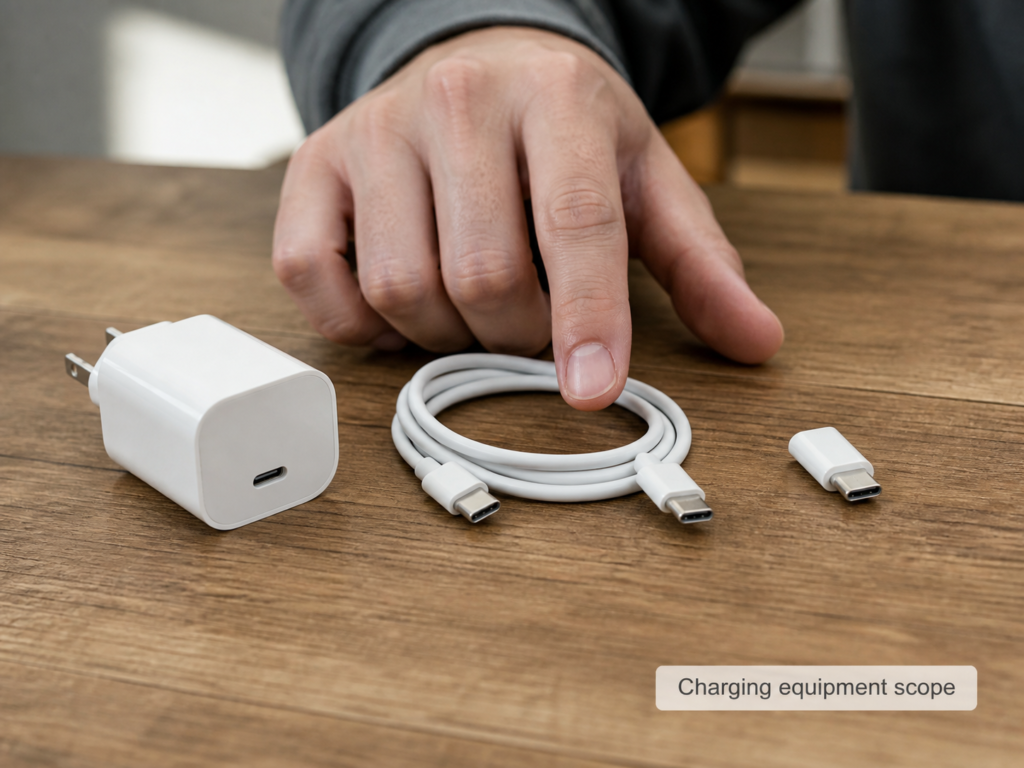
The applicable scenarios cannot be judged solely by sales channels: whether you are engaged in cross-border retail, B2B wholesale, or offline distribution, as long as the products enter the EU market for circulation, you shall assess whether local WEEE obligations are triggered.
The statutory exclusion scope of WEEE is not limited to special customized products for military and medical use. For example, equipment specially designed and installed as a component of other excluded equipment, large fixed installations, stationary large-scale industrial tools, some means of transport, equipment for specific professional purposes, and active implantable medical devices, etc., may not fall within the scope of the Directive. Ordinary medical equipment will not be automatically exempted just because it is “medical” or “customized”. The actual applicability shall be subject to the WEEE Directive and the transposition laws of the target country.
What Are the Consequences of Non-Compliance?
Don’t think compliance is a trivial matter. Non-compliance may lead to measures taken by the competent authorities of member states such as restricting placement on the market, ordering rectification, and administrative penalties; e-commerce platforms may also require verification of registration information or restrict sales in accordance with their rules.
Whether there will be cargo detention, return, destruction, how fines are calculated, and whether the platform will remove products, restrict accounts or take other measures shall be subject to the laws of the target country, decisions of law enforcement agencies and platform terms; these results cannot be regarded as unified and fixed WEEE consequences across Europe.
4 Common Entry-Level Misconceptions for Novices
These misconceptions are the most common ones made by sellers who are new to this field. Remembering them clearly in advance can save you a lot of detours:
First, WEEE is not equal to EPR. EPR is a broad responsibility framework that includes requirements for categories such as packaging and batteries in addition to WEEE for electronic products. In addition to WEEE, packaging EPR shall be assessed country by country; if the product contains batteries, battery regulations and EPR obligations shall also be assessed. Whether registration, declaration, and fee payment are triggered, and whether there are thresholds or simplified arrangements, shall be subject to the laws and system rules of the target country.
Second, the CE mark cannot replace WEEE. The CE mark is a compliance mark indicating that a product meets the requirements of applicable EU harmonized regulations, usually based on the manufacturer’s conformity assessment and EU declaration of conformity; the regulations it involves may include safety, electromagnetic compatibility, RoHS, etc. WEEE governs the obligations of recycling, registration and declaration after product scrapping, and the two cannot replace each other.
Third, there is no such thing as an “EU-wide universal WEEE number”. WEEE in each country is registered and managed separately, and no single number can cover all EU countries. Anyone who claims to sell a “pan-European universal number” is basically a scam.
Fourth, the vast majority of countries do not have full exemption policies for small sellers or small-volume goods. Don’t think that you don’t need to comply just because you only sell dozens of orders a month. As long as the product is placed on the market, you shall first confirm whether there are applicable registration, declaration or simplified rules locally.
Boundary Judgment: Does Your Charging Product Need Compliance? Which Category Does It Belong To?
After clarifying the basic concepts, what you care about most is definitely whether your product needs compliance and how to classify it correctly. In fact, you can make a quick judgment in just 3 steps.
3 Steps to Quickly Judge the Necessity of Compliance
Step 1: Check whether the product is electrical and electronic equipment. Chargers and power adapters usually belong to EEE; cables, connectors or adapters cannot be judged solely by “whether they are charging accessories”, but depend on whether they rely on electric current or electromagnetic fields to work properly, and how the rules of the target country classify them.
Step 2: Check who the legally responsible entity is in the target country’s market. Whether you ship directly from China, use overseas warehouses, or use platform warehouses, and whether you sell to individual consumers or corporate customers, WEEE obligations may be triggered. However, who ultimately bears the producer’s obligations shall be confirmed in accordance with the definition of producer in the target country’s laws, brand identification, import arrangements, sales targets and actual contract chain.
Step 3: Check whether the product falls within the statutory exclusion scope. The exemption scope shall be subject to Article 2 of the WEEE Directive and the implementation laws of the target country, and cannot be simply understood as only special customized products for military and medical use are exempted.
If the product belongs to EEE, the relevant entity meets the definition of “producer” in the target country, and does not fall within the exclusion scope, the WEEE compliance steps required by the local authority shall be completed.
Common WEEE Classifications for Charging Products
After confirming that compliance is required, the next step is to classify the products. Classification directly affects registration and declaration, and cannot be done randomly.
Chargers, power adapters and accessories with independent electronic functions shall be classified in accordance with the category rules of the registration authority or performance system of the target country. The EU adopts six categories of EEE, and there is no unified “electronic cable/accessory” category.
For example, chargers and power adapters are usually treated according to applicable categories in the target country such as small equipment; for data cables with chips, indicator lights or other functions, technical documentation shall be provided, and the registration authority, compliance system or professional opinion of the target country shall confirm whether they belong to independent EEE and the applicable category.
Classification naming, registration methods and fee categories may vary slightly from country to country, which shall be subject to the official rules of the target country.
Core Basis for Classification
Many sellers will ask: Can I classify according to the customs HS code? The answer is no.
The core of WEEE classification is the function, purpose and structure of the product, which has nothing to do with the logic of customs HS codes. You cannot exempt yourself from WEEE obligations or choose a category randomly on the grounds that “customs classifies it into other categories”.
If you are really unsure about the category of your product, the safest way is to organize the product’s photos, parameters, and uses into materials, and submit them to the registration authority of the target country, applicable compliance system or professional service provider for confirmation, to avoid subsequent problems.
Judgment Rules for Easily Confused Products
There are several frequently confused products in the charging category that require special attention:
• Multi-port chargers: No matter how many USB-A or USB-C ports they have, they shall usually be handled according to the equipment function of the charger main body and the classification rules of the target country, and shall not be split only by the number of ports;
• Data cables with chips and indicator lights: They cannot be directly classified as cables or accessories just because “the core function is a cable”; it shall be confirmed whether they belong to independent EEE and the applicable category in combination with their electronic functions and the rules of the target country;
• Charging accessory sets: The main unit and accessories in a set shall be judged according to the EEE definition, registration category and actual placing entity of the target country. When placed on the market as the same set by the same producer, some countries or performance systems may allow combined declaration according to their rules; however, this does not automatically exempt the accessories from WEEE assessment, registration or declaration obligations;
• Gifts, samples, after-sales replacement parts: Even if they are given to customers for free, as long as they are placed on the EU market, it shall be assessed whether they need to be included in local WEEE obligations; “free of charge” cannot automatically be a reason for exemption.
Determination of Responsible Entities: Who Must Register? Who Can Handle It on Behalf of Others?
Many sellers will struggle: I am a cross-border seller in China, do I not need to register? Can I let the supplier be responsible? In fact, the responsible entity cannot be judged only by who ships the goods; the key is the definition of “producer” in the target country’s laws and the actual transaction chain.
Criteria for Determining “Producer”
The “producer” referred to in WEEE does not only refer to the manufacturing factory, but an entity that meets the definition of producer in the target country’s laws.
Common responsible entities may include: brand owners or importers within the EU, cross-border sellers with own brands, entities that resell products under their own names, and sellers that conduct distance sales to consumers in the target country.
Direct mail, overseas warehouses, platform warehouses and B2B transactions may all trigger WEEE obligations in the target country, but the responsible entity shall be confirmed on a case-by-case basis in accordance with the definition of producer in the target country’s laws, brand identification, import arrangements, sales targets and actual contract chain. The attribution of responsibility cannot be directly concluded just because “it is the first to be sold to Germany” or “it is shipped directly from China”.
If you sell products of multiple brands at the same time, you shall check whether the target country’s registration system requires brands to be registered one by one in the producer registration, registered by brand and equipment category, or allows the same producer to declare multiple brands under one registration account; you shall not use registration information that does not belong to your own legal entity and applicable scope without authorization.
EU Authorized Representative Requirements for Non-EU Sellers
If you are a cross-border distance seller, you shall check the WEEE authorized representative requirements country by country.
Some countries require producers not established in the country to appoint a local authorized representative; whether it covers third-country sellers, when it must be appointed, and the qualifications and responsibilities of the authorized representative shall be subject to the WEEE implementation law and registration authority requirements of the target country.
The authorized representative may assist in receiving local official notifications, completing registration and declaration, and liaising with regulatory authorities and compliance systems. It should be noted that the WEEE authorized representative requirements cannot be confused with the authorized representative requirements in product regulations such as CE, and the scope of authorization shall also cover the target country and corresponding WEEE obligations.
Responsibility Division for Different Sales Models
No matter what model you use for sales, the determination of responsibility cannot be based solely on the shipping method, but there are several common scenarios that require special explanation:
• Direct mail, overseas warehouses, platform warehouses: All three models may trigger WEEE obligations in the target country, but the responsible entity shall be judged in combination with the brand, import arrangements, distance sales relationship and local laws;
• B2B sales: Selling to corporate customers does not automatically exempt from WEEE responsibilities. EEE from non-household sources may have different rules on financing, recycling and historical waste compared to EEE from household sources, which shall be confirmed according to the system of the target country;
• Cooperation with distributors and importers: The contract may stipulate who is responsible for operation, declaration and bearing costs, but it cannot automatically change the legally responsible entity determined by the competent authority;
• E-commerce platforms: Platforms may verify WEEE registration information and restrict the sale of unregistered products in accordance with their own rules and the laws of the target country, and may bear the obligations of market operators or distributors as stipulated by the laws of the target country. Whether a platform constitutes a legal producer under a specific model shall be judged in accordance with the laws of the target country and actual sales arrangements.
Pitfall Avoidance Tips for Multi-Entity Cooperation
If you cooperate with suppliers, peers or other brands, there are two pitfalls you must avoid:
First, you must never share the WEEE registration number of a factory, peer or supplier. Each registration information has a corresponding entity and scope of application. Using someone else’s number is a risk of fraudulent use, which may lead to penalties, rectification or invalidation of registration.
Second, when multiple parties cooperate, it must be clearly written in the contract who is responsible for registration, who is responsible for declaration, and who bears the costs, to avoid mutual shirking of responsibility when problems arise later. But also remember that contracts cannot replace the determination of responsible entities by local laws.
Full Registration Process: From Preparation to Obtaining the WEEE Registration Number
After confirming that you may need to register, the next step is the specific registration process. The steps are not necessarily complicated; the key is to first confirm the system of the target country, and do not confuse the registration authority, compliance system and service provider.
Preparations Before Registration
Before officially submitting the registration, you need to do 3 things first:
First, determine your target sales countries. WEEE is registered by country, so you don’t need to register all EU countries at the beginning. Just select the countries where you actually plan to sell first, which can save a lot of costs.
Second, check whether the target country requires producers not established locally to appoint a WEEE authorized representative; if required, you shall select a qualified local authorized representative and sign an agreement.
Third, prepare registration materials, which usually include: business license, brand certificate (trademark certificate or brand authorization letter), product list, product classification materials, unit weight or other data required for declaration, estimated annual sales volume, and materials on authorized representatives or import arrangements required by the target country’s system.
General Registration Steps
After preparing the materials, the registration process can usually be advanced according to the following ideas:
Step 1: Confirm the statutory registration authority, producer registration process of the target country, and whether it is necessary to join a compliance system or recycling system. You can handle it yourself or find a service provider to assist, but the service provider cannot automatically replace the statutory registration authority.
Step 2: Submit the materials as required by the registration authority, and pay the applicable registration fees or other fees.
Step 3: Complete the statutory producer registration in the target country and obtain the corresponding registration information or registration number. The review cycle varies from country to country, so it is recommended to prepare in advance.
Step 4: After getting the number, you shall timely file it in the backend of the e-commerce platform where you open your store. When filing, check whether the entity, brand and category are consistent with the registration information, otherwise the filing may fail.
Selection Criteria for Service Providers/Agents
There are many institutions providing WEEE services now, and novices can easily fall into pitfalls. When choosing, focus on 4 points:
First, they should be able to clearly explain the statutory registration authority of the target country, the registration process, their own service scope, and whether they cooperate with local compliance systems or recycling systems. Do not mistake “service provider qualification” for “the service provider can issue WEEE registration numbers on its own”.
Second, the fees shall be transparent. The amounts of registration fee, annual management fee, declaration service fee, and system fee shall be clearly written in the contract, and there shall be no hidden charges.
Third, supporting services shall be complete. For example, there shall be guidance during declaration, special personnel to answer questions about how to affix the mark, and timely reminders when regulations are updated, instead of ignoring you after receiving the money.
Fourth, be wary of low-price traps. Anyone who claims to be able to handle an “EU-wide universal WEEE number” or “guaranteed approval without providing materials” is a scam. Don’t believe it, otherwise you will be the one who suffers in the end.
Ongoing Compliance: Marking Affixation, Periodic Declaration and Fee Payment
Obtaining the WEEE registration number is only the first step; subsequent marking affixation and regular declaration are long-term tasks. Many sellers just ignore it after getting the number, and end up with compliance problems.
Correct Way to Affix the WEEE Mark
The WEEE mark is the pattern of a crossed-out trash bin. Although it looks simple, incorrect affixation may also lead to non-compliance.
First is the style: it must be the standard crossed-out trash bin pattern, and the size shall meet the minimum legibility requirement, and cannot be so small that it is unreadable.
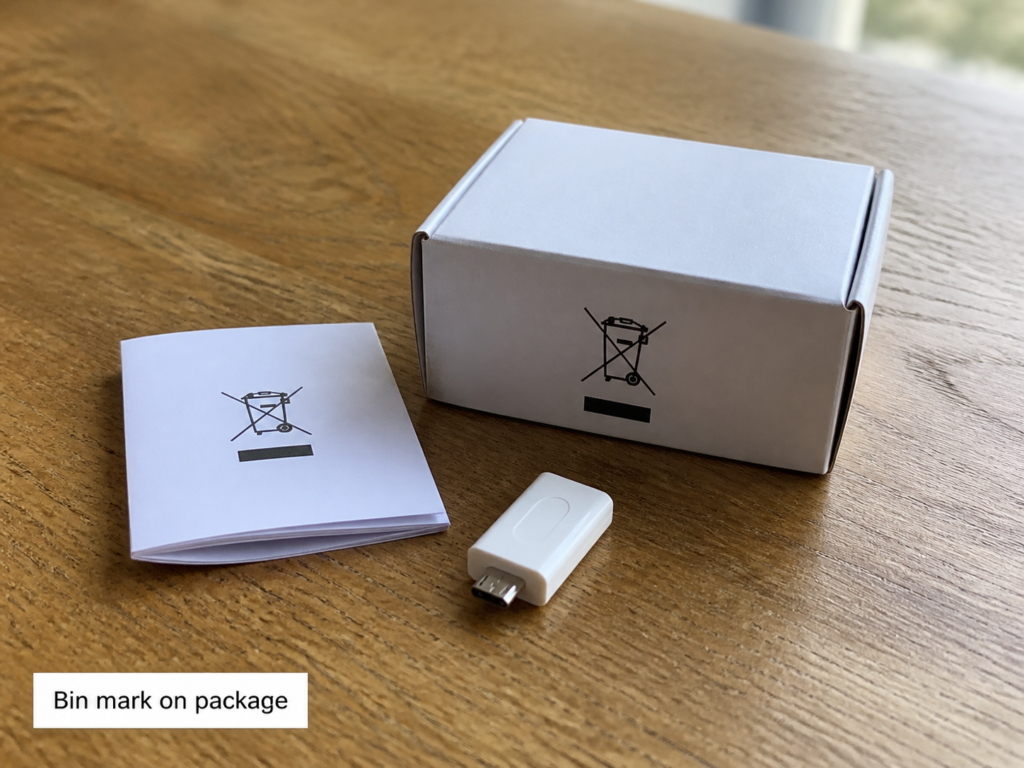
Then is the affixation position: the crossed-out trash bin mark shall in principle be affixed to the EEE itself; only when it cannot be affixed to the body due to the size or function of the equipment can it be affixed to the packaging, user manual or warranty certificate. For very small data cables and connectors, first determine whether the product belongs to EEE; if it belongs to EEE and really cannot be marked on the body, alternative positions such as packaging or manuals can be used according to the rules.
It should be noted that the mark shall not be blurred, blocked by other things, nor replaced by the CE mark or ordinary recycling arrows. Whether information such as the date of placing on the market needs to be marked shall be handled in accordance with applicable standards and the requirements of the target country.
Core Logic and Cycle of Declaration
Many novices think that getting the number is the end of the matter. In fact, subsequent declaration of the placement volume according to local requirements and bearing applicable recycling financing fees are usually required.
The declaration unit may be the number of products, weight, or both. Whether gifts, samples, and after-sales replacement parts are included in the placement volume shall also be handled in accordance with the rules of the target country and the requirements of the applicable system.
The declaration cycle varies from country to country, and may be monthly, quarterly, annually, or in accordance with the settlement arrangements of the compliance system. The specific implementation shall be subject to the written requirements of the registration authority, competent authority and applicable system of the target country.
Late declaration, false declaration or under-declaration may result in supplementary payment, late fees, fines, rectification or other consequences, and in severe cases, may also affect the continued placement of products locally.
Fee Composition and Influencing Factors
The fee items, declaration criteria and settlement methods of WEEE vary by country, registration authority and compliance system, and may include registration fees, fixed management fees, minimum charges, advance payments, or recycling financing fees settled by weight, number of pieces, or category.
Charges for different categories and different countries may vary greatly, but you cannot presuppose that chargers are necessarily more expensive than data cables, nor can you think that advance payments are non-refundable. Whether the advance payment difference can be refunded, carried forward or adjusted shall be subject to the system of the target country and the price list and settlement terms of the selected system.
There are also many variables affecting the final cost: sales country, product classification, annual sales volume, declaration frequency, applicable compliance system and service contract may all affect the actual cost.
Declaration Materials and Record Keeping Requirements
The declaration unit, required supporting documents and retention period are not uniformly regulated by the EU.
Operators shall keep data and vouchers that can support the declaration of placement volume, such as sales records, product classification materials, weight or quantity data, registration certificates and payment records. The registration authority, competent authority or compliance system of the target country may require other materials, but the specific document list shall be subject to their written requirements.

The record retention period shall also be implemented in accordance with the applicable regulations of the target country, and cannot be uniformly understood as 3 to 5 years. The more complete the usual archiving is, the easier it is to explain the situation when encountering platform verification, system check or regulatory inquiry.
Scenario Differences: Compliance Differences Between Different Markets and Sales Models
There are dozens of countries in Europe, each with slightly different rules, and different sales models have different requirements. We have sorted out the differences in markets and models that charging product sellers most frequently contact to help you avoid detours.
| Market/Region | Regulatory Strictness | Registration Characteristics | Fee Level | Precautions |
| Germany | Strictest | Registered through officially designated systems, with a long registration cycle | Relatively high | Clear classification rules and high verification frequency |
| France | Relatively strict | WEEE, packaging and batteries belong to different EPR responsibility streams, and the applicable unique producer identification number, eco-organization or individual performance, declaration and payment requirements shall be confirmed separately | Medium | Relevant data or identification information can be managed in association in the competent system, but cannot replace each other |
| Italy/Spain/Netherlands | Medium | Classification details are slightly different from those in Germany | Medium | Regulation is becoming stricter, and verification intensity has increased significantly in recent years |
| Nordic countries | Relatively strict | Mature processes and clear rules | High | High labor costs and expensive recycling and treatment fees |
| Central and Eastern European countries | Relatively loose | Rules are updated quickly | Relatively low | Follow up on regulatory changes in time to avoid missing update requirements |
| United Kingdom | Relatively strict | Independent system after Brexit, EU registration numbers are completely invalid | Medium | Need to register for the UK version of WEEE separately |
In addition to national differences, there are also some differences in compliance requirements for different sales models:
• B2C sales: The financing, recycling and declaration rules for EEE from household sources shall be handled in accordance with the system of the target country, and cannot be simply understood as being “fully borne” by the seller in all cases;
• B2B sales: EEE from non-household sources may have different rules on financing, recycling and historical waste. Some non-household source products can arrange financing responsibilities through agreements within the scope permitted by the Directive and recognized by the target country’s laws, but whether the declaration is simplified shall be subject to the local system;
• Direct mail, overseas warehouses, platform warehouses: All three models may require completion of WEEE obligation assessment and registration in the target sales country. Compliance requirements cannot be judged only by the shipping location, nor can the responsible entity be simply judged only by the consumer’s receiving country.
Ideas for Optimizing Compliance Costs for Pan-European Sales
If you are doing the Pan-European Plan and selling to many countries, will the compliance cost be very high? In fact, as long as the method is correct, you can save a lot of money. Here are 4 practical optimization ideas:
First, register according to sales priority. Register core countries with large sales volume such as Germany, France and Italy first, and supplement other small countries after you have stable sales. You don’t need to register all of them at the beginning, which is a waste of money.
Second, products of the same brand and same category shall be managed and declared in a combined manner as permitted by local authorities as much as possible, to reduce duplicate management costs, and there is no need to set up separate accounts for each product.
Third, try to keep the estimated sales volume close to the actual situation. Different systems may adopt advance payment, minimum charge or subsequent settlement mechanisms. Too high or too low estimates may affect cash flow and subsequent adjustments, so adjustment, carry-over or refund clauses shall be confirmed in advance.
Fourth, choose a regular agent for long-term cooperation. Frequent replacement of agents is prone to connection gaps, such as interruption of declaration and errors in information transmission, which will instead increase costs and risks. Finding a reliable long-term partner is more worry-free.
Pitfall Avoidance and Inspection: Common Violations and Self-Inspection Remedies
Even if you think you have done a very good job, there may be things you have overlooked. We have sorted out the most frequent violation scenarios for charging product sellers, as well as self-inspection and remedy methods.
6 Most Frequent Violation Scenarios for Charging Product Sellers
These pitfalls are the most common ones for charging product sellers. You can check whether you have them:
1. Using a non-existent “EU-wide universal WEEE number”, which is the most common scam, and will be directly deemed a violation once found out;
2. Incorrect product classification, such as classifying chargers into an inapplicable low-fee category to intentionally underpay fees. Once found out, you will not only have to make up the payment, but may also face penalties;
3. Missing the WEEE mark on small EEE that should be marked. In principle, it shall first be marked on the product body; only when it cannot be marked on the body due to size or function can it be marked on the packaging, user manual or warranty certificate;
4. Fraudulently using others’ registration numbers, such as those of factories, peers or suppliers. Each registration information has a corresponding entity and scope, and fraudulent use is a serious violation;
5. Only registering but not declaring, thinking that getting the number is a once-and-for-all solution. Missing sales volume declaration may result in late fees, and in severe cases, will affect the registration status;
6. Only complying with WEEE and ignoring EPR requirements for packaging and batteries. Both packaging and battery obligations shall be assessed country by country. You cannot directly apply unified rules just because the product has packaging or contains batteries, nor can you make no judgment at all.
3-Minute Quick Self-Inspection Checklist
You can spend 3 minutes quickly going through these 4 items to check for obvious compliance problems:
• Check qualifications: Do you have a valid WEEE registration number for the corresponding sales country, and are the registered entity, brand and product scope consistent with the actual store and sales arrangements;
• Check products: Whether charging products belonging to EEE are affixed with a compliant WEEE mark as required. In principle, it shall be marked on the product body; only when it cannot be marked on the body due to size or function can alternative positions such as packaging, manuals or warranty certificates be used;
• Check declaration: You have truthfully declared the placement volume according to the required cycle, and payment vouchers and supporting data are well kept;
• Check agent: Can the agent or service provider you cooperate with clearly explain their service scope, the target country’s registration process and their cooperation with the local compliance system, and are they not an unqualified black intermediary.
Key Points of Compliance Verification by Cross-Border Platforms
Now all major e-commerce platforms are checking EPR compliance, and the verification logic is actually very simple:
First, you are required to upload the corresponding EPR registration number for verification;
There are two core points of verification: first, whether the entity of the registration number is consistent with the entity of your store, and second, whether the product category you sell matches the category you registered;
If the verification fails, the platform may restrict the sale of corresponding category products, require supplementary materials or take other measures. The specific measures shall be subject to the backend rules and the requirements of the target country.
Remedial Steps After Violation
If you accidentally violate the rules, don’t panic, just take remedial measures according to the corresponding situation:
• If the platform removes the listing: first confirm what is missing — is it no registration number, no mark affixed, or no declaration? After completing the corresponding materials, submit an appeal according to the platform’s requirements;
• If there is missed declaration or late declaration: quickly make a supplementary declaration and pay the fees, and handle late fees or other consequences according to regulations. Don’t delay, it will be troublesome if the registration status is affected;
• If the product classification is wrong: resubmit the classification materials as soon as possible, make up the previous fee difference, and keep the correction records to avoid being checked again later;
• If other EPR categories are missed: for example, only WEEE is done and packaging EPR is not assessed, confirm as soon as possible whether corresponding registration and declaration need to be supplemented according to the rules of the target country.
Full-Cycle Practical Summary
Finally, we have sorted out the entire WEEE/EPR compliance process into an actionable checklist, as well as a refinement of the core logic, for your convenience to check at any time.
Full-Cycle Inspection Checklist for WEEE/EPR of Charging Products
• Before listing: First confirm whether the product belongs to EEE and the applicable category → complete the WEEE registration required by the target country → affix the WEEE mark as required → complete the filing in the platform backend → assess packaging EPR country by country, and battery regulations or EPR obligations when the product contains batteries;
• During sales: Count the placement volume according to the declaration cycle → declare on time and pay applicable fees → keep all vouchers and records → regularly monitor whether the registration status, authorized representative or service arrangement remains valid;
• When delisting: Stop new placement → go through business suspension, cancellation or status change procedures according to the procedures of the target country’s registration authority and applicable compliance system → complete the final declaration, settlement and statutory archiving. Historical responsibilities related to products already placed on the market shall still be handled in accordance with local rules.
Core Compliance Logic Refinement
In fact, the entire WEEE/EPR rules are both complex and simple. The core is three sentences. Remember these three sentences and you won’t make big mistakes:
First, the responsible entity shall be judged according to the definition of producer in the target country’s laws and actual transaction arrangements; for cross-border distance sales, the authorized representative requirements shall also be checked country by country;
Second, for whichever country you sell to, assess the registration and declaration obligations of that country; there is no so-called EU-wide universal certificate;
Third, truthfully declare the placement volume in accordance with the regulations of the target country, and bear applicable fees in accordance with the local registration system, compliance system and settlement rules.
Abilities You Can Master After Learning
After reading this guide, you should be able to do the following things:
• Judge whether your charging products need WEEE/EPR assessment;
• Clarify which countries need to be assessed and who may be the responsible entity under different sales scenarios;
• Master the full process operation from registration, mark affixation to declaration and fee payment;
• Be able to check compliance risks by yourself, and avoid service provider scams and common violation pitfalls.
Overall, WEEE/EPR compliance in Europe seems cumbersome, but as long as you sort out the logic and plan in advance, it will not add too much extra cost. On the contrary, it can help you avoid greater losses such as listing removal, cargo detention and fines. For sellers of rigid-demand categories such as charging products, compliance is the foundation of long-term operation, and the earlier you plan, the more proactive you will be.