
When you take off a sweater in winter and touch a USB-C charging port, your phone stops charging as soon as you plug it in, or even the device restarts directly? When you use fast charging next to a microwave oven, the original 65W power suddenly drops to 10W? When the air conditioner at home starts up, the charger makes a “ding-dong” sound and renegotiates the protocol? These phenomena may sometimes be related to electromagnetic compatibility or immunity, but they can also be caused by protocol compatibility, poor contact, over-temperature protection, power supply capacity, or equipment failure. The cause cannot be judged solely by the phenomena.
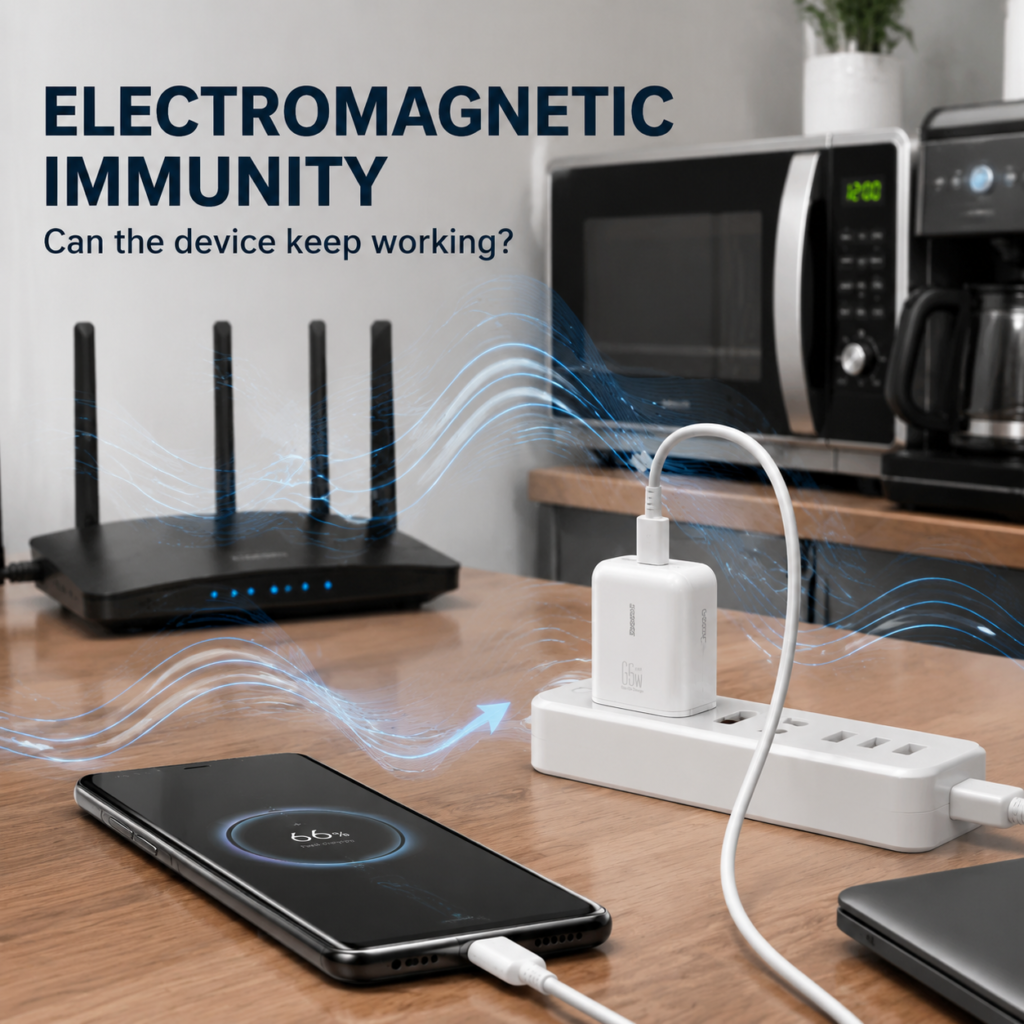
Electromagnetic immunity focuses on whether a device can continue to work normally in the presence of external interference. The European Union’s EN 55035 is a product family standard for immunity applicable to multimedia equipment within the specified scope. It may be related to some chargers, smart charging devices, or cables with electronic functions, but whether a specific product is applicable still needs to be judged in combination with equipment classification, functions, ports, and other applicable standards.
First, figure out: What exactly does EN 55035 regulate?
EN 55035 is an electromagnetic immunity product family standard applicable to multimedia equipment (MME) within its scope. Simply put, it is used to evaluate whether such equipment can continue to perform its declared basic functions when subjected to external interference such as static electricity, radio waves, and power transients.
Whether a certain charger, smart charging device, or cable with electronic functions is subject to EN 55035 cannot be determined only by whether it has a protocol chip or USB interface, but must be judged in combination with its functions, equipment classification, ports, and whether there is a more applicable product standard.
Electromagnetic immunity is abbreviated as EMS, which can be understood as the ability of a product to “not be disturbed”. It is two different directions from electromagnetic emission (EMI): EMI focuses on whether a product will generate interference exceeding the limit value outward, affecting other equipment; EMS focuses on whether the product can still work normally after being subjected to external interference.
In terms of standard identity, EN 55035 is a harmonized standard that can be used to support the conformity assessment of the EU EMC Directive. Within its scope of application, if the effective version listed in the Official Journal of the European Union is adopted, it can generate a presumption of conformity for the corresponding essential requirements; however, manufacturers can also adopt other applicable technical specifications to prove conformity, and harmonized standards are not the only technical path.
For products falling within the scope of relevant multimedia equipment, EN 55032 is usually used for emission assessment, and EN 55035 is used for immunity assessment. But the specific applicable standards depend on product classification, functions, and applicable harmonized standards, and it cannot be generalized that all charging products must adopt both standards at the same time. Certain products may be subject to dedicated product standards or other general standards.
A special reminder here: EN 55035 only involves electromagnetic immunity performance within its applicable scope, and is not an electrical safety standard. It cannot prove that the product has no safety risks such as electric shock, overheating, or insulation failure. These issues need to be evaluated in accordance with corresponding safety regulations and standards.
For ordinary users, charging products with good immunity design usually have a better chance of maintaining stable operation in daily electromagnetic environments; but a single charging interruption, power drop, or restart cannot directly prove that the product has not passed EN 55035. For merchants selling charging products, you cannot conclude that this standard must be adopted just because the product has smart functions, but should first confirm the regulatory classification and applicable standards of the product.
There is another common misunderstanding: Having a CE mark does not mean that the product must have adopted EN 55035. The CE mark itself does not require EN 55035 to be clearly marked on the packaging or product detail page. Manufacturers shall complete the conformity assessment, prepare the EU Declaration of Conformity and keep the technical documentation. Consumers or purchasers can request to view the declaration of conformity, list of applicable regulations and standards, and then check the product model and version.
Which charging products need to comply with EN 55035? Judge in two steps
Many people will ask: Do all chargers with USB ports need to do EN 55035? In fact, you can’t judge like that. You can first narrow down the scope by the following two steps:
First step: Look at the actual function and equipment classification of the product. Does it have data processing, display, communication, wireless connection or other multimedia equipment characteristics? Does it fall within the scope of multimedia equipment covered by EN 55035?
Second step: Check whether the product has a more applicable product standard or dedicated standard, and whether it is placed on the EU market as an independent device.
Therefore, “with protocol chip”, “with E-Marker” or “with USB interface” can only indicate that the product may have electronic or communication functions, and cannot automatically lead to the conclusion that “EN 55035 must be adopted”.
Charging products that clearly need to have their applicability evaluated first
The following products usually require EMC assessment, but whether EN 55035 is adopted must first confirm whether they are applicable multimedia equipment and whether there is a more suitable product standard:
- USB-C/USB-A chargers and power adapters with fast charging protocol chips such as PD and QC;
- Smart chargers and wireless charging pads with screen display, smart control, Wi-Fi or Bluetooth functions;
- USB-C docking stations with charging function, multi-port smart charging stations;
- USB-C fast charging cables with E-Marker chips.
For example, E-Marker allows the cable to provide information such as cable capabilities to connected devices, but whether the cable is a regulated device that requires separate relevant EMC conformity assessment still depends on its specific functions, whether it is placed on the market independently, and applicable regulations. It is not possible to automatically determine that EN 55035 must be adopted just because of the presence of an E-Marker chip.
Situations where it should not be directly applied or require further confirmation
The following products cannot simply and directly apply EN 55035:
- Passive ordinary charging cables without electronic components: such cables are usually not typical multimedia equipment targeted by EN 55035, but whether other forms of assessment are required still depends on whether they are regulated equipment, whether they are placed on the market independently, and their specific functions;
- Minimalist chargers that only perform basic 5V voltage conversion and have no protocol or data functions: for example, some old-fashioned 5V1A charging heads may not fall within the applicable scope of EN 55035, but the applicable EMC standards still need to be confirmed according to product classification;
- Charging equipment dedicated to industrial, automotive, and medical use: the applicable regulations, product standards, and equipment classification should be confirmed first. If dedicated standards cover relevant EMC requirements, priority should be given to assessment according to applicable dedicated standards, but exemption cannot be determined solely by product names such as “industrial”, “automotive” or “medical”;
- Passive charging cables sold together with matching adapters: when passive cables are part of the complete machine configuration, they should be evaluated in the representative configuration of the complete machine; but whether separate assessment is required cannot be determined solely by whether they are sold in a package.
Common boundary misunderstandings that are easy to step into
There are two common judgment errors here:
First, Having a USB port does not mean the standard applies. If it is a USB interface product that only provides pure power supply and has no smart or protocol functions, you still need to first confirm the product classification and applicable standards.
Second, Not all products with chips must be tested separately. Whether accessories with chips require separate assessment depends on whether they are placed on the market as independent devices, what functions they have, and how the complete machine configuration and manual are defined. Assessment along with the complete machine does not mean that all independent sales situations can be exempted from separate conformity requirements.
Don’t confuse: Several groups of EMC standards that are easy to misidentify
People who are new to EMC can easily mix up several standards. Understanding what each is responsible for helps in reading test reports and judging product compliance paths.
EMS and EMI: The two core directions of EMC
EMC (Electromagnetic Compatibility) is a broad category, with the core goal of enabling equipment to work normally in an electromagnetic environment while not causing unacceptable interference to other equipment.
It usually includes two directions:
- EMS (Electromagnetic Immunity): The ability of a product to resist external electromagnetic interference, that is, “not afraid of being disturbed”;
- EMI (Electromagnetic Emission): The situation where a product generates electromagnetic interference outward, that is, “does not disturb others”.
EN 55035 evaluates immunity within the scope of applicable multimedia equipment, while EN 55032 is used for emission requirements of relevant multimedia equipment. Emission assessment not only involves whether the product will interfere with Wi-Fi, but also includes items such as radiated emission and port conducted emission specified in the standard.
EN 55035 and EN 55032: Common supporting standards
For products falling within the scope of relevant multimedia equipment, these two standards often appear together:
- EN 55035: Immunity assessment, focusing on whether the equipment can work normally after being interfered;
- EN 55032: Emission assessment, focusing on the radiated and conducted interference generated by the equipment outward.
But they are not a “fixed combination” that all charging products must adopt at the same time. The actual choice depends on product classification, functions, ports, and whether there is a more applicable dedicated product standard. Only when the relevant standards actually cover the equipment and its functions can the corresponding emission and immunity assessments be carried out accordingly.
EN 55035 and IEC 61000-4 series: Differences between requirements and methods
Many people confuse these two series, and some merchants even use a single IEC 61000-4 report to pass off as a complete EN 55035 report. In fact:
The IEC 61000-4 series mainly specifies the methods and conditions for specific immunity tests, such as how to implement electrostatic discharge, radio frequency radiation, or surge tests. It is not automatically applicable to all electrical and electronic products, nor does it mean that every product must complete all items of this series. Which specific items are applicable is usually determined by product standards or other applicable standards.
EN 55035, on the other hand, specifies which immunity tests need to be carried out, what levels to adopt, and how to judge the performance of the equipment for multimedia equipment within the applicable scope.
Only when the product falls within the applicable scope of EN 55035, the adopted version is valid, and the applicable complete assessment is completed, can EN 55035 be used as a harmonized standard to support the presumption of conformity under the EMC Directive. A single IEC 61000-4 item report cannot replace a complete EN 55035 assessment.
| Comparison Item | EN 55035 | IEC 61000-4 Series |
|---|---|---|
| Standard Positioning | Immunity product family standard for applicable multimedia equipment | Standard for methods and conditions of specific immunity tests |
| Applicable Objects | Multimedia equipment within the scope of EN 55035 | Specific applicable items are determined by product standards, and do not automatically cover all electrical and electronic products |
| Core Function | Specifies applicable test items, levels and performance criteria | Specifies unified test operation methods and test conditions |
| Can it be used alone as a basis for EU CE-EMC access | Only when the applicable scope, valid version and complete assessment conditions are met can it support the corresponding presumption of conformity | Cannot replace product standards or complete EMC conformity assessment |
Core Test Items: Corresponding to These Charging Faults You Encounter
EN 55035 involves many test items, and each test is used to simulate a certain type of electromagnetic environment. However, daily fault phenomena and specific test items cannot be simply equated, and the real cause still needs to be confirmed through controlled tests and fault troubleshooting.
1. Electrostatic Discharge (ESD) Immunity Test
Simulated scenario: Electrostatic shock when plugging and unplugging charging cables or touching USB-C ports after taking off a sweater in winter.
Test points: Charging plugs, USB interfaces, product metal shells, buttons and other places that are easily accessible to the human body. The specific positions shall be determined according to the standard and equipment structure.
Common abnormalities: Charging interruption, fast charging protocol disconnection, automatic device restart. If the protection is insufficient, ESD may also cause permanent damage; permanent damage usually cannot meet the corresponding immunity performance requirements.
Common household level: Contact discharge 4kV, air discharge 8kV. The specific values and applicable conditions are subject to the applicable standard version and test tables.
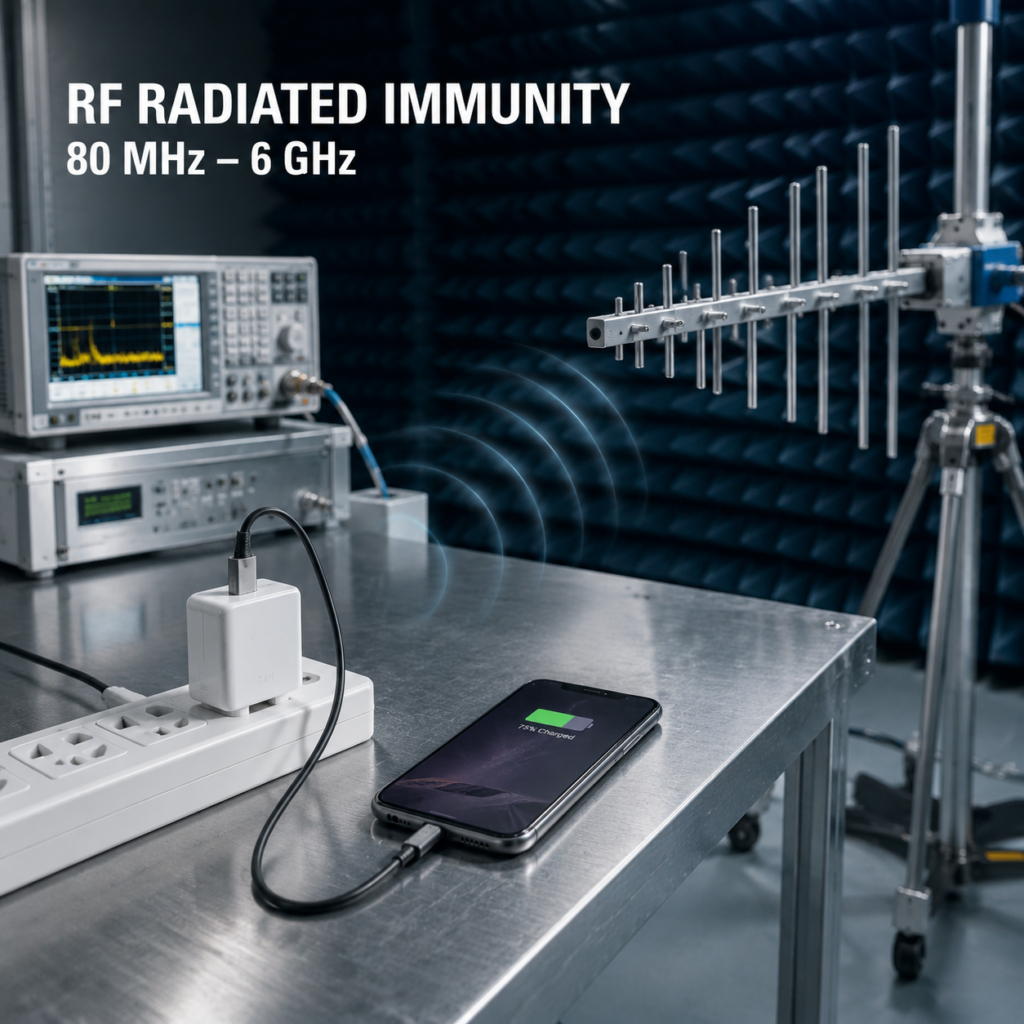
2. Radio Frequency Radiated Immunity Test
Simulated scenario: Interference from radio frequency signals emitted by wireless devices such as nearby mobile phone base stations, routers, and walkie-talkies.
Test frequency range: 80MHz—6GHz. The specific range is subject to the applicable standard version and equipment category.
Common abnormalities: Charging current fluctuates back and forth, USB-C identification fails, frequent charging interruptions, and smart chargers with screens may also display abnormalities.
Highly sensitive products: Smart chargers with Wi-Fi or Bluetooth functions, wireless charging pads, etc. They usually include more communication and control functions, but whether they are more prone to problems still depends on the specific design, and conclusions cannot be drawn solely based on product type.
3. Electrical Fast Transient Burst (EFT) Immunity Test
This name sounds awkward, you can understand it as “small glitches” in the power grid.
Simulated scenario: A series of high-frequency transient spikes on the power line when plugging and unplugging plugs, or when nearby equipment such as air conditioners and refrigerators start and switch.
Test points: Usually involves the power input end of the charger. The specific ones shall be determined according to the ports and coupling methods specified in the standard.
Common abnormalities: Output voltage fluctuation, short-term charging interruption, fast charging protocol reconnection.
4. Surge Immunity Test
Simulated scenario: Large voltage shock caused by lightning activity or power grid switching.
Test points: Surge is mainly evaluated for AC or DC power ports and specified related ports according to applicable conditions. Whether the USB output port needs to be tested and what level to adopt depends on port classification, cable length, equipment configuration and standard tables, and cannot be generalized.
Common abnormalities: Fuse blown, power chip damaged, unable to charge normally after the test. Whether these faults actually occur depends on product design and test conditions.
Common household level: Some civil scenarios involve levels such as 1kV/2kV line-to-ground, but the specific level must be subject to the applicable standard version and port conditions. The surge test is usually used to simulate induced or power grid shocks under certain conditions, and cannot replace the function of a lightning protection power strip. In thunderstorm weather, it is still recommended to take safety measures such as powering off valuable equipment.
5. Radio Frequency Conducted Immunity Test
Simulated scenario: Radio frequency interference generated by other equipment is transmitted into the device along power lines, charging cables or other connecting cables.
Test points: May involve power input cables, USB output cables or other wired ports. The specific ones are determined by port type, cable length and standard applicable conditions.
Common abnormalities: Changes in charging speed, increased output voltage ripple, and products with data functions may also experience data transmission interruption.
6. Voltage Dips/Short Interruptions Test
Simulated scenario: The situation where the power grid momentarily drops power, recovers after a short power outage.
Test points: Power input end.
Common abnormalities: Charger restarts automatically, fast charging protocol disconnects, or cannot automatically resume charging.
Passing baseline: The equipment shall not suffer permanent damage or safety hazards due to the test. The specific allowable temporary performance changes and whether automatic recovery is required shall be judged according to applicable standards, test items and the basic functions declared by the product.
Optional Tests (Only required for specific products)
Not all products need to test all items. Whether power frequency magnetic field and wired port related tests are applicable shall be judged according to the applicable conditions specified in EN 55035 for equipment category, port type, cable length, function and operating conditions, and cannot be solely based on “whether it has a Hall sensor” or “whether it has an Ethernet port” as the only standard.
| Test Item | Corresponding Daily Scenario | Common Fault Manifestations |
|---|---|---|
| Electrostatic Discharge (ESD) | Plugging/unplugging cables in winter, touching charging ports | Charging interruption, device restart, interface damage |
| Radio Frequency Radiated Immunity | Nearby radio frequency sources such as walkie-talkies, routers | Charging changes, charging interruption, identification failure, display abnormality |
| Electrical Fast Transient Burst (EFT) | Plugging in plugs, turning on air conditioners or refrigerators | Short-term charging interruption, protocol reconnection, voltage fluctuation |
| Surge | Lightning activity, power grid switching | Charger damage, unable to charge |
| Radio Frequency Conducted Immunity | Interference transmitted along connecting cables | Charging changes, data interruption |
| Voltage Dips/Short Interruptions | Momentary power outage, tripping of power grid | Restart, protocol disconnection, unable to automatically recover |
What does passing the test mean? Criteria and influencing factors
Many people think that “passing” means there is no problem at all during the whole test. In fact, equipment may be allowed to have a certain degree of temporary performance changes in different test items. EN 55035 specifies corresponding performance criteria according to test items and equipment functions, usually using criteria such as A, B, C, but there is no special A/B/C/D four-level passing system for charging products.
Basic understanding of performance criteria A/B/C
You can first understand these criteria like this:
- Class A: During the test, the equipment continues to work as expected, and the basic functions remain normal;
- Class B: A certain temporary performance degradation is allowed during the test, but it shall recover as specified after the interference stops, and shall not cause unacceptable continuous impact;
- Class C: Temporary loss of function may occur during the test, but it can be recovered under specified conditions. Whether manual intervention is allowed depends on the specific test items and standard clauses;
- Permanent damage or unrecoverable state: Cannot be called “Class D”, and usually does not meet the corresponding immunity performance requirements.
The meaning of the criteria is not to simply divide charging power, protocol and data transmission into unified levels. The allowable performance changes, recovery methods and basic functions for each test shall be judged in combination with the corresponding clauses of the standard and the product declaration.
Pass requirements for charging products
It is not possible to uniformly preset Class B or Class A requirements according to “ordinary fast charging adapters”, “E-Marker cables” or “high-end smart chargers”. Different immunity items may adopt different performance criteria, and the product’s ports, operating status and declared basic functions will also affect the judgment.
Therefore, the specific criteria need to be determined item by item according to applicable standards, test items, ports and product functions, rather than simply thinking that ordinary chargers uniformly require Class B or above, and data products uniformly require Class A.
Key conditions affecting test results
The same product may have very different test results under different conditions. When reading the test report, pay special attention to the following conditions:
- Working status: The performance may be different under no-load, light-load, and rated load. When functions such as fast charging protocol negotiation and data transmission are running, the working status of the device is closer to real use; if only standby or no-load is tested, the results may not represent the actual working performance.
- Supporting accessories: The shielding structure, length, whether it has an E-Marker of the charging cable, and whether the connected terminal load is a mobile phone or a laptop, may affect the test results. If the cables used in the laboratory are inconsistent with commercially available cables, the reference value of the report will be affected.
- Port configuration: When a multi-port charger works with multiple ports at the same time, the internal working state may be different from that of single-port operation, and the immunity performance may also change.
- Firmware version: Different firmware may have different protocol reconnection logic and fault tolerance mechanisms. Some firmware will try to reconnect after encountering interference, while others may require manual operation.
- Standard version: The listing status, withdrawal date and applicable transition period of the standard version in the Official Journal of the European Union shall be checked. Withdrawn versions usually cannot be used for the latest presumption of conformity in the current market, but whether relevant reports can still be used as technical evidence depends on the time when the product is placed on the market and regulatory requirements.
Quickly understand EN 55035 reports: 3 steps to avoid pitfalls
Whether it is consumers buying products, or small merchants asking suppliers for reports, you don’t have to read all the dozens or hundreds of pages of the report. First grasp the following 3 core points, you can initially judge whether the report matches the product.
Step 1: Check product matching
First, check whether the product information in the report is consistent with the product you want to buy or sell:
- Check the model, hardware version, firmware version and port configuration;
- Products of the same series with different power, different number of interfaces or different internal configurations cannot directly share the report conclusion;
- For example, for 65W and 120W chargers of the same series, you cannot use the 65W report to replace the assessment of the 120W product just because they look similar.
Step 2: Check whether the test conditions are close to real use
Many reports look qualified, but the test conditions may not cover the typical working state of the product:
- Is the fast charging protocol enabled? Is a representative load used? If only standby or no-load is tested, the reference significance is limited;
- Is the charging cable used for testing a common commercially available model? Is the terminal load a typical mobile phone or laptop? Are the cable parameters clearly stated;
- Are there any untested items? Does the exemption reason match the port, function and standard applicable conditions;
- For example, passive charging cables are usually not typical objects of radiated immunity tests, but cables with electronic functions cannot be directly exempted just by their name.
Step 3: Check the validity of the results
Finally, compare the results in the report with the applicable standards item by item:
- Whether the performance criteria adopted for each test item meet the requirements of the standard for that item, port and basic product functions;
- Whether permanent damage, unrecoverable state or manual reset requirements are recorded;
- Whether the standard version used still has corresponding applicability and conformity presumption conditions in the target market;
- Do not use “ordinary fast charging uniformly requires Class B or above” as the judgment rule, but check the report and standard clauses item by item.
Common report pitfalls
There are 3 common problems here, be sure to avoid them:
- Only test standby or no-load: The test conditions are lighter, and the results look better, but they do not represent the real use state;
- The test cable is inconsistent with the commercially available model: The laboratory uses cables with better shielding, while the actually sold cables have different structures, and the report conclusion may not directly represent the sales configuration;
- Using a single IEC 61000-4 report to pass off as a complete assessment: For example, only one electrostatic item is tested, and it is claimed that the product has passed EN 55035. A single item report cannot replace the complete assessment for applicable standards.
Common Misconceptions and Fault Self-Check
3 High-frequency cognitive misconceptions
- Misconception 1: Passing EN 55035 means you are completely immune to interference Wrong. The standard is evaluated under specified test conditions, levels and performance criteria. When exceeding the test level or in an extreme electromagnetic environment, the equipment may still have problems. In addition, daily faults may also be caused by protocol compatibility, poor contact, temperature protection, power supply capacity or device failure.
- Misconception 2: All charging cables need to do EN 55035 Wrong. Passive ordinary charging cables are usually not typical multimedia equipment targeted by EN 55035, but for cables with E-Marker or other electronic functions, whether separate assessment is required depends on their specific functions, whether they are regulated equipment and whether they are placed on the market independently. Being sold with the complete machine does not mean automatic absolute exemption.
- Misconception 3: EN 55035 is a globally universal standard Wrong. EN 55035 is a standard in the European standard system for immunity assessment of specific multimedia equipment. Other regions may adopt different regulations, standards or certification systems, and it cannot be directly regarded as a globally unified requirement.
Daily charging fault self-check
The following phenomena may be related to corresponding immunity problems, but they can only be used as troubleshooting directions, and cannot directly judge specific test items:
- Sudden charging interruption or device restart after plugging/unplugging the charging cable: may be related to factors such as electrostatic discharge or poor contact;
- When a walkie-talkie, microwave oven or other equipment is turned on nearby, charging slows down or is interrupted: may be related to radiation, conducted interference, or may also be related to the power supply or protocol problems of the equipment itself;
- When the home air conditioner or refrigerator starts, the charger interrupts charging or renegotiates the protocol: may be related to electrical fast transients, voltage dips or power quality;
- Charger damage and inability to use after thunderstorms: may involve surges or other power abnormalities, but cannot be judged as insufficient surge immunity solely based on the time of failure.
To further confirm the cause, you can observe whether the fault can be stably reproduced, replace the charging cable and terminal load, record the working state when it occurs, and have a capable institution carry out targeted EMC tests.
Common reasons why charging products fail the test
If a product performs poorly in immunity tests, it may be related to the following design factors:
- USB interface lacks sufficient electrostatic protection components, such as TVS diodes;
- Insufficient filtering design at the power input end, such as unreasonable configuration of components such as common mode inductors and X capacitors;
- Insufficient anti-interference ability of USB-C control chips or power management chips;
- Poor shielding structure or connection quality of the charging cable.
These are just common design directions, and you cannot conclude that a product is definitely qualified or unqualified solely based on the presence or absence of a certain component.
Practical Guide: How Ordinary Users and Small Merchants Use This Standard
Whether it is consumers buying charging products or small merchants doing business in the EU market, you can use EN 55035 as an entry point to judge whether the EMC assessment is reasonable, but you cannot take a standard number as the entire compliance conclusion.
How overseas consumers check compliance
If you buy charging products in the EU and want to confirm which EMC standards they adopt, you can do this:
- Don’t just look at the CE mark. The CE mark itself cannot indicate whether EN 55035 or other standards are specifically adopted;
- You can request to view the EU Declaration of Conformity, list of applicable regulations and standards, and check the product model, hardware version and sales configuration;
- If the merchant provides a test report, focus on checking the model, test items, ports, working status, supporting cables and performance criteria;
- Don’t believe the statement that “products with USB ports must pass EN 55035”. First confirm whether the product has functions that fall within the scope of relevant multimedia equipment, and whether there are more applicable standards.
Basic decision-making for small merchants in the EU market
If you are a small merchant doing cross-border e-commerce in the EU, you can refer to the following ideas:
- For products with fast charging protocols, smart functions or data transmission functions, first confirm their equipment classification and applicable standards, then determine the emission and immunity assessment path, and cannot directly use EN 55035 and EN 55032 as a fixed combination for all products;
- If passive ordinary charging cables are part of the complete machine configuration, they should be evaluated in the representative configuration of the complete machine; if they are placed on the market independently, it is necessary to judge whether separate assessment is required in combination with their functions and regulatory attributes;
- Laboratories with corresponding testing capabilities, equipment and quality systems should be selected, and it should be confirmed that the report covers applicable standards and actual product configurations. The EMC Directive usually does not require reports to be issued by a notified body; whether a notified body is required shall be judged according to applicable regulations and specific conformity assessment procedures. CNAS accreditation is also not equivalent to EU notified body qualification.
Scenarios where EN 55035 does not need to be forced to apply
Not all charging products need to adopt EN 55035. The following situations especially need to be confirmed first:
- The product falls within the applicable scope of other dedicated product standards;
- The product is for industrial, automotive or medical use, and relevant regulations, intended use and product standards have other provisions;
- The product classification is unclear, and it is impossible to judge whether it belongs to the multimedia equipment covered by EN 55035;
- Although the product has a USB interface or electronic components, there is not enough information to confirm whether it falls within the applicable scope of this standard.
At this time, the classification should be confirmed first according to the product function, port, use environment, sales method and target market requirements, and then the corresponding EMC standard should be selected to avoid doing inapplicable tests or missing the really needed assessment.
In general, EN 55035 is not a unified mandatory standard for all smart charging products, but an immunity harmonized standard that can be used to support the conformity assessment of the EU EMC Directive within the scope of applicable multimedia equipment. After understanding this, you can first judge whether the product falls within the scope of relevant equipment, then distinguish between immunity and emission requirements, check the model, configuration, test items and performance criteria when reading the test report, and finally judge the compliance path in combination with the EU Declaration of Conformity and technical documents. For phenomena such as charging interruption, fast charging power level drop, or device restart, immunity should also be regarded as one of the possible causes, rather than drawing conclusions solely based on the phenomena.