
Electronic product sellers operating in the South African market, especially those dealing with chargers, charging cables, and power adapters, have most likely heard of the term NRCS: some say it is the “entry ticket” to the South African market, some say CE certification can replace it, and others have had entire batches of goods detained by customs because they did not understand the rules. Today we will thoroughly explain the South African NRCS electronic product safety requirements, from how to judge whether compliance is required to how to avoid pitfalls. Entry-level users can apply what they learn directly after reading, and will also acquire semi-proficient judgment ability.
First, Understand: What Exactly is NRCS and Why It Matters
The full name of NRCS is the National Regulator for Compulsory Specifications of South Africa. It is South Africa’s official mandatory product safety regulatory agency, equivalent to a “safety goalkeeper” at the entrance of the market. South Africa’s compulsory specifications are usually determined by relevant laws and compulsory specifications promulgated by the Minister. NRCS is mainly responsible for compliance supervision of relevant products, LOA approval, market spot checks, and law enforcement. In essence, NRCS regulates whether products meet applicable market access requirements, and it is not a voluntary quality selection.
Compliance is very important for both consumers and merchants: for ordinary users, products that meet applicable safety requirements help reduce common safety risks such as electric shock, fire, and scalding; for merchants, it is an important mandatory threshold for entering the South African market, and cannot be replaced solely by overseas certifications or verbal promises from suppliers. Failure to meet applicable compulsory specifications may result in refusal or delay of release, ordered rectification, recall, prohibition of sale, or other law enforcement measures; fines and criminal liability shall be determined based on specific illegal facts and applicable laws, and not all cases will automatically produce the same consequences.
Here we first clarify three most common cognitive misconceptions, which are the cause of many people’s pitfalls:
First, it is not only products produced locally in South Africa that require compliance. Products imported into South Africa for sale and falling within the scope of compulsory specifications must also meet NRCS requirements;
Second, overseas requirements such as CE, CCC, and FCC cannot directly replace NRCS compliance. They may be used as reference materials in technical assessments, but cannot automatically replace South Africa’s applicable compulsory specifications or LOA;
Third, do not confuse SABS certification with NRCS access. NRCS is a government regulatory agency responsible for mandatory access supervision and issuance of LOA; SABS mainly provides standards, testing, and related certification services. Whether a product can enter the South African market ultimately depends on the compulsory specifications applicable to the product and NRCS requirements, not solely on the SABS name.
Does Your Product Need Compliance? 3-Step Quick Judgment
What many people find most troublesome is “whether the product I sell needs NRCS compliance”. Actual judgment cannot be based solely on the product name, nor can it be concluded only by “connecting to mains electricity” or “having a fast charging chip”. Instead, it must be combined with the product’s electrical structure, intended use, rated parameters, sales method, and the latest compulsory specification catalog.
First, look at **products that usually require key judgment**. Wall-mounted chargers, power adapters, multi-port charging docks with mains input, travel conversion chargers, etc., usually need to be judged whether LOA is required based on applicable NRCS compulsory specifications. Common 20W USB-C wall chargers and 65W laptop power adapters cannot skip compliance checks due to power level or product name.
USB/USB-C cables and connectors cannot be generalized. Whether a simple cable is regulated shall be judged in combination with its structure, intended use, rated parameters, and applicable compulsory specifications; even if the product has a fast charging identification chip or protocol, it cannot be automatically deemed a 100% mandatory product based solely on this point. Devices with power conversion functions and cables only responsible for connection cannot be confused.
Next are **products judged on demand**. For passive ordinary data cables that have no power conversion function and are only used for connecting devices or transmitting data, whether they are subject to NRCS compulsory specifications shall be judged based on their structure, intended use, rated parameters, and specific applicable specifications, rather than being determined solely by rated voltage. When sold as a set with a charger, the charger and cable shall still be checked separately for applicable requirements and LOA coverage, and it cannot be taken for granted that the cable “follows the main product”.
Independent low-voltage power supply accessories with AC voltage below 50V also need to be confirmed in combination with product use, input/output structure, and NRCS’s latest mandatory product catalog. Low voltage does not automatically equal exemption, and set sales do not automatically change the compliance attribute of the product itself.
Finally, there are some **scenarios that may be outside the specific scope**. Non-commercial personal carry-on items, products for specific industrial uses, custom equipment, or passive cables may be outside the scope of certain compulsory specifications, but cannot be automatically deemed exempt based on this. Whether they are excluded shall be confirmed based on specific compulsory specifications, nature of import, product use, and enforcement requirements of NRCS or customs. Small quantities carried into the country for personal use and bulk import for sale cannot be confused.
In actual judgment, the following screening sequence can be adopted:
Step 1: Confirm the electrical structure of the product, including input, output, and whether it includes power conversion, charging control, or wireless transmission functions;
Step 2: Confirm the product’s intended use, rated parameters, plug structure, and sales method to determine whether it is a charger, adapter, cable, or other device;
Step 3: Compare with applicable NRCS compulsory specifications and the latest catalog to confirm whether LOA is required, and further check whether the LOA covers the actual product.
Mains input, active functions, and higher power can be used as risk screening factors, but they are not legal automatic judgment standards. For example, a product called a “data cable” may have a built-in power conversion module; conversely, some low-voltage accessories, although indirectly connected to a charger, may not automatically fall under the same compulsory specification. Ultimately, specific product classification and applicable regulations shall prevail.
What Exactly Do NRCS Core Safety Requirements Check?
For products falling within the scope of VC 8055, evaluation shall be carried out in accordance with this compulsory specification and the relevant standards it references. Specific products may also be subject to other safety, EMC, radio, or energy efficiency requirements at the same time, and all requirements for all electronic products cannot be summarized as being uniformly covered by VC 8055.
For chargers, power adapters, and related products, common concerns can still be understood from the following categories. The specific test items, limits, and methods for different products shall be subject to applicable compulsory specifications and the SANS/IEC standards they reference.
Category 1: Electrical Safety (The Most Core)
This is the top priority among all requirements, directly related to whether safety accidents will occur:
• **Electric shock protection**: Parts accessible to humans must not be live. There must be reliable isolation between the high-voltage area (the part connected to mains electricity) and the low-voltage area (the part connected to mobile phones) to prevent users from being exposed to dangerous voltage during normal use;
• **Abnormal operating condition protection**: In case of abnormal conditions such as short circuit, overvoltage, and overcurrent, the product shall remain safe under the conditions specified in applicable standards, and must not catch fire, explode, or expose live parts. For example, in case of output short circuit, the charger shall have corresponding protection instead of burning out directly;
• **Insulation durability**: After long-term use, insulating materials shall still maintain the specified safety performance, and must not fail rapidly due to aging, heat, or mechanical stress.
Category 2: Mechanical and Structural Safety
Mainly regulates whether the physical structure of the product is strong enough and whether problems will occur due to daily use:
• **Plug compatibility**: Plugs, sockets, and converters shall comply with the applicable South African SANS 164 series and related safety standards. The specific type, size, grounding method, and rated current shall be confirmed according to applicable standards, and cannot be judged only by common names such as “large South African standard” or “small South African standard”;
• **Enclosure strength**: After normal dropping, squeezing, or use, there must be no cracks that affect safety, let alone exposure of internal live parts;
• **Cable reliability**: The connections between the cable and the plug, and the interface shall have appropriate anti-bending design. Normal pulling and bending must not cause core breakage, copper exposure, or insulation damage;
• **Interface firmness**: After applicable plug-in and mechanical strength tests, the USB/USB-C interface shall maintain normal connection, and must not be loose, fall off, or cause safety hazards.
Category 3: Temperature Rise and Material Safety
Mainly regulates whether the product will overheat or catch fire during operation:
• **Temperature rise control**: Under applicable rated load and test conditions, the temperature and temperature rise of each part of the product shall comply with relevant standards, must not cause unreasonable scalding risks, and must not ignite surrounding items;
• **Material flame retardancy**: The enclosure and internal insulating materials shall meet the material and flame retardant requirements specified in applicable product standards, and must not increase fire risk due to improper materials;
• **Additional attention for high-power products**: High-power products shall undergo temperature rise, abnormal operation, insulation, and material safety tests according to their applicable product standards and rated operating conditions. 65W cannot be used as a general regulatory threshold, nor can product qualification be judged solely by power value.
Category 4: Labeling and Instruction Requirements
Labeling is an important basis for users to use the product correctly and for regulatory authorities to identify the product, but the specific content cannot be generalized:
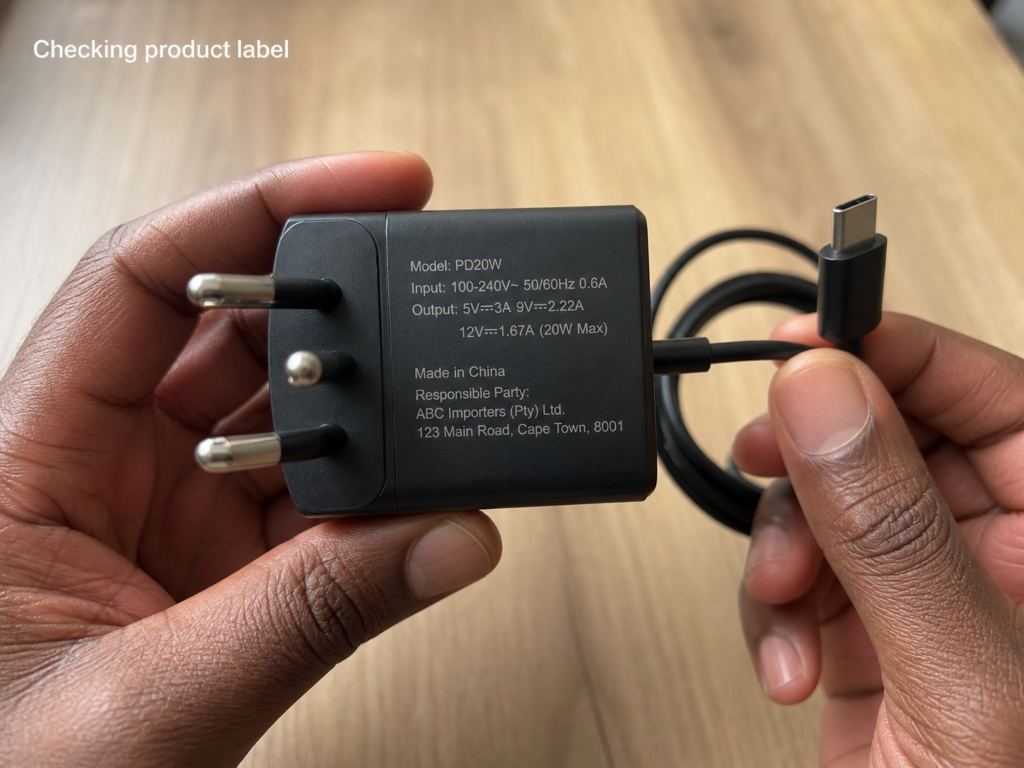
• **Product body labeling**: The product shall be marked with specified rated parameters, model, manufacturer or responsible party information, and other required labels in accordance with applicable compulsory specifications and relevant standards;
• **LOA number or specific mark**: If applicable specifications or LOA conditions require marking of LOA number, certification mark, or other information, it shall be marked as required. It cannot be generally required that all regulated electronic products must be printed with a unified “NRCS compliance mark”;
• **Label durability**: Applicable labels shall remain clear under normal wiping and use conditions, and must not easily blur, fall off, or become unrecognizable;
• **Packaging and instructions**: Instructions and safety information shall be provided in accordance with applicable compulsory specifications, relevant standards, and South African consumer regulations. English is usually the language commonly used in commercial compliance documents, but the South African Constitution stipulates 11 official languages. It cannot be simply stated that English is the only official common language in South Africa, nor can the unified language requirements for all products be summarized based on this.
Category 5: Basic Electromagnetic Compatibility (EMC) Requirements
EMC, or Electromagnetic Compatibility, simply means that a product should not cause unreasonable interference to other equipment during operation, and should also maintain a safe state under specified external interference.
However, EMC is not an NRCS safety item uniformly applicable to all VC 8055 electronic products. Whether EMC testing is required and which rules regulate it depends on whether the specific product falls under relevant EMC or radio equipment categories:
• If applicable product standards or other South African regulatory requirements include emission testing, the corresponding requirements shall be met to avoid interfering with surrounding equipment;
• If applicable requirements include immunity testing, the product shall also remain compliant under specified external electromagnetic interference;
• Devices with Bluetooth, Wi-Fi, or other wireless transmission functions shall also be separately checked for ICASA type approval and spectrum requirements.
Core Compliance Voucher: How to Verify the LOA Authorization Letter
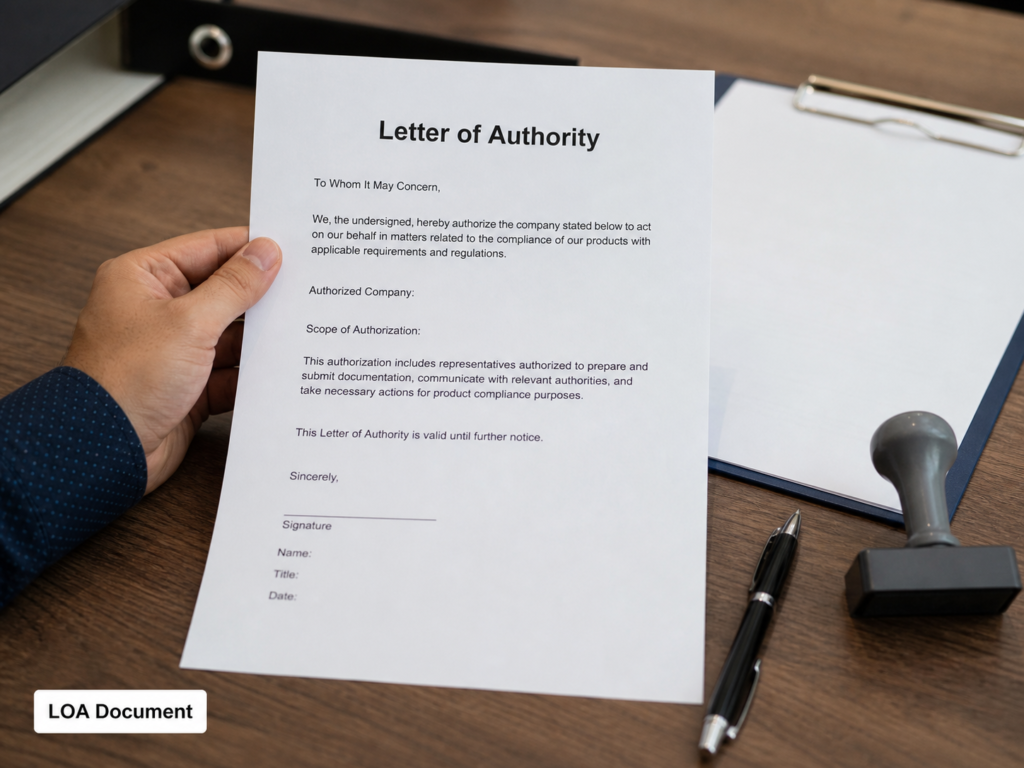
For products subject to relevant compulsory specifications, an LOA issued by NRCS that is still valid and covers the actual product and responsible entity is usually required. LOA stands for Letter of Authority, which is an authorization letter, not a “global certification certificate” that can be used independently of the product scope in the usual sense.
The coverage of the LOA is subject to the content specified in the document, which may involve the applicant, brand, model, product scope, rated parameters, key configurations, or other conditions. It cannot be simply summarized as “one certificate per model”, nor is it brand-universal or globally universal. Whether a product requires an LOA, and whether a particular LOA is sufficient to support import and sale, shall be judged in combination with specific compulsory specifications and LOA conditions.
Application Rules and Responsible Entities
Many cross-border sellers will ask: I am overseas, can I apply for LOA by myself? The actual application eligibility, requirements for local South African responsible parties, and application methods for overseas manufacturers shall be confirmed in accordance with NRCS’s current application rules. Usually, it needs to be submitted by a qualified applicant recognized by NRCS, and the corresponding responsibility shall be borne by the local South African importer, manufacturer, or authorized responsible party in accordance with current rules.
Overseas test reports cannot directly guarantee LOA approval. Whether a report is accepted depends on the laboratory’s qualifications, report coverage, adopted standard version, consistency between test samples and mass-produced products, and NRCS’s specific review. Even if the laboratory has ILAC mutual recognition accreditation, it does not mean the report will be automatically accepted.
The test coverage shall also be checked against South Africa’s 230V, 50Hz power supply conditions and applicable plug and product standards. South Africa’s rated voltage is usually expressed as 230V, rather than using 220–240V as a fixed notation for all products. When the report is insufficient, whether supplementary testing is required and which items to supplement shall be determined by NRCS based on the specific product and applicable standards.
Key Points for Validity Judgment
After obtaining the LOA, it is necessary to confirm whether it is still valid and whether the actual product is within the coverage:
• **Coverage**: Check the applicant, brand, model, rated parameters, key configurations, and product scope specified in the document. It cannot be directly applied solely based on the same brand or similar appearance;
• **Valid status**: Confirm whether the LOA is still within the validity period, and whether there are suspensions, revocations, changes, or other restrictive conditions;
• **Entity consistency**: Confirm that the applicant or responsible entity on the LOA is consistent with the actual import and sales arrangements;
• **Official verification**: The original LOA issued by NRCS or official documents provided by the responsible entity shall be checked, and the number, holder, product scope, and valid status shall be confirmed through NRCS official channels. If NRCS provides a public inquiry system, inquiries shall be made through that system. LOA is essentially a Letter of Authority, and a “certificate screenshot” made by the supplier itself cannot be regarded as sufficient proof.
Compliance Requirements for Product Changes
Product model changes are inevitable during sales. Not all changes require re-application, but they cannot be changed arbitrarily:
• If only the appearance and packaging are changed, and the core circuit, parameters, and safety structure remain unchanged, it is still necessary to confirm with NRCS whether reporting is required;
• Changes involving circuits, rated parameters, plugs, key safety components, or product models shall be confirmed with NRCS before launch whether a change application, supplementary testing, or re-application for LOA is required;
• After the model of the matching charging cable is changed, it cannot be directly assumed that it must require an independent LOA, nor can it be assumed that the existing LOA will necessarily cover it. Only when the cable itself falls under applicable compulsory specifications is it necessary to check the independent certificate or the coverage of the existing LOA.
Quick Self-Inspection and Fake Compliance Identification, Doable for Small Businesses
Whether it is ordinary users buying chargers or small merchants selecting products, obvious problems can be found first with simple methods without sending them to a laboratory. However, it should be noted that visual inspection cannot replace formal compliance assessment.
3-Step Quick Self-Inspection Method
Step 1: Check labeling. Check whether the product body is marked with rated parameters, model, and manufacturer or responsible party information in accordance with applicable requirements, whether the content is clear, and whether the pins meet applicable South African specifications;
Step 2: Check documents. Verify the applicant entity, product scope, brand, model, rated parameters, and key configurations on the LOA, confirm whether the document is still valid, and cannot just look at whether the supplier sends a picture with a LOGO;
Step 3: Test structure. Check whether the plug is loose when inserted into an applicable South African socket, whether there are obvious gaps or cracks in the enclosure that affect safety, and whether the cable connections are loose, have exposed copper, or obviously lack anti-bending protection.
If full-load operation and hand-feel inspection are carried out, they can only be used as preliminary screening. They cannot replace temperature rise, insulation, withstand voltage, abnormal operating condition, and flame retardant tests conducted in accordance with applicable SANS/IEC standards. “Not hot to the touch after 1 hour of operation”, 60°C, or no peculiar smell shall not be used as compliance judgment standards.
Key Points for Fake Compliance Identification
There are many fake compliance products on the market, and some obvious risks can be found by mainly looking at three aspects:
• **Labeling category**: The label content is inconsistent with the actual parameters of the product, model, manufacturer or responsible party information is missing, the label is easy to fall off, or the product only provides overseas marks without applicable South African compliance documents;
• **Rated input category**: Check whether the rated input of the product covers South Africa’s 230V, 50Hz and applicable plugs. Products only marked 110V without appropriate voltage transformation or wide voltage input capability shall not be directly connected to South African mains; but “whether it falls within the 220–240V range” cannot be used as the only criterion, because some products may be marked with a wider input range such as 100–240V;
• **Certificate category**: The applicant, brand, model, manufacturer or product scope on the LOA does not match the actual product, the document has expired, or there are only overseas materials such as CE, FCC, RoHS, without applicable NRCS LOA;
• **Structure category**: The pin size or type is incompatible, loose after insertion, the enclosure has large gaps, and the root of the cable does not have appropriate anti-bending design.
Key Points for Compliance Check Before Import
If you are importing to South Africa for sale, be sure to check these three points before shipment to avoid detention of goods:
First, confirm the mandatory attribute of the product. You cannot judge whether it is exempt solely based on the product name, power, or whether it has a fast charging function;
Second, check whether the LOA covers the model, configuration, rated parameters, and responsible entity of the products you actually import. For example, if the documents provided by the supplier only list a certain version, and the actually imported color, plug, power, or internal configuration has changed, further confirmation is needed to see if it is covered;
Third, confirm that the sample and the mass-produced version are completely consistent. Do not have a compliant sample but replace components, plugs, or cables in the bulk goods, resulting in inconsistency between goods and certificates.
High-Frequency Non-Compliance Scenarios and Pitfall Avoidance Guide
During NRCS spot checks, several types of problems occur particularly frequently. Knowing them in advance can avoid most pitfalls.
3 Most Frequent Non-Compliance Points
• **Electrical category**: Insufficient high-low voltage isolation due to shoddy insulation, overheating due to falsely marked output parameters, and no overcurrent or overvoltage protection circuits. These problems are the most dangerous and most likely to cause serious rectification;
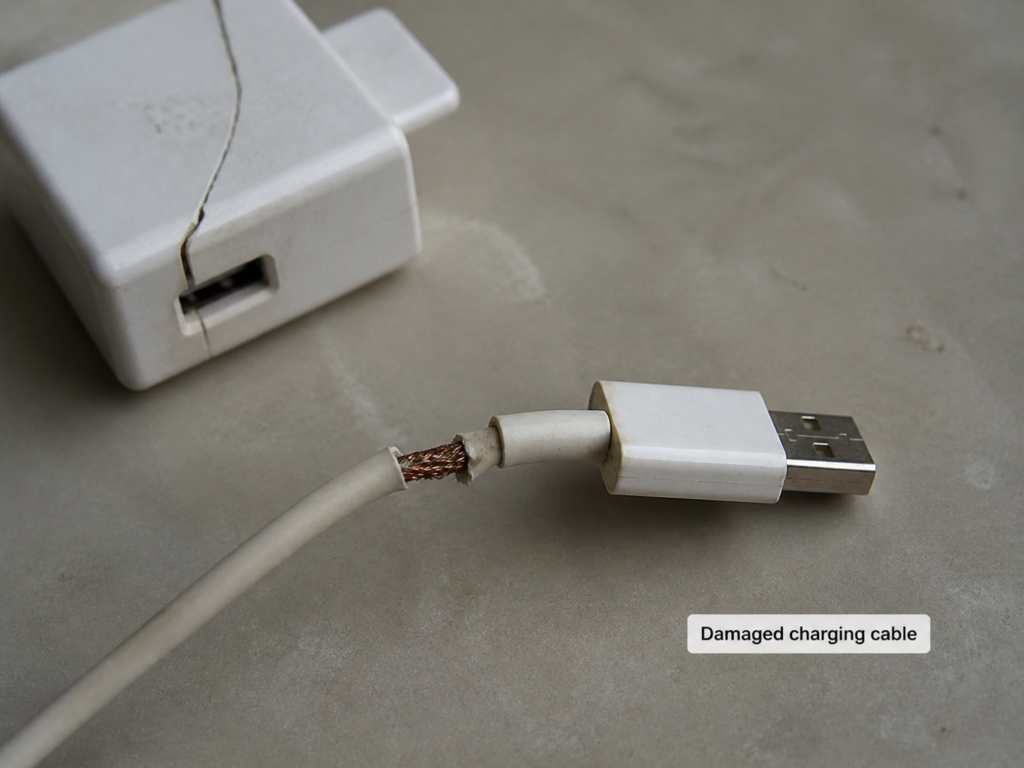
• **Structural category**: Plugs or pins do not meet applicable standards, resulting in loose insertion; cables have no anti-bending design, prone to core breakage and copper exposure; enclosure materials or structures do not meet applicable flame retardant and mechanical safety requirements;
• **Labeling category**: Missing rated information, model, manufacturer or responsible party information specified in applicable requirements, incomplete instructions and safety prompts, or documents cannot correspond to the actual product.
Product Selection Pitfall Avoidance Suggestions
Checking well during product selection can save a lot of trouble later:
• Prioritize suppliers who can provide NRCS LOA and test materials that cover the corresponding product scope and are still valid, and be sure to check by yourself, do not just believe what the supplier says;
• Do basic self-inspection first when the sample arrives: whether the pins are compatible with South African sockets, whether the labeling is clear, and whether the enclosure and cable structure are firm;
• Do not choose public version solutions without protection circuits and with reduced insulation configuration just to reduce costs. It seems to save a few dollars, but the subsequent costs of rectification, recall, or delayed release may be higher;
• Distinguish between active devices and ordinary cables. For devices with power conversion functions, focus on confirming applicable specifications; whether ordinary USB/USB-C cables are regulated shall be judged based on specific structure and the latest catalog, and cannot be simplified to a one-size-fits-all approach based on “with chip” or “without chip”.
Import and Sales Pitfall Avoidance Suggestions
• Confirm the mandatory attribute of the product before import, reserve time for compliance application and document review in advance, do not find out that LOA is required when rushing to ship;
• The model declared at customs and the model on the packaging must be consistent with the product information specified in the LOA or other compliance documents;
• After the product is launched, keep test reports, LOA, supply chain records, and version change materials properly, so that they can be provided in time in case of market spot checks;
• If safety problems such as overheating or smoking are found in the product, stop selling immediately and conduct investigation, do not wait until an accident occurs to deal with it.
5-Step Investigation Sequence When Detained/Questioned
In case the goods are actually detained by customs or questioned by NRCS, don’t panic, investigate in this order:
Step 1: First check the product classification to confirm whether specific compulsory specifications apply to the product;
Step 2: Check the valid status, responsible entity, and product coverage of the LOA to see if the document is expired, the scope does not correspond, or the applicant is inconsistent;
Step 3: Compare whether the actual product labeling, packaging, and application documents are consistent, and whether there are cases where the model, parameters, or labeling have been changed but the change requirements have not been confirmed;
Step 4: Check for unconfirmed hardware or key component changes, such as replacement of transformers, plugs, cables, or protection devices;
Step 5: The local South African responsible entity shall contact NRCS to confirm the specific path for rectification, supplementary testing, change application, or re-application, and do not handle it privately by yourself.
Clarifying Easily Confused Concepts: What’s the Difference Between NRCS, SABS, and CE?
Many people confuse NRCS with other institutions and certifications. Here we clarify the boundaries once and for all, so you will never be confused again.
Differences from Relevant Institutions/Certifications
• **Difference from SABS**: NRCS is a government regulatory agency responsible for compliance supervision of compulsory specifications and LOA; SABS mainly provides standards, testing, and related certification services. SABS testing or voluntary certification cannot automatically replace NRCS requirements;
• **Difference from ICASA**: NRCS mainly handles applicable mandatory product safety requirements, while ICASA is responsible for wireless communications, spectrum, and related equipment type approval. If the product has Bluetooth, Wi-Fi, or other wireless transmission functions, ICASA requirements shall be further checked;
• **Difference from CE/FCC/RoHS**: CE is a conformity mark under applicable EU regulations, FCC is a requirement under relevant US radio or electromagnetic compatibility regulations, and RoHS is a restriction of hazardous substances requirement. They cannot automatically replace South Africa’s applicable compulsory specifications or LOA, and can at most be used as reference materials in technical documentation or compliance assessment.
Compliance Differences Across Different Sales Channels
The applicability of NRCS compulsory specifications mainly depends on the product and specific behaviors such as import and sale, rather than being determined by the sales channel:
• Offline physical stores: Products falling within the scope of compulsory specifications shall meet applicable requirements and have the required documents;
• Cross-border e-commerce platforms: Online sales do not automatically exempt from compliance obligations. Platforms may verify qualifications, and customs may also check incoming goods;
• Personal second-hand transfer: Whether relevant requirements apply shall be confirmed based on specific legal facts, nature of transfer, and compulsory specifications, and personal second-hand transfer cannot be generalized as universal exemption.
Coordination with Other Local Regulations
NRCS safety requirements are not isolated, and some products must also comply with other regulations at the same time:
• Products with Bluetooth, Wi-Fi, or other wireless transmission functions shall be checked for ICASA type approval and spectrum requirements;
• For wireless chargers that only use near-field induction for power supply and do not have regulated wireless transmission functions, whether ICASA approval is required shall be confirmed based on the specific technical structure and ICASA regulations, and cannot be directly judged just because the name contains “wireless”;
• Only product categories included in South Africa’s energy efficiency regulations or relevant designated product lists need to be checked for energy efficiency labels and minimum energy efficiency requirements; whether ordinary USB chargers require energy efficiency labels cannot be judged solely by charging power;
• Plugs, sockets, and converter components need to comply with local applicable South African size, grounding, and safety standards, and plugs of other specifications cannot be used arbitrarily.
Core Summary and Quick Checklist
In general, South African NRCS compliance judgment cannot be based solely on whether the product is connected to mains electricity, has a fast charging function, or is a consumer electronic product. Wall-mounted chargers, power adapters, and other products usually need to be judged whether a valid LOA is required based on applicable NRCS compulsory specifications; whether cables and other low-voltage accessories require LOA shall be confirmed item by item based on specific structure, intended use, rated parameters, and the latest compulsory specifications. Overseas materials cannot automatically replace South African requirements, and the actual goods, documents, and responsible entities shall also be consistent.
Core Knowledge Points Review
1. NRCS is South Africa’s official compulsory specification regulatory agency. Compulsory specifications are determined by relevant laws and regulations promulgated by the Minister. LOA is an important access document for relevant regulated products;
2. Products such as mains-connected chargers and power adapters usually need to focus on checking applicable compulsory specifications and LOA, but not all active USB/USB-C cables can be listed as 100% mandatory products;
3. Core safety concerns include electrical safety, structural safety, temperature rise and materials, labeling and instructions, as well as EMC, radio, and energy efficiency requirements where applicable;
4. Overseas materials cannot automatically replace NRCS compliance. The coverage of LOA is subject to the content specified in the document and applicable conditions, and cannot be simply understood as one certificate per model or brand-universal.
Compliance Quick Checklist
| Inspection Item | Compliance Requirement |
| Product Labeling | Mark rated parameters, model, manufacturer or responsible party information in accordance with applicable requirements; whether LOA number or specific mark is required shall be subject to specific specifications and LOA conditions |
| Plug Structure | Comply with applicable South African SANS 164 series and related standards, with tight insertion and no obvious looseness |
| Appearance and Structure | The enclosure has no obvious gaps or cracks that affect safety, the interfaces and cable connections are firm, and the cable has appropriate anti-bending design |
| Qualification Voucher | Able to provide NRCS LOA or other applicable compliance documents that cover the actual product and responsible entity and are still valid |
| Basic Performance | No obvious abnormalities in appearance and operation inspection, but “not hot to the touch”, 60°C, or 1 hour of operation shall not be used as compliance judgment; formal compliance still requires laboratory testing based on applicable standards |
Abilities You Can Master After Learning
After reading this article, you should be able to: quickly judge whether a charging product needs further checking of NRCS requirements; discover obvious fake compliance or inconsistency between goods and certificates through product labeling, document scope, and structural status; avoid common NRCS compliance risks during product selection, import, and sales; clarify the differences between NRCS and SABS, ICASA, CE, FCC, and RoHS. For sellers operating in the South African market, doing a good job of product classification and document verification in advance is more reliable than having goods detained or being required to rectify afterwards.