
For those who make products like USB chargers and charging cables, especially those operating in overseas markets, most have probably heard of the term TID: some large clients require this qualification, some e-commerce channels require it to be provided, and you must also meet corresponding conditions if you want to print the official USB Logo. But many people are confused when they first encounter it: What exactly is TID? What is the difference between it and safety certifications like CE and UL? Does my product need to apply? How much does it cost and how long does it take to get approved? In this article, we will thoroughly explain USB-IF TID from basic concepts to the full application process, and then to key points for avoiding pitfalls. Whether you are a brand owner, contract manufacturer, or ordinary purchaser, you can find the information you need.
First, Understand: What Exactly Is TID, What It Covers and What It Doesn’t
The full name of TID is Test ID, which is a test identification number used in the USB-IF compliance program to identify compliance submissions or listing records for specific products. USB-IF, short for USB Implementers Forum, is responsible for maintaining compliance testing, product lists, and trademark programs related to USB specifications. You can think of it as an identification number in USB compliance records, but it is not a “universal product ID card” that is uniformly assigned to all products that pass testing and applies to all situations. The specific scope of association is subject to the current compliance program and product records. It has three core functions: first, it is one of the prerequisites for applying to use the official USB Logo; second, it is a public record that the product meets corresponding USB requirements; third, it is an access requirement for many overseas channels and B2B customers.
This number is not given randomly; it is usually associated with the specific product model, hardware version, firmware version, and configuration record at the time of application. The specific coverage is subject to the current official rules of USB-IF, and it cannot be shared by all products of the same brand. You can usually find the TID number on the nameplate of the charger, product packaging, instruction manual, or e-commerce product detail page. Some brands print it in an inconspicuous corner, such as the compliance information area on the back of the packaging.
Here, we must first distinguish three completely independent systems, which 90% of beginners confuse at the beginning:
The first set is the USB-IF compliance program, which is what we usually call TID-related certification or compliance records. It governs the physical specifications of USB interfaces, protocol compatibility, and device interoperability. It is a voluntary compliance program directly linked to the ability to use official USB trademarks and Logos, but specific use must also comply with USB-IF’s trademark and licensing rules.
The second set is the conformity requirements of USB technical specifications. If a product claims to comply with USB specifications, uses USB-related marks, or implements corresponding USB functions, it shall follow the applicable USB technical specifications. Whether it has passed the USB-IF compliance program and obtained a TID is an independent matter of compliance certification and trademark use. Without a TID, you cannot promote “USB-IF certification” based on this. At the same time, applying for a TID does not automatically replace other technical and legal requirements that the product should meet in design, sales, or usage scenarios.
The third set is the statutory access requirements of various countries and regions, such as CE conformity requirements under applicable EU regulations, FCC equipment authorization requirements applicable in the United States, and third-party safety certifications such as UL that may be required by customers or regulations. Their scope of application and mandatory nature vary: CE involves applicable EU regulations and manufacturer conformity assessment; FCC requirements apply to eligible US radio frequency or digital devices, and the specific procedure depends on the product category; UL is usually a voluntary third-party safety certification, but may become a de facto access condition due to regulations, customers, channels, or insurance requirements. The above requirements are independent of USB-IF TID and cannot replace each other.
Many people think TID is a “universal certification”, but its scope of certification is very clear:
What it can prove is the USB-specific test or compliance record of the corresponding category, such as the interface specification, PD protocol, power output, and interoperability of a charger; what it can indicate is that this product may be eligible to apply for the corresponding USB Logo, and relevant compliance records can be verified through the currently public product list or query system of USB-IF.
What it cannot prove is also clear: it cannot prove that the product meets statutory safety and EMC requirements, cannot guarantee 100% compatibility with all USB devices, cannot represent that other models of the same brand are also compliant, and cannot prove that the product supports all fast charging protocols or full power levels — all of these depend on specific product records, test scope and actual declarations.
Beginners also tend to confuse TID with several similar concepts, let’s clarify them one by one:
First is the difference from VID/PID. VID is Vendor ID, and PID is Product ID. These two are used for “identity recognition” of USB devices, just like the “factory number” of the product. You can have them regardless of whether you have passed the test, which is completely different from the “compliance certification” attribute of TID.
Second is the difference from the official USB Logo. TID is only one of the prerequisites for using the official USB Logo. After getting the TID, you must also comply with USB-IF’s trademark usage rules, such as requirements for the size, color, labeling method and applicable products of the Logo. You cannot print it casually just because you have a TID.
Last is the difference from the product model. The product model we usually talk about is a commercial model set by the manufacturer, such as “XX Brand 20W Charger”, while TID is associated with the specific hardware, firmware and configuration submitted at the time of application — even if your commercial model remains unchanged, as long as you change the interface chip or adjust the power, the original TID needs to be re-evaluated for whether it is still applicable.
Many people who are new to TID tend to fall into these pitfalls, and avoiding them in advance can save a lot of money:
The first misconception is “you can get a TID by paying the USB-IF membership fee”. The membership fee is only the fee for joining USB-IF, and cannot replace testing and product submission requirements. The product must also comply with the corresponding compliance program, and it cannot be understood that you will automatically get a TID after paying the money.
The second misconception is “one TID can cover all products in the same series”. For example, for 20W and 30W chargers of the same series, whether they can share a TID must comply with USB-IF’s product family and variant rules, and cannot be decided arbitrarily, otherwise it will be a violation.
The third misconception is “having a TID means meeting all overseas access requirements”. As mentioned earlier, TID is only a voluntary compliance record related to USB, and does not cover safety, EMC and other statutory requirements of various markets. To sell legally, you still have to meet the access conditions of the corresponding country or region.
The fourth misconception is “application rules are the same for all products with a USB port”. In fact, the test items and application requirements vary greatly for different categories. For example, the test content of chargers, charging cables, and docking stations is completely different, and experience cannot be copied blindly.
Should You Apply for TID? Judge by These Criteria
Many people are most纠结 about “whether my product needs to apply for TID”. In fact, you can judge according to the following criteria:
If your product plans to legally use the applicable USB-IF Logo or promote that the product has passed USB-IF related certification, you shall complete necessary conditions such as certification, membership or license in accordance with the corresponding trademark and compliance program requirements; if the customer or sales channel explicitly requires TID to be provided, you shall apply for or provide corresponding records according to their procurement conditions. Requirements from customers or channels are usually commercial access conditions, not a universal legal obligation stipulated by USB-IF for all products.
If your product belongs to a category covered by the USB-IF compliance program, and you want to prove the USB compliance of the product and improve user trust, but there is no mandatory requirement, you can consider applying, which is a bonus item.
If your product does not promote USB certification, does not use the official Logo, has no requirements from customers or channels, or is a non-commercial DIY work or internal test prototype, then you do not necessarily need to apply, which can save a cost.
Here is a special reminder: whether to apply for TID does not mean that applicable USB technical specifications, product safety requirements or statutory market access requirements can be ignored. If a product claims to comply with USB specifications, uses related marks or implements corresponding USB functions, it shall be designed and described in accordance with applicable requirements; statutory safety, EMC and other requirements will not be exempted just because you do not apply for TID, and they still must be met.
The USB-IF compliance program covers many products with USB interfaces. We have sorted out the roles and core test focuses of common charging products for your comparison:
| Product Type | USB Role | Core Test Focus |
|---|---|---|
| Single-port USB-C PD Charger | Power supply end (Source) | Interface physical specifications, PD protocol, power output, interoperability |
| Multi-port USB-C PD Charger | Multi-port power supply end | Single/multi-port output combinations, dynamic power adjustment, interoperability |
| USB-A Port Charger | USB-A power supply end | USB-A interface specifications, BC charging protocol |
| USB-C to USB-C Charging Cable | Cable | Connector and cable electrical/mechanical requirements, rated current, declared data rate or function and interoperability; for cables equipped with E-Marker as required by applicable specifications, E-Marker information and related functions must also be verified |
| USB-A to USB-C Charging Cable | Cable | Connector specifications, rated current, interoperability |
| USB-C Port Power Bank | Role confirmed by actual port, may be power supply end (Source), power receiving end (Sink) or dual-role port | Charging and discharging protocol, interface specifications, interoperability corresponding to port roles and declared functions |
| USB-C Port Docking Station | Hub + power supply/power receiving end | Interface specifications, data transmission, power supply protocol, interoperability |
Here is a special explanation of E-Marker. It is an electronic marker chip in the cable, used to report the rated current, data rate or other capabilities supported by the cable to the device. But not all USB-C to USB-C cables must have an E-Marker; whether it is needed depends on the rated current, data rate of the cable, as well as whether functions such as USB4 and video are declared and applicable specifications.
Many people who make series products will ask: can several products of the same series share one TID to save money? Here is a preliminary judgment standard, but the final decision must be subject to the confirmation of USB-IF or an authorized test center, and you cannot decide by yourself:
Only if there are changes in appearance color, silk screen, packaging, etc., and the applicable product family or variant rules allow, and the core USB hardware, firmware, port structure and declaration scope have not changed, can it may be included in the same product family or continue to use the original record. You cannot directly conclude that re-evaluation is definitely not needed just because “it’s just an appearance change”.
If you change the interface chip or protocol controller, adjust the PD power/PDO/PPS levels, or add/remove USB interfaces, you need to apply separately or add tests, and cannot directly use the original TID.
PDO here refers to PD power supply levels, and PPS is Programmable Power Supply, both are core parameters in PD fast charging. As long as these are changed, it is very likely that a re-evaluation is required.
What to Prepare Before Applying? Do These Tasks Well to Avoid Detours

Before the official application, you must first figure out whether you are eligible to apply, and which path is more cost-effective.
First is the applicant entity requirement: the actual application eligibility, membership requirements and applicable compliance programs shall be subject to the current USB-IF policy and specific product rules. If you are an individual seller or non-commercial entity, you cannot simply follow the application path of commercial brands. Usually, you need to first confirm whether you have the applicable enterprise entity and product submission eligibility.
Then is the application path. Membership fees, testing fees, product submission fees, whether non-members can participate in specific compliance programs, and review arrangements are all determined by the current USB-IF membership policy, product category and compliance program. Do not presuppose that members must enjoy lower per-model fees or higher review priority, nor presuppose that there is a unified non-member per-model TID application path for all products. Before preparing to apply, you should directly check the current official USB-IF quotation, membership conditions and corresponding product programs to confirm which path is applicable to your product.
There are also VID/PID requirements: different categories have different requirements for VID/PID, and the specific ones shall be subject to official rules; if you use a third-party VID (such as the foundry’s), you must obtain the other party’s written authorization in advance, otherwise the application may be rejected.
If your products are manufactured by an OEM/ODM factory, you must clearly stipulate in the contract in advance the ownership of the TID, the party responsible for costs after product revisions, and subsequent maintenance responsibilities, otherwise disputes are very likely to arise when you change the factory or revise the product later.
Next, you need to sort out the core information of the product. This information will be used for filling out application files and testing later, and must be accurate:
General basic information includes brand, product model, hardware version, firmware version, sales region, and USB role (such as power supply end or cable).
If it is a charger product, you also need to prepare additional information such as interface type and quantity, PD version, PDO/PPS levels, single-port/multi-port power distribution rules, and rated input and output parameters.
If it is a cable product, you need to prepare the connector combination at both ends, rated current/power, data rate level, whether there is an E-Marker chip, cable length, and conductor structure.
If it is a multi-function product such as a power bank or docking station, you should list clearly the role, function and corresponding parameters of all USB ports, without omission. Especially for power banks, having a USB-C interface does not mean that it necessarily has both power supply and power receiving functions; it shall be confirmed one by one according to the actual port design, controller, firmware and product declaration.
In addition, you should also clarify in advance whether the charging cable and adapter included with the product should be included in the scope of this compliance, otherwise it will be troublesome if they are missed during testing.
TID-related testing should usually be carried out by a testing center within the USB-IF recognized or authorized system (referred to as ATC). Self-tested results may not be used as the basis for formal submission. When choosing an ATC, try to choose one with experience in testing charging products. They are more familiar with the rules, communicate more smoothly, and can help you find problems in advance.
The test scope must fully correspond to the product functions you declare, and no items can be missed — for example, if you say the product supports PPS fast charging, you should confirm whether PPS-related items are within the applicable test scope this time, and you cannot only test basic PD and then write unvalidated functions into the promotion.
Samples shall meet the requirements of the applicable USB-IF compliance program, usually shall be production intent samples, and have clearly recorded hardware, firmware and configuration versions. If changes that affect the compliance scope occur after testing, the ATC or USB-IF must evaluate whether supplementary testing or re-submission is required. The number of samples and specific version requirements shall be subject to the specific compliance program and ATC notification.
Testing of charging products will use specialized equipment such as PD protocol analyzers and electronic loads to simulate handshake scenarios and power requirements of different devices, to ensure that the product is normally compatible with various devices.
Before submitting the application, you must do a consistency check, which can greatly reduce the probability of being rejected by the official. This is the experience summed up by many people who have fallen into pitfalls:
The first is document consistency: the product model, hardware/firmware version must be completely consistent on the product nameplate, test report, and application materials, not even a single letter difference.
The second is parameter consistency: the power, protocol, number of interfaces, and functions you declare must fully match the content in the test report. You cannot have the test report measure 20W but write 65W when applying.
The third is entity consistency: the applicant entity and trademark information must be completely consistent with the registration information of the USB-IF account. You cannot use Company A’s account to apply for Company B’s product.
The fourth is sample consistency: the hardware, firmware, BOM and configuration version of the test samples must be recorded, and the relationship with the test samples must also be explained during subsequent mass production or changes. You cannot directly apply test results to products that have undergone major changes without evaluation.
Finally, you should also confirm in advance that the current USB-IF compliance program, application system entry, and the ATC qualification you choose are all up-to-date and valid, so as not to work in vain using old rules.
Full TID Application Process: Key Steps from Registration to Getting the Number
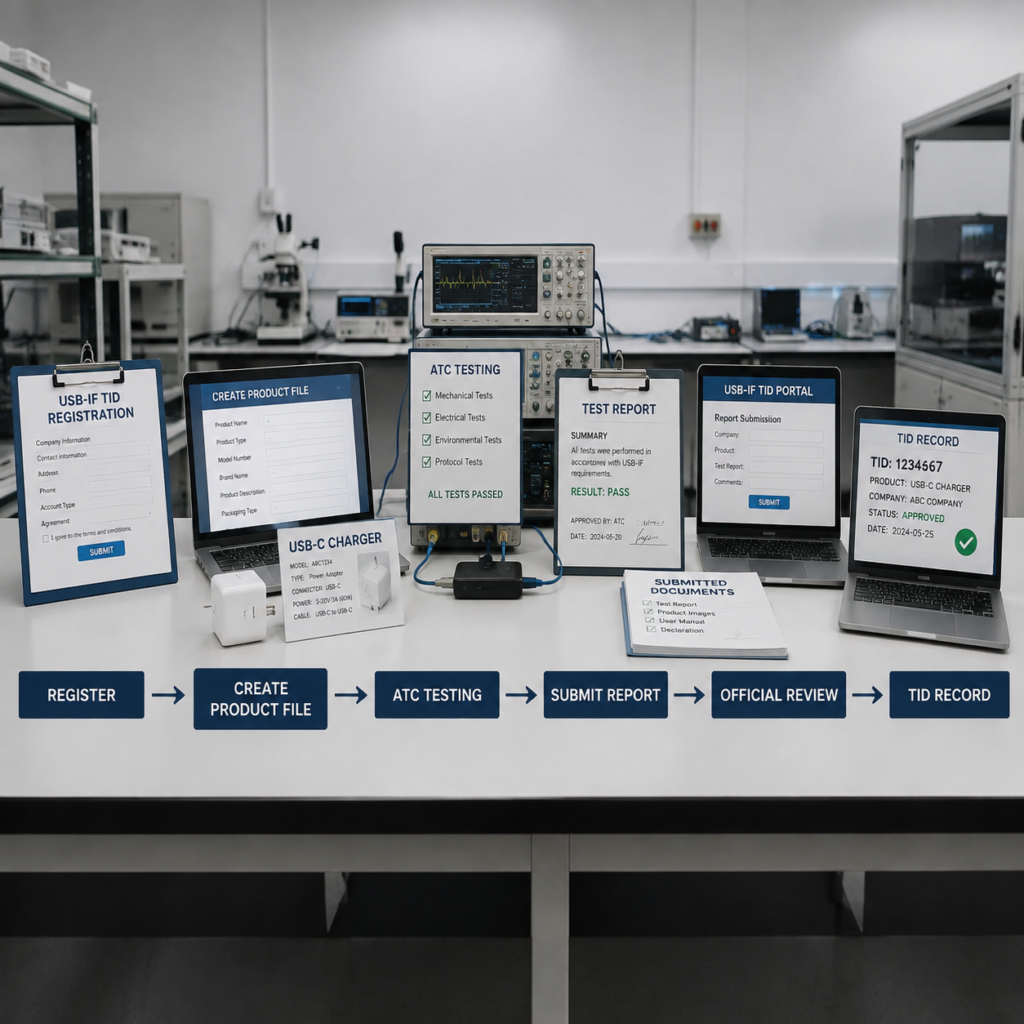
The first step is to register an account and create a product file. You need to register the corresponding account in accordance with the current USB-IF policy and specific product compliance program, and prepare company information, trademark information and qualification documents.
After the account is registered, create a new product file in the USB-IF compliance system, and fill in all the product information and functional parameters sorted out earlier as required.
The check point here is: all the information filled in must be completely consistent with the subsequent test report. Once filled in incorrectly, even if the test passes, the application may be rejected, and you have to revise and resubmit, wasting time.
Next is to entrust an ATC to conduct testing. You can select an applicable ATC from the official list on the USB-IF official website, communicate the test scope, schedule, and quotation in advance, and send samples for testing after confirming the requirements.
There is a special point to note for testing charging products: multi-port chargers should cover all the single-port and multi-port power combinations you declare. For example, if you say the dual-port simultaneous output is 20W+20W, and the three-port simultaneous output is 15W+15W+10W, you must confirm whether these combinations are included in the test scope, and you cannot only test the single-port maximum power.
There are two common reasons for test failure of charging products: first, the physical size of the USB-C interface does not meet the standard, such as too loose or too tight insertion, which does not comply with the specification; second, abnormal PD protocol handshake, such as failure to connect with some mobile phones or computers, or incorrect power output.
If the test fails, don’t panic. Modify the product according to the rectification opinions given by the ATC, and then you can apply for a re-test. The re-test scope after rectification is determined by the ATC based on the failure reason, change content and applicable compliance program. It may only re-test the failed items, or may need to re-execute the affected test items or more complete tests.
Here we emphasize again: test samples should not have unrecorded key differences from the products actually intended to be submitted or sold. Production intent samples that meet the requirements of applicable programs should be used, and records of hardware, firmware and configuration versions should be kept.
After passing the test and getting the official report, you can submit the formal application in the system. You need to upload the official test report, as well as supporting materials such as product photos, nameplate drawings, specifications, and user manuals.
After confirming that all information is correct, you can submit the application and pay the fee. The fee varies depending on the product type, account type and current compliance program, and shall be subject to the current quotations of USB-IF and ATC.
The check point here is: the product model, hardware/firmware version, and test scope on the test report must fully match the application file you created earlier. Even if there is a slight mismatch, you must revise it in advance before submitting, otherwise you may be rejected even after paying the fee.
After submission is the official review stage. The review and processing time shall be subject to the current USB-IF process, completeness of submitted materials, product category, and the actual schedule of the official or ATC. Unless explicitly stated in the current official policy, it shall not be promised that members enjoy higher priority or faster speed.
If the materials are incomplete or there is a problem with the information, the official will send you a notice to supplement materials, and you need to supplement or revise within the specified time. If you exceed the time limit, the application may be rejected.
After the review is passed, you can check the TID number and corresponding compliance record in the system. The specific delivery form shall be subject to the rules of the current system.
After getting the result, you should check it immediately: whether the brand, specific model, product category, and certification scope are all correct, and if there is any problem, you should contact the official to modify it in time, otherwise there will be problems when using it later.
How to Estimate Cost and Cycle? What Are the Tips to Save Money and Time
Many people care about how much it costs to apply for TID. In fact, there is no fixed value. All fees are subject to the current official and ATC quotations, and mainly consist of three parts:
The first part is official-related fees: including product submission or TID-related fees, membership fees (if required by the specific path), and information change fees (which may only be incurred if you need to change certification information later). The fees and membership conditions of different product compliance programs may be different, and you cannot take the price of one product as the unified standard for all products.
The second part is testing-related fees: mainly the testing service fee of the ATC, which is proportional to the complexity of the product and the number of test items. The more complex the product and the more items tested, the higher the fee; if the test fails and requires re-testing, you also need to pay an additional re-test fee.
The third part is other miscellaneous fees: such as sample fees, logistics fees for sending samples, labor costs for preparing materials, etc.
There is also no fixed commitment for the application cycle. It can be as fast as a few weeks, or as slow as several months, which is mainly affected by factors in three stages:
Preparatory stage: if your materials are well organized and the product design itself complies with USB specifications, the preparation will be fast; if the materials are incomplete and the product itself has many problems, it will take a lot of time to rectify.
Testing stage: it depends on whether the ATC’s schedule is busy, how high the product complexity is, and whether the test can pass at one time — if repeated rectification and re-testing are required, the cycle will be very long.
Review stage: it depends on the current official application volume, whether the product is complex, and whether the submitted materials are complete and whether supplementary materials are needed. Whether members enjoy faster processing speed shall be subject to the current official policy and cannot be guaranteed in advance.
Here are some proven tips to save money and time, which can help you avoid detours:
The first is to do a pre-test before application. Test the most problematic items such as interface size, PD protocol, E-Marker information, and power output by yourself in advance, and send for testing only after there is no problem, which can reduce the probability of re-testing and save re-test fees. However, pre-testing cannot replace the formal testing required by ATC or USB-IF.
The second is to apply for products of the same series that meet the product family rules together. If several products belong to the same product family, they may share some test items, and it is not necessary to test exactly the same content for each model, which can save part of the test fee. But you must confirm with the ATC and the official in advance whether they can be shared.
The third is to carefully check according to the consistency checklist mentioned earlier before submitting the application, to avoid being rejected due to wrong information or incomplete materials, which wastes time.
The fourth is to choose an ATC with experience in testing charging products. They are more familiar with the testing rules for charging products, can help you find problems in advance, reduce communication costs and testing errors, and are much more worry-free than choosing inexperienced institutions.
How to Use TID After Getting It? These Red Lines Must Not Be Crossed
After getting the TID, you cannot use it however you want. There are clear legal scenarios and prohibited red lines:
Allowed usage scenarios include: marking the TID corresponding to the product record and the applicable USB Logo on the product packaging and instruction manual, but must comply with USB-IF’s trademark usage specifications; you can also display TID and compliance information on e-commerce product detail pages and B2B qualification documents to illustrate the USB-related compliance records of the product.
Absolutely prohibited behaviors include: using this TID on products of other models or other categories, that is, unauthorized use; forging TID or compliance records; using TID to promote non-USB compliance, such as “having TID so it meets UL safety standards”. These are all violations.
If you violate the rules, it may lead to the revocation of the TID or related product records, the impact on trademark use rights, and members may also face treatment from USB-IF. In serious cases, it may even involve legal liabilities such as trademark infringement. Don’t lose the big for the small.
When products sell well, it is inevitable to revise them, such as changing the shell or adjusting the power. At this time, many people will ask: can the original TID still be used after the revision? Here is also a preliminary judgment standard, but the final decision shall be subject to USB-IF’s confirmation:
The original record may only be used if it is allowed by the applicable USB-IF product family or variant rules, and does not change the model, brand, port structure, USB function, hardware, firmware and declaration scope of the certified product. Even if it is just a change in packaging, color, silk screen or shell, you should confirm with the ATC or USB-IF whether you need to change the record, conduct supplementary testing or re-submit before mass production or continuing to use the TID. You cannot directly conclude that no application is needed.
If you change the interface chip or protocol controller, adjust the PD power/PDO/PPS levels, or add/remove USB interfaces, you need to re-apply or add tests, and cannot directly use the original TID.
There is a simple quick judgment principle: as long as the change may affect the USB interface, protocol, power supply, interoperability, product model or certification declaration scope, you must consult USB-IF or ATC in advance. Don’t think it’s fine and continue to use it, otherwise it will be a violation if found.
Another point to note: the compliance status of TID is not static.
The compliance records you can find in the official product list or query system usually reflect the applicable specifications and record information at the time of the product’s submission. When USB-IF updates specifications or compliance programs later, you should check the effective date, transition arrangements and scope of application of the new rules. Whether supplementary testing, re-submission or re-certification is required shall be subject to official requirements and whether the product declares compliance with the new version. Whether old records continue to be valid also depends on the current official status and transition rules, and you cannot automatically conclude that all old records are invalid just because the rules are updated.
If the product’s TID is revoked due to violation, or the applicant entity actively cancels the TID, the corresponding compliance record may be removed or marked as invalid, and can no longer be used for promotion. The specific status shall be subject to the display of the current USB-IF system or official confirmation results.
How to Check if a TID Is Real or Fake? Avoid These 4 Fraud Tactics
Whether you are a purchaser or an ordinary consumer, after getting a TID, you must check its authenticity through official channels by yourself, and don’t just trust the merchant’s promotion.
The USB-IF official website will provide the current public product list or query entry. Whether membership is required, what query conditions are supported, and page fields may be adjusted with the system. You can check the TID, brand, model, product category and certification information listed on the page through the current official USB-IF product list or query system.
It must be noted: you must query through the official USB-IF channel, do not trust the query results of third-party websites, and do not only trust the screenshots given by the merchant. If the page does not clearly show the status, or there is a difference between the record and the actual product, you should confirm with USB-IF or ATC whether the record is currently valid and whether it still meets the corresponding Logo usage conditions.
After checking the result, don’t just look at “whether there is this TID”, you should check carefully according to these four steps, otherwise you will be easily deceived by fraud:
Step 1: Confirm that the corresponding TID can be found in the official product list or query system, and view the product record and certification information listed on the page. Do not judge validity solely by the number format or third-party screenshots.
Step 2: Check the brand and specific product model, which are completely consistent with the product you have — it cannot just be the same series. For example, the TID of a 20W product cannot be used on a 30W product of the same series, and the specific model must match exactly.
Step 3: Check the product category, such as charger or cable. Unauthorized use across categories is not allowed, and you cannot use the TID of a charging cable to impersonate that of a charger.
Step 4: Check the certification scope, such as power, number of interfaces, and supported functions, to see if they are consistent with the product’s promotion. You cannot use a 20W TID to promote 65W power.
Finally, a reminder: TID only proves the USB-related compliance record of the product, and cannot replace statutory safety and EMC certifications. When buying charging products, you also need to check other mandatory or de facto access requirements of the corresponding market.
There are many cases of TID fraud in the market now, and there are four common tactics:
The first is misattribution: using the TID of another model of the same brand to impersonate that of this product, for example, using the TID of a high-end model for a low-end model.
The second is status fraud: using records that have been revoked, cancelled or no longer applicable to impersonate valid status, anyway, many people do not check the current status of the record.
The third is outright fabrication: making up a non-existent TID number randomly to deceive those who do not know how to check.
The fourth is category or parameter swapping: for example, using the TID of a charging cable to impersonate that of a charger, or using a low-power TID to impersonate a high-power one.
The way to avoid these tactics is very simple: all TIDs are verified through official USB-IF channels, and the three items of model, category, and certification scope are checked. Only when all three are completely consistent can it be credible. As long as one item does not match, or the page does not have enough information to confirm the current status, you should further verify with USB-IF or ATC.
Core Decision-Making Suggestions for Different Roles
People with different identities focus on different points. We have sorted out core decision-making suggestions for different roles for your reference:
If you are a brand owner or exporter: first judge whether you need to apply — if you need to use the USB Logo, promote USB-IF certification, or if the customer/channel explicitly requires it, you shall handle it in accordance with the corresponding compliance program and trademark requirements. In terms of path selection, do not presuppose a member or non-member plan only based on the number of products. You should compare based on the current membership policy, specific product programs, costs and eligibility requirements. In addition, when signing a contract with the foundry, you must clarify the ownership of the TID, maintenance responsibilities, and the party responsible for revision costs to avoid subsequent disputes.
If you are a foundry/OEM/ODM: first, you must clarify the ownership and scope of use of VID and TID with customers in advance, don’t find out that you haven’t clarified who owns them after finishing the work. Second, refer to USB compliance requirements in the product design stage, and reserve a window for test rectification. Don’t find out that the test cannot be passed after mass production, and there is no way to modify it. Finally, you must keep test samples, BOM, hardware/firmware versions, test reports and change records, so that it is convenient for the ATC or USB-IF to judge whether supplementary testing, re-submission or re-certification is needed later. This cannot guarantee that no re-testing is required for product revisions.
If you are a purchaser or ordinary user: TID is an important reference for judging the compatibility of USB products, but it is not the only standard. You also need to confirm other qualifications such as product safety. When buying charging products, you can prioritize products that can find corresponding records in the USB-IF official product list or query system, but you still have to judge in combination with the actual certification scope and market access requirements. Don’t just look at the merchant’s promotion, be sure to check it officially by yourself, and verify whether the TID matches the product’s model, category, and parameters to avoid buying counterfeit products.
Overall, USB-IF TID is an important record and identification information for the compliance of USB products. Although it is not a mandatory requirement for all products, it plays an increasingly important role for merchants who build brands and operate through formal channels. After reading this article, you should have mastered the core knowledge about TID: you can distinguish the three independent systems of TID, USB technical specifications and statutory safety standards, and will no longer confuse them; you can judge whether to apply for TID according to your own products and customer/channel requirements; you know how to sort out application materials and do pre-checks to reduce the probability of being rejected; you can roughly estimate the cost and cycle of the application, and also know how to optimize to save money and time; you can judge whether the TID qualification needs to be re-evaluated when the product is revised; you also know how to legally use TID and USB Logo to avoid violation risks; you can also query the authenticity and certification scope of TID through official channels by yourself, will not be deceived by fraud tactics, and can also distinguish easily confused concepts such as TID and VID/PID. Whether you want to apply for a TID or verify the authenticity of a TID, as long as you follow the method in this article, there will basically be no major problems.