
If you shop for chargers or USB-C charging cables on overseas e-commerce platforms, you have definitely seen all kinds of USB logos: some only have a trident pattern, some are printed with PD or USB4, and some are marked with 100W or even higher fast charging power. Many people default to the idea that “a product with a USB logo is a compliant product”, but this is not the case — among these logos, there are patterns from official certification or trademark systems, logos used by manufacturers not in accordance with the rules, and even misattributed false specifications.
To understand the ins and outs of these logos, we have to start with the usage rules of USB-IF logos. USB-IF is an industry organization responsible for advancing USB specifications, conducting compatibility testing, and managing related trademarks. Its certification logos only indicate that the product has passed the corresponding category of USB compatibility certification, and cannot replace complete specification, performance, and safety information. Many people have only a partial understanding of its definition, classification, and compliance requirements, and are easily misled by a wide variety of promotions.
First, understand: What exactly is a USB-IF logo?
Many people think that USB logos are public icons that can be printed on any USB product, which is the biggest misunderstanding. USB-IF manages a variety of USB trademarks and certification logos. Specific logos must be used in accordance with the corresponding brand guidelines; certification logos usually require the product to pass the corresponding category of USB-IF certification and meet trademark licensing conditions, and ordinary interface identification patterns and speed patterns cannot be lumped together with certification logos.
For ordinary consumers, formal USB-IF related logos have three practical values:
First, they help determine what type of USB interface, protocol, or data capability a product uses, reducing the chance of buying the wrong product just by looking at its appearance. However, whether it can charge, what power it supports, or what data speed it can achieve still requires checking the product specifications.
Second, if the product has indeed passed the corresponding USB-IF certification, the USB functions and rated capabilities covered by the certification test have been verified accordingly, but the actual power should still be judged in combination with the product nameplate, port combination, temperature conditions, and specific output specifications. The USB-IF logo cannot be interpreted as an absolute guarantee of all advertised power and performance under all usage conditions.
Third, the corresponding certification can reduce the risk of protocol interoperability in covered test scenarios, but it cannot guarantee that there will be no handshake failures, overheating, or damage under all device combinations and abnormal conditions; safety still requires checking applicable regulations and safety certifications.
Here we need to particularly clarify three most easily confused concepts, which many merchants use to mislead consumers by taking advantage of the cognitive gap:
- Having a USB interface and being able to work normally ≠ having USB-IF certification: The absence of USB-IF certification only means that it cannot be confirmed that it has passed the corresponding USB-IF certification program, and it cannot be concluded solely on this basis that the product must be incompatible or unstable. Whether the product has undergone other tests and whether it meets usage requirements depends on specific specifications and compliance information.
- Supporting fast charging ≠ having an official USB-IF PD logo: Some products claim to support fast charging, but actually only support the manufacturer’s proprietary protocol, or only partially support USB Power Delivery. Proprietary protocols and USB PD are not the same protocol; whether standard USB PD is supported should be checked against clear PD specifications and certification information.
- USB-IF logo ≠ safety certification: CE is a conformity mark under applicable EU regulations, FCC requirements mainly involve compliance matters such as radio frequency and electromagnetic compatibility in the United States, and UL and others are third-party safety certification systems. They focus on different things from USB-IF compatibility certification and cannot replace each other.
The 3 most common types of USB-IF related logos in daily life
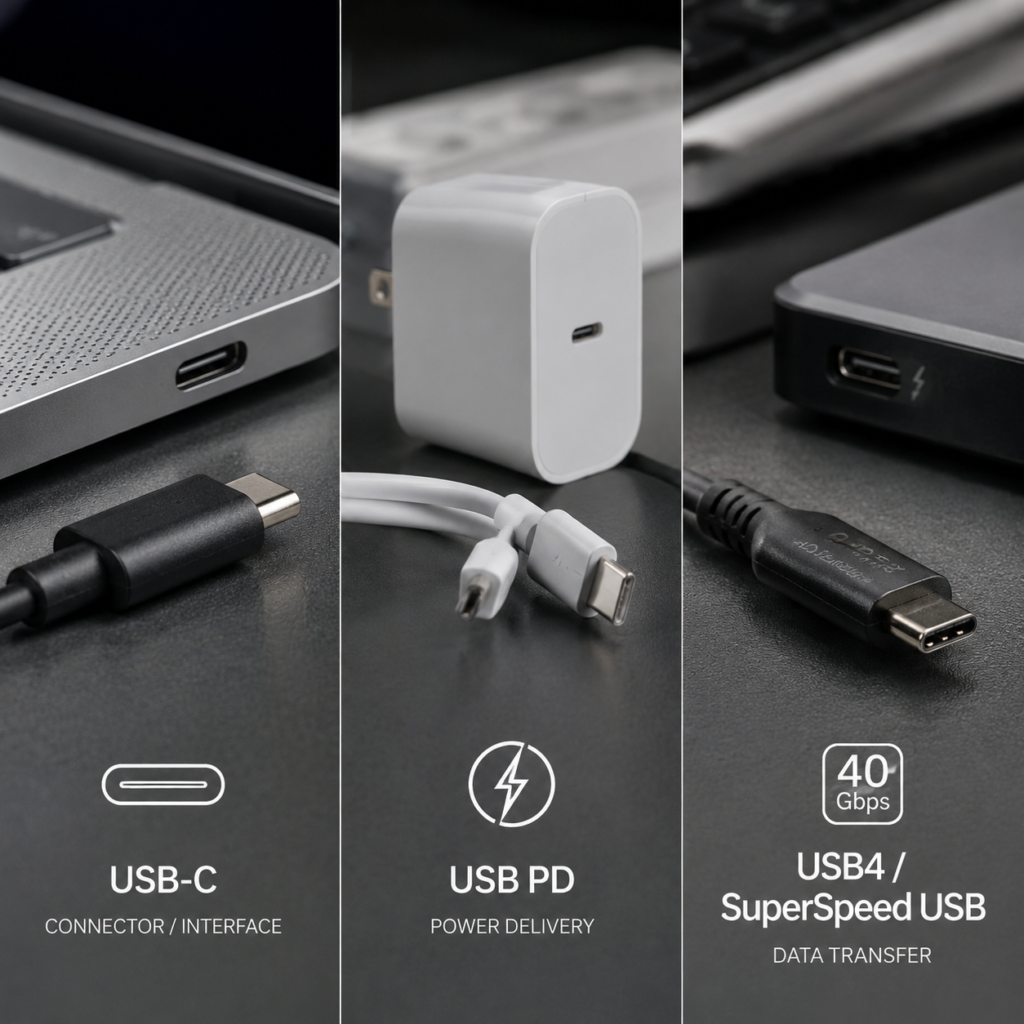
Now that we understand the basic positioning, let’s look at the three types of USB-related logos most commonly encountered when shopping for charging products. They may respectively indicate interface type, charging protocol, power range, or data transmission capability. Whether they specifically belong to certification logos and whether they can be used shall be subject to the corresponding USB-IF brand guidelines and certification categories. For easy comparison, they are organized in the table below:
| Logo Type | Appearance Features | Commonly Found on Which Products | Core Meaning (Notes) |
|---|---|---|---|
| USB-C Basic Interface Logo | USB trident pattern + the words “USB-C” | On the shell of USB-C chargers, charging cable connectors, next to the USB-C port of devices | Indicates that a USB Type-C connector is used or that the corresponding interface logo requirements are met; the connector supports reversible plugging, but the specific charging, power, and data transmission capabilities must be checked separately in the product specifications |
| USB PD Fast Charging Logo | May include USB-related patterns, PD, or other corresponding logos; the specific style is subject to the brand guidelines | PD fast charging chargers, fast charging cables, devices that support PD fast charging | Only indicates certification or logo eligibility for its corresponding category and power program; the SPR power range of USB PD is up to 100W, and EPR is used for the extended power range from over 100W up to 240W. The specific logo style and usage eligibility must be confirmed in accordance with the corresponding USB-IF brand guidelines and certification categories |
| USB-C Logo with Transmission Capability | SuperSpeed USB and its speed logo, or USB4 logo may be seen; the specific patterns, text, and speed names are subject to the current brand guidelines | Full-featured USB-C charging cables, chargers/devices with full-featured USB-C ports | Mainly indicates the corresponding data transmission capability or speed logo eligibility; data logos such as USB4 and SuperSpeed do not automatically represent high-power PD, and PD power and data capabilities should be checked separately |
In simple terms, the USB-C pattern is mainly used to indicate the interface or connector type, and cannot alone prove that the product has passed USB-IF certification, nor can charging power and data speed be inferred solely from the pattern. PD-related logos involve USB Power Delivery and the corresponding power range, but the specific capabilities still need to be judged in combination with the certification category and product specifications. Logos such as SuperSpeed USB and USB4 mainly involve data transmission capabilities, and also do not automatically mean that the product supports high-power PD.
3 core prerequisites for legal use of logos (advanced)
Many people don’t know that just because a product has passed a test once, it doesn’t mean the USB-IF logo can be used arbitrarily. Its legal use also involves certification programs, trademark licensing, and brand specifications, which are also important bases for us to judge whether a logo is credible.
First, attention must be paid to the finished product and its corresponding official certification program. USB-IF’s test objects and requirements vary with product categories and application programs. Finished products such as entire chargers and entire charging cables cannot simply be replaced by the test results of a single component; different products in a set also cannot naturally share the same qualification. The test content depends on the product category and the applied certification program, and may involve protocol interoperability, electrical characteristics of connectors or cables, data speed, or charging capability, etc.; USB-IF testing is not equivalent to complete product safety certification.
After passing the corresponding test, a TID or related certification record will be generated. Whether the TID is marked on the product or packaging, and what information is available to the public, shall be subject to the USB-IF certification database and current program rules. It cannot be assumed that all certified products must have the TID printed on the shell, nor can it be guaranteed that complete information can be directly found for each public record by brand or model.
Second, the user entity must meet official licensing requirements. The use of certification logos must meet the applicable USB-IF membership, trademark licensing, product certification, and brand specification requirements. Who specifically can use it shall be subject to the licensee entity and certification records. It cannot be simply summarized that only test applicants or their partners can use it, nor can it be assumed that foundries, OEMs, or distributors naturally have the same right to use.
Third, the logo must correspond one-to-one with the authorization scope. One product corresponds to one authorization scope, and it cannot be applied across models. For example, if a 65W charger of model A has passed a certain certification, the same logo cannot be directly printed on a 100W charger of model B without judgment. If key designs that affect USB functions, rated capabilities, or certification scope are changed, it should be confirmed whether supplementary testing, re-certification, or establishment of new certification records is required in accordance with the corresponding certification plan and change rules. Not all component changes or port changes will automatically require a full retest.
Official requirements for logo usage
Even if the product has the corresponding certification or usage eligibility, the logo cannot be printed however one wants. USB-IF has corresponding brand guidelines for different trademarks and certification logos, and appearance, position, and function matching shall all be subject to specific rules.
Appearance Requirements
The official standard pattern specified by USB-IF should be used, and it cannot be stretched, deformed, or have its color changed arbitrarily. For small-volume products such as charging cable connectors, if the brand guidelines allow reduction, they should also be scaled proportionally and kept clearly legible. Custom exaggerated words such as “fastest” or “all-around” cannot be added next to the logo to mislead consumers.
Position Requirements
If a manufacturer chooses to use the USB-IF logo, it must be used in accordance with the specified carrier, size, clarity, and position requirements in the corresponding brand guidelines. Whether it must appear on the product, packaging, or manual at the same time depends on the specific certification plan and brand rules, rather than all chargers, power adapters, and USB cables being uniformly forced to adopt the same labeling method.
Function Matching Requirements
This is the place where misinformation is most likely to occur. The core principle is “only what certification or logo eligibility you have can you indicate what capability you have”:
- Products that only involve the USB-C interface type cannot claim to have passed PD fast charging certification solely based on the interface pattern;
- The power corresponding to the PD charging cable logo must be consistent with the actual maximum load capacity and product specifications. For example, a cable that can only actually carry 3A current cannot be marked as 5A, 100W;
- Multi-port chargers should clearly state single-port and combined output capabilities in accordance with applicable regulations, product nameplate requirements, and manufacturer specifications; it cannot be inferred that any port can reach the total power solely based on the USB-IF logo;
- Data logos such as USB4 and SuperSpeed can only indicate the corresponding data capability or logo eligibility, and do not automatically represent high-power PD. PD power and data capabilities should be checked separately;
- Logos and descriptions in promotional materials such as e-commerce pages, manuals, and advertisements should be consistent with the product itself, certification scope, and actual specifications. It is not allowed that the promotional page says PD 100W, but the actual product only has basic USB-C interface capabilities.
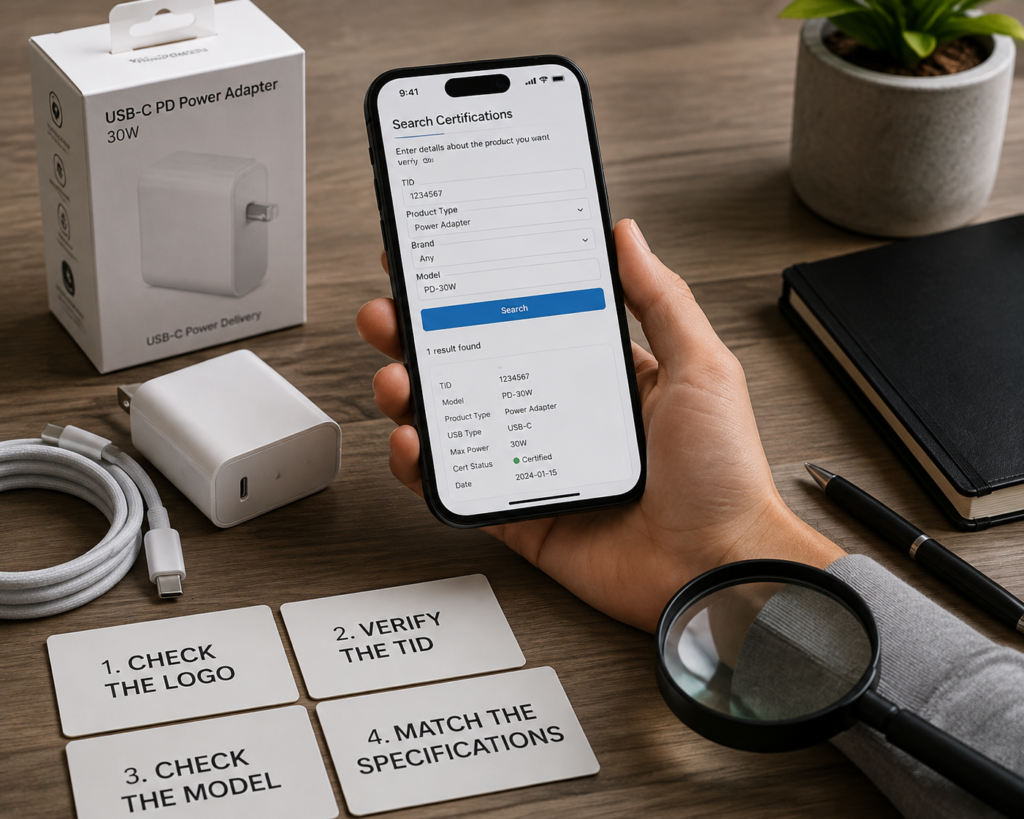
Practical operation for ordinary people: 4 steps to judge whether a logo is compliant
You don’t need to understand complex technology. Just follow these four steps, and you can quickly judge whether most USB logo promotions are credible.
Step 1: 10-second initial appearance check (filter out obvious fake logos)
When you get the product, first check three places:
- Check the appearance: whether the pattern and text of the logo are close to the official brand guidelines, whether there is deformation or color change, and whether there are exaggerated words such as “fastest” or “strongest” added next to it;
- Check the position: if the product uses a certification logo, whether the logo is clearly legible and whether it is blocked by other stickers or labels;
- Check the match: whether the power, functions, and logo type advertised by the product correspond — for example, if the product claims to be 100W PD fast charging, but only a pattern indicating the USB-C interface type can be seen, then its 100W PD capability cannot be confirmed solely by this pattern.
Step 2: TID official verification (most authoritative)
First check whether the product or packaging provides TID, certification model, or verifiable USB-IF certification information, then verify it through the USB-IF official certified product database. TID is not a consumer identification code that is usually necessarily printed on the product shell, packaging, or manual.
When verifying, you should also check the brand, model, product category, and certification program to confirm whether the queried record is consistent with the product in hand. The fields and query methods of the public database may depend on USB-IF’s current certification programs; not finding a TID cannot alone prove that the product has a fake logo, because certified products do not necessarily have to have the TID printed on the product or packaging.
Step 3: Identify common fake logo features
Some logos are made to look very much like official logos, but as long as you pay attention to the following situations, they are worth further verification:
- Abnormally low prices can be used as a prompt for further verification, but cannot alone prove that the logo is in violation. It should be based on USB-IF official certification records, product models, certification programs, and actual specifications;
- A separate USB trident pattern cannot prove USB-IF certification, nor can fraud be determined solely by the absence of a TID or functional text. It may just be an interface or USB trademark identification pattern.
It should be particularly noted here: No USB-IF logo does not mean the product is bad. Some products may not have applied for USB-IF certification, but this in itself cannot prove that they must be incompatible or unstable. Conversely, if a product explicitly claims to have passed a certain USB-IF certification, the corresponding brand, model, product category, and certification records should be verified.
Step 4: Distinguish easily confused unofficial logos
There are two other common logos that look like USB-IF logos, but in fact cannot be directly used as a basis for official certification:
- Ordinary USB interface diagram: mainly used to indicate the interface or connector type, and cannot alone prove USB-IF certification. If the manufacturer explicitly claims to use the USB-IF certification logo, it should be verified against the official trademark pattern, licensing conditions, and certified product records, and fraud cannot be determined solely by the absence of a TID;
- Brand proprietary fast charging logo: not equivalent to USB-IF certification or USB PD certification. Whether it also supports USB PD and other devices must be checked against specific specifications and test information, and the compatibility range cannot be judged solely by the brand name.
Avoid 4 common shopping misconceptions
Many people have a biased understanding of USB-IF logos, which instead makes them prone to pitfalls. Here are the four most common misconceptions:
- Misconception: The more logos, the better the product quality Correct answer: The number of logos cannot judge quality. You should confirm the meaning of the patterns, applicable brand rules, and corresponding certification records one by one, and cannot use the failure to find a TID as the only criterion. Multiple patterns may respectively indicate interface, speed, power, or other trademarks; the key is whether they are consistent with the product’s functions and licensing scope.
- Misconception: With a PD logo, you will definitely be able to fast charge at full speed Correct answer: PD fast charging requires the charger, charging cable, and device to all support the PD protocol of the corresponding power to be realized. For example, if you have a 100W PD charger and a 100W PD cable, but your phone only supports 27W PD, then the maximum is only 27W, and it is impossible to reach full speed 100W.
- Misconception: Products with a USB-IF logo will absolutely never break Correct answer: The USB-IF logo only means that the product has passed the compatibility requirements within the corresponding certification program and scope, and is not a “never-break guarantee”. It does not guarantee safety in extreme scenarios, such as water ingress, dropping, or overloaded use, nor does it mean that the product has a longer service life.
- Misconception: All charging products sold overseas have legal logos Correct answer: In overseas markets, including mainstream platforms such as Amazon and AliExpress, there may also be products that use USB logos not in accordance with the rules. It is not that “products sold abroad are definitely compliant”; you still have to judge for yourself when shopping.
Final Summary
USB-IF related logos are a reference when we choose USB charging products, but not the only standard. By mastering these rules, you can identify common logos such as USB-C, USB PD, SuperSpeed USB, and USB4, and distinguish interface patterns, data speed logos, proprietary fast charging logos, and certification logos; through initial appearance checks and verification with the USB-IF official certified product database, you can judge whether product promotions are consistent with certification records and actual specifications; avoid the four common shopping misconceptions, not be misled by false specification promotions, and choose USB charging products that better meet your needs.
Of course, if you don’t have high requirements for fast charging power and data transmission, you don’t have to insist that all products have USB-IF certification. You should confirm that the product meets the mandatory regulations and safety requirements applicable in the place of sale, and check the specific specifications according to the device, power, data speed, and protocol requirements. USB-IF certification is not mandatory safety certification, and safety marks cannot replace USB protocol compatibility verification.