
Have you ever had this experience: you bought a charger labeled “USB-C PD fast charging”, but when you plug it into your laptop, it only charges slowly; you switch to a “100W fast charging cable”, but it gets hot after charging for a while, and even disconnects frequently? USB charging products on the market are varied, and the USB-C, PD, and USB-IF certification mentioned in promotions are dazzling. Which ones are really reliable, and which are marketing gimmicks? Today we will thoroughly explain USB-IF’s test items and qualification rules, from entry-level concepts to practical pitfall avoidance. After reading this, you will be able to judge for yourself.
First, Understand: What Exactly Does USB-IF Do?
Many people, when hearing USB-IF for the first time, may think it is some government regulatory agency. In fact, it is a non-governmental, non-profit industry organization composed of USB-related enterprises, responsible for maintaining and promoting USB specifications, and verifying the USB functions of specific products through conformance testing.
Simply put, a product passing a certain USB-IF certification means that this specific model complies with the corresponding specifications within the scope of functions declared and covered by testing. It helps to judge whether a product’s interface, protocol, or related USB functions meet requirements, but it does not equal an absolute compatibility guarantee for all brand, model, and device combinations.
USB-IF certification is a voluntary industry conformance certification, not a mandatory government safety regulatory requirement. It can be used as an important reference for judging whether a specific USB product meets corresponding interface, protocol, and electrical requirements, but it cannot alone determine the compatibility or charging stability of all cross-brand combinations. The actual charging effect will also be affected by factors such as the device’s power demand, cable capability, PD version, manufacturer implementation, power supply environment, and fault status.
Three Core Concepts That Are Most Easily Confused
Many merchants’ promotional misleading is essentially swapping these three concepts. Let’s first clearly distinguish them:
| Name | Plain Language Explanation | Core Features |
|---|---|---|
| USB-C | Oval connector shape that can be inserted either way up | Only represents the connector’s appearance; does not indicate charging power level, nor does it indicate transmission speed |
| USB PD | The “communication rule” for fast charging: after a charger and device are connected, they use this set of rules to negotiate what voltage and current to use for charging | A fast charging protocol that determines whether fast charging can be triggered and what maximum power can be delivered |
| USB-IF certification | A compliance certificate issued after USB-IF conducts conformance testing on a specific product in accordance with corresponding specifications and test plans | It is a voluntary industry certification, valid only for the specific USB functions and product scope that were declared and passed testing |
Take the most common example: many small Bluetooth earbuds have a USB-C charging port, but they only support 5V slow charging, have no USB PD fast charging function at all, and even less does it mean they have passed USB-IF certification. If a merchant promotes “USB-C interface” as “fast charging”, that is a concept swap.
How Is It Different from Regulatory Requirements Such as CE and FCC?
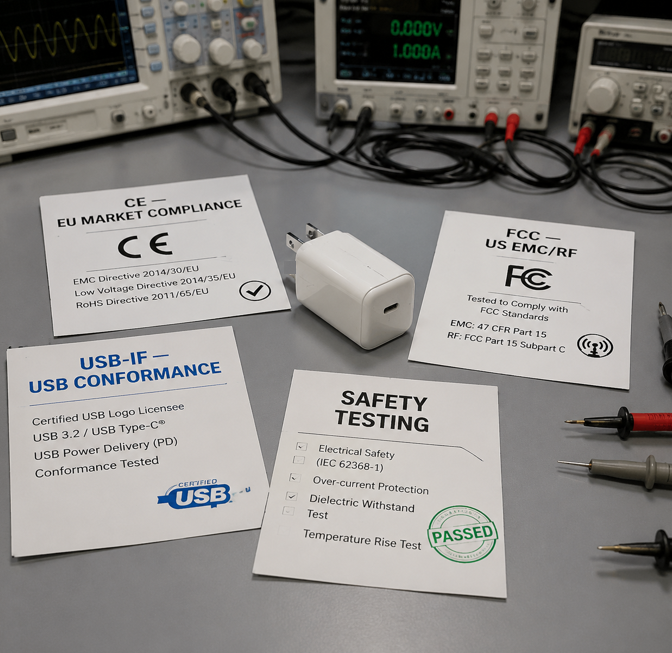
Many people mix up USB-IF certification with safety and market access requirements, but in fact they focus on different scopes. USB-IF certification is a voluntary USB conformance certification from an industry organization; when products are sold in different regions, they may also need to meet local regulatory or market access requirements, as well as applicable third-party safety testing or certification.
| Type | Core Scope | Nature | Common Examples |
|---|---|---|---|
| USB-IF certification | Specific USB functions, connectors, protocols, and conformance requirements | Voluntary certification by an industry organization | USB-IF corresponding product logo or certification record |
| Regulatory or market access requirements | Depending on the sales region and product type, may cover safety, electromagnetic compatibility, radio, environmental protection, or market access | Applicable scope is determined by local regulations | CE-related compliance, FCC requirements, PSE, CCC, etc. |
| Third-party safety testing or certification | Specific safety requirements such as electrical safety, insulation, and fire resistance | Whether it is mandatory depends on regulations, procurement, or market requirements | UL, ETL and other marks or related tests |
CE is a compliance mark under the EU regulatory framework, and is not issued by a unified “CE certification body”; FCC mainly involves US radio frequency and electromagnetic compatibility regulation, and whether it applies depends on the product type; UL, ETL, etc. usually belong to third-party safety testing or certification marks, and not all products in the US are legally required to obtain the UL mark.
Therefore, a charger may have passed a certain safety test, but not passed USB-IF protocol or interface conformance testing; conversely, passing USB-IF related tests does not equal completing electric shock, fire, insulation, and comprehensive thermal safety assessments. Different requirements can exist at the same time, and their roles do not conflict.
What Products Does USB-IF Testing Actually Cover?
Not all products with USB take the same test. The scope of USB-IF testing depends on the product category, USB functions, and applicable compliance program.
This article only discusses charging-related tests. Common products can be roughly divided into four categories according to their actual roles:
- Power supply end: Chargers with USB interfaces, power adapters, power banks with charging ports, monitors, etc., that is, products that supply power outward;
- Power receiving end: Mobile phones, tablets, laptops, wireless earbuds and other electronic products with USB functions. Whether a complete device can obtain USB-IF compliance certification depends on its specific USB functions and applicable certification programs;
- Transmission components: USB charging cables, including USB-C fast charging cables, as well as USB plugs, connector assemblies, etc.;
- Adapter category: Docking stations, adapters, etc. with USB charging function.
Charging devices with non-USB interfaces, such as old DC round-port chargers and round-port charging cables, do not belong to the USB system. It should be noted that pure data USB devices such as USB flash drives and wired keyboards are not part of the charging tests discussed in this article, but this does not mean they cannot participate in USB-IF compliance tests for corresponding USB device categories, transmission functions, or interoperability.
Brand proprietary fast charging protocols also cannot be automatically certified just because the product passes USB-IF tests. USB-IF certification only covers the USB functions that the product declared and participated in testing for; brand proprietary fast charging protocols not included in the USB specification compliance scope will not obtain USB-IF certification as a result.
Another important point: USB-IF testing is divided by product role and declared functions, and cannot be compared across categories. For example, a bidirectional power bank can be both a power supply end and a power receiving end; fast charging cables with E-Marker chips will also have different test items from ordinary cables. Even if a product only provides 5V output, it must still meet applicable USB Type-C, USB Battery Charging or other related specification requirements for its product role, and cannot evade applicable USB requirements by “declaring slow charging”.
What Do the Core Test Items Measure?
Many people think USB-IF testing is just “plug it in and see if it charges”, but in fact test items vary by product and certification program. Below only introduces key points related to charging that are helpful for ordinary users.
Physical Compatibility and Durability Testing
This type of test focuses on the mechanical dimensions, connection status, and use durability of connectors and cables. Common contents include:
- Whether the dimensions of the plug and socket comply with applicable specifications, and whether insertion and removal are normal;
- Whether insertion force, withdrawal force, and connection status are within the specified ranges;
- Whether the connector and device operate in accordance with specifications when USB-C is plugged in either way;
- Whether cables, connectors, or product interfaces still meet requirements after specified mechanical durability tests.
Mechanical dimensions, insertion force, withdrawal force, and durability cycles shall be determined in accordance with applicable USB connector specifications, cable specifications, and specific compliance programs. “10,000 cycles” cannot be used to represent a unified requirement for all USB-C products. Nor can it be said that all products with USB interfaces must undergo the same durability test.
These items may involve USB interfaces on charging cables, chargers, and USB interface components on devices, but the specific coverage shall be subject to the product category and declared items.
Electrical Performance and Protection Testing
This part may focus on power supply capacity, signal or electrical parameters, cable capacity, and specified behavior under specific abnormal conditions. Specific tests depend on product category and applicable specifications, for example:
- Whether the product provides corresponding voltage, current, or power supply capacity in accordance with USB specifications;
- Whether the cable meets applicable requirements under the declared current conditions, and whether the voltage drop is within the specified range;
- Whether cable identification information such as E-Marker is consistent with the cable’s actual declared capacity;
- Whether the product exhibits the required protective behavior under abnormal conditions specified in the applicable test plan.
E-Marker can be understood as the “electronic ID card” in the cable. Compliant cables will report their supported current or other capabilities to the charger and device, and the system will then determine the usable charging conditions based on this. But this does not mean that all cables with E-Marker necessarily support high-speed data, nor does it mean that all performance of the entire cable is determined by this chip.
USB-IF may test corresponding electrical parameters, protective behavior, and connector or cable temperature rise requirements for specific USB products and specifications; but the electric shock, fire, insulation, and comprehensive thermal safety of the complete device still need to be separately evaluated in accordance with applicable regulations and safety standards. USB-IF conformance testing cannot be regarded as a complete electrical safety, thermal safety, or fire protection certification, nor can “must not catch fire, must not cause burns” be taken as a unified judgment content for all USB-IF items.
Fast Charging Protocol Interoperability Testing
For products declaring USB PD, USB Type-C, or other related USB functions, testing may verify protocol messages, power supply roles, capability declarations, and operating behavior under specified conditions, for example:
- Whether chargers, cables, and devices correctly exchange information in accordance with the protocol;
- Whether the power supply capacity reported by the product is consistent with the actual declaration and test results;
- Whether the device can select applicable voltage and current levels under specified conditions;
- Whether power supply role, power receiving role, or role switching behavior complies with corresponding specifications.
These tests do not mean that all brand and model combinations are exhausted, nor is there a unified conclusion applicable to all multi-port chargers to guarantee that their power distribution will definitely meet every user’s expectations. Dynamic power adjustment by multi-port devices based on connection status may be normal USB PD behavior; compatibility with brand proprietary protocols also cannot be automatically inferred from general USB-IF certification.
Therefore, a product labeled 65W, 100W, or higher power does not mean that any device can obtain the corresponding power. Actual power also depends on the conditions jointly supported by the charger, cable, and device.
Compatibility and Anti-Interference Testing
USB-IF related tests can verify the electrical and protocol behavior specified in applicable USB specifications, but this does not equal testing all brand and model combinations, nor does it equal a commitment for all wireless or complex household electricity environments.
Radio interference, immunity, and compatibility with specific brand devices shall be separately judged based on applicable EMC tests, regulatory requirements, and actual device combinations. For example, whether Wi-Fi or Bluetooth earbuds are affected, or whether other nearby electrical appliances cause charging interruptions, cannot be used as a unified mandatory test item for all USB-IF charging certifications.
Boundaries of High-Speed Data and Video Testing
Corresponding USB function tests are only required when the product declares and supports the corresponding USB high-speed data or video functions. Ordinary charging cables usually do not involve high-speed data testing.
For example, USB 3.x or USB4 are high-speed data functions within the USB system; Thunderbolt 3/4 are independent technology and certification systems. The USB-C connector can carry different protocols, but USB-IF certification cannot replace Thunderbolt certification.
High-speed data, video, and charging are different functional dimensions. Passing a certain USB charging or power supply test does not mean the product supports high-speed data or video output.
What Kind of Product Is Considered Qualified?
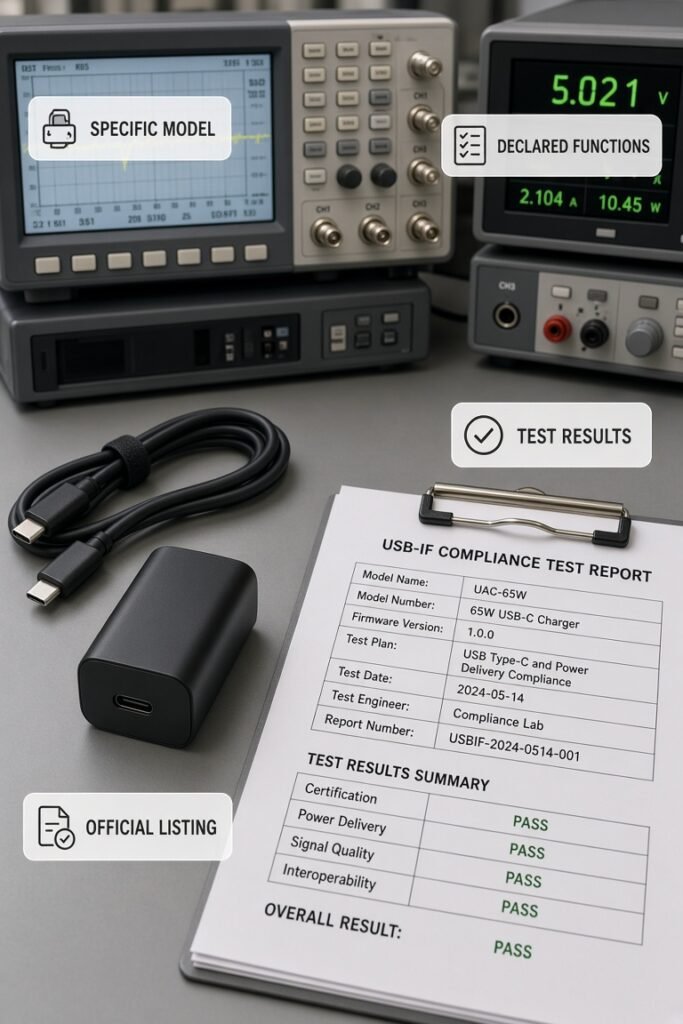
USB-IF qualification judgment is not simply based on promotional slogans, but on whether the specific product has passed the tests for its declared functions in accordance with applicable processes and test plans.
Three Basic Prerequisites for Qualification
First, testing shall be completed in applicable authorized laboratories or specified environments in accordance with USB-IF recognized compliance processes. Internal testing conducted by the manufacturer on its own cannot automatically be equated with official USB-IF compliance results.
Second, certification is for specific models and designs. If mass production involves key design or component changes that affect USB compliance, it shall be determined in accordance with USB-IF’s change policy whether re-testing or re-listing is required, and results from an old model cannot simply cover obviously different products.
Third, certification is only valid for specific products, product categories, versions, and declared functions in the public list. Passing the test for one model does not mean that other models in the same series, different power versions, or different function versions automatically pass.
Core Logic of Qualification Judgment
- The product needs to meet all requirements in its product role and applicable USB specifications, rather than evading applicable requirements by reducing declared power;
- Test results shall comply with the provisions of specific compliance items, and a general statement like “60 points is a pass” cannot be used to summarize all USB-IF tests;
- Judgment will combine test data, functional behavior, and whether the declared information is consistent;
- Product advertised functions cannot exceed the scope of actually passed tests and public listing. For example, a product passing a certain USB PD function test does not mean its high-speed data, video, or brand proprietary fast charging functions are also certified.
What Happens If the Test Fails?
The USB-IF public compliance process cannot be simply summarized as three unified formal conclusions: “fully qualified, rectification within a time limit, unqualified”.
A more accurate understanding is: test results are based on the pass or fail of specific compliance items. If failed, the manufacturer needs to revise the product according to the test report, and re-test or re-submit in accordance with the applicable process; whether rectification, supplementary testing, or re-submission is allowed depends on the specific compliance item and USB-IF process. Only after passing the corresponding process and being included in the relevant certification or compliance list can the product use the corresponding USB-IF logo.
Valid Boundaries of Qualification Conclusions
Don’t deify certification; its effectiveness has clear scope:
- The certification conclusion only covers test results under corresponding specifications, test plans, and specified conditions. Actual use shall also comply with the input voltage, temperature, humidity, load, and installation conditions marked on the product; performance beyond rated conditions is not guaranteed by this certification;
- Certification only covers functions that are declared and passed testing. Passing charging-related tests does not mean high-speed data or video functions are also qualified; passing a certain USB-C related test also does not mean all PD capabilities are certified;
- The complete model, version, and certification scope in the official list shall be verified. If changes in model, cable length, connector, key circuit, or power input affect USB compliance, it shall be determined based on USB-IF change rules whether separate listing or re-testing is required;
- Simply replacing a detachable power plug or regional power cord does not necessarily mean that the USB part must undergo all re-tests, but it shall still be subject to specific change rules and public listing.
How to Identify Genuine USB-IF Certified Products?
There are many “supports USB” promotions on the market. For actual judgment, the text on the product, complete model, and official public records should be matched.
Identification of Official Certification Marks
The specific name, graphic, applicable object, and power or speed information of the USB-IF mark shall be subject to the trademark and logo usage guidelines published by USB-IF. “USB-C certification mark”, “USB PD certification mark”, “USB cable certification mark” cannot be regarded as fixed unified classifications applicable to all products, nor can it be assumed that all USB-IF marks will indicate power or speed in the same way.
A more reliable approach is:
- Check whether the logo used on the packaging or product is the corresponding product logo published by USB-IF;
- Verify the complete model, manufacturer, and product category on the packaging against the official product list;
- Do not assume a product has passed USB-IF certification solely based on the words “USB-C”, “PD”, “100W” or similar graphics.
Steps to Verify Authenticity on the Official Website
Product records can be verified through the product or Integrators List query entry on the USB-IF official website. Since website fields, access permissions, and displayed content may change with the website and compliance program, queries should be operated according to the fields currently provided by the website.
Key points to verify:
- Manufacturer or brand;
- Complete product model and version;
- Product category;
- USB functions that passed testing or are listed;
- Whether the certification scope is consistent with the product in hand.
Do not judge solely based on the TID on the packaging, promotional screenshots, or “the brand is a USB-IF member”. The TID should correspond to the complete product record and certification scope in the official list.
If no record is found, it may be that the product has not participated in the corresponding compliance process, or that only a single accessory is listed, rather than the complete device or the entire set being listed. For example, a merchant says “the charging set is certified”, but in reality only the charger has a record, and the included cable has not separately passed relevant tests.
Common Counterfeit or Misleading Tactics
Be careful when encountering the following statements:
- Promoting “supports USB PD protocol” as “passed USB-IF certification”. Supporting the protocol only means the product can use relevant rules, and does not mean it has undergone official USB-IF conformance testing;
- Using modified similar logos to impersonate official certification marks;
- Only a single accessory has passed the test, but claiming the entire charging set is certified;
- The brand is a USB-IF member, so claiming all products are certified. Membership does not mean every product has participated in and passed testing.
Several Common Cognitive Misconceptions
Misconceptions About Certification Effectiveness
- Misconception: Certified products will never break.
Correct understanding: Certification only indicates that a specific product meets corresponding requirements within specific functions and test scopes, and does not cover human damage, normal aging, and long-term wear. A cable that is damaged after years of use does not mean the certification was invalid. - Misconception: If there is mandatory certification, USB-IF certification is not needed.
Correct understanding: The two have different functions. Regulatory or safety requirements focus on market access, electrical safety, electromagnetic compatibility, etc.; USB-IF focuses on the conformance of specific USB functions. Passing a certain safety requirement does not mean that USB protocol interoperability functions have definitely passed testing.
Misconceptions About Test Strictness
- Misconception: The higher the power, the stricter the test must be.
Correct understanding: Test content and requirements depend on product category, declared functions, and applicable specifications, and cannot be simply compared by power level. 20W and 100W products may apply to different test items, but both must meet their respective applicable requirements. - Misconception: All USB-C products must pass USB-IF testing.
Correct understanding: USB-IF is a voluntary industry conformance certification, not a unified mandatory condition for all USB-C products to be marketed. No certification record does not automatically prove that the product is definitely unqualified; but consumers also cannot interpret “no certification” as “has obtained certification”.
Misconceptions About Product Capabilities
- Misconception: All USB-C interface products support high-power fast charging.
Correct understanding: USB-C is just the connector form factor. Fast charging capability also depends on USB PD or other protocols, device-side demand, charger capability, and cable specifications. Many USB-C earbuds, fans, and other devices can only perform 5V slow charging. - Misconception: USB-C cables that support fast charging must support high-speed data.
Correct understanding: Fast charging and data transmission are two independent dimensions. Some fast charging cables may only support basic data transmission and cannot achieve the capabilities required for high-speed file transfer or video output. Whether USB 3.x, USB4, or video functions are supported should be checked against clear specifications and corresponding certification records.
How to Judge and Troubleshoot in Actual Use?
After talking about so many rules, when it comes to actual use, we still need to judge based on device requirements, cable specifications, regulatory requirements, and specific fault phenomena.
Certification Priority When Purchasing
It is not necessary to treat a certain power figure as a unified threshold for all products. When purchasing, products should be selected according to the power required by the device, USB PD or USB Type-C functions, cable current capacity, and applicable safety regulations in the sales region.
USB-IF certification can be used as a reference for compatibility, especially suitable for verifying whether the product has passed USB conformance tests related to one’s own needs. But it cannot be automatically assumed that certification is mandatory just because the power reaches 65W, nor can it be inferred that a product is necessarily safe, compliant, or suitable for all devices just because it is only 5V/2A or is a brand original.
When purchasing a charging set, also verify the charger and charging cable separately. A certification record for one accessory does not mean that other accessories in the entire set have automatically passed certification.
Basic Troubleshooting for Common Charging Problems
You can cross-replace chargers, cables, and devices to observe whether the problem moves with a certain component, helping to narrow down the scope:
- Slow fast charging or no fast charging triggered: Check the power required by the device, the USB PD levels supported by the charger, and the current capacity of the cable, then cross-replace accessories;
- Frequent disconnection: Check whether there is dust in the interface, whether the plug is loose, and whether there is obvious damage to the cable and interface;
- Obvious heating during charging: First stop high-load charging, check whether the product’s rated conditions are exceeded, and pay attention to whether the cable, plug, and interface have poor contact;
- Odor, smoke, sparks, interface discoloration, or abnormal heating occur: Stop using immediately, do not continue to make do, and do not self-determine the specific fault cause solely based on the phenomenon; replace the product or have it inspected by a professional.
These troubleshooting steps can only find obvious contact, abnormal heating, or disconnection phenomena, and cannot replace standard testing or safety testing, nor can they prove whether the product has passed USB-IF certification. Abnormal Wi-Fi or Bluetooth also cannot alone prove that a USB product is non-compliant.
Simplified Verification Checklist for Consumers
In daily use, you can observe the following phenomena, but remember they are only preliminary checks:
- The plug can be inserted normally, and there is no obvious looseness or repeated disconnection after connection;
- When charging with a single port or multiple ports, the device status does not change abnormally and repeatedly;
- There is no abnormal heating, odor, smoke, sparks, or interface discoloration during use;
- If wireless devices have abnormalities, disconnections, or noise, troubleshoot the charger, device, surrounding electrical appliances, and wireless environment separately, and cannot judge whether a USB product is certified solely based on this phenomenon.
These observations cannot verify USB-IF compliance, nor can “whether it is hot to the touch” be used to judge whether the temperature is safe. Charging power changes dynamically during use, and short-term power changes should not be directly regarded as a fault.
After reading this, you should be able to independently do these three things: First, distinguish the differences between USB-C, USB PD, and USB-IF certification, and also know their different roles from regulatory requirements and third-party safety testing; Second, be able to verify certification records based on official logo guidelines and product lists, and avoid common promotional tricks; Third, be able to select products based on device requirements, cable capabilities, and sales region requirements, and conduct preliminary troubleshooting of common charging problems.
USB-IF certification is not omnipotent. It can be used as an important reference for judging whether a specific USB charging product has passed corresponding USB conformance testing, but it should still be comprehensively judged in combination with product specifications, device compatibility, cable capabilities, and safety and regulatory requirements of the sales region.