
Sellers of charging products targeting the Saudi market have most likely heard the term “CITC certification” — some say all chargers require it, some say only wireless charging products do, and others say an FCC certificate can be used directly. What exactly is CITC radio certification? What does it have to do with the chargers, charging cables, and power banks we commonly use? Today, we will explain this thoroughly from basic judgment to key pitfall avoidance tips. After reading, you will be able to judge by yourself whether your product needs the certification, how to apply for it, and what pitfalls to avoid.
Basic Knowledge Essential for Getting Started
Let’s start with the most basic name. Many people wonder why some places call it CITC and others call it CST. In fact, these are the old and new names of the same agency: its predecessor was the Saudi Communications and Information Technology Commission (abbreviated as CITC), which was later reorganized and renamed the **Communications, Space and Technology Commission (abbreviated as CST)**. It is just because the term “CITC certification” has been used for many years and people are used to it, so it is still commonly referred to as CITC radio certification in the market now.
The essence of this certification is a **mandatory access approval** implemented by Saudi Arabia for products within the regulatory scope of radio equipment — it is not an ordinary quality certificate, nor does it test whether charging is safe. Its core function is to control the use of radio spectrum, preventing wireless signals from various products from interfering with local public communications, broadcasting, emergency signals, etc. For analogy, just like urban roads are divided into motor vehicle lanes, non-motor vehicle lanes, and sidewalks, so that everyone uses their own lane to avoid chaos. What CITC regulates is the “lanes” of wireless signals, ensuring that relevant equipment operates within specified frequency bands and parameters and does not randomly encroach on other lanes.
For charging products, this certification mainly focuses on whether the product has regulated radio or communication functions. Ordinary wired chargers, power adapters, and charging cables are usually not within this scope; however, whether the certification is required still needs to be confirmed in combination with the product’s actual wireless interfaces, working methods, and applicable technical specifications. It regulates the compliance of wireless functions, which is a separate matter from the electrical safety of charging itself — do not confuse the two.
Many people who are new to this also tend to confuse three terms, which we will clarify once and for all:
• **Type Approval**: This is what we commonly call CITC certification. It is an official radio and communication compliance approval for specific equipment or models, confirming that they meet applicable technical requirements.
• **Equipment Registration or Other Registrations**: Importers, operators, or specific equipment categories may also involve licenses, registrations, or customs platform procedures. Whether they are required and how to handle them shall be confirmed in accordance with applicable CST rules and specific import scenarios. Not all equipment that has obtained type approval automatically requires the same independent registration.
• **Test Report**: A test document issued by a third-party laboratory or other CST-accepted assessment channels, equivalent to an “exam transcript”. Having only a report does not necessarily mean that CITC certification has been obtained; it also depends on CST’s approval and applicable procedures.
Applicable Scope for Charging Products and Quick Judgment
The question everyone is most concerned about must be: Does my charging product need CITC certification? The core judgment logic is very simple: **it depends on whether the product actually has regulated radio transmission or communication functions, not on whether the word “wireless” is in the product name**.
Let us first clarify one of the most common misunderstandings: wireless charging ≠ CITC certification is necessarily required. If it is pure inductive power transmission, that is, it mainly works through coil power transmission and load modulation, without additional wireless communication modules such as Bluetooth, Wi-Fi, or cellular, it cannot be judged as required or not solely based on the name “wireless charging”. It needs to be checked separately in accordance with the latest applicable technical specifications and product classification of CST. On the contrary, products with Wi-Fi, Bluetooth, cellular, or other regulated radio communication functions shall be further confirmed in accordance with corresponding rules.
As for wired fast charging, ordinary USB interfaces, etc., they will not trigger radio certification requirements solely because they have fast charging or USB functions.
For your quick reference, we divide common charging products into two categories:
| Charging products that require further application for or verification of CITC certification | Charging products that usually do not require CITC certification for radio functions |
| Smart chargers, charging docks, desktop charging stations, and smart power strips controlled by Bluetooth/Wi-Fi | Ordinary wired chargers and power adapters |
| Wireless charging products with regulated radio transmission or communication functions such as Wi-Fi, Bluetooth, cellular, UWB, etc. | Wired power banks/portable chargers without wireless functions |
| Smart power banks and charging tracking accessories with radio transmission functions such as cellular, Bluetooth, Wi-Fi, etc. | USB/USB-C charging cables (even those with e-Marker chips do not need it) |
| USB-C adapter accessories and multi-functional charging docks with integrated wireless modules | Passive charging adapters, charging bases only for wired power supply/data transmission |
Among them, wireless charging pads, wireless power banks, and wireless charging bases that only have inductive wireless power supply or Qi load modulation functions cannot be directly classified into the “must apply” column, and must still be confirmed in accordance with applicable CST technical specifications and product classification. Car chargers also do not automatically require CITC certification solely due to their “vehicle-mounted” attribute; it depends on whether they integrate regulated radio interfaces.
If you are still unsure, you can use this 1-minute self-check method, which can give you a pretty accurate judgment in three steps:
Step 1: Look for wireless marks: Check whether there are antenna symbols, Bluetooth/Wi-Fi logos, SIM card slots, or functions such as “APP connection control” on the product body, packaging, or manual — if these are present, the product most likely has wireless transmission or communication functions.
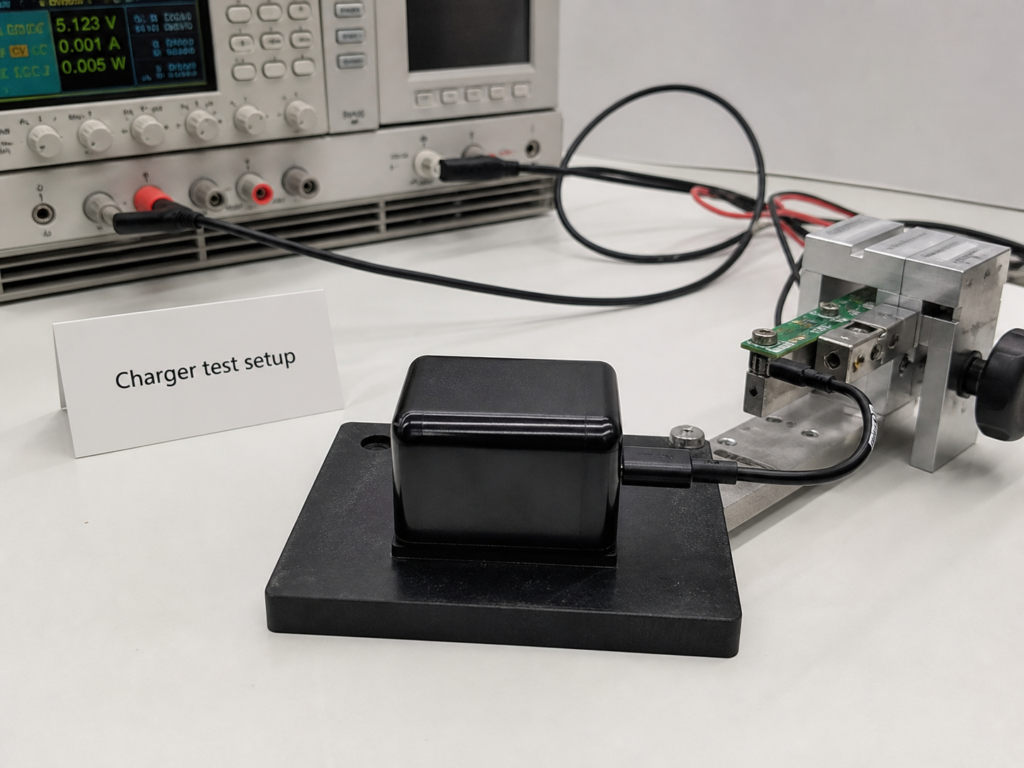
Step 2: Distinguish function types: Differentiate between “wireless power supply (pure inductive power transmission)” and “wireless communication/radio transmission”. The latter definitely requires further verification of certification requirements; if the former has no communication modules at all, it can be further confirmed according to CST classification. For products that only have GNSS reception, passive NFC, or other receiving/passive functions, it also cannot be judged that certification is required solely based on the function name.
Step 3: Verify ambiguous scenarios: If you are still unsure, directly check the currently applicable product classification and technical specifications on the CST official website, or consult a qualified accredited body. Do not judge based on intuition.
There are also several boundary cases that many people tend to get wrong, which are listed separately here:
• Pure inductive wireless charging (no additional wireless communication module): It needs to be confirmed in accordance with the latest CST technical specifications and product classification, and cannot be judged solely based on the three words “wireless charging”.
• Wireless chargers with Bluetooth power adjustment: They shall apply for certification, or at least be further verified in accordance with the requirements of Bluetooth radio functions, because they have radio transmission functions.
• Magnetic wired charging docks without wireless functions: No certification is required due to the magnetic function; it is essentially wired charging, and magnetism is just a fixing method.
• Special permits or exemptions: Some equipment for testing, display, temporary import, government or special purposes may be subject to special permits or exemptions, but this is not an automatic exemption. Bare radio frequency modules, experimental samples, as well as products for military police, diplomatic or other special purposes, shall have their written requirements confirmed with CST or Saudi competent authorities before import, and cannot be self-identified as exempt.
Necessity and Risks of Applying for CITC Certification
Some people may ask: What happens if I don’t apply for this certification? What is the use for ordinary users?
First of all, for equipment within the scope of CST type approval, if the required approval is missing, the following situations may occur:
• Customs clearance delays, being required to supplement certificates or technical documents, or being refused release in specific circumstances.
• Some e-commerce platforms or sales channels may require valid CST approval materials, which shall be subject to platform policies and product category requirements.
• If imported, sold or used in violation of regulations, corresponding regulatory penalties may be borne. The actual consequences depend on the product category, the circumstances of the violation, and the handling of the competent authority.
For end users, this certification is not empty either. Type approval is used to confirm that relevant wireless interfaces comply with applicable Saudi frequency bands, power, and other technical requirements, which can reduce the risks of illegal transmission and wireless interference. However, it is not equivalent to a guarantee of the overall product quality, network compatibility, or usage stability. The actual usage effect will also be affected by factors such as the regional version of the equipment, local network, spectrum allocation, terminal compatibility, and usage environment.
From the perspective of actual sales scenarios, there are three main high-incidence scenarios of violations for charging products:
First, wireless charging pads with radio communication functions are directly shipped without certification, and as a result, they are required to supplement materials during customs clearance;
Second, smart charging products with Wi-Fi/Bluetooth are rejected by the platform when being listed, and are required to supplement CST approval documents;
Third, smart power banks or charging tracking accessories with wireless transmission functions such as cellular and Bluetooth are required to provide corresponding compliance certificates during customs clearance.
Core Requirements for CITC Certification
If it is determined that the product needs CITC certification, what core requirements need to be met? We will explain them in three parts, all of which are closely related to charging products.
First, radio frequency technical requirements, which are also the most core:
• The equipment must use the frequency bands, channels, bandwidths, and transmission parameters permitted by CST in applicable technical specifications. Radio communication frequency bands and wireless power transmission frequencies cannot be judged solely based on the product name or “ISM” label.
• Transmission power, including EIRP (Effective Isotropic Radiated Power), which simply refers to the total signal strength transmitted by the antenna, must not exceed the upper limit of applicable requirements. The limit values vary for different types of products.
• The type, gain, and installation position of the antenna cannot be changed at will, otherwise it will affect the radio frequency performance and cause non-compliance with the original approval conditions.
• Software or firmware restrictions can be part of the compliant design, but they must be effective, cannot be easily bypassed by ordinary users, and must be consistent with the test samples and application materials. If the modified equipment can operate in unapproved frequency bands or with power exceeding the limit, re-evaluation is required.
• Do not think that as long as your product’s wireless function works normally, it meets the requirements. Test reports and technical documents shall be prepared in accordance with CST-accepted assessment methods and confirmed through applicable approval procedures.
Second, product labeling and documentation requirements:
• Specified marks and approval information shall be used in accordance with specific CST technical specifications, type approval decisions, and applicable Saudi labeling and manual regulations. It cannot be generalized that all products must have the CITC mark and number in exactly the same format printed on the body or minimum packaging.
• When consumer products are involved, the requirements for Arabic labels and manuals shall also be checked separately. The language, label position, and content may be jointly determined by specific technical regulations, approval conditions, or other Saudi product regulations.
• When applying, technical materials consistent with the final product need to be provided, including product model, wireless module parameters, operating frequency band, antenna information, software or firmware configuration, user manual, etc. The specific scope of materials shall be subject to current CST requirements.
Third, requirements for testing and application entities:
• CST-accepted test reports and technical documents shall be prepared in accordance with equipment categories and applicable technical specifications. The source of the report, the accreditation status of the laboratory, and whether CST accepts existing reports, manufacturer materials, or other conformity assessment methods shall all be subject to current CST requirements.
• Overseas enterprises usually need to handle the application through Saudi local importers, authorized representatives, or service entities that meet the system qualifications. However, whether a certain type of entity can submit directly shall be confirmed based on the entity qualifications of the CST application system and local import liability rules.
Basic Application Process and Common Sticking Points
Many people want to know how to apply for the certification. In fact, the process is not complicated, mainly divided into three steps. By the way, we will also mention the places where charging products tend to get stuck.

Step 1: Pre-preparation and self-check:
First, confirm whether the product needs the certification according to the judgment method we mentioned earlier, so as not to work in vain; then prepare samples, manuals, compliance materials of the wireless module, and information of the local importer or handling entity. It is best to check in advance whether the product’s wireless interfaces, frequency bands, power, and software configuration meet the applicable Saudi requirements. Otherwise, you will find non-compliance only at the testing stage, which wastes time and money.
Step 2: Testing and application submission:
Select the currently accepted CST assessment method according to the equipment category, and prepare corresponding test reports and technical documents. The test content may include frequency band, channel, power, bandwidth, spurious emission (that is, other interfering signals leaked out in addition to the main signal), etc. After the materials are prepared, a qualified local importer, representative, or service entity shall submit the application and pay the fee through the applicable CST system. If materials are missing during the review process, just supplement them as required.
Step 3: Certificate acquisition and daily maintenance:
After the review is passed, the official will issue a type approval certificate. The validity period of the certificate shall be subject to the certificate issued by CST and current service rules. When the certificate expires, regulations change, or product configuration changes, renewal, modification, or re-application shall be handled in accordance with CST requirements.
It should be noted that type approval is for the final product and wireless configuration submitted at the time of application. After replacing the wireless module, antenna, firmware, or key radio frequency parameters, you cannot directly assume that the original certificate is still applicable. You should first confirm whether modification or re-evaluation is required.
There are three points where charging products are most likely to get stuck during application. Paying attention to them in advance can save a lot of trouble:
• First, the operating frequency, wireless interface, or power related to wireless charging does not meet applicable Saudi requirements, resulting in direct test failure;
• Second, the module materials are incomplete, or the module parameters and existing approval conditions are inconsistent with the antenna, housing, software, and installation method of the complete machine, increasing the difficulty of complete machine evaluation;
• Third, the product labeling, manual, or approval information is not prepared in accordance with specific CST requirements, or the relevant numbers and models are inconsistent with the application materials, resulting in the application being rejected during review.
There is another very important point: if the product has been modified, not all modifications necessarily require re-application, but the following situations usually require re-confirmation before launch:
• The wireless module is replaced, or the position and gain of the antenna are changed;
• Wireless standards are added or removed, and the supported frequency bands, channels, or transmission power are modified;
• Firmware, regional configuration, or working mode are modified, which may cause the equipment to operate outside the original approval scope;
• The mainboard, coil, or housing shielding structure of the charger is changed — these may affect radio frequency performance;
• The brand, model, packaging, or sales combination changes. Whether it is necessary to modify the certificate or re-apply shall be judged item by item in accordance with CST’s certificate modification rules, rather than being generalized.
As for the cycle and cost that everyone cares about, there is actually no unified universal value. They are mainly affected by several factors: whether the materials are complete, whether there is a queue for testing, the number of supplementary submissions, and the review time for multi-band and multi-standard products will also be longer. The specific details shall be subject to the latest official requirements of CST. Do not believe promises such as “guaranteed pass, certificate obtained in a fixed number of days”.
Relationship with Other Saudi Compliance Requirements
Many people confuse CITC certification with other Saudi compliance requirements. Here we will clarify the division of responsibilities once and for all, so as not to mix them up.
First, the relationship with SASO/SABER:
• **CST** mainly handles type approval of applicable radio and communication equipment.
• **SASO technical regulations and SABER platform** may involve requirements such as electrical safety, energy efficiency, electromagnetic compatibility, and import conformity assessment. The specific certificates or documents required depend on the product, HS code, and applicable technical regulations.
• Charging products with wireless functions may involve both CST and SASO/SABER requirements, or may only be subject to some of the requirements depending on the product category. This cannot be generalized, and one set of documents cannot automatically replace the other set of requirements.
SABER is an electronic platform related to Saudi product conformity assessment and import. It may involve documents such as product certificates and shipment certificates, and is not a “safety certificate” universal for all products. Therefore, what materials need to be prepared for customs clearance shall be confirmed based on the specific product and applicable regulations.
Then, the relationship with overseas wireless certifications (such as FCC, CE):
• FCC and CE related materials can be used as technical references, but they cannot directly replace CST certification.
• Whether overseas laboratory reports can be accepted by CST shall be confirmed with CST or application channels based on specific technical specifications, laboratory accreditation qualifications, report content, and equipment categories. It cannot be claimed that they automatically replace or generally simplify CST approval.
• If the product version corresponding to the overseas certification is different from the version you want to sell to Saudi Arabia in terms of antenna, module, firmware, frequency band, or power, you cannot directly assume that the report is applicable, and re-evaluation may be required.
During customs clearance and listing, various documents are used in coordination: CST approval materials are used to verify the compliance of radio or communication equipment, and relevant conformity assessment documents in SABER are used to verify applicable Saudi product regulatory requirements. What documents are required in customs, platform, or market supervision links shall be subject to product categories and specific channel requirements.
Common Misconceptions and Certification Validity Inquiry
Finally, let’s talk about several misconceptions that charging product sellers are most likely to fall into, and how to check whether the certification is really valid.
Let’s first talk about the four most common misconceptions. Avoiding these can save you a lot of detours:
**Misconception 1: All chargers sold to Saudi Arabia require CITC certification**
Correct answer: Ordinary wired chargers, power adapters, charging cables, and power banks without wireless functions usually do not require CITC certification for the charging function itself. Only products with regulated radio transmission or communication functions such as Bluetooth, Wi-Fi, and cellular need to be verified in accordance with corresponding rules.
**Misconception 2: CITC certification is mandatory as long as there is a wireless charging function**
Correct answer: For wireless charging products that are purely inductive and have no additional wireless communication modules, it cannot be judged that certification is required solely based on “wireless charging”. It shall be confirmed in accordance with CST official technical specifications and product classification.
**Misconception 3: If the wireless module has already obtained CITC certification, the complete machine does not need to apply**
Correct answer: Module materials or existing approvals can help with the complete machine evaluation, but module approval is not equivalent to complete machine approval. The antenna, housing shielding, internal layout, firmware, transmission power, and working mode of the complete machine will all affect the final compliance. It still needs to meet applicable CST requirements according to the final configuration.
**Misconception 4: Products with similar models can share one certificate**
Correct answer: The scope of application of a certificate is related to the specific model, manufacturer, wireless configuration, and approval conditions. Changes such as adding Wi-Fi function, replacing the wireless module, or changing the antenna may require modification or re-application; changes in brand, model, packaging, and sales combination shall be judged in accordance with CST certificate modification rules, and cannot be judged only by whether the appearance is similar.
Then if you get a CITC certificate, how do you confirm whether it is valid? It can be handled in the following ways:
The first is preliminary verification: Check the marks, approval number, and model information on the product or packaging, and verify whether they are consistent with the official certificate provided by the supplier. Do not judge the authenticity solely based on a number printed on the packaging.
The second is official verification: Priority is given to verifying the certificate, approval number, product model, and validity period through the Type Approval service currently published on the CST official website, or by directly contacting CST. If the official website currently does not have a unified entry open to the public that can directly search all certificates, you should require the supplier to provide a verifiable official certificate and confirm it through CST or a qualified authorized handling channel. Do not rely on third-party query pages of unknown origin.
There are several common invalid or high-risk situations: the certification number is forged and cannot be verified through official channels; the certified model, manufacturer, or wireless configuration is inconsistent with the actually sold product; the certificate has expired; the product has undergone changes that affect wireless functions, but the modification or re-evaluation has not been handled as required. All these should be noted.
Overall, CITC radio certification is an access requirement of Saudi Arabia for products within the regulatory scope of radio equipment. For charging products, the core judgment standard is not whether there is “wireless” in the product name, but whether there are regulated radio transmission, communication, or other related wireless interfaces. Pure inductive wireless power supply cannot be judged solely based on “wireless charging”, while products with wireless transmission functions such as Wi-Fi, Bluetooth, and cellular shall be verified in accordance with corresponding rules. Understanding the differences between it and requirements such as SASO/SABER, FCC, and CE, judging in advance whether the product needs the certification, and avoiding common misconceptions can reduce the risks of customs clearance, listing, and sales. If you are unsure, the safest way is to check the current CST rules or consult a qualified institution, and do not make decisions based on intuition.