
If you operate in the Saudi Arabian market for charging products, whether through offline wholesale or e-commerce platforms, you have most likely heard of the term “CITC certification”. Some say it is required for products with wireless functions, some say all smart chargers need it, and others say you can directly exchange a CE-RED certificate for it. With all kinds of conflicting statements, it is easy to fall into pitfalls. In fact, the official Saudi agency responsible for this certification has been renamed CST (Communications, Space and Technology Commission), but the industry still habitually uses the old name CITC certification. It mainly covers the market access requirements for some radio, communication and related ICT equipment entering the Saudi market. Today, we will explain this matter thoroughly from product judgment, application rules, full process to key pitfall avoidance tips, so that even if you are new to Saudi compliance, you can understand it clearly.
First, Understand Several Core Concepts
Many people’s misunderstandings about CITC stem from confusing several similar terms. Let us first clarify the most core concepts:
First is **CST Type Approval**, which is commonly referred to as “CITC certification” — this is a market access document issued by Saudi Arabia’s CST official authority for communication, radio and related ICT equipment. For products within the CST regulatory scope and without applicable exemptions, they usually cannot be imported or sold without approval. Whether type approval is ultimately required shall be subject to CST’s current technical specifications and official classification results. Its core purpose is to unify the use of radio spectrum, avoid signal interference between different devices, and ensure communication security.
Second is **test report**, which is a technical performance certificate issued by a third-party laboratory. It can only be used as supporting material for applying for CST Type Approval, and is not equivalent to an access certificate itself. You cannot use a test report directly for customs clearance.
The third easily confused term is **SABER**. It is Saudi Arabia’s official product compliance and conformity assessment platform, not an independent certification body. For applicable regulated products, it is usually necessary to apply for or register the Product Conformity Certificate (PCoC) and Shipment Conformity Certificate (SCoC) through SABER; whether these documents are required depends on the technical regulations to which the product belongs and customs requirements.
Finally, there is the **local responsible entity**, that is, a locally registered importer or authorized representative in Saudi Arabia. Whether overseas enterprises can apply directly, and who acts as the applicant or certificate holder, shall be determined in accordance with CST’s current service and platform requirements. When overseas manufacturers or brands are involved, it is usually required that a qualified Saudi local entity, importer or authorized representative participate in the application or bear local responsibility. The specific authorization and certificate holding arrangements shall be subject to the requirements of the CST system.
It is also necessary to clarify a boundary here: CST requirements and other Saudi compliance requirements run in parallel and cannot replace each other. For products with wireless or communication functions, you should first confirm whether CST Type Approval is required, and check applicable requirements such as low-voltage safety, EMC, energy efficiency, plugs and sockets, and SABER according to the product category. Purely wired products usually do not involve CST, but still need to check other potentially applicable requirements. For example, purely wired chargers usually need to focus on checking applicable low-voltage electrical equipment, energy efficiency, plug and socket, and labeling requirements, but whether a specific certificate must be obtained shall be subject to Saudi Arabia’s current technical regulations, product scope and SABER classification results.
Does Your Charging Product Need CITC Certification? Judge by This Method
The core of judging whether a product needs CITC certification is to look at **technical functions, not marketing names** — no matter how many “smart” or “black technology” labels are in the product title, as long as there is no wireless communication-related function, it usually does not fall within CST’s wireless communication regulatory scope. Let us first classify common charging products by function, and then provide a set of operable judgment methods.
Regulatory Classification by Technical Function
CST regulation is divided according to the core technical functions of the product, and has nothing to do with the product name. Charging-related products can be roughly divided into five categories:
1. **Power Conversion Only / Wired Transmission Category**: for example, purely wired chargers, ordinary charging cables, which have no wireless function and are only responsible for voltage transformation or wired data transmission;
2. **Wireless Power Transmission Category**: for example, pure wireless charging pads, which only have the function of electromagnetic induction energy transmission and do not have communication modules such as Bluetooth or Wi-Fi;
3. **Short-Range Wireless Communication Category**: charging devices with short-range wireless functions such as Bluetooth, Wi-Fi, NFC, etc., but not connected to public communication networks, such as desktop smart chargers with Bluetooth;
4. **Telecommunication Terminal Category**: charging devices with cellular, SIM card, eSIM that can access public networks, such as public charging stations with 4G connectivity;
5. **Passive Component Category**: separately sold interfaces, connectors without active circuits, such as separate Type-C male connectors.
Judgment Reference for Common Charging Products
For your convenience in comparison, we have sorted out the judgment results of 7 most common charging products, along with other compliance requirements that need attention:
• **Purely wired USB-C charger / power adapter**: usually does not involve CST, need to check applicable low-voltage safety, energy efficiency, plug and socket (Saudi Arabia generally uses British standard plugs) and other requirements;
• **Wired charging cable (with fast charging protocol chip)**: usually does not involve CST, because it is wired transmission and does not emit radio waves, need to check electrical safety, USB specifications, and labeling requirements;
• **Pure wireless charging pad (only for energy transmission, no communication module)**: cannot be directly judged as required or not, need to confirm according to CST official classification, and also need to check applicable requirements such as low-voltage safety and energy efficiency;
• **Desktop smart charger with Bluetooth**: may involve CST, need to confirm according to specifications, and also need to check applicable requirements such as low-voltage safety and EMC;
• **Networked charging cabinet / charging station with Wi-Fi**: may involve CST, need to confirm according to specifications, and also need to check applicable requirements such as low-voltage safety and energy efficiency;
• **Charging base with NFC pairing function**: may involve CST, need to confirm according to specifications, and also need to check applicable requirements such as low-voltage safety;
• **Public charging station with cellular network connectivity**: most likely involves CST, evaluated as telecommunication terminal category, and also need to check applicable requirements such as low-voltage safety and energy efficiency.
Four-Step Quick Judgment Method (Final Result Subject to Official Confirmation)
If your product is not in the above list, you can do a preliminary evaluation by following these four steps:
Step 1, **Identify core technical functions and ignore marketing names**. First, remove the gimmicks in product promotion, and see whether it essentially has wireless communication capabilities — for example, some “smart fast chargers” only automatically identify current and have no wireless module at all, so they are purely wired products.
Step 2, **Check radio / communication characteristics**. See whether the product has the ability to transmit or receive wireless signals, whether it has a built-in wireless module, and whether it can access the public network. You can refer to the “Wireless Parameters” column in the product specification sheet, or open the casing to check whether there are Bluetooth or Wi-Fi chips inside, and whether there is a SIM card slot.
Step 3, **Check key technical parameters**. If there is a wireless function, sort out the corresponding parameters: operating frequency band, transmit power, modulation method, antenna type, wireless module model, and also clarify whether it has cellular function, whether it is receive-only, and whether it can access the public network.
Step 4, **Confirm the regulatory attribute through CST official classification or authorized bodies**, and keep the confirmation records as the basis for subsequent applications.
For kit products (such as a combination of “charger + charging cable + wireless base”), you need to check the function of each component one by one, and then confirm the overall regulatory attribute. You cannot default that the entire kit does not need or all need approval.
6 Most Common Judgment Misconceptions
Many people fall into these pitfalls when making judgments for the first time. We specially list them to help you avoid them:
1. **A smart charger needs CST? Wrong**. If it is only a wired fast charger with intelligent current identification and no wireless communication function, it usually does not involve CST;
2. **USB cables with data transmission need CST? Wrong**. Wired data transmission does not emit radio signals, and usually does not involve CST;
3. **Wireless charging = CST required? Wrong**. For wireless charging pads that only transmit energy and have no communication module, confirmation shall be made according to CST official classification. Not all wireless charging products need it;
4. **No CST needed = no Saudi compliance required? Wrong**. Even if CST is not required, you still need to check potentially applicable requirements such as low-voltage safety, energy efficiency, labeling, and plugs. Purely wired chargers usually also need to confirm applicable electrical safety or other conformity requirements according to Saudi Arabia’s current technical regulations and SABER classification;
5. **Any product with wireless function must apply for CST? Wrong**. Whether it is required needs to be confirmed in combination with specific functions, parameters and official classification. It is not that all products with wireless functions must apply;
6. **Kit accessories are defaulted to be within the approval scope? Wrong**. For example, if you previously applied for a certificate for a single charger, and later add a charging cable to sell as a kit, you need to check whether the charging cable is within the scope of the original certificate, and conduct a separate evaluation if necessary.
Core Rules You Must Know Before Applying for CITC Certification
If you confirm that your product needs CST Type Approval, understanding these rules first can save you a lot of detours.
Who Can Apply? Who Holds the Certificate?
The qualifications of the applicant and certificate holder shall be determined in accordance with the requirements of CST’s current Type Approval service and platform. When overseas manufacturers or brands are involved, it is usually required that a qualified Saudi local entity, importer or authorized representative participate in the application or bear local responsibility. The specific authorization and certificate holding arrangements shall be subject to the requirements of the CST system.
Whether it is a local importer, distributor or cross-border seller, as long as they sell products within the regulatory scope in Saudi Arabia, they must ensure that the products obtain CST approval in accordance with applicable requirements. The application channel is usually CST’s E-approval system, and the specific details shall be subject to the services currently open on the official platform.
What Materials Should Be Prepared Before Application?
These materials are not only used during application, but also should be kept as decision-making evidence:
• **Basic information**: product model, brand, photos of appearance and nameplate, user manual, accessory list;
• **Wireless parameters**: wireless module model, firmware version, operating frequency band, transmit power, modulation method, antenna type, and also state whether it has cellular function, whether it is receive-only, and whether it accesses the public network;
• **Technical documents**: circuit block diagram, wireless module specification sheet, existing relevant test reports (if any).
Requirements for Test Reports and Laboratories
Test requirements shall be determined according to the technical specifications of the corresponding product and the application path. The laboratory must meet CST’s accreditation requirements. ISO 17025 qualification is a common prerequisite, but having it does not guarantee acceptance — it also depends on whether the laboratory’s accreditation scope covers the corresponding product and test items.
Overseas certificates or test reports such as CE-RED and FCC cannot directly replace CST Type Approval. CST or its accredited assessment path may accept overseas test materials that meet the requirements. Whether they are recognized and whether supplementary Saudi difference tests are required shall be confirmed according to the specific product category, laboratory accreditation scope, report content and current CST technical specifications.
The submitted test reports and technical materials shall cover wireless, radio frequency, EMC and other items required by applicable product categories and CST technical specifications. Whether whole-machine testing, module materials, antenna information, firmware version and testing of each operating frequency band are required shall be confirmed according to the specific product configuration and application path.
What Is the Relationship Between Wireless Modules and Whole Devices?
Many sellers will ask: “The wireless module I use already has CITC approval, so does the whole device not need to apply?” The answer is usually **no**. The approval or test report of the module can only be used as supporting material for the whole device application, and cannot replace the type approval of the whole device — after all, after the module is installed in the whole device, changes in the casing, antenna, and power supply circuit may affect wireless performance.
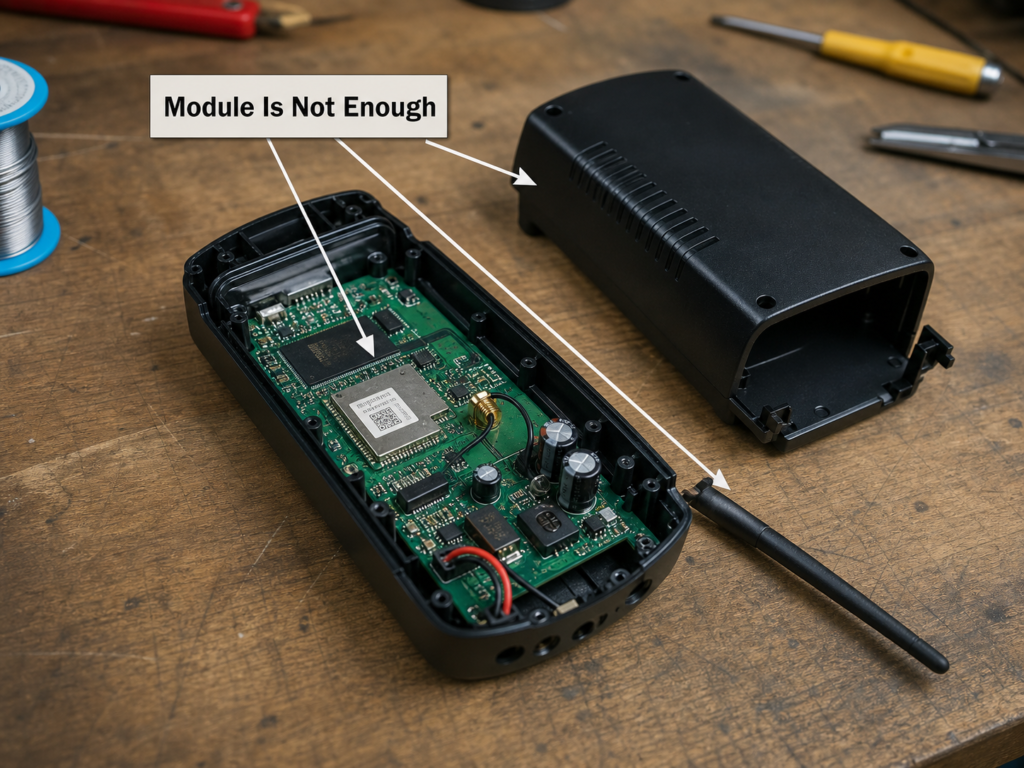
Whether the whole device can use the test results of the module and be exempted from some tests shall be determined according to CST rules and product categories, and it is not always possible. If the whole device replaces the wireless module, the approval status must be re-evaluated, and you cannot continue selling after secretly replacing it.
Certificate Validity and Change Management
CST Type Approval is usually valid for three years from the date of issuance, but the specific validity period, renewal method and whether there is a special period shall be subject to the certificate and current CST rules. Renewal applications should be submitted before expiration. Whether retesting is required depends on the product category and the rules at that time.
If there is a change to the product, you must first confirm the handling method against CST change rules. Any change in appearance, label, power supply, hardware, wireless module, antenna, firmware, brand, model or manufacturing information may involve filing, change application, supplementary testing or re-application, and cannot be judged solely by the change of name. For example:
• Only changes in appearance, color, packaging label: confirm whether they affect the certificate scope or labeling requirements, and whether filing is required;
• Changes in wired power, casing, power supply circuit: evaluate the impact on wireless performance and applicable requirements, and conduct supplementary testing if necessary;
• Changes in wireless module, antenna, radio frequency parameters, firmware that affects transmission: usually require key evaluation, which may involve retesting and change applications;
• Changes in brand, OEM party, model, production factory: submit change applications or supplement corresponding materials according to CST rules;
• Addition or reduction of kit accessories: check whether they are within the original approval scope, and conduct separate evaluation if necessary.
How to Save Money on Application? Try Series Application
If you have multiple models of products that use the same or CST series application-eligible wireless modules, radio frequency parameters and core wireless circuits, you may apply to merge them into one series, which can reduce some testing fees and time.
However, series application is only possible when CST allows it for the corresponding product category, and the wireless configuration, radio frequency parameters and certificate scope of each model meet the requirements. Whether configurations that only differ in casing color, wired interface or other parameters that do not affect approval can be classified into the same series is also subject to CST review. Different frequency bands or wireless configurations usually require separate evaluation, and it cannot be asserted in advance that they can or cannot be merged for application.
Full Process for CITC Certification Handling (6 Stages)
The entire handling process can be divided into 6 stages. We have sorted out the core actions and precautions for each stage:
Stage 1: Pre-Assessment and Classification Confirmation
The core action is to use the four-step judgment method mentioned above for preliminary evaluation, implement the local responsible entity, and confirm the regulatory classification of the product. After this stage, you should clearly know whether the product needs to be applied for, what technical specifications are applicable, and the general application path. Be sure to archive the classification confirmation results as the basis for subsequent applications.
Stage 2: Material Preparation and Self-Inspection
Sort out all application materials according to the information collection list above. Before submitting, be sure to check them yourself first: are the model, brand, and wireless parameters in all materials completely consistent? Is the qualification of the local responsible entity valid? Are the authorization documents complete? If there is a test report, does it cover the applicable wireless functions and meet Saudi requirements? Do product labels and user manuals meet CST’s basic requirements? If these places are not checked properly, it is easy to be rejected and asked for supplementary materials later.
Stage 3: Sample Testing (If Required)
Not all applications require testing — if you already have a report that meets the requirements and meets the Saudi difference requirements, testing may not be needed. If there is no qualified report, or the report does not meet Saudi requirements, you need to send samples for testing.
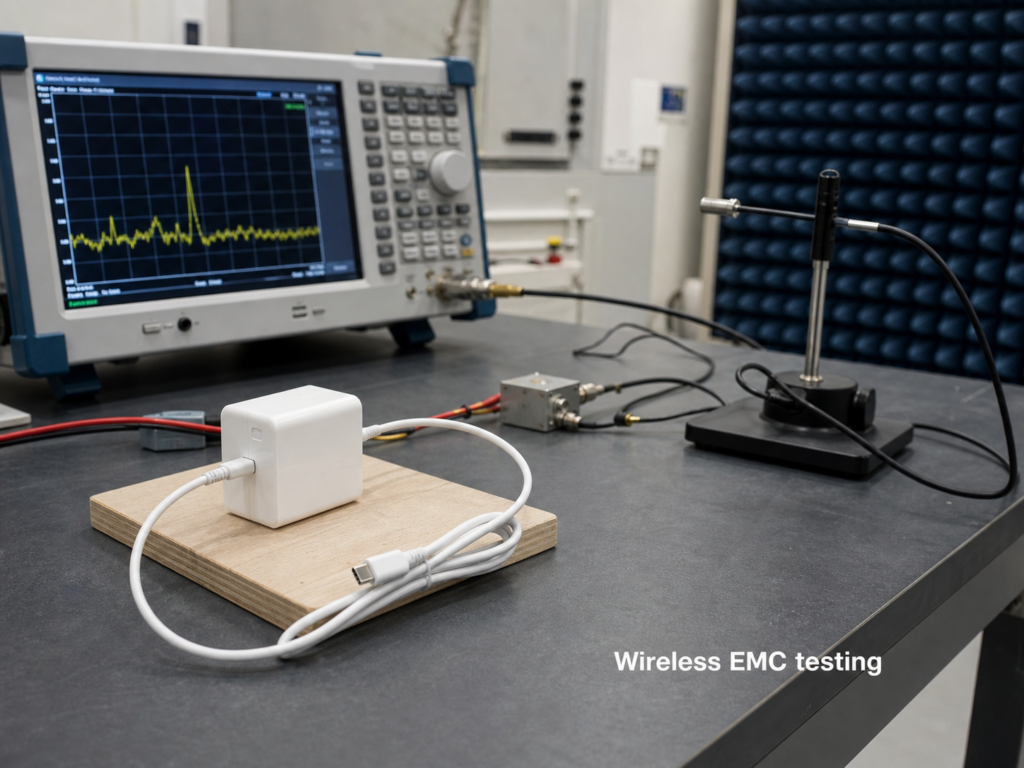
Common test items for charging products are the transmission and reception performance of wireless signals (commonly referred to as radio frequency performance in the industry) and wireless-related EMC tests. The specific items still depend on the product category, wireless technology and applicable specifications. The testing cycle is affected by the number of test items, sample pass rate, whether rectification and retesting are required, etc.
Stage 4: Online Submission and Official Review
The submission channel is CST’s official E-approval system. Just upload all application documents according to the system instructions. Common problems during review include: inconsistent models, contradictory parameters, unclear authorization documents, and unqualified test reports. If the review fails, you can supplement materials or rectify according to official requirements and resubmit. The review cycle depends on the completeness of materials, product category, and official review rhythm.
Stage 5: Certificate Verification and Label Confirmation
CST issues electronic certificates, which can be queried and verified on the official system. After getting the certificate, be sure to verify it first: are the brand, model, wireless function scope, validity period, and any special restrictions consistent with what you applied for?
Product labels shall simultaneously comply with CST’s general rules, applicable technical specifications and certificate approval conditions. Some products may need to be marked with approval numbers, regulatory labels or other specified information. You cannot assume that there is no mandatory labeling requirement just because there is no unified format applicable to all products.
Stage 6: Customs Clearance and Pre-Launch Recheck
The documents required for customs clearance shall be determined according to whether the product is within the CST regulatory scope, whether it is a SASO/SABER regulated product, and specific shipment requirements, which may include CST approval or registration documents, SABER Product Conformity Certificate, Shipment Conformity Certificate and customs declaration materials.
Ensure that information such as model, brand, configuration, manufacturer and shipment quantity is consistent with the actual goods in applicable documents. Before the product is launched, do a final check to confirm whether the product’s configuration, label and approval certificate are consistent to avoid problems.
Key Pitfall Avoidance Tips: Common Misconceptions, Cost & Cycle, and Reasons for Rejection
4 Most Common Process Misconceptions
1. **Can CE-RED/FCC reports be directly exchanged for CST certificates? Wrong**. These overseas reports cannot directly replace CST Type Approval, and must go through CST’s official review process. Qualified overseas test materials may be included in the evaluation, but whether they are accepted and whether supplementary Saudi difference tests are required depends on the specific product and current rules;
2. **If an approved wireless module is used, the whole device does not need to apply? Wrong**. Module approval cannot replace whole device approval. Even if an approved module is used, the whole device must be applied for and evaluated separately;
3. **Is CST Type Approval voluntary? Wrong**. For products within the CST regulatory scope and without applicable exemptions, type approval is usually a mandatory requirement. Failure to meet the requirements may affect import and sales, and the specific details shall be subject to applicable regulations and official classification;
4. **Reports from ISO 17025 laboratories must be accepted by CST? Wrong**. In addition to having ISO 17025 qualification, the laboratory must also be within CST’s accreditation scope, and the testing must comply with Saudi technical specifications. It is not enough just to have the qualification.
What Factors Affect Cost and Cycle?
Many people ask right away “How much does CITC cost? How long does it take?” In fact, there is no unified answer, because each product’s situation is different.
Cost is mainly affected by these factors: the number of wireless functions, whether testing / supplementary testing / rectification is required, laboratory charging standards, agency service fees, and product category.
Cycle is mainly affected by these factors: test pass rate, material completeness, official review speed, and whether supplementary materials or retesting are required.
Here is a non-official reference (does not constitute a quotation): for consumer-grade charging products with a single conventional wireless function (such as only Bluetooth), if the materials are complete and no rectification is required, the total cycle is about several weeks. The specific cost and cycle must be subject to actual product evaluation. Do not believe promises of a fixed price.
Common Reasons for Application Rejection
Most application rejections can be avoided in advance. There are four common categories of reasons:
1. **Material consistency issues**: inconsistent model, brand, and wireless parameters in different documents, which is the most common;
2. **Technical non-conformity**: the product’s operating frequency band and transmit power do not comply with Saudi specifications, or the test report does not meet the requirements;
3. **Qualification issues**: invalid qualification of the local responsible entity, laboratory not accredited by CST, incomplete authorization documents;
4. **Information contradiction**: inconsistent statements before and after about wireless module model, firmware version, hardware configuration, etc.
These Compliance Risks Should Also Be Noted After Launch
Getting the certificate does not mean everything is fine. Saudi regulation runs through the entire process, and you should also pay attention to compliance after launch.
There are three common spot check scenarios: customs entry spot check, e-commerce platform qualification verification, and market circulation spot check. Violations may lead to customs clearance delays or detention, product removal, recall, administrative penalties or other regulatory measures; the specific consequences depend on the facts of the violation, product category and applicable CST, SASO, customs and consumer protection rules.
Remember these compliance points after launch:
First, the sold products must be completely consistent with the model and configuration of the approval certificate. You cannot privately replace the wireless module, nor adjust the radio frequency parameters at will;
Second, for products sold as a kit, each accessory must be checked one by one to see if it is within the approval scope, and apply separately if necessary;
Third, all compliance files must be kept completely, and the retention period shall be implemented in accordance with Saudi regulatory requirements, so that they can be produced in case of spot checks;
Fourth, regularly pay attention to CST’s regulatory updates, adjust compliance strategies in a timely manner, and avoid violations due to rule changes.
Summary
Overall, CITC (CST) certification mainly covers Saudi Arabia’s access requirements for some wireless, communication and related ICT products. Sellers of charging products do not need to be overly intimidated by it. As long as you first make a good product judgment based on technical functions (rather than marketing names), clarify its boundary with other compliance requirements such as low voltage, energy efficiency, and SABER, and then prepare materials, test, and submit step by step according to the process, you can advance access more steadily.
At the same time, pay attention to avoiding common misconceptions in product judgment, material preparation, and application processes, sort out product technical materials in advance, evaluate in time whether re-application is required when products change, and do a good job of consistency check during customs clearance and after launch, so as to minimize compliance risks.