
If you plan to sell USB chargers in Korea, or buy chargers online in Korea, you will most likely see a mark composed of “KC” on the product packaging or the product itself. Many people have a vague understanding of this mark: some think it is a fast charging certification, and having it means fast charging; some think it is a globally universal safety mark, similar to CE and UL; others think that as long as the power is low, you don’t need to apply for it.
In fact, KC is Korea’s national unified certification mark. The “KC safety compliance” discussed in this article specifically refers to requirements such as safety certification and safety confirmation under Korea’s electrical appliance safety management system, which mainly evaluates the electrical safety of products. Note that the KC logo itself may also correspond to electromagnetic compatibility or radio conformity assessment managed by the RRA, so you cannot conclude that it only proves electrical safety just by seeing the KC mark; you must also judge in combination with product category, identification number and official database records.
This article starts from the most basic definitions, covering scope of application, compliance requirements, authenticity verification, common misconceptions, certification processing and responsibility division. Whether you are an ordinary consumer or a seller targeting the Korean market, you can find the information you need.
First, Understand: Who Manages KC Certification? What Does It Cover?
Many people think KC is managed by a single agency, but in fact, Korea’s electrical product compliance is a system with clear division of labor. Different departments manage different matters, so don’t mix them up:
The Korean Agency for Technology and Standards (KATS) is the “general manager” of all electrical safety compliance, responsible for formulating rules and control catalogs related to electrical appliance safety management, and coordinating electrical safety-related supervision.
Safety Korea is a product safety information and business portal operated by KATS, where you can query safety certification, safety confirmation and related product information. Specific applications, reviews, tests and declarations are undertaken by legally designated safety certification bodies, safety confirmation testing institutions, etc. within their respective authorization scopes; the final legal documents and processing procedures depend on which compliance path applies to the product, and cannot be generally understood as “issuing certificates” by platforms or laboratories.
As for electromagnetic compatibility (EMC) and radio-related compliance, it is independently managed by the Korean Radio Research Agency (RRA) in accordance with the . RRA’s conformity assessment for broadcasting and communication equipment may also use the KC mark, so many people mix up different systems, which requires special attention.
In addition, there is a special energy efficiency management system responsible for requirements related to external power supply energy efficiency, standby power consumption, etc., which is also an independently assessed rule separate from KC safety.
So what is KC safety compliance mentioned in this article? Simply put, it is Korea’s mandatory safety access requirement for some regulated electrical products — as long as the product is in the statutory control catalog and has not completed the applicable safety procedures, it cannot be sold or rented in the Korean market. But note that KC safety compliance mainly verifies basic electrical safety, such as electric shock risk and fire risk, and usually does not prove performance such as fast charging speed, protocol compatibility, product lifespan, etc.
For consumers, chargers that have completed applicable safety procedures usually have more guaranteed basic safety risks; for sellers, selling without compliance may result in goods being detained, removed from shelves, suspended from sale, or even recalled, with serious consequences.
Here we need to clarify three most easily confused concepts first to avoid misunderstanding later:
First, KC safety compliance is not a fast charging certification. It does not focus on verifying fast charging protocols such as PD, QC or charging speed. Even if it is marked as 65W fast charging, the safety requirements mainly focus on whether the product meets electrical safety requirements under its rated conditions, not whether it can actually fast charge a certain phone.
Second, KC is not a globally universal certification. Korea’s statutory compliance procedures cannot be automatically replaced by documents from other countries or regions, and certifications from other markets cannot be directly used as Korean compliance credentials.
Third, the KC logo is not proof of a single item. The KC safety compliance discussed in this article mainly covers electrical safety; requirements such as EMC, energy efficiency, and radio may apply to other independent systems. When you see the KC logo, you should confirm its specific meaning combined with the number, product category and the corresponding official database.
How to Judge Whether Your USB Charger Needs KC Certification?
To judge whether a USB charger needs to meet Korean safety compliance, first of all, it should be judged according to the controlled product categories, product structure and rated parameters in the and its implementation rules. Input type, rated input and output, whether it is an independent power adapter, product use, etc., are often more critical than “who to sell to”.
Sales form is also worth confirming: is it a retail model sold separately to consumers, a bundled accessory for mobile phones or tablets, or a supporting product for industrial equipment? Does the product only have wired charging function, or does it have wireless charging, Bluetooth or even WiFi? Where is the manufacturer, and is there a Korean importer or local responsible entity? These factors may affect the applicable method, other regulatory obligations or whether there are exclusion clauses, but cannot be used as a basis for exemption alone.
Typical Scenarios Where KC Safety Compliance Should Be Prioritized
There are two types of products that need to be prioritized for confirmation according to the statutory catalog:
The first type is USB chargers with AC mains input or AC/DC power adapters. Whether it is a single-port PD fast charger, a multi-port travel charger, or an ordinary charger with Type-A and Type-C ports, as long as it is directly connected to Korean mains power, you should first confirm whether it applies to safety certification, safety confirmation or other paths according to the controlled product categories, structure and rated parameters.
The second type is power supplies as bundled accessories, such as chargers included in mobile phone boxes. Such products cannot be deemed to require no separate safety procedures just because they are bundled accessories; it depends on the product classification, parameters, announcements and their relationship with the whole machine. For example, a 30W A+C dual-port charger bundled with a mobile phone also needs to be judged in combination with the actual product and applicable rules.
Special Scenarios Requiring Separate Rule Assessment
Some products look like USB chargers, but cannot directly apply the judgment method of consumer AC chargers, and need to be confirmed separately:
Car chargers with DC input: For example, a dual-port USB charger plugged into a car’s 12V cigarette lighter, because it is not AC mains input, does not necessarily apply to the safety category of ordinary AC power adapters, and should be judged according to its actual product category and other regulatory requirements.
Special power supplies for industrial supporting use: If it is a charging power supply for industrial equipment, even if it is only sold to professional industrial users, it cannot automatically exclude safety obligations. It is necessary to confirm whether it belongs to the controlled product categories, whether there are applicable exclusion clauses, and obtain written classification opinions from the competent authority or designated agency.
Chargers purchased overseas online for personal use: If they are purchased by individuals from overseas for personal use in reasonable quantities, they may apply to the customs clearance rules for personal items, but they must not be resold for profit.
Non-independent charging modules built into other devices: For example, USB charging modules embedded in desk lamps and speakers may be evaluated as part of the whole machine according to the whole machine rules, rather than automatically being processed separately as chargers; the specific situation should still be confirmed in combination with product definitions and classifications.
Easily Confused Product Boundaries
There are also several types of products that are often mistakenly considered to belong to the KC category of USB chargers, but in fact they belong to different product categories with completely different requirements:
Pure charging cables, data cables: Even USB-C fast charging cables with E-Marker chips, because they usually do not perform power conversion, the safety certification or safety confirmation materials of the charger usually do not automatically cover independent cable models. Whether the cable needs Korean safety or other compliance procedures depends on whether it belongs to the statutory controlled wire and cable category, rated value and sales method, and it cannot be asserted that all USB or E-Marker cables must apply for KC separately.
Power banks (portable chargers): Because they have built-in lithium batteries, they may also involve multiple requirements such as battery safety, transportation rules, EMC, etc., and do not belong to the classification of ordinary USB chargers.
Power strips with USB ports: They belong to the power strip category, and the certification requirements are different from those of separate chargers, so they cannot be judged according to the charger standard.
Wireless chargers: In addition to basic safety, they should also be separately checked whether they belong to RRA-regulated broadcasting and communication equipment and the applicable category, and cannot directly apply the rules of wired chargers.
USB-powered electrical devices: For example, devices such as Bluetooth headsets that are charged via USB ports belong to downstream electrical products and are not certified as chargers.
Three-Step Method for Preliminary Classification
If you just want to make a rough judgment by yourself first, you can follow these three steps:
The first step is to check whether the product belongs to the statutory controlled product categories, focusing on confirming the input type, product structure and rated parameters; external chargers or power adapters with AC mains input should be prioritized for checking relevant categories.
The second step is to look at the sales form and use. Independent sales, bundled accessories, industrial special use, built-in use and personal import may affect the applicable method or whether there is exclusion, but you cannot self-determine exemption based solely on the sales target.
The third step is to look at additional functions. If it has wireless communication functions such as Bluetooth and WiFi, you also need to additionally judge the corresponding conformity certification or conformity registration requirements according to RRA announcements; the wireless charging function should also be separately confirmed whether it falls within the RRA regulated scope.
Finally, a special reminder: Korea does not have a unified “power exemption rule”. It is not that if the power is lower than a certain wattage, you definitely do not need to go through safety procedures. The final classification and compliance requirements shall be subject to the written conclusion of the competent authority or designated agency, do not make decisions on your own.
What Are the Core Compliance Requirements for USB Chargers?
Many people think that getting a KC certification is enough, but in fact, complete compliance involves several independent systems, and KC safety is only the most basic one.
I. KC Electrical Safety Requirements
This is the KC safety compliance mentioned in this article. The regulatory basis is the electrical appliance safety management related regulations issued by KATS, applicable to products in the KC control catalog.
All test items revolve around the core of “basic safety”, and have nothing to do with performance. Common test items include:
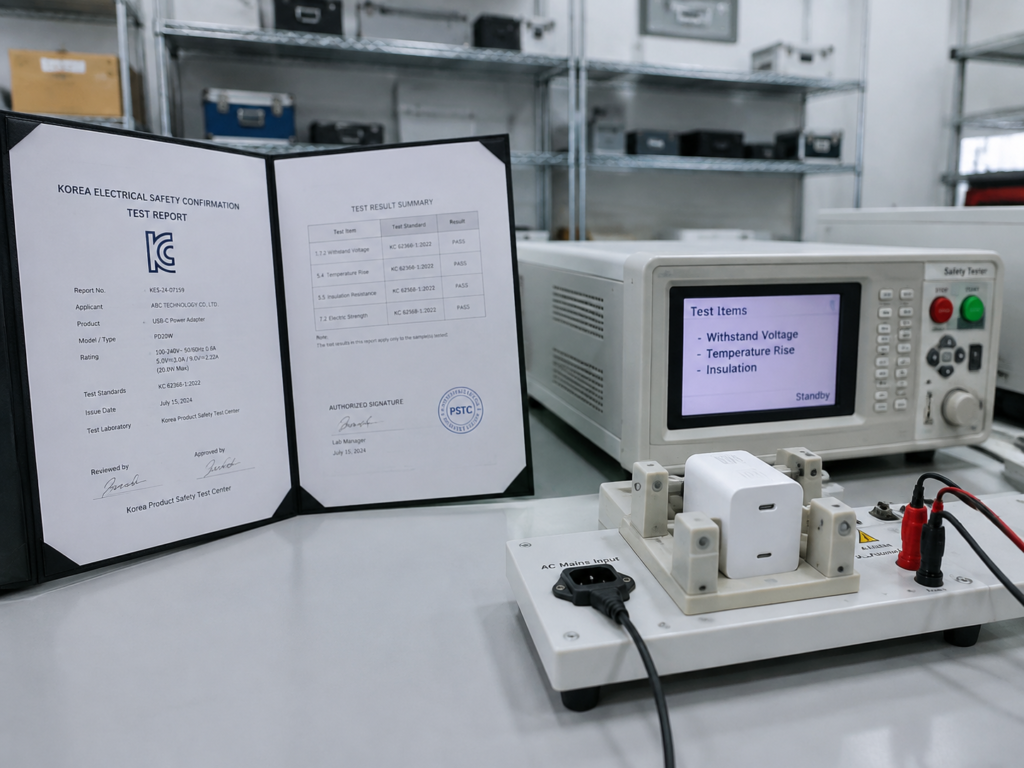
Insulation and withstand voltage test, to verify the isolation effect between the internal high-voltage and low-voltage parts of the charger, to prevent electric shock caused by the enclosure being energized;
Touch current test, to ensure that the leakage current of metal parts that the human body can touch is within the safety limit;
Creepage distance and electrical clearance test, to check whether the distance between internal live parts is sufficient, to prevent short circuit caused by high voltage breaking down air or insulating materials;
Temperature rise test, let the charger work for a long time under rated load, to ensure that the temperature of the enclosure and internal components does not exceed the safety limit, and will not melt or catch fire;
Abnormal operation test, simulate specified conditions such as short circuit, overload or fault, and evaluate whether unacceptable hazards such as electric shock, fire, overheating, and accessible dangerous live parts occur according to applicable standards. Whether the product is allowed to stop working and what kind of damage is allowed shall be subject to the judgment clauses of specific standards;
Mechanical strength test, test the state after plug pin insertion and removal, enclosure drop, and extrusion, to ensure that internal live parts are not exposed;
Flame retardant test, check the flame retardant performance of materials such as enclosure and PCB board, to ensure that in case of internal fire, the material will not continue to burn and spread;
Key component consistency check, confirm that the key safety parts such as transformers, fuses, and optocouplers used in mass production are consistent with the model and supplier declared during certification, and cannot be replaced at will.
Emphasize again: KC electrical safety usually does not aim to verify performance indicators such as fast charging protocol compatibility, charging speed, and output protocol matching. These do not mean that the product has passed the corresponding performance verification.
II. EMC and Radio Compliance (RRA System)
Many people confuse EMC with KC safety, but in fact, this part is independently managed by the Korean Radio Research Agency (RRA) in accordance with the , and is another set of conformity assessment system.
This part can involve two common situations:
One is electromagnetic compatibility (EMC), that is, the product will not generate electromagnetic interference exceeding the requirements when working. Some wired USB chargers may need to go through conformity registration or other applicable procedures according to RRA regulations;
The other is wireless communication functions. If the charger has wireless communication functions such as Bluetooth and WiFi, it is usually necessary to judge whether conformity certification or conformity registration applies according to RRA announcements.
Wireless charging devices also need to be separately checked whether they belong to RRA-regulated broadcasting and communication equipment, and which type of conformity assessment applies. You cannot generally conclude that it must obtain “radio equipment type certification” just because it has inductive power supply functions such as Qi.
Whether it needs to be done and which type to do depends on the product function, operating frequency band, output or use method and RRA announcements. Common legal procedure names are conformity certification, conformity registration or provisional certification, not all called “type certification”.
III. Energy Efficiency Labeling Requirements
Whether external power supplies are subject to Korea’s energy efficiency management or standby power reduction plan should be confirmed according to the current list of controlled equipment, product definitions and exclusion clauses.
When applicable, products may need to meet corresponding test, limit and labeling requirements; the specific form depends on the product category and applicable system, not all external power supplies only label “standby power consumption level”. This part is also independent of KC safety and needs to be evaluated separately, and cannot be confused with KC safety compliance.
IV. Label and Manual Requirements
Whether it is KC safety or other compliance, there are clear requirements for product labeling and manuals:
First of all, the content that must be labeled usually includes the applicable KC mark, number or declaration information, rated parameters, manufacturer information, Korean importer information, etc. The specific content shall be subject to the labeling standard applicable to the product.
Labeling rules do not allow arbitrary choice of carrier. In principle, the specified information should be labeled on the product according to the KC safety labeling standard applicable to the product. Only when it is difficult to label due to product size, structure or other statutory reasons, can part of the information be labeled on the smallest package or accompanying documents according to the standard; the package or manual cannot be regarded as an unconditional substitute.
In addition, parameter labeling must be consistent with the actual situation, and false labeling is not allowed. For example, if the product is labeled as 65W output, but the actual capacity is obviously not up to standard, even if the safety test is passed, it may involve other non-compliance issues in terms of labeling or consumer protection.
V. Additional Considerations for USB-C PD and Multi-Port Fast Chargers
Many current USB chargers are USB-C PD fast chargers, or multi-port fast chargers. There are several additional points to note for such products:
First, high-voltage output will be evaluated according to the product’s rated parameters and applicable safety requirements, it is not that the USB-C interface itself naturally comes with a set of additional KC safety requirements.
Second, it should be ensured that the actual capacity, rated output and external claims of the product are consistent. The single-port capacity, total power, and combined power supply rules when multiple ports are used at the same time are best clearly disclosed for consumers to use correctly; but whether these pieces of information are mandatory labeling items should be confirmed according to the applicable KC labeling standards, consumer labeling rules and USB-C, USB PD specifications respectively, and cannot be generally regarded as KC mandatory requirements for all multi-port chargers.
Third, PD capability information such as PDO (power output levels) should be consistent with the actual capacity that the product can provide and the external description. The PDO list and its technical requirements mainly involve USB-C and USB PD specifications, and are not a general mandatory clause of Korean KC safety labeling.
Fourth, if the product is within the scope of energy efficiency control, standby power consumption and other energy efficiency indicators need to meet the corresponding requirements.
Finally, emphasize again: the matching charging cable and the E-Marker chip in the cable will not be automatically covered just because the charger has completed safety certification or safety confirmation. Whether the cable is subject to Korean safety or other compliance procedures should be judged separately according to the specific category, rated value and sales method.
How to Check the Authenticity of KC Certification?
For ordinary consumers and platform auditors, the most commonly used skill is to check KC-related compliance information — after all, it is easy to print a KC mark, and only real, applicable official records consistent with the product are valid. When checking, you can follow three steps, and you can basically confirm the risk step by step.
Step 1: First Check Product Labeling (Preliminary Screening, Not Absolute Judgment)
When you get the product, first look at the labeling on the surface. This is the most basic screening. Although it cannot 100% determine the authenticity, it can first eliminate a batch of obviously problematic products.
The content to be checked includes: whether there is a clear KC mark, whether there is a corresponding number or declaration information, whether the rated parameters are complete, whether the manufacturer and Korean importer information are labeled.
Also pay attention to several details: the label should be clear and wear-resistant; the position of the information should comply with the applicable labeling rules; if it is a fixed plug charger directly connected to Korean mains, it should be confirmed that its plug type, rated value and use method are consistent with Korean power supply and applicable safety requirements. A flat pin plug is a risk signal that requires further verification, but you cannot conclude that the product has no KC compliance just based on the pin shape; you should also check the product design, the attached power cord or converter, and official records.
Step 2: Official Database Verification (Most Authoritative Judgment Method)
Just looking at the label is not enough. The most reliable way is to check the corresponding compliance information in the Korean official database. Different types of compliance go to different entries:
KC safety certification, safety confirmation and related product information can be queried through the official system of Safety Korea;
EMC and radio-related conformity assessment can be queried in RRA’s official database.
When searching, you can use fields such as product name, model, certification number or declaration information, manufacturer, importer, production factory — you don’t have to have a number to check.
After finding it, focus on checking these items:
The first is model. Pay attention to the suffix of the model. Many products of the same series have different suffixes, and the configuration may be completely different. For example, 65W and 30W chargers of the same series, if the suffix is different, they cannot automatically share the same compliance material;
The second is applicant entity and production factory, which should be consistent with the information labeled on the product;
The third is rated parameters. Input and output voltage, power, number of interfaces, etc. should match the labeling on the product;
The fourth is record status and applicable path, to confirm whether the safety certification certificate or safety confirmation declaration record is valid, whether it is suspended or revoked, and whether it is indeed applicable to the product in front of you.
If you can’t find the information, don’t rush to judge it’s fake. You can first confirm that you are checking the correct system category and correct database entry, then check the Korean model name, applicant name, number format and model spelling. If you still can’t find it, you should contact the corresponding certification body, safety confirmation declaration agency or RRA to confirm the record status. Unless the competent authority or agency clearly states that there is a data synchronization delay, you should not preset a unified waiting period of 1–3 months.
If the found information is inconsistent with the product labeling, you can require the seller or certificate holder to provide official change certificates, because some compliance changes can be applied to the agency, and they may also be valid if there is a formal certificate.
Step 3: High-Risk Feature Screening (For Risk Warning Only)
There are also some features that cannot directly prove that the certification is fake, but are high-risk signals, so you should be more careful when encountering them:
For example, the price is much lower than regular products of the same specification — after all, compliance testing and certification have costs, and if it is too cheap, there is probably a problem;
For example, the labeled power is obviously inconsistent with the volume. Of course, chargers with new technologies such as gallium nitride do have much smaller volume, which should be excluded;
For example, there is no brand, no clear manufacturer or importer information, and even the most basic labeling is incomplete;
Another example is that the model and parameters do not match the records in the official database, and the seller cannot give a reasonable explanation and proof.
Common Misconceptions About KC Certification
Misconception: Having a KC Mark Means the Product Is Fully Compliant?
Wrong. The KC logo is Korea’s national unified certification mark, which may correspond to safety certification or safety confirmation under the electrical appliance safety management system, or may correspond to RRA’s EMC or radio conformity assessment. Just looking at the KC logo, you cannot judge that the product has completed all compliance obligations.
If it is confirmed that a certain mark or number corresponds to the KC electrical safety path, then it mainly reflects basic safety risk requirements such as electric shock and fire, and does not automatically include EMC, energy efficiency, fast charging protocol compatibility, charging speed and other content. It must be judged in combination with product category, number and official database records.
Misconception: KC Certification Certificate Is Valid for Life?
Wrong. The validity of the certificate or declaration confirmation materials should be judged in combination with the record status and product consistency: if the product is modified, or key safety parts are replaced, you need to re-declare or apply for changes, otherwise even if the original record is still there, it may not apply to the modified product.
Also note that not all product paths will form a “KC certification certificate”. For products applicable to safety confirmation, the core procedure is to complete the safety confirmation test, then handle the safety confirmation declaration, and keep the test report and declaration confirmation materials.
Misconception: Having Overseas Certifications Such as CE, FCC, UL, CB Can Directly Replace KC?
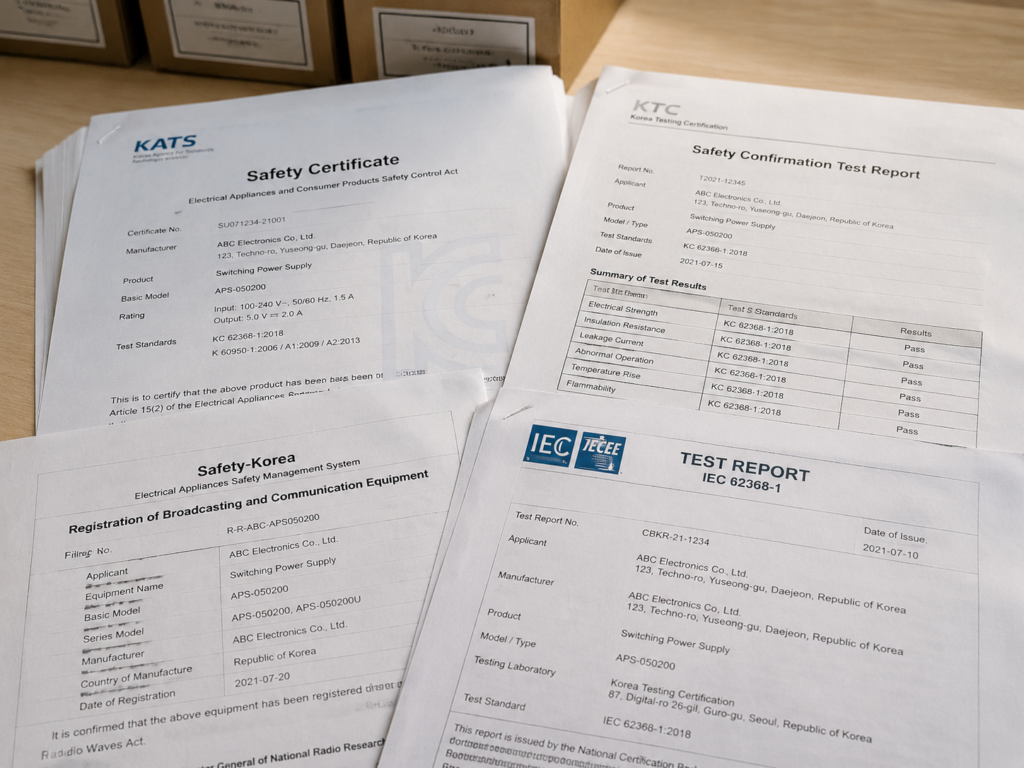
Wrong. CE, FCC or UL documents cannot automatically replace Korean statutory compliance procedures. In particular, CE itself is not a certification issued by a unified third-party agency, and cannot be directly used as a Korean safety compliance credential.
However, valid IECEE CB certificates and reports can be used as assessment materials within the scope accepted by Korean designated agencies. But it is still necessary to check the validity of the report, product consistency, Korean national differences, and complete the applicable safety certification or safety confirmation declaration. The acceptable scope and whether supplementary tests are needed shall be determined by the corresponding agency, and cannot be simply understood as definitely “reducing part of the tests” or still needing to redo all tests.
Misconception: If the Charger Passes KC, the Matching Cables and Charging Devices Are Also Automatically Compliant?
Wrong. The safety certification certificate or safety confirmation declaration materials only cover the product model and scope corresponding to the declaration. The matching charging cables and downstream electrical devices, such as mobile phones and power banks, cannot automatically “ride on” the compliance of the charger.
However, whether the cable needs to undergo separate Korean safety or other compliance procedures depends on whether it belongs to the specific controlled wire and cable category, rated value and sales method, and it cannot be considered that all USB charging cables or E-Marker cables must apply for KC separately.
Misconception: All Products with USB Ports Use the Same Set of KC Standards?
Wrong. Products with USB ports are divided into many categories. Power banks, power strips with USB, and wireless chargers all belong to different product categories, and the corresponding safety and other compliance requirements are completely different, so the rules of ordinary USB chargers cannot be applied.
Misconception: Low-Power USB Chargers Definitely Do Not Need KC?
Wrong. Whether to go through safety certification, safety confirmation or other procedures depends on multiple factors such as whether the product belongs to the statutory controlled product categories, input method, structure, rated parameters and applicable exclusion clauses. Korea does not have a unified “power exemption threshold” — it is not that below 5W or 10W you definitely do not need to do it, and the final conclusion shall be subject to the classification conclusion of the competent authority or designated agency.
Misconception: Having a Test Report Equals Having KC Certification?
Wrong. The test report only proves that the tested sample passed the relevant test items under the corresponding conditions. For products applicable to the safety certification path, they need to complete the corresponding certification procedures and obtain a safety certification certificate; for products applicable to the safety confirmation path, they should complete the safety confirmation test, handle the safety confirmation declaration, and keep the declaration confirmation materials. A separate test report cannot automatically be used as a market access credential.
Misconception: Replacing Key Components Does Not Affect the Validity of Certification?
Wrong. Changes to key safety components such as transformers, fuses, and optocouplers, or important parameters such as output power, circuit topology, and enclosure materials, need to be confirmed with the certification body or declaration agency in advance, and if necessary, re-declare certification or handle changes. You cannot secretly replace them and continue to use the original materials.
Action Points for Different Roles
People with different identities need to do different things when facing KC certification. We have sorted out the corresponding action points according to four common roles, and you can find the one that suits you.
Ordinary Consumers (Purchasing in Korea)
When purchasing, try to choose regular channels, first check whether the product has a clear KC mark and complete parameters, do not buy no-name products that do not even have manufacturer and importer information. If you have questions about compliance, you can check the corresponding database of Safety Korea or RRA by yourself. If the merchant cannot produce valid certification, declaration confirmation or other applicable certificates, you can report to the Korean regulatory authority.
Brand Owners/Overseas Manufacturers (Exporting to Korea)
Before shipment, be sure to confirm the official classification of the product first, figure out what compliance obligations you need to meet, and don’t take it for granted. Prepare technical materials such as product specifications, circuit diagrams, BOM lists, and key component certificates in advance to avoid delaying the cycle due to incomplete materials.
If there are changes or compliance issues with products that have been shipped, suspend shipment first, and continue exporting after completing safety certification changes, safety confirmation declaration changes or rectification.
Korean Importers (Compliance Responsible Entities)
Korean importers of consumer products are usually important responsible entities for market compliance, so they must require suppliers to provide valid safety certification certificates, safety confirmation declaration materials or other applicable technical documents, carefully check the consistency between products and materials, and clarify the responsibility boundaries.
If the product is non-compliant, require the supplier to rectify or apply for changes, and unqualified products must not be imported.
Procurement/Platform Auditors (Bulk Procurement/Listing)
When auditing, don’t just look at the certificate photos provided by the merchant, be sure to verify the authenticity and current status of safety certification certificates, safety confirmation declaration records or RRA conformity assessment records in the official database, and also check whether the key components, labeling, parameters of the product are consistent with the information on the official records.
If it is non-compliant, directly reject the listing or procurement application, and require the other party to supplement compliance certificates or complete rectification before resubmitting.
How to Apply for KC Certification? What to Pay Attention to After Completing the Procedure?
If you are a brand owner or importer and need to handle Korean safety compliance procedures for your products, the following content will help you sort out the basic logic and precautions to avoid pitfalls.
First Choose the Right Compliance Path
The first step of processing is not to send samples for testing directly, but to first determine the official classification according to the product’s statutory category, input, parameters, structure, use and applicable exclusion clauses. Different classifications correspond to completely different paths. There are three common safety management paths:
The first is safety certification, which has strict requirements, usually requires factory inspection and product testing, and may have follow-up tracking inspections after completion. It is generally applicable to statutory high-risk category products.
The second is Safety Confirmation. For products applicable to this path, they shall complete the safety confirmation test according to regulations, and handle the safety confirmation declaration before sales or rental. Usually, factory inspection is not implemented according to the safety certification path, but may be subject to market spot checks and other supervision. After completion, the test report and safety confirmation declaration confirmation materials should be kept, and cannot be generally referred to as “getting a certification certificate”.
The third is supplier conformity confirmation, applicable to statutory low-risk products, where the enterprise confirms conformity according to requirements. Whether ordinary USB chargers are applicable shall still be subject to the specific category classification, and cannot be taken for granted.
Reminder again: the final classification and compliance path shall be subject to the written classification conclusion of KATS, Safety Korea or the designated agency. Don’t make a wrong judgment and waste money.
Processing Flow and Required Materials
The procedures for different paths are not exactly the same. Generally, you can first do a pre-classification assessment to confirm which category the product belongs to and what path to take; then prepare technical materials; then send the samples to a qualified institution for testing or review; for products applicable to the safety certification path, obtain the safety certification certificate after completing the review; for products applicable to the safety confirmation path, handle the safety confirmation declaration after completing the test and obtain the declaration confirmation materials. Before official sales, you also need to check the product labeling and consistency to ensure there are no problems.
The materials to be prepared usually include: product specifications, circuit diagrams, BOM lists; certificates of key safety components such as transformers, fuses, and optocouplers; certification documents of flame retardant materials, photos of PCB boards and labels; Korean version of labels and manuals, manufacturer and Korean importer information.
If you have overseas CB or IEC test materials, you can submit them together. Valid IECEE CB certificates and reports may be used as assessment materials within the scope accepted by the designated agency; whether they are accepted and whether supplementary Korean national difference tests are needed shall be confirmed by the agency.
For products of different models with the same platform, same circuit and same key safety components, you can apply for series model coverage — you don’t need to test each model separately, but whether it can be covered and how much can be covered need to be confirmed by the certification body, you can’t decide by yourself.
Factors Affecting Cost and Cycle
Many people ask “how much does a KC certification cost, how long does it take to complete”. In fact, there is no unified standard, because there are too many influencing factors.
In terms of cost, the number of test items, which certification path to take, and whether to do factory inspection will affect the basic cost; if the test fails and rectification is needed, there will be rectification fees and translation fees; the more series models, the higher the cost; if there are already acceptable CB reports or other materials, it may also reduce some duplicate work.
In terms of cycle, the tightness of the certification body’s schedule, how many times rectification is needed for testing, whether the materials are fully prepared, the number of series models, and the processing time of review or declaration will all affect the completion speed.
So don’t believe the “one-price” or “how many days to get the certificate” online. For specific costs and cycles, you must find a regular designated certification body for a formal quotation.
Ongoing Compliance Requirements After Completing the Procedure
Many people think that completing the safety certification or safety confirmation declaration is the end of the story, but in fact, the subsequent ongoing compliance is also very important, otherwise the original materials may no longer be applicable, and you may even be punished.
First of all, change management: any product or production-related changes must first be confirmed with the certification body or declaration agency whether they will affect the validity of compliance, and you must not secretly change them yourself. For example, if the output power, circuit topology, or power chip changes, you need to evaluate first; if key safety components such as transformers, fuses, and optocouplers are replaced, you need to evaluate first; if the plug pin specification, enclosure material, or number of interfaces changes, you need to evaluate first; if the production factory is changed, label parameters are modified, or output gears are changed, you also need to evaluate first. If the change affects safety consistency, you need to re-declare, handle changes or re-certify.
Second, market supervision: Korean officials will conduct regular spot checks on products on the market. If non-compliance is found in spot checks, you may face penalties such as rectification, suspension of sales, recall or even fines.
In addition, all technical documents, safety certification certificates, safety confirmation declaration confirmation materials, and change records must be properly kept, and must be available at any time when official verification is required.
How to Divide the Compliance Responsibility Chain?
Many people can’t figure out who is responsible for Korean safety compliance. In fact, there is no unified single responsible person, and the responsible entity will change with the compliance path and sales model:
Korean importers of consumer products are usually important responsible entities for market compliance;
Overseas manufacturers need to provide real technical materials and test samples, and cooperate with certification, declaration and rectification work;
Brand owners and sales platforms need to verify the compliance qualifications of products on sale;
The final responsibility division shall still be subject to Korean official regulations and the requirements of the certification body.
Frequently Asked Questions
Do USB-C PD Chargers Need KC?
As long as it is a USB-C PD charger with AC mains input, it should first confirm whether it applies to safety certification, safety confirmation or other procedures according to Korean statutory controlled product categories, product structure and rated parameters. Forms such as independent sales and bundled accessories may affect the applicable method, but cannot alone determine whether to exempt, and the final conclusion shall be subject to the official classification conclusion of the competent authority or designated agency.
Does the KC Certification of the Charger Include the Matching Charging Cable?
Usually not. The safety certification certificate or safety confirmation declaration materials of the charger will not automatically cover independent cable models.
But whether the cable needs Korean safety or other compliance procedures depends on whether it belongs to the statutory controlled wire and cable category, rated value and sales method, and it cannot be considered that all ordinary USB cables or E-Marker cables must apply for KC separately.
What If KC Certification Cannot Be Found in the Official Database?
You can first confirm that you are querying the correct system category and database entry, then try searching with the Korean model name, manufacturer, importer or applicant name, and check the number format and model spelling.
If you still can’t find it after changing the method, you should contact the corresponding certification body, safety confirmation declaration agency or RRA to verify the record status. Unless the competent authority or agency clearly states that there is a data synchronization delay, you should not preset a unified waiting period.
Can CE or CB Reports Directly Replace KC Certification?
No. CE, FCC or UL documents cannot automatically replace Korean statutory compliance procedures.
However, valid IECEE CB certificates and reports can be used as assessment materials within the scope accepted by Korean designated agencies, but it is still necessary to check the validity of the report, product consistency, Korean national differences, and complete the applicable safety certification or safety confirmation declaration. Whether supplementary tests are needed shall be determined by the corresponding agency.
After reading this, you should have a relatively comprehensive understanding of the KC safety compliance of USB chargers in Korea: you can initially judge whether a product needs to meet safety requirements, you can also distinguish the differences between KC safety, RRA EMC, energy efficiency labeling and even fast charging performance, and you can also check relevant records through the official database and identify high-risk products.
If you are a seller targeting the Korean market, you also understand the basic logic, change requirements and responsibility division of safety certification and safety confirmation declaration, which can meet basic compliance needs.
Korean compliance seems complicated, but the core is all around product safety and correct classification. Whether consumers choose products or sellers do compliance, as long as you first confirm the actual category of the product, and then check step by step according to different systems, you can avoid most pitfalls.