
Whether you are buying a USB charger in the UK or running a charging product business for the UK market, you have most likely heard the term “UKCA”. Some say it is the “British version of CE”, some think having it means good quality, and others have fallen into pitfalls because they cannot figure out the rules — either their goods are detained by customs, or the charger they bought smokes during use.
This guide will start from the most basic definitions, cover self-judgment of compliance and avoidance of common pitfalls, and meet the needs of different roles including ordinary consumers, e-commerce sellers, and manufacturers. All content is based on official UK regulatory requirements, with no empty clichés.
Beginner’s Basics: First Understand What UKCA Really Is
First of all, we need to correct the most common misunderstanding: UKCA is not a “quality certificate” issued by the UK government, nor is it a “premium product” label. Its full name is the UK Conformity Assessed mark, which is essentially a mark affixed by the manufacturer itself to prove that the product complies with relevant mandatory UK regulations — in short, it is a “compliance commitment” from the enterprise to regulators and consumers, not an official rating, and has no direct relation to charging speed or quality grade.
Moreover, UKCA only reflects compliance with some regulations, not all compliance requirements need to be proven by affixing the UKCA mark; many mandatory requirements that need to be verified separately will be discussed later.
Applicable Regional Boundaries: Don’t Confuse GB, Northern Ireland and the EU
First, let’s set a major premise: there is no unified “yes” or “no” answer to whether the CE mark can be used in the UK. It must be subject to the latest announcements of the UK government for specific regulations, product categories and launch dates. Don’t just believe what others say casually that “CE can still be used for two years”.
Specifically for different regions:
• Great Britain (GB, i.e. England, Scotland, Wales): UKCA is one of the compliance paths. Whether CE can be used depends on the latest policy for the corresponding product, and it is not the only access mark;
• Northern Ireland (NI): It follows the EU regulatory framework and cannot use UKCA alone;
• EU market: The CE certification system applies, and the UKCA mark alone cannot be used to enter the EU.
Which Chargers Require UKCA? Which Don’t?
This guide focuses on independent mains USB chargers for consumers that circulate separately in GB, that is, the type that is directly plugged into the wall. Typical examples include wall-mounted mobile phone chargers, USB-C laptop adapters, multi-port desktop chargers, GaN fast chargers, and travel conversion chargers.
If the charger is sold together with the complete machine (such as the power supply included with a laptop), the mark, declaration of conformity and technical documents can be integrated with the complete machine, but it still needs to meet all regulatory requirements, and the standard will not be lowered just because it is a gift.
Industrial supporting chargers are not automatically exempt either. It is necessary to specifically determine whether they fall within the scope of regulatory exclusion, and you cannot take it for granted that “industrial use does not require compliance”.
Products purchased by individuals for their own use usually do not fall under the situation where individuals place products on the market as manufacturers or importers, so generally there is no need to go through conformity assessment by themselves; however, bulk import, commercial resale, commercial supply or other situations covered by the definition of regulations still need to be verified item by item, and cannot be generalized that only personal second-hand transfer and self-use have exceptions.
Charging cables, power banks, wireless chargers and products with radio modules cannot directly apply the judgment method of ordinary mains USB chargers. Applicable regulations should be verified separately according to their functions, input and output, and whether they contain radio transmission modules. These products are not necessarily excluded from UKCA or CE; products with radio transmission modules also require additional assessment of radio equipment regulations.
Applicable Regulation Layers: It’s Not Just UKCA Requirement
According to the type of obligations, the regulations that USB chargers need to comply with can be divided into three categories.
The first category is core compliance category, that is, those that require preparation of a declaration of conformity and technical documents, and affixing the corresponding conformity mark where applicable, mainly electrical safety and electromagnetic compatibility (EMC) regulations. This is the core part of the compliance assessment of USB chargers.
The second category is mandatory supporting category. RoHS restriction of hazardous substances, applicable external power supply energy efficiency requirements, and plug safety requirements all need to be verified separately. The General Product Safety Regulations are mainly used for safety risks not covered by special regulations and related general obligations. Whether they apply and the scope of application need to be judged in combination with specific products.
RoHS and applicable energy efficiency regulations are independent compliance obligations, and corresponding technical materials, declarations and other statutory requirements need to be completed separately. In cases where a product conformity mark is required, the UKCA mark may correspond to multiple applicable regulations at the same time, which should be confirmed in accordance with each regulation and the latest GB marking policy.
The third category is special additional category. If the charger has a radio transmission module (such as with Bluetooth and Wi-Fi functions), it must additionally comply with radio equipment regulations.
Finally, let’s emphasize again: the compliance path is not only UKCA, CE may also apply. The specific situation depends on the product function, sales region and the official policy corresponding to the launch time.
5 Common Beginner Misconceptions, Clarified All at Once
Misconception 1: UKCA is the only access mark for GB. Wrong. The applicability of CE needs to be checked against the latest official policy. In many cases, a CE mark that meets the requirements can also be used in the GB market.
Misconception 2: UKCA requires official UK certification. Wrong. UKCA is affixed by the manufacturer itself. Whether third-party testing is required depends on specific regulations and product types. There is no unified requirement for an “officially issued UKCA certificate”.
Misconception 3: Having a UK plug means having UKCA. Wrong. Plug compliance is only one of many requirements. If core requirements such as insulation, fire protection, and EMC are not up to standard, even if the plug is correct, it is still non-compliant — just like a qualified sole does not mean the entire shoe is safe.
Misconception 4: If it can be sold on e-commerce platforms, it is compliant. Wrong. The platform’s review standards are not equal to legal requirements. In many cases, platforms only conduct random inspections. Being able to be listed does not mean that it fully complies with UK regulations, and you still have to bear responsibility if found by regulators.
Misconception 5: UKCA covers all compliance requirements. Wrong. RoHS, energy efficiency, plug safety and other mandatory obligations need to be verified separately. Affixing UKCA does not mean everything is fine.
What Are the Risks of Non-Compliant Chargers?
Some people may think, it’s just a mark, is it necessary to be so serious? In fact, behind UKCA corresponds to a whole set of mandatory regulations to protect consumers and the market. Non-compliant products have real risks for both users and operators.
Personal Safety Risks (Mains Side)
If the insulation design of the charger is insufficient, 230V mains power may be exposed to the USB interface or the shell, which will cause electric shock after contact; if the temperature rise is too high during full load or abnormal operation, and the shell and internal materials are not flame-retardant, they may melt or even catch fire. Don’t think that low-power chargers are fine. Even a 5W mobile phone charger will be dangerous if it cuts corners and fails to meet the standard, and it will not be automatically exempted from liability just because the power is low.
Property Loss Risks (Output Side)
If the output voltage and current are unstable and the protection circuit fails, it is easy to burn out devices such as mobile phones and laptops that are being charged; if the power distribution logic of a multi-port fast charger is problematic, either it cannot charge, or it damages the device due to power mismatch.
Electromagnetic Compatibility (EMC) Risks
Let’s briefly explain EMC first: when electronic products work, they will neither interfere with other surrounding electrical appliances nor be interfered by surrounding electrical appliances so that they cannot work normally.
If the emission does not meet the standard, the charger may interfere with home appliances such as WiFi, Bluetooth headsets, and TVs when working, for example, WiFi is very laggy when charging; if the anti-interference ability is poor, turning on a hair dryer or microwave next to it may cause the charger to stop charging or output abnormally. High-power, multi-port, and GaN type chargers have more EMC risk points due to more complex circuits, and more working modes need to be assessed.
Specific test items, working modes and performance criteria shall be determined in accordance with applicable UK regulations, designated standards, product functions and risk analysis, and cover representative working modes and the most unfavorable working conditions. Multi-port, fast charging and protocol switching usually require assessment of more configurations, but the following items cannot be expressed as unified statutory mandatory test items for all types.
| Product Type | Typical Scenarios Requiring Key Assessment | Scenarios That May Require Additional Assessment |
| Ordinary single-port charger | Representative load, standby or low load and other declared functions | Different input conditions, load changes, etc., determined according to applicable standards |
| Multi-port charger | Representative load combinations of single port and multi-port | Simultaneous operation of multiple ports, different port combinations and power distribution |
| Fast charger | Representative gears such as declared PD/PPS | Protocol switching, different fast charging gears and other most unfavorable working modes |
Environmental and Energy Efficiency Risks
In terms of environmental protection, if the harmful substances in the charger exceed the standard, disassembly after disposal will pollute the environment; in terms of energy efficiency, if the no-load power consumption is too high, the charger will waste electricity when it is plugged into the wall and not in use. In the long run, it is a considerable loss for both individuals and society.
RoHS restriction of hazardous substances and applicable external power supply energy efficiency requirements are independent compliance obligations. They require separate preparation of corresponding materials and compliance with their respective statutory requirements, and the specific marking method shall be confirmed in combination with applicable regulations and current UK policies.

Traceability Risks
If there is no model, manufacturer or responsible party information on the charger, the responsible person cannot be found at all in case of an accident; if it is a false mark, consumers or sellers think the product is compliant, and only find out it is fake when a problem really occurs, and can only bear the loss themselves.
Disassembly of Core Requirements: What Exactly Does UKCA Test?
Many people think that UKCA is just “sticking a label”. In fact, the mark is only the result, and behind it is a whole set of testing and assessment requirements corresponding to regulations. We don’t need to understand the specific test steps, but we need to know what the core requirements are, so that we can have a basis for judgment.
Electrical Safety Requirements
This is the most basic of all requirements, with four core directions:
• Electric shock protection: Not only the insulation of the plug must meet the standard, but also the USB interface must not have high voltage exposed, so that you will not get an electric shock even if you touch the metal part during normal use;
• Fire resistance and temperature resistance: When working at full load, the temperature of the shell and internal components must not exceed the standard limit, and the materials must be flame-retardant and will not catch fire easily;
• Output protection: Under short circuit, overload, overheating and other abnormal conditions, the product shall adopt current limiting, shutdown or other protection measures in line with applicable safety standards to avoid dangers, and meet output parameters and equipment compatibility requirements;
• Mechanical and abnormal protection: It must pass tests such as mechanical strength, plugging and unplugging, and drop, so that it will not break during normal use, and will not cause safety problems even in some abnormal use scenarios (such as accidentally blocking the heat dissipation holes).
As for which specific standards apply, it cannot be judged by the product name. For example, for the same “65W GaN fast charger”, different interfaces and circuit structures may have different applicable standards. The correct approach is to match from the list of officially designated standards in the UK according to the product’s circuit structure, input and output specifications, power, interface, and additional functions. Moreover, standards will be updated with regulations, so be sure to confirm the latest version before launch.
Electromagnetic Compatibility (EMC) Requirements
The core is two points: emission does not exceed the standard, and anti-interference allows normal operation.
During testing, test items shall be selected in accordance with applicable standards, and cover the functions declared by the product, representative working modes and the most unfavorable working conditions. Multi-port, fast charging and protocol switching usually require assessment of more configurations, but there is no fixed test matrix that is exactly the same for all USB chargers.
Environmental and Energy Efficiency Requirements
These two are compliance obligations that need to be verified separately, but they cannot be simply understood as naturally unrelated to the UKCA mark:
• RoHS restriction of hazardous substances: Relevant technical materials need to be prepared to prove that the restricted substances in the product meet the requirements;
• External power supply energy efficiency: Indicators such as no-load power consumption and average efficiency must comply with applicable rules.
RoHS and applicable energy efficiency regulations require separate completion of their technical materials, declarations and other statutory requirements. In cases where a product conformity mark is required, the UKCA mark may correspond to multiple applicable regulations at the same time, which should be confirmed in accordance with each regulation and the latest GB marking policy.
Plug and AC Input Structure Requirements
This is an independent mandatory obligation and cannot be replaced by UKCA or CE:
• If it is a fixed UK wall charger (plug and charger integrated), it must comply with the BS 1363 standard system, that is, the common three-pin square plug with a fuse. The rated value of the fuse must be determined in combination with multiple factors such as power, and cannot be selected randomly;
• If it is a desktop adapter + detachable AC cable style, only the plug at the AC cable end needs to comply with the regulations of the corresponding socket, and the input interface of the adapter itself does not need to comply with the plug standard;
• Travel adapter/conversion plug: The UK plug and socket regulations must be assessed separately. You cannot sell a European two-pin plug plus a conversion plug directly to the GB market, which is a pitfall that many small sellers easily fall into.
Let’s emphasize again: plug compliance is an independent requirement. Even if UKCA is affixed, if the plug does not comply with BS 1363, it is still illegal.
Marking and Document Requirements
These are the first things to look at during regulatory spot checks.
First is product body marking, which must include the following content: UKCA mark (if applicable), model, input/output parameters, rated power; if it is a multi-port charger, it is also necessary to mark the power limit of each port and the total power distribution rule, such as “total power 65W, single port maximum 65W, dual port simultaneous charging is 45W+20W”.
If the product size is too small (such as a mini 20W charger) and the body cannot print so much content, it can be moved to the packaging or accompanying documents, but it must be clearly visible, not easy to fall off, and the format must meet the requirements of the corresponding regulations.
Then is responsible party information: the manufacturer’s name and address are mandatory requirements, which can be marked on the product, packaging or accompanying documents; if the product is produced overseas and imported into GB, the contact address of the UK importer must also be marked; an authorized representative is not mandatory, must have written authorization, and cannot replace the manufacturer’s final responsibility.
User manual is also required, with English safety tips. Multi-port chargers also need instructions on power distribution and reminders of applicable scenarios (such as do not use in humid environments).
Finally, there are two necessary documents: the UK Declaration of Conformity (DoC for short, equivalent to a compliance guarantee signed by the manufacturer) and technical documents (including all test and assessment materials). These two documents do not need to be placed in the packaging, but must be available when required by regulators.
Compliance Boundary of Matching Charging Cables
Many people can’t figure out whether charging cables need UKCA. Here is the explanation by situation:
• Charging cables sold as a complete set with the charger: directly included in the overall compliance assessment of the charger, no separate treatment is required;
• Individually sold passive USB cables (ordinary cables without chips): need to comply with safety, RoHS and general product safety requirements, not automatically exempt, but just do not need to follow the UKCA rules for chargers;
• High-power PD cables with E-marker chips (such as 100W cables supporting 5A current): also need to additionally verify whether the rated current, conductor specification, terminal temperature rise, and chip function are consistent with the promotion;
• Special cables with active functions or wireless modules (such as cables with power display screens, cables with Bluetooth): applicable regulations need to be assessed separately, and may have their own compliance marks.
Full Process of Handling: What to Do from Preparation to Launch?
If you are a seller or manufacturer and want to do UKCA compliance for USB chargers, you don’t need to find so-called “official certification bodies”. Just follow the steps below, and all processes must comply with UK regulatory requirements.
Pre-Handling Preparations
If this step is not done well, it is easy to rework later.
The first is product identity and model family determination: models with different core circuits, power, and interfaces cannot use the same set of materials; if only the shell color and silk screen are different, and the core configuration is exactly the same, those that meet the family rules can be assessed together to save costs.
The second is selection of the most unfavorable samples: family and most unfavorable configuration demonstration shall be carried out based on circuit topology, key components, power level, port combination, software or protocol, and structural differences. Only when there is sufficient technical basis to prove the representativeness and coverage relationship can testing be reused or reduced, and cannot be determined solely by the highest power or the most ports.
For example, a series has 20W single-port, 65W dual-port, and 100W triple-port. Even if the 100W triple-port is usually more complex, it cannot be automatically assumed that it can cover the other two models just because it has the highest power and the most ports. The 20W, 65W and 100W models may still need to be assessed separately.
The third is preparation of basic materials: including product specifications, list of key components, mass-produced samples of the final sales version, or samples that are consistent with the final version placed on the market and have sufficient representativeness. Engineering prototypes are not necessarily invalid, but the differences between them and the mass-produced version must be recorded, and whether these differences will affect the test conclusion must be assessed.
The fourth is compliance path selection: you can test internally by yourself, or entrust a capable third-party laboratory. No matter which one you choose, the test method must comply with UK regulations and standards, and there must be sufficient evidence to prove compliance. It is not necessary to find a third party.
Four Core Steps of Handling
Step 1, conformity test/assessment. The test must be carried out based on applicable regulations, designated standards, and demonstrated representative or most unfavorable product configurations. Third-party testing is not mandatory, but there must be sufficient evidence. Scenarios that must be covered include: multi-port chargers need to assess single-port and multi-port combined loads, fast chargers need to assess representative gears and protocol switching, and also cover applicable standby and abnormal working conditions. The common reasons for failure are mainly four: insufficient insulation, excessive temperature rise, excessive electromagnetic interference, and false power labeling.
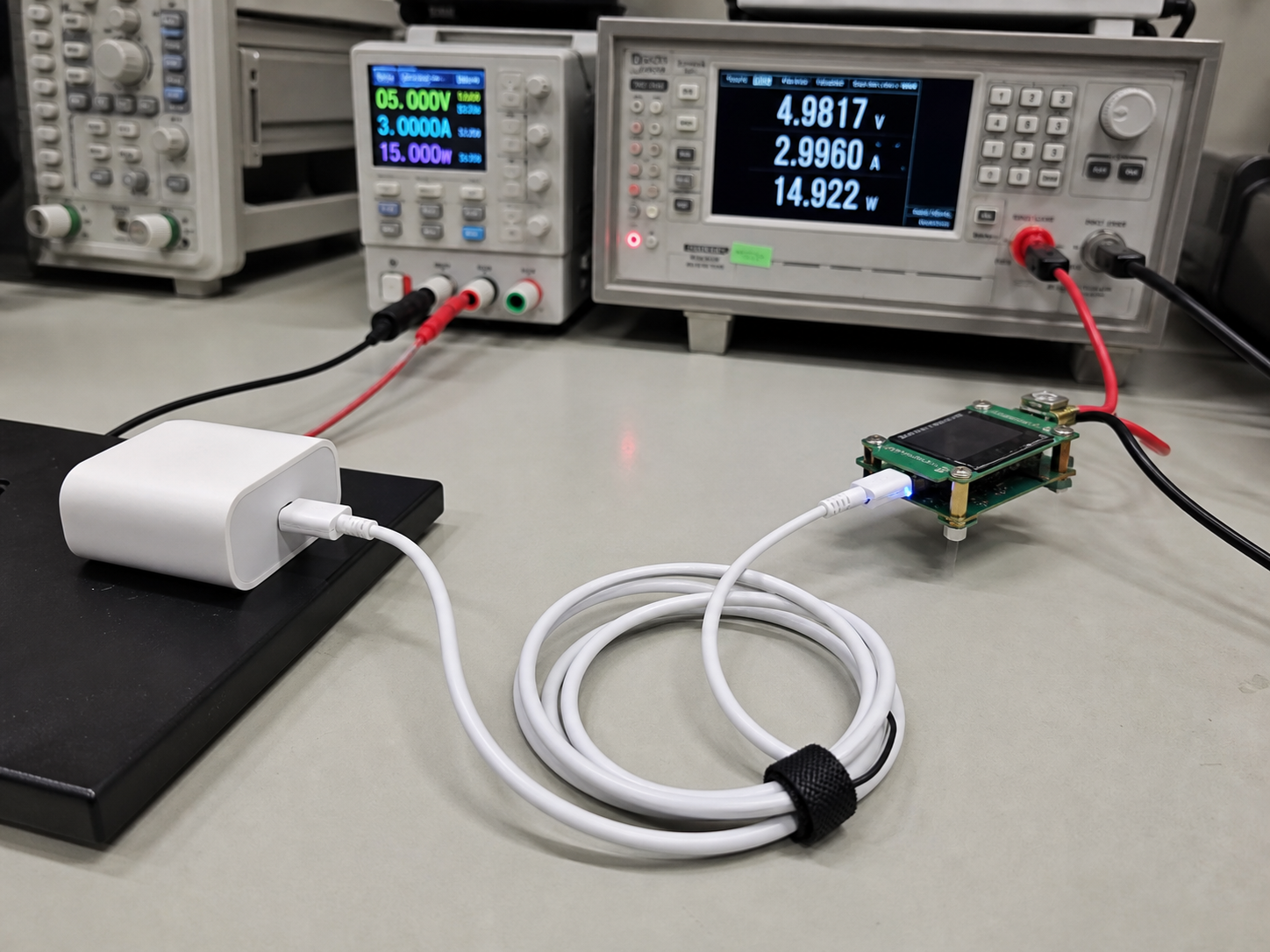
Step 2, organize technical documents. Technical documents are the core evidence of compliance, mainly including: product description, test report, risk assessment, marking design draft, key component consistency certificate, and applicable standard version description.
Step 3, sign the UK DoC (UK Declaration of Conformity). This declaration must be prepared and signed by the manufacturer, who bears the final legal responsibility; the authorized representative or importer only performs their duties within the scope of authorization or law, and cannot replace the manufacturer’s main responsibility.
Step 4, affix the compliance mark as required. Only after completing the conformity assessment, DoC and technical documents required by applicable regulations, and affixing UKCA, CE or other applicable marks in accordance with the sales region and specific regulatory requirements, can the product be placed on the corresponding market; at the same time, it is also necessary to perform obligations such as importer, instruction manual, traceability and other market supervision obligations.
Validity Period and Change Control
UKCA has no fixed validity period. As long as the product design remains unchanged and the applicable regulations remain unchanged, it is valid for a long time, and there is no need to pay an annual fee every year.
If these situations occur, re-assessment is required: replacement of core circuits or key components, adjustment of output parameters or power, addition of interfaces or fast charging protocols.
There are also requirements for the retention of technical documents: most regulations require that they be kept for at least 10 years from the date the product is placed on the GB market for regulatory spot checks.
Every time there is a change in design, materials, key components, software, production location or supplier, a change impact assessment shall be carried out. Only when there is recorded technical demonstration proving that it does not affect conformity can consistency verification be adopted; if the change affects safety, EMC, energy efficiency or other applicable requirements, supplementary or re-testing shall be carried out, and technical documents and DoC shall be updated. The DoC shall continuously reflect the current product and applicable regulations, and it is not only updated when there is a substantial modification.
Cost, Cycle and Sample Planning
Here to explain: UKCA has no unified fixed price, mainly depending on several factors:
• Product complexity: single-port ordinary charger is the cheapest, followed by multi-port PD/GaN charger, and those with radio or wireless functions are the most expensive;
• Validity of existing reports: if there is a CE report that meets UK requirements, test items can be reduced and costs can be lowered;
• Test coverage: whether to add additional items such as plug special test, energy efficiency, RoHS, radio, etc. If added, the cost will increase;
• Number of rectifications and retests: if the first test fails, rectification and retest are required, which will incur additional costs.
Regulations usually do not stipulate a unified handling cycle. The actual cycle is jointly determined by product complexity, test scope, sample preparation, rectification and retest, document review and laboratory scheduling, and a fixed number of weeks cannot be promised.
The number of samples is usually 2-3 mass-produced samples of the most unfavorable configuration, depending on the requirements of the test items.
Reuse Rules for Test Reports and Compliance Documents
Reasonable reuse can save a lot of costs:
• Can CE reports be used for UKCA? It depends on three prerequisites: the version of regulations and standards meets UK requirements, the test coverage is complete, and the laboratory issuing the report has qualified capabilities. Not any CE report can be used;
• Same series products: models that meet the family determination rules and have sufficient technical basis to prove the coverage relationship can reuse core test data and only retest the difference parts. They cannot be automatically reused just by the words “same series”. For example, when the core circuit, port configuration and power distribution are indeed consistent, a model with new ports may need to be supplemented with multi-port load tests;
• Modified products: if it is a non-core change (such as shell silk screen, non-key components), you must first do a change impact assessment; only when it is confirmed that it does not affect conformity can consistency verification be adopted. If it is a core change, it is necessary to retest.
Mark Identification and Risk Screening: Quickly Judge Whether There Is a Problem
If you are an ordinary consumer, or a seller who wants to make a preliminary judgment when purchasing goods, you can use the following methods, but note: these are only preliminary screenings, not official appraisals. The final compliance depends on the complete evidence chain.
Basic Specifications of Formal UKCA Mark
First is style: the three letters UKCA are arranged in the official fixed proportion, cannot be deformed, stretched, or added with extra patterns (for example, making UKCA into a cartoon style or adding a check mark is wrong);
Second is size: usually the minimum height is 5mm, depending on the applicable regulations. The core requirement is that it is clearly visible and not easy to fall off;
Third is position: it is preferred to be marked on the product body. If the product is too small or cannot be marked, it can be placed on the packaging or accompanying documents.
Consumer Risk Screening (Non-Official Appraisal)
First, look at mark appearance: if the printing is blurry, it can be scraped off with a nail, or the letter deformation proportion is wrong, there is a high probability of compliance risks;
Second, look at parameter consistency: the rated maximum output of the charger and the power distribution of each port shall be verified under the same protocol, cable, input voltage and test conditions. Just because a certain laptop actually only absorbs 30W, you cannot conclude that a 65W nominal charger has false power labeling, because the actual power may be affected by the device’s battery level, USB PD negotiation gear, cable capability, temperature, system load and the device’s own input limit. 65W usually refers to the maximum output capacity of the charger under specified conditions, not that every device always actually consumes 65W.
Third, look at compliance traceability: you can ask the merchant to provide the compliance basis and responsible subject information of the corresponding model. If they cannot provide it, you should be cautious about purchasing.
Here is a special reminder: just relying on the appearance of the mark cannot prove that the product is fully compliant, because the mark can be printed casually. Real compliance requires a complete evidence chain to support. The formal verification logic is: physical model → DoC of the corresponding model → applicable regulation description → test/technical materials, all information must correspond one by one.
Quick Distinction of Easily Confused Marks
• CE mark: It is the EU access mark. Its applicability in GB needs to be verified against the latest official UK policy. You cannot directly say “CE can be used in the UK” or “cannot be used”;
• UKNI mark: It is not an independent market access mark; it is only used when applicable regulations require third-party conformity assessment and the assessment is completed by a UK body, and must be used in combination with CE. It is used for NI-related scenarios, does not apply to GB, and cannot replace CE;
• MFi/PD certification: These are Apple’s accessory certification and USB-IF’s fast charging protocol certification, which are completely different from UKCA’s safety access. Having MFi does not mean having UKCA, and vice versa.
Realistic Boundaries of UKCA Certification Query
Many people think there is an official database to check UKCA, but that’s not the case: UKCA for most ordinary USB chargers is self-declared by the manufacturer, and there is no unified official query database.
So not being able to find it does not mean it is non-compliant, and finding a so-called “UKCA certificate” does not mean it must be compliant — many certificates issued by third-party institutions are just their own proof, not official. The most reliable verification method is to check one by one according to the evidence chain mentioned above.
Scenario-Based Compliance Decision-Making: How to Choose in Different Situations?
The application of UKCA is not one-size-fits-all. Different sales scenarios and different products have different requirements. Here is a decision-making framework for you, which you can judge by yourself when encountering specific situations.
Differences in Requirements for Different Sales Scenarios
• Offline physical stores/e-commerce platforms (such as Amazon UK): Must meet the compliance requirements of the corresponding market, otherwise they may be removed from the shelves, goods detained, or even fined;
• Personal overseas shopping for self-use: Usually no need to go through conformity assessment by yourself, but if you buy in bulk and resell, you must comply with the requirements for market entry circulation;
• Supporting sales: Chargers sold together with the complete machine (such as laptops, mobile phones) can integrate compliance materials with the complete machine, but still must meet all regulatory requirements and cannot lower the standard;
• Chargers with special functions: If integrated with radio transmission modules such as Bluetooth and Wi-Fi, additional assessment of radio equipment regulations is required; if it is just an ordinary wireless power supply function (no radio module for data transmission), it may not trigger radio regulations, and specific assessment is required.
Mark Decision Table for GB/NI/EU Markets
First, emphasize the major premise: the applicability of CE in GB is subject to the latest announcement of the UK government for specific regulations, product categories and launch dates. The specific corresponding relationship is as follows:
| Sales Region | Product Type | Applicable Regulatory Framework | Available Compliance Marks | Responsible Subject for Documents |
| Great Britain (GB) | Ordinary chargers without radio | UK electrical safety/EMC/RoHS/energy efficiency/plug regulations | UKCA (CE needs to verify the latest policy) | Manufacturer (overseas import requires marking of UK importer address) |
| Great Britain (GB) | Chargers with radio | UK electrical safety/EMC/RoHS/energy efficiency/plug + radio equipment regulations | Verified according to corresponding regulations | Manufacturer (overseas import requires marking of UK importer address) |
| Northern Ireland (NI) | Ordinary chargers | EU regulatory framework | CE | The specific responsibilities of economic operators such as manufacturers, EU or Northern Ireland importers, and authorized representatives shall be determined in accordance with applicable EU regulations |
| EU market | All chargers | EU CE system | CE | Corresponding economic operators such as manufacturers, importers, and authorized representatives within the EU |
| Whole UK (GB+NI) | All chargers | Meet the corresponding requirements of GB and NI respectively | Applicable regulations and current marking policies for GB and NI shall be verified separately: GB may use UKCA or qualified CE according to specific regulations; NI usually uses CE, and if applicable mandatory third-party assessment is completed by a UK body, CE UKNI is used | Responsible subjects shall be determined separately according to applicable regulations of GB and NI |
When selling in the whole UK, not all products must be affixed with both UKCA and CE/UKNI at the same time. UKCA cannot alone replace the CE requirement for NI; for GB, the available marks shall be judged according to specific regulations, product categories and policy conditions.
Key Variables Affecting Compliance Conclusions
When judging, check these five factors one by one, and don’t take it for granted:
1. Whether the sales region is GB, NI or the EU;
2. Whether the product has a radio transmission module;
3. Whether the product is sold separately or sold as a set with the complete machine;
4. The official CE recognition policy corresponding to the launch time;
5. Whether the product falls within the scope of regulatory exemption (needs to be verified item by item).
Pitfall Avoidance and Responsibility: Never Step on These Minefields
Whether it is a seller or a manufacturer, it is easy to step on some pitfalls when doing UKCA compliance. Here are the most common ones listed for you to avoid by comparison.
Four Most Common Operational Violation Pitfalls
Pitfall 1: Only printing the UKCA mark, without DoC and technical document support. Many small sellers think that just sticking a label is enough. In fact, the mark is only the surface. Technical documents and DoC are the core evidence of compliance. If you can’t produce them when inspected, it is still a violation.
Pitfall 2: Directly using CE test reports to replace UKCA documents, without verifying the UK’s recognition conditions. For example, the standard version used for CE is no longer recognized by the UK, or the test coverage is incomplete. Such reports are invalid and cannot be used to support UKCA.
Pitfall 3: Multi-port chargers only test single port, without covering the most unfavorable working conditions such as multi-port combined load. For example, a dual-port charger with a total power of 65W only tests that the single port 65W is fine, but when the dual ports are charged at the same time, the total power exceeds the standard and the temperature is too high, which is also non-compliant.
Pitfall 4: Abusing the statement of “CE transition period”, without verifying the scope of application according to the latest policy. Policies are updated, and you cannot use the “transition period” statement from a few years ago as a basis. Be sure to check the latest official announcement before launch.
Common Consequences of Violations
Divided into several levels according to severity:
• Mild: Regulators require correction of materials and rectification of marks;
• Moderate: Order to stop sales, e-commerce removal, customs detention of goods, product withdrawal or recall;
• Severe/refusal to rectify: Confiscation of products, fines, prohibition of entry into the UK market;
• Causing personal/property losses: Bear corresponding civil compensation liability, even criminal liability.
Compliance Responsibilities of Different Subjects
Don’t confuse who should be responsible:
• Manufacturer: Responsible for compliance assessment, preparation of technical documents and DoC, affixing marks, product recall, bearing final legal responsibility, and is the first responsible person;
• UK importer: Only required for products imported from overseas to GB. Its duties are to confirm that the product complies with UK regulations, mark the domestic contact address, retain documents to cooperate with supervision, and do not replace the manufacturer’s final responsibility;
• Authorized representative: Must have written authorization, its duties do not exceed the scope of authorization, and cannot replace the manufacturer’s final responsibility;
• Distributor/e-commerce seller: Cannot sell products without compliance marks and responsible party information. The promotional content must be consistent with the physical product. If complaints are received, sales must be stopped in time and traceability must be carried out.
Post-Launch Compliance Maintenance
It’s not over after selling:
• Batch traceability records shall be established, and compliance documents shall be retained in accordance with regulatory requirements;
• When regulations are updated, it is necessary to timely assess whether existing products still meet the requirements;
• If complaints such as overheating, smoking, and loose pins are received, risks shall be investigated in time, and sales shall be stopped and recalled if necessary;
• If it is OEM or modified (changing brand, changing core parts, adjusting power), you cannot directly use the original compliance documents, and the party making substantial modifications shall bear the responsibility of the manufacturer.
Self-Check List and Official Query Channels
Finally, we have sorted out self-check lists that can be used directly for different roles, as well as official information query channels, for everyone to check at any time.
Self-Check List by Role
Consumer Purchase Self-Check (5 Items)
1. There is a clear, non-falling compliance mark (UKCA/CE, judged according to the sales region);
2. The UK wall charger is a three-pin square plug with a fuse;
3. There are clear model, input and output parameters (multi-port chargers have clear power distribution instructions);
4. There is an English safety manual;
5. The merchant can confirm the compliance basis and responsible subject information of the corresponding model.
E-Commerce Seller/Distributor Purchase Self-Check (4 Items)
1. The supplier can provide compliance documents (DoC, test report, etc.) of the corresponding model;
2. The product mark, parameters, and instruction manual are consistent with the promotional content;
3. The product is marked with responsible party information that meets the requirements of the corresponding market;
4. It is not a prohibited illegal product.
Importer Compliance Self-Check (3 Items)
1. It has been confirmed that the product complies with all applicable UK regulations;
2. The UK domestic contact address has been marked;
3. Compliance documents have been retained in accordance with regulatory requirements.
Manufacturer Compliance Self-Check (3 Items)
1. All applicable compliance requirements have been covered, and test and assessment evidence is sufficient;
2. The UK DoC of the corresponding model has been signed, and the technical documents are complete;
3. The product mark and responsible party information comply with regulatory requirements.
Official Verification Entrance for Regulations and Standards
The most authoritative channel is the official website of the UK government’s product safety and marking, where you can find the latest CE policies, applicable regulations, and designated standard catalogs. It should be noted that standards will be updated with regulations, so be sure to confirm the latest version before the product is launched. If it is a complex product (such as high-power multi-port charger, with radio function), you can also consult a capable compliance service provider to avoid pitfalls.
In general, UKCA is a conformity mark used by manufacturers to indicate that products comply with applicable UK regulations. Whether a USB charger requires UKCA and whether it can use a qualified CE must be verified according to the sales region, applicable regulations, product functions and launch time. No matter which marking path is adopted, it cannot replace compliance with electrical safety, EMC, RoHS, energy efficiency, plugs and other applicable requirements. Whether you are an ordinary consumer buying a charger or a seller doing business in the UK market, as long as you understand the above content, you can quickly judge compliance, avoid most pitfalls, and no longer be fooled by various specious statements.