
Have you ever had these experiences: you forget your charger in a sun-exposed car in summer, and when you take it out in the afternoon, it won’t charge; after staying in the plum rain season or tropical humid areas for a long time, the charging port always has poor contact when you plug in the cable; when a charging cable you bought via overseas online shopping arrives after long-distance transport, it rattles when you shake it? These problems are essentially related to the environmental reliability of charging products — and the three most common environmental tests: high and low temperature, damp heat, and vibration, are used to verify in advance whether products will have problems in these daily scenarios.
Many people think this type of test is “testing whether the product can withstand extreme abuse”, but that is not the case. These three types of tests all belong to environmental reliability testing. Their core is to simulate the cold, heat, humidity, and continuous shaking scenarios encountered in real use, transportation, and storage, to check whether the product can work normally under specified conditions and whether hidden damage will be left. They test long-term reliability in corresponding scenarios, not ultimate destructive resistance.
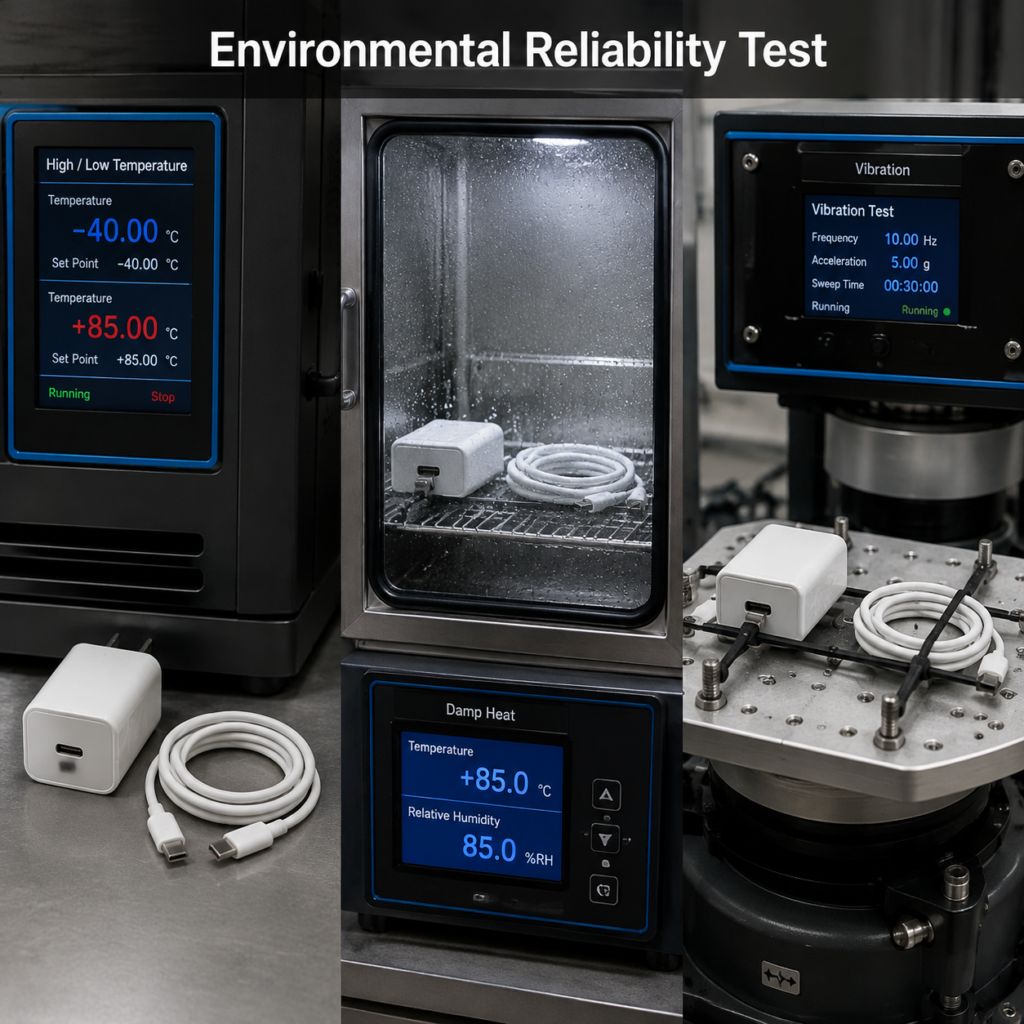
Basic Knowledge: The Relationship Between the Three Types of Tests and Charging Products
Specific to the charging products we use daily, the scenarios corresponding to these three types of tests are very clear: high and low temperature tests correspond to extreme temperature scenarios such as sun exposure in cars in summer, outdoor use in winter, and cross-border warehousing and transport; damp heat tests correspond to long-term humid scenarios such as huinan tian (spring damp condensation period), plum rain season, use near bathrooms, and tropical high-humidity areas; vibration tests correspond to continuous shaking scenarios such as bumping during express delivery, shaking while driving in a car, and long-term swinging of hanging charging cables. The common impact of these scenarios ranges from unstable charging and unavailable fast charging at best, to shortened interface life, reduced electrical insulation performance, and even safety hazards at worst.
You may ask: which charging products need these tests? Chargers, car chargers, travel chargers, charging cables, adapter cables, charging ports, and docking stations with charging functions that we often contact all fall within the applicable scope. Products unrelated to charging accessories, such as ordinary home appliances, industrial equipment, and toys, are not within the scope of this discussion.
There are also clear boundaries for the test objects of different products: tests of independent chargers will include detachable AC prongs or power cords, because loose prongs and aging power cords are common problems; USB-C cable tests should usually cover both end connectors and the entire cable; for cables equipped with E-Markers, the test should also cover their electronic marker components and communication functions. E-Markers are used to declare cable capabilities, and USB PD power negotiation is carried out between the power supply end and the power receiving end; car charger tests will include mounting fixtures to avoid problems caused by insecure fixtures themselves. Generally speaking, this type of test only tests the charging accessories themselves, and does not include electronic products being charged such as mobile phones and laptops.
When you first come into contact with this type of test, it is easy to confuse it with other common tests. Here are a few of the most easily confused concepts clarified:
First, environmental testing ≠ electrical safety testing. The core of safety testing is to test “whether there is a risk of electric shock or fire”, which is the safety bottom line; while environmental reliability testing tests “whether it can be used normally for a long time in corresponding scenarios”, which is a requirement for performance and lifespan. For example, a charger that passes safety tests but fails to charge after being left in a hot car in summer has poor environmental reliability, not unqualified safety.
Second, damp heat test ≠ IP waterproof test. The water ingress protection level in the IP code is used to evaluate the protection ability of the enclosure under specified conditions such as dripping, splashing, strong spraying, or immersion, and the specific conditions depend on the IP level; while the damp heat test tests the problems of corrosion and insulation decline caused by moisture penetration and condensation in long-term high-temperature and high-humidity environments. IP water ingress protection does not evaluate material aging and corrosion caused by long-term damp heat, moisture diffusion, or condensation, so it cannot replace the damp heat test.
Third, vibration test ≠ drop impact test. The vibration test is shaking that lasts for hours or even days, simulating long-term bumping; drop is an instantaneous impact, simulating the scenario of falling to the ground, and the weak points tested are completely different.
Fourth, test standards ≠ product certification. Test standards are unified “test methods and procedures”, such as specifying how to cool down in high and low temperature tests and how to place samples; while product certification is a qualification certificate issued by a third-party organization that “the product meets the requirements of a certain standard”. The two are the difference between “method” and “result proof”.
Standard Hierarchy and Standard Selection Logic
After clarifying the basic concepts, you may be curious: why do some chargers mark an operating temperature of 0~45℃, while others mark -10~55℃? Where do these requirements come from? In fact, environmental test standards are layered, not a unified qualification line. We can understand them with a four-layer logic, and we can also use this logic to judge whether a product’s test is reliable.
The first layer is method standards, which are the most basic rules of “how to test”. The internationally通用 standard is the IEC 60068 series, developed by the International Electrotechnical Commission. It mainly specifies environmental test methods, procedures, and optional test severity levels, such as test equipment requirements, operation procedures, sample installation methods, and optional conditions.
The second layer is severity level, which is the intensity of “how strict the test is”. The specific severity level to be adopted needs to be determined in combination with relevant product standards, regulatory or contract requirements, actual use and transportation environments, installation location, and risk analysis. The use scenario claimed by the product is only one of the reference factors. For example, home chargers and car chargers have different actual use environments, so applicable conditions may also be different.
The third layer is sources of mandatory requirements, that is, “which items must be tested”, usually from the product’s safety standards, regulatory requirements of the sales region, or special specifications of automotive or OEM customers. For products used in vehicles or supplied as vehicle components, it is necessary to confirm whether the regulations of the sales region, applicable product standards, and OEM/customer specifications specify corresponding environmental tests; it cannot be generally assumed that a product must comply with a specific automotive environmental standard just because it is advertised as “for automotive use”.
The fourth layer is judgment requirements, that is, “what counts as qualified”, usually from the product’s specification sheet, corresponding safety standards, or requirements of the manufacturer commissioning the test. There is no globally unified qualification threshold.
The standard systems in different regions are slightly different: most of the EU’s EN standards and China’s GB standards adopt the IEC 60068 series identically or with modifications, and the test methods are basically the same; the US UL system is independent, but its core logic is also the structure of “method standard + severity level + judgment basis”, which is largely similar.
If you see standard numbers on the product parameter page or test report, you can correspond them to specific test types:
- High and low temperature related: IEC 60068-2-1 (low temperature test), IEC 60068-2-2 (high temperature test), IEC 60068-2-14 (temperature change test, i.e., high and low temperature cycling)
- Damp heat related: IEC 60068-2-78 (constant damp heat test), IEC 60068-2-30 (cyclic damp heat test, some test cycles include condensation)
- Vibration related: IEC 60068-2-6 (sinusoidal vibration test), IEC 60068-2-64 (random vibration test), IEC 60068-2-47 (mounting guide for specimens in vibration, impact, and similar dynamic tests; installation conditions should be specified in accordance with relevant specifications to improve the repeatability and representativeness of the test)
- Automotive supplement: ISO 16750 series (environmental requirements for electronic equipment of road vehicles), which is a commonly used reference standard in the automotive industry, not a mandatory requirement, but more in line with the actual use scenario inside the vehicle.
Many people think “the higher the test level, the better the product”, but that is completely wrong. Severity levels have no distinction between high and low, only the difference between matching and not matching the use scenario:
- For chargers for fixed indoor use, it is sufficient to refer to the ordinary indoor temperature and humidity range, and usually no vibration test in operating state is required (except for vibration in transportation state);
- As long as the product is transported with packaging, it may need to undergo transportation vibration and temperature-humidity tests in a non-energized state to simulate the logistics process;
- For products installed and used in vehicles, the corresponding high and low temperature, damp heat, and operating vibration levels should be selected in combination with the in-vehicle environment;
- For products used outdoors or semi-outdoors, a wider temperature and humidity range should be selected, and cyclic damp heat tests may also be added.
In short, the level suitable for your use scenario is the best level — overly strict tests beyond the scenario will only increase the product cost and have no practical significance for you.
For ordinary users, you don’t need to memorize these standard numbers. Here are a few tips for quickly finding effective information:
First, prioritize checking clearly marked fields such as “operating temperature”, “storage temperature”, and “operating humidity” on the product parameter page, which are directly linked to the use scenario;
Second, if the product only writes “complies with international standards” but has no specific test conditions and test objects, the reference value of this publicity is very low, basically equivalent to saying nothing;
Third, prioritize choosing public descriptions or test reports with clear combinations of test conditions and test objects. The more specific the information, the more reliable it is.
High and Low Temperature Test: Tolerance to Hot and Cold Environments
The principle of the high and low temperature test is very simple: it simulates an extreme temperature environment through a temperature-controlled test chamber to test whether the internal connections, enclosure, and components of the product will have problems under thermal expansion and contraction.
There are two common types of high and low temperature tests: one is constant temperature test, which maintains a fixed temperature for a long time to test the continuous tolerance of the product; the other is temperature cycling test, which switches between high and low temperatures repeatedly, mainly used to expose thermal fatigue, connection, and interface problems caused by thermal expansion and contraction. The constant temperature test mainly evaluates the tolerance or operating ability at a specified temperature, and the severity of the two cannot be directly compared without specific temperature, time, cycle conditions, and criteria.
A complete set of high and low temperature test conditions must include several fields; without any one of them, it is impossible to judge the intensity: temperature value, duration, temperature change rate (required for temperature cycling tests), and test state (operating state or storage state).
Operating temperature, storage temperature, load, and duration must be subject to specific product specifications, applicable product standards, or commissioned test plans. If examples are cited, their source, product category, test state, load, duration, and judgment criteria should be clarified, and individual enterprise conditions should not be generalized as general settings for consumer-grade products.
Here are two key reminders to note:
First, the ambient temperature of the test chamber is not equal to the actual temperature of the core components inside the charger (called junction temperature in the industry). High-power chargers generate heat themselves when operating at full load, and the internal temperature may be dozens of degrees higher than the ambient temperature. Therefore, when using high-power chargers above 65W in summer, it is best to place them in a ventilated place and do not cover them with anything.
Second, the operating temperature declared by the product does not mean that it can operate at full power indefinitely within the entire temperature range — many products will actively reduce power for protection at high temperatures, which is normal, unless the specification sheet clearly marks “full power operation over the entire temperature range”.
For charging products, the focus of high and low temperature tests is also different:
- For chargers and power adapters, the main checks are whether the output power is stable, whether over-temperature protection is triggered by mistake, and whether internal components will age acceleratedly;
- For charging cables, the main checks are whether the outer sheath will harden and crack, and whether the core resistance will increase (increased resistance will lead to slower charging and increased heat generation);
- For USB interfaces, plugs, and charging ports, the main checks are whether the insertion and extraction force is abnormal, whether the plastic core will crack brittlely, and whether the solder joints will fall off.
Damp Heat Test: Tolerance to Humid and High-Temperature Environments
The damp heat test simulates a high-temperature and high-humidity environment, and its core is to test whether metal will corrode acceleratedly and insulation performance will decline under long-term humidity, thereby affecting charging stability.
There are also two common types of damp heat tests: one is constant damp heat, where temperature and humidity remain stable, simulating a long-term humid indoor environment, such as a room with a humidifier running all year round or an indoor room in tropical regions; the other is cyclic damp heat, where temperature and humidity change cyclically, simulating humidity changes caused by day-night temperature differences, which is closer to outdoor or semi-outdoor humid scenarios.
Many people think that cyclic damp heat must have condensation, but that is not the case. The generation of condensation depends on conditions such as temperature and humidity settings and the initial temperature of the sample. Only some cyclic damp heat test cycles include a condensation环节, and it cannot be generalized.
A complete damp heat test condition needs to include these fields: temperature, relative humidity (the air humidity percentage we often talk about), duration or number of cycles, whether condensation is included, test state, operating load, and recovery time (the stabilization time after returning to normal temperature and humidity after the test).
40℃ and 93% relative humidity is one of the common condition combinations in constant damp heat tests, but the duration and whether it is applicable must be specified by product standards or test plans; 48 hours cannot be called a general basic requirement for household charging products. Stricter plans may extend the test time, increase the temperature, or add condensation cycles, which are suitable for products used in humid areas or outdoors.
Here is a special reminder: humidity cannot be compared independently of temperature. For the same 90% relative humidity, the destructive power at 25℃ and 40℃ is completely different — the higher the temperature, the higher the water vapor content in the air, the faster it penetrates into the product, and the higher the risk of corrosion and insulation decline. Therefore, when looking at damp heat test conditions, temperature and humidity must be considered together.
For charging products, the focus of the damp heat test is mainly on several aspects:
- Whether the metal contact springs of plugs, USB interfaces, and charging ports will oxidize, whether the contact resistance will increase, and whether insertion and extraction will be unsmooth — this is also the main reason for poor charging contact for many people during the plum rain season;
- Whether the internal insulation performance of the charger will decline, whether there is a short circuit risk, and whether fast charging protocol identification will be abnormal (because moisture will affect the signal transmission of the circuit);
- Whether the outer sheath of the charging cable will become sticky, age, and fall off.
Finally, the boundary between the damp heat test and other protection tests should be clarified: it is not equivalent to the IP waterproof test, and it tests the long-term effects of moisture and condensation; the water ingress protection level in the IP code is used to evaluate the protection ability of the enclosure under specified conditions such as dripping, splashing, strong spraying, or immersion, and the specific conditions depend on the IP level. The two cannot replace each other; it is also not equivalent to the salt spray corrosion test. Ordinary damp heat tests use pure water, do not contain salt, and do not test the corrosion resistance in a salt spray environment. There is also a very important safety tip: if there is water or condensation on the surface of the product, it is strictly forbidden to use it with power on. Be sure to wait until it is completely dry before use.
Vibration Test: Tolerance to Continuous Shaking Environments
The vibration test simulates a long-term shaking environment, and its core is to test whether the product will have loose internal parts and poor interface contact due to continuous vibration, thereby affecting the stability of the charging connection.
Common vibration tests can be classified from two dimensions:
According to vibration mode, there are two types: sinusoidal vibration and random vibration:
- Sinusoidal vibration can use frequency sweep or fixed frequency procedures: frequency sweep changes the frequency within a specified range, which can be used to search for resonance or perform sweep endurance tests; fixed frequency endurance runs for a specified time at a selected frequency, such as the resonance frequency. Long-term vibration at the resonance frequency is more likely to damage the product, so sinusoidal vibration is often used to locate the weak points of the product;
- Random vibration is irregular shaking at multiple frequencies, which is closer to the real bumping scenarios of express delivery and driving, so random vibration is more used when simulating actual use and transportation.
There is no general rule for the choice between the two, which is usually determined according to the vibration spectrum of transportation, the vehicle installation position of the product, the corresponding product standard, or customer specifications.
According to the test state of the product, it can be divided into transportation vibration and operating vibration:
- Transportation vibration is in a packaged and non-energized state, simulating bumping during logistics and transportation;
- Operating vibration is in an energized and loaded state, simulating shaking during vehicle use and mobile use.
The verification objectives of these two tests are completely different and cannot replace each other — for example, passing the transportation vibration test does not mean that the product can work normally when used in a vehicle with power on.
A complete vibration test condition must include these fields: vibration mode, frequency range; if it is sinusoidal vibration, displacement or acceleration, sweep rate, and number of cycles should also be additionally marked. Without these parameters, it is impossible to judge the intensity of the test.
Random vibration conditions should at least disclose the PSD spectrum shape, frequency range, total Grms, each axis direction, duration per axis, installation or packaging state, and energized load state. Simply writing “10~500Hz, 1Grms” cannot explain the test intensity, nor can it be used as a general product grade.
For charging products, the focus of the vibration test is also very clear:
- For chargers and adapters, the main checks are whether internal solder joints are loose, whether components fall off, and whether there is abnormal noise;
- For charging cables, the main checks are whether the cable core will break, whether the connector will come off, whether the sheath at the base of the connector will crack, and for USB-C cables equipped with E-Markers, whether their electronic marker components and communication functions will be affected;
- For USB interfaces, plugs, and charging ports, the main checks are whether the prongs are loose, whether the female socket is skewed, and whether the contact is intermittent.
General Test Process and Report Reading
After understanding the specific content of the three types of tests, you may be curious: how is a formal environmental test carried out? How do you quickly judge whether a test report is reliable when you get one?
First of all, formal environmental testing has a complete set of processes to ensure the accuracy and repeatability of results:
The first step is sample preparation: the model, configuration, and quantity of test samples should be clarified to ensure that the samples are representative, and “top-performing” samples should not be specially selected for testing;
The second step is pretreatment and baseline test: first place the sample in a normal temperature and humidity environment to stabilize, then perform initial performance checks according to the requirements of the test method and relevant product specifications, such as output power, insertion and extraction force, insulation resistance, etc. For tests with performance change as the criterion, the comparison data before and after the test is particularly important;
The third step is installation and fixation: fix the sample according to the actual use or transportation state of the product, and also comply with the installation requirements of the corresponding standard. For example, the installation of the vibration test should comply with the relevant provisions of IEC 60068-2-47 to avoid the installation method affecting the results;
The fourth step is test execution: run the test according to the set conditions. Whether it is necessary to operate with power on, apply rated load or other loads in the operating state should be determined according to the adopted test method and relevant product specifications;
The fifth step is recovery phase: after the test, place the sample back in a normal temperature and humidity environment for a specified time, and test again after the product performance is stable. For example, after the damp heat test, wait for the internal moisture to dissipate;
The sixth step is retest and judgment: retest the performance according to the preset test items, compare with the previous baseline data, and judge whether it is qualified;
The last step is recording and reporting: truthfully record the deviations and failure phenomena during the test, and issue a complete test report.
The judgment logic of the three types of tests is universal, and they are mainly judged from the following dimensions:
- Appearance and structure: no cracking, deformation, falling off, or abnormal noise. Whether slight discoloration or oxidation counts as unqualified depends on the agreement in the product specification sheet;
- Charging function: all declared functions are normal, fast charging protocol negotiation is normal, and output parameters meet product specifications;
- Interface performance: insertion and extraction force, retention force, and contact resistance all meet the requirements, and there is no looseness or skewing;
- Safety performance: insulation resistance and dielectric strength meet the corresponding safety standards, and there is no risk of electric leakage or short circuit;
- Protection function: the trigger logic of protection functions such as over-temperature and over-current is normal;
- Optional disassembly inspection: if required, the product will be disassembled to check whether internal solder joints and components are displaced or fallen off, which is carried out on demand.
It should be noted that the specific thresholds for these judgments all come from product specifications, safety standards, or commissioning requirements, and there is no globally unified general qualification line.
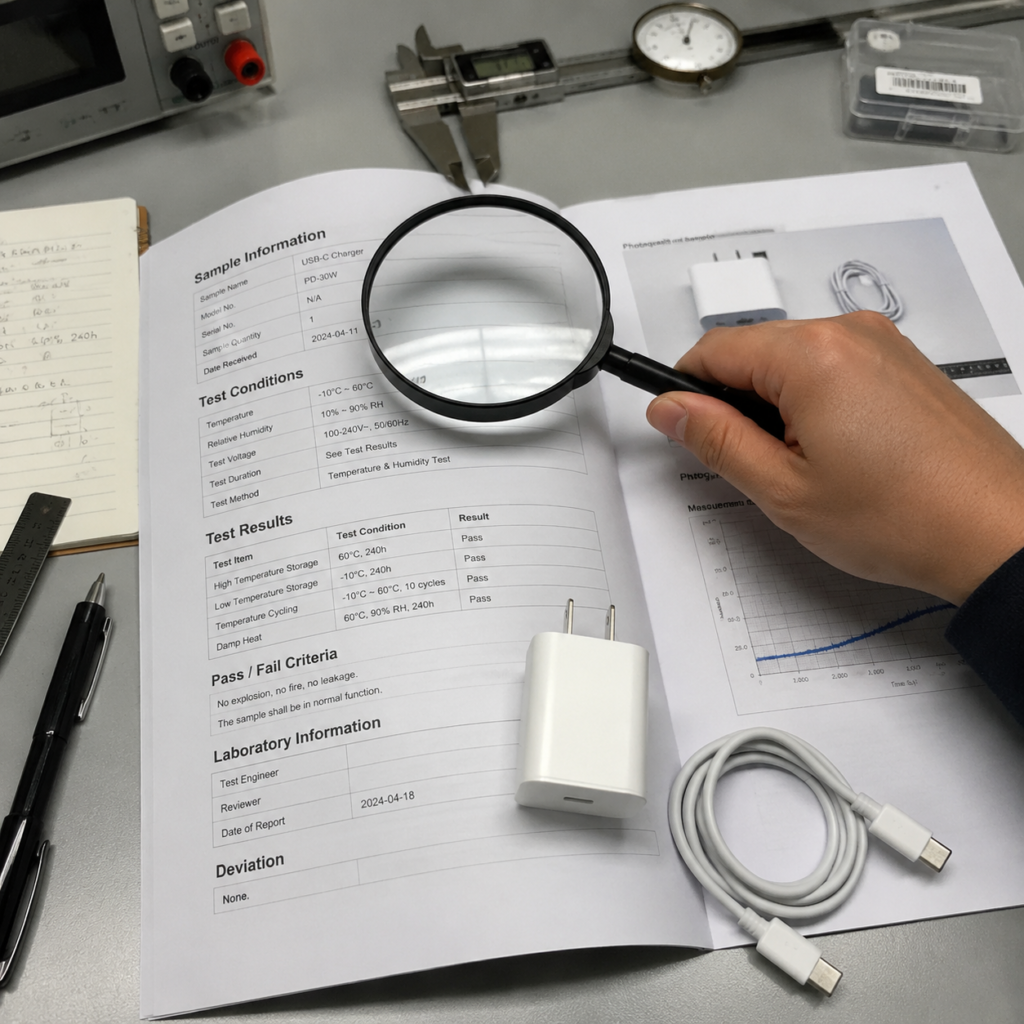
If you get a test report, you don’t need to read the pages of professional data. Just focus on these places to quickly judge its credibility:
First, check sample information: whether the model, configuration, and quantity are clearly marked. If even the specific model is not written, it is likely that the report is borrowed from other products;
Second, check test conditions: whether all parameters, test states, and load details are completely listed. For example, whether the high and low temperature test indicates whether it is in operating or storage state, whether the damp heat test indicates temperature and humidity, and whether the vibration test indicates mode and frequency range;
Third, check judgment basis: whether the source of the qualification standard is clearly stated, whether it is the product specification sheet or a certain safety standard;
Fourth, check test data: for tests with performance change as the criterion, check whether there is comparison data before and after the test, instead of just writing the word “pass”;
Fifth, check qualifications and deviations: it should be verified whether the laboratory has the accreditation ability corresponding to the test item, whether the report is issued within the scope of accreditation, and its issuance information; the accreditation mark can be used as a clue, but the validity of the report cannot be judged solely by whether the mark is printed. Also pay attention to whether there is a description of test deviations — for example, if a certain condition is slightly different from the standard, it will be noted in the report.
Test Information Interpretation and Pitfall Avoidance Guide
Many people are easily misled by merchants’ rhetoric when looking at test information in product promotions. Here are a few core principles, failure patterns, and common misconceptions sorted out for you to help you avoid pitfalls.
First, the core principles for reading test information:
First, focus on whether the test conditions match your own use scenario, not just the words “passed the test” — for example, a product that has passed the -20℃ storage test is useless to you if you want to use it outdoors in winter (operating state).
Second, it is necessary to distinguish between operating state and storage state. Many merchants deliberately mix these two concepts. For example, they use a -40℃ storage temperature to advertise “low temperature resistance”, but the actual operating temperature is only 0℃, which is purely a case of concept swapping.
Third, confirm the combination of test objects: for example, whether the test is for a complete charger with prongs, or only the internal motherboard; whether the test is for the entire charging cable with connectors, or only the cable core — different combinations lead to completely different test results.
Fourth, whether pre-test baseline measurement, energized operation during the test, rated load, and post-test retest are required should be determined according to the adopted test method and relevant product specifications. For tests with performance change as the criterion, the comparison data before and after the test is particularly important; but baseline comparison cannot be regarded as a unified mandatory condition for all formal environmental tests.
Understanding the failure patterns of the three types of tests can also help you judge the weak points of the product:
- High and low temperature: both low and high temperatures may affect the performance of the charging system, but the direction and degree of impact depend on the charger design, load, and the device being charged. At high temperatures, products equipped with temperature protection or derating control may reduce power or stop output after reaching the design threshold; it cannot be presumed that all products will necessarily have reduced efficiency at low temperatures or trigger thermal protection at high temperatures. Temperature cycling (repeated switching between high and low temperatures) is more likely to expose thermal fatigue, connection, and interface problems, because the stress of thermal expansion and contraction acts repeatedly.
- Damp heat: the higher the temperature and humidity, the faster the metal corrosion and insulation decline; cyclic damp heat tests with condensation are more destructive than constant damp heat, because the liquid water of condensation will directly penetrate into gaps.
- Vibration: the damage is the greatest at the resonance frequency; the longer the vibration duration and the higher the intensity, the higher the probability of failure; the interface and the base of the cable end are the most easily damaged positions because of stress concentration.
There are many promotional misconceptions about these three types of tests on the market. Here are the most common ones:
- “Passing the three types of tests = waterproof and drop-proof”: Wrong. These three types all belong to environmental reliability testing, which are completely different categories from IP waterproof and drop impact tests, and cannot replace each other. Passing the damp heat test does not mean waterproof, and passing the vibration test does not mean drop-proof.
- “The higher the test level, the better the product”: Wrong. Overly strict tests beyond your use scenario will only increase the cost of the product and have no practical significance for you. The one that matches the scenario is the best.
- “All charging products must undergo the three types of tests”: Wrong. Whether to do these three types of tests depends on the regulations of the sales region, the corresponding product standards, the claimed use scenario of the product, and risk assessment. Not all charging products are mandatory to do them. Ordinary household products should at least meet the applicable regulations and product standards of the sales region; whether specific damp heat, vibration, or extended environmental tests are also needed should be judged in combination with product design, use environment, and applicable specifications.
- “A test report means it is reliable”: Wrong. Be alert to merchants’ concept swapping, such as using reports of other models, using storage state to pretend to be operating state, and using low-intensity tests to pretend to be high-intensity ones. Be sure to read the specific information in the report.
Finally, the reasonable boundaries of test results should be clarified, and unrealistic expectations for tests should not be held:
First, the test results only represent that the tested samples meet the requirements under the specified test conditions, and do not mean that all mass-produced products can withstand harsher conditions;
Second, passing the test does not mean that the product can experience extreme environments infinitely. Long-term use in extreme environments will still accelerate product aging and shorten its lifespan;
Third, the test results only correspond to the marked model and configuration, and other models in the same series cannot directly apply this test result — for example, a 20W charger in the same series that has passed the test does not mean that a 65W one can also pass.
Scenario-Based Purchase and Usage Recommendations
After talking so much, finally, here are some practical purchase and usage recommendations, as well as a simple 3-step judgment method to help you quickly choose the right product for yourself.
First, scenario-based purchase tips:
- If you live in a humid southern region with a long plum rain season, or live in a tropical high-humidity region: prioritize products that clearly mark damp heat tests (with specific temperature, humidity, and duration conditions). You can regularly clean the interfaces in daily life to reduce the impact of oxidation.
- If you mainly use it in a car: prioritize products marked as suitable for vehicles and with high and low temperature + operating vibration tests (with specific conditions). Do not buy ordinary chargers that are only marked for household use and use them in the car.
- If you often use it outdoors or during travel: prioritize products with clear operating temperature declarations (loaded state), including cyclic damp heat and transportation vibration tests, which are more capable of coping with complex environments.
- If it is just for ordinary household use: products that meet the applicable regulations and product standards of the sales region should be selected. Public damp heat test declarations can be used as information reference, but cannot be used alone as a sufficient condition for whether the product is suitable for household use, and there is no need to blindly pursue high-level tests.
Even if the product has passed the corresponding tests, paying attention to these details in daily use can also extend the product’s lifespan:
- High and low temperature scenarios: do not leave the charger in a sun-exposed car or next to a heater for a long time; do not forcibly bend the charging cable in a low-temperature environment, otherwise the outer sheath is easy to crack; keep ventilation during high-power charging, and do not cover the charger with anything.
- Humid scenarios: never turn on the power when there is water in the interface; when entering a warm room from a low-temperature outdoor environment, wait until the product is completely dry and free of condensation before use; if the interface is severely oxidized, do not continue to use it to avoid heat generation due to poor contact.
- Vibration/transportation scenarios: protect the prongs when transporting the charger to avoid squeezing the interface; when using in a car, try to fix the charging cable well to reduce hanging pulling and avoid breakage at the base; if the product rattles when shaken or the interface is loose, do not use it again to avoid safety problems.
If you are too lazy to remember so many details, you can use this 3-step quick judgment method, which is simple and easy to use:
Step 1: Clarify your core use scenario — is it indoor household use, vehicle use, outdoor use, or do you have special humidity or transportation needs?
Step 2: Find the corresponding test items of the product and confirm the core conditions — is it in operating state or storage state? What are the specific parameters? Is the test for a complete product (e.g., with prongs, with connectors)?
Step 3: Compare the test conditions with your own use scenario. As long as they match, it is okay, and there is no need to blindly pursue a higher level.
Learning Summary
Finally, let’s review the core knowledge points:
First, the three types of tests: high and low temperature, damp heat, and vibration, correspond to long-term reliability in scenarios of cold, heat, humidity, and continuous shaking, not ultimate abuse resistance;
Second, IEC 60068 is a general series of environmental test methods, which mainly specifies how to test, test procedures, and optional severity levels; the specific adopted conditions and qualification judgment should be determined according to the use scenario, relevant product standards, regulatory or contract requirements, product specifications, etc.;
Third, when reading test information, focus on “test state + complete conditions + test object”, not just the words “passed the test”;
Fourth, these three types of tests belong to different test categories from electrical safety, IP waterproof, and drop impact, and cannot replace each other.
After learning these, you can not only distinguish the functions, applicable scenarios, and common differences of the three types of tests, understand the basic test logic, and quickly verify the credibility of test reports, but also identify merchants’ concept-swapping promotions, choose suitable charging products according to your own use scenarios, and correctly protect charging accessories in daily life to reduce damage caused by environmental factors.