
Charging product sellers doing cross-border business in Southeast Asia are most likely to be confused by “IMDA certification” when first entering the Singapore market: Do all chargers need it? Is IMDA mandatory for wireless chargers? What is its relationship with the Safety Mark?
This article focuses specifically on charging products, and explains in detail the core logic, scope of application, judgment methods, application process, and pitfall avoidance tips for IMDA — from beginner-friendly understanding to semi-proficient independent judgment, so you no longer need to search for scattered information everywhere.
First, Understand the Basics: What Exactly is IMDA? (Charging Product Exclusive Version)
Many people think “certification” means unified testing, but IMDA actually has a clear scope of jurisdiction, which is completely separate from the electrical safety of charging products.
The Infocomm Media Development Authority (IMDA) of Singapore is the local competent authority responsible for the compliance of wireless communications and telecommunications equipment. Its equipment supervision focuses on radio communication equipment, as well as specific telecommunications equipment that is connected or intended to be connected to Singapore’s public telecommunications network. The core focus is on whether the equipment uses the radio spectrum in compliance with regulations, and whether it meets applicable requirements when connected to public communication networks.
For charging products, the essence of IMDA is: whether a product needs to handle IMDA compliance cannot be judged solely by whether it is a charger, nor solely by whether it actively transmits signals. It must be judged in combination with the actual radio function, network connection method, equipment category, and exemption conditions. Charging products with wireless or communication functions may require registration, conformity assessment, or confirmation of eligibility for exemption before being launched on the market; not all products require “certification”, nor can they be exempted casually.
Why must charging product sellers pay attention? Because as long as your product has regulated wireless/communication functions, it falls within the scope of assessment — if you violate the regulations, it may be intercepted by customs during import, and public sales may result in goods seizure, fines, removal from shelves, or even being placed on a regulatory blacklist. Special attention should be paid: do not assume that small-batch direct mail or sample orders can be exempted. As long as it is commercial sales or import, compliance cannot be automatically skipped, and products for special purposes also need to first check official rules.
Many sellers confuse IMDA with other Singapore compliance requirements. Let’s clarify first: IMDA mainly regulates compliance related to wireless/communication functions, spectrum use, and public communication network connections; the commonly mentioned Safety Mark regulates electrical safety, is completely independent of IMDA, and requires separate assessment; plug safety and energy efficiency labels attached to products are also independent compliance items that need to be separately verified as needed, and cannot replace each other.
Quick Judgment: Does Your Charging Product Need IMDA Verification?
You don’t need to memorize the product list by rote. Just follow the five steps and combine with boundary judgment to quickly draw a conclusion.
Five-Step Judgment Method
Step 1: First confirm the sales and usage scenarios: For products publicly sold, supplied, or commercially imported in Singapore, usually the focus should be on verifying dealer licenses and equipment registration or exemption obligations. Personal carry-on or import for personal use may be subject to specific license exceptions, but it must still be confirmed that the equipment is not prohibited equipment and complies with applicable spectrum and usage rules.
Step 2: Check equipment functions: See if the product has radio functions, or functions to connect or intend to connect to public communication networks. Note that you cannot only look at whether it “actively transmits” signals; some equipment may need to be judged according to specific equipment categories and technical conditions even if data communication is not its main purpose.
Step 3: Verify spectrum/public network use: If it has wireless functions, check whether it uses frequency bands allowed in Singapore, and whether it meets power, field strength, and usage conditions; if it involves network connection, verify whether it is a regulated equipment connected to the public communication network.
Step 4: Check exemption categories: Compare with IMDA’s latest exemption conditions and applicable technical specifications to see if the product meets the exemption conditions.
Step 5: Final confirmation: If it is not exempt, further confirm whether it belongs to a registrable regulated category, applicable technical specifications, compliance path, and who needs to be the local responsible entity.
The core principle of judgment is: look at actual functions, not product name, power, or interface. For example, a product called “smart charger” that does not have any wireless module or public network connection function usually does not need to be processed for IMDA equipment registration; conversely, a product called “ordinary wireless charger” that has Bluetooth to connect to an APP must be assessed.
The final conclusion is generally divided into three levels: not within the registration scope, requiring scope and exemption verification, and requiring registration.
Reference for Common Product Classification
For your quick comparison, we divide common charging products into three categories according to the conclusion:
Products That Require Prior Verification
General principle: The specific path needs to be confirmed in combination with wireless functions, frequency bands, power, equipment categories, and exemption lists.
Common ones include: smart chargers and smart power banks with Bluetooth/WiFi/NFC; wireless chargers with Bluetooth/APP control; shared charging cabinets and shared power banks with 4G/5G/SIM cards; PoE power adapters with regulated communication/wireless functions; smart charging docks and smart charging sockets with wireless data transmission; and wireless chargers that do not have data communication modules but use inductive wireless power transmission.
Products Usually Not Within the Registration Scope
General principle: No radio function, no connection or intended connection to public communication networks, only for power supply or wired data transmission.
Common ones include: ordinary chargers and power adapters with only wired charging/wired data transmission; USB/USB-C charging cables for only charging/wired transmission (even with E-Marker chips, because it is wired communication and not wireless transmission); ordinary charging plugs, adapters, and charging ports that only supply power.
Boundary Products That Are Easy to Fall Into Pitfalls
Some products have relatively complex functions and are easy to misjudge. Pay special attention to the following categories:
1. Wireless + wired 2-in-1 chargers: As long as they contain regulated wireless transmission functions, or involve regulated public network connection functions, verification is required, regardless of whether they have wired charging functions.
2. Sample/display products: Before public display, it should be confirmed whether the equipment will transmit, connect to the network, or be supplied, and whether IMDA’s license or exemption arrangements for exhibitions, testing and other purposes apply; if the activity constitutes supply, sales, or normal operation and use, it should not be assumed that applicable registration or license obligations can be exempted.
3. Chargers with USB Hub/Ethernet port: Having only a USB Hub or Ethernet interface does not automatically trigger or exclude IMDA requirements; it should be verified whether the equipment is a regulated telecommunications equipment connected to the public telecommunications network, whether it has radio functions, and whether registration exemption applies.
4. Private label/OEM/ODM products: Whether the original compliance materials can be reused and whether re-registration is required shall be confirmed by the local licensed dealer (TDL), not by the factory or supplier.
5. Complete machines equipped with certified wireless modules: Even if the wireless module used has passed IMDA certification, the complete machine still needs separate verification, and module certification cannot replace the compliance of the complete machine.
Quick Reference Table for IMDA Obligations of Common Products
For more intuitiveness, we have sorted out the IMDA obligations of common charging products in the table below, which you can directly compare:
| Product Type | Core Function | Regulated Wireless Communication | Trigger Reason | Conclusion Level | Next Action |
| Ordinary wired charger | Only wired power supply/wired data transmission | None | No radio function or public network connection function | Not within registration scope | Verify other compliance (e.g., Safety Mark, plug safety) |
| Pure inductive wireless charger | Inductive wireless power transmission such as Qi | Requires verification | Involves technical requirements and exemption conditions for wireless power transmission | Requires verification | Check relevant technical specifications and exemption conditions for wireless power transmission |
| Wireless charger with Bluetooth | Inductive power transmission + Bluetooth communication/APP control | Yes (short-range) | Equipped with Bluetooth wireless communication module | Requires verification | Check short-range device specifications and exemption eligibility |
| WiFi smart charger | Wired power supply + WiFi network control | Yes (WLAN) | Equipped with WiFi wireless communication module | Requires verification | Check specifications, exemption lists, and registration requirements |
| 4G shared power bank | Charging + 4G public network access management | Yes (cellular) | Connected to public telecommunications network | Requires verification | Prioritize checking public telecommunications equipment requirements |
| Ordinary USB-C cable | Only wired charging/data transmission | None | No radio function | Not within registration scope | Verify other compliance as needed |
| Smart charging socket | Power supply + Bluetooth/WiFi control | Yes | Equipped with wireless communication module | Requires verification | Check specifications and exemption/registration requirements |
How to Choose the IMDA Compliance Path?
After confirming that verification is required, the next step is to select the corresponding compliance path, which is mainly divided into two categories:
One category is registration category: When the product belongs to a regulated category and does not meet the registration exemption conditions, it may be necessary to complete registration before it can be sold on the market.
The other category is exemption category: The product meets the registration exemption categories and conditions applicable to IMDA, and does not require registration, but still needs to comply with the corresponding technical specifications — it does not mean that exemption allows arbitrary practices, it just means that the registration process is not required.
Applicable Scenarios for Common Paths of Charging Products
For charging products, the two most common situations are:
1. Short-Range Devices (SRD): For example, smart chargers and wireless chargers with Bluetooth, WiFi, NFC. For such products, it should first be confirmed whether they meet the applicable technical specifications of IMDA, as well as the registration exemption categories and conditions. Those that meet the conditions can be treated as exempt equipment; if they do not meet the exemption conditions, it is necessary to further confirm whether they belong to a registrable regulated category. If the product does not comply with Singapore’s spectrum or technical specifications, it may need to be rectified, have relevant functions disabled, or not be supplied, and it cannot be assumed that registration will solve the problem.
2. Public network access products: For example, shared charging cabinets and shared power banks with 4G/5G. Such products need to access the public telecommunications network and usually need to go through the registration process.
Several Key Path Judgment Rules
There are several points that many sellers easily get wrong, which are clarified separately here:
• Module certification ≠ complete machine compliance: Even if the wireless module you use has passed IMDA certification, it can only be used as supporting material for the complete machine application. Because the antenna, housing, power supply noise, firmware, function combination, and model coverage of the complete machine will affect wireless parameters, all of which need separate verification. Module certification cannot replace the IMDA compliance assessment of the complete machine.
• Overseas certification cannot directly replace IMDA: Overseas certifications or test reports such as CE, FCC, and CB cannot directly replace IMDA registration or exemption condition judgment. Overseas reports can only be submitted as supporting materials if they meet IMDA’s specified specifications, test methods, and laboratory accreditation conditions.
• If you are unsure, do a pre-assessment first: First make a preliminary confirmation according to the five-step judgment method, then match with IMDA’s current equipment list and exemption list; if you are still unsure, find a laboratory with the corresponding accreditation scope and accepted by IMDA or a local licensed dealer to do a pre-assessment, don’t take a gamble.
Full IMDA Registration Process (with Key Checkpoints)
If your product needs to go through the registration process, below are the complete steps and key checkpoints for each link to help you avoid detours.
Step 1: First Confirm the Responsible Entity
IMDA registration has a hard threshold: The application must be submitted by a locally registered entity or dealer holding a Singapore Telecommunication Dealer’s Licence (TDL). Overseas brand owners cannot directly complete local registration with overseas entities. So if you are an overseas seller, you must first find a qualified local TDL holder, otherwise you won’t even have access to the application.
Step 2: Pre-Application Preparation
Before the official application, make sufficient preparations for the following:
1. Use the five-step judgment method above to confirm that the product is indeed within the registration scope, so as not to waste effort.
2. Prepare basic materials: product specifications, wireless function description, label draft, TDL qualification documents.
3. Find a testing laboratory with the corresponding accreditation scope to ensure that the laboratory is qualified to test your type of product.
4. Verify that the wireless frequency band of the product is allowed to be used in Singapore, and do not use locally prohibited frequency bands.
✅ Key checkpoint: The product model, hardware/firmware version, and functions submitted for testing must be completely consistent with the final sold version — do not use engineering prototypes for testing, and then modify the sold version later, otherwise the testing will be in vain.
Step 3: Test Report Preparation
After finalizing the final hardware, firmware, antenna, and regional version, confirm the test items with the laboratory.
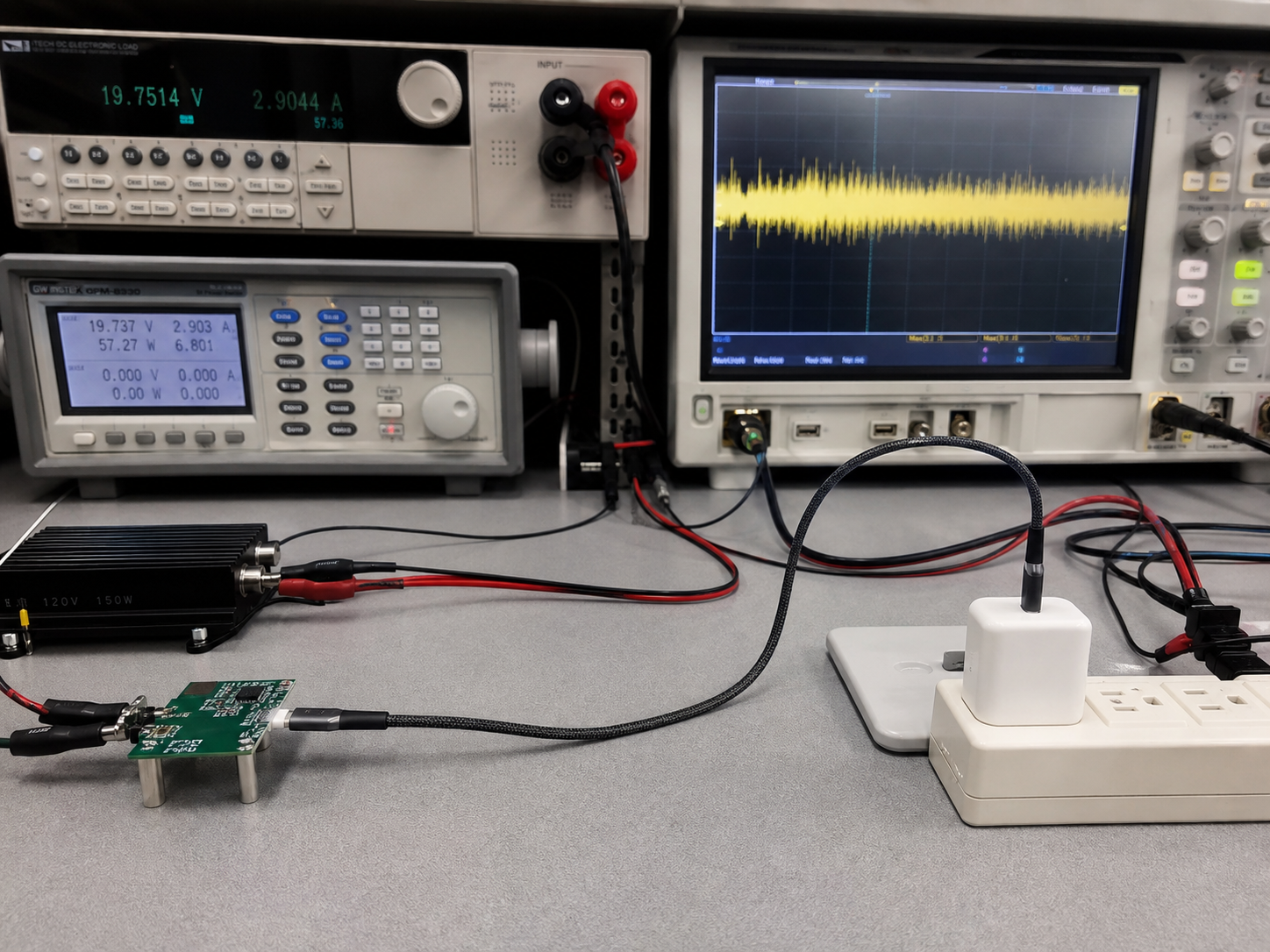
Common test items include: Radio Frequency (RF) parameters (such as transmission power, frequency band), and Electromagnetic Compatibility (EMC). EMC usually includes emission limits and immunity requirements, the purpose of which is to ensure that equipment does not generate unacceptable interference in the specified electromagnetic environment and has a specified level of immunity.
Whether Specific Absorption Rate (SAR, which is the amount of electromagnetic radiation absorbed by the human body) or other human radio frequency exposure assessment applies shall be confirmed according to the equipment’s frequency band, power, antenna position, expected use distance, and applicable IMDA technical specifications; desktop equipment may not require SAR testing only if it meets the corresponding exemption threshold or separation distance conditions.
The most common reasons for non-conformity of charging products are excessive transmission power and frequency band offset, for example, the transmission power of Bluetooth exceeds the upper limit specified in Singapore, or the WiFi frequency band deviates to a prohibited range.
The test report shall be issued by a laboratory with the corresponding accreditation scope and accepted by IMDA, in accordance with applicable IMDA technical specifications and application requirements. Whether reports from overseas laboratories are acceptable depends on the specifications corresponding to the report, the laboratory’s accreditation status, and specific application requirements.
✅ Key checkpoint: The product model on the report must be consistent with the final sales model, and the content must be complete and compliant.
The testing cycle is affected by the number of test items, product complexity, and rectification situation. It can be as fast as one or two weeks, or as slow as one or two months, depending on the actual situation.
Step 4: Submit Registration Application
The application channel is submitted by the TDL-holding entity through IMDA’s official system, or a compliance agent can be entrusted to operate.
Required materials include: test report, product information, TDL qualification, brand and model certification.
The application fee is determined according to the product type and registration path, and the specific amount is subject to IMDA’s latest fee standard.
✅ Key checkpoint: The brand, model, function, and version in all materials must be completely consistent, otherwise it is easy to be rejected.
Step 5: IMDA Review and Registration Confirmation
IMDA will review the completeness of the materials, the compliance of the test report, and the compliance of frequency bands and functions.
The review cycle is affected by the equipment category, material compliance, and supplementary document situation, and there is no fixed time.
Common reasons for rejection include: the report has no accreditation qualification, product information is inconsistent with the declaration, and frequency band or function violations.
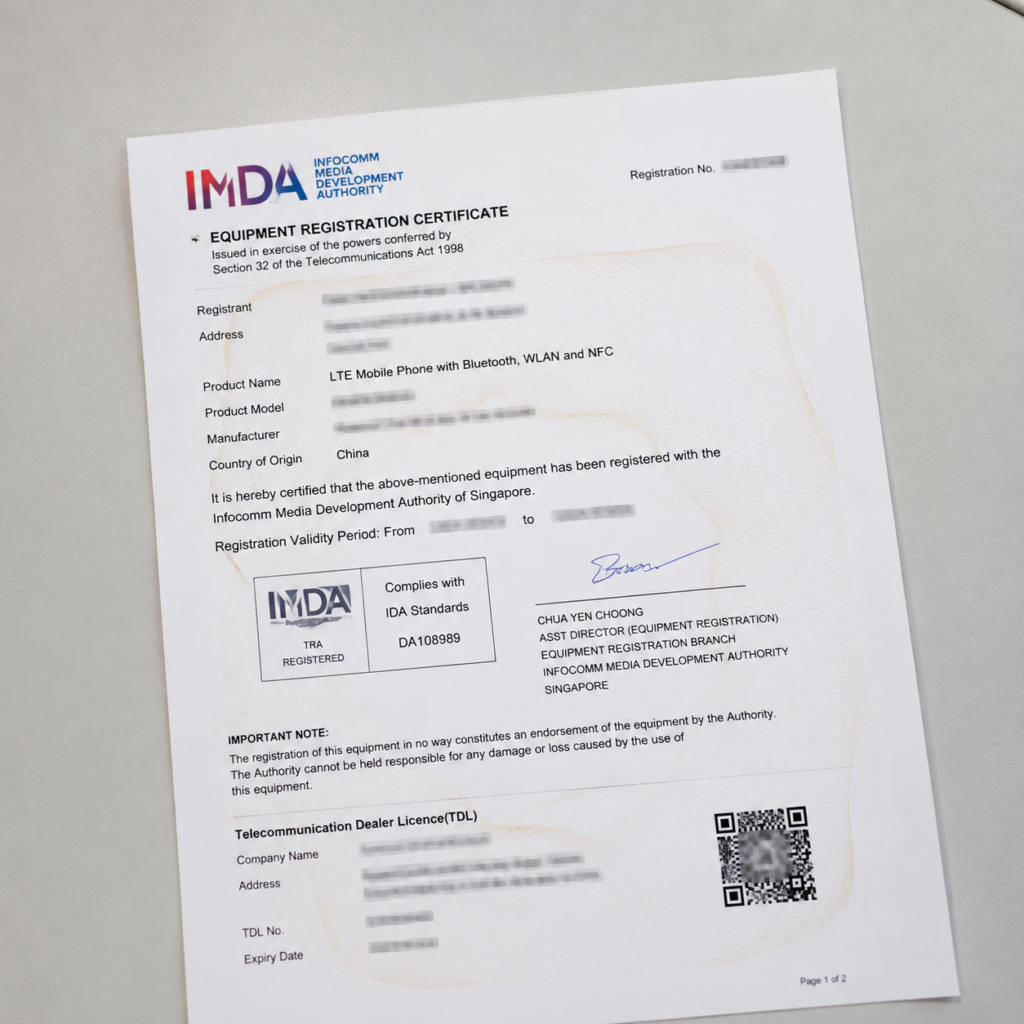
✅ Key checkpoint: After receiving the registration documents, be sure to check whether the registration number, applicable models, function scope, and responsible entity are all correct. Don’t just put the documents aside after getting them. If the model is written incorrectly, it will still be non-compliant when sold later.
Step 6: Post-Marketing Ongoing Compliance Obligations
Many sellers think that registration is a once-and-for-all solution, but in fact there are ongoing compliance obligations after launch:
1. Labeling: Mark according to IMDA rules and registration status. Some require physical labels, some can use electronic labels, and compliance marks or registration numbers must be marked.
2. Document retention: Registration documents, test reports, and shipment records must be properly kept to cooperate with market spot checks.
3. Change management: If the product’s configuration, functions, brand or model change, it is necessary to evaluate whether to go through the change process according to the hierarchical decision tree below.
4. Spot check cooperation: If the spot check is unqualified, corrective measures, supply suspension, recall and other measures shall be taken as required.
5. Status tracking: Equipment registration is not permanently valid. The validity period shown on the registration certificate or IMDA’s official database should be checked, and renewal should be carried out in time according to IMDA rules. The validity period is usually five years. At the same time, changes in brand, model, hardware or wireless functions should be evaluated before sales to see if modification, re-registration, or new registration coverage is required.
What to Do If the Product Changes? Hierarchical Decision Tree
Product adjustments are inevitable after launch. Not all changes require re-registration. They can be handled in three categories according to risk level:
High Risk: Changes to Core Wireless Configuration
If these changes are made, they are high risk and require new registration or re-assessment. You cannot sell after modifying them on your own:
• Changes to wireless module, antenna, transmission power, frequency band;
• Addition of wireless or public network functions;
• Wireless functions that were not previously declared are enabled after firmware upgrade.
Medium Risk: Changes to Identity and Coverage Scope
If these changes are made, they are medium risk and require update, transfer, or new registration. You cannot sell under the original status without confirmation:
• Changes to product brand, model;
• Change of registration responsible entity.
Low Risk: Changes to Non-Wireless Configuration
If these changes are made, as long as the assessment shows that they do not affect radio frequency, EMC, and model coverage, no new procedures are required, just keep records on your own:
• Adjustments to packaging, manuals, non-wireless related appearance parts;
• Replacement of accessories that do not affect wireless functions;
• Modification of non-wireless parameters of the power supply (e.g., output power adjustment, but the wireless module remains unchanged).
Fallback Judgment Principle
If you are unsure which category the change belongs to, check one by one in the order of “wireless configuration → identity coverage → non-wireless parameters”; if you are still unsure, follow the principle of “verify first, sell later”, consult the local TDL-holding entity or IMDA official, and do not take chances.
Common Misconceptions and Pitfall Avoidance Tips
7 High-Frequency Misconceptions, Don’t Fall for Them Again
1. Misconception 1: All charging products require IMDA — Wrong. Only products with regulated wireless functions, or products that may belong to the regulated category of connecting to public communication networks, require verification. Most purely wired products do not.
2. Misconception 2: Wireless chargers definitely require IMDA — Not necessarily. Pure inductive power supply wireless chargers do not have data communication modules such as Bluetooth and WiFi, but their wireless power transmission function should still be checked against IMDA technical specifications and registration exemption conditions; only after meeting the frequency, power, and usage conditions can it be determined that registration is not required.
3. Misconception 3: CE/FCC/CB can be used directly — Wrong. They cannot replace IMDA registration or exemption condition judgment, and the acceptability of materials is confirmed on a case-by-case basis.
4. Misconception 4: Complete machines using certified modules do not need to be processed — Wrong. Module certification is not equal to complete machine compliance, and separate verification is required.
5. Misconception 5: IMDA equals Singapore safety certification — Wrong. IMDA regulates compliance related to wireless and telecommunications equipment, while the Safety Mark regulates electrical safety, and the two are completely independent.
6. Misconception 6: Small-batch/direct mail does not require compliance — Wrong. Commercial sales/import cannot be automatically exempted on the grounds of small-batch/direct mail, and special purposes need to check the rules.
7. Misconception 7: One registration is valid for life — Wrong. Equipment registration is not permanently valid, usually with a validity period of five years, and requires timely renewal according to the rules; configuration changes also need to be separately evaluated to see if they affect existing registration coverage.
Core Concept: Wireless Charging ≠ Wireless Data Communication
This is the most easily confused point for charging products, so it is explained separately in detail:
Inductive wireless charging such as Qi relies on magnetic field induction to transmit power, just like two coils of a transformer, except that the coils are separated. It is usually not treated as a data communication module like Bluetooth or WiFi, but it does not mean that IMDA requirements can be directly ignored.
Wireless power transmission equipment has corresponding frequency, power or field strength, and usage conditions in IMDA’s short-range device technical specifications. Only after confirming that the product meets the applicable technical specifications and registration exemption conditions can the conclusion that registration is not required be drawn.
For example: an ordinary wireless charger can charge a phone by placing it on it, no need to connect to an APP, and it has no Bluetooth or WiFi data communication module; but it should still first check whether its wireless power transmission parameters meet the applicable requirements of Singapore. If another wireless charger can connect to Bluetooth, view charging power and set timing in the APP, then the Bluetooth communication function must also be verified by IMDA.
Exclusive Pitfall Avoidance Tips for Charging Products
According to the characteristics of charging products, these tips can help you avoid detours and save costs:
1. For wireless chargers with communication functions, self-test the transmission power in advance to avoid exceeding the standard, so as not to need rectification after the laboratory test fails.
2. For all-in-one charging products (e.g., with Bluetooth, WiFi, NFC at the same time), all wireless functions must be declared, do not miss testing or reporting, otherwise it will be a violation if found.
3. Prioritize laboratories with experience in IMDA compliance for charging products. They are familiar with the testing requirements of charging products and can reduce rework.
4. Confirm a qualified local TDL-holding entity in advance. Don’t wait until all tests are completed to find that no one can submit the application, causing a deadlock.
5. Do not promote undeclared wireless functions on e-commerce product detail pages. For example, if you only declared Bluetooth, but the detail page says it has WiFi, regulators will definitely find it.
6. For product changes, judge according to the hierarchical decision tree above. Don’t find it troublesome, otherwise the cost of problems will be much higher than the compliance cost.
Parallel Compliance Matrix: Relationship Between IMDA and Other Compliance Requirements
Many sellers mix IMDA with other Singapore compliance requirements. Let’s clarify again: There are four types of independent compliance requirements for charging products in Singapore, which cannot replace each other and need to be assessed separately:
1. IMDA compliance: Regulates wireless/communication, spectrum, and public network access, only applicable to products with regulated communication functions, or products belonging to relevant regulated telecommunications equipment categories.
2. CPSR Safety Mark: Regulates electrical safety. The scope of application is subject to the CPSR control list. It is not linked with IMDA, and each regulates its own area.
3. Plug/socket safety: Singapore-standard plugs and converters supplied with the product need to be compliant as required.
4. NEA energy efficiency label: Only applicable to the controlled product categories announced by NEA, not applicable to ordinary charging cables and most chargers.
Reference for Compliance Combinations of Common Products
We have sorted out the compliance combinations of common charging products for your comparison:
| Product Type | IMDA Requirement | Safety Mark Requirement | Plug Compliance | Energy Efficiency Label |
| Ordinary wired AC charger (listed in CPSR list) | Not required | Required | Required if included and applicable | Usually not required |
| Pure inductive wireless charger (listed in CPSR list) | Need to check wireless power transmission technical specifications and exemption conditions | Required | Required if included and applicable | Usually not required |
| Smart wireless charger with Bluetooth | Requires verification/registration | Required if in the CPSR list | If Singapore plugs, converters or regulated AC power components are supplied with the product, verify according to applicable requirements | Usually not required |
| Ordinary USB-C charging cable | Not required | Usually not required | Not required | Usually not required |
The judgment principle for parallel compliance is very simple: each requirement is assessed independently and cannot replace each other; if you are unsure, consult the corresponding regulatory authority or compliance service provider separately, and do not assume that passing one means passing all.
How to Verify Whether the IMDA Compliance Status is Real?
Whether you are purchasing products or checking your own registration status, you can verify according to the following methods to avoid getting fake compliance documents.
Three Verification Dimensions
1. Official database verification: IMDA’s official website has a public database that anyone can check. Enter the model, registration number, or responsible entity to find the corresponding registration status.
2. Exemption basis verification: If the supplier says the product is exempt, ask them to provide corresponding technical materials and exemption basis to confirm that the product meets the category or scenario requirements of IMDA exempt equipment. You can’t just take their word for it. Exempt equipment usually does not necessarily have an “official exemption document” issued by IMDA for each product.
3. Version consistency verification: The brand, model, wireless function, and applicable configuration of the actual product should be consistent with the registration records and technical materials. For information such as hardware/firmware versions and antennas that are not disclosed in the database, you should request model coverage instructions, test materials, or technical declarations from the responsible entity for verification.
The complete verification list includes: registration status, brand, model, hardware/firmware version, wireless system/frequency band, antenna/configuration, and registration entity, all of which must match.
Common Situations of Invalid Compliance
In the following situations, even if there are documents, it is considered invalid compliance:
• No legal registration documents or applicable exemption basis;
• Product brand, model, wireless function are inconsistent with registration records, technical materials, or exemption conditions;
• Registration has been revoked, cancelled by IMDA, or expired without renewal;
• Only provide screenshots or materials of unknown origin that cannot be verified, and cannot be cross-confirmed through official databases, responsible entity documents, and technical materials.
The official database query result itself can be used as one of the verification bases. The key is whether the query result comes from the official system, whether the product identity matches, and whether the supplier can provide corresponding supporting materials.
What If It Can’t Be Found in the Database? Four-Step Processing Method
If the corresponding product cannot be found in the IMDA database, do not directly conclude that it is fake. Process it according to these four steps:
Step 1: Recheck the query fields, such as whether the model is entered incorrectly, whether the name of the registration entity is correct, and whether there are spelling errors — most of the time it’s your own input error.
Step 2: Request official registration materials from the supplier, or technical materials and declarations that can prove the applicability of exemption. Don’t just look at screenshots of unknown origin.
Step 3: Check whether the product meets the requirements of IMDA’s exemption categories — if it is an exempt product, there is no record in the database originally.
Step 4: If you still have doubts, apply for written confirmation from the TDL-holding entity or directly from IMDA official. Don’t guess on your own.
Summary of Core Competencies
After reading this article, you should have mastered three core competencies:
First, you can independently assess the IMDA verification needs of charging products, distinguish the difference between IMDA and other compliance requirements, and clarify the boundaries of the three conclusions: “not within registration scope, requires verification, requires registration”.
Second, you can correctly choose the compliance path, be familiar with the key nodes, responsible entities, and checkpoints of the entire registration process, and will not fall into major pitfalls.
Third, you can avoid common misconceptions, use the hierarchical decision tree to handle product changes, and verify compliance status according to the checklist.
Although Singapore’s compliance requirements seem detailed, as long as you grasp the core — whether a charging product involves IMDA depends on its actual radio function, network connection method, equipment category, and exemption conditions, not on whether it is a charging product — you can quickly sort out your thoughts. The cost of compliance is far lower than the cost of violations. Only by doing a good job of assessment in advance can unnecessary losses be avoided.