
Many overseas users have encountered situations where customs or international express delivery services require a UN38.3 certificate when cross-border purchasing power banks, travel chargers with built-in batteries, or shipping charging products to other countries — without it, the goods may be detained at best, or directly returned at worst. Many people are confused by this unfamiliar number: what exactly is it? Which charging products require it? What does the test cover? How to tell if a report is actually useful or just a marketing gimmick by merchants? This article will thoroughly explain common knowledge about UN38.3 and charging products from beginner to advanced levels, helping you avoid pitfalls in cross-border transportation and product selection.
First, Understand the Basics: What Exactly is UN38.3
UN38.3 is a lithium battery transportation safety test standard formulated by the United Nations, derived from Section 38.3 of the Manual of Tests and Criteria for the Transport of Dangerous Goods. Its core purpose is to verify the safety of lithium batteries during transportation. Here, we first draw two most important boundaries to avoid misunderstanding from the start: First, it only covers safety during the transportation link, and does not involve performance indicators such as charging speed, battery life, or charging protection in daily use at all. It is not the same as what we often call “good product quality”; Second, the test results apply to the tested cell or battery type. When changes in materials, components, structure, etc. that may affect test results occur, or a new cell/battery type is formed, a re-evaluation and necessary tests shall be conducted in accordance with UN38.3 requirements. You cannot “use one report for all products”.
For ordinary users and cross-border merchants, the most direct impact of UN38.3 is: when products with lithium batteries are transported cross-border, the contained cells or batteries shall usually meet UN38.3 test requirements. Carriers, platforms, or regulatory authorities may require the provision of UN38.3 test summaries and other transportation documents; specific acceptance and declaration requirements shall be subject to the mode of transport, destination regulations, and carrier rules. Of course, the existence of this set of standards does greatly reduce safety risks in cross-border transportation — for example, hidden dangers such as liquid leakage under high-altitude low pressure and explosion in high-temperature environments can be screened out in advance through testing.
Before continuing to explain the test content, let’s first understand three common terms that will be useful when reading reports and identifying products later. The first is cell, which is a single electrochemical energy storage unit, the core component of a battery, equivalent to an independent small battery; the second is battery pack, which usually corresponds to “battery” in UN regulations, generally composed of two or more cells electrically connected, and may include protection circuits, housings, and connecting components. The specific composition shall be subject to the actual product and the cell/battery definitions in transportation regulations; the third is rated energy, with the unit of watt-hour (Wh), which is a unit measuring the total stored electricity of a battery. The restriction levels during transportation are all divided by Wh — which is more accurate than the milliamp-hour (mAh) we often talk about, because batteries with different voltages may have different stored electricity even with the same mAh.
Applicable Boundaries: Which Charging Products Require UN38.3
After understanding the basic concepts, the question everyone is most concerned about next must be: does the charging product I have need to pass UN38.3? We can first quickly distinguish through the table below:
| Charging products for which it is usually necessary to verify that the contained cells or batteries comply with UN38.3 | Charging products that do not require UN38.3 at all |
|---|---|
| Power banks with built-in lithium batteries (including USB-C and magnetic models) | Pure plug-in power adapters/charging heads |
| Portable wireless chargers and magnetic charging bases with built-in batteries | Ordinary USB/USB-C charging cables/data cables |
| USB-C travel charging plugs with built-in batteries | USB-C hubs, splitters, and adapters without batteries |
| Multi-functional charging cables with emergency batteries | (When transported as a set, only the matching batteries are verified) |
There are also several easily confusing details that require special explanation. First is the matching of test objects: for charging products containing lithium batteries, it shall be verified whether the contained cells or batteries have UN38.3 test certificates applicable to that type. Batteries composed of multiple cells usually shall have test data corresponding to the battery type; you cannot presume that any combined battery has passed the test just because a single cell has a report.
In addition, UN38.3 documents shall match the type of cells or batteries actually transported. Batteries built into equipment, packaged with equipment, or transported separately will affect the applicable transport entries and packaging conditions; just because of the difference in built-in/detachable installation methods, the original battery test documents shall not be automatically deemed invalid.
Not all charging products with lithium batteries are subject to the same document and acceptance requirements during transportation. There are two common situations: first, for a small number of charging products with lithium batteries for personal use, such as carrying one power bank on a plane, it is usually not necessary to actively submit a UN38.3 certificate to the airline; second, small lithium cells/batteries may be eligible for specific transport exceptions or simplified requirements when they meet conditions such as rated energy, packaging, short-circuit protection, and marking; but this usually does not exempt them from meeting UN38.3 test requirements as a cell/battery type. For specific standards, you can consult the transport service provider you use.
Basic Test Rules: Prerequisites for Understanding Test Items
Knowing which products need to be tested, next let’s look at how UN38.3 tests are actually conducted. Only by understanding these basic rules can we comprehend the subsequent test items.
First are the requirements for test samples: UN38.3 requires that the type of cells or batteries to be transported be tested in accordance with the specified sample quantity, pre-treatment, and procedures. Mass-produced products shall be consistent with the tested type; when changes in materials, components, or structure that may affect the results are involved, the applicability of the test shall be re-evaluated.
The entire set of tests has 8 items, divided into two categories: the first 4 items (T1-T4) are physical environment tests, simulating environmental changes, bumps and collisions encountered during transportation; the last 4 items (T5-T8) are electrical abuse tests, simulating various abnormal extreme electricity use situations. Test samples are not independent for each item. According to UN38.3 procedures, T1 to T5 shall be conducted continuously on the same group of samples in the specified order; T6, T7, and T8 shall be conducted separately for their applicable cell or battery objects. UN38.3 specifies test methods and qualification conditions, but does not uniformly require that they must be completed by internationally recognized third-party laboratories. In actual transportation, carriers, platforms, or regulatory authorities may require laboratory documents with specific qualifications, which shall be confirmed in accordance with their rules.
The accuracy of test results is also directly related to three key variables: the first is state of charge (SOC), which is simply the percentage of remaining battery power. The state of charge shall be implemented according to specific test items and cell/battery categories, and cannot be uniformly understood as around 50%. Some tests specify that samples shall be in a state of no less than 50% of rated capacity, and special charging conditions apply to items such as overcharge; the second is standard version. UN38.3 will adjust test conditions along with revisions to the Manual of Tests and Criteria for the Transport of Dangerous Goods. The report must indicate the version it is based on, otherwise it may not be accepted by current transportation regulations; the third is cell form. Cylindrical, pouch, and prismatic cells have different test methods in mechanical tests, and shall be judged according to their respective form standards.
Interpretation of 8 Core Tests: Corresponding Scenarios and Qualification Key Points
After understanding the basic rules, let’s break down the 8 core tests one by one — what real scenario each test corresponds to, what the qualification criteria are. After reading, you will know exactly what UN38.3 is testing.
Before talking about specific items, let’s make one point clear: the qualification criteria for each item are not exactly the same. T1 to T4 and T5 to T8 respectively specify different requirements such as leakage, venting, disassembly, rupture, fire, open circuit voltage, or temperature, which shall be judged according to the original criteria of the corresponding test item. Each test item also has its own unique qualification requirements. Let’s go through them one by one:
T1 Altitude Simulation (Low Pressure Test)
This test conducts a low pressure test under conditions of no higher than 11.6 kPa and 20°C to evaluate the impact of low pressure environments such as air transportation. According to air passenger rules, power banks and spare lithium batteries are usually not allowed in checked baggage, and shall be carried with you and comply with airline requirements.
After T1, the sample shall not leak, vent, disassemble, rupture, or catch fire; the open circuit voltage of rechargeable cells and batteries after the test shall be no less than 90% of that before the test.
T2 Temperature Cycle Test
This test simulates the alternation of extremely cold and extremely hot environments during transportation, corresponding to the temperature changes when cross-border express deliveries pass through frigid and tropical zones — for example, a package sent from Southeast Asia to Northern Europe may experience repeated changes from tens of degrees above zero to tens of degrees below zero. This test conducts temperature cycles between -40°C ± 2°C and +72°C ± 2°C as specified, and includes specified transition time, number of cycles, and subsequent low pressure conditions.
After T2, the sample shall not leak, vent, disassemble, rupture, or catch fire; the open circuit voltage of rechargeable cells and batteries after the test shall be no less than 90% of that before the test. Specific judgment shall also be made in accordance with the procedures and observation period specified for the item.
T3 Vibration Test
This test simulates continuous three-dimensional bumps during transportation, corresponding to the vibration of express trucks and cargo aircraft during long-distance transportation. After T3, the sample shall not leak, vent, disassemble, rupture, or catch fire; the open circuit voltage of rechargeable cells and batteries after the test shall be no less than 90% of that before the test. Specific judgment shall also be made in accordance with the procedures and observation period specified for the item.
Special attention should be paid here: the transportation packaging vibration test we often talk about is completely different from this UN38.3 vibration test for the battery itself — passing the vibration test for packaging does not mean the battery itself can withstand vibration.
T4 Mechanical Shock Test
T4 is a mechanical shock test that applies specified acceleration pulses to cells or batteries, used to evaluate transportation shock tolerance; it is not equivalent to the free drop test of a complete power bank or the drop test of transportation packaging.
After T4, the sample shall not leak, vent, disassemble, rupture, or catch fire; the open circuit voltage of rechargeable cells and batteries after the test shall be no less than 90% of that before the test. Specific judgment shall also be made in accordance with the procedures and observation period specified for the item. Many people think that scratches on the appearance mean unqualified, but that’s not the case — minor appearance scratches do not affect safety and do not count as failure; only when dangerous deformation or exposure of internal cells occurs will it be judged unqualified.
T5 External Short Circuit Test
This test simulates the situation where the positive and negative electrodes of the battery are accidentally connected by metal objects, corresponding to the scenario where a power bank is placed in a pocket and its interface touches coins or keys causing a short circuit. Its unique qualification requirement is: the surface temperature of the battery shall not exceed the 170°C safety upper limit specified in most versions of the standard, to avoid scalding or igniting surrounding items.
T6 Heavy Impact/Crush Test
T6 only applies to cells: cylindrical cells meeting specified dimensions undergo an impact test, and other applicable cells undergo a crush test. After the test, no disassembly or fire shall occur within the specified observation period.
T7 Overcharge Test
This test simulates the extreme situation of a battery being overcharged, corresponding to the scenario where a low-quality charger causes a power bank to be continuously overcharged. T7 only applies to rechargeable batteries. After conducting the overcharge test with the specified charging current, voltage, and duration, the sample shall not disassemble or catch fire within 7 days after the test. It should be noted that this test is only for rechargeable lithium batteries; disposable lithium batteries do not need to be tested.
T8 Forced Discharge Test
T8 only applies to primary lithium cells and rechargeable lithium cells, examining the safety of cells when forced discharge is caused by an external circuit. No disassembly or fire shall occur within 7 days after the test.
General Qualification Judgment Rules: What Counts as “Passed”
After reading about the 8 tests, you may ask: what exactly counts as overall qualified? Are there any unified judgment rules?
First is the most basic requirement: all specified test items corresponding to your battery type must be passed, and the corresponding qualification criteria for each item must be met. It should be noted that not all batteries need to be tested for all 8 items — test items will be adjusted according to battery type (rechargeable/disposable) and form (cell/battery pack). For example, disposable lithium batteries do not need to be tested for the overcharge item.
In addition to general requirements, several key items have additional qualification thresholds: the surface temperature in the external short circuit test shall not exceed the safety upper limit of the corresponding version of the standard; after the overcharge test is completed as specified, the sample shall not disassemble or catch fire within 7 days after the test; after the three items of temperature cycle, vibration, and shock, the sample shall not leak, vent, disassemble, rupture, or catch fire, and the open circuit voltage of rechargeable cells and batteries after the test shall be no less than 90% of that before the test.
Judging from the test situation of charging products, there are three most common reasons for failure: first, fire or explosion occurs during short circuit or overcharge; second, electrolyte leakage occurs after temperature cycling; third, the housing ruptures and exposes the cell after impact or shock. If the charging product you bought has user feedback of bulging or liquid leakage, there is a high probability that it cannot pass UN38.3.
How to Check UN38.3 Reports: Practical Methods to Identify Authenticity
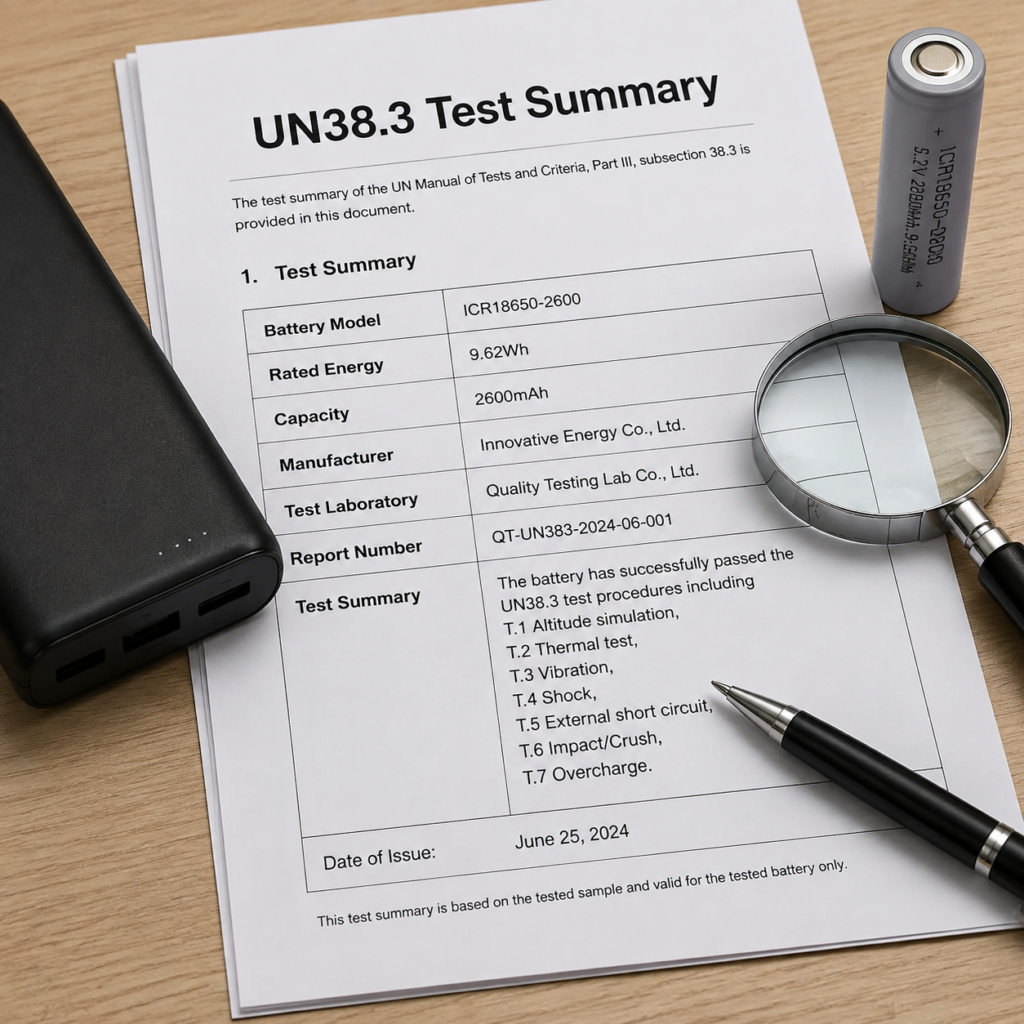
Knowing how to pass the test, here comes the most practical part: how to tell if a UN38.3 report is real or fake, and whether it is valid? After all, many merchants will claim that their products “have passed UN38.3”, but not that many can actually produce valid reports.
First of all, there are two types of UN38.3-related documents: one is the complete test report, which is very thick, contains all test data, and is generally kept by the manufacturer; the other is the Test Summary, which is concise and is the most commonly used document for daily verification and transportation declaration. What we ordinary users come into contact with is basically this summary.
Even if you don’t understand professional knowledge at all, you can eliminate 80% of fake reports by checking 4 core pieces of information: First, the battery model, rated energy (Wh), and capacity on the report must be completely consistent with those marked on the actual product and the product detail page, not a single word can be different; Second, the version on which the test is based and its applicability to actual transportation rules shall be verified. Old version test documents are not automatically invalid, but their acceptability shall be confirmed in combination with the cell/battery type, manufacturing time, rule transition clauses, and carrier requirements; Third, it shall be verified whether the test summary includes the manufacturer information, cell/battery model, test laboratory information, unique report number, and declaration that the test has been completed in accordance with applicable tests and meets requirements, etc. as required by the rules; Fourth, whether a signature, seal, accreditation mark, or specific wording is required shall be confirmed in accordance with the requirements of the carrier or destination.
If you want to go deeper and avoid more hidden pitfalls, you can check two more details: first, the test object must match the product — if it is a finished power bank, it shall be confirmed that the contained cells or batteries belong to the corresponding tested type. You cannot assume that the finished product’s transportation documents are complete just because the individual cells have reports; second, the sample description in the report must be consistent with the actual structure of the product, such as the number of cells and the model of the protection board. If they don’t match, the report is invalid.
Many people will ask: how long is the validity period of a UN38.3 report? The answer is: there is no fixed validity period. It only corresponds to the specific battery model and specification tested. As long as the battery itself does not change, the report remains valid. However, there are several situations where the applicability of the report needs to be re-evaluated: first, changes in battery capacity, cell supplier, or internal structure that may affect test results; second, bulging, liquid leakage, or damage of a single battery will not invalidate the report of the original model, but the damaged battery usually cannot be transported under ordinary lithium battery conditions; third, when the report is based on an old version of the standard, its acceptability shall be confirmed in combination with the cell or battery type, manufacturing time, rule transition clauses, and carrier requirements.
Common Misconceptions and Pitfall Avoidance Guide
Finally, we have sorted out several of the most common misconceptions about UN38.3, as well as pitfall avoidance methods for cross-border selection and shipping, to help you avoid detours.
Let’s first talk about a few cognitive pitfalls that are easiest to fall into:
First, and also the most common: having UN38.3 means a high-quality charging product. Let me emphasize again: UN38.3 is a transportation safety test, not a daily use safety certification. It cannot replace applicable product safety standards or prove the overall use safety, charging performance, and lifespan of the product based on it. Don’t be fooled by merchants who use UN38.3 as a “quality endorsement”.
Second, all charging products need to undergo UN38.3. That’s wrong. Products without lithium batteries, such as ordinary charging heads, charging cables, adapters, and hubs without batteries, do not need UN38.3 at all, because they have no safety risks related to lithium battery transportation.
Third, passing UN38.3 equals air transport permission. That’s wrong. Passing UN38.3 is only the basic prerequisite for air transport. You also need to meet the packaging requirements and power limits of air transport (for example, power banks under 100Wh can be carried with you, and those between 100-160Wh require airline approval). You can’t just ship or carry them freely just because you have a report.
Fourth, the 100Wh flight limit for power banks is required by UN38.3. That’s wrong. This is an energy limit regulation for international air transport, and has nothing to do with UN38.3. UN38.3 only manages safety performance, not the upper limit of transported power.
Fifth, being able to charge and having no damage to the appearance means the test is passed. That’s wrong. Many internal damages are invisible to the naked eye, such as micro-short circuits inside the cell. The appearance may be intact and it can charge normally, but it is very prone to problems during transportation. Formal laboratory test records shall prevail.
Let’s talk about report-related pitfall avoidance points: don’t believe reports that claim “lifetime validity” or “universal for all categories” — they are definitely fake. UN38.3 only corresponds to specific battery models and cannot be universal. Batteries of the same brand and same capacity but different models cannot share the same report either, because their internal structures may be different. In addition, reports that only test cells and not finished battery packs cannot be directly used for transportation declaration of finished products. This is a loophole many merchants exploit, so special attention should be paid.
If you are cross-border purchasing charging products with lithium batteries and want to confirm whether the product’s UN38.3 is valid, you can follow these three steps: first, ask the merchant to provide the UN38.3 test summary for the corresponding battery model, and do not accept vague statements such as “has certification”; second, carefully check the parameters on the summary to ensure they are completely consistent with those marked on the product detail page and the actual product nameplate, including model, rated energy, and capacity; third, if you have questions about the report, you can verify with the transport service provider you use, or an internationally recognized third-party laboratory.
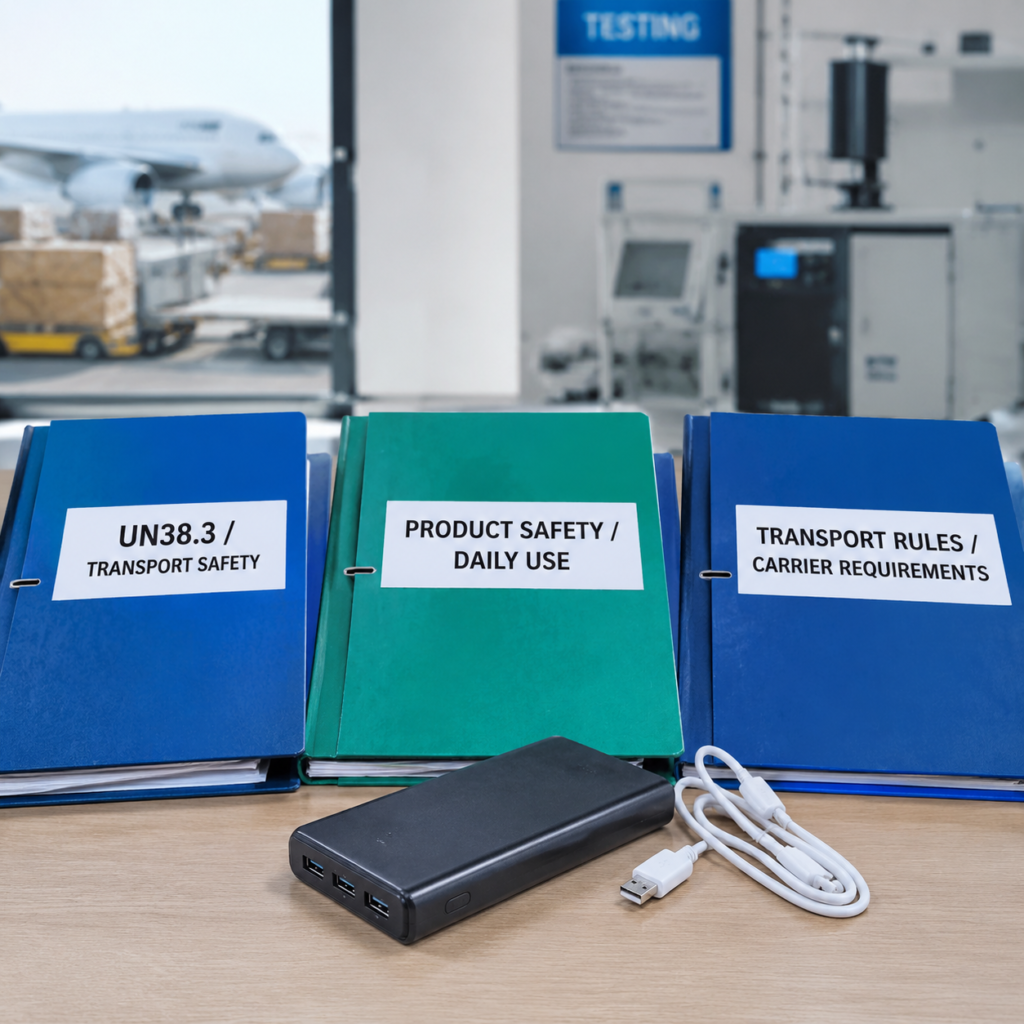
Overall, UN38.3 is a set of test standards for lithium battery transportation safety, closely related to cross-border shipping and selection of charging products. After reading this article, you should be able to quickly distinguish which charging products need to pass UN38.3, name the real scenarios corresponding to each of the 8 tests, understand the core information of UN38.3 reports and judge their validity, and avoid common marketing misconceptions of merchants about UN38.3. Finally, a reminder: UN38.3, daily charging safety certification, and transportation rules are three completely different things — UN38.3 only manages lithium battery safety during the transportation link, daily use safety depends on the corresponding product safety certification, and transportation rules are restriction requirements formulated by various transport channels. The three cannot be confused.