
Have you ever encountered situations like this: a magnetic power bank you bought via cross-border online shopping gets stuck at customs and is returned, a battery-powered charging base you brought on an international trip is stopped by security, or you want to send a power bank to a friend abroad but the courier directly refuses to accept it? Most of the time, this is not necessarily because the product has quality issues, but because its battery transport documentation, packaging, or declaration does not meet requirements. The UN38.3 lithium battery transport test is one of the items often required to be verified by transport parties, and it is especially relevant for overseas users who frequently shop cross-border or travel.
First, Understand the Basics: What Exactly is UN38.3?
In plain terms, UN38.3 is the lithium battery design type test requirement in the United Nations Recommendations on the Transport of Dangerous Goods: Manual of Tests and Criteria. It has been adopted by many dangerous goods transport regulations for air, sea, and land transport. Applicable lithium battery cells or batteries usually need to meet the relevant design type test requirements, but whether they can actually be transported also depends on compliance with regulations on transport mode, packaging, labeling, quantity, and declaration at the same time.
Its core function is to assess whether lithium battery cells or batteries will pose hazards under environmental, mechanical, and electrical abuse conditions that may be encountered during transport, such as leakage, venting, disintegration, rupture, fire, or explosion. It is not a quality certification specifically for a certain type of complete charging product, nor is it equivalent to a product’s daily use safety certification.
For ordinary charging product users, its impact is mainly reflected in three scenarios: First, when shopping for or mailing charging products with batteries cross-border, the transport party may require relevant documentation, and non-compliant products may be detained or returned. Second, when carrying them on international trips, whether they can be brought on the plane depends on air dangerous goods regulations, airline policies, airport security, and destination regulations. Third, unbranded, unmarked charging products with batteries are often difficult to confirm battery parameters and transport documentation for, and may be rejected by couriers and cannot be transported cross-border.
Several Easily Confused Concepts
Many people mix up UN38.3 with related concepts. Let’s first clarify the core differences:
| Name | Core Position | Application Scenario |
|---|---|---|
| UN38.3 | Lithium battery design type transport test requirement | To determine whether cells or batteries meet relevant transport safety requirements |
| UN Number | Lithium battery transport classification code | Category identifier printed on packaging or transport documents, to help transport parties identify product categories |
| CE | Conformity mark when EU regulations apply | Indicates that the manufacturer declares the product meets applicable EU regulatory requirements |
| FCC | Requirements applicable in the US for radio frequency and electromagnetic compatibility, etc. | Mainly involves radio frequency and electromagnetic interference requirements for relevant electronic equipment |
| UL, etc. | Usually voluntary third-party safety certification or testing | Used to evaluate whether specific products meet corresponding safety standards |
First is the difference between UN38.3 and UN numbers: UN38.3 is a set of transport test requirements; UN numbers are transport classification codes. For example, lithium-ion power banks transported alone usually correspond to UN3480, and lithium-ion batteries installed in equipment or transported with equipment usually correspond to UN3481. The two are completely different things. Whether it is necessary to mark the packaging and how to mark it also depends on applicable transport regulations and packaging conditions.
Second is the difference between UN38.3 and requirements such as CE, FCC, and UL: CE is a conformity mark when EU regulations apply, FCC mainly involves radio frequency and electromagnetic compatibility requirements applicable in the US, and UL is usually a voluntary third-party safety certification or test. They are different from the transport test requirements of UN38.3 and cannot replace each other. Even if a power bank has UL certification, it does not mean it automatically meets UN38.3 or other lithium battery transport requirements.
Another pair that is easily confused is test reports and test summaries. A test report usually records specific test conditions, sample information, and test results; a test summary is content provided in accordance with relevant regulatory requirements, used to explain the battery design type test and product information. The test summary can be provided by the manufacturer or relevant responsible entity, and is not necessarily just a simple abbreviation of the full report from a third-party laboratory.
Transport carriers may require test reports, test summaries, or other declaration documents. It cannot be generally assumed that only a summary is needed and a full report is not required for transport. Which documents are actually needed should be determined according to the carrier, transport mode, and destination regulations.
Applicable Boundaries: Does Your Charging Product Need to Comply with UN38.3?
After clarifying the basic concepts, what everyone is most concerned about is definitely whether the product in their hand needs to meet the requirements. We will explain it in three categories.
Charging Products That Must Meet Relevant Requirements
All charging-related products with built-in lithium batteries usually need to have their battery UN38.3 design type test and transport conditions verified in accordance with applicable transport regulations. The most common ones are mobile power supplies, that is, power banks; there are also portable chargers with built-in lithium batteries, wireless chargers, magnetic power banks; USB-C charging bases with lithium batteries, multi-port charging hubs with batteries; in addition, replacement lithium battery packs for charging equipment sold separately also need to be handled in accordance with applicable rules.
Charging Products That Do Not Need to Comply with UN38.3
The first category is wall plug chargers, power adapters, and charging cables without batteries. These products do not have lithium batteries themselves and are not subject to UN38.3 lithium battery design type tests.
The second category is certain small lithium batteries. Under specific transport clauses, they may enjoy partial exemptions in terms of packaging, labeling, or declaration, but it cannot be simply assumed that “small capacity exempts from UN38.3”. Whether exceptions apply depends on the battery type, whether it is installed in equipment, transport mode, and specific special clauses.
The third category is charging products with non-lithium batteries, such as older power banks using nickel-metal hydride batteries. Such products are not subject to UN38.3, but this does not mean they are completely free from other battery transport regulations.
Special Cases Where Passing the Test Still Does Not Allow Ordinary Transport
Even if the battery used in the product has passed the applicable UN38.3 design type test, it does not mean it can be transported as ordinary goods at any time. If the battery is damaged, swollen, leaking, has other defects, or belongs to a recalled batch, it cannot be treated as an intact battery.
Such products should first stop being transported, and the carrier and competent authority should be consulted to handle them in accordance with applicable regulations for damaged, defective, or recalled batteries. Especially in air transport, some damaged, defective, or recalled lithium batteries may be prohibited from transport.
How Strict Is Compliance? It Mainly Depends on These 4 Factors
Even for lithium batteries, the requirements for different products and transport scenarios may vary, mainly affected by the following four factors.
1. Battery Chemistry Type
Among the charging products we usually use, the most common are lithium-ion batteries, including common lithium polymer batteries, that is, pouch batteries. They are usually rechargeable batteries.
The other type is lithium metal batteries, most of which are disposable and relatively rare in charging products. The transport classification, test application scope, and transport conditions of lithium-ion batteries and lithium metal batteries are different, and they cannot be confused.
Special note here: Lithium polymer batteries usually fall into the category of lithium-ion batteries, and there is no completely independent set of UN38.3 transport rules just because they adopt the “polymer” form.
2. Transport Form
Whether the battery is transported alone, packaged with equipment, or already installed in equipment usually corresponds to different UN numbers, packaging instructions, quantity limits, and transport conditions.
For example, power banks or spare batteries transported alone usually belong to the category of batteries transported alone; if transported in the same box as equipment, or already installed in equipment, another set of transport clauses may apply. But the three forms cannot be simply sorted as “strictest, second, most lenient”, because the UN38.3 design type test itself does not automatically change just because of different packaging forms. Specific requirements also depend on the transport mode and battery parameters.
3. Core Parameter: Watt-hour (Wh)
Many people are used to using mAh, that is, milliampere-hours, to judge battery capacity, but the important parameter in transport is usually watt-hour (Wh), which represents the total energy of the battery.
The calculation method is:
Rated voltage × Rated capacity (convert mAh to Ah by dividing by 1000)
For example, for a battery pack with a rated voltage of 3.7V and a rated capacity of 10000mAh, the energy is approximately:
3.7 × 10 = 37Wh
Why can’t we directly use mAh to judge? Because batteries with different voltages may have different total energy even if the mAh is the same. It should be noted that the 5V marked on power banks is usually the USB output voltage, not the rated voltage of the cell or battery pack. The USB output voltage of 5V cannot be directly used to calculate battery energy, otherwise it may be overestimated or miscalculated.
When making actual transport declarations, the rated Wh marked by the product or battery manufacturer shall prevail, and the battery rated capacity and the capacity at the USB output end shall be distinguished. Carry-on boarding restrictions and many express transport requirements also use Wh as an important judgment basis.
4. Test Coverage Objects
UN38.3 test objects can usually be divided into three types:
The first is the cell, which is the smallest energy storage unit of the battery, such as the cylindrical cell or pouch cell in a power bank;
The second is the battery pack, which is a combination of cells plus a protection board, casing, etc. Common power banks usually belong to this level;
The third is the complete machine, that is, the product where the battery has been installed in the casing of the final charging product, such as a wireless charger or charging base with a battery.
Here is a key point: Cell test documentation cannot alone replace the compliance certification required for battery packs or complete machines. For example, if a merchant says “the cells we use have passed UN38.3”, this only means that a certain cell design type may have completed relevant tests, and does not mean that the entire power bank after being put into a casing and equipped with a protection board automatically meets all transport requirements.
8 Core Tests, All Simulating Real Transport Risks
Many people are curious about what exactly UN38.3 tests. Its test items mainly simulate risks such as air pressure, temperature, vibration, shock, short circuit, and charge-discharge faults that may be encountered during transport.
It should be particularly noted that the actually applicable test combination shall be determined according to the chemical system of the lithium battery, rechargeable attribute, cell or battery category, and the UN38.3 version adopted. The 8 tests cannot be understood as unconditionally applicable to all lithium battery products. Rechargeable lithium-ion batteries usually involve T1 to T8; lithium metal batteries should not simply apply T7 and T8; for T6, the applicable impact or crush procedure shall be selected in accordance with regulations.
Environmental Adaptation Category: Corresponding to Temperature and Pressure Change Scenarios
These tests simulate air pressure and temperature changes that may be encountered during transport, such as low air pressure during airplane flight, and alternating hot and cold during cross-regional transport.
- Altitude Simulation Test (T1): Simulates a low-pressure environment, checks whether hazards such as leakage, venting, disintegration, rupture, or fire occur after pressure changes, and verifies whether the voltage or mass change before and after the test exceeds the specified limit when applicable. It should be noted that passing this test does not mean the battery can withstand all high-altitude extreme environments. For example, using it in extremely high altitude areas is not within the full coverage of this transport test.
- Temperature Cycle Test (T2): Simulates repeated exposure to high and low temperatures during transport, checks whether problems such as leakage, venting, disintegration, rupture, or fire occur after temperature changes, and verifies corresponding judgment conditions such as voltage and mass in accordance with standards. It is not a simple test of whether the product can be used for a long time in any desert or cold region environment.
Mechanical Resistance Category: Corresponding to Bump and Collision Scenarios
These tests simulate continuous vibration, instantaneous shock, and external extrusion during transport.
- Vibration Test (T3): Simulates long-term continuous bumps during express delivery and freight transport, checks whether leakage, venting, disintegration, rupture, or fire occur after the test, and verifies applicable change conditions such as voltage and mass according to standards.
- Shock Test (T4): Simulates instantaneous shock during loading, unloading, and transport, checks whether the battery has leakage, venting, disintegration, rupture, or fire, etc. This test has different purposes and conditions from ordinary product drop tests, and cannot replace each other — it is not that “a power bank that is fine after being dropped” is equivalent to passing T4.
- Impact/Crush Test (T6): Simulates the risk of internal short circuit caused by cargo stacking, heavy object impact, or extrusion, checks whether hazards such as fire or explosion occur. The applicable procedures for cells and battery packs may be different, and usually one applicable procedure between impact and crush shall be selected in accordance with standards, and the two cannot be simply summarized as a fixed combination.
Electrical Safety Category: Corresponding to Circuit Fault Scenarios
These tests simulate circuit faults such as short circuit, overcharge, and forced discharge. The applicable tests for different chemical systems and battery categories are not exactly the same.
- External Short Circuit Test (T5): Simulates the scenario where the positive and negative electrodes of the battery are accidentally connected by a conductive object, to verify whether dangerous temperature rise or other failures occur under short circuit conditions. When tested under specified external short circuit conditions, the external temperature of the battery shall not exceed the specified limit, and shall not disintegrate, rupture, or catch fire during the test and within the specified observation time. 170°C is one of the specified judgment conditions for the external temperature of the battery in the test, and should not be generally understood as a general “safety threshold” for all product casings. Having a protection board does not mean it will definitely pass, and actual testing is still required according to applicable conditions.
- Overcharge Test (T7): Mainly used for applicable rechargeable lithium-ion batteries, simulates the situation of charging control failure or overcharging, checks whether hazards such as disintegration, rupture, or fire occur. The charging management design of the charger itself cannot replace this standard test.
- Forced Discharge Test (T8): Mainly used for applicable rechargeable lithium-ion batteries, simulates the fault where one cell in a multi-series battery pack is reversely discharged by other cells, checks whether disintegration, rupture, or fire occurs. Lithium metal batteries should not simply apply T8, as their test application scope and requirements are different.
Therefore, the 8 tests cannot be simply said to be required to be completed item by item for all lithium batteries. To judge whether a set of documentation is complete, it depends on the corresponding battery chemical system, rechargeable attribute, cell or battery category, and the test requirements in the applicable standard version.
How to Judge Whether UN38.3 Documentation Is Valid?
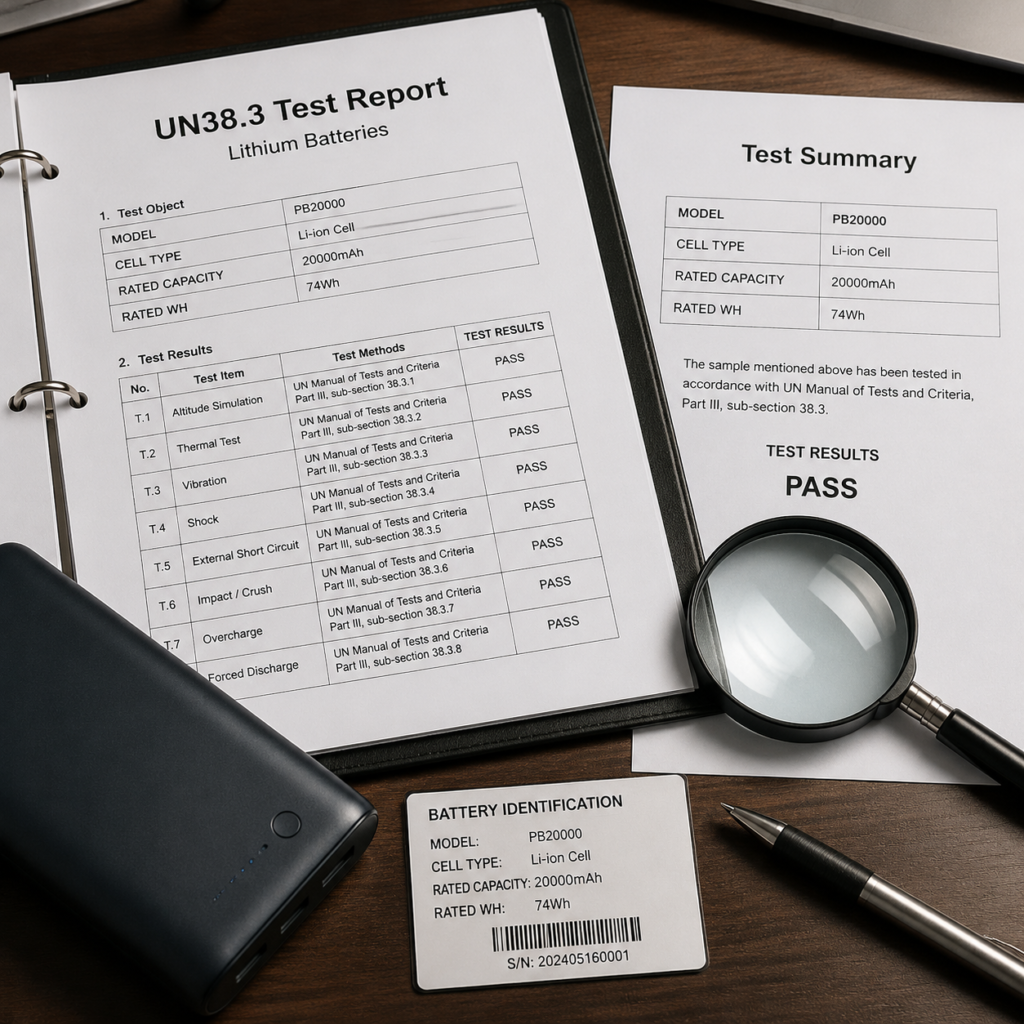
Now many merchants will say that their products “have passed UN38.3”, but how to judge whether this documentation actually covers the product in hand? You can check from several core dimensions.
There Are Two Types of Core Compliance Vouchers
UN38.3 related documentation mainly includes full test reports and test summaries.
A test report usually records specific sample information, test conditions, test process, and results; a test summary is content provided in accordance with relevant regulatory requirements, used to explain the battery design type test and product information. The test summary can be provided by the manufacturer or relevant responsible entity, and does not necessarily have to be issued by a specific internationally accredited laboratory.
If it is a small amount of charging products with batteries for personal use, generally you will not actively submit full test documents when purchasing, but whether you need to provide documentation to the carrier still depends on the regulations of postal services, express delivery, airlines, and destinations. Bulk or commercial transport usually requires submission of corresponding declaration or compliance documentation in accordance with the carrier and applicable regulations.
4 Key Points for Validity Check
When checking, don’t just look at whether the words “UN38.3” are on the report, but confirm the following content:
- Product information matches the design type: The report or test summary shall clearly cover the product model or model range actually transported. Focus on checking the cell, battery pack or complete machine level, chemical system, rated capacity, rated Wh, series-parallel structure, and protection design. The model or brand text does not necessarily have to be identical word for word, but the actual product must belong to the design type and scope clearly covered by the document.
- The test combination is applicable and the results meet the requirements: It shall be confirmed that the test is completed in accordance with the applicable UN38.3 version, and all applicable test items have been completed and meet the judgment conditions. It is not possible to mechanically require all lithium batteries to complete the same 8 tests; the applicable items for lithium-ion, lithium metal, cells, and battery packs may be different.
- Test and quality management requirements are traceable: It shall be confirmed that the test is completed in accordance with the applicable UN38.3 version, relevant quality management requirements, and actual product design. Whether it must be issued by a specific accredited laboratory, and whether the transport party accepts reports, summaries, or other documents, shall be subject to the requirements of the competent authority, transport mode, and carrier. ILAC or CNAS accreditation may help prove laboratory capability, but it does not mean that all countries and carriers will automatically accept the document.
- Test object matches: Whether the report covers cells, battery packs, or complete machines must be consistent with the level and design of the actually transported product. A cell report cannot replace the compliance certification required for battery packs or complete machines, but it cannot be simply said that the cell report itself is “invalid”; the key is whether it is correctly used for the objects it covers.
Common Situations of Changes in Report Applicability
Many people think that UN38.3 reports have a fixed validity period, but in fact, UN38.3 usually does not have a unified fixed validity period. However, whether a report is still applicable depends on the product design, the version of the test basis, and actual transport regulations.
If the following situations occur, the manufacturer or a qualified testing institution shall re-evaluate, and supplementary tests shall be conducted if necessary:
- Safety-related changes in cell supplier, chemical system, rated capacity, or series-parallel mode;
- Obvious changes in protection circuits, casing structure, battery installation method, etc.;
- The actual product no longer belongs to the design type clearly covered by the original report or test summary;
- UN38.3 or related transport regulations are revised, and requirements need to be implemented in accordance with the new version.
Standard version updates will not automatically invalidate existing reports in all cases. When encountering version revisions, the implementation date, transition arrangements, and destination transport regulations of the new rules shall be checked.
Passing the Test Is Not Enough: Transport Supporting Requirements
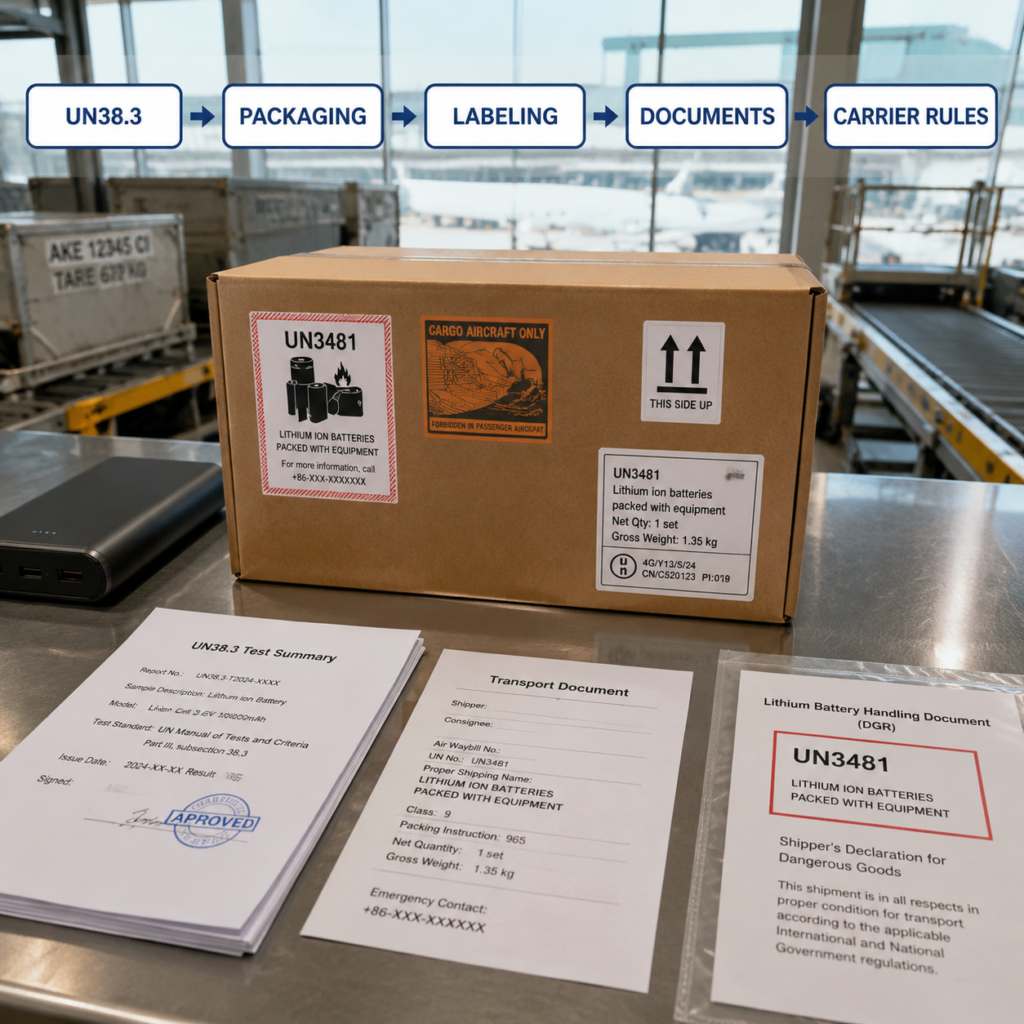
Even if the battery used in the product meets the applicable UN38.3 design type test, it cannot be mailed casually. The transport link also needs to meet corresponding packaging, marking, labeling, quantity, and declaration requirements according to the transport mode and battery category.
Corresponding Correct UN Number
Common classifications include:
- Lithium-ion power banks or spare lithium-ion batteries transported alone usually correspond to UN3480;
- Lithium metal batteries transported alone usually correspond to UN3090;
- Lithium-ion batteries installed in equipment or transported with equipment usually correspond to UN3481;
- Lithium metal batteries installed in equipment or transported with equipment usually correspond to UN3091.
However, whether the UN number needs to be directly marked on the packaging cannot be judged without specific rules. The requirements for packaging marks, lithium battery marks, hazard labels, and transport documents are affected by battery category, quantity, packaging instructions, transport mode, and applicable exemption clauses. Filling in the wrong number or category may result in carrier rejection, delay, or detention.
Packaging and Labeling Requirements
In all cases, measures to prevent short circuits and accidental damage shall be taken. For example, spare batteries should avoid electrode contact with metal objects, and insulating materials or independent packaging should be used if necessary; products should also take measures to avoid extrusion or accidental activation during transport.
As for whether it is necessary to use lithium battery marks, Class 9 hazard labels, cargo aircraft only marks, and contact information, it shall be determined according to the specific UN number, packaging instructions, quantity, transport mode, and applicable exemption clauses. It cannot be generally assumed that all packages must be affixed with both Class 9 labels and cargo aircraft only marks, nor can it be assumed that all transport modes uniformly require filling in an “emergency contact person” on the packaging.
If the rules require filling in the contact information of the manufacturer, shipper, or carrier, it shall also be filled in in accordance with the specified format and position. Specific packaging and labeling requirements shall be subject to the operating rules of the actual carrier.
Additional Requirements for Different Transport Modes
Air transport usually has stricter requirements on the energy, quantity, packaging, and declaration of lithium batteries; the specific conditions for sea and land transport may be different, but they still need to comply with corresponding transport regulations. Different express companies, airlines, and postal institutions may also set stricter internal regulations, such as limiting the quantity per shipment, energy, or transport routes.
Therefore, you cannot judge whether it can be sent only by “passing UN38.3”. You should also confirm the battery type, rated Wh, packaging method, labeling, and document requirements accepted by the carrier before sending.
Common Misconceptions and Practical Pitfall Avoidance Guide
Having talked about so many rules, what everyone is most likely to stumble on are several cognitive misconceptions, as well as problems in actual scenarios.
Clarification of 6 High-Frequency Cognitive Misconceptions
- With CE/FCC/UL, UN38.3 is not needed: Wrong. CE, FCC, UL and UN38.3 have different application scopes and cannot replace each other.
- UN38.3 represents good product quality: Wrong. It mainly involves the safety of lithium batteries under specified transport test conditions, and does not represent product performance, durability, or charging speed.
- All chargers need to do UN38.3: Wrong. Ordinary wall plug chargers, power adapters, and charging cables that do not contain lithium batteries are not subject to UN38.3 lithium battery tests; charging products with lithium batteries need to be verified in accordance with applicable transport regulations.
- Small-capacity power banks do not need to comply with UN38.3: This cannot be judged this way. Certain small batteries may enjoy partial exemptions in packaging, labeling, or declaration, but small capacity does not automatically exempt from the UN38.3 design type test. Whether exceptions apply depends on the battery type, transport mode, and specific clauses.
- UN38.3 reports have a fixed validity period: Wrong. UN38.3 usually does not have a unified fixed validity period, but when product design, test basis version, or transport regulations change, the original documentation may need to be re-evaluated.
- Passing UN38.3 means you can send it casually: Wrong. Passing the test is only part of transport compliance, and it also needs to meet requirements such as packaging, quantity, energy, labeling, declaration, and carrier policies.
Pitfall Avoidance Guide for Three Common Scenarios
Pitfall Avoidance for Cross-Border Shopping of Charging Equipment
Before purchasing, confirm with the merchant and the actual carrier first whether they can provide the UN38.3 test summary or other required documents accepted by the transport party. Don’t just require “ILAC-accredited reports”, because the test summary does not necessarily have to be issued by an ILAC-accredited laboratory, and ultimately it depends on what documents the carrier and destination regulations accept.
Prioritize choosing regular brands and products with complete information, and confirm that necessary information such as battery category and rated Wh can be found on the packaging or product labels. Whether the UN number and lithium battery mark on the packaging are needed and how to use them shall also comply with actual transport regulations.
If the product is detained by customs or the carrier, submitting a test summary or other documents may help with the review, but it does not guarantee release. Whether it is released also depends on the product status, declaration situation, destination regulations, and the carrier’s decision.
Pitfall Avoidance for Carrying on International Trips
Before traveling, check ICAO/IATA regulations, airline policies, airport security, and destination regulations at the same time.
Carry-on power banks are spare lithium batteries and usually must be placed in carry-on luggage, not in checked luggage. Power banks with a rated Wh of no more than 100Wh usually do not require prior approval from the airline, but may still be subject to restrictions on quantity, short-circuit protection, and the carrier’s internal regulations. When exceeding this value, it is usually necessary to confirm with the airline in advance, and some batteries with higher energy may not be accepted.
Whether devices such as battery-powered charging bases and portable chargers can be checked in cannot be judged only by whether the packaging is compliant, but also by the device type, whether it is completely turned off, whether the battery is removable, and airline regulations. When you cannot confirm, putting them in carry-on luggage is usually safer, but you should still comply with the airline’s requirements.
Ordinary charging cables and wall plug chargers without lithium batteries are not subject to UN38.3; whether they can be carried on or checked in shall still comply with the luggage regulations of airlines, airport security, and destinations.
Pitfall Avoidance for Personal Mailing of Charging Equipment
Do not mail charging products with batteries that are unbranded, unmarked, or whose battery parameters cannot be confirmed. Even if such products have small capacity, they may be rejected because the declaration cannot be completed or compliance with transport requirements cannot be proven.
Before mailing, confirm the required documents, packaging, quantity, and battery parameters with the actual express, postal, or freight carrier. Personal use and small capacity do not automatically exempt from applicable transport regulations, nor can it guarantee that no other documents are needed as long as the packaging is compliant.
Try to choose regular channels, keep product model, rated Wh, and battery documentation, to avoid being detained during transit due to incomplete declaration information. Providing a test summary or other documents may help the carrier and customs review, but it does not guarantee customs clearance or release.
Final Summary
Overall, UN38.3 is not a one-size-fits-all product certification, but a lithium battery design type test requirement in the United Nations Recommendations on the Transport of Dangerous Goods: Manual of Tests and Criteria. It mainly focuses on the safety performance of lithium batteries under transport environment, mechanical shock, and electrical fault conditions. Specific transport also needs to meet corresponding transport mode, packaging, labeling, quantity, and declaration regulations at the same time.
After reading this content, you should be able to quickly judge whether the charging product in your hand involves UN38.3, distinguish the difference between it and requirements such as UN numbers, CE, FCC, UL, etc., and not be misled by publicity like “with certification you can send it casually”; you can also understand that different lithium battery types and test objects do not necessarily apply exactly the same test combination.
When shopping cross-border, traveling, and mailing charging products with batteries, confirming the rated Wh, transport form, carrier requirements, and necessary documentation in advance is more important than just looking at a “UN38.3 report”.