
If you often buy charging products, or engage in cross-border e-commerce in Southeast Asia, you must have heard of “SIRIM certification” — many people say it is the “entry ticket” to the Malaysian market, and products cannot be sold without it. But is that really the case?
In fact, many people have a misunderstanding of SIRIM certification: it is not a single certificate, nor is it a mandatory requirement for all charging products. Even having it alone is not enough to legally sell mains-connected chargers in Malaysia. Today, from the perspective of charging products, we will clearly explain SIRIM certification, related regulatory requirements, judgment methods, and key points to avoid pitfalls. Whether you are an ordinary consumer or a cross-border seller, you can understand and apply this information.
1. First, get the basics straight: What exactly is SIRIM certification?
First of all, it should be clarified that the “SIRIM certification” we commonly refer to is a product conformity certificate issued by SIRIM QAS, a certification body under the Standards and Industrial Research Institute of Malaysia. However, for mains-powered charging products, market access involves ST regulation, the CoA (Certificate of Approval) issued by ST, and corresponding labels — it is not sufficient to only have SIRIM certification. This is the core point that most people easily get wrong.
For electrical equipment under ST regulation, it is usually mandatory to first obtain the ST CoA, and complete the required labeling, registration or import procedures. The test report, CB report, SIRIM registration or independent SIRIM product certification required for CoA applications depend on the product category and current application scheme. Not all products are required to obtain independent SIRIM product certification.
Many people also confuse several types of similar compliance documents. In fact, there are four core compliance documents related to charging products in Malaysia, with completely different functions: SIRIM test report, SIRIM product certification, ST CoA (Certificate of Approval), and related SIRIM registration or compliance labels. We will compare their differences in detail later.
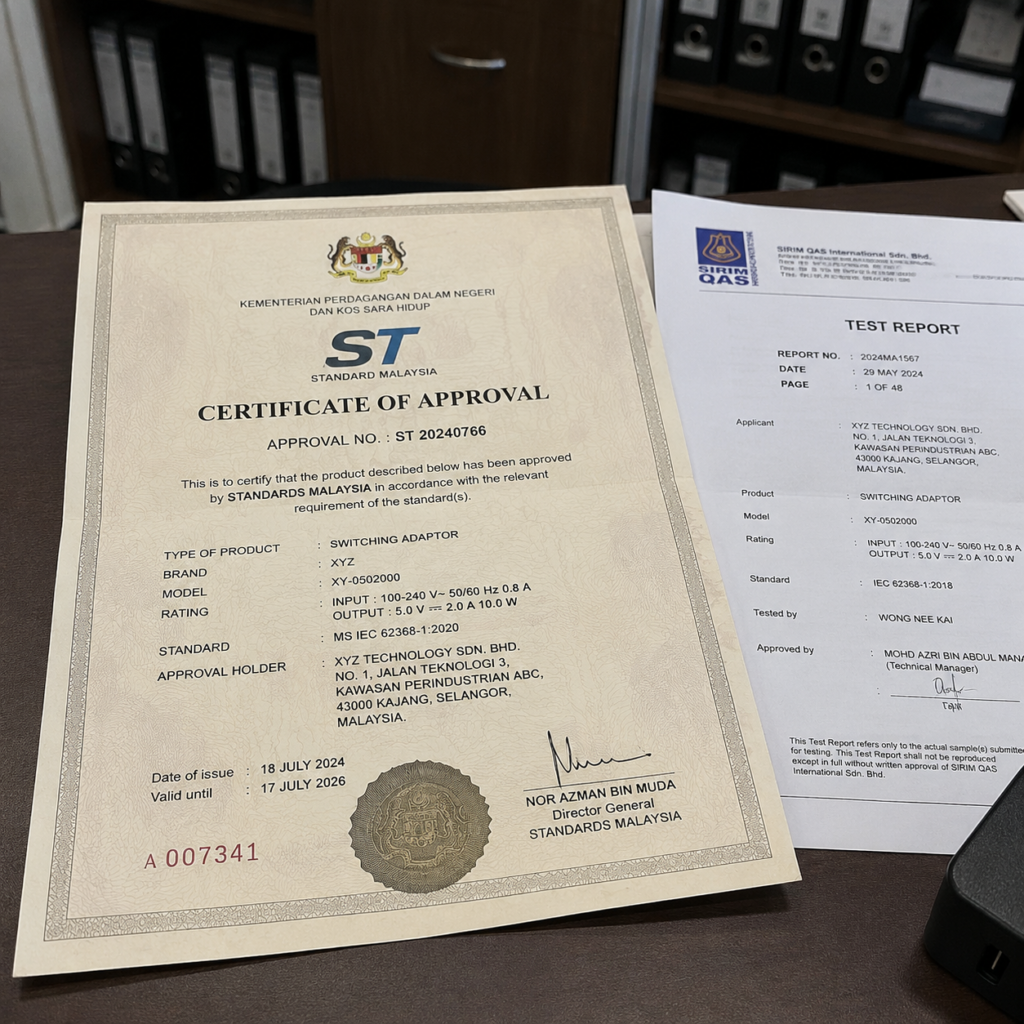
To understand the relationship between these documents, you must first know the three departments that regulate charging products in Malaysia, with completely different divisions of labor:
• ST (Energy Commission of Malaysia): It is the competent authority for charging products, responsible for safety supervision, access approval and law enforcement of regulated electrical equipment. Simply put, whether a product falls under ST regulation and whether it requires a CoA usually depend on its provisions.
• DSM (Department of Standards Malaysia): It is mainly responsible for formulating national standards and coordinating the standard system, and does not directly administer market access approval. It is equivalent to the “rule-maker”, but not the “gatekeeper”.
• KPDN (Ministry of Domestic Trade and Cost of Living of Malaysia, formerly Ministry of Domestic Trade and Consumer Affairs): It may handle false or misleading publicity in accordance with applicable consumer protection, trade description and other laws. Specific responsibilities and penalties depend on the facts of the violation and applicable provisions. It is not the regular competent authority for electrical safety.
So what is the role of SIRIM certification for charging products? There are two scenarios:
For products on the ST regulation list, a valid CoA must be obtained before import, manufacture or sale, and required labeling, registration or other procedures must be completed. The required form of SIRIM testing, registration or certification shall be confirmed according to the product category and current ST procedures. Related advertisements and publicity must also comply with Malaysian consumer protection, trade description and anti-false publicity regulations.
For products not on the ST regulation list, SIRIM certification is usually a voluntary application. Obtaining it can enhance market trust and serve as a reference mark for consumers to judge electrical safety, but it is not the only reference, nor is it a mandatory requirement.
2. Do charging products need certification? You can judge by these dimensions
First of all, remember a core principle: all judgments must ultimately be based on ST’s latest regulation list, product classification and official interpretation, because the list may be updated, and empirical judgment can only be used as a reference.
Preliminary judgment can be made from four dimensions:
1. Whether it is connected to the Malaysian mains supply (nominal 230V, 50Hz; the specific voltage range shall be subject to local power supply standards and product applicable standards): Products such as chargers and power adapters directly connected to the Malaysian mains supply are categories that require priority verification. However, whether they are ultimately regulated by ST must be confirmed against ST’s latest list of regulated electrical equipment and specific product classification.
2. Whether it is sold independently: For example, separately sold fast charging heads and separately sold wireless charging bases need to be evaluated for compliance requirements separately; if the power supply is sold bundled with mobile phones or laptops, there may be different rules, but you cannot directly assume exemption.
3. Whether it contains wireless communication functions: If the charger has wireless communication functions such as Bluetooth and Wi-Fi, in addition to electrical safety requirements, the radio equipment certification requirements of MCMC (Malaysian Communications and Multimedia Commission) must also be additionally evaluated.
4. Import/sales purpose: If it is for commercial batch import and sale, you must apply in accordance with regulations; if it is for personal use brought into the country, or samples for testing and display, there may be exemptions, but they are not automatically effective and must be verified in advance.
Combining these dimensions, the compliance attributes of common charging products can be used as a general reference:
• Mains input category: For example, wall chargers with non-detachable Type G British standard plugs, USB-C fast charging heads and other products directly connected to the mains are categories that require priority verification of ST regulation attributes. The final requirements shall be subject to the ST list and specific classification.
• Non-mains input category: That is, charging products that are not directly connected to the Malaysian mains supply are usually not within the scope of ST’s mains regulation, but may still involve other safety, labeling or product requirements.
• Wireless charging category: It needs to be judged by scenario. In the most common “mains adapter + wireless charging base” set, the adapter is a mains input product, and its compliance requirements must be evaluated separately as a mains product, not just based on the base.
Many people ask about exemption situations. It should be clarified here that all exemptions are not automatically effective. You must verify the applicable conditions, quantity limits, and whether prior approval is required. There are several common exemption scenarios:
• Carried into the country for personal use: Usually only applies to a reasonable quantity for personal use. Malaysian regulations do not establish a generally applicable fixed judgment standard based on “two or three” or “a dozen”. The specific quantity and whether prior approval is required should be verified with ST and customs.
• Non-sale samples for testing and display: Corresponding proof of use is required, and in some cases, a temporary import permit is required — you cannot send them casually.
• Built-in power modules supplied with the whole machine: For example, the charging module in a mobile phone, or a charger sold with a mobile phone, you cannot infer exemption just because of “bundled sales”. You must confirm whether the ST CoA of the whole machine covers this power supply/charger. If not, you still need to confirm separately and go through corresponding procedures.
Exemptions or special permits for personal use, testing or display are usually accompanied by conditions such as purpose, quantity and prohibition of sale. Without explicit permission from the competent authority, they shall not be used as commercial sales inventory or for profit-making purposes.
3. Test and label requirements: What exactly is checked, and what is not?
Many people think that certification testing is to test how fast charging is, but the focus is not on the “charging experience” that consumers refer to — electrical safety testing mainly checks safety requirements. Moreover, test items are not fixed, and will be adjusted according to product type, applicable standards, and certification scheme. Not all products need to be tested for all items.
Common test items fall into several categories:
• Input terminal tests for mains products: For example, whether the plug size and fuse meet local standards, insulation withstand voltage — simply put, whether the insulation layer can withstand high voltage without leakage — and electric shock protection, etc., all intended to prevent danger when plugging in.
• Output terminal tests for products with low voltage output: For example, whether the output voltage and current exceed safety limits, and whether there is a risk of high voltage entering the output terminal, i.e. ensuring you will not be exposed to mains danger when plugging in your mobile phone.
• General test items: No matter what charging product, it may involve tests such as temperature rise, abnormal operation or short circuit, mechanical strength, and shell flame retardancy. They mainly check whether the product will overheat, catch fire, or cause electric shock during normal or abnormal operation, and whether the shell will crack and expose live parts after falling or squeezing.
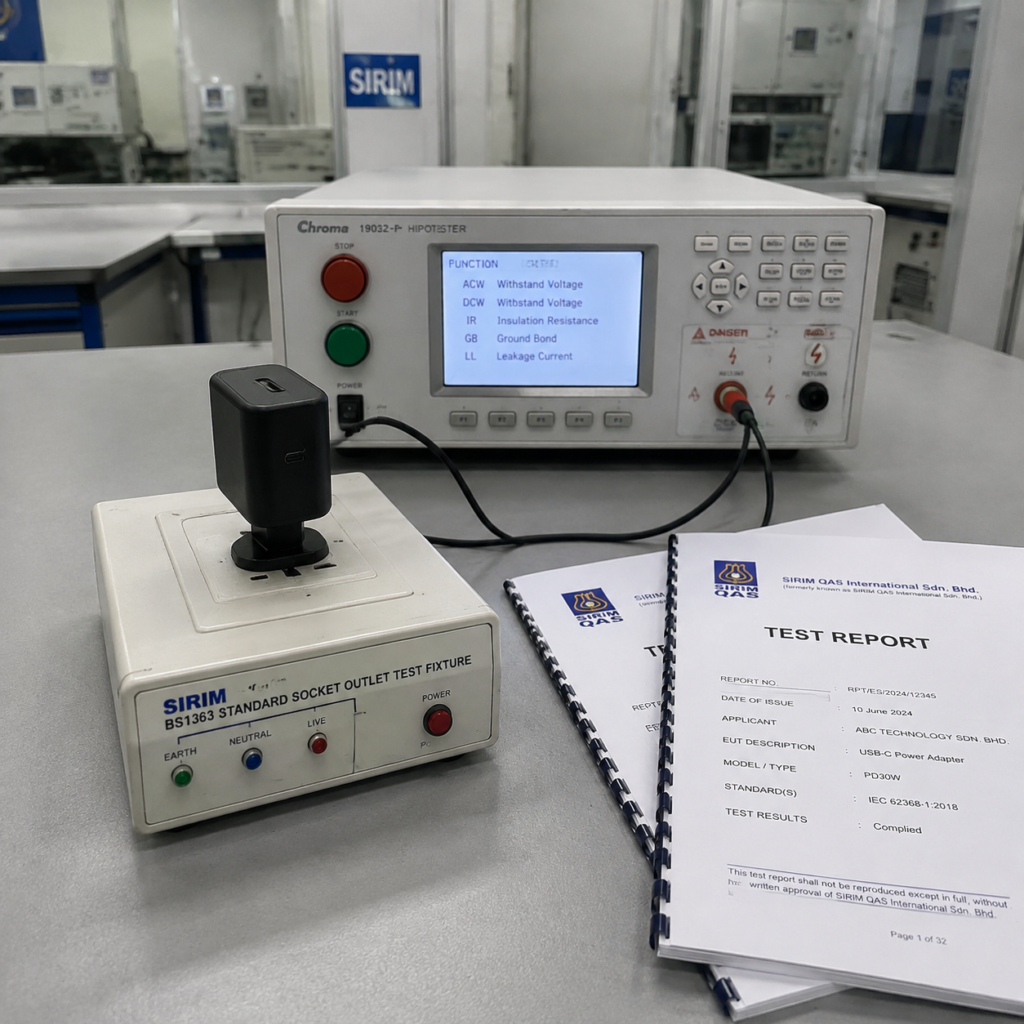
The core of SIRIM safety certification is the safety requirements specified in applicable standards, and it usually does not endorse the charging speed or complete fast charging experience as consumers describe it. Whether specific output characteristics, protocols or compatibility items are tested shall be subject to applicable standards and test schemes. Therefore, having certification does not mean charging is necessarily fast, nor does it mean it is necessarily compatible with all mobile phones or laptops.
In addition to electrical safety, some charging products with circuits also need to test EMC (Electromagnetic Compatibility). Simply put, it means the product will not cause undue interference to other electrical appliances when operating, and will not malfunction due to interference from other equipment. EMC is another technical compliance requirement alongside electrical safety. Whether testing is required and applicable standards shall be confirmed according to product type, function and related regulatory requirements.
In addition, many people confuse wireless charging with radio certification. Products that only have the common Qi near-field power supply function and do not contain communication wireless modules such as Bluetooth and Wi-Fi are generally not subject to MCMC type approval as communication equipment; if they contain other wireless functions, or their transmission parameters fall within the applicable scope of MCMC, separate confirmation is still required.
Another easily overlooked point is energy efficiency requirements, but not all charging products need them — only charging products listed in Malaysia’s energy efficiency regulation list need to comply. Specific requirements and involved categories shall be subject to ST’s current energy efficiency rules.
Marking on the product body is also part of compliance. Usually, the following information needs to be marked: product model, rated input/output parameters, manufacturer or country of origin. The SIRIM mark, SIRIM registration label or other compliance labels that people often see have different usage rules according to different certification schemes and product categories, and cannot be printed casually.
There are many types of numbers on labels, such as certification numbers, registration numbers, batch numbers, and there is no unified format. You cannot say “if there is no certain number, it is fake”. The language, content and position of labels and warning statements must comply with applicable ST regulations, product standards and Malaysian labeling regulations; specifically, it shall be confirmed according to the corresponding product category whether Bahasa Malaysia, English or bilingual is required.
4. The relationship between various compliance documents, and can foreign certifications be used?
Many people cannot tell the difference between the four core compliance documents. Let’s sort out their relationship with a table:
| Compliance Document Type | Issuing or Authorizing Body | Core Function | Can it be directly used as a market access voucher for ST-regulated products? |
| SIRIM Test Report | SIRIM Accredited Laboratory | Proves that the submitted sample has completed and passed tests of the corresponding standard, and is only responsible for the sample and the scope of the report | Cannot be used as a voucher alone |
| SIRIM Product Certification | SIRIM QAS | Proves that the product meets the corresponding standards, and conducts corresponding audits on mass production consistency | Cannot replace ST CoA alone; whether it is required depends on the product category and application scheme |
| ST CoA (Certificate of Approval) | ST (Energy Commission) | Official market access permit for regulated electrical equipment in Malaysia | Yes, but corresponding labeling, registration and import requirements must also be complied with |
| SIRIM Registration or Compliance Label | Authorized in accordance with current ST and SIRIM procedures | Corresponding compliance mark affixed to the product, with form and number varying by product category | Cannot be used as a voucher alone; cannot prove the validity of the current CoA solely by the label |
In actual processing, there is no fixed “test → SIRIM product certification → CoA → label” sequence applicable to all products. Usually, required tests or conformity certificates should first be confirmed based on ST classification, then CoA, SIRIM registration or labels and other import procedures should be processed according to the specific product category. Whether independent SIRIM product certification is required, whether batch inspection is required, and documents required for customs clearance shall be subject to the current procedures of ST, SIRIM and customs for this category.
Many sellers will ask: I already have foreign certifications such as CE, FCC, UL, can I use them directly in Malaysia? The answer is no — these foreign certifications cannot directly replace Malaysia’s market access vouchers. However, there is one situation to note: CB report, that is, the general test report under the IECEE mutual recognition system of the International Electrotechnical Commission, after being reviewed and accepted by ST or SIRIM in accordance with current procedures, may reduce or exempt some repeated tests. Whether it is accepted and the scope of reduction or exemption shall be subject to the specific product and application scheme.
In addition, certifications from industry associations such as USB-IF are not in the same system as SIRIM safety certification and ST market access, and cannot be used to prove that products meet Malaysian safety requirements, nor can they replace access.
There is another very important rule, and many people fall into pitfalls because they do not understand it: The coverage of certification is strictly limited, only covering the product model, specification parameters, and manufacturing factory clearly listed on the certificate. For example, if you have certification for a 20W fast charging head, you cannot use it for a 65W fast charging head of the same brand; for the same model of product, if the manufacturing factory is changed, you cannot automatically share the same certification.
If the key components of the product are changed, such as the plug, insulating material, or power IC, you must declare to the certification body in advance, and the certification can continue to be used after the review is passed — otherwise it may be non-compliant. In addition, the status of the certificate is also very important — valid, expired, suspended, revoked, different states directly affect the compliance of the product. Be sure to take official query results as the standard, not just look at the certificate photo given by the seller.
5. Basic process for applying for SIRIM-related certification for charging products
Before applying, you must first clarify several prerequisites:
First, in terms of application subject, ST CoA usually requires processing by a Malaysian registered applicant, importer or authorized holder that meets ST’s regulations. The qualification of the applicant for SIRIM testing and product certification shall be confirmed according to the specific scheme, and overseas manufacturers should not be generally assumed to be unable to apply directly.
Second, you must first conduct pre-confirmation to judge the regulatory attribute of the product, and clarify whether additional requirements such as ST CoA and MCMC certification are needed, instead of blindly applying right away.
Third, choose a suitable certification scheme: if it is long-term mass sales, you can consider formal product certification according to the product category; if it is small-batch trial sales, batch inspection may also be suitable. The specific scheme shall be subject to current regulations and product classification.
Fourth, prepare application materials, generally including product specifications, circuit diagrams, label drafts, and manufacturer information. If you already have international test reports such as CB reports, you can also submit them together, which may reduce or exempt some test items.
After preparation, the core process is roughly as follows:
1. Confirm product category and required documents: According to the ST list, product structure, rated parameters, plug form and import purpose, confirm whether CoA, SIRIM registration, test report, batch approval or other procedures are required.
2. Send samples for testing: Send samples to a laboratory that meets the requirements of the scheme for testing. If there are reusable international reports, you can apply for review to see if some test items can be reduced or exempted.
3. Rectification and retest: If the test fails, the product needs to be rectified, and then retested after rectification. Common reasons for rectification include plugs not meeting applicable standards, insufficient insulation strength, missing label information, etc.
4. Consistency audit: If applying for formal product certification, you also need to verify the factory’s quality control ability to ensure that mass-produced products are consistent with the submitted samples, avoiding the situation where “the submitted samples are high-quality, but the bulk goods are defective”.
5. Apply for ST CoA and related registration procedures: If the product falls within the scope of ST regulation, you should apply for CoA in accordance with the current procedures for this product category, and complete the required SIRIM registration, labeling or batch procedures.
6. Import customs clearance and subsequent obligations: When importing, you may also need importer registration, batch or shipment approval, customs documents and other regulatory materials. During product sales, the product must remain consistent with the submitted materials, certificates or approval scope. You cannot casually change the design or replace parts, and you must accept random inspections by regulatory authorities.
Many people will ask how much certification costs and how long it takes. In fact, there is no unified fixed standard, because different product types, certification schemes, whether rectification is required, and whether there are reusable reports will all affect the cost and cycle. The specific shall be subject to the official quotation of the authority or authorized body.
After getting the certificate, it is not all smooth sailing. You also need to do a good job of maintenance:
• The validity period of the certificate varies according to the certification scheme, depending on the validity period stated on the certificate.
• Some certification schemes require regular supervision and audits to ensure mass production consistency.
• If the product is revised, the manufacturing factory is changed, or key components are replaced, be sure to declare the change to the certification body in advance. After the review is passed, the certificate can continue to be valid.
• Apply for renewal before the certificate expires to avoid affecting sales and customs clearance after expiration.
6. How to check the authenticity of SIRIM-related certifications? Remember these key points
Whether consumers buy chargers or sellers purchase goods, they are afraid of encountering fake SIRIM certification. First, let’s talk about several reference points for initial appearance screening, but note that these are only preliminary judgments and cannot be used as absolute basis, because counterfeiting technology is getting more advanced, and a similar appearance does not mean it is real.
1. The mark style must comply with official specifications. For example, the SIRIM mark is a circle with the word “SIRIM” inside, without obvious deformation or typos.
2. Product parameters must be complete, including model, input and output parameters, manufacturer information, etc. If parameters are vague and there is no manufacturer, you should be careful.
3. Plugs directly connected to the Malaysian mains supply must meet Malaysian standards and ST requirements applicable to the product. Common 13A BS 1363/MS 589 plugs usually have fuses, but compliance cannot be judged only by “two-pin/three-pin” or appearance. You should check the specific model, applicable standards and official approval records.
Let me remind you again: the label form and number type of different certification schemes are different. You cannot directly judge authenticity only by “whether there is a number” or “what format the number is”. For example, the number for batch inspection may be different from the number for formal product certification.
The most reliable method is to verify through official channels:
• Priority is given to verification through the public query entry on the official website of SIRIM QAS. However, the scope of public query may be limited by the certification scheme, and some records may not be found.
• When querying, the core is to check the following information: whether the certificate holder is consistent with what the seller said, whether the product model matches, whether the manufacturing factory is consistent, and whether the certificate is within the validity period.
• You can also additionally check: input and output parameters, plug specifications, certification standards — these must be consistent with the actual product. Otherwise, even if the certificate is real, it may be a case of misappropriated certification.
• If it cannot be found on the official website, you can apply for verification from SIRIM QAS or ST in writing.
• In addition, if it is a ST-regulated product, you also need to verify the validity of the ST CoA, because SIRIM certification alone is not enough. Only with ST access and corresponding procedures can products be legally sold.
There are several common types of fraud, you can compare them:
• Misappropriated certification: Using the certification number of other models to impersonate. After verification, you will find that the model or factory does not match.
• Expired certificate: The certificate has expired, been suspended or revoked, but the mark is still used for publicity.
• Confusing publicity: Promoting voluntary certification and test reports as mandatory market access certificates. For example, taking a SIRIM test report and claiming “passed mandatory SIRIM certification”, when in fact the test report cannot be used as an access voucher alone at all.
• Fake number: Directly fabricating a non-existent certification number, which cannot be found through official channels at all.
If you buy charging products online or through overseas shopping, you can refer to these two judgment logics: if the product page only marks foreign certification marks such as CE, FCC, UL, and does not mention Malaysian local compliance information at all, you should be more vigilant; in addition, low-price unbranded chargers with vague parameters have relatively high fraud risks, so you should be careful when buying — after all, it involves electricity safety.
7. Certification boundaries and common key points to avoid pitfalls
Many people have misunderstandings about SIRIM certification. In fact, it has clear boundaries:
1. It is not performance certification: It mainly proves that the product meets applicable safety or related technical requirements, and does not mean fast charging speed or good compatibility. Do not take safety certification as performance endorsement.
2. It is not energy efficiency certification: It is a different system from Malaysia’s energy efficiency label. Its core focus is electrical safety, not power saving.
3. It is not universal for an entire brand: It only covers the product scope listed on the certificate. It does not mean that if a brand has one SIRIM certification, all its products are compliant.
4. It is not the only compliance requirement: Products with wireless communication functions must also meet the requirements of MCMC; mains products under ST regulation must also obtain ST CoA and complete corresponding labeling, registration or import procedures in accordance with regulations.
For ordinary consumers, remember three points to avoid pitfalls:
First, do not blindly believe the SIRIM mark printed on the product. The mark is easy to counterfeit. It is best to verify the validity of the certificate and CoA through official channels.
Second, do not take safety certification as performance certification. When buying a fast charging head, you still need to look at parameters such as output power and protocol. Having certification does not mean charging is fast.
Third, do not judge compliance only by the shape of the plug. For example, some products have detachable power cords or converters, and the plug looks correct, but the product itself may not be compliant. You still have to judge based on the product model, applicable standards and official verification results.
For cross-border sellers and importers, there are more pitfalls to pay attention to:
First, be sure to confirm the regulatory classification of the product before stocking. Do not take it for granted that all charging products need certification, or that none need certification. For example, the adapter in a wireless charging set needs to be evaluated separately, and missing this step will cause problems.
Second, distinguish between platform requirements and legal requirements. E-commerce platforms asking you to upload certification is a platform rule. The final compliance requirements are subject to official regulations and the requirements of the competent authority. Even if the platform does not require it, as long as the law requires it, failure to comply may still lead to compliance risks.
Third, certification must correspond to the actually sold product model. You cannot use the certification of other models of the same brand as a substitute — that is, misappropriated certification. If found, you may face law enforcement action and affect the sales of your store and products.
Fourth, pay attention to customs clearance risks. ST-regulated products that do not have a valid CoA or other required import documents may be intercepted by customs or regulatory authorities. The specific handling result depends on the facts of the violation and applicable regulations.
Fifth, do not engage in false publicity. You cannot promote voluntary certification or test reports as mandatory market access certificates. KPDN may handle false or misleading publicity in accordance with applicable consumer protection, trade description and other laws. Specific responsibilities and penalties depend on the facts of the case and applicable provisions.
Here are several typical pitfall cases, you can take them as a warning:
• A seller used the SIRIM certification of a popular 20W fast charging head for the 65W fast charging head of the same series, thinking it was okay because they were the same brand and same series. As a result, it was discovered during regulatory random inspection, which may lead to law enforcement action and affect the store’s reputation.
• A seller sold wireless charging sets and only applied for voluntary SIRIM certification for the wireless charging base, thinking there was no need to worry about the adapter when selling the set. As a result, whether the bundled mains adapter falls under ST regulation and whether it needs a CoA was not confirmed. After the goods arrive at the port, they may face interception or supplementary procedures.
• A seller sold chargers bundled with mobile phones, thinking that since they were sold together with the phones, no separate certification was needed. As a result, the whole-machine CoA of the mobile phone did not cover this charger at all. After being investigated, compliance is judged based on the actual product scope.
8. Summary and official information query guide
After reading this article, you should be able to solve these core problems:
First, you can distinguish the general compliance attributes of common charging products in Malaysia, and know that final requirements are subject to the official regulation list, and cannot be judged by experience.
Second, you can distinguish the different functions of SIRIM test reports, SIRIM product certification, ST CoA, and SIRIM registration or compliance labels, and will no longer confuse them.
Third, you can initially sort out the basic process and core influencing factors of applying for Malaysian compliance for charging products. Whether you apply by yourself or find a service provider, you will not be misled by simple publicity statements.
Finally, I would like to remind everyone that the content of this article is sorted out based on the current regulations at the time of release. Specific requirements may be updated, so be sure to take the latest official information as the standard. You can query the latest information through these official channels:
• ST (Energy Commission) official website: You can query the list of regulated electrical equipment, CoA application instructions, energy efficiency rules, etc.
• SIRIM QAS official website: You can query the introduction of certification schemes and the public certification query entry.
• MCMC (Malaysian Communications and Multimedia Commission) official website: You can query the regulatory requirements for wireless devices.
If you are not sure what category your product belongs to, you should submit complete product specifications, photos, nameplates, plug details and import purpose materials to ST for verification, and consult SIRIM QAS for testing, registration or certification procedures as needed. After obtaining written opinions, you still need to ensure that mass-produced products are consistent with the submitted materials.
Overall, SIRIM certification is an important part of Malaysia’s charging product compliance system, but not the whole of it. Whether consumers buy safe charging products or sellers explore the Malaysian market, understanding these rules can not only avoid risks, but also protect your own rights and interests.