
Whether you are traveling abroad, studying abroad, or on a business trip, you have most likely encountered the situation where you are asked to take out your power bank for inspection during security checks—sometimes your power bank may even be confiscated directly because it does not meet the requirements. Many people are confused: why are charging heads allowed to be placed in luggage freely, while power banks must be carried with you, even though they are both charging products? What battery capacity is compliant? Why are you stopped again during a transfer? In this article, we will thoroughly explain the transport rules for personal use lithium batteries in civil air passenger transport, from quick judgment to pitfall avoidance tips. After reading it, you can complete the pre-trip self-check by yourself.
Scope of Application and Basic Judgment
First of all, it should be clear that all rules mentioned in this article apply to charging and consumer electronic products containing lithium batteries for personal use in civil air passenger transport. The rules for large industrial batteries, bulk freight lithium batteries, and express delivery lithium batteries are completely different from those for personal carry-on, and we will provide supplementary explanations at the end.
Aviation rules are updated from time to time. The 2025–2026 edition of the International Civil Aviation Organization (ICAO) Technical Instructions for the Safe Transport of Dangerous Goods by Air constitutes an important basis for international air transport of dangerous goods, but the regulations for passengers’ carry-on items shall still be subject to the requirements announced on the day by the competent authorities of the place of departure, destination, and transfer, as well as the operating airline.
One-Second Judgment on Whether a Product Is Regulated
Many people worry about a schoolbag full of electronic accessories, not knowing which ones need to comply with lithium battery rules. In fact, you can first grasp a core point: all spare batteries, power banks, or electronic devices containing lithium batteries may be subject to air transport rules; among them, spare batteries and power banks that can be independently removed and used as power sources usually have stricter carry-on requirements.
The so-called “independent energy storage” means that it can discharge power without being plugged in. For example, power banks, portable charging heads with built-in batteries, mobile phones, and laptop computers all have lithium batteries capable of independent energy storage, and are within the scope of regulation. Mobile phones and laptops with built-in batteries are also subject to rules on capacity, carrying method, and battery status, except that they can usually be carried with you or checked in if conditions are met.
Ordinary wall-plug charging heads, power adapters, charging cables, and adapters without batteries are usually not subject to lithium battery carry-on restrictions, but they must still comply with general baggage and security check requirements; when making a judgment, you should confirm that the product does not contain batteries or other dangerous goods.
Why Are Lithium Batteries Strictly Regulated in Aviation?
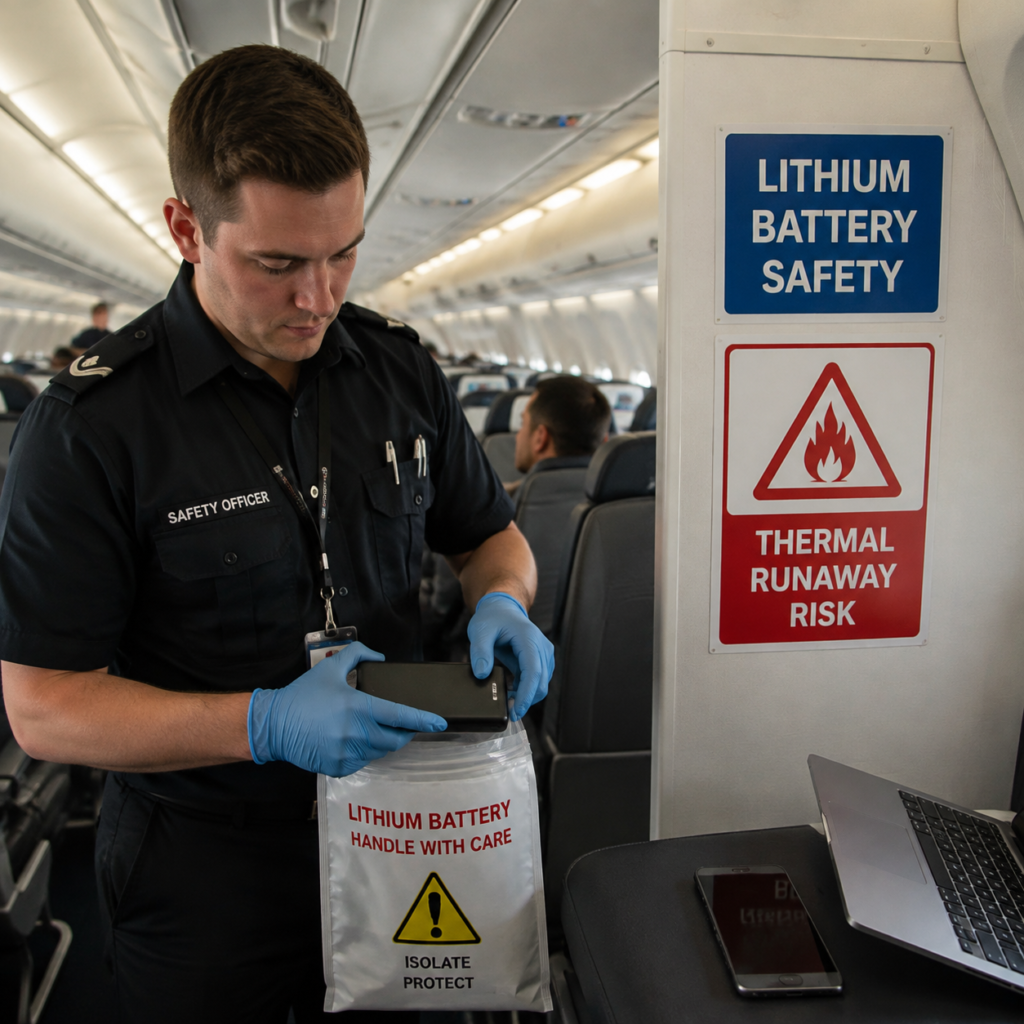
You may ask: I use lithium batteries fine on a daily basis, why are there so many rules on the plane? This is because lithium batteries have an inherent characteristic: if they are squeezed, short-circuited, or exposed to high temperatures, thermal runaway may be triggered—that is, instantaneous severe heating, fire, or even explosion. The aircraft cabin is a confined space, and fire extinguishing at high altitude is much more difficult than on the ground. Even a very small battery fire may escalate into a serious safety accident.
However, there is no need to be overly nervous: the essence of these rules is to control risks, not to prohibit lithium batteries from being carried on planes. As long as they are compliant and undamaged lithium batteries, normal carrying is usually safe, but you must still comply with applicable regulations, airline policies, and on-site security check requirements.
Implementation Logic of Rules and Common Terms
Many people think that the global air transport rules for lithium batteries are one-size-fits-all, but in fact they are implemented at different levels, and whether you can carry them ultimately depends on the requirements of the airline you actually take and the applicable region.
The top level is the International Civil Aviation Organization (ICAO), which is responsible for formulating important technical requirements for the international air transport of dangerous goods, equivalent to a basic framework, and is not itself a law that directly and uniformly applies to all passengers; the middle level is the civil aviation authorities of various countries and regions, such as the FAA of the United States, EASA of the European Union, and the Civil Aviation Administration of China, which formulate local implementation rules based on international requirements; the operating airline may also implement stricter regulations on the basis of international basic requirements.
Airport security checks are carried out in accordance with applicable regulations, airport procedures, and on-site safety judgments. They are usually not the entities that independently formulate aviation dangerous goods rules, but they can require passengers to cooperate with inspections, and refuse release when the nature of the item cannot be confirmed or there are safety doubts.
Special reminder here: if it is a connecting or transfer flight, you should confirm the requirements of all operating airlines, as well as the competent authorities and airports applicable to each transit point, and prepare in accordance with all applicable requirements; if the regulations are inconsistent, you should confirm with the operating airline in advance.
Don’t Be Misled by UN38.3
When it comes to lithium battery transport, many people have heard the term “UN38.3”, and some even think that as long as a battery passes UN38.3, it can be carried on the plane. In fact, UN38.3 specifies a set of design tests that lithium batteries and battery packs should complete before transport, to evaluate their safety performance under specified transport environments and test conditions. Passing the test does not mean that the product is absolutely safe under all damage or abuse scenarios.
Individual passengers usually do not need to carry or proactively submit the UN38.3 test summary; but as air transport items, lithium batteries should still meet applicable transport safety and test requirements, and the test summary is mainly provided by the manufacturer, shipper, or carrier when needed. Passing UN38.3 also does not mean that the requirements for capacity, carrying location, quantity, or airline stricter regulations are automatically met.
Product Classification and Comparison
Before talking about specific carry-on rules, let’s first divide common lithium batteries into two categories, because their judgment indicators are completely different:
- Lithium-ion batteries (rechargeable): Most rechargeable consumer electronics such as mobile phones, laptops, and power banks usually use lithium-ion batteries or lithium-polymer batteries, and the unit for judging capacity is “watt-hour (Wh)”; the specific situation shall still be subject to the product battery label and manufacturer’s information;
- Lithium metal batteries (disposable): For example, CR2032 button batteries used in some cameras, disposable lithium-manganese batteries, the judgment indicator is “lithium content” (unit: gram).
For easy comparison, we divide common lithium battery and electronic products into 5 categories according to regulatory requirements:
| Product Category | Core Feature | Judgment Indicator | Basic Carry-on Rules |
|---|---|---|---|
| Battery-free charging accessories | No built-in lithium battery, works only when plugged in | None | Usually can be carried on or checked in, but must still comply with general baggage and security check requirements |
| Spare lithium batteries/power banks | Capable of independent energy storage, not installed inside the device | Wh/lithium content | Usually can only be carried on, checked in is prohibited |
| Electronic devices with built-in batteries | Batteries are fixedly installed inside the device | Wh/lithium content | When the battery does not exceed 100Wh, it can usually be carried on or checked in, but for checked-in, the device must be completely turned off and protected from damage; batteries exceeding 100Wh and up to 160Wh usually require airline approval, and those exceeding 160Wh shall not be transported as ordinary passenger baggage |
| Disposable spare lithium metal batteries | Disposable, individually packaged | Lithium content (grams) | When the lithium content of a single unit does not exceed 2g, it can usually only be carried with you and must be protected from short circuits; those exceeding this limit shall not be transported as ordinary passenger baggage |
| Lithium batteries without clear labels | Unable to verify type, capacity, or safety status | Unable to confirm | May be refused carriage by the airline or security check due to inability to confirm compliance with transport requirements |
Three Types of Products That Are Most Easily Confused
There are several types of products whose attributes are particularly easy to misjudge, let’s explain them clearly separately:
- Pure plug-in wireless chargers, 2-in-1 charging heads: They have no built-in energy storage batteries themselves, must be plugged into the wall to work, and belong to “battery-free charging accessories”. They are usually not subject to lithium battery carry-on restrictions, but must still comply with general baggage and security check requirements;
- Magnetic wireless chargers with batteries, portable charging heads: They can charge mobile phones without being plugged in, belong to spare lithium batteries with independent energy storage, and are managed according to the rules for power banks;
- Wireless earphone charging case: The battery is fixed in the case and can only charge the corresponding earphones, belonging to “electronic devices with built-in batteries”, not spare batteries, and the rules are similar to those for mobile phones.
Reading, Calculation, and Exception Handling of Wh Parameter
Since the core of judging lithium-ion batteries is Wh, why don’t we use the more familiar mAh? First of all, it should be understood that mAh (milliampere-hour) is only a unit of battery capacity, and it must be combined with voltage to calculate the actual energy storage. For example, for two batteries both with 10000mAh, one with 3.7V and the other with 5V have different actual energy storage, so they cannot be directly compared by mAh.
For rechargeable lithium-ion batteries, aviation rules usually use Wh to judge capacity; for lithium metal batteries, the lithium content (grams) of a single battery is usually used for judgment.
How to Calculate Wh?
Normally, lithium battery products produced by regular manufacturers will directly mark the Wh value on the parameter label on the shell. It is better to use this marked value first, without calculating it yourself. You can turn to the back of the power bank or laptop to find the label with small printed parameters, which usually marks capacity, nominal voltage, and Wh value at the same time.
If the product only marks mAh and nominal voltage, you can also convert it yourself:
Wh = Nominal voltage (V) × Capacity (mAh) ÷ 1000
A common misunderstanding should be paid special attention to here: when calculating, you must use the “nominal voltage of the battery”, not the output voltage of the charger. For example, many power banks mark output parameters of 5V/2A, but the nominal voltage of their internal battery may be 3.7V. You must use the battery’s nominal voltage for calculation, otherwise the result will be higher than the actual value.
What If the Labeling Is Incomplete?
If you encounter incomplete parameter labeling, handle it according to the following rules:
- If only mAh is marked without Wh, but the nominal voltage can be found, calculate it yourself according to the above formula;
- If even the nominal voltage is not marked, since Wh cannot be accurately calculated, it is very likely to be rejected by security check;
- When the product contains multiple batteries or battery packs, priority is given to using the rated Wh provided by the manufacturer for each battery or battery pack, and judge separately according to the product structure and the requirements of the operating airline; when the relationship between multiple batteries cannot be confirmed, verify with the manufacturer or airline;
- When the “cell capacity” advertised by the merchant is inconsistent with the “rated capacity” marked on the product, the rated Wh marked on the product or battery pack shall prevail, and do not refer to unverifiable advertised values.
General Basic Rules for Personal Passenger Carry-on
Let’s first talk about the carry-on rules for lithium-ion batteries (rechargeable), which account for the vast majority. They are divided into three levels according to Wh size, with different requirements. Specific routes and airlines may have stricter regulations.
Graded Requirements for Lithium-ion Batteries (Rechargeable)
≤100Wh (Most Consumer Electronics)
This is the category we contact the most in daily life. Many mobile phones, laptops, and wireless earphones fall into this range. Many power banks with a nominal voltage of 3.7V and a capacity of 20000mAh are about 74Wh, but they must be judged according to the Wh marked on the product or calculated by the nominal voltage, not just by mAh.
- Batteries built into devices (such as mobile phones, laptops, earphone charging cases): They can usually be carried with you or placed in checked baggage, but when checking in, make sure the device is completely turned off and properly protected to avoid squeezing, damage, or accidental activation;
- Spare batteries/power banks: They can only be carried with you, cannot be placed in checked baggage, and must meet the quantity requirement for reasonable personal use. According to the current stricter requirements, the number of power banks is usually no more than 2 per person, but the specific situation still needs to confirm whether the operating airline has a lower quantity limit.
>100Wh to ≤160Wh (Large-capacity Professional Equipment)
For example, some high-performance gaming laptops and professional-grade large-capacity power banks fall into this range.
- Whether it is a device with a built-in battery or a spare battery/power bank, you need to apply for approval from the operating airline in advance, and you can only carry it after approval;
- The maximum number of spare batteries/power banks per person is 2, and they can only be carried with you, checked in is prohibited;
- If a device with a built-in battery needs to be checked in, it must be completely turned off and properly protected from damage.
>160Wh (Large Energy Storage/Industrial Batteries)
For example, outdoor energy storage power supplies of more than 200Wh and industrial lithium batteries cannot be transported as ordinary passenger baggage, and if necessary, they must go through a special dangerous goods freight channel.
Carry-on Requirements for Lithium Metal Batteries (Disposable)
Disposable lithium metal batteries are divided according to the lithium content of a single battery:
- Single lithium content ≤2g (for example, common CR2032 button batteries have a lithium content of only about 0.2g): Those installed in devices can be carried on or checked in; spare independent batteries can usually only be carried with you, checked in is prohibited, and must meet the quantity requirement for reasonable personal use;
- Single lithium content >2g: Shall not be transported as ordinary passenger baggage.
General Operational Requirements
No matter what type of battery it is, several general requirements must be followed:
- Spare batteries must be properly insulated, for example, placed in the original packaging, or the electrodes covered with insulating tape. Do not mix them with keys, coins, metal jewelry, etc., to avoid short circuits;
- Devices with wireless communication functions should use airplane mode or turn off wireless functions as required by the airline and crew; checked-in devices with batteries should usually be completely turned off and properly protected;
- Power banks must be carried with you, and comply with the regulations on quantity, in-flight use, and charging on the day of departure. According to the current stricter requirements, it is usually not allowed to use power banks to charge other devices during flight, nor to use on-board power to charge power banks; if the airline has stricter regulations, they shall be implemented in accordance with the airline’s requirements.
Battery Products That Are Universally Rejected
There are several types of lithium batteries that usually should not be carried regardless of capacity, and must be disposed of in advance:
- Lithium batteries that are bulging, leaking, have damaged casings, abnormal heating, or have ever smoked, have inherent safety hazards;
- Batteries that are publicly recalled by the manufacturer and have clear safety defects;
- Multifunctional power banks with cigarette lighting, ignition, or other dangerous functions may be subject to restrictions on lighters, ignition devices, or other dangerous goods regulations at the same time, and are prohibited from being carried by many airlines and regions; must be confirmed in accordance with the regulations of the specific airline and competent authority before travel;
- Batteries without clear labels whose type, rated capacity, or safety status cannot be verified may be refused carriage by the airline or security check due to inability to confirm compliance with transport requirements.
Differences in Airline/Regional Rules and Query Methods
The above are common basic rules in international air transport, but in actual implementation, national and regional competent authorities and operating airlines may formulate stricter requirements, which is also where many people make mistakes.
Common Stricter Rules
The stricter requirements of airlines or competent authorities usually focus on the following items:
- Quantity limit for spare batteries/power banks;
- Restrictions on the use of power banks during flight;
- Clarity requirements for Wh labels, those that are worn and unreadable may be rejected;
- Approval process requirements for devices with >100Wh to ≤160Wh;
- Check-in restrictions for large-capacity built-in batteries.
In Which Situations Do You Need to Check the Rules in Advance?
You don’t have to specially check the rules every time you travel, but if you have the following situations, it is best to confirm in advance to avoid being stopped:
- When planning to carry power banks, you should first prepare no more than 2 per person in accordance with current rules, and at the same time confirm whether the operating airline has a lower quantity limit;
- Carrying devices or power banks with >100Wh to ≤160Wh;
- Carrying electronic devices with built-in large-capacity batteries;
- Taking connecting or transfer flights, especially cross-regional transfers;
- When taking any airline, you should check the specific regulations of the carrier, especially to confirm the number of power banks, in-flight use, and approval requirements for large-capacity batteries.
How to Check Most Accurately?
You don’t need to look for guides everywhere to check the rules. Just go directly to the official website of the operating airline and find the “Baggage Service” or “Baggage Policy” section, which usually has special instructions for carrying lithium batteries. Just focus on three contents:
- How many spare batteries within 100Wh can be carried at most;
- How to apply for approval for devices with >100Wh to ≤160Wh;
- Whether power banks can be used or charged during flight.
If it is a transfer, you need to confirm the requirements of all operating airlines, as well as the competent authorities and airports applicable to each transit point. If the regulations are inconsistent, you should confirm with the operating airline in advance.
Pre-trip Self-check and Exception Handling
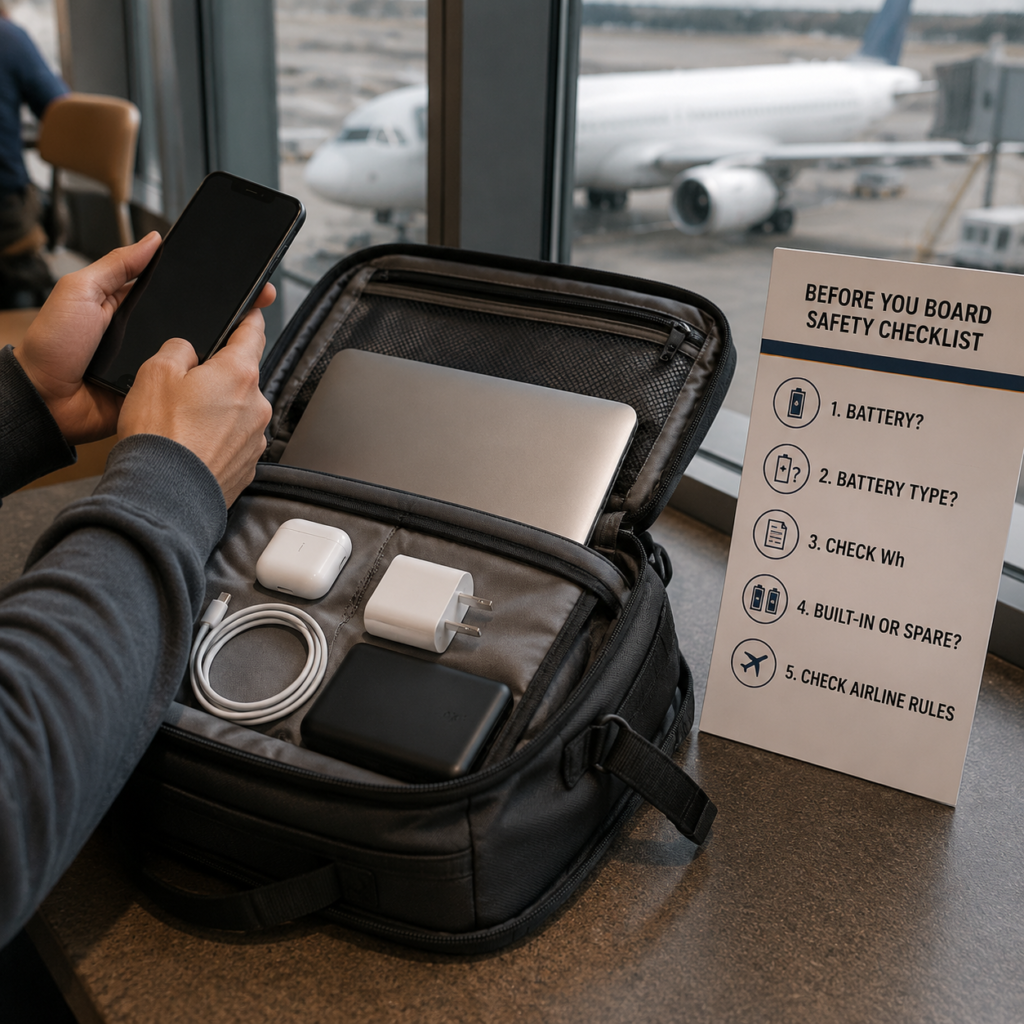
After talking about so many rules, you may feel a bit confused. We have sorted out a 5-step pre-trip self-check process. Go through it in order, and you can quickly judge whether the items you carry are generally compliant:
- First go through all the charging and electronic products you want to bring, and judge whether they contain lithium batteries; if none of them contain batteries, just pack them as ordinary baggage, but still comply with ordinary baggage and security check regulations;
- Distinguish the battery type, whether it is a rechargeable lithium-ion battery or a disposable lithium metal battery, and confirm whether the corresponding judgment indicator is Wh or lithium content;
- Find the parameter label of the product, read or calculate the Wh value or lithium content, and make a preliminary judgment against the general basic rules;
- Distinguish whether the battery is built into the device or is a spare one, such as a power bank or a separate battery, and confirm whether it can be checked in or can only be carried with you;
- Judge whether it belongs to the scenario where you need to check the airline’s stricter rules, and if so, check and confirm in advance according to the method.
Judgment Cases of Common Products
Let’s give a few of the most common examples, you can directly compare them:
- 20000mAh/3.7V ordinary power bank: Converted to 74Wh (≤100Wh), belongs to spare battery, can be carried with you, cannot be checked in;
- 99Wh laptop: The battery is installed in the device, usually can be carried on or checked in. For checked-in, it must be completely turned off and properly protected;
- 99Wh power bank: Belongs to spare battery, can only be carried with you, and must comply with quantity and in-flight use restrictions;
- 200Wh outdoor energy storage power supply: Capacity >160Wh, shall not be transported as ordinary baggage;
- Power bank without clear label: Parameters cannot be verified, may be refused carriage by the airline or security check.
How to Deal with Problems?
If you really encounter security check problems, don’t panic, just handle them according to the situation:
- If the battery itself has problems such as bulging, leaking, damage, abnormal heating, etc., never carry it. Contact the manufacturer or local battery recycling point for proper disposal, and do not throw it into ordinary garbage;
- If it is a battery publicly recalled by the manufacturer, do not carry it, return or replace it according to the recall requirements;
- If it is a compliant product but is rejected due to quantity, label, etc., for example, carrying 3 power banks exceeding the airline’s limit, you should obey the arrangement of on-site staff, and contact the airport-designated dangerous goods disposal, recycling, or abandonment channel. Items that are compliant but exceed the quantity or do not meet the airline’s requirements can only be selected from the on-site available and staff-confirmed methods of return, temporary storage, or disposal. Do not hand them over to others for carrying without authorization. The airport may not provide temporary storage or mailing services.
Supplement: Personal Carry vs Commercial Freight/Express
Many people confuse personal carry rules with freight and express rules, but in fact the two are completely different. Here is a simple supplement.
Core Differences
- Individual passengers mainly need to confirm requirements such as battery type, capacity, quantity, whether installed in the device, carrying location, short-circuit protection, and airline approval; usually passengers are not required to submit the UN38.3 test summary with them, but the battery itself should still meet applicable transport safety requirements;
- Commercial freight lithium batteries need to meet the packaging, labeling, and declaration requirements for dangerous goods transport, and also need to provide the UN38.3 test summary when needed, the process is much more complicated;
- Common misunderstanding: Lithium batteries that can be carried on the plane may not be sent as ordinary express, which is why many people have their power banks returned when sending them.
About UN Numbers
You may have heard the set of numbers UN3480, UN3481, UN3090, UN3091. They are the transport names and classification numbers of lithium batteries in dangerous goods transport, and are also used to distinguish related passenger baggage rules:
- UN3480: Lithium-ion batteries or battery packs transported separately;
- UN3481: Lithium-ion batteries or battery packs packed with equipment or installed in equipment;
- UN3090: Lithium metal batteries or battery packs transported separately;
- UN3091: Lithium metal batteries or battery packs packed with equipment or installed in equipment.
Individual passengers usually do not need to fill in these numbers or prepare freight labels, while commercial shippers must handle them in accordance with applicable packaging, marking, labeling, and declaration requirements.
Precautions for Sending Charging Products
If you need to send charging-related products, you can simply understand:
- Ordinary charging accessories confirmed to be free of batteries or other dangerous goods, such as ordinary charging heads, charging cables, adapters, etc., can usually be sent as ordinary items, but must still comply with the general prohibited and restricted mailing regulations of the carrier logistics, postal service, and destination country;
- Power banks, electronic products with batteries: You need to choose a logistics company with lithium battery transport qualifications, and declare truthfully, do not conceal;
- The state of charge limit depends on whether the battery is transported separately, packed with equipment, or installed in equipment, as well as the applicable packaging instructions and airline and logistics requirements. For example, some independent lithium-ion battery air freight is subject to a state of charge requirement of no more than 30%, which cannot be generalized to all battery-powered products.
Summary
In general, the air transport rules for lithium batteries seem complicated, but in fact the core is three steps: First, check whether the product has a lithium battery, then distinguish whether it is a built-in battery or a spare battery that can be used independently; second, find the Wh value or lithium content of the product, and make a preliminary judgment against the general rules on whether it can be carried, and whether it is carry-on or checked-in; third, if there are large-capacity batteries, transfers, or products with special functions, check the stricter rules of the competent authority and airline in advance.
Completing the self-check can reduce the risk of being rejected due to capacity, carrying location, or label issues, but the final decision is still subject to the applicable regulations on the day of travel, the operating airline, and the on-site security check.