
Charging product sellers new to the Thai market have most likely encountered or heard of this pitfall: they ship a batch of smart chargers with wireless charging function to the port, and are immediately required to provide relevant compliance documents upon arrival at customs. Many people are confused when they first hear about NBTC: I’m selling a charging product, why does it involve the broadcasting and telecommunications commission? In fact, the core difference lies in whether your product includes regulated radio transmission, reception or communication functions.
This article is specifically for charging product sellers. It starts with the most basic introduction to what NBTC is, covers how to determine whether certification is needed, which certification path to choose, what materials to prepare, what process to follow, and then how to use the certificate compliantly after obtaining it and avoid common pitfalls. After reading it, you will be able to independently handle most NBTC certification-related issues.
Basic Knowledge: Essential Common Sense for Charging Product Sellers
First, let’s clarify the most basic question: what exactly is NBTC?
NBTC is the abbreviation of the National Broadcasting and Telecommunications Commission of Thailand, which is the official agency responsible for the compliance management of radio communications and related equipment in Thailand. Its core function is to ensure that the frequency bands, transmission power, etc. used by relevant wireless equipment entering the Thai market comply with Thai regulations, so as to avoid occupying inappropriate frequency bands, interfering with communication networks or affecting other equipment.
For charging products, you don’t have to be nervous as soon as you hear about NBTC. It mainly involves charging products that include regulated radio transmission, reception or communication functions. Ordinary pure wired chargers, power adapters, passive charging cables, etc., usually do not fall within the scope of NBTC wireless equipment conformity assessment; however, you still need to separately check TISI and other applicable regulations according to the product category.
Many sellers confuse NBTC with other compliance requirements in Thailand. Here we clarify them in the context of charging products:
Difference from TISI certification: TISI is mainly responsible for the conformity assessment of products included in Thailand’s mandatory standard scope. Some chargers, power adapters or plug products may require TISI certification; whether it is necessary to apply shall be confirmed according to the specific product category and applicable standards. NBTC is mainly responsible for the compliance of radio communication and radio frequency equipment. For example, smart fast charging products with Wi-Fi control may involve both NBTC and TISI, but whether both need to be applied for at the same time cannot be judged only by the product name, but must be determined in combination with specific functions, specifications and applicable standards.
Difference from customs access: NBTC is a market access compliance requirement that products need to meet under specific circumstances, while customs will check whether the imported goods are consistent with relevant documents. For example, if the model on the certificate or registration document is A, but the imported goods are B, even if you have the documents, you may be required to explain, make corrections or suspend release.
Difference from e-commerce platform requirements: Some platforms, categories or specific products may require NBTC or other compliance documents, which shall be subject to the listing page and the current rules of the platform. Platform requirements cannot replace the product compliance judgment stipulated by Thai law, nor can you assume that the product does not need to go through relevant procedures just because the platform does not require it temporarily.
In short, smart charging products with wireless functions may have dual compliance requirements of “NBTC + TISI”, but whether both are required and which standards are applicable respectively shall be confirmed according to the specific situation of the product.
If a product requires NBTC license or conformity assessment according to law but has not been processed, it may be required to make corrections, suspend import or sales, be detained or confiscated during import, sales or market spot checks, and may bear liabilities such as fines and recalls according to law. The specific consequences depend on whether the product is a regulated device, the nature of the violation, the import license status, and the actual decisions of law enforcement agencies and platforms. It cannot be simply understood that every unprocessed product will automatically be fined, destroyed or removed from all channels.
Applicable Boundary: How to Determine Whether Your Charging Product Needs NBTC Certification
Now that you understand what NBTC is, the next core question is: does the charging product I sell need NBTC certification? You can first conduct a quick self-check through 3 simple steps, but this is only a preliminary screening, and the final result shall still be subject to the current NBTC equipment classification and applicable standards.
Step 1: First ask the supplier for the official product specification sheet, and check whether there are radio transmission, reception or communication functions such as Bluetooth, Wi-Fi, NFC, and cellular network;
Step 2: Check whether the product connects to mobile phone Apps, routers or other devices through wireless interfaces such as Bluetooth, Wi-Fi, and cellular network. App control itself is not equal to wireless function. If the App controls the product through a wired interface such as USB, you cannot make an NBTC judgment solely based on “supporting App”;
Step 3: Confirm whether the product actually contains radio functions regulated by NBTC, and then determine whether certification is needed and which procedure is applicable according to the working frequency band, power, purpose and NBTC equipment classification. If it is confirmed that there is no wireless function, separately check TISI and other applicable regulations.
Specifically for charging products, the following usually require key NBTC determination: smart chargers, charging bases, and smart sockets with Bluetooth, Wi-Fi or wireless App control functions; wireless charging products with wireless communication modules such as Bluetooth or Wi-Fi; car chargers and portable charging Wi-Fi with cellular network or hotspot functions; as well as multi-port fast charging stations and USB-C docks with wireless modules and supporting App interaction.
However, containing the word “wireless” does not mean that the same NBTC procedure must be applicable. Qi wireless power supply is not the same concept as Bluetooth and Wi-Fi wireless communication. Whether Qi, NFC and other wireless power supply or near-field functions belong to a certain NBTC equipment category needs to be confirmed item by item in combination with the actual frequency band, transmission parameters, working mode and the latest NBTC classification.
Conversely, pure wired chargers, cables and adapters that do not contain radio transmission, reception or communication functions usually do not require NBTC wireless equipment conformity assessment. Ordinary wired chargers, power adapters, passive charging cables, data cables, adapters without wireless functions and pure wired multi-port chargers should first be treated as pure wired products; but this does not mean that they are completely not bound by Thai regulations, and you still need to separately check TISI, energy efficiency, plugs, electrical safety and other potentially applicable requirements.
Of course, there are some cases with blurred boundaries that require special attention: for example, for a wireless charger that only has Qi inductive charging and no Bluetooth or Wi-Fi communication, whether it needs certification and which procedure is applicable must be confirmed against the latest NBTC classification. In addition, non-wireless independent accessories in the set, such as ordinary charging cables and ordinary power adapters included in the smart charger set, usually do not require separate NBTC wireless equipment conformity assessment. In addition, car chargers with hidden Bluetooth, positioning or cellular functions look like ordinary car chargers, but may actually have wireless modules, which must be further evaluated.
Regarding set products, let’s talk about the compliance logic separately here, as many sellers easily fall into pitfalls here: if it is a charging accessory sold separately, whether it is the main unit or an accessory, it is necessary to separately judge whether it contains regulated wireless functions; if it is a non-wireless accessory included with the whole machine, such as an ordinary charging cable given with a smart charger, it usually does not require separate NBTC wireless equipment conformity assessment; if it is a set composed of multiple components, each component with wireless functions must be confirmed whether it has been covered by relevant documents, and you cannot think that everything is fine as long as the main unit has a certificate.
Path Selection: How to Choose Between Type Approval and SDoC
After confirming that the product may involve NBTC, the next step is to select a compliance path. The specific procedures of NBTC include Type Approval, Supplier’s Declaration of Conformity (SDoC), and other registration or approval procedures applicable to certain equipment categories. The applicable scope of different procedures is jointly determined by equipment category, technical standards, frequency band, power and purpose.
| Comparison Item | Type Approval | SDoC (Supplier’s Declaration of Conformity) |
| Applicable Objects | Applicable to equipment categories that require type approval as stipulated by NBTC | Applicable to equipment categories that meet corresponding conditions and can adopt supplier’s declaration of conformity |
| Review Method | Submit technical materials and test reports as required, and the competent authority will review them in accordance with procedures | The supplier issues a declaration of conformity based on applicable standards, and submits or registers as required |
| Supervision Intensity | Usually requires relatively complete pre-technical review and is subject to subsequent supervision | The procedure may be relatively simplified, but it must still comply with technical standards and be subject to spot checks |
| Judgment for Charging Products | Cannot be directly judged solely by Wi-Fi, Bluetooth, cellular, wireless charging or power level | Cannot be directly judged solely by low power, one-way communication or product name |
A warning must be sounded here: both paths are legal procedures, but SDoC is not “pass as long as you pay”. The product must still comply with the applicable technical standards of NBTC, and the supplier is also responsible for the content of the declaration and product consistency, and may be subject to spot checks later.
Specifically for charging products, products with Wi-Fi, Bluetooth, cellular or wireless power supply functions shall confirm whether SDoC, Type Approval or other procedures are applicable according to the frequency band, power, purpose of each wireless interface and the current NBTC equipment classification. You cannot simply think that “two-way communication must require Type Approval”, nor can you think that “low power or only basic Bluetooth pairing can definitely go through SDoC”.
There is a special case to explain: if the product uses a wireless module that has been approved by NBTC, it may reduce part of the radio frequency assessment when meeting the module approval conditions, but it cannot automatically exempt the whole machine from compliance. The module certificate, antenna, output power, installation method, software configuration and host function shall be submitted to an NBTC-recognized institution for confirmation to determine whether the whole machine needs registration, Type Approval or supplementary testing.
You can use these steps to practically judge the path:
Step 1: First list all wireless functions, transmission power, working frequency band, antenna and purpose of the product clearly. For these data, ask the supplier for the official specification sheet, don’t guess by yourself;
Step 2: Compare with the latest equipment classification and applicable technical standards on the NBTC official website, or find a formal agent or recognized institution for pre-judgment. Don’t choose blindly based on the product name. Products also called “wireless charger” may have one with a Bluetooth speaker and another with only wireless power supply function, and the applicable procedures may not be the same;
Step 3: If the product has multiple wireless interfaces, check the applicable requirements of each interface separately, and cannot judge only by the main function or maximum power of the product.
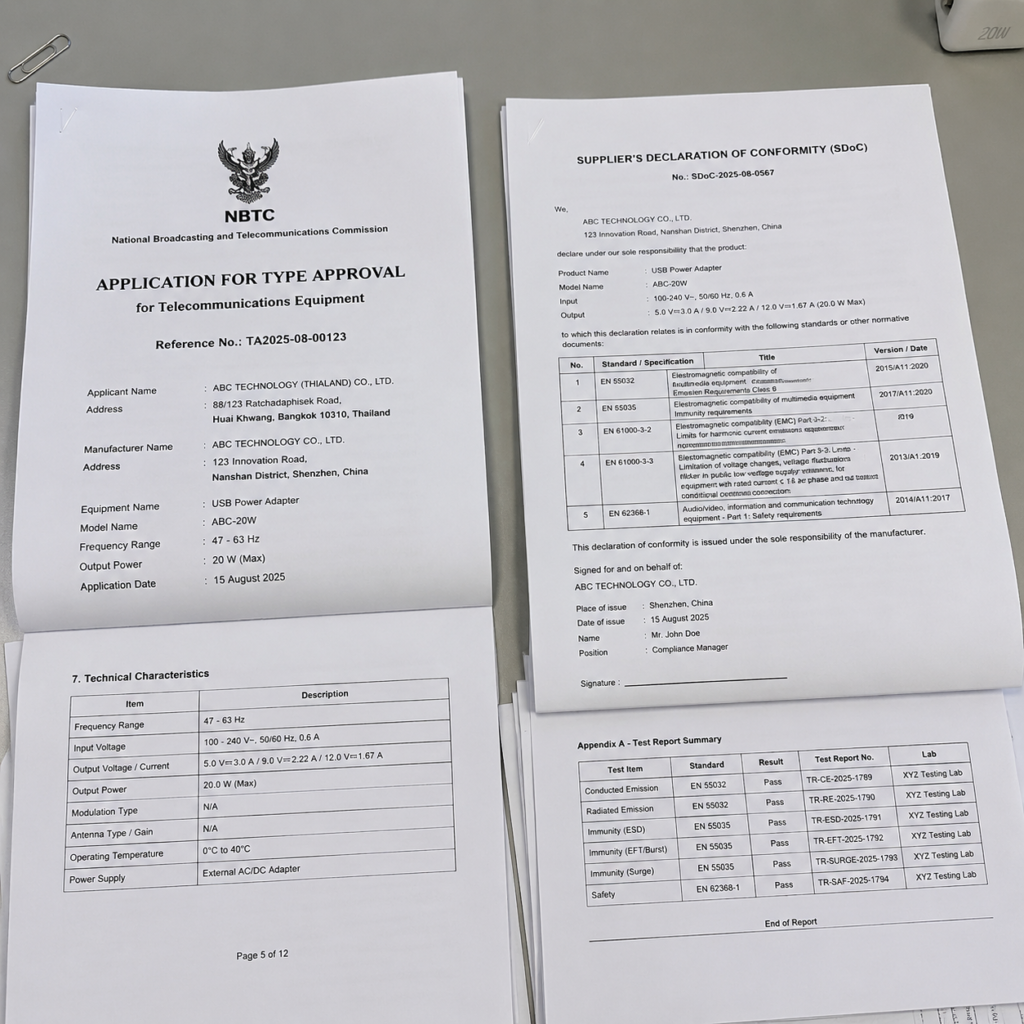
The most common pitfall is to declare products that should be subject to other procedures as SDoC in order to save money. The correct approach is to first confirm the equipment category and technical standards, and then decide the path, instead of the other way around, forcing the product to fit a cheap procedure.
Pre-application Preparation: Prepare in Advance to Avoid Detours
After choosing the path, don’t rush to send samples for testing. Preparing in advance can save you a lot of detours. There are 3 key prerequisites that directly determine the certification cost, cycle and whether the process can be completed successfully.
The first is product information: you must apply with the model, wireless function and radio frequency parameters of the final sales version, and the frequency band used by the product must comply with applicable Thai regulations. If the frequency band, power or wireless interface itself does not meet the requirements, the subsequent application is likely to fail.
The second is the applicant entity: the requirements for the applicant entity and the local representative in Thailand shall be confirmed according to the equipment category and the specific NBTC procedure. Import and sales usually involve a local import entity or license holder in Thailand. Overseas manufacturers should first confirm whether they need to designate a local representative or importer in Thailand. You cannot simply think that all applications can only be filed by Thai companies, nor can you default that overseas manufacturers can apply directly under any procedure.
The third is existing materials: if you already have information about wireless modules approved by NBTC, or wireless test reports issued by other countries, take them out in advance. Whether relevant materials can reduce testing or be accepted depends on the module approval conditions, laboratory accreditation scope, applicable standards, mutual recognition arrangements and NBTC’s requirements for specific equipment, and it is not guaranteed that they can be used directly.
The specific materials to be prepared can be divided into several categories, and the model, brand, software and hardware versions in all materials must be completely consistent, otherwise it is easy to be required to make corrections:
The first category is product materials: prepare Thai, English or recognized translation materials according to the specific application procedure, including manuals, product parameter sheets, appearance photos, internal circuit board photos and label drafts. Whether bilingual documents must be provided shall be subject to the specific procedure and submission requirements;
The second category is technical materials: wireless module model and relevant approval certificates, radio frequency circuit block diagram, antenna specifications, transmission power, working frequency band, as well as power adapter specifications, etc.;
The third category is entity materials: entity certificates of the applicant, importer or local representative, manufacturer’s authorization letter, and agency authorization documents required by the procedure;
The fourth category is consistency materials: ensure that the test samples, product models, wireless modules, software versions, labels and final sales versions correspond to each other.
Test reports shall be issued by laboratories accepted by NBTC, or laboratories that comply with applicable mutual recognition arrangements and accreditation scopes. Whether re-testing by the laboratory is required depends on the specific application procedure, applicable standards, report format and NBTC’s accreditation rules. When choosing a laboratory, you can pay attention to the following points: confirm whether it is within the NBTC accreditation scope and whether it has an ISO/IEC 17025 accreditation scope consistent with the project; for charging products, give priority to laboratories with experience in testing wireless chargers, Bluetooth or Wi-Fi devices; if using an overseas laboratory, confirm in advance whether the report can be accepted, as well as translation, certification and format requirements.
Finally, you must avoid this pitfall: don’t believe the claim of “100% pass without sample testing”. Whether physical samples are required and which items to test depend on the specific procedure, but any formal application cannot use false materials to replace product conformity.
Many sellers will ask: can I apply for NBTC by myself? Whether it is feasible depends on whether you meet the applicant requirements of the specific procedure, whether you have a local representative or import entity in Thailand, and whether you can handle Thai or English materials and application systems. For most overseas small and medium-sized sellers, especially those without a local entity, applying for the first time, or with relatively complex product functions, finding a formal agent will be more worry-free. To judge whether the agent’s fee is reasonable, it depends on what its services include: the fee of a formal agent generally may include consultation, data sorting, test follow-up, submission and correction services. If the quotation is particularly low, you should be alert to whether testing, translation, correction or subsequent change services are omitted.
Core Application Process: 5 Key Steps
After the preparation work is done, you enter the formal application process. The core is 5 key steps, which we will explain in combination with the characteristics of charging products:
Step 1: Product Classification and Scheme Confirmation
You can compare with NBTC’s classification by yourself, or entrust a recognized institution or agent to make a pre-judgment to clarify whether SDoC, Type Approval or other procedures are applicable. For charging products, the key points to confirm are the type of wireless interface, working frequency band, transmission power, antenna configuration, whether it has wireless data communication function, and the specific purpose of the product.
The technical requirements involved in Qi, NFC, Bluetooth, Wi-Fi and cellular communication may be different. You cannot classify only by product name, nor by promotional terms such as “wireless charger” or “smart charger”. After this step is completed, the applicable standards, items that need to be tested or evaluated, as well as the approximate cost and cycle should be clarified.
Step 2: Sample Testing or Conformity Assessment
Test items shall be determined according to the actual wireless interface of the equipment and the applicable NBTC standards, which may involve radio frequency, spectrum occupancy, spurious or out-of-band emission, electromagnetic compatibility (EMC) and other items. Not all NBTC equipment undergoes exactly the same tests uniformly.
The test focus of charging products depends on the actual configuration. For example, only products with 2.4GHz Bluetooth or Wi-Fi transmission function are subject to the corresponding 2.4GHz frequency band requirements; the 2.4GHz limit cannot be applied to all wireless charging products. The working modes and frequencies of Qi wireless power supply, NFC, Bluetooth and Wi-Fi may be different, and testing must be carried out according to the actual radio frequency specifications.
Try to use mass-produced samples of the final sales version for testing. Engineering machines that are inconsistent with the sales version cannot be used, nor can wireless modules, antennas be replaced at will or key parameters be modified after sending samples for testing.
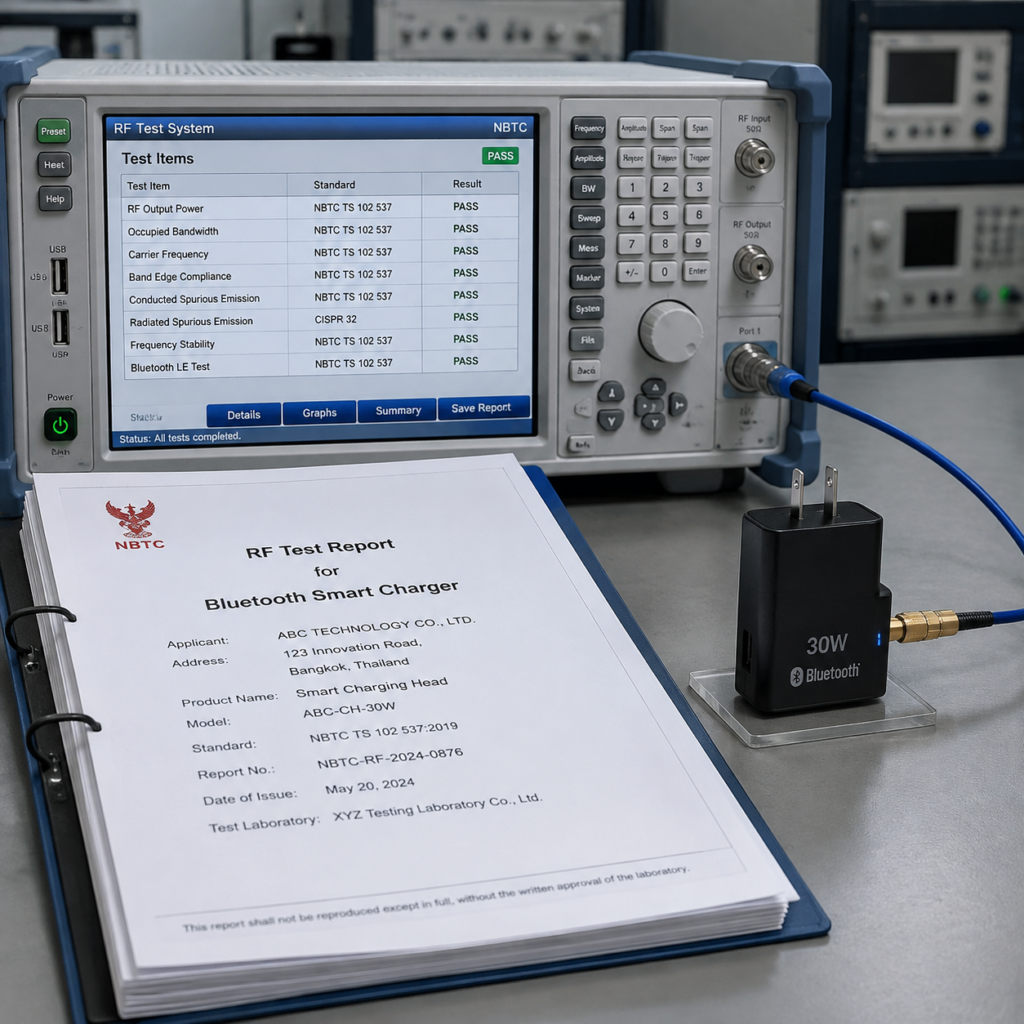
After passing the test, obtain the corresponding report or conformity document according to the procedure; if not, the product needs to be rectified and re-tested or evaluated as required.
Step 3: Submit Application
The requirements for the applicant entity, local representative and import entity shall be confirmed according to the equipment category and specific procedure. Usually, applications need to be submitted through the NBTC official system or prescribed channels. Whether paper submission is allowed in special cases shall also be subject to the official requirements at that time.
The materials to be prepared usually include test reports or declarations of conformity, product materials, entity certificates, authorization documents and other technical documents required by the procedure. For charging products, special attention should be paid to marking the power adapter parameters, wireless module information, antenna and product model to ensure that these contents are consistent with the test samples and the final sales version.
After submission, pay relevant fees according to NBTC’s current charging requirements, and keep application records, registration records or application numbers. The document forms generated by different procedures may be different, which shall be subject to the official system and specific application categories.
Step 4: Official Review and Correction
The official or relevant review agency usually pays attention to the consistency of materials, whether the frequency band and power comply with regulations, whether the test report is applicable, whether the label and product information are accurate, etc. Common correction reasons for charging products include incomplete parameters in test reports, inconsistent model or wireless module information, incorrect frequency marking, and label content that does not meet the requirements of specific categories.
There is no unified fixed number of weeks for processing time applicable to all products. It will be affected by equipment category, test arrangement, data completeness, number of applications, number of corrections and NBTC review status. The cycle provided by the agent or laboratory can only be used as an unofficial estimate and does not constitute a guarantee of processing time limit.
Do not arbitrarily change the product’s software and hardware, wireless modules, antennas, power, frequency band or labels during the review period. If changes are really needed, you should first confirm with NBTC or a recognized institution whether a change application, supplementary testing or re-application is required.
Step 5: Obtain and Verify the Results
After passing the review, you may obtain registration records, certificates, approval documents or other result documents stipulated by the procedure in the NBTC system. The specific document form and verifiable method shall be subject to the NBTC system and corresponding procedures; if paper documents or certification copies are required, they shall also be processed according to the specific procedure.
After getting the results, first check whether the key information such as brand, model, wireless function, frequency band, power, applicant entity or local representative is correct. Especially for charging products, it is necessary to confirm whether the wireless interfaces and configurations covered by the documents are consistent with the actual sales version, so as to avoid problems during customs clearance, listing or market spot checks.
After confirmation, synchronize the certificate, registration record or approval document to the supply chain, operation and customs clearance teams in time to ensure that the information on procurement, import, product pages and packaging is consistent.
Cost and Cycle: How to Estimate Cost and Time
Many sellers are most concerned about the cost and cycle. In fact, there is no fixed figure, which is affected by many factors. We will explain the composition and judgment method clearly, and you can estimate the approximate amount by yourself.
First, look at the cost composition, which mainly includes several parts: the first part is the testing or conformity assessment fee, which is usually affected by the number of wireless interfaces, applicable standards, test items and sample conditions; the second part is the NBTC official fee, which shall be confirmed according to the current fee schedule and equipment category; the third part is optional service fees, such as agency service fees, translation fees, data sorting fees and correction assistance fees, etc.
The total cost cannot be simply compared in a one-size-fits-all manner based on SDoC or Type Approval. Testing, translation, agency, number of models, report evaluation and rectification costs may all affect the final quotation. When asking for a quotation, don’t just look at the total quotation. Be sure to confirm whether the quotation includes the whole process service to avoid additional charges later.
Costs are usually affected by the following factors:
First is the procedure type and equipment category. Different procedures have different official fees, testing requirements and service workloads; then is the functional complexity. Products with a single wireless interface are usually easier to evaluate than multi-functional charging stations that also have Wi-Fi, Bluetooth or cellular functions, but this does not guarantee that they are definitely cheaper; there is also the rectification situation. If the test fails, sample modification, supplementary testing or re-application will increase the total cost; finally is the module situation. Modules that have been approved by NBTC may reduce part of the radio frequency assessment when meeting the approval conditions, but it must first be confirmed whether the whole machine still needs supplementary testing or application.
The cycle also cannot be judged only by a fixed number of weeks. It should comprehensively consider equipment category, sample preparation, laboratory scheduling, data completeness, report evaluation, NBTC review and correction status. When asking for a quotation, it is best to ask the laboratory or agent to explain the estimated time of each stage and clarify which time is not within their commitment scope. Whether the official provides specific expedited arrangements shall also be subject to the formal rules at that time. The “expedited” mentioned by the agent sometimes only means prioritizing testing or strengthening follow-up, which does not mean that the official will definitely shorten the review time.
Finally, here are four questions you must ask when inquiring, which can avoid most quotation pitfalls:
First, does the quotation include testing or report evaluation fees, official fees, translation fees and basic correction services;
Second, if I already have an overseas test report, or use an approved wireless module, which materials can be submitted and which items need supplementary testing;
Third, how many models and how many wireless versions does the quotation cover, and how to charge for adding models or replacing modules;
Fourth, what are the additional charging standards for test failure, correction, change application or re-testing.
Post-certification Compliance: How to Use the Certificate Without Problems
Many sellers think that everything is fine once they get the results. In fact, compliant use after obtaining the certificate is also very important, otherwise problems may still occur.
First are the NBTC labeling requirements. The prescribed conformity mark and approval or registration number shall be used in accordance with the corresponding NBTC announcements, approval documents and certificate conditions. Whether it is necessary to mark the name and address of the Thai importer on the product body or packaging, as well as the specific pattern, size, position and number format of the mark, shall be subject to the specific requirements of the equipment category.
For charging products, the label should not block interfaces, heat dissipation holes or affect normal use, nor should it be pasted in positions that are easy to wear or fall off. The brand, model, wireless function, number and other contents on the label shall be consistent with the NBTC system records, certificates or approval documents, and the model or brand cannot be changed at will.
Then are the inspection requirements for import and sales. Customs or other regulatory links may require NBTC system records, certificates, approval documents or other compliance materials, which shall be subject to the equipment category and actual law enforcement requirements. The model, brand and wireless configuration of imported goods shall be consistent with relevant documents, and documents of one model cannot be used to cover another model.
When listing on e-commerce platforms, some Thai platforms or specific categories may require uploading NBTC or other compliance documents. The model, function description and actual configuration on the product page shall also be consistent with relevant documents, and functions cannot be exaggerated or models mislabeled. If you encounter market supervision spot checks, you should be able to provide corresponding certificates or registration documents, test reports, authorization materials and import batch records, so these documents must be kept properly.
Next are the situations that require updating or re-applying for certification, and those that do not. First, check the validity period, change and renewal clauses in the specific certificate or registration document. You cannot default that all NBTC documents have a unified expiration time and a 1-2 months in advance renewal rule.
Before replacing wireless modules, antennas, firmware, transmission power, working frequency band, brand, model, manufacturer or certificate holder, you should confirm with NBTC or a recognized institution whether change, re-testing or re-application is required. Even if you only modify the label or manual, it depends on whether it touches the specific certificate conditions and label requirements. You cannot assume that no update is needed solely based on “no change in radio frequency parameters”.
Finally is document retention after listing. You need to keep the certificate or registration documents, test reports, authorization letters, import batch records and product version materials properly. It is best to establish a corresponding file of “certificate – model – batch”, so that when encountering spot checks, you can quickly take out the corresponding materials without being flustered.
Pitfall Avoidance Guide: 6 Most Common Pitfalls for Charging Product Sellers
Finally, we have sorted out 6 NBTC certification pitfalls that charging product sellers are most likely to fall into. Avoiding them in advance can save you a lot of money and time:
The first is the classification mismatch pitfall: forcing products into inapplicable SDoC to save money
The risk is: if the product should be subject to other NBTC procedures according to law, but uses an inappropriate declaration or registration method, it may be required to make corrections, suspend sales, be detained or bear other legal liabilities during import, market spot checks or sales.
For charging products, the path cannot be directly judged solely by “with Bluetooth”, “with Wi-Fi” or “high power”. Wireless chargers with Bluetooth speakers and smart fast charging stations with Wi-Fi control should be evaluated based on wireless interface, frequency band, power, purpose and current equipment classification.
The avoidance method is to first confirm the specific equipment category and technical standards, and then choose SDoC, Type Approval or other procedures. Do not reverse the classification to save costs.
The second is the material/sample inconsistency pitfall
Common situations include: the model on the materials is different from the sample, the test sample is an engineering machine, while the actual sales product is a mass-produced machine. A common problem with charging products is that the actual transmission parameters of the wireless charger are inconsistent with the declaration, and the wireless module, antenna or software version is changed midway without re-evaluation.
This situation may lead to failure of the review, or may be required to rectify in subsequent supervision. The avoidance method is to establish a five-unification list of “model – module – software – label – report”, try to use the final mass-produced samples when sending for testing, and all materials are aligned with the actual sales version.
The third is the certification substitution misunderstanding: thinking that CE or FCC eliminates the need for NBTC
Certifications or certificates such as CE and FCC cannot directly replace NBTC. Whether their test reports can be accepted by NBTC depends on the accreditation scope of the issuing agency, applicable standards, report format, international mutual recognition arrangements and NBTC’s requirements for specific equipment. It must be confirmed in advance. You cannot generally think that they can be used directly, nor can you generally think that they can only be used as reference.
If the product uses a wireless module that has been approved by NBTC, the module information may help reduce part of the radio frequency assessment, but whether it can be applied to the whole machine still depends on the module approval conditions, antenna, power, installation method and host configuration. Whether the whole machine needs registration, Type Approval or supplementary testing shall be confirmed by NBTC or a recognized institution.
The fourth is the certificate holder pitfall: not confirming the requirements for applicants and local representatives
Whether an individual can be an applicant for a specific device or procedure needs to be judged according to NBTC regulations. You cannot generally think that a certificate held by an individual is necessarily invalid; but if the certificate holder cannot continuously handle import, change, renewal or supervision matters, subsequent maintenance will indeed become difficult.
The correct approach is to confirm the requirements for qualified applicants and local representatives according to the specific equipment category. For long-term maintenance convenience, relevant documents are usually held or managed by a Thai entity that can continuously perform import, change and supervision obligations. Whether the certificate holder must be consistent with the importer, distributor and sales entity shall be subject to specific NBTC rules and certificate conditions.
The fifth is the missing certification pitfall for set products
Many sellers think that as long as the main unit has NBTC documents, the matching charging accessories don’t need to be taken care of. The real situation is that wireless charging accessories sold separately need to be judged separately; non-wireless accessories included in the set usually do not require separate NBTC wireless equipment conformity assessment.
Take a charging product example: ordinary charging cables in a smart charger set do not need to apply for NBTC as wireless devices; but accessories with regulated radio functions such as Bluetooth, Wi-Fi, and NFC need to be evaluated separately. It should be noted that “smart chip” is not equal to wireless communication function. Many fast charging cables that support USB, PD, power management, identification chips or other wired protocols still only have wired communication, and will not automatically become NBTC wireless devices just because they contain chips; but they still need to be checked against other Thai regulations.
The sixth is the model change without update pitfall: arbitrarily modifying the product after obtaining the certificate
Many sellers think that just replacing a cheaper wireless module or updating firmware is a small change that does not affect the certification. In fact, changes involving wireless modules, antennas, wireless functions, frequency bands, power, brand, model, manufacturer or certificate holder may trigger change applications, re-testing or re-application.
The risk is that the product is found to be inconsistent with the documents during spot checks, and then you are required to rectify, suspend sales or bear other liabilities. The avoidance method is also simple: for any changes involving wireless-related configurations, first consult NBTC or a recognized institution to confirm whether a change or re-application is required, and then proceed with mass production.
Learning Summary
By now, you should be able to independently judge three things: first, whether your charging product contains wireless functions regulated by NBTC and which procedure to follow; second, what materials need to be prepared for application, what are the core steps, and how to estimate the cost and cycle; third, how to use the documents compliantly after obtaining them, which changes need to be confirmed in advance, and how to avoid common pitfalls.
In general, NBTC-related compliance seems to have many processes and detailed requirements, but the core logic is very clear: first confirm whether the product actually contains regulated radio transmission, reception or communication functions, and then select the applicable procedure according to frequency band, power, purpose and equipment classification; at the same time, ensure the consistency of materials, samples and the final sales version, and use and maintain documents in accordance with specific certificate conditions. For charging product sellers, preparing for compliance in advance is far more reliable than remedying after the goods enter the import or sales link.