
If you often buy chargers and power adapters on overseas e-commerce platforms, you have most likely seen the string “IEC 61558” when browsing product specification pages. What exactly is it? Is it a marketing gimmick by merchants, or does it truly represent safety? Do all chargers have to comply with this standard? In this article, we will thoroughly explain this international standard closely related to charging safety from the perspective of ordinary users — from basic concepts that beginners can understand, to practical methods for advanced product selection and report verification. After reading it, you will be able to avoid the vast majority of safety pitfalls with charging products.
First, Understand: What Exactly Is IEC 61558?
This part covers the most basic introductory knowledge. We will first clarify the core positioning and common misconceptions to avoid going astray at the very beginning.
Core Positioning of the Standard
IEC 61558 is developed by the International Electrotechnical Commission (IEC), an international organization composed of electrotechnical standardization bodies from countries around the world, which specializes in formulating general specifications for the electrical field. The core function of this standard is to set a minimum safety threshold for transformer and power converter products, to minimize the risks of electric shock, fire, and equipment damage.
But there is a very important premise that must be stated first: it is not a universal mandatory standard that all chargers must comply with. Whether a charging product needs to meet IEC 61558 depends on its internal structure, specific intended use, and the regulatory requirements of your target market, and cannot be generalized. Products such as wall-mounted single-port or multi-port chargers, desktop chargers, and external laptop power adapters may be subject to IEC 61558, and IEC 61558-2-16 should be specifically checked; however, whether it applies cannot be judged solely by appearance, whether it has a voltage transformation function, or the form of sale, but must also be determined in combination with the product’s intended use, structure, rated parameters, the scope of relevant standards, and the regulations of the target market.
Practical Value for Ordinary Users
You might say, I’m just buying a charging head, what’s the use of understanding standards? In fact, the uses are very practical:
First, it is a safety reference when you buy chargers and adapters overseas. The specification pages or labels of正规 products will mark the standards they comply with. Understanding this allows you to initially judge whether a product has basic safety guarantees.
Second, it can help you identify inferior products. Many low-quality cheap charging heads also print the standard number, but as long as you know how to look at the details, you can spot false markings at a glance.
Third, you can understand the standard markings in certification reports and parameters, and will not be fooled by merchants’ vague promotions. For example, products that only mark “IEC 61558” without specifying the specific part and version cannot be directly used as proof of compliance.
Several Basic Terms You Must Understand
Before continuing, let’s explain a few frequently appearing terms in plain language to avoid confusion later:
- Power converter: This is the charging head and power adapter you usually plug into the wall. Its function is to convert the 110V/220V high-voltage mains electricity at home into low-voltage electricity that can be used by mobile phones and laptops.
- Transformer: Many people think the transformer is the entire charging head, but that’s not the case. It is the core component in a switching power supply responsible for isolating high and low voltage and transferring energy. Complete voltage conversion also requires a set of components such as control circuits, switching transistors, and rectifier filter circuits to be completed.
- Safety Extra-Low Voltage (SELV): It is a protective measure that requires the circuit to maintain specified electrical isolation from hazardous voltage circuits, and not exceed the corresponding extra-low voltage limits under normal operation and specified fault conditions. Whether it is SELV needs to be determined according to applicable standards, and cannot be judged solely by the output voltage.
3 Most Common Cognitive Misconceptions
Most people’s misunderstandings about this standard basically stem from these three points. Clarifying them in advance can save a lot of detours:
First, safety requirements are not directly related to power. It is not that higher-power chargers have stricter safety requirements; the level of requirements depends on the internal structure of the product, the applicable part, and the usage scenario. Medical power supplies usually also need to be checked against standards related to medical electrical equipment and their power supplies; whether the specific requirements are stricter depends on the product’s intended use, patient connection method, insulation classification, and applicable standards, and cannot be compared solely by power.
Second, not all chargers with voltage transformation function must comply with IEC 61558. For example, some external adapters bundled with laptop computers may be evaluated according to the IEC 62368 whole-device standard along with the complete machine, or may be evaluated according to other applicable standards. You cannot only look at whether it can perform voltage conversion.
Third, a standard number marked on the product does not mean it is truly compliant. Printing the standard number is very easy. Whether it actually complies must be cross-verified with certification reports, manufacturer’s declarations of conformity, and product information, not just by looking at the label.
How to Judge: Does Your Charger Apply to This Standard?
After understanding the basics, the question everyone is most concerned about must be: does the charging head I bought fall under the jurisdiction of IEC 61558? We will explain step by step, from the applicability of common products to advanced judgment methods.
Applicability of Common Charging Products
Let’s first classify the charging-related products we see in daily life, so you can directly match them:
- Applicable or possibly applicable: Independently sold wall-mounted single/multi-port chargers, desktop chargers, external laptop power adapters, switch-mode power supply units, etc., may fall under IEC 61558, and IEC 61558-2-16 should be specifically checked. But not all USB chargers, laptop adapters, or desktop power supplies will automatically apply; the final determination should be based on the product scope, structure, manufacturer’s compliance path, and target market requirements.
- Require combined assessment: Built-in power modules in equipment, the power supply part in wireless charging pads — these may be evaluated separately according to IEC 61558, or may be evaluated along with the whole device according to whole-device standards such as IEC 62368, and cannot be generalized.
- Common accessories that are completely not subject to IEC 61558: Ordinary charging cables without circuits, conversion plugs that only change the shape of the plug, such as US to EU standard converters without any internal circuits, are usually not subject to IEC 61558. But this does not mean they are not subject to other product safety standards or local regulations.
A special reminder here: applicability cannot be judged solely by appearance. For example, two identical-looking travel adapters, one with a power conversion circuit inside and the other only converting the plug shape, may be subject to different standard systems. Travel adapters with power conversion function also need to be further checked for product category, isolation method, intended use, and target market standards, and cannot be simply assumed that “with voltage transformation function, it must apply to IEC 61558”.
4 Core Variables Affecting Applicability (Semi-Proficient)
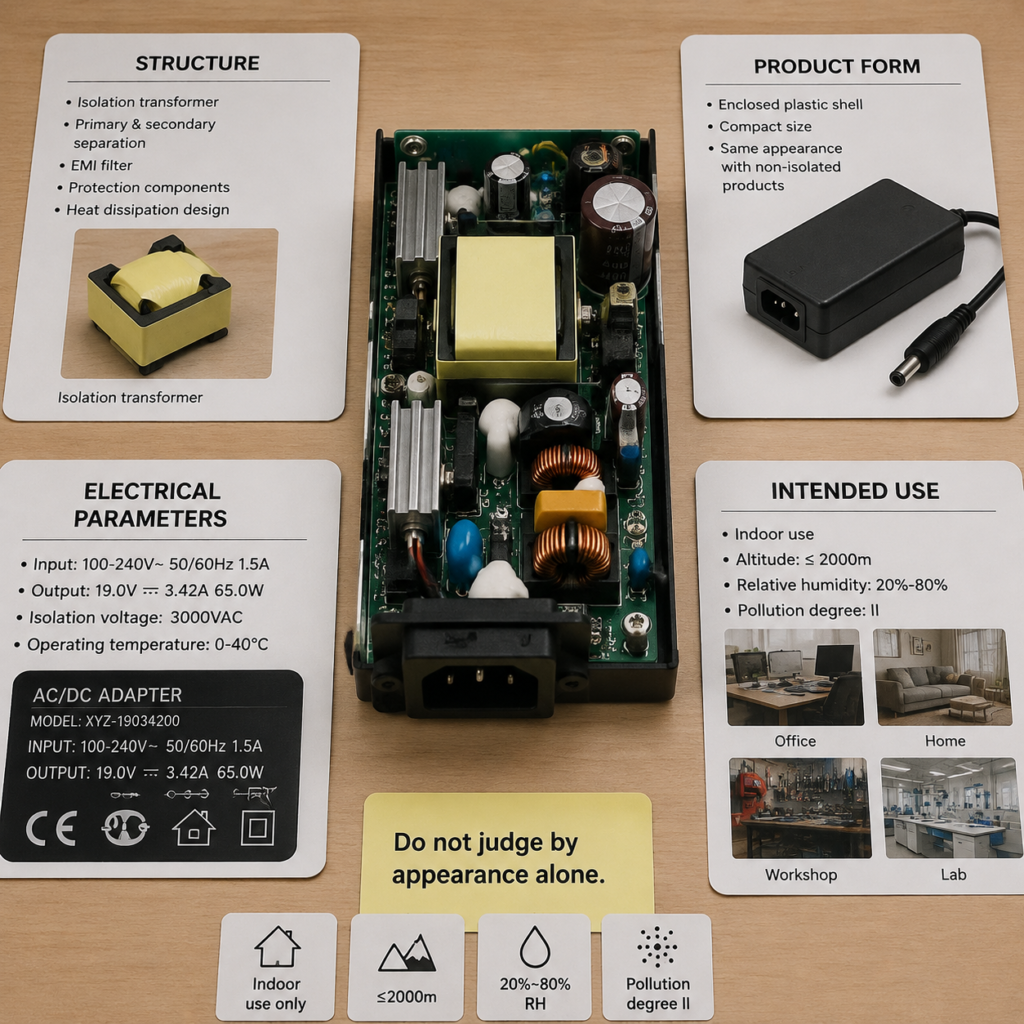
If you want to make a more accurate judgment, you need to look at these four core variables, which directly determine which standard and which part the product applies to:
- Structure type: Is it isolated or non-isolated, is it transformer type or switching power supply type — most consumer electronics chargers now are basically switching power supply type, but the requirements for isolated and non-isolated are very different.
- Product form: Is it fixed installation or movable, is it sold separately or bundled with equipment, is it external with a plug or built into the device.
- Electrical parameters: Rated input voltage range, output voltage and power, voltage category — for example, if the output voltage is within the SELV range, the requirements are different.
- Usage scenario: Is it an ordinary dry household environment, or a special environment such as medical, industrial, outdoor high humidity — special scenarios have dedicated standards with higher priority.
In Which Cases Are Other Standards Also Required?
IEC 61558 is not omnipotent. In some scenarios, complying with it alone is not enough, and other standards need to be superimposed or given priority:
- Special-purpose power supplies for medical, industrial, outdoor, high-humidity and other special scenarios should first be checked against the corresponding dedicated standards and local regulations, not just IEC 61558.
- External power supplies bundled with the whole device may be assessed separately according to IEC 61558, or may be assessed along with the whole device according to the corresponding whole-device standard, depending on the product definition, structure, and certification path.
- Since IEC 61558 does not have a unified part that covers all USB chargers, USB chargers must match the corresponding part according to their own structure, and cannot directly apply general requirements.
Easily Confused Boundary Cases
There are several boundary cases that are particularly easy to get wrong, everyone should pay attention:
First, the form of sale is not the sole determining factor. It’s not that separately sold power supplies must apply to IEC 61558, and bundled ones do not; the final determination should be based on the actual scope of the product, the manufacturer’s compliance path, specific certificates, and target market regulations.
Second, travel adapters with USB output depend on their product category, internal structure, isolation method, intended use, and target market requirements. Products with power conversion function require further evaluation; products that only convert the plug shape are usually not subject to IEC 61558, but may still be subject to other requirements.
Third, chargers that look identical on the outside may have different internal structures that apply to different parts, or even different standard systems — for example, one uses an isolated switching power supply, the other uses a non-isolated structure, the applicable requirements are completely different.
Five-Step Judgment Method, You Can Make a Preliminary Judgment by Yourself (Semi-Proficient)
If you want to quickly judge by yourself whether a product involves IEC 61558, you can follow these five steps:
- Step 1: First check if it is a power conversion device. Pure accessories such as ordinary charging cables and pure plug shape converters are usually not subject to IEC 61558 and can be excluded first; but having a power conversion function does not mean it automatically applies to IEC 61558, further checks are needed.
- Step 2: Check if there are standards with higher priority. For example, if it is a medical power supply, first look at the medical dedicated standard, no need to consider IEC 61558 first.
- Step 3: Check the product structure and isolation method. Match the corresponding dedicated part according to the structure type; for example, switching power supply products usually need to check the -2-16 part.
- Step 4: Confirm the intended use and environment. The applicable requirements are different for ordinary consumer electronics and industrial use.
- Step 5: Combine with target market regulations. Confirm the locally adopted standard version, certification scheme, and additional requirements, such as plug specifications, label language, etc.
What the Standard Looks Like: The System Structure of IEC 61558
Many people think IEC 61558 is a single document, but in fact it is a “standard family” with a clear hierarchical structure.
Two-Tier Structure: General Requirements + Dedicated Parts
IEC 61558 adopts a two-tier structure of “general requirements + dedicated parts”. For products evaluated using the IEC 61558 system, both the applicable IEC 61558-1 general requirements and the corresponding Part 2 dedicated requirements should be checked. Specific reports may be presented in merged, referenced, or separate forms, and inapplicable clauses and standard versions should also be checked.
- IEC 61558-1 (General requirements): These are the basic safety rules that applicable products must comply with, such as basic requirements for electric shock protection and overheating protection, equivalent to “general courses”.
- IEC 61558-2 series (Dedicated requirements): These are supplementary requirements for different types of power supplies and transformers, equivalent to “specialized courses”; products with different structures correspond to different parts.
Common related parts include: 2-4 (Isolating transformers for general use), 2-6 (Safety isolating transformers), 2-13 (Auto-transformers), 2-16 (Switch-mode power supply units and transformers for switch-mode power supply units). A special note here: there is no unified part covering all USB chargers. USB chargers must match the corresponding part according to their own internal structure, and cannot be applied arbitrarily. The names, versions, and scopes of all parts shall be subject to the current valid versions of IEC and the target market.
Simply put, when checking a power supply product evaluated using the IEC 61558 system, you can’t just look for the “61558” mark, but must confirm whether both the applicable general requirements and dedicated requirements are covered, and whether the report adopts a merged, referenced, or separate form. When you read the certification report, you should also pay attention to whether these contents are explained in the standard number list and remarks.
Relationship Between International Standards and Local Versions
IEC standards are internationally collaborative standards. Various regions may adopt identical or modified versions of IEC 61558, and may specify some differences through national deviation clauses, for example:
- The EU converts it to EN 61558
- The UK converts it to BS EN 61558
- Australia and New Zealand convert it to AS/NZS 61558
But note: requirements such as plug specifications, local voltage, label language, electromagnetic compatibility (EMC) and energy efficiency are not necessarily specified by the local 61558 version, and you also need to check local regulations and other applicable standards separately. The version numbers of converted versions in different regions may vary, and the specific version shall be subject to the current valid version of the target market.
Version Updates and Transition Periods: Why Only Marking the Standard Number Is Useless
IEC standards are regularly revised to update safety requirements, and reports and certificates of old versions may become invalid after the transition period. If you want to check the latest version, you can go to the IEC official website, or the official website of the standardization body of the target market.
There is a very important pitfall here: only marking “IEC 61558” is not sufficient to confirm the scope of application, part, and version, and cannot be used as proof of compliance. The complete standard number, version, report or manufacturer’s declaration of conformity, and product model should be further checked.
Important Reminder: IEC Standard ≠ Global Universal Access
Many people think that complying with IEC standards means you can sell worldwide, which is completely wrong:
First, IEC is only an international collaborative standard, not a mandatory law of various countries. Whether it can be sold locally depends on local regulatory requirements.
Second, in addition to safety standards, market access also needs to comply with a series of requirements such as plug specifications, voltage, label language, electromagnetic compatibility (EMC), and energy efficiency, not just complying with IEC 61558.
Third, if the product is marked with vague statements such as “IEC Approved”, the credibility is very low — because IEC itself does not do product certification, nor does it have so-called “IEC approval”, this is basically false propaganda by merchants.
What It Mainly Covers: The Safety Guarantees You Can Enjoy
Having talked so much about the structure, what safety issues does IEC 61558 actually cover? What guarantees can it bring us? We will explain by major categories, first to give you a bottom line: all limits and test items must be determined according to the applicable part, insulation type, voltage level, and product type; there is no unified general value, so you don’t have to memorize the numbers by rote.
Electric Shock Protection: Electrical Safety Requirements
This is the core safety requirement, which is to ensure that you will not get an electric shock when touching the charger:
- Insulation system: You can think of insulation as a “safety cover” outside live parts. The standard distinguishes between different protection methods such as basic insulation, double insulation, and reinforced insulation. Many consumer electronics external power supplies with two-pin plugs adopt Class II or equivalent double/reinforced insulation design, but whether they are Class II shall be subject to the product structure, marking, and applicable standards.
- Withstand voltage (dielectric strength): That is, applying high voltage to the insulation layer to test whether it will break down. If the insulation layer breaks down, high voltage may reach the enclosure, and people who touch it will get an electric shock.
- Insulation resistance: Measures the conductivity of insulating materials. The higher the resistance, the less electricity leaks through, and the better the electric shock protection performance usually is.
- Touch current (leakage current): Under normal operation or specified fault conditions, the current at parts accessible to the human body must be lower than the corresponding safety limit, otherwise it may cause tingling or even danger.
- Creepage distance / clearance: There must be sufficient surface distance (creepage distance) and spatial straight-line distance (clearance) between internal live parts, and between live parts and accessible enclosures, to prevent high-voltage arcing and sparking.
- Protective earth: Class I equipment needs to be provided with protective earth as specified; Class II equipment relies on double or reinforced insulation and usually does not require protective earth. The specific class cannot be judged solely by power or the number of plug pins, but should be checked against product markings, wiring structure, and applicable standards.
Fire Prevention: Thermal Safety Requirements
That is to prevent the charger from overheating and catching fire:
- Temperature rise requirements: During normal operation, the temperature of accessible enclosures and internal parts must be lower than the corresponding limits, and must not cause burns, part damage, or fire risks due to excessive temperature.
- Material and fire resistance requirements: The standard specifies corresponding material and fire resistance, flame retardant test requirements for enclosures, insulating materials, and parts that may be ignited, to reduce the risk of fire and flame spread. The specific grade and test results shall be determined according to the applicable part, and cannot guarantee that the product will never burn.
- The standard only requires that the corresponding requirements be finally met, and does not mandate a unified protection method — manufacturers can use heat sinks, better materials, or add thermal protectors, as long as they meet the test and judgment conditions specified in the applicable standards.
Prevention of Electric Shock from Breaking: Mechanical Safety Requirements
That is to prevent the charger from exposing live parts due to physical damage:
The core principle is simple: even if the charger is dropped, falls, or pulled, it must not expose the live parts inside. Common test items include enclosure strength, pin fixation, terminal or cord fixation, etc., but the specific items depend on whether the product is fixed or movable, whether it has a cord or plug, and the applicable standard part.
For example, if you often pull the cord when unplugging the charger, the relevant requirements may focus on the fixation and strain relief structure at the connection between the cable and the plug, to avoid insulation damage or exposure of live parts due to pulling during use.
Safe Even in Case of Failure: Abnormal and Durability Requirements
That is, when the charger fails, there must be no safety risks:
- Output abnormality: For example, output short circuit or overload must not cause unacceptable dangers such as electric shock and fire. Reverse polarity test is not a universal mandatory test item for all USB output chargers; whether it applies depends on the specific product type and standard requirements.
- Abnormal input: For example, when the grid voltage fluctuates or exceeds the rated load, there must be no safety hazards.
- Single fault: The standard evaluates specified single faults or foreseeable fault modes to confirm that they will not lead to unacceptable dangers such as electric shock and fire; it does not test the failure of any component in any way.
- Durability: Durability and thermal aging tests only represent safety verification under specified conditions, and are not equivalent to a guarantee of actual service life.
The Bottom Line Is Not Omnipotent: Limitations of the Standard
Finally, it must be made clear: IEC 61558 is a safety bottom line, not a guarantee of “permanent durability”:
It only verifies safety performance under specified test conditions, and does not guarantee that the product will last a lifetime. If you use it in violation of regulations — such as water ingress, dropping or smashing, overloading, or stuffing it in a quilt with poor heat dissipation — these are not within the protection scope of the standard. Even products that meet the standard may have problems if they age after long-term use or are damaged by external forces, so you should regularly check the appearance of the charger for damage.
How Design and Testing Correspond (Semi-Proficient)
You may be curious, how do manufacturers implement these safety requirements through design, and what tests are used to verify them? In fact, each type of risk has corresponding design control points and test items:
- Electric shock risk: Design is mainly controlled by primary-secondary isolation structure, insulation system, Y capacitor, creepage distance and clearance on the PCB board; corresponding tests may include withstand voltage, insulation resistance, touch current, creepage distance and clearance measurement.
- Overheating and fire risk: Design is guaranteed by transformer magnetic component selection, heat dissipation design of rectifier/switching devices, fuses/thermal protectors, and flame-retardant enclosure materials; corresponding tests may include temperature rise, material fire resistance, and abnormal tests such as short circuit and overload.
- Mechanical damage risk: Design is realized by high-strength enclosure, pin fixation structure, cord strain relief structure, and interface fixation method; corresponding tests may involve mechanical strength, terminal or cord fixation and other items.
- Failure risk: Design is prevented by overcurrent/overvoltage protection circuits, single fault tolerance design, and durable component selection; corresponding tests may include single fault, durability, and abnormal input tests.
Simply put, “design prevents risks, testing verifies effects”, but the specific design items and test items shall be subject to the standard clauses applicable to the product, and not all types of products implement exactly the same set of tests.
How to Read Reports: Teach You to Verify Compliance
If the merchant gives you a test report or declaration of conformity, how do you judge whether it is real and whether it matches the product you bought? We will first talk about the basic principles of testing, and then give you a verification checklist.
Basic Principles of Testing
IEC 61558 testing is not done randomly, there are several core principles:
First, the test simulates the harsh usage scenarios specified in the standard. The specific conditions depend on the applicable part and product type. It’s not that the stricter the better, it must meet the regulations.
Second, the test covers scenarios such as normal operation, specified single faults, and other abnormal conditions, not only testing when it is in good condition.
Third, the test results are mainly for the model, structure, and key components of the submitted samples. If the manufacturer changes the model, such as replacing the internal transformer, enclosure material, plug, or key safety components, the original testing or certification body should evaluate whether supplementary testing, report change, or re-certification is required. Product changes do not automatically invalidate the original report, but they cannot be directly used without evaluation.
Fourth, the test does not cover any abuse scenarios, such as you deliberately disassemble the charger and destroy it, which is not counted.
What Are the Main Test Items
The test items basically correspond to the safety requirements we mentioned earlier. Common items may include withstand voltage, insulation, temperature rise, abnormal operation, material fire resistance, mechanical strength, terminal or cord fixation, marking and manual verification, etc., but the specific items, sample status, number of times, and judgment conditions must be based on the applicable IEC 61558-1 and the corresponding Part 2, and some items may not be applicable.
Therefore, items such as “interface plugging and unplugging”, “polarity test” or “drop” cannot be simply listed as mandatory items for all IEC 61558 products. When viewing the report, you should also pay attention to whether the items are applicable, whether there are legal inapplicable markings, and the corresponding remarks and judgment basis.
How to Check When You Get the Report: 6 Verification Points (Semi-Proficient)
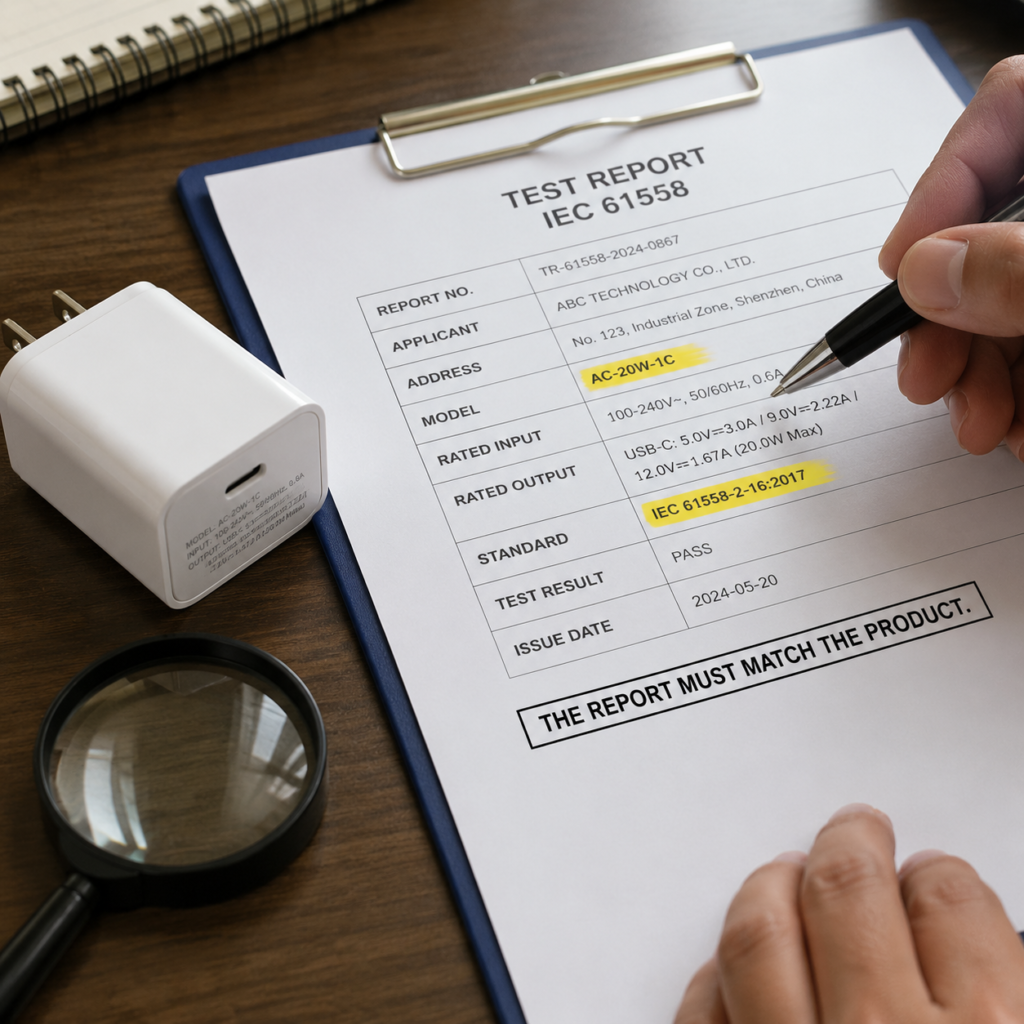
If you get a test report or declaration of conformity, you can check according to these 6 points, which can basically judge whether the materials have reference value:
- Standard information must be complete: Check whether the report covers the general part and dedicated part actually applicable to the product, and check the standard version. Relevant content may be merged in the same report, or may be presented through referenced or separate documents.
- Product information must match: The product model, rated input and output parameters, and sample photos in the report must be consistent with the product you want to buy. You cannot use the report of model A for model B.
- Test conditions must be compliant: The ambient temperature, input voltage/frequency, load conditions, etc. during the test must meet the requirements of the corresponding part, otherwise the test results cannot be directly applied under the original conditions.
- Appearance information must match: Prioritize checking the information you can see from the product appearance, such as model, parameters, plug type, manufacturer, label style — if these do not match, further verification is required.
- Check the judgment of each clause: It should be confirmed that all applicable clauses have a qualified conclusion, and distinguish between legal inapplicable clauses, conditional requirements, deviations, and remarks. You cannot understand all unimplemented items as non-compliant exemptions.
- Check the status of the report or certificate: Distinguish the role of test reports and certificates, and check the testing or certification body, certificate holder, issue date, applicable version, and change records. When the product undergoes changes in key components, structure, materials, input/output, or plugs, the original body or certification body should evaluate whether supplementary testing, report revision, or re-certification is required.
Why Inferior Chargers Cannot Pass the Test
Inferior chargers on the market basically cut corners in these areas, so they cannot pass the standard tests:
- The insulation layer is too thin, and the creepage distance/clearance is insufficient, resulting in failure of withstand voltage and leakage current tests, and easy electric shock.
- The enclosure uses materials that do not meet the requirements, and tests such as fire resistance and mechanical strength may fail, resulting in higher risk of fire and flame spread in case of failure.
- There is no reasonable fault protection design, and the temperature soars during short circuit or overload, and even catches fire directly.
- The pins and interfaces are made of poor materials, and may become loose after tests related to mechanical strength, fixation, or plugging and unplugging, and even expose live parts.
Don’t Confuse: Differences from Other Standards/Certifications
Many people see several standard numbers marked on the product when buying a charger, such as both IEC 61558 and IEC 62368, as well as CE, UKCA and other marks, and can’t figure out what the differences are. Let’s explain one by one.
Why a Charger Is Marked with Several Standards
First of all, we must understand: different standards target different risk dimensions, and a charger may involve multiple standards or regulatory requirements at the same time, which is very normal. But it’s not that the more markings the better, it depends on the mandatory requirements of your region. Non-mandatory standards are only for reference and cannot be used as a basis for compliance.
Differences from IEC 62368-1
These are the two most easily confused standards. Let’s compare them with a table for clarity:
| Comparison Dimension | IEC 61558 | IEC 62368-1 |
|---|---|---|
| Applicable Objects | For transformers, converters, power supply units and their combinations within the specified scope | Mainly applicable to audio/video, information and communication technology equipment and their related power supplies |
| Requirement Characteristics | More targeted requirements for details such as power supply transformers and insulation | A general safety framework for related electronic equipment, covering multiple energy risks in equipment |
| Applicability Logic | Depends on whether the product falls within the scope of 61558 and the corresponding part | Depends on whether the product belongs to audio/video or information and communication technology equipment and related power supplies |
Simply put, the two have different scopes of application, and there is no absolute “who is stricter”. Which standard an external power supply adopts must be determined according to the product’s intended use, structure, standard scope, and target market requirements. It cannot be judged solely by whether it is sold separately or bundled with the whole device, nor can it be generally said that both paths are necessarily compliant.
Differences from Other Common Requirements
In addition to IEC 62368, there are several other frequently appearing requirements that should not be confused:
- And IEC 60335 (Household appliance safety standard): Household appliances are usually evaluated according to the IEC 60335 series. Whether their external adapters are evaluated along with the whole appliance according to this series, or separately evaluated according to IEC 61558 or other power supply standards, shall be determined according to the specific product structure, manufacturer’s certification scheme, and target market requirements.
- And EMC (Electromagnetic Compatibility): IEC 61558 covers safety risks, while EMC covers electromagnetic interference — for example, whether the charger will interfere with your WiFi or Bluetooth. The two are independent requirements, and both may need to be complied with.
- And energy efficiency standards: IEC 61558 covers safety, while energy efficiency standards cover power consumption, such as standby power consumption. The two have no direct relationship, and complying with safety standards does not mean high energy efficiency.
- And USB PD certification: PD certification covers the compatibility of fast charging protocols, such as whether it can fast charge your laptop. It cannot replace safety certification. Don’t think that a charger with a PD mark is necessarily safe.
Cognitive Correction of Common Certification Marks
There are also several common overseas certification marks that many people misunderstand:
- CE (EU): CE is not a third-party certification mark. Whether a notified body is required depends on the specific EU regulations and conformity assessment procedures applicable to the product. Most power supply products that only fall under the Low Voltage Directive usually have the manufacturer complete the conformity assessment and sign the DoC; if other applicable regulations require the participation of a notified body, the number shall be marked according to the corresponding rules.
- UKCA (UK): Whether CE can be used or UKCA must be used in the GB market shall be judged according to the current rules issued by the UK government for specific product regulations, product categories, location of assessment bodies, and sales time; the mark rules applicable to Northern Ireland shall be checked separately.
- Australia and New Zealand compliance: Electrical equipment compliance in Australia is implemented according to applicable state/territory rules and systems such as EESS. Depending on the risk level, equipment may require certification, supplier registration, or supplier declaration, and usually uses the RCM mark. SAA Approval is a certification issued by relevant certification bodies and cannot be confused with pure test reports; whether this certification is required depends on the specific equipment and local rules.
- CB report/certificate: It is a mutual recognition system under IEC. With a CB report, it can be used as the basis for applying for certification in the target market, making certificate conversion more convenient, but it does not mean that it can be sold directly in all countries around the world, and it still needs to meet local requirements.
Practical Guide: Pitfall Avoidance for Buying Chargers and Daily Use
After talking so much theory, finally let’s get to the point: how to choose when buying a charger, and what to pay attention to in daily use?
Entry-Level Screening: Avoid 80% of Pitfalls by Looking at These Points
If you don’t want to study so much, just remember these points and you can avoid the vast majority of inferior products:
- First look at the complete product information: whether the brand, model, rated parameters, and manufacturer information are complete. Don’t buy ones with nothing.
- Check the mandatory certification marks of the target market: for example, CE for the EU, applicable rules for CE or UKCA for the UK, RCM and related compliance information for Australia and New Zealand.
- Avoid “three-no” products: those without brand, without model, without parameters. Don’t buy them no matter how cheap they are.
- Only marking “IEC 61558” without part number and version number cannot be used as a basis for compliance. The complete standard number, version, report or manufacturer’s declaration of conformity, and product model should be further checked.
Advanced Verification: 6 Steps to Check Compliance Clearly (Semi-Proficient)
If you want to be more secure, such as bulk purchasing or buying high-power chargers, you can verify in 6 steps:
- Step 1: Confirm the target sales region, clarify the local mandatory compliance requirements. For example, in the EU, in addition to safety, it must also meet EMC, energy efficiency, RoHS and other requirements.
- Step 2: Confirm the complete model and rated parameters of the product, check whether they are consistent with those on the promotional page. Don’t let the promotion say 65W but the actual label says 45W.
- Step 3: Ask the merchant for the manufacturer’s Declaration of Conformity (DoC) or certification report. If they can’t provide it, at least it means the compliance documents are incomplete, and you need to be cautious and verify.
- Step 4: Check the standard number (including part and version) and product model in the report/declaration, whether they match the product you bought.
- Step 5: Check the appearance information such as sample photos, labels, and manufacturers in the report, whether they are consistent with the actual product.
- Step 6: Confirm whether the product has undergone key changes, such as replacing the plug, power, enclosure, transformer or other key components. When changes occur, the original testing or certification body should evaluate whether supplementary testing, report revision, or re-certification is required.
Quick Identification Features of Inferior Chargers
If you buy in a physical store, or have the actual product in hand, you can quickly identify high-risk inferior products through these characteristics:
- Price significantly lower than similar regular products — this can be used as a risk warning, but cannot be used as a sole basis for judgment. You should also check the brand, model, rated parameters, manufacturer, certification documents, and actual workmanship.
- Loose pins, burrs on the enclosure, easy deformation, very rough workmanship.
- The label is a temporary sticker, with blurred fonts, incomplete parameters or standard numbers.
- “Three-no” products without brand, without model, without manufacturer information.
Safety Precautions for Daily Use
Even if you buy a qualified charger, there will be risks if you don’t pay attention when using it:
- Chargers with cracked enclosures or loose pins should be stopped immediately, don’t make do with them, they are prone to electric shock.
- Do not use in a closed environment with poor heat dissipation, such as stuffed in a quilt or under a pillow, which is prone to overheating and fire.
- Do not plug or unplug chargers for ordinary dry environments with wet hands. Water is conductive and easy to cause electric shock.
- Charging cables must be matched: cables should be selected according to the actual negotiated voltage and current of a single port and the rated capacity of the cable. If a USB Type-C cable claims to support more than 3A current, it usually needs to have a compliant electronic marker; when judging 65W, you also need to confirm the actual output power of the port, not just look at the total power of the charger.
Frequently Asked Questions
Which is stricter, IEC 61558 or IEC 62368-1?
The two have different scopes of application, and there is no absolute “stricter”. IEC 61558 is a standard for power supplies, transformers and related devices within the specified scope, with more targeted requirements for power supply details; IEC 62368-1 is mainly applicable to audio/video, information and communication technology equipment and their related power supplies. You cannot directly compare the strictness, it depends on which standard the product applies to.
Is a charger marked with IEC 61558 trustworthy?
Not necessarily. You need to confirm whether there is a complete part number and version number, whether there is a corresponding certification report or manufacturer’s declaration of conformity, and also check whether the report matches the product’s model, parameters, and structure. Just printing the standard number may be the merchant’s self-declaration or even mislabeling, and cannot be directly used as a basis for compliance.
Does the charging cable apply to IEC 61558?
Ordinary charging cables without circuits do not apply. This standard is mainly for transformers, converters and power supply units within the specified scope. Charging cables have corresponding special standards and interface specifications, and do not need to refer to IEC 61558. At the same time, cables still need to meet their own electrical, mechanical and market requirements.
Is IEC 61558-2-16 required for all chargers?
No. It mainly involves switch-mode power supply units and their transformers. If it is an old power supply using a power frequency transformer, other parts may apply; and some information technology or audio/video equipment power supplies may also be evaluated according to paths such as IEC 62368-1. The specific situation depends on the internal structure of the product, intended use, standard scope, and target market requirements.
Can an IEC 61558 report be used globally?
No. IEC is an international collaborative standard, and countries may convert it into local versions. Market access also needs to meet local requirements such as plug specifications, label language, EMC, and energy efficiency. The CB report can be used as the basis for target market certification, but it is not equivalent to direct access.
Summary
To understand IEC 61558, you don’t have to memorize complex standard numbers by rote. The core is to understand its positioning — it is an important international safety standard for power supply and transformer products within the specified scope, but it is not a mandatory universal standard for all chargers.
At the entry level, as long as you can distinguish which products may apply to this standard, know that you need to look at the complete part and version when checking the standard number, and avoid three-no products and vague promotions, you can avoid most safety pitfalls. If you want to go deeper, you can use the five-step judgment method to determine the applicability of the product, understand the structure of “general requirements + dedicated parts”, know that mainstream switching power supply products need to check the -2-16 part, and distinguish the difference between it and common standards such as IEC 62368, so you will not be misled by merchants’ promotions.
When selecting products, for entry level, you can first look at certification marks and check product information; for advanced level, you can verify the report according to the 6-step process; in daily use, pay attention to checking the appearance, maintaining heat dissipation, not plugging/unplugging with wet hands, and choosing a suitable charging cable according to the actual voltage and current of a single port, so as to minimize the safety risk of charging.