
When shopping for power banks, wireless earbud charging cases, or spare camera batteries in North America, you may often see the term “UL certification” on product pages. Many people assume that as long as this term is present, the battery is absolutely safe, but in fact, UL has hundreds of safety standards for different products. UL 2054 is one of the safety assessment standards for specific household and commercial batteries and battery packs, and whether it applies shall be determined based on the Scope of the current version and the specific certification scheme.
Many people have obvious misunderstandings about UL 2054: some think it is a globally mandatory regulation, some think it also covers chargers and charging cables, and others are confused by merchants’ marketing rhetoric of “battery cells have UL certification”. This article will explain UL 2054 clearly from basic knowledge to pitfall avoidance tips, helping you go from beginner to being able to judge the safety and compliance of batteries on your own.
How to Judge: Whether Your Battery Falls Under the Regulatory Scope of UL 2054
Many people hold up a product and ask “does this have UL 2054 certification?”, but in fact, you first need to determine whether UL 2054 applies to the product itself. You can check these core conditions in order of priority:
- Must contain battery components: Whether it is a cell, battery pack, disposable battery, or rechargeable battery, if there is no battery, it is not applicable at all;
- Intended for household/commercial scenarios: If the battery is used in vehicles, medical equipment, stationary energy storage, or other specialized products, it usually must also meet the corresponding product or application standards; whether UL 2054 also applies shall be confirmed based on the specific product, intended use, and current Scope;
- Battery parameters are within the scope covered by the standard: The battery’s chemical system, rated voltage/capacity, and structural design must meet the coverage scope of the corresponding version of the standard;
- Meets the requirements of the specific certification scheme: Different certification schemes may have additional restrictive conditions.
It is also important to note here: USB/USB-C is not a separate applicability judgment condition; whether a battery pack with USB-C is subject to UL 2054 still needs to be judged in combination with the intended use, structure, parameters, and current Scope.
Common Applicable Products (with Judgment Logic)
These products you come into contact with daily may be included in the UL 2054 assessment, but you cannot conclude this solely based on the product name:
- Built-in battery packs of power banks (portable chargers): If they are finished battery packs with protection circuits and are used in household or commercial scenarios, they may be included in the UL 2054 assessment. The complete power bank may also be subject to standards such as UL 2056;
- Built-in batteries of charging bases with backup batteries and portable wireless chargers;
- Independently sold portable batteries, such as fast-charging lithium batteries for cameras, spare batteries for flashlights, etc., which need to be judged specifically in combination with intended use, structure, chemical system, and certification records;
- Built-in battery packs of consumer electronics such as wireless earbud charging cases, portable speakers, and small handheld fans. The complete units of these products must also meet the safety standards of the corresponding categories, and it is not enough to only assess the battery.
Common Non-Applicable Products
Do not forcefully apply UL 2054 to these products just by their name:
- Batteries for specialized scenarios such as industrial equipment, electric vehicles, medical equipment, and grid energy storage power stations usually need to meet the corresponding product or application standards; whether UL 2054 also applies shall be confirmed based on the specific product, intended use, and current Scope;
- Disposable dry batteries, micro button batteries, etc.: such products need to be judged according to their type, intended use, and the scope of application of the current standard, and most adopt other specialized standards;
- Battery-free power supply/transmission accessories such as pure chargers, power adapters, and charging cables are subject to safety standards for power supplies and cables;
- Built-in batteries of complete devices such as mobile phones and laptop computers need to be comprehensively judged in combination with product structure and complete device standards, involving multiple safety standards, and cannot only look at UL 2054.
3-Step Quick Judgment Method for Ordinary Users
If you don’t want to remember so many rules, just follow these 3 steps to make a quick general judgment:
- First confirm that the product has built-in battery components, and judge whether it is a disposable battery or a rechargeable battery;
- Then confirm whether it belongs to household or commercial scenarios, or specialized products such as transportation, medical, or industrial products;
- Finally, in combination with the battery’s chemical system, rated parameters, structure, and current Scope, check the certification standard number marked on the product, or query the scope of application of the certification through official channels.
What Exactly Does the Standard Test: Corresponding to These Scenarios You Encounter Daily
Many people find the test items in the standard look like hieroglyphics, but in fact, most tests simulate risks that may be encountered in daily use. Before talking about specific tests, let’s clarify a few general rules:
- The test object depends on the certification scheme, which may be a cell or a finished battery pack — for ordinary users, battery pack-level tests have higher reference value, because most of what you buy are finished battery packs;
- Test results are affected by many variables: standard version, battery chemical system, whether the protection circuit is enabled, sample pretreatment method, certification scheme, etc., may lead to different results, and cannot be generalized;
- Different categories of tests have their own test conditions and qualification judgments, and the results of a single test cannot be directly extended to all usage scenarios;
- Electrical safety tests usually focus on whether the sample has dangerous consequences under specified abnormal conditions;
- Mechanical safety tests usually focus on whether there is fire, explosion, liquid leakage, or other specified dangerous conditions after mechanical damage;
- Environmental thermal safety tests focus on safety performance under specified temperature conditions;
- Structural insulation tests focus on whether there is dangerous voltage on accessible parts, and whether the insulation meets requirements.
The tests mentioned below are logical examples to help you understand, and the specific requirements shall be subject to the current standard text and certification scheme.
Electrical Safety: Corresponding to High-Risk Charging and Discharging Scenarios
This type of test mainly simulates abnormal situations that may occur during charging and discharging:
- Abnormal charging test: Used to evaluate the battery’s safety performance under specified abnormal charging conditions. The protection function may be realized by charging control, battery management/protection circuit, cells, and other structures together. The specific test conditions and qualification criteria shall be subject to the current standard and certification scheme;
- External short circuit protection test: Used to evaluate the safety risk of the battery under specified external short circuit conditions. The test should not be simply understood as all products must have the protection circuit “quickly cut off the current”; the actual response method and judgment conditions depend on the product structure, chemical system, and certification scheme;
- Over-discharge/over-current protection test: Used to evaluate safety performance under specified abnormal discharge conditions. Over-discharge can be used to understand risks such as long-term idleness or too low power, and over-current can be used to understand risks such as output overload, but the specific test methods and judgment standards cannot be presumed solely based on daily scenarios.
Mechanical Safety: Corresponding to Daily Usage Scenarios
This type of test simulates physical damage that may be encountered in daily use:
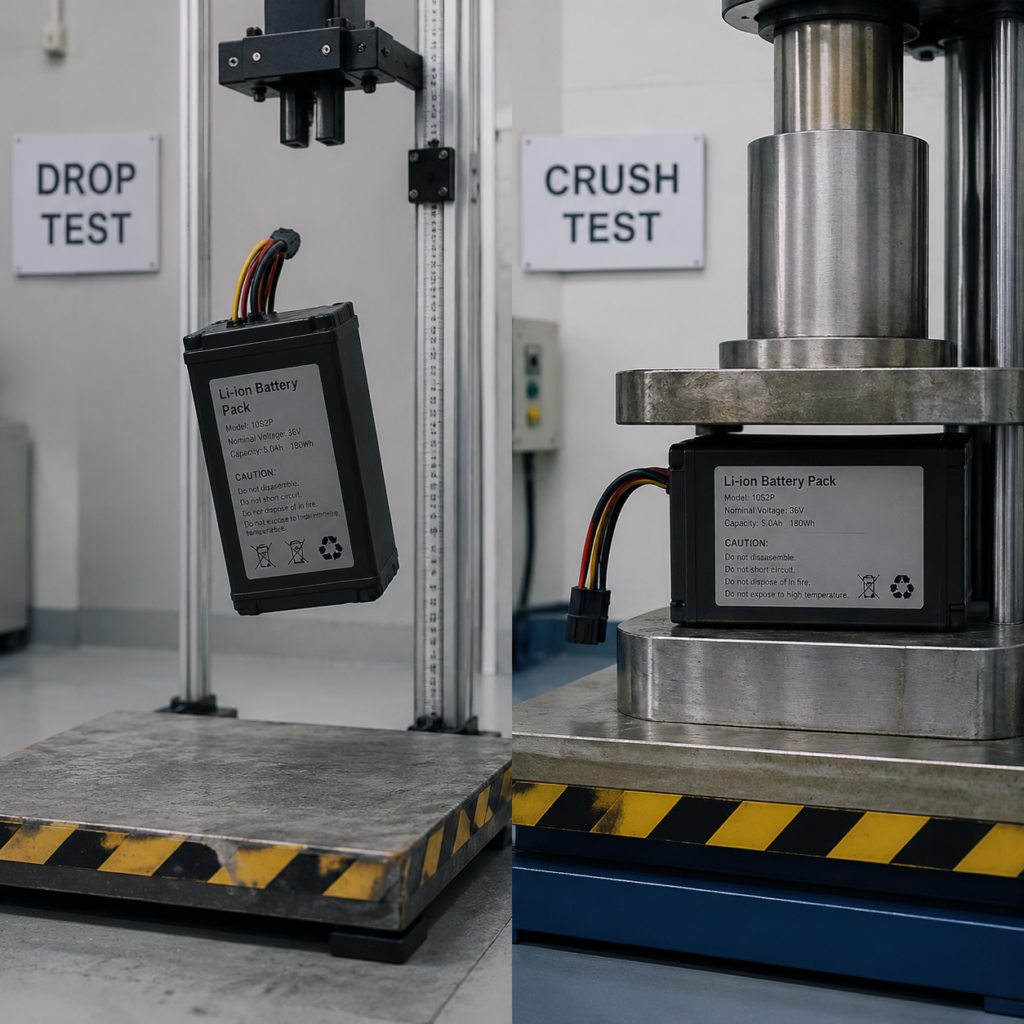
- Drop test: Simulates the scenario where a handheld product is accidentally dropped on the ground. The test focuses on assessing whether there are dangerous conditions specified in the standard after dropping and impact. The specific judgment items included shall be subject to the current clauses;
- Crush test: Simulates the scenario where the battery is squeezed by heavy objects, such as being sat on when placed in a pocket. The test is used to evaluate the safety performance of the housing and internal structure after being stressed, and cannot be generalized that all products only use “no dangerous short circuit of internal pole pieces” as the sole criterion.
Environmental Thermal Safety: Corresponding to Temperature Change Scenarios
This type of test simulates the battery safety in different temperature environments:
- Thermal abuse (high temperature exposure) test: Used to evaluate the battery’s safety performance under specified high temperature conditions. Leaving a battery in a closed car in summer, or near heat sources such as heaters or stoves, can help understand high temperature risks, but the actual environment is not necessarily equivalent to the standard test conditions;
- Temperature cycle test: Simulates usage scenarios where the product is frequently switched between high and low temperature environments, such as bringing it from a cold outdoor to a warm indoor in winter, and then taking it out immediately. The standard will specify test conditions and judgment methods based on product structure and applicable clauses, and cannot be uniformly generalized that a certain fixed result must be met after cycling;
- It is particularly important to note here: the temperature cycle test is not equivalent to verifying all low-temperature charging scenarios, and the safety requirements for low-temperature charging have separate assessment conditions, so do not confuse them.
Structural and Material Safety Requirements
In addition to performance tests, UL 2054 also specifies requirements for housing, insulation, materials, liquid leakage, and temperature according to product structure and applicable clauses, and judges them through corresponding tests:
- The housing and other materials must meet the requirements of applicable clauses, and the specific flame retardant grade and material category cannot be generalized;
- There must be sufficient insulation isolation between live parts and external interfaces, and the specific insulation requirements depend on the product structure and standard clauses;
- Requirements for liquid leakage, electrolyte, and related materials must also be evaluated in accordance with the conditions and criteria specified in the current standard, and cannot be simply understood as passing the standard can guarantee that any liquid leakage will not cause contact injury.
How Ordinary People Use It: Practical Methods from Purchase to Use
After talking about so many standards and rules, it ultimately comes down to actual use. Here is a set of practical methods from purchase to daily use for you.
Judgment Logic When Purchasing
When buying products with batteries, choosing according to these points can avoid most pitfalls:
- Confirm that the product clearly marks UL 2054 certification (for the battery/battery pack part), rather than the vague “UL certification”;
- Prioritize products whose battery packs have finished product-level UL certification, rather than only cell/component certification;
- Use chargers and charging cables specified in the product manual or clearly compatible. USB-C/USB PD devices usually determine voltage and current under compliant negotiation conditions, but it cannot be assumed that all high-power chargers, power banks, and cables can automatically match;
- Special reminder: Charging cables are not within the certification scope of UL 2054, and their insulation, rated current, and interface compliance need to be verified separately.
Risk Judgment in Daily Use
Even compliant batteries may have problems if used improperly. Stop using them immediately if the following situations occur:
- If the battery exhibits bulging, liquid leakage, peculiar odor, or housing damage, store it in isolation immediately and do not charge it;
- If the temperature continues to rise during charging, accompanied by a peculiar odor or repeated charging interruption, cut off the power immediately and stop using it;
- If the housing is deformed after dropping, and it becomes obviously hot during subsequent charging, it is recommended to replace it directly and do not continue to use it.
Safety Decisions for Common Scenarios
You may encounter these uncertain situations in daily life, here are clear judgments for you:
- Using a high-power fast charging head to charge a low-power power bank: Use a charger specified in the product manual or clearly compatible. USB-C/USB PD devices usually determine voltage and current under compliant negotiation conditions, but it cannot be assumed that all high-power chargers, power banks, and cables can automatically match; abnormal output may still cause risks;
- The power bank has no deformation in appearance after dropping, but gets hot when charging: Even if it has passed UL 2054, there may be hidden internal damage. It is recommended to stop using it and replace it;
- Power bank advertises “cells have UL certification”: This only means that the cells meet the cell-level UL 1642 standard, and does not mean that the entire battery pack meets UL 2054;
- Wireless earbud charging case marks complete device UL certification: This only means that the complete device meets the product standard of the corresponding category, and is not equivalent to the built-in battery having passed UL 2054;
- Leaving a power bank in a closed car in summer: Batteries that meet UL 2054 are not prone to thermal runaway at normal high temperatures, but if the temperature inside the car exceeds the standard test range, there is still a risk, so try not to leave it for a long time;
- Exposed metal wires of charging cable: It may cause external short circuit, so it must be replaced immediately. Do not default that the battery will definitely trigger protection — if the protection circuit fails, there will be danger.
Quick Decision Checklist
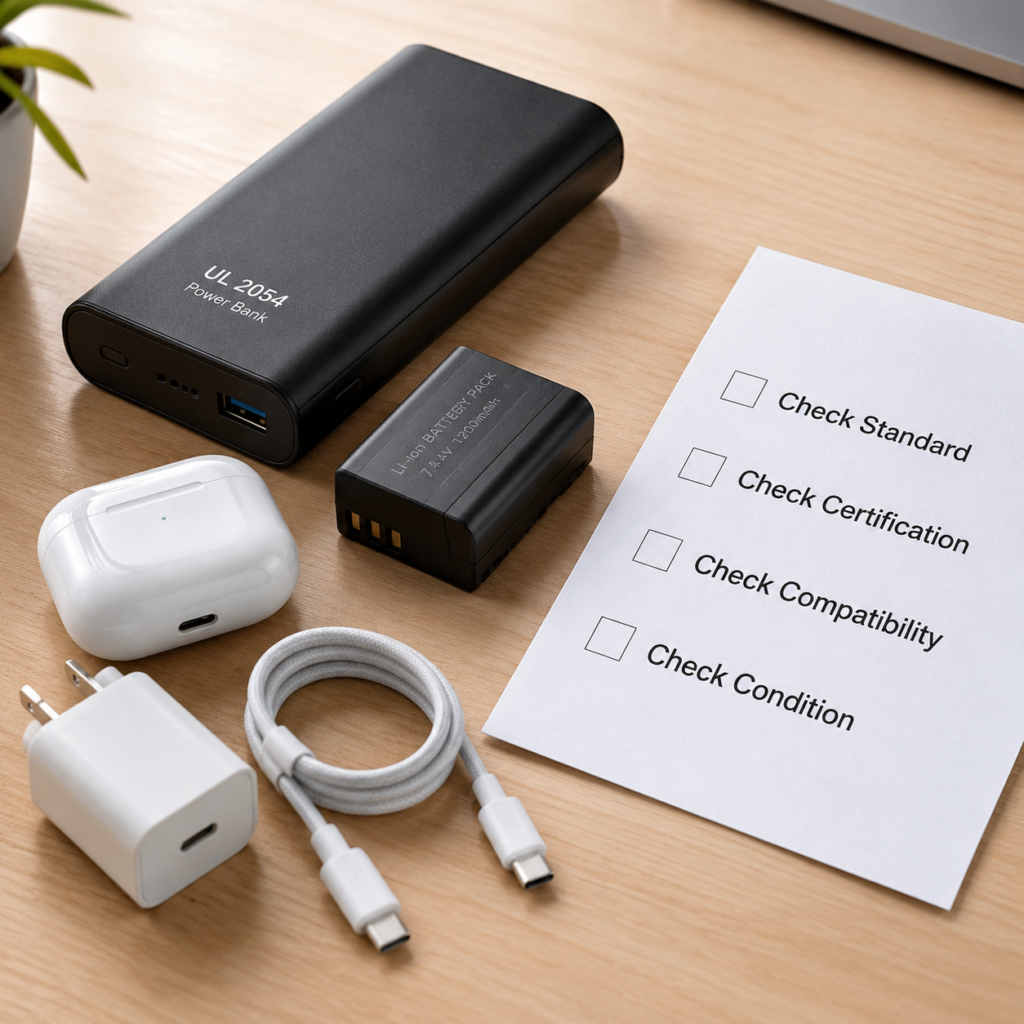
It doesn’t matter if you can’t remember so much, just remember these 4 sentences:
- When choosing batteries: look at the standard number (UL 2054), look at the certification level (finished product level), and check official records;
- When matching accessories: check chargers and charging cables against corresponding standards separately, do not confuse them with battery certification;
- When using products: use according to the requirements of the manual, and stop using immediately if abnormalities occur;
- When distinguishing misunderstandings: do not take cell certification as whole pack certification, do not take complete device certification as battery certification, do not take transportation tests as use safety certification.
Overall, UL 2054 is one of the safety assessment standards for specific household and commercial batteries and battery packs. It assesses the safety performance of batteries from multiple dimensions and is an important reference for us when purchasing battery products. But it is not omnipotent: it mainly targets the battery itself within the scope of application of the standard, and does not cover chargers, charging cables, and complete devices; it only targets specific models and certification conditions, and not all “UL certifications” are equal to UL 2054; it only covers the use and test conditions specified in the standard, and man-made damage or out-of-scope use is not within the scope of protection.
After reading this article, you should have mastered several core abilities: you can use basic conditions to judge whether a battery may fall within the applicable scope of UL 2054, you can distinguish the regulatory boundaries between UL 2054 and other common safety standards, you can identify common certification fraud pitfalls and verify authenticity through official channels, you can sort out the safety responsibilities of batteries, accessories, and complete devices, and you can also judge battery risks in combination with daily scenarios, and correctly purchase and use charging products with batteries. Mastering these, you can avoid the vast majority of battery safety pitfalls and choose more reliable products.