
If you deal with electronic accessories such as chargers and charging cables and want to enter the Indian market, you will most likely encounter India RoHS requirements. Many people’s first impression of it is that it is “similar to EU RoHS”, but when actually preparing for import and sale, they often find that the two systems cannot directly replace each other. In this article, we start from the most basic definitions, and thoroughly explain the scope of application, core requirements, practical methods, and common pitfalls of India RoHS. Even if you are a complete beginner, you can complete the entry-level self-check on your own.
First, Understand: What Exactly is India RoHS
RoHS stands for Restriction of Hazardous Substances, and its core function is to set upper limits on toxic and hazardous chemical substances in electrical and electronic products, reducing the harm of e-waste to the environment and human health. Unlike the EU RoHS that many people are familiar with, India RoHS is not an independent law, but a requirement under the E-Waste (Management) Rules. India RoHS requirements are set out in Article 16 and Schedule II of the E-Waste (Management) Rules, 2022; these rules came into effect on April 1, 2023, and in practice, subsequent amendments and CPCB requirements in effect at the time of import or sale should also be verified. Legislation is the responsibility of the Ministry of Environment, Forest and Climate Change (MoEFCC) of India, while daily supervision is implemented by the Central Pollution Control Board (CPCB).
For practitioners in the charging product industry, India RoHS is a key market compliance requirement that needs to be confirmed. For applicable products, producers must meet RoHS requirements; the CPCB may conduct market sampling inspections and take corresponding actions against non-compliant producers. Other requirements may also apply to import, registration, customs, and sales links, and specific consequences shall be subject to product category, violation circumstances, and decisions of the competent authority. Moreover, its coverage is very wide: not only obvious electronic products such as chargers and power adapters, but also related components, consumables, parts, and spare parts may be included in the requirements.
Beginners are most prone to three cognitive misunderstandings, which we will clarify here first to avoid proceeding with wrong judgments:
First, India RoHS is not equivalent to EU RoHS; the two differ in legal status, control scope, and exemption list; the EU CE marking and EU Declaration of Conformity also cannot directly replace the India RoHS self-declaration.
Second, the legal responsible entity for RoHS is the “producer” as defined in the rules, including entities that manufacture, sell, or import EEE under their own brand. Producers must ensure that new EEE and its components, consumables, parts, and spare parts are compliant; they may require suppliers to provide certification through contracts, but whether suppliers bear legal responsibility depends on whether they also qualify as “producers”.
Third, small batches do not automatically exempt applicable products from RoHS obligations; however, samples, R&D use, second-hand or refurbished products and their imports shall be confirmed on a case-by-case basis based on whether they are Schedule I products, the nature of the transaction, and concurrently applicable import and competent authority regulations.
How to Judge: Whether Your Charging Product Needs Compliance
To judge whether a product falls within the control scope of India RoHS, first confirm whether it is electrical and electronic equipment (EEE) listed in Schedule I of the E-Waste (Management) Rules. At the same time, Article 16 also requires producers to ensure that new EEE and its components, consumables, parts, and spare parts meet the requirements of Schedule II.
This means that “whether it has a chip or circuit” cannot be used as the sole judgment standard. Even if passive cables and plugs do not constitute independent EEE themselves, they may still need to comply with RoHS if provided as components, parts, spare parts, or consumables of regulated EEE; independent sale is also not the sole decisive condition stipulated in the rules.
Combined with the actual situation of charging products, we can divide products into three categories for quick judgment:
| Product Type | Specific Examples | Control Status |
|---|---|---|
| Clearly require priority assessment | Mobile phone fast chargers, PD chargers, laptop power adapters, car chargers; fast charging cables with E-Marker chips, data cables with indicator lights/overcurrent protection circuits; charging docks, multi-port charging power strips, docking stations with charging modules | First verify whether it is EEE listed in Schedule I and confirm applicable requirements |
| Boundary verification required | Purely passive ordinary charging cables, purely mechanical power plugs/adapters without electronic components, accessories bundled with complete devices | Cannot be excluded solely due to lack of electronic components; must be judged based on product classification and its use as a component, part, spare part, or consumable |
| Clearly excluded | Purely mechanical hardware fasteners/decorative parts, packaging materials such as paper boxes/plastic packaging without electronic functions | Generally not managed as EEE itself |
It is necessary to specially explain the judgment logic for boundary products: many people think that purely passive charging cables and purely mechanical plugs definitely do not need to be managed because they have no electronic components, but conclusions cannot be drawn solely based on this; ultimately, it must be judged based on official catalogs, product classification, and actual use. Accessories bundled with complete devices also cannot be judged only by whether they are sold separately, but by whether they are provided as components, parts, spare parts, or consumables of regulated EEE.
Core Requirements: What is Restricted, What are the Limits, and What Exceptions Exist
India RoHS currently controls 6 restricted substances, each of which has common sources in charging products, and is also a key focus when we conduct compliance:
- Lead (Pb): The most common source is solder on circuit boards; it may also be present in shell pigments and copper alloys of charging connectors.
- Mercury (Hg): Used in fluorescent indicators of early chargers, now very rare.
- Cadmium (Cd): May be present in connector plating of low-quality charging cables and plastic stabilizers.
- Hexavalent chromium (Cr⁶⁺): The electroplated anti-rust layer of metal charging plugs is a high-risk area.
- Polybrominated biphenyls (PBB): Flame retardants for old plastic shells, now basically eliminated.
- Polybrominated diphenyl ethers (PBDE): Commonly used flame retardants in circuit boards and plastic parts, also a high-risk substance.
How are Limits Calculated: First Understand Homogeneous Materials
Many people think that the limit is calculated based on the entire product, but that is not the case. The limit of India RoHS is determined based on homogeneous materials — the so-called homogeneous material is a single material that cannot be further divided into smaller components by mechanical methods (such as prying, scraping, disassembling). For example, the plastic shell of a charging plug is one homogeneous material, the electroplated layer on the surface of the prongs is another, and the solder on the circuit board is yet another. You cannot smash the entire product to test the average value; even if the overall average does not exceed the limit, as long as one homogeneous material exceeds the limit, it is considered non-compliant.
The specific limits are: the content of cadmium shall not exceed 100 ppm (one hundred parts per million, equivalent to a maximum of 100 milligrams of cadmium per kilogram of material), and the limit for the other five substances (lead, mercury, hexavalent chromium, polybrominated biphenyls, polybrominated diphenyl ethers) is 1000 ppm. For charging products, solder, plastic parts, and connector plating are three types of materials with higher risk of exceeding the limit, and should usually be prioritized for attention.
Exemption Rules: Not All Exceedances are Violations
For some materials or uses, because suitable alternatives cannot be found temporarily, India RoHS provides specific use exemptions, allowing exceedances within the specified scope, but exemptions can only be used in accordance with the uses and conditions listed in Schedule II.
Exemptions that may be involved in charging products include: lead in glass of cathode ray tubes, electronic components, and fluorescent lamps; lead content in copper alloys as an alloying element not exceeding 4%; lead content in aluminum alloys as an alloying element not exceeding 0.4%.
Two points should be noted when using exemptions: first, they must correspond to specific parts, uses, and conditions, and the scope cannot be arbitrarily expanded; second, the EU RoHS exemption list cannot be directly applied — India has its own applicable Schedule II, and some exemptions recognized by the EU are not adopted by India. Whether exemptions remain valid should be continuously verified against the effective legal text and subsequent amendments, and a unified 3 to 5 year period should not be assumed.
Compliance Practice: Who is Responsible, What to Do, and What Materials to Prepare
Who Bears Compliance Responsibility
India RoHS collectively refers to the responsible entities as “producers”, including entities that manufacture, sell, or import EEE under their own brand, and these are the ultimate responsible parties. Entities that import EEE into India usually fall under the definition of “producer” and need to fulfill corresponding registration and compliance obligations. Overseas brands should clarify in the transaction structure who will act as the Indian importer or producer to handle obligations; whether an authorized representative is required should also be confirmed in accordance with applicable import, product certification, and platform rules.
In addition, contract manufacturers and component suppliers in the supply chain usually need to provide material compliance certificates in accordance with contracts to help producers complete compliance verification. If a violation is caused by excessive substances in components, the ultimate responsibility will generally still fall on the importer or brand owner as the producer, so it is necessary to confirm with suppliers in advance.
Four Steps for Entry-Level Compliance
For small sellers who are new to this, there is no need to do a full set of complex tests at the beginning; follow these four steps to complete basic compliance:
Step 1: Split the product into all relevant homogeneous materials, and list the composition and supplier of each material clearly.
Step 2: Verify one by one whether the content of each material meets the limit requirements, and whether there are applicable India RoHS exemptions.
Step 3: Collect and organize all compliance certification documents, such as supplier declarations, test reports, etc.
Step 4: Keep all documents properly. If the product’s materials or suppliers change in the future, re-evaluate compliance, and do not think it is done once and for all.
What are the Compliance Certification Materials

India RoHS implements a self-declaration system, and there is no mandatory requirement for third-party certification. The core legal requirement is that the producer makes and submits a RoHS self-declaration, and provides the composition information of the product and its components, consumables, parts, and spare parts as required by the rules.
In actual certification and risk management, the following supporting documents are usually prepared:
- Product Bill of Materials (BOM): Mark the material of each part and the corresponding supplier.
- Supplier Compliance Declaration: Clarify the RoHS information applicable to the material or part, and try to correspond to the specific model, material version, or supply batch.
- High-Risk Material Test Reports: Corresponding testing evidence can be prepared for high-risk materials such as solder, plastic parts, and connector plating.
- Product RoHS Self-Declaration: Made by the responsible entity as the producer in accordance with the requirements of the rules.
Many people do not know how to judge whether a third-party test report is useful. It mainly depends on three points: first, whether the test object corresponds to a specific homogeneous material; second, whether it covers all 6 restricted substances required by India RoHS; third, whether the test sample is consistent with the actually sold model and material version.
Since the limit is calculated based on homogeneous materials, whole-product mixed testing is usually not sufficient to alone prove that all materials are compliant; but this does not mean that whole-product test reports are of no value. The sufficiency of the entire set of evidence should be judged in combination with material splitting, sample correspondence, testing methods, and other supporting materials.
What Should be Marked on Products and Packaging
For RoHS, composition information of the product and its components, consumables, parts, and spare parts shall be provided in accordance with Article 16, and the required self-declaration shall be completed.
Whether products and packaging must also use the crossed-out trash bin symbol, indicate the country of origin, importer information, etc., shall be verified separately against other provisions of the E-Waste Rules, metrology rules for packaged commodities, BIS requirements, and product category regulations; do not collectively refer to these as three fixed RoHS markings.
Don’t Confuse: Differences from Other Common Compliance Requirements
Many people confuse India RoHS with other compliance requirements, so we will clarify them one by one:
Differences from EU RoHS
The two have similarities: the 6 core restricted substances and basic limits are consistent, and the judgment logic for homogeneous materials is also the same. But the differences are also obvious, and they cannot be directly used interchangeably.
The EU CE marking and EU Declaration of Conformity cannot replace the RoHS self-declaration that Indian producers should make. EU supply chain materials or homogeneous material test reports can be used as supporting evidence, but they can only be used for India compliance verification when the actual model, material version, test items and methods, limits, and India Schedule II exemptions all match.
| Comparison Item | India RoHS | EU RoHS |
|---|---|---|
| Legal Status | Provisions under the E-Waste (Management) Rules | Independent EU mandatory directive |
| Controlled Substances | 6 types | 10 types (4 additional phthalates) |
| Exemption List | Independently formulated by India, not fully consistent with the EU’s | Unified EU list |
| Document Universality | EU CE marking and EU Declaration of Conformity cannot directly replace India RoHS self-declaration | Universal across EU member states |
Differences from India EPR
EPR stands for Extended Producer Responsibility. Simply put, after a product is sold, the producer is also responsible for its recycling and treatment after scrapping. India RoHS controls the content of hazardous substances in the production stage, while EPR controls the recycling and treatment responsibility after disposal. Both are part of the E-Waste (Management) Rules, need to be completed simultaneously, and cannot replace each other.
Differences from India BIS/CRS
BIS is the Bureau of Indian Standards, and CRS is its Compulsory Registration Scheme, which mainly controls the safety and performance of products — for example, whether a charger has electric leakage, whether the output power is sufficient, whether it has over-temperature protection, these are all contents that BIS may involve. RoHS controls the content of hazardous substances in materials. The two are completely independent systems and do not cover each other.
Whether a charging product also requires CRS registration shall be confirmed item by item in accordance with the current effective compulsory registration product list, product definition, and corresponding Indian standards; products listed in the CRS scope need to meet both the corresponding BIS/CRS requirements and applicable RoHS requirements.
Differences from Energy Efficiency and Battery Regulations
Energy efficiency regulations focus on the energy performance of products, such as whether the conversion efficiency of a charger is high, whether it consumes power; energy saving does not equal RoHS compliance. Battery regulations are specifically for hazardous substances and recycling requirements of batteries. If your charging product has a built-in battery (such as a charging dock with a battery), separate assessments are required: the battery part follows battery regulations, and other electronic parts follow RoHS.
Pitfall Avoidance Guide: 8 Most Common Mistakes
We have compiled the 8 most common pitfalls when dealing with India RoHS. Avoiding them in advance can save a lot of trouble:
Product Classification Pitfalls
- Passive charging cables/pure plugs definitely do not need compliance: Do not take it for granted. Passive cables and plugs cannot be automatically excluded just because they have no chips; they must be judged based on whether they are products listed in Schedule I and their use as components, parts, spare parts, or consumables.
- Refurbished/used chargers do not need to re-confirm compliance: Refurbished or second-hand EEE cannot automatically prove current compliance solely based on old documents; it is necessary to verify whether their refurbishment activities, EPR obligations, and replaced new components meet applicable requirements. For newly replaced EEE, components, parts, or spare parts, RoHS shall be evaluated in accordance with Article 16; it is not appropriate to generically state that all refurbished products must have their entire unit re-evaluated as new products.
Limit Determination Pitfalls
- A whole-product RoHS report can handle spot checks: Regulatory limits are determined based on homogeneous materials, and whole-product mixed testing is usually not sufficient to alone prove that each homogeneous material is compliant. The sufficiency of evidence should be judged in combination with material splitting, sample correspondence, and testing methods.
- EU RoHS exemptions can be directly applied: India has its own exemption list, and some exemptions recognized by the EU are not adopted by India. Be sure to confirm against the official effective version of India.
Compliance Operation Pitfalls
- Having a supplier’s RoHS declaration is enough: The supplier’s declaration should preferably correspond to specific materials, models, or supply situations, and if the declaration is false, the ultimate responsibility is usually still borne by the local Indian importer or brand owner. Declarations can be used as supporting materials, but should be judged in combination with other evidence.
- Exemptions can be used permanently: Exemptions can only be used in accordance with the uses and conditions specified in Schedule II, and their validity should be continuously verified in accordance with subsequent amendments to the regulations; they cannot be taken as done once and for all.
Market Access Pitfalls
- Small batch/sample orders do not need compliance: Small batches do not automatically exempt applicable products from RoHS obligations; however, samples, R&D use, second-hand or refurbished products and their imports shall be confirmed on a case-by-case basis based on product classification, transaction nature, and concurrently applicable import and competent authority regulations.
- Having BIS certification equals RoHS compliance: The two are completely independent systems, with different control contents, and do not cover each other. Even if a product requires BIS/CRS, it is still necessary to confirm applicable RoHS obligations.
Entry-Level Self-Check: Complete It Yourself in 4 Steps
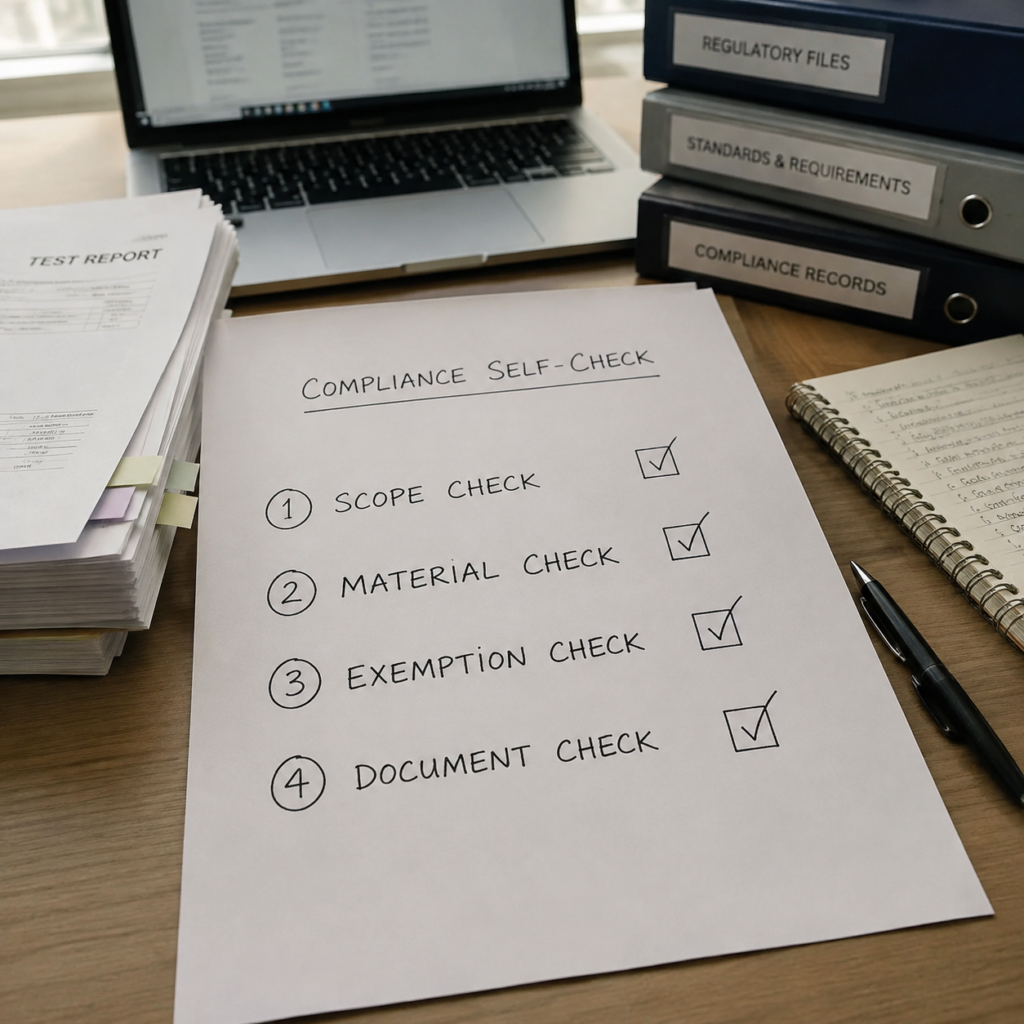
If you do not want to spend a lot of money on a full set of tests at the beginning, you can first do an entry-level self-check according to these four steps to cover the main risks:
Step 1: Determine if it is Within the Control Scope
First confirm whether the product is EEE listed in Schedule I, then confirm whether the product is provided as a component, consumable, part, or spare part of relevant EEE. You cannot only look at whether the product has electronic components or circuits; boundary products such as purely passive charging cables and plugs without electronic components should also be confirmed in combination with official catalogs, product classification, and actual use.
Step 2: Verify Compliance of High-Risk Materials
Solder, plastic, plating, and PCB can be prioritized for risk screening, and ask suppliers for India RoHS compliance declarations or test reports for these materials.
However, the compliance conclusion should still cover all relevant homogeneous materials in the product and applicable components, consumables, parts, and spare parts. Before a full-coverage verification is completed, this can only be used as a preliminary risk screening, and cannot be called product RoHS compliance confirmation.
Step 3: Verify the Applicability of Exemptions
If your product has parts that may use exemptions, such as copper alloys, glass, and aluminum alloys, confirm whether they meet the requirements against the effective Indian RoHS exemption list. Never directly apply EU RoHS exemption items.
Step 4: Check Documentation and Information Provision Requirements
First verify whether the RoHS self-declaration and the composition information of the product and its components, consumables, parts, and spare parts are complete; then check whether supporting documents such as BOM, supplier compliance declarations, and high-risk material test reports can correspond to the actual product.
Whether the product or packaging needs the crossed-out trash bin symbol, country of origin, or importer information, etc., shall also be confirmed separately in accordance with other provisions of the E-Waste Rules, metrology rules for packaged commodities, BIS requirements, and specific product category regulations.
RoHS certification materials shall be properly preserved during the period required for product placement on the market and regulatory verification; the specific retention period shall be determined in accordance with the current effective E-Waste Rules, registration conditions, other applicable regulations, and contract requirements, and should not be generically stated as a uniform 3 years.
Final Summary
After reading this article, you should be able to independently complete the following tasks: quickly judge whether a charging product may fall within the control scope of India RoHS, verify whether the limits and exemptions of high-risk materials such as solder and plastic parts meet the requirements, distinguish the different obligations of India RoHS from EU RoHS, BIS, EPR, and energy efficiency regulations, avoid common compliance pitfalls, and complete the entry-level risk self-check of the product.
For small and medium-sized sellers who have just entered the Indian market, there is no need to pursue perfect compliance at the beginning. Start with product classification and high-risk materials, and then gradually improve the full material coverage and certification documents. If the product’s materials, suppliers, or components change in the future, remember to re-evaluate compliance to avoid greater compliance risks caused by small changes.