
Merchants exporting charging products to Vietnam have most likely heard of the “CR mark” — either freight forwarders say customs clearance is impossible without this mark, or e-commerce platforms require uploading a CR certificate before listing. Many people get confused when they first encounter it: What exactly is CR? Do my chargers and charging cables need it? Can a CB report be used directly? This article explains the core rules, judgment methods, practical procedures, and pitfall avoidance points related to Vietnam’s CR mark from beginner to semi-proficient level, focusing on common products such as chargers and charging cables.
Pre-check: Does your charging product need CR?
Important Reminder: The following quick check table is for preliminary screening reference only. Vietnam’s CR is a conformity mark applicable to products regulated by mandatory technical regulations; whether a specific product requires conformity certification, declaration of conformity, registration, or national quality inspection upon import shall be determined separately based on the current catalogs of the competent ministries responsible for the corresponding product areas, applicable QCVNs, and import regulations. Product regulatory requirements are updated and adjusted with regulations. Rechecking before each import is recommended, and this guide does not replace official written confirmation.
| Product Type | Preliminary Screening Conclusion | Example |
| Mains-input chargers/adapters | To be confirmed in combination with product definition, intended use, competent authority catalogs, and QCVNs; cannot be judged solely by mains input | 65W USB-C PD wall charger |
| Passive low-voltage charging cables/data cables | To be confirmed based on the valid catalog at the time of import and applicable QCVNs | Ordinary USB-A to USB-C charging cable |
| Low-voltage charging cables with E-Marker chip | The chip itself does not directly determine the regulatory attribute; confirmation still needs to be combined with product functions, import form, and catalogs | 100W USB-C to C cable with E-Marker |
| Smart chargers with wireless communication modules | In addition to the product’s own quality requirements, additional verification of radio regulatory requirements is needed | Smart wireless charger with WiFi |
This table is only for quick preliminary judgment. The specific determination shall be combined with the subsequent five-step method and the official confirmation from the competent authority, designated body, or accredited body.
Beginner Basics: What is the CR mark, and what does it regulate?
Core Definition and Function of the CR Mark
The CR mark is a conformity mark in Vietnam applicable to products regulated by mandatory technical regulations. Whether a specific product requires conformity certification, declaration of conformity, registration, or national quality inspection upon import depends on the Group 2 or other mandatory regulatory product catalogs issued by the competent ministries responsible for the corresponding product areas, applicable QCVNs, and relevant import regulations. Not all electronic products are subject to the same “CR certification process”.
QCVN refers to Vietnam’s national technical regulations, which are mandatory technical requirements that may cover safety, electromagnetic compatibility, energy efficiency, etc. For charging products, the CR mark is not a universal document that alone determines customs clearance, sales, or accident liability. For products subject to mandatory technical regulations, the CR mark may be used as required and placed on the market only after completing the procedures required by the regulations, such as conformity assessment, declaration of conformity or registration, and import quality inspection; the CR mark itself does not exempt product liability or other civil, administrative, or criminal legal liabilities.
Common Risks of Non-Compliance
If a product falls within the scope of mandatory regulation but has not completed the applicable compliance procedures, it may face three types of risks:
• Import stage: If problems are found by customs or relevant quality inspections, the goods may be suspended from release, detained, returned, or subject to fines and other penalties.
• Distribution stage: If offline stores or online e-commerce platforms are spot-checked by market regulatory authorities, they may be required to remove products from shelves, make rectifications, or even have non-compliant products confiscated.
• After-sales stage: If a product causes a safety accident, the enterprise may still bear corresponding liabilities in accordance with laws on product quality, safety, and consumer protection. The CR mark does not automatically determine or reduce these liabilities.
Division of Regulatory Responsibilities
CR-related regulation in Vietnam is not uniformly covered by a single agency for all electronic products; different products may be under the responsibility of different competent ministries:
• Vietnamese competent ministries for corresponding product areas: Responsible for issuing applicable QCVNs, Group 2 or other mandatory regulatory product catalogs, and specifying requirements for conformity assessment, declaration, registration, and import quality inspection.
• Quality management agencies in the field of science and technology, such as STAMEQ: Mainly responsible for standards, metrology, quality management, and related accreditation or designation within their scope of authority. STAMEQ does not uniformly issue mandatory catalogs or QCVNs for all electronic products.
• Designated certification bodies and accredited laboratories: Responsible for product testing, conformity assessment, or issuance of relevant technical documents within the designated scope and accreditation scope of the corresponding competent authority. The designation qualification of certification bodies, the accreditation scope of laboratories, and product coverage need to be verified separately.
• Vietnamese importer or local responsible entity: Usually responsible for the declaration of conformity, registration, Vietnamese language labeling, and related quality responsibilities during import. Specific responsibilities depend on applicable regulations and import arrangements. The certificate applicant or the entity specified on the certificate shall be confirmed in accordance with applicable QCVNs, assessment schemes, and requirements of the designated certification body; it cannot be generally assumed that overseas manufacturers cannot be listed on the certificate.
• Customs and import quality inspection authorities: Responsible for document verification, customs declaration, and national quality inspection during import.
• Market regulatory authorities: Responsible for spot checks in the distribution stage, handling of violations, and supervision of rectification or recall when necessary.
Logical Relationship Between Core Documents and the CR Mark
Many people confuse various types of documents. We can use the analogy of “taking the college entrance exam” to quickly clarify:
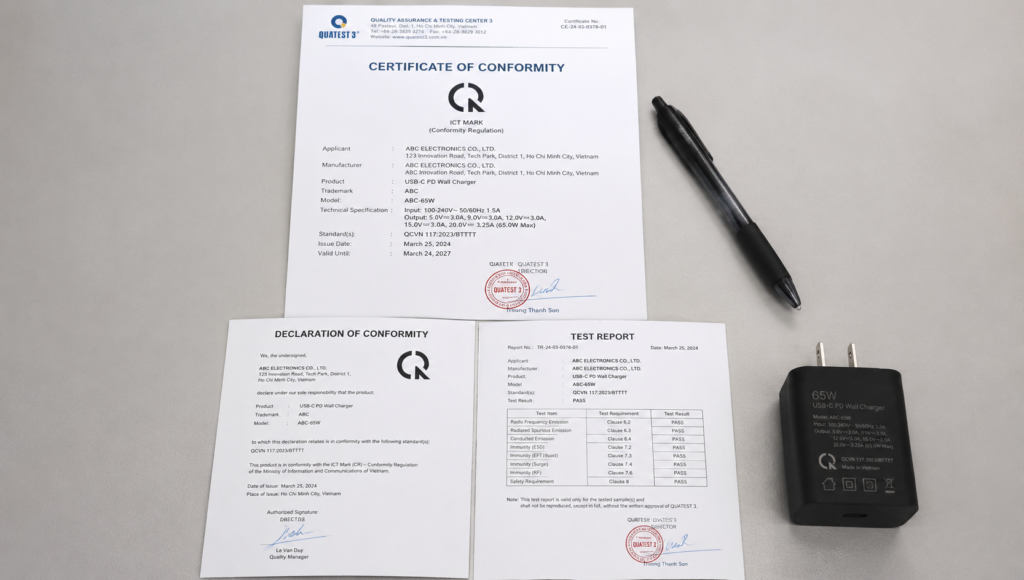
• Test report: Equivalent to an exam transcript, it is an important technical basis for conformity assessment, proving that the submitted sample has been tested according to certain standards and obtained corresponding results. However, it usually cannot alone replace the declaration of conformity, registration, certification, or import quality inspection documents required by regulations.
• Certificate of Conformity (CoC for short): A document issued by a designated certification body under certain conformity certification routes. Not all Group 2 products uniformly take the CoC as the only prerequisite document.
• Declaration of Conformity (DoC for short): Made by the manufacturer, importer, or other responsible entity as specified by regulations. Whether it must be based on a CoC depends on applicable QCVNs, specific assessment methods, and requirements of the competent authority; some methods allow making a declaration based on test results from designated or accredited laboratories and other specified documents.
• Import quality inspection document: Used for national quality inspection or release procedures during import. Its relationship with product conformity certification and declaration of conformity shall be confirmed in accordance with specific product regulations and import procedures; one document cannot simply replace another.
• CR mark: A conformity mark used after the product complies with applicable mandatory technical regulations and completes the required procedures. The specific pattern, usage method, and placement shall be confirmed in accordance with relevant regulations, QCVNs, and certification or declaration requirements. It cannot be designed independently, nor can the CR mark replace other statutory documents.
Validity Boundary of Overseas Certifications
Many people ask: I have CE, CB, FCC certificates, can I use them directly? The answer is: Overseas certifications or reports usually cannot directly replace the applicable conformity procedures and CR mark requirements in Vietnam.
A CB report can be submitted as technical data, but the designated certification body shall decide whether to accept it, require supplementary testing, or require retesting based on applicable QCVNs, report coverage, laboratory qualifications, international mutual recognition or cooperation arrangements, report version, and Vietnam’s difference requirements. Not all products or all CB reports necessarily require additional so-called “Vietnam national difference testing”, nor does having a CB report mean it can be directly converted into a Vietnamese document.
Regulatory Basis and Version Verification Methods
When doing certification, you cannot just listen to what the agency says. Only by mastering the official verification methods yourself can you avoid pitfalls.
Types of Core Regulatory Documents
Vietnam’s CR-related regulations have different levels, and all requirements are subject to the official current valid text:
1. Group 2 or mandatory regulatory product catalogs and supporting QCVNs: Used to determine whether a product is subject to mandatory quality regulation. Being listed in the catalog does not mean that all products must adopt the same conformity certification route; the specific situation depends on the corresponding regulations.
2. QCVN (Vietnam National Technical Regulation): Mandatory technical requirements that may cover safety, electromagnetic compatibility, energy efficiency, etc.
3. TCVN (Vietnam National Standard): Most are recommendatory standards. Only when cited by QCVNs or other mandatory regulations may the relevant content become mandatory requirements.
4. Rules for national quality inspection of imports: Clarify the registration, inspection, document submission, and release requirements for certain products during import.
5. Label and mark management regulations: Clarify the use requirements for commodity labels, Vietnamese supplementary labels, and the CR mark.
Official Verification Channels
When checking regulations, you must use official channels and do not only trust second-hand information from informal websites:
• Official websites of competent ministries responsible for corresponding product areas: Query applicable Group 2 or mandatory regulatory catalogs, QCVNs, import quality inspection requirements, and lists of designated bodies.
• Official websites of quality management agencies such as STAMEQ: Query standards, quality management, accreditation, or designation information within their scope of authority.
• Official website of Vietnam Customs: Query the latest policies and requirements for import regulation.
It should be particularly emphasized here that: HS codes are only an aid for customs clearance classification and cannot alone determine whether CR or other conformity procedures are required. The same HS code may cover multiple products, some of which are subject to mandatory regulation, while others may not be subject to the same requirements. The final determination must be combined with the actual functions, intended use, and applicable catalogs of the product.
Regulatory Version Verification Requirements
Vietnam’s product catalogs and QCVNs are updated, so you cannot use rules from several years ago to judge current products. When verifying, the following fields need to be recorded: document name, issuing authority, number or revision, effective date, applicable products, official link, and last verification date. It is recommended to keep written records.
The timing of verification is also important: re-verification should be carried out before new product introduction, before each batch import, and after the release of regulatory update announcements. If you have doubts about the rules, you can apply for written confirmation from the competent authority, designated body, or accredited body responsible for the product, and do not guess on your own.
Five-Step Method for Scope Judgment: Does a Charging Product Need CR?
If the quick check table cannot give a clear conclusion, you can use this five-step method to judge step by step.
Step 1: Collect Product Factual Information
The premise of judgment is to have complete product information; you cannot just say “I have a charging cable”. The core information to be collected includes:
• Core parameters: input and output voltage, current, power, port type, whether with power conversion, whether connected to mains.
• Product features: whether with wireless communication module, whether with active chip, plug standard.
• Sales form: sold independently or sold as a set with the whole machine, sales channel.
• Entity information: manufacturer, factory address, Vietnamese importer or responsible entity.
• Customs clearance information: HS code, import method, import batch.
The core of judging CR or other mandatory quality requirements is the actual function, intended use, and regulatory classification of the product, rather than the product name. Even if they are all called “charging cables”, different functions, import forms, and product definitions may correspond to different regulatory requirements.
Step 2: Mapping to Mandatory Catalogs and QCVNs
With the collected product information, match them according to product function, intended use, input type, and technical features against the Group 2 or other mandatory regulatory catalogs issued by the competent ministries responsible for the corresponding product areas and the corresponding QCVN requirements.
After matching, three preliminary screening conclusions can be formed: subject to mandatory regulation, no mandatory regulatory entry matched temporarily, or boundary needs confirmation. However, it is still necessary to further verify whether the specific procedures to be handled are conformity certification, declaration of conformity, registration, national quality inspection upon import, or a part of them.
If you cannot accurately match by yourself, you can be assisted by compliance specialists, designated bodies, or local agencies familiar with Vietnamese regulations.
Step 3: Confirm the Conformity Assessment Method
• Products subject to mandatory regulation: First confirm the applicable competent authority and QCVN, then handle according to the assessment method, declaration, or certification route specified in the regulation. Methods such as batch, type, and system cannot be regarded as general schemes that all charging products can freely choose.
• Products not included in the relevant mandatory regulatory scope: Usually, they are not required to obtain the CR mark due to CR rules, but they may still be subject to general product quality, labeling, consumer protection, or other special regulatory requirements.
At this step, it is best to obtain written confirmation of the assessment method, clarifying which documents are required, which entity shall handle them, and whether import quality inspection is applicable.
Step 4: Clarify Import and Market Access Procedures
First confirm the competent authority, QCVN, and import procedures applicable to the product, then handle according to the corresponding regulations:
• Products subject to mandatory regulation: Complete the corresponding conformity assessment, declaration of conformity or registration, national quality inspection upon import, and labeling procedures in accordance with regulatory requirements.
• Products not subject to CR mandatory regulation: Only need to meet general import documents, labeling, and other applicable requirements, and shall not use the CR mark without authorization.
• Special products: If they have wireless communication functions, they may also require radio equipment type approval, licensing, or other communication regulatory procedures. Whether ordinary charging products involve additional access permits shall be verified in combination with specific functions.
It cannot be understood that all documents must be obtained in the same order before customs clearance. Some import quality inspection procedures may be handled after customs declaration, before release, or at other time points specified by the competent authority, depending on product regulations and import procedures.
Step 5: Official Confirmation for Boundary-Ambiguous Products
If the matching result is boundary-ambiguous and uncertain, never make a decision on your own. You should first seek assessment from a designated or accredited body responsible for the product area, and apply for written confirmation from the competent authority if necessary.
When applying, you can prepare: product specifications, photos, HS code, sales form, intended use description, description of whether sold with the whole machine, and import method description. Obtaining the agency’s assessment opinion or the competent authority’s written reply in the end is a more reliable conclusion.
Core Requirements: Technical Rules and Labeling Specifications
After confirming that the product is subject to mandatory technical regulations, it is necessary to understand the specific compliance requirements. The following content is only a framework for understanding; actual projects shall still be subject to applicable QCVNs and their referenced standards.
Core Safety Technical Requirements
The safety items, test limits, and applicable scope for different products are not exactly the same. It is necessary to confirm whether the following contents need to be tested according to the QCVN and referenced standards corresponding to the specific product:
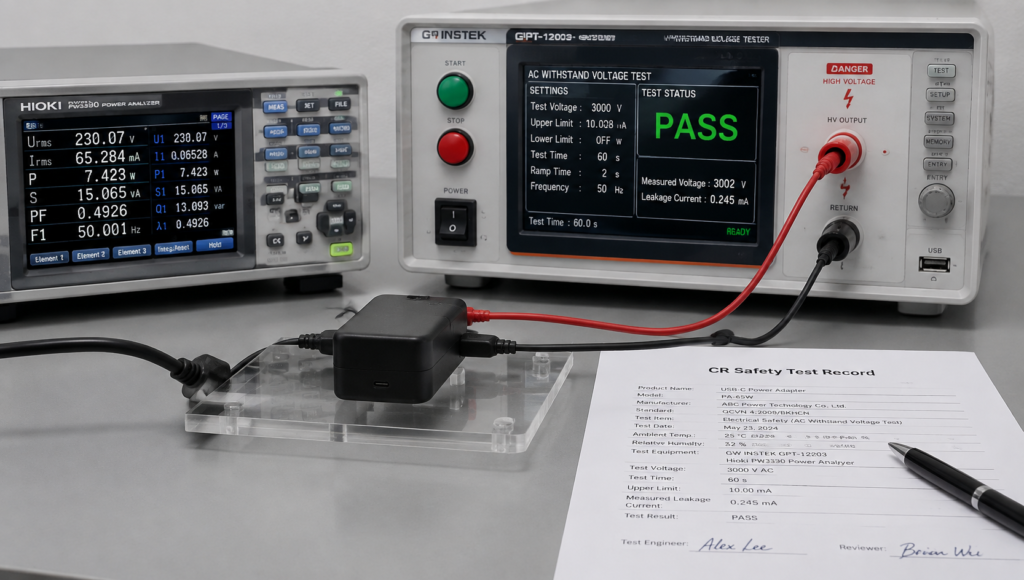
• Insulation and electric shock protection: Check the isolation of live parts, insulation, creepage distance, clearance, and protection under normal and abnormal use conditions.
• Temperature rise and abnormal operation: Test temperature rise and protection performance under normal operation, overload, short circuit, or other abnormal conditions according to product category.
• Flame resistance: When applicable, check the flame resistance or flame retardant performance of the enclosure, insulating materials, and other key components.
• Grid compatibility: Whether the rated input covers Vietnam’s commonly used 220V, 50Hz power grid shall be confirmed in combination with product use, nameplate, and applicable standards, and cannot be judged solely by a unified conclusion.
USB interfaces cannot be simply understood as “metal contacts cannot be energized”. Contacts such as USB VBUS may inherently carry safety low-voltage potential during normal operation. What really needs to be confirmed is whether they meet the requirements of safety low voltage, insulation, accidental touch protection, creepage distance, and abnormal conditions specified in applicable standards.
Additional Technical Requirements
These requirements are not automatically applicable to all products and need to be confirmed according to product category, competent authority catalogs, and QCVNs:
• Electromagnetic Compatibility (EMC): That is, the product shall not cause interference exceeding limits to other equipment during operation, and shall have the specified anti-interference ability. Whether it is mandatory depends on the product category, applicable QCVNs, and catalogs. There is no unified power threshold, so do not believe the saying that “EMC is not required below a certain wattage”.
• Energy efficiency requirements: Energy efficiency labels or minimum energy efficiency requirements are only applicable when the product falls within Vietnam’s current energy efficiency catalog and its applicable regulations. Whether external power adapters are included must be verified against the specific catalog and regulations effective at the time of import, and cannot be directly regarded as an established catalog category.
• USB-C/PD fast charging requirements: If applicable safety or performance standards involve multi-port output, temperature rise, overload protection, or protocol functions, confirmation shall be carried out in accordance with the corresponding requirements. Products with fast charging protocols shall also verify power negotiation and protection functions to avoid damage to electrical equipment due to protocol or protection design issues.
Marking and Labeling Requirements
Labeling is a link prone to problems, but the specific requirements for the product body, packaging, and instructions are not exactly the same for all charging products. They shall be confirmed in combination with Vietnam’s commodity labeling regulations, applicable QCVNs, and product types:
• Product body and packaging information: The content and carrier of information such as model, rated input and output parameters, country of origin, and responsible entity shall be determined in accordance with applicable regulations; not all information must be directly printed on the product body.
• Vietnamese supplementary label: Imported goods can usually meet the corresponding requirements by adding a Vietnamese supplementary label to the original label. The importer shall ensure that statutory content such as Vietnamese information, responsible entity, and country of origin is complete and accurate, and complies with applicable regulations such as Decree 43/2017/ND-CP and Decree 111/2021/ND-CP.
• Instructions and safety warnings: Whether Vietnamese instructions, warning content, and specific formats must be attached shall be confirmed in accordance with commodity labeling regulations, applicable QCVNs, and product types. It cannot be simply summarized that all mandatory catalog products are fully subject to the same set of requirements.
• Importer’s supplementary label: When supplementary information is needed, a Vietnamese label shall be affixed in accordance with the law, and shall not cover the original mandatory marks or cause information contradictions.
• CR mark: It can only be used as required after completing the applicable conformity procedures. The pattern, size, usage method, and placement shall be confirmed based on relevant regulations, QCVNs, and certification or declaration requirements. Do not generalize that all products must be affixed on both the product body and the minimum sales package at the same time.
Product Consistency Control and Change Classification
After obtaining the relevant documents, you cannot modify the product at will. Vietnamese regulations do not uniformly stipulate the same set of “retesting, filing, internal record” classifications for all charging products. The handling of brand, model, key components, production location, structure, and labeling depends on the certificate type, applicable QCVNs, certification body rules, and the impact of changes on conformity.
Any change in model, key components, structure, production location, or labeling that may affect conformity shall be confirmed with the designated or issuing body before implementation. Whether retesting, certificate replacement, filing, or only record keeping is required shall be subject to the written judgment made by the body in accordance with applicable regulations.
Full Practical Process: From Application to Customs Clearance Access
After understanding the requirements, let’s go through the complete practical process, from preparing the application to normal sales. Each step must be based on specific product regulations.
Pre-Application Preparation
Preparing in advance can save a lot of time and money:
• Document preparation: Product manual, draft Vietnamese safety warnings, circuit diagram, key material list, CB report (if any).
• Entity confirmation: The responsibilities for declaration of conformity, import quality inspection, and Vietnamese labeling of imported products are usually borne by the Vietnamese importer or local responsible entity. The certificate applicant or certificate holder shall be confirmed in accordance with applicable QCVNs, assessment schemes, and requirements of the designated certification body; it cannot be generally assumed that overseas manufacturers cannot be listed on the certificate.
• Pre-verification: First confirm the product’s intended use, plug standard, rated voltage range, applicable competent authority, and QCVN to reduce the probability of subsequent rectification.
• Inquiry list: Provide the agency with product model, testing requirements, CB materials, import batch, and labeling requirements to get a more accurate quotation and cycle estimate. Do not just ask “how much does CR cost” at the beginning.
Testing and Conformity Assessment
After preparation is complete, testing or assessment can be arranged according to applicable regulations:
• When there is no valid CB report, whether it is necessary to send the sample to an accredited laboratory for testing according to applicable QCVNs shall be confirmed by the corresponding assessment route.
• When there is a valid CB report, it can be submitted to the designated certification body for review. The body will decide to accept it, require supplementary testing, or require retesting based on applicable QCVNs, report coverage, laboratory qualifications, mutual recognition arrangements, and Vietnam’s difference requirements. Not all projects require supplementary Vietnam difference testing as a fixed rule.
Assessment methods may include batch, type, system, etc., but whether a certain method can be adopted is first determined by applicable regulations and the designated scope of the certification body. When choosing, you need to check the batches, models, factories, and supervision obligations covered by the certificate, and do not think that one document can cover all products.
If the test fails, apply for retesting after adjusting the product or documents according to the rectification opinions. The rectification cycle depends on the severity of the problem; minor problems can be solved in a few days, while major problems such as mold modification may take 1-2 months.
Certificate Obtainment and Declaration of Conformity/Registration
After testing or other conformity assessment documents are prepared, submit an application to the designated certification body or relevant authority in accordance with applicable regulations. The review content usually includes the completeness of documents, the validity of testing or assessment documents, the conformity of the product with applicable technical regulations, and whether the applicant entity matches the product scope.
If the certification route is applicable, a Certificate of Conformity (CoC) can be obtained after passing the review. If the declaration of conformity route is applicable, the manufacturer, importer, or other responsible entity specified by the regulations shall make a declaration based on the specified documents. Whether registration is required and whether national quality inspection upon import is required shall be confirmed according to the competent authority and import procedures.
Note: The validity period of the certificate, supervision frequency, whether factory inspection is required, and the scope of certificate coverage are all subject to applicable regulations and certification body requirements, and vary greatly among different assessment methods.
Access Requirements for Different Import Scenarios
Requirements vary for different import scenarios. All exemptions require prior applicable regulatory basis and cannot be self-determined:
• Commercial batch import: Provide corresponding conformity certification or assessment documents, declaration of conformity or registration documents, labeling documents, import quality inspection documents, and customs documents according to product regulations. The specific documents required and handling time points shall be confirmed according to the corresponding product procedures.
• Non-sale exhibition or test samples: Whether samples, exhibition items, or test items are exempt from a certain import quality inspection or conformity procedure depends on the specific exemption conditions, quantity, intended use, and competent authority procedures. They shall be handled and the basis shall be retained before import. Without completing the compliance procedures required for sales, they cannot be converted into market sales.
• Cross-border e-commerce or local warehouse sales: Products must still fulfill applicable quality, labeling, declaration of conformity or certification, and inspection obligations according to their product category and import method. Displaying CR certificates or compliance information on web pages may be a platform requirement, but cannot be described as a unified statutory page requirement for all products. Online sales also cannot evade physical product labeling and quality responsibilities.
Certificate Maintenance
After obtaining the certificate or completing the relevant declaration, maintenance is still required to avoid inconsistency between the documents and the actual product:
• Batch-related documents: If the document only covers specified batches, its validity scope is usually limited to that batch.
• Continuously applicable certificates or assessment results: Supervision shall be carried out and consistency documents shall be submitted as required by the body, and it shall be confirmed whether renewal, certificate replacement, or re-assessment is required before expiration or regulatory changes.
• Supervision and verification: Whether annual consistency verification, factory audit, or other supervision is required depends on the assessment method, applicable regulations, and requirements of the issuing body. Non-cooperation may lead to suspension or invalidation of the documents.
Semi-Proficient Skills: Verification Methods and Scheme Decision-Making
If you already have basic knowledge and want to control compliance costs and risks more professionally, you must master these skills.
Authenticity Verification of CR Certificates and Marking Compliance
Whether it is your own certificate or a certificate provided by a supplier, you must learn to verify its authenticity to avoid getting unusable documents:
1. Preliminary marking judgment: Check whether the CR wording, pattern, placement, and usage method comply with applicable regulations. If the printing is blurry or the style is obviously inconsistent, further verification should be carried out, but authenticity cannot be judged solely by appearance.
2. Verify issuance qualification: First confirm whether the issuing body is within the designated scope of the corresponding competent authority, and whether the laboratory has the corresponding accreditation scope.
3. Official or written verification: Verify the certificate number, model, factory, batch, and validity through the issuing body, public lists of the competent authority, or written channels. There is no unified public inquiry system of the competent authority in Vietnam that can be generally applied to all CR certificates; some bodies may provide their own inquiry services. The absence of a public database does not mean the certificate is invalid.
4. Cross-verification: Verify the authenticity with the certificate-issuing body, and check whether the product parameters, model, factory, and certificate scope are consistent.
There are three core criteria for judging validity: time limit matching, model matching, and scope matching.
Judgment Method for Selecting Conformity Assessment Schemes
The assessment method is not a commercial scheme that operators can freely choose solely based on cargo value, trial sales, or shipment scale. The available conformity assessment methods shall first be confirmed according to applicable QCVNs and competent authority regulations, and then the cost and cycle shall be compared in combination with batches, models, factories, and supervision obligations.
When making a decision, be sure to confirm in advance: the validity period of the scheme, coverage scope, supervision requirements, whether factory inspection is required, and whether it can cover the products and batches planned to be imported, to avoid finding that it does not meet the needs after selection.
Applicability Judgment for Converting CB Reports to CR
Having a CB report does not necessarily mean it can be used directly, nor does it always save time and cost:
• Situations where submitting CB materials may be suitable: There is already a valid CB report for the corresponding product, the standards, key components, and product scope covered by the report are relatively close to Vietnam’s applicable requirements, and the laboratory qualifications, mutual recognition arrangements, and report version can be accepted by the designated body.
• Situations where direct adoption may not be suitable: No CB report, many product differences, key components or plugs need to be changed, or the CB report version, scope, or laboratory qualifications do not meet the body’s requirements.
CB reports can only be submitted as technical data. The designated certification body shall decide to accept, require supplementary testing, or require retesting based on applicable QCVNs, report coverage, laboratory qualifications, mutual recognition arrangements, and Vietnam’s difference requirements.
Variables Affecting Cost and Cycle
There is no unified answer for the cost and cycle of CR-related conformity assessment, which are mainly affected by the following factors, subject to the agency’s quotation:
• Cost influencing factors: product power and type, whether there is an acceptable CB report, applicable assessment method, number of test items, whether factory inspection is required, rectification situation.
• Cycle influencing factors: number of test items, agency scheduling, document supplementation, number of rectifications, duration of declaration or registration process, import quality inspection arrangement.
Be sure to provide complete product information when inquiring, otherwise the quotation may vary greatly.
Certification Body Qualification Verification Checklist
When looking for an agency, you cannot only look at the low price; you must verify the qualifications to avoid getting documents that cannot be used for import or sales:
1. Whether it has the product certification or testing qualification designated by the corresponding competent authority, as well as the corresponding accreditation scope.
2. Whether the issued certificate or report can be verified through the issuing body, public lists of the competent authority, or written channels.
3. Whether it clearly informs the applicable scope, validity period, supervision requirements, and import document requirements of the scheme.
4. Whether the contract clearly specifies the test scope, rectification rules, cost details, and cycle agreement.
Pitfall Avoidance and Exception Handling: Common Misconceptions + Regulatory Exception Handling
Common Misconceptions About CR Certification for Charging Products
The following 8 misconceptions are pitfalls many people have stepped into, and you must avoid them:
1. Misconception: CE/CB reports can be directly exchanged for CR certificates
Correction: Overseas documents cannot automatically replace applicable procedures in Vietnam. CB reports need to be reviewed by the designated certification body based on applicable QCVNs, report scope, laboratory qualifications, mutual recognition arrangements, and Vietnam’s difference requirements, and may be accepted, require supplementary testing, or require retesting.
2. Misconception: All charging cables require CR certification
Correction: Whether a charging cable is subject to CR or other quality requirements depends on product definition, function, import form, applicable catalogs, and QCVNs, and cannot be judged solely by the name “charging cable”.
3. Misconception: If the charger is certified, the matching charging cable is automatically compliant
Correction: Charging cables sold or imported separately need to be judged separately, and will not automatically obtain the same compliance status just because the charger has completed the relevant procedures.
4. Misconception: Products with a rated voltage below 50V definitely do not need CR
Correction: Low voltage does not automatically exclude regulation. Confirmation still needs to be combined with product definition, actual functions, mandatory catalogs, and applicable QCVNs.
5. Misconception: You can ship first and then make up CR certification
Correction: Products subject to mandatory regulation must complete the procedures required for sales and import stages in accordance with applicable regulations. You cannot import goods for sales purposes first and then assume that all documents can be made up later.
6. Misconception: Changing the product appearance does not affect the validity of certification
Correction: Changes in model, key components, structure, production location, or labeling may affect conformity. Before implementation, you should confirm with the designated or issuing body whether retesting, certificate replacement, filing, or only record keeping is required.
7. Misconception: The CR mark can cover all Vietnam market access requirements
Correction: CR only corresponds to applicable product conformity requirements. Products with wireless communication modules may also need to meet radio regulatory requirements, which CR cannot cover.
8. Misconception: HS codes can directly determine whether CR is needed
Correction: HS codes are only an aid for customs clearance classification. The final judgment needs to be combined with the product’s actual functions, intended use, competent authority catalogs, and QCVNs.
Common Regulatory Exceptions and Handling Procedures
In case of problems, don’t panic, just handle them according to the process:
• Test failure: Analyze the cause of failure, apply for retesting after rectifying the product or documents, and keep rectification records.
• Inconsistency in customs clearance spot check: Immediately suspend customs clearance, provide supplementary supporting materials, rectify or return the goods as required, and verify the consistency between the certificate and the product.
• Market spot check failure: Isolate inventory, stop sales, rectify or recall as required by the regulator, and apply for re-inspection.
• Certificate suspension or revocation: Investigate the cause, apply for reinstatement after rectification as required by the body, or re-apply for relevant conformity assessment.
• Safety accident response: Initiate product recall procedures, cooperate with regulatory authorities in investigations, and keep all compliance documents.
Compliance Evidence Retention Requirements
All compliance documents must be properly kept, as they are important supporting materials when problems occur:
• Documents to be retained: regulatory version verification records, test reports, certificate of conformity (if applicable), declaration of conformity or registration documents, import inspection records, change confirmation letters.
• Retention period: At least cover the product sales cycle and after-sales liability period. Do not discard documents after selling the goods.
Case Exercises and Frequently Asked Questions
Case Exercises
We use three common charging products to practice the judgment logic.
Case 1: 65W USB-C PD Wall Charger (mains input, no wireless module)
• Preliminary judgment: It cannot be concluded that CR must be obtained solely based on mains input or 65W power. Confirmation needs to be combined with product use, technical parameters, whether it is a supporting power supply for specific ICT equipment, as well as the catalogs and QCVNs of the competent ministries responsible for the corresponding product areas.
• Official basis to be verified: Group 2 or mandatory regulatory product catalogs effective at the time of import, applicable QCVN safety or EMC requirements, and potentially applicable energy efficiency regulations.
• Final conclusion conditions: Only after confirming that the product falls within the corresponding mandatory regulatory scope, shall procedures such as conformity assessment, declaration of conformity or registration, and national quality inspection upon import be handled in accordance with the corresponding regulations, and the CR mark be used as required after completing the applicable procedures.
Case 2: Passive USB-C Ordinary Charging Cable (no mains input, no power conversion)
• Preliminary judgment: It cannot be pre-determined that CR is not needed solely based on “no mains input” or “low voltage”.
• Official basis to be verified: Product catalogs of the competent authority effective at the time of import, applicable QCVNs, and import and labeling requirements related to low-voltage accessories.
• Final conclusion conditions: After verification against catalogs and applicable regulations, if the product does not fall into relevant mandatory regulatory entries, it shall be handled according to the import, labeling, and quality requirements for ordinary accessories; if there are other special requirements, they must still be complied with.
Case 3: USB-C Charging Cable with E-Marker (no mains input, no power conversion)
• Preliminary judgment: The E-Marker chip itself does not automatically determine the regulatory attribute, nor can the product be classified as “boundary-ambiguous” solely based on the chip.
• Official basis to be verified: Current product catalogs of the competent authority, applicable QCVNs, product functions, import form, and sales method.
• Final conclusion conditions: Complete written verification based on product definition and catalogs; if still uncertain, apply for assessment or written confirmation from the designated body or competent authority responsible for the product.
Frequently Asked Questions
1. Is CR mandatory for chargers in Vietnam?
It cannot be judged solely by “charger” or mains input. It is necessary to confirm whether the product falls into the catalogs of the competent authority responsible for the corresponding field and applicable QCVNs, and then determine whether conformity certification, declaration of conformity, registration, import quality inspection, or a part of them is required.
2. Do charging cables need CR?
Pure passive low-voltage cables, cables with E-Marker, and other USB cables shall all be verified against product functions, import forms, current catalogs, and applicable QCVNs, and cannot be judged solely by low voltage or whether they have a chip.
3. Can CE/CB replace CR?
Usually, they cannot directly replace CR. CB reports can be used as technical data, and the designated certification body will decide whether to accept, require supplementary testing, or require retesting based on applicable regulations, report scope, laboratory qualifications, mutual recognition arrangements, and Vietnam’s difference requirements.
4. Is a product sold as a set with a mobile phone judged separately?
It is necessary to confirm whether the product is imported as part of the whole machine or sold as an independent product, as well as the applicable product catalogs, technical regulations, and import form. It cannot be generally treated as a whole machine accessory or an independent product.
5. Can samples imported first be sold?
Whether samples, exhibition items, or test items can be exempt from a certain import quality inspection or conformity procedure shall be handled and the basis shall be retained in accordance with applicable regulations before import. Without completing the compliance procedures required for sales, they cannot be converted into market sales.
6. Where should the CR mark be affixed?
Confirm according to applicable regulations, QCVNs, and certification or declaration requirements. Do not generalize that all products must be affixed on both the product body and the minimum sales package at the same time.
7. Does replacing the PD fast charging chip require re-certification?
Fast charging chips are key components that may affect conformity. Before the change, it shall be submitted to the designated or issuing body for assessment, and the body shall judge whether retesting, certificate replacement, filing, or record keeping is required based on applicable regulations.
Learning Summary
At this point, the core content of Vietnam’s CR mark and compliance judgment for charging products has been covered. You can check against the following criteria to verify whether you have reached the beginner to semi-proficient level:
• Able to judge whether common charging products are subject to CR or other mandatory quality regulation according to the five-step method.
• Able to clarify the relationship between the CR mark, test report, certificate of conformity, declaration of conformity, registration, and import quality inspection, as well as the responsibilities of each entity.
• Able to verify the authenticity and validity of relevant certificates and marks through public lists of competent authorities, issuing bodies, and written channels.
• Able to compare the applicable scope, supervision requirements, cost, and cycle of available conformity assessment methods based on applicable QCVNs and competent authority regulations.
• Able to identify 8 common misconceptions and handle common exceptions in customs clearance and market regulation.
• Able to communicate basic compliance needs with designated bodies, certification bodies, and Vietnamese importers, and clarify the change assessment process.
One final reminder: Vietnam’s product catalogs, QCVNs, import quality inspection, and labeling requirements are updated. All judgments shall be based on the official valid documents applicable at the time of import. When in doubt, you should confirm with the competent authority, designated body, or accredited body responsible for the corresponding product area, and do not make conclusions solely based on product name, power, HS code, or overseas certificates.