
Sellers of charging products who are just entering the Vietnamese market are always confused by MIC certification: Do all charging heads need it? Can FCC/CE certificates be used directly? Why do some people apply for TAC and others for DoC? This article starts with the most basic judgment methods, covers the full process operation, exclusive rules for charging products, and pitfall avoidance tips. After reading it, you will master the core decision-making logic from beginner level, and no longer be led by service agencies.
First, Understand: What is MIC Certification? Does Your Product Need It?
MIC is the abbreviation of the former Ministry of Information and Communications of Vietnam. The MIC name may still be retained in relevant regulations and QCVN documents, but after Vietnam’s institutional adjustment, the current competent authority and specific accepting agency shall be subject to the Ministry of Science and Technology of Vietnam and the latest official announcements.
MIC-related compliance is not a unified certification covering all charging products. Whether conformity assessment is required shall be judged based on whether the product is included in the latest mandatory product list and the corresponding Vietnamese National Technical Regulations (QCVN). Relevant requirements may involve radio, communication terminals, electromagnetic compatibility (EMC, simply put, whether the product will interfere with other devices or be interfered with), or spectrum use. Ordinary USB, USB-C interfaces, and charging protocols such as PD and QC should not be judged as MIC certification items solely by the interface name.
For products included in the MIC mandatory management list, corresponding conformity assessment, declaration of conformity registration, labeling, or other import compliance procedures are usually required before import and sale. Ordinary non-wireless chargers, ordinary cables, and other products cannot be generally regarded as requiring MIC materials; whether to apply shall be confirmed in combination with the product category, applicable QCVN, and import method.
3-Step Judgment Method for Charging Products
You don’t have to stare at the complicated official list. Follow these three steps to quickly judge whether further assessment is needed:
Step 1: Check whether the product transmits or receives radio frequency signals, or has data communication functions. For example, products with Bluetooth-connected APPs, Wi-Fi, or NFC usually need to be further assessed according to the radio product list and corresponding QCVN. If a charging cable can transmit data, its specific product category and list should also be checked, and it cannot be directly concluded that MIC is mandatory just because it “can transmit data”.
Step 2: Check whether the product is sold independently. Only when the accessory is clearly within the certification scope of the certified complete machine, sold together with the complete machine, and regulations allow handling according to the scope of the complete machine, may it not need to be handled separately. Independently sold charging cables, charging heads, or bases shall be re-judged according to their own product categories, and cannot automatically enjoy the certification scope of the complete machine just because they were matched with a certain mobile phone.
Step 3: Check the latest MIC mandatory product list and corresponding QCVN. The regulatory requirements for a few boundary products will be updated with the list and regulations. If you are unsure, you can find a qualified institution in advance for pre-assessment and require the other party to explain the applicable regulatory basis.
Applicable Boundaries for Charging Products
For a more intuitive understanding, we have sorted out the judgment directions of common charging products into a table:
| Category | Specific Products | Description |
| Usually require key assessment | Smart chargers and charging bases with wireless transmission or reception functions such as Bluetooth, Wi-Fi, NFC, etc. | Usually need to be judged based on the radio product list and corresponding QCVN, not just by product name |
| Need to check the list | Wireless chargers with wireless functions, pure wireless power supply devices, independently sold USB data cables | Whether they fall within the MIC mandatory scope depends on the working method, product category, and the latest list |
| Usually not triggered by MIC | Ordinary charging heads or power adapters that only charge, have no wireless or data communication functions; passive pure charging cables, ordinary plugs | Other compliance requirements still need to be judged based on Vietnam’s safety, energy efficiency catalogs and product parameters |
| Need to confirm certification scope | Matching charging cables or charging heads for complete machines that have obtained relevant certifications | Only when the certificate scope, sales method, and applicable regulations allow, may they not need to be handled separately |
Clarification of Common Misconceptions
Many people fall into these pitfalls when they first contact MIC. Avoiding them in advance can save a lot of wasted money:
• Misconception 1: All charging products need MIC certification. Wrong. Pure charging products usually do not trigger MIC requirements due to the “charging” function itself, but it is still necessary to determine whether CR conformity and energy efficiency requirements are needed based on Vietnam’s mandatory safety and energy efficiency catalogs, as well as the product’s rated power, intended use, and specific model. Not all ordinary charging heads, charging cables, and plugs automatically require both certifications.
• Misconception 2: CE/FCC/CB certificates can be used directly. Wrong. Whether these reports are acceptable and which tests they can replace must be confirmed item by item according to the specific QCVN, report scope, and certification body requirements. They cannot be generally regarded as Vietnam MIC qualifications, nor can they guarantee to directly replace the conformity assessment required by Vietnam.
• Misconception 3: Products with USB-C interfaces must apply for MIC. Wrong. The interface itself does not automatically trigger certification requirements. The key depends on the product function, whether it has wireless or communication attributes, and whether it is included in the mandatory list. The safety, performance, and protocol interoperability of USB-C may also fall within the assessment scope of other product standards or regulations.
• Misconception 4: MIC certificates are permanently valid. Wrong. The validity period, renewal, and re-assessment requirements of TAC and DoC shall be subject to the latest applicable Circular, QCVN, and specific certificate or registration documents, and cannot be uniformly stated as “TAC is valid for five years, DoC has no fixed term”. When regulations are updated, it is also necessary to re-assess whether the product continues to meet the requirements.
Choose the Right Certification Path: What is the Difference Between TAC and DoC?
Many people struggle to choose between TAC and DoC. In fact, first of all, it must be clear that TAC Type Approval and DoC Declaration of Conformity are not commercial packages that enterprises can freely choose according to sales volume, channels, or subjective risks. The specific product list and corresponding QCVN will stipulate whether type approval, declaration of conformity, or other conformity assessment methods shall be adopted.
| Comparison Item | TAC Type Approval | DoC Declaration of Conformity |
| Basic Method | Conduct type approval assessment in accordance with regulatory requirements and obtain the corresponding certificate | The enterprise issues a declaration of conformity based on compliant tests and technical documents, and registers as required |
| Applicable Scope | Determined by the specific product list and QCVN | Determined by the specific product list and QCVN |
| Audit Method | Usually involves assessment procedures prescribed by designated bodies or competent authorities | Usually based on test reports, technical documents, and enterprise declarations |
| Processing Cycle and Cost | Depends on product category, test items, and data situation | Depends on product category, registration procedures, and data situation |
| Can it be freely chosen? | Cannot be chosen solely based on sales volume or sales channel | Cannot be chosen solely based on sales volume or sales channel |
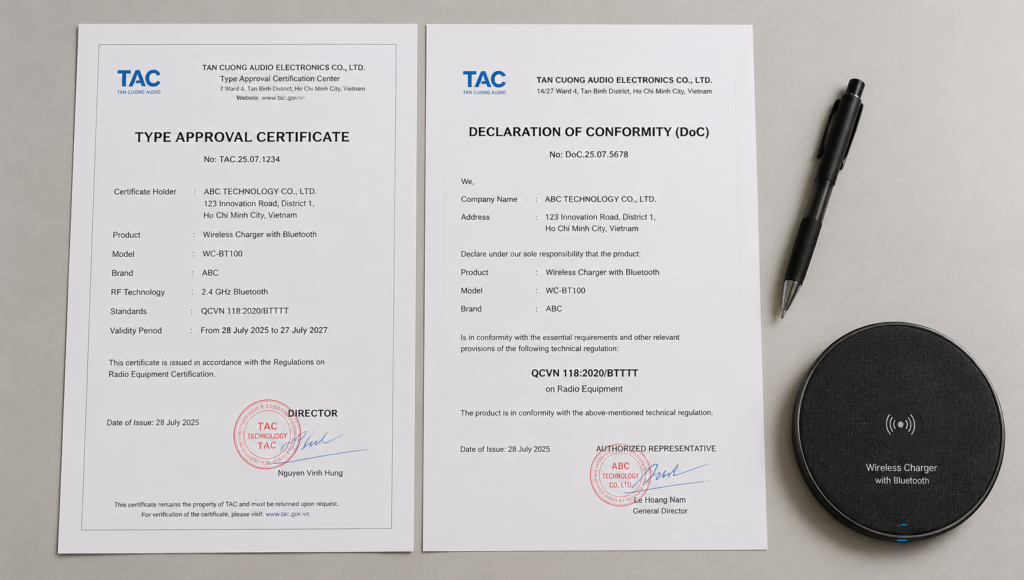
When handling specifically, you should first check the latest mandatory product list and corresponding QCVN, confirm the legal conformity assessment method, and then prepare materials according to the product scope, model combination, import entity, and sales arrangement. Shipping scale and sales channels can only affect commercial arrangements and cannot change the assessment method prescribed by regulations.
For example, smart chargers with Bluetooth APP control usually need to be assessed according to the list and QCVN related to wireless devices; for ordinary charging cables with data functions, it is first necessary to confirm whether they are MIC mandatory management products, and they cannot be directly classified into either DoC or TAC.
Prepare Before Application: Qualifications, Materials, Samples – None Are Dispensable
Before formally submitting the application, first confirm that you meet the basic conditions, otherwise it is easy to repeatedly supplement materials:
The first is entity requirements: For the import and sale of regulated products, it is usually required that an importer, responsible entity, or legally recognized authorized representative within Vietnam participate in the application, registration, and market responsibility. The specific application qualification shall be confirmed according to the product category and the latest acceptance rules, and cannot be simply understood that overseas sellers are absolutely unable to be relevant parties to the application in all MIC matters.
The second is product requirements: The product does fall within the relevant regulatory scope and has complete and accurate specifications and parameters.
The third is data requirements: Able to provide technical documents that meet the requirements, as well as test samples consistent with the mass-produced version or equivalent test bases permitted by regulations when necessary.
Exclusive Material List for Charging Products
When preparing materials, organize them according to these four categories, and nothing will be missed:
1. Entity materials: Business license of the local Vietnamese entity, power of attorney of the applicant; if a third party is entrusted to handle it, an agency authorization letter is also required.
2. Product materials: Complete product specifications, list of core charging components (such as charging IC, transformer and other key components), interface function description, product appearance, nameplate, and internal structure photos.
3. Test reference materials: Existing CB, CE, FCC and other reports. Whether they can be accepted and which tests can be reduced shall be confirmed by the certification body according to the specific QCVN and report content.
4. Additional materials for wireless products: Wireless module model and certification information, working frequency band, transmission power, antenna type and gain parameters. These materials help to determine which wireless assessments are required for the complete machine.
Sample and Series Certification Rules (Key to Saving Money)
Many people hope to reduce costs by merging models, but there is no unified rule for series certification applicable to all MIC products. The number of samples, representative models, series merging methods, and whether model-by-model testing is required shall be confirmed on a case-by-case basis by the applicable QCVN, designated certification body, and competent authority according to differences in product structure, wireless module, power, interface, and software.
Therefore, do not assume that multiple models can definitely be merged just because “the core charging circuit is the same”, “the power difference does not exceed 10%”, or “the interface type is the same”. Before submission, list the differences of each model clearly, including charging IC, wireless module, antenna, output power, interface, firmware, and production site, and then let the institution confirm the representative model and test scope.
Wired and wireless products, data-enabled and pure charging products, or products of different brands and manufacturers usually have obvious technical or responsible entity differences, and even more cannot be directly reported together. Whether series processing is possible in the end shall be subject to the specific assessment rules and the written confirmation result of the institution.
Complete Application Process: 6 Steps to Avoid Pitfalls
After preparing the materials, you can proceed according to the formal process. There are 6 steps in the general application idea for charging products, but the specific steps will vary with product categories and regulatory requirements.
Step 1: Product Pre-assessment and Classification Confirmation
Don’t rush to send samples. The first step must be pre-assessment. Find a qualified certification body or agent, submit detailed product information, and confirm three core issues: whether the product is within the regulatory scope, what the legal conformity assessment method is, and which Vietnamese National Technical Regulation (QCVN) it corresponds to.
The key to this step is that the information must be accurate: the function description must not be concealed, the model list must be complete, and it must be clearly stated whether the product is sold independently or sold together with the complete machine. Common reasons for repeated pre-assessment include incomplete function descriptions, blurred classification boundaries, or inconsistent model information. Just supplement the materials and then confirm.
Step 2: Select a Testing or Certification Body
There are two main criteria for selecting an institution: first, it must have the service qualification for the corresponding product and regulations; second, it is best to have experience in charging products and understand the key points of assessment when fast charging, wireless charging, and wireless modules are integrated.
When confirming qualifications, you can ask two questions: Do you accept overseas laboratory reports? Is local testing, sampling, or on-site procedures required in Vietnam? Don’t assume that the report must be usable just because you hear “the laboratory is accredited by ILAC MRA”. Whether overseas reports are acceptable also depends on the specific QCVN, the laboratory’s accreditation scope, test standards, report format, and the requirements of the Vietnamese competent authority or designated body. It is best to obtain written confirmation before sending samples for testing.
Pitfall avoidance tip: Prioritize institutions that are bilingual and have charging product cases. Otherwise, inconsistent understanding of PD protocols, wireless charging parameters, etc. during communication will easily lead to repeated material supplementation.
Step 3: Submit Application and Preliminary Data Review
After selecting the institution, submit the full set of application materials. The institution will first conduct a preliminary review to check the completeness and consistency of the materials, reducing rework in subsequent official audits.
The preliminary review mainly checks three points: whether the entity qualification is qualified, whether the product falls within its service and regulatory scope, and whether the product information in all materials is consistent. For example, if the power in the specification, the nameplate model, and the test sample are inconsistent, it may need to be reconfirmed. Common problems include incomplete entity materials, missing materials, inconsistent model parameters, etc.
Step 4: Sample Testing or Document Assessment
Whether physical samples are required and which items to test shall be determined by the applicable QCVN and the specific assessment method. For products requiring type testing, compliant sample test bases shall usually be provided; however, some conformity assessments may also be handled based on existing test reports accepted by regulations, document review, or other methods. The rule that “2-3 samples must be sent” cannot be regarded as a unified rule.
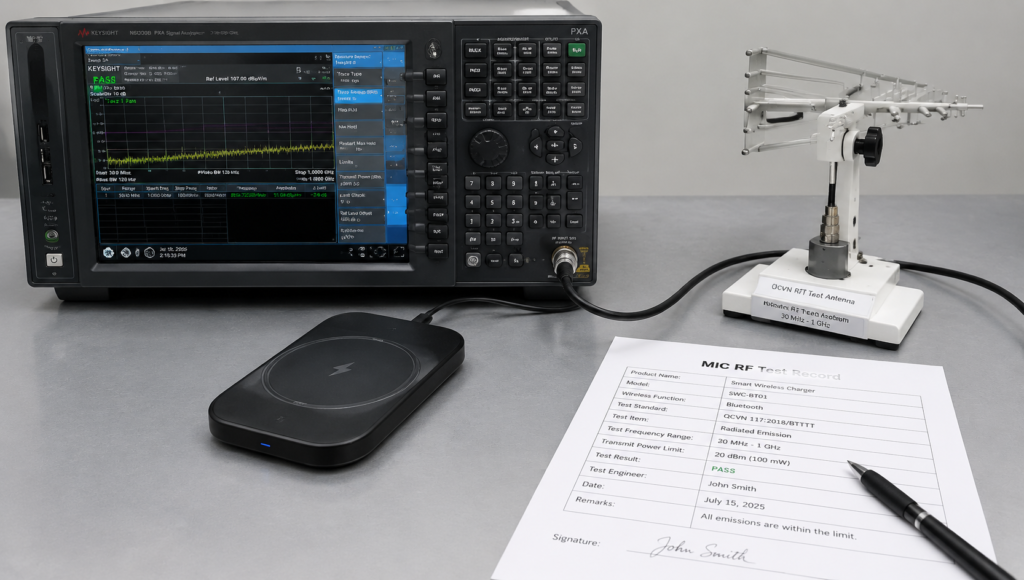
The test directions that charging products may involve include:
• Radio testing: Applicable to products with wireless transmission or reception functions, which may involve transmission power, frequency range, spurious emissions, etc.
• Electromagnetic compatibility (EMC) testing: According to the applicable QCVN, it may involve radiated disturbance, conducted disturbance, and immunity.
• Communication terminal or other special tests: Only applicable when clearly required by the corresponding product category and QCVN.
Compliance with USB, USB-C, USB Power Delivery (PD), and QC protocols is not a general test item for ordinary MIC type approval. Their safety, performance, and interoperability shall be separately assessed in accordance with corresponding product standards and other Vietnamese regulations, and cannot be directly called MIC interface compliance testing.
The test location cannot be generalized either. Whether overseas laboratory reports can be used shall be confirmed in writing before testing according to the specific QCVN, the laboratory’s accreditation scope, and the requirements of the competent authority or designated certification body. It cannot be automatically assumed that all foreign laboratory reports are accepted solely based on ILAC MRA, and some items may require Vietnamese designated laboratories or local sampling.
The cycle and cost will vary due to product category, test items, data completeness, laboratory arrangement, and whether rectification is required. Products with wireless functions usually require more assessment than products with simple structures, but any specific number of weeks can only be used as a reference for the institution’s case experience and cannot be regarded as the unified official time limit of Vietnam. Pre-testing before sending samples helps reduce the risk of failure in formal testing.
Step 5: Report Review and Issuance of Certificate or Registration Document
After the testing or document assessment is completed, the institution will form a formal report and application documents in accordance with the applicable procedures, and then submit them to the corresponding competent authority, designated body, or registration system for processing.
The audit cycle depends on the product category, data completeness, whether the test report is accepted, and whether supplementary materials are required. After passing, the corresponding certificate, declaration of conformity registration result, or other compliance documents will be obtained; if not passed, it is necessary to supplement materials, rectify, or re-assess according to the reasons.
Step 6: Registration, Labeling, and Market Launch Preparation
Different products may involve type approval certificates, declaration of conformity registration, import quality inspection, labeling, and customs documents respectively. Not all products have the same “MIC electronic system filing” step. For products included in the mandatory management list, the certification, declaration of conformity registration, labeling, and import procedures required by the product’s regulations must be completed before import or sale. The specific process shall be subject to the product category and the latest procedures of the competent department.
In terms of labeling, the conformity mark prescribed by Vietnam shall be marked on the product, packaging, or accompanying documents in accordance with applicable regulations, usually involving the CR mark and necessary product information. The specific mark, size, position, and label content shall be subject to the corresponding QCVN, product quality regulations, and labeling regulations. Do not make or use the so-called unified “MIC mark” without authorization, nor use the mark for uncovered models.
Exclusive Advanced Knowledge for Charging Products: Experience to Avoid Detours
After mastering the basic process, this advanced knowledge can help you sort out boundaries and save wasted money, suitable for sellers who plan to do long-term business in the Vietnamese market.
Key Application Points for Different Charging Products
The precautions for each type of charging product are different. Don’t generalize:
• Ordinary wired chargers or adapters: First confirm that there are no wireless and data communication functions, then check whether they are included in the MIC mandatory list. Even if MIC is not triggered, it is still necessary to determine whether CR conformity or energy efficiency requirements are needed based on Vietnam’s safety and energy efficiency catalogs and product parameters.
• USB or USB-C charging cables with data function: When sold independently, they shall be judged according to their own product categories and the latest list. It cannot be directly concluded that MIC is required just because they can transmit data, nor can they naturally share the compliance documents of the charger. For set sales, it is necessary to confirm whether the relevant documents cover the cables, sales methods, and all models.
• Wireless chargers: First distinguish between “pure wireless power supply” and “with wireless communication”. Wireless chargers that use pure electromagnetic induction power supply and have no Bluetooth, NFC, or Wi-Fi do not necessarily fall within the MIC mandatory scope. You need to check the latest list or conduct pre-assessment in advance.
• Smart chargers (with APP or Bluetooth): Prioritize wireless modules with complete materials and meeting applicable requirements. The existing certification of the module can be used as technical data and assessment basis, but whether the complete machine can reduce tests and which items can be exempted must still be confirmed item by item by the designated body according to the module certificate scope, installation conditions, antenna, and complete machine configuration.
Boundaries with Other Vietnamese Certifications
Many people can’t figure out when to apply for which certificate, and it is easy to apply for more or less. You can judge according to this logic: first check whether the product has wireless or communication functions and check the MIC list; then check whether it is connected to the mains to judge safety requirements; finally check the energy efficiency catalog and other applicable regulations.
• MIC and CR safety requirements: MIC-related requirements may involve radio, communication terminals, and EMC; CR and other product quality requirements mainly focus on electrical safety and other matters. The regulatory purposes of the two are different. Whether chargers with wireless functions also need CR shall be confirmed in combination with product categories and safety catalogs.
• MIC and energy efficiency requirements: Energy efficiency focuses on energy consumption indicators such as standby power consumption and conversion efficiency, which are different from wireless communication compliance. Some adapters connected to the mains may require superimposed energy efficiency assessment, but not all charging products are automatically applicable.
Certificate Maintenance and Change Rules
Getting the documents is not a once-and-for-all thing. For subsequent changes, first confirm the impact:
• Validity period: The validity period, renewal, and re-assessment requirements of TAC and DoC shall be subject to the latest applicable Circular, QCVN, and specific certificate or registration documents.
• Change triggers: Changes involving wireless modules, frequency bands, transmission power, antennas, key circuits, models, manufacturers, or production sites shall first be judged by the certification body whether change filing, supplementary testing, or re-certification is required. You cannot continue to use the original documents after self-modification.
• Supervision and random inspection: The frequency of market supervision and random inspection shall be subject to the annual plan of the competent authority and specific regulations, and cannot be simply summarized as “high-risk products once a year, low-risk accessories generally not”.
• Renewal requirements: Renewal or re-assessment shall be arranged in advance according to the validity period of the specific certificate and registration documents to avoid affecting import and sales after the documents expire.
Cycle, Cost, and Pitfall Avoidance Guide
The time, cost, and anti-fraud issues that everyone is most concerned about are clearly explained here at once.
Application Cycle Reference
When the materials are complete, the test passes at one time, and no rectification is required, the institution usually provides a cycle estimate, but these figures can only be used as a reference for case experience and cannot be regarded as the official unified time limit. The actual time may be lengthened due to product category, applicable QCVN, laboratory arrangement, report acceptance, competent authority audit, and re-testing. It is recommended to prepare in advance.
There are many factors affecting the cycle: material completeness, whether local testing or sampling in Vietnam is required, whether overseas reports are acceptable, whether testing requires rectification, whether audit requires supplementary documents, etc.
Cost Composition and Money-Saving Tips
Relevant costs usually may include testing fees, certification or compliance service fees, certificate or registration fees. The cost difference is mainly related to product type, wireless function, power, number of models, whether model-by-model testing is required, whether rectification is required, and test location.
Here are three practical money-saving tips for you:
1. When you have valid CB, CE, FCC and other reports, submit them to the institution for confirmation in advance. Whether they can be accepted and which tests they can replace must be confirmed item by item according to the specific QCVN and report scope.
2. Before applying for multiple models of the same series, first sort out the technical differences between the models, and then let the institution confirm whether series assessment is possible. You cannot make a guarantee on your own based on power difference or the same interface.
3. Do pre-testing before sending samples. For example, let the factory R&D department check EMC, wireless performance, and product safety to avoid repeated rectification after the formal assessment fails.
There is no unified market price for related projects applicable to all products. If the quotation is far lower than the normal service cost, you should be alert to whether the other party has not conducted actual testing, used unacceptable reports, or provided documents that cannot be verified.
Common Scams and Authenticity Verification
The certification industry is mixed. Be vigilant when you encounter the following statements:
• “Guaranteed pass, no testing or materials required.” For products requiring type testing, there should usually be compliant sample testing or equivalent test bases recognized by regulations. Whether physical samples must be sent shall be checked against the specific QCVN and the requirements of the designated body, and cannot be judged solely by verbal promises.
• “The certificate is permanently valid.” The validity period of relevant certificates and registration documents shall be subject to specific regulations and documents, and the general statement of “permanent validity” cannot be accepted.
• “Far lower than the market price.” Extremely low quotations may mean that the actual assessment has not been completed, or the provided documents cannot be used for import and sale.
When verifying authenticity, do not rely solely on the query results of a certain web page. Cross-verification shall be carried out through the certificate issuing body, the system designated by the competent authority, certificate number, product model, manufacturer, importer, and certificate scope. Public query entrances, fields, and queryability may vary depending on the certificate type and the system of the competent authority. It is also necessary to confirm whether the documents cover the actual sales models and whether the registration, labeling, and import procedures required by regulations have been completed.
Differences in Requirements for Different Sales Channels
The certification method is determined by the product list and corresponding QCVN, and cannot be freely chosen based on sales channels, shipment volume, or product risk. E-commerce platforms and offline channels may have additional commercial material requirements, but platform rules are not equivalent to Vietnamese legal requirements.
• Offline physical stores or wholesale: The channel may require the provision of complete compliance documents, and may check product labels, import materials, and certificate scope.
• Cross-border e-commerce (Shopee, Lazada Vietnam site): The platform may require uploading test reports, declarations of conformity, or other documents. The specific requirements shall be subject to the current rules of the platform, and it cannot be generally considered that DoC can be used first and TAC can be supplemented later.
• Vietnamese local e-commerce: The platform or local partner may require Vietnamese importers, responsible entities, or compliance documents that meet their rules. The specific requirements shall be checked against both legal requirements and platform requirements at the same time.
Pre-Submission Self-Check List
In order to reduce rework, we have sorted out a pre-submission self-check list. Just check off each item one by one:
Product Judgment Category
□ Confirmed whether the product is under MIC supervision using the 3-step judgment method
□ Distinguished between ordinary charging, wireless-enabled, and data-enabled products
□ Confirmed whether the product is sold independently or sold as a matching accessory for a certified complete machine as permitted by regulations
□ Verified that the applied model, brand, and manufacturer information are completely consistent
□ Confirmed the applicable latest mandatory product list and QCVN
Technical Document Category
□ Confirmed the applicable version of QCVN technical regulations
□ Prepared test reports and samples consistent with the mass-produced version, or confirmed equivalent bases accepted by regulations
□ For wireless products, verified frequency band, power, antenna, and module information
□ Explained the differences in circuits, modules, power, interfaces, and software between different models
□ Confirmed with the body whether overseas laboratory reports are accepted and which items they can cover
Import and Market Launch Category
□ Determined the local Vietnamese importer, responsible entity, or authorized representative
□ Confirmed the legal certification or declaration of conformity method, instead of choosing TAC or DoC solely based on the channel
□ Confirmed registration, import quality inspection, and labeling requirements
□ Prepared key contents of Vietnamese labels and instructions
□ Verified that the models on the product, packaging, certificate, and customs declaration documents are consistent
□ Confirmed which conformity mark such as CR should be used, to avoid using the so-called unified MIC mark without authorization
Generally speaking, Vietnam MIC-related compliance seems complicated, but the core logic is actually very clear: first check whether the product is included in the latest mandatory list, then confirm the applicable QCVN and legal conformity assessment method, then prepare the entity, technical documents, and test basis, and finally complete the registration, labeling, and import procedures.
Ordinary charging products should not be generally required to apply for MIC just because of the word “charging”; products with wireless functions such as Bluetooth, Wi-Fi, and NFC cannot be judged solely by product name, and must be combined with specific regulations and certification scope. At the same time, safety, energy efficiency, labeling, and import quality requirements may exist separately from MIC. When in doubt, it is recommended to find a formal institution with experience in charging product services for written pre-assessment, and require the other party to clarify the applicable list, QCVN, assessment method, and document scope to avoid detours.