
If you run a cross-border e-commerce business selling chargers and charging cables, with target markets including Russia, Kazakhstan and other countries, or if you want to send a power bank to a local friend, you have most likely heard of the term “EAC certification”. But many people either have a vague understanding of it — not knowing which countries require it and which products need it — or fall into pitfalls: thinking that CE certification is sufficient, or being fined for improperly affixing the EAC mark. This article will thoroughly explain the applicable rules of EAC certification focusing on the most familiar charging products, from basic concepts to being able to judge compliance on your own, which you can put to use right after reading.
First, Understand: What Exactly is EAC Certification?
You can think of EAC certification as the “market access ticket” for the Eurasian Economic Union (EAEU for short, a unified large market composed of several neighboring countries). Its full name is Eurasian Conformity Certification, which is the unified product access standard of the Union. Its core function is to prove that products meet the safety requirements of the Union. For civil charging products that are on the mandatory list of EAEU member states and enter commercial circulation, without valid EAC documents, they usually cannot be cleared normally or listed on formal channels.
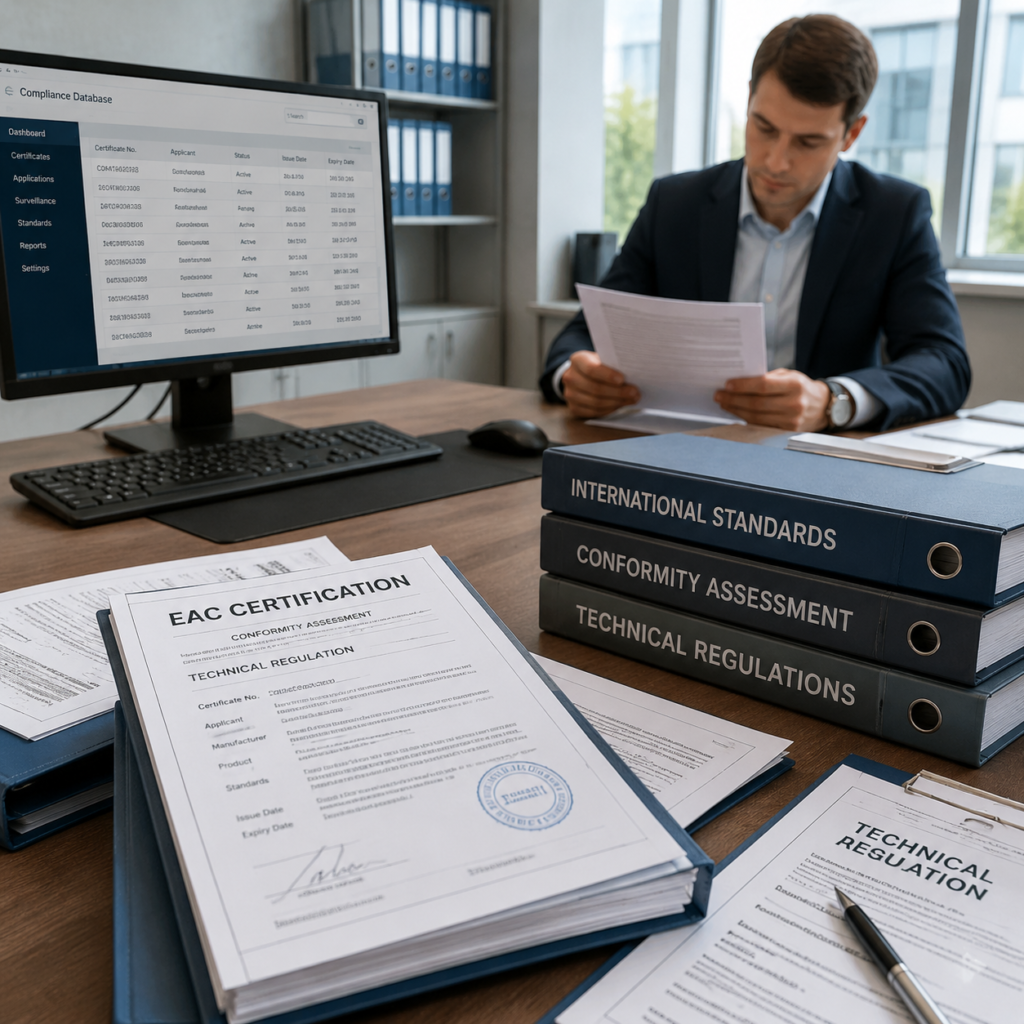
Charging products are high-risk categories because they are directly connected to the mains power and have electrical safety risks. Both customs and mainstream e-commerce platforms such as Ozon and Wildberries take them as key supervision targets, and the probability of being inspected without a certificate is much higher than that of ordinary products.
People who are new to EAC often have several common misunderstandings, which are clarified here in advance to avoid 80% of entry-level pitfalls:
First, it is not a single-country certification for Russia, but a unified standard for the entire Union. A certificate issued by one country is valid in all five member states, so there is no need to apply for it separately for each country;
Second, it is not mutually recognized with CE certification — CE is the access rule of the European Union, and EAC is that of the Eurasian Union. Even if you have a CE test report, it can only be used as a reference and cannot directly replace EAC. Re-evaluation must be carried out in accordance with the Union’s standards;
Third, the old national certifications have basically been replaced. For example, the former GOST-R of Russia and STB of Belarus are no longer required separately for the vast majority of civil products now. Only a very few special categories retain the old requirements, and charging products basically follow the unified EAC process;
Fourth, not all electronic products need EAC certification. Only civil circulation products for ordinary consumers that are on the mandatory list require it. Industrial-specific products and non-sale products may not need it.
If charging products within the mandatory scope are sent to the Union market without compliance, the consequences are straightforward: goods may be detained, returned or even destroyed at the customs link; if found by e-commerce platforms, product links will be directly removed and store funds frozen; if the products have already flowed into the market and are spot-checked by the regulatory authorities, you will also face penalties such as fines and mandatory recalls, resulting in considerable losses.
Which Countries Require EAC? Don’t Get Confused
Many people think that all Russian-speaking countries and CIS countries require EAC, but that is not the case at all. We will explain it clearly in three categories according to the degree of applicability:
First are formal member states, a total of 5: Russia, Kazakhstan, Belarus, Armenia, Kyrgyzstan. These five countries are the core members of the Eurasian Economic Union and implement completely unified EAC rules — a valid EAC document is valid throughout the territory of the five countries, and there is no need to apply for it repeatedly. For example, for the 20W USB-C fast charger you sell, as long as the EAC document covers the corresponding model, brand and technical requirements, and the label, manual and importer information are configured according to the target country, in principle, the same EAC document can be used in all member states such as Russia and Kazakhstan.
Second are candidate/observer and other informal member states (EAC is not mandatory for the time being). Here, a core judgment logic must be clarified: the identity of a candidate country, observer country, or Russian-speaking/CIS market does not automatically mean that it has been included in the unified EAC mandatory access of the EAEU; only formal member states apply the rule that “one valid EAC document is valid for five countries”. For example, Uzbekistan and other countries are not currently formal members of the EAEU and do not implement unified EAC mandatory access. When exporting to these countries, the rule of one EAC certificate for five countries does not apply, and you need to check according to the local separate certification, labeling, customs and radio access requirements — for example, when selling charging cables to Uzbekistan, you do not need to apply for EAC for the time being, and you only need to prepare materials in accordance with local compliance requirements.
Last are easily confused non-applicable countries, such as Ukraine, Georgia, all EU countries, and other Central Asian non-member states, do not require EAC certification. The simplest way to judge is: first confirm whether the target country is a formal member of the EAEU. If not, there is no need to consider EAC. Stop equating “Russian-speaking market” with “EAC applicable market”, this is the most common entry-level pitfall.
Of course, there are not completely no local requirements among member states — the EAC document itself is valid throughout the Union, but each country has slight local differences in the language of product labels and manuals, as well as importer information. These requirements do not affect the validity of the EAC document, and you can adjust them according to the regulations of the target country before shipment. For example, chargers exported to Russia need Russian labels, and those exported to Armenia can add the local official language, but the same EAC certificate is used.
Do Charging Products Need EAC Certification? How to Judge
Now that we understand the applicable countries, the next core question is: does the charger or charging cable I sell need EAC certification? In fact, it is not difficult to judge. For beginners, you only need to look at three conditions. If all are met, it is very likely that you need to apply: first, the country of sale or customs clearance is one of the 5 formal member states mentioned above; second, the product is within the mandatory list of electronic and electrical products; third, it is a civil product sold to ordinary consumers, not for industrial use or special purposes.
If you often deal with compliance issues, or want to judge more accurately, you need to know a core basis: HS code. Many people think that power and voltage can determine it, but that’s not right — the HS code is the “product classification ID card” commonly used by customs all over the world. Each product has a corresponding code. Different classifications may lead to completely different applicable certification requirements, even if two products have similar names. However, beginners don’t have to bother to check by themselves. Formal certification agencies can generally provide free pre-assessment. You only need to provide photos, parameters and uses of the product, and they can help you check the HS code and tell you whether you need to apply and what requirements you need to meet.
In addition, different power supply methods and functions of products require different EAC requirements, and you don’t need to do all items:
• Products directly plugged into the AC mains, such as wall-mounted chargers and wall sockets with USB ports, need to meet both electrical safety requirements and electromagnetic compatibility requirements;
• Passive ordinary charging cables (pure conductive wires without electronic chips or active circuits): the key control is the restriction of hazardous substances, and usually they are not tested for low-voltage safety and electromagnetic compatibility items;
• Low-voltage DC products with active circuits or chips, such as car chargers, USB-C cables with E-Marker chips, and powered docking stations, need to evaluate electromagnetic compatibility and hazardous substance requirements according to specific circuits and HS codes;
• Products with wireless and Bluetooth functions, such as wireless chargers and smart charging docks, may require additional radio frequency-related access in addition to conventional EAC requirements;
• Purely mechanical accessories without electronic or conductive functions, such as silicone protective covers and storage bags for chargers, are not within the scope of EAC for electronic and electrical products.
As for the exemption situation that everyone cares about, there are only two core judgment criteria: whether the product enters commercial circulation, and whether it is for civil consumers. Only non-commercial circulation and non-civil products may meet the exemption conditions. Products that you carry with you and are not for sale generally do not need to be certified.
Key Points: Detailed List of EAC Applicability for Charging Products
The above is the judgment logic. Below we will directly list a detailed list of charging products, which you can refer to, and most cases can be directly matched.
First are civil commercial circulation charging products that usually require mandatory EAC documents. As long as they are sold to ordinary consumers, these basically cannot be exempted: wall-mounted and desktop power adapters, chargers for mobile phones, tablets and laptops; civil commercial circulation charging cables of all interfaces (USB-A, USB-C, Lightning are all included, whether they are pure charging or data-charging 2-in-1, and regardless of length and power), are all within the mandatory scope of EAC, and need to hold corresponding compliance documents; plugs with USB charging ports, travel adapters, power strips with charging functions; power banks, car chargers, wireless chargers; USB-C docking stations with power supply functions, charging bases. The shell or packaging of these compliant products usually bears the EAC mark, which is convenient for consumers and regulators to identify.
Second are products that need to be judged in combination with parameters and uses. They are not definitely required, nor definitely not required, it depends on the specific situation:
• High-power industrial charging modules: if they are not sold to ordinary consumers, but only used as accessories for industrial equipment and not circulated separately in the civil market, they may be exempted after checking the HS code;
• Pure maintenance spare parts: such as internal charging interfaces and internal wires sold separately to repair shops, which are not sold to end consumers, may be exempted;
• Passive charging cables (pure conductive wires without any electronic chips or active circuits): there are clear boundaries for test items, usually focusing on the restriction requirements of hazardous substances, and low-voltage safety and electromagnetic compatibility tests are not implemented in accordance with products with AC input.
Then are scenarios and products that clearly do not require EAC:
• Portable chargers and charging cables that meet the customs limit for personal use, for example, you take two fast chargers and a few cables with you when going abroad, which are not for sale, so you don’t need to apply;
• Exhibition or test samples that have no commercial value and enter the country temporarily, if you explain the situation to the customs in advance and they are not used for sale;
• Purely mechanical charging accessories without conductive or electronic functions, such as protective covers and storage bags;
• Military and aerospace-specific charging equipment, which belong to special supervision categories, do not need to follow the ordinary EAC process.
Finally, we need to specifically mention the rules for set and combined sales, where many people fall into pitfalls: if the product is sold as a set, such as a set of charger + charging cable + packaging, all accessories in it must be within the coverage of EAC, and it is not allowed that only the charger has a certificate but the cable does not; if the accessories in the set are disassembled and sold separately, each accessory must have its own separate EAC document, which cannot be replaced by the set certificate; if the accessories of the same series of products are changed, for example, the original USB-A cable is replaced with a USB-C cable, or the plug specification is changed, you need to reconfirm whether the original EAC document can cover it, and you cannot directly use the old certificate.
What Does EAC Certification Check? Explain the Core Requirements in Plain Language
Many people think that EAC is just a certificate, but in fact it corresponds to several different types of requirements, and different products need to meet different items. You don’t need to memorize complex regulation numbers, the certification agency will help you match them, but a general understanding can avoid being cheated by unreliable agencies.
The first category is low-voltage safety requirements, which manage the most basic electrical safety risks such as electric shock prevention, fire prevention and overheating prevention, mainly for products such as chargers directly plugged into the mains, adapters, and plugs with charging ports. After all, chargers are plugged into the wall for a long time, and if they fail to meet safety standards, it is easy to cause accidents, which is also the most basic requirement.
The second category is Electromagnetic Compatibility (EMC) requirements. Simply put, when the product is charging, it will not interfere with other electronic devices, nor will it be interfered by other devices. For example, when some low-quality chargers are charging, the WiFi will slow down and the Bluetooth headset will have noise, which is because the electromagnetic compatibility is not up to standard. Chargers with switching power supplies, adapters, wireless chargers, USB-C cables with E-Marker chips, and powered docking stations all need to meet this requirement.
The third category is restriction of hazardous substances requirements, that is, toxic and hazardous substances such as lead, mercury and cadmium in the product cannot exceed the standard, similar to the EU’s RoHS rules. Almost all charging products need to meet this requirement, even ordinary charging cables, plugs and connectors are included. Here is a reminder: if you change the material supplier, for example, the original plastic shell supplier is changed, it is best to re-evaluate whether the hazardous substances still meet the requirements, otherwise there may be problems.
The fourth category is energy efficiency requirements, which mainly control the standby power consumption of chargers, to avoid consuming a lot of power when they are plugged into the wall and not in use, and reduce invalid power consumption. This is not required for all chargers, mainly for some external power adapters, especially those for IT and office use, and the specific ones are subject to the assessment of the certification agency.
Finally, there are additional requirements for wireless functions. If your charging product has wireless charging, Bluetooth, WiFi functions, such as a smart wireless charger with Bluetooth, in addition to the conventional EAC requirements, some wireless functions may also require radio frequency/communication registration locally in the member states, which EAC cannot fully cover, so this requires extra attention.
How to Verify the Authenticity of EAC Documents? Two Forms and Key Check Points

When many sellers ask suppliers for EAC documents, they often cannot distinguish the differences between different certification forms, nor do they know how to judge whether the documents are valid. Here we sort out the key information to help you avoid the pitfall of invalid certificates.
EAC mainly has two common certification forms, the core difference lies in the responsible subject and the strictness of review:
One is Declaration of Conformity (DOC), which is a self-declaration made by the applicant within the territory of the Union, as long as it is supported by a test report that meets the requirements. The responsibility is mainly borne by the applicant itself, and the cost is relatively low;
The other is Certificate of Conformity (COC), which is issued by a certification body recognized by the Union. The body will participate in testing and review, and the responsibility is borne by both the body and the applicant. The requirements are stricter and the cost is higher.
The specific applicable form is subject to the pre-assessment conclusion given by the certification agency according to the product type, and you don’t need to judge by yourself.
For charging products, ordinary chargers, adapters, charging cables, and plugs usually use Declaration of Conformity (DOC); but if the product is included in the mandatory certification catalog of specific technical regulations, belongs to a higher-risk structure, involves some energy efficiency requirements, or is a high-power charging device with wireless functions, it may need to go through Certificate of Conformity (COC) after evaluation by the certification agency. Note: The choice of DOC or COC cannot be judged solely by power or whether it has wireless functions. The final decision is subject to the applicable technical regulation catalog, HS code classification, product use and the pre-assessment of the certification agency. In addition, it should be distinguished: Bluetooth, WiFi, and some wireless communication functions may also have local radio frequency/communication access requirements in member states, which is not the same thing as the choice of DOC/COC form of EAC itself, and cannot be confused.
In addition, there is a difference between single-batch certification and series certification, which are suitable for different sales stages: single-batch certification is only applicable to one-time import or trial sale, with low cost and short validity period, suitable for sellers who have just entered the market to test the waters; series certification can cover multiple models with the same circuit and the same core functions, with long validity period, suitable for sellers with long-term stable sales. It should be noted that if charging products are of the same series but have different power and different numbers of interfaces, you should confirm with the certification agency in advance whether they can share one document. Not all products of the same series can share one.
Whether you apply for the certificate yourself or ask the supplier for it, you must check these key points, otherwise getting an invalid certificate is useless:
First, the product name, model, and brand must be completely consistent with the physical product, not even a single character difference;
Second, the applicable technical requirements in the document must cover all corresponding regulations of the product. For example, a charger with mains input must cover both safety and electromagnetic compatibility requirements;
Third, the qualification of the responsible subject must meet the requirements: when applying for EAC Declaration of Conformity, the registered applicant/responsible party should usually be a legal person or individual business legally registered within the territory of the EAEU; different roles such as manufacturer, applicant, authorized representative or importer may appear on the Certificate of Conformity at the same time, which need to be checked according to the corresponding technical regulations and certification schemes. Note that unqualified overseas entities or individuals cannot be randomly used as the responsible party, otherwise the document will be invalid;
Fourth, there must be an official registration number, within the validity period, and the authenticity can be checked in the official database of the Eurasian Economic Union. A formal EAC document will clearly list these information, and you can directly enter the registration number to verify on the official website.
Practical Pitfall Avoidance: Don’t Step on These Common Pitfalls for Charging Products
Having talked about so many rules, finally we have sorted out the most easily stepped pitfalls in practice. Whether you are a novice who has just entered the industry or an experienced seller, you can check against them.
The three elements of country, product and use mentioned above are still the basis for initial screening. In practice, check the specific compliance requirements according to different sales scenarios:
For listing on cross-border e-commerce platforms (such as Ozon, Wildberries), you must have valid EAC documents to list, and the platform will review them; for batch customs clearance of general trade, you must provide EAC documents to complete customs clearance, otherwise the goods will be detained; for direct mail of small parcels for personal use, as long as they meet the customs limit for personal use, EAC is not required; for temporary samples for exhibitions, which have no commercial value and are only temporarily entered for display, EAC is not required, but they must absolutely not be sold.
There are also two common cognitive misunderstandings that many people get wrong:
The first is thinking that all charging products need a Certificate of Conformity (COC). In fact, most ordinary charging products, such as ordinary fast chargers and charging cables, only need a Declaration of Conformity (DOC), and there is no need to spend extra money on COC;
The second is thinking that as long as the EAC mark is affixed to the product, it is compliant. This is a serious mistake — the EAC mark must be based on valid registration documents. Improper affixing is a high-risk violation, and you will be fined heavily if found.
Finally, there are several pitfalls exclusive to charging products, which must be avoided:
1. Don’t think that charging cables without electronic components don’t need EAC — charging cables in civil commercial circulation are within the mandatory scope. Even the simplest pure copper cables must at least meet the requirements of hazardous substance restriction, and still need to apply for the corresponding EAC declaration;
2. Don’t think that the matching charging cable sold separately doesn’t need certification just because the original charger has a certificate — as long as it is a separately sold accessory, it must hold a separate EAC document, which cannot be replaced by the charger’s certificate;
3. Don’t think that plugs with USB ports are hardware parts and don’t need certification — as long as they have charging functions, they belong to the mandatory scope of low-voltage electrical appliances and must be certified;
4. Don’t think that multiple models of the same series can share one certificate casually — only those with the same circuit and the same core functions can share. For example, a single-port 20W fast charger and a dual-port 20W fast charger may not be able to share, so be sure to confirm the coverage in advance;
5. Don’t think that second-hand charging products don’t need EAC — as long as they are second-hand civil charging products that enter commercial circulation, they still need to meet EAC requirements.
There are also several pitfalls in boundary situations, don’t step on them either:
Don’t certify industrial customized charging modules as civil products. If they are for industrial use and do not enter civil circulation, they may be exempted. Do a compliance assessment first, don’t waste money for nothing;
Don’t sell products for a long time under the name of “samples”. As long as the products enter commercial circulation, no matter what name they are called, they need to be compliant, and regulators will impose penalties if found;
Don’t use the old certificate after the product parameters have changed. For example, changing a 20W fast charger to 30W, or changing the fast charging protocol and input voltage, these changes may cause the original EAC document to become invalid, and you must re-evaluate.
In general, EAC certification is the unified market access requirement of the 5 member states of the Eurasian Economic Union. As a key supervision category, charging products must first judge the compliance requirements from the three dimensions of applicable countries, product attributes, and circulation purposes, then verify the validity of documents and avoid common misunderstandings. When encountering boundary situations that you are not sure about, doing a compliance assessment in advance can avoid unnecessary losses.