
If you sell products like chargers and charging cables and want to enter the Indian market, BIS certification is an unavoidable hurdle — but when many people first encounter it, the biggest headache is that asking ten service providers can yield ten different prices, and timelines range from 1 week to half a year, leaving them completely confused. This article explains the cost composition, timeline calculation, influencing factors, and common pitfalls of BIS certification from beginner to advanced levels. After reading it, you can make preliminary judgments on your own, without being dizzy from the wide variety of quotes.
First Things First: Scope of Application and Why There Is No Unified Quote
Before calculating costs and time, you must first understand what BIS is, whether your product requires it, and several basic concepts that directly affect quotes.
Core Function of BIS
BIS stands for the Bureau of Indian Standards, the official agency responsible for standard formulation and conformity assessment in India. Products such as chargers and power adapters that are included in the mandatory catalog of Indian competent authorities must obtain certification or registration under the BIS system in accordance with corresponding Indian standards before they can legally enter the Indian market. Simply put: mandatory products without corresponding BIS certification/registration cannot clear customs in India, nor can they be listed on e-commerce platforms such as Amazon India and Flipkart. Many people ask “I have CE and FCC certifications, is that okay?” The answer is no — India implements local standards, and overseas certifications cannot replace BIS at all. If you violate the rules, the lightest consequences are customs detention of goods and e-commerce delisting, and the heaviest are fines after market spot checks, which may even affect subsequent Indian market access qualifications.
Mandatory/Non-Mandatory Scope for Charging Products
Not all charging-related products require BIS. First, check against the scope below:
- Mandatory certification required: Mobile phone chargers, power adapters, USB-C fast charging cables with chips, wired charging plugs, USB charging docks. As long as these products are sold separately in the Indian market, they must hold BIS certification.
- No mandatory certification required: Ordinary USB extension cables, bare circuit boards, unassembled accessories, accessories that are only sold together with the complete device and not sold separately.
- Special boundary notes: The core criterion for judgment is “whether it is sold separately”. For example, if you supply matching chargers to an Indian mobile phone brand, which are only sold bundled with the complete device and not listed separately, you still need to first confirm whether the certification scope of the complete device covers this accessory, whether the accessory itself is separately included in the mandatory catalog, the customs declaration method, and platform listing rules — you cannot assume full exemption from certification just because it is sold with the complete device; but if you sell the same charger separately on an e-commerce platform, you must apply for BIS certification separately.
3 Basic Terms You Must Understand
These terms are the basis for calculating costs and timelines. If you don’t understand them, you can easily be fooled by quotes:
- Application unit: The minimum unit for BIS billing. Simply put, “products with the same circuit design, power, and core components count as one unit”. For example, the same 20W PD charger, only available in black and white casings, belongs to the same application unit. Only one main model needs to be tested, and the other can be added as a model directly without paying for full testing again.
- Authorized Indian Representative (AIR): A local Indian counterpart that overseas applicants must have — BIS does not accept applications directly submitted by overseas companies. Applications must be submitted on behalf of the applicant by a local Indian authorized entity, which is also responsible for subsequent compliance liaison, so this cost cannot be saved.
- BIS recognized laboratory: Only test reports issued by laboratories officially recognized by BIS will be accepted by the authority. Self-testing or reports from non-recognized laboratories are completely useless; do not try to save money on this.
Why There Is No Unified Quote
Many people feel “why not just give a fixed price” when asking for a quote for the first time. In fact, there is no unified price for BIS certification, mainly because four variables have such a great impact that the cost of different situations can differ by several times:
- Different certification routes: The costs and durations of the three routes CRS, ISI, and FMCS vary greatly, which will be explained in detail later.
- Different product parameters: Power level, number of ports, presence of fast charging protocols, and presence of E-Marker chips all affect the number of test items, which in turn affects costs.
- Different application plans: Prices vary whether it is a single model or a package of multiple models of the same series, and whether you choose full-service or semi-self-service.
- Different quality of documentation and samples: This directly affects whether additional costs such as retesting and supplementary documentation are incurred.
Certification Route Selection: The Factor That Most Affects Cost and Timeline
If there is one factor that directly determines how much you spend and how long it takes to get BIS certification, it must be the certification route. There are two commonly used routes for charging products, with completely different applicable scenarios.
CRS Route: The Mainstream Choice for Charging Electronics
CRS stands for the Compulsory Registration Scheme. Simply put, it is a certification route that focuses on product testing + document review, with no routine factory audits.
- Applicable products: Electronic charging products such as mobile phone chargers, power adapters, USB-C fast charging cables with chips, and USB charging docks basically use the CRS route.
- Core features: Short timeline and low cost, making it the first choice for most charging product sellers.
ISI/FMCS Route: Applicable to Plugs/Power Cables
ISI is India’s mark certification, with stricter requirements than CRS. It includes factory quality audits, and continuous annual supervision is required after obtaining the certificate. If an overseas factory applies for ISI, it must go through the dedicated FMCS channel, which requires official personnel to conduct on-site factory audits.
- Applicable products: Mains-connected products such as mains plugs, power cables, and integrated charging cables with Indian pins require the ISI/FMCS route.
- Core features: Long timeline and high cost, because it includes additional expenses such as factory audit travel and annual supervision, and the process is more complex.
Quick Judgment Method for Charging Product Routes
You don’t need to memorize complex rules; you can initially judge which route your product should take in three steps:
Step 1: Check the product type: Electronic charging products (chargers, fast charging heads, fast charging cables, etc.) prioritize the CRS route; mains plugs and power cables prioritize the ISI route.
Step 2: Check the sales method: Products in the mandatory catalog such as separately sold chargers, USB charging docks, and USB-C fast charging cables with chips must meet the certificate holding requirements in their own name; when imported as accessories of a complete device, you cannot assume exemption from certification by default. You should verify the certification coverage of the complete device, whether the accessory is separately included in the mandatory catalog, the customs declaration method, and platform rules.
Step 3: Check the factory location: If an overseas factory wants to apply for ISI certification, it must go through the FMCS overseas factory channel.
Breakdown of BIS Certification Costs for Charging Products
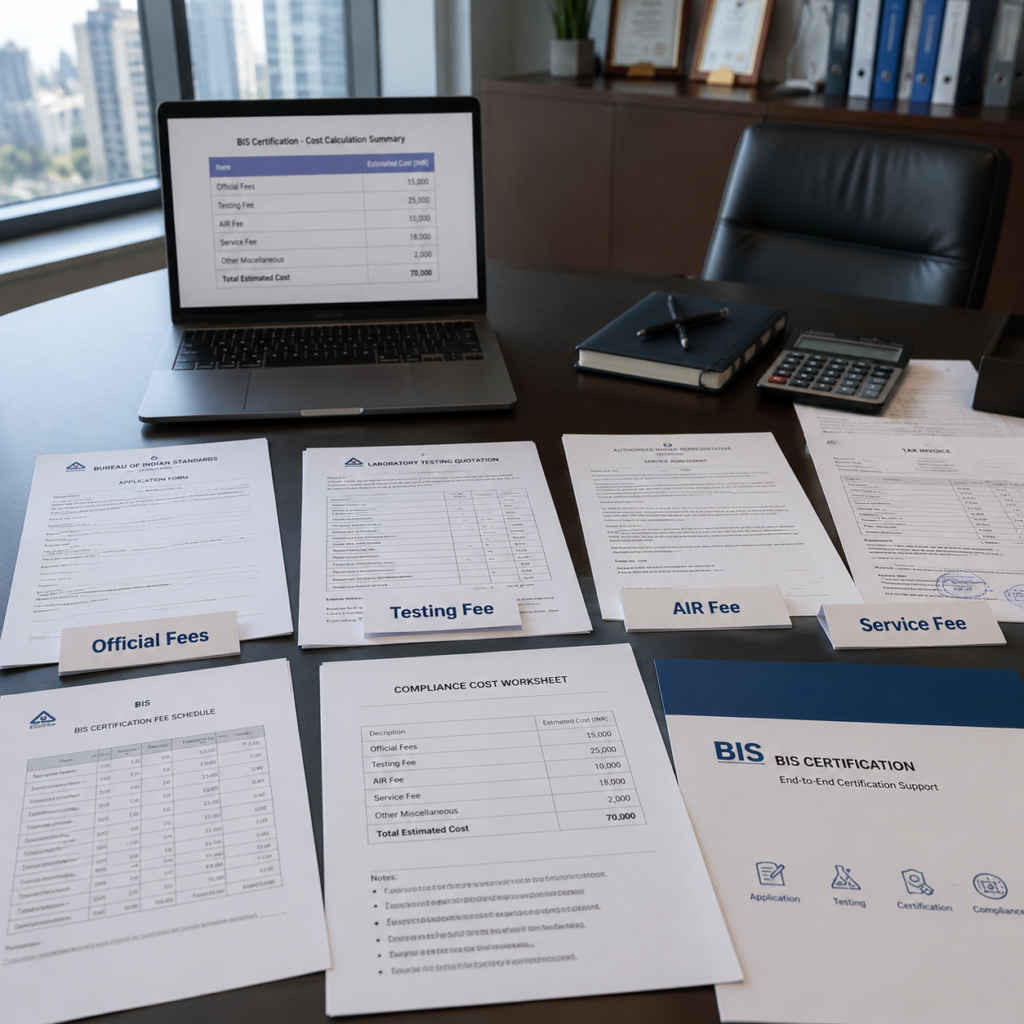
After clarifying the route, we will break down the BIS costs for charging products clearly, so you can see at a glance which are mandatory and which are easily miscalculated.
BIS Official Fixed Fees (Mandatory, Publicly Verifiable)
This part is the fee paid to BIS official, with publicly transparent standards, charged per application unit:
- Initial application/registration fee: The fee standards for CRS and ISI are different. ISI has a higher initial application fee due to factory audit-related costs.
- Annual fee/mark usage fee: Must be paid annually to maintain the validity of the certificate. CRS usually charges for fixed official items such as registration and renewal; ISI/FMCS may also involve license fees, minimum mark fees, or mark usage fees calculated based on license conditions. The specific amount is subject to BIS’s current fee schedule and the corresponding license requirements for the product.
- Change-related fees: Fees for subsequent model addition, renewal, and modification of certificate information are much lower than the cost of the initial application.
Authorized Laboratory Testing Fee (Highest Proportion, Largest Variation)
The testing fee accounts for the highest proportion of the total cost, and is also the part with the largest price difference between different products:
- Billing logic: Calculated based on product type and number of test items. The more complex the product, the more test items, and the higher the fee.
- Possible testing or verification items: In addition to basic safety testing, it may also include EMC (Electromagnetic Compatibility, simply put, the product does not interfere with other devices when operating, nor is it interfered with by external sources), USB interface compliance testing, PD/QC fast charging protocol testing, E-Marker chip testing, etc. The presence or absence of these items is an important reason for the difference in testing fees for charging products. Which items will ultimately be included in the BIS-recognized test report is subject to the applicable Indian standards for the product, the laboratory’s testing plan, and official acceptance requirements.
- Same-series discount: If products of the same series have the same circuit and power, and only differ in appearance and color, only one main model needs to be tested, and other models can be added directly without paying for full testing again.
Essential Service Fees for Overseas Sellers
For overseas applicants, there are two unavoidable service fees:
- Authorized Indian Representative (AIR) service fee: This is a mandatory expense, responsible for local compliance liaison, official communication, etc.
- Agency service fee: Divided into full-service and semi-self-service. Full-service includes testing liaison, document preparation, application submission, and progress follow-up, which is worry-free but more expensive; semi-self-service generally only handles application submission on behalf of the applicant, and testing and documents need to be prepared by the applicant themselves, which is cheaper but requires higher professional competence from the seller.
Easily Overlooked Hidden Costs
Many people only calculate explicit certification fees when making a budget, and end up overspending because they miss these hidden costs:
- Sample and logistics fees: Testing requires sending samples to recognized laboratories in India, and international express delivery and customs clearance are both costs; if the sample fails the test and needs to be retested, you need to send additional samples and pay logistics fees again.
- Document notarization and translation fees: Documents such as business licenses, brand authorization letters, and OEM/ODM agreements of overseas companies usually need to be provided in English; when involving overseas entity qualifications, brand ownership, or OEM relationship certification, you may be required to provide translated, notarized, or consular authenticated documents, which is also an easily overlooked expense.
- Label revision fee: After obtaining BIS-related certificates, products and packaging need to be marked with compliance marks according to the requirements of the corresponding route: CRS route products need to be marked with BIS standard mark and registration number and other information according to registration requirements; ISI/FMCS route products need to use the ISI mark and related license information according to license requirements. If the original nameplate and minimum sales packaging do not reserve space for the corresponding marks, redesign and plate making are required, resulting in revision costs; if it is a large-volume stock, this cost is not low.
Ongoing Maintenance Fees After Obtaining the Certificate
BIS certification is not a “one-and-done” thing; there are ongoing maintenance costs after obtaining the certificate:
- Certificate renewal fee: The certificate has a validity period, and you need to apply for renewal before it expires, and pay the renewal fee.
- Standard update retesting fee: If BIS updates the standards for related products, after the transition period ends, additional testing under the new standards is required to maintain the validity of the certificate.
- Spot check rectification fee: BIS conducts random spot checks on products on the market. If the spot check fails, rectification and retesting are required, resulting in additional costs, and in severe cases, the certificate will be revoked.
Timeline Breakdown: What Is the Real Timeline
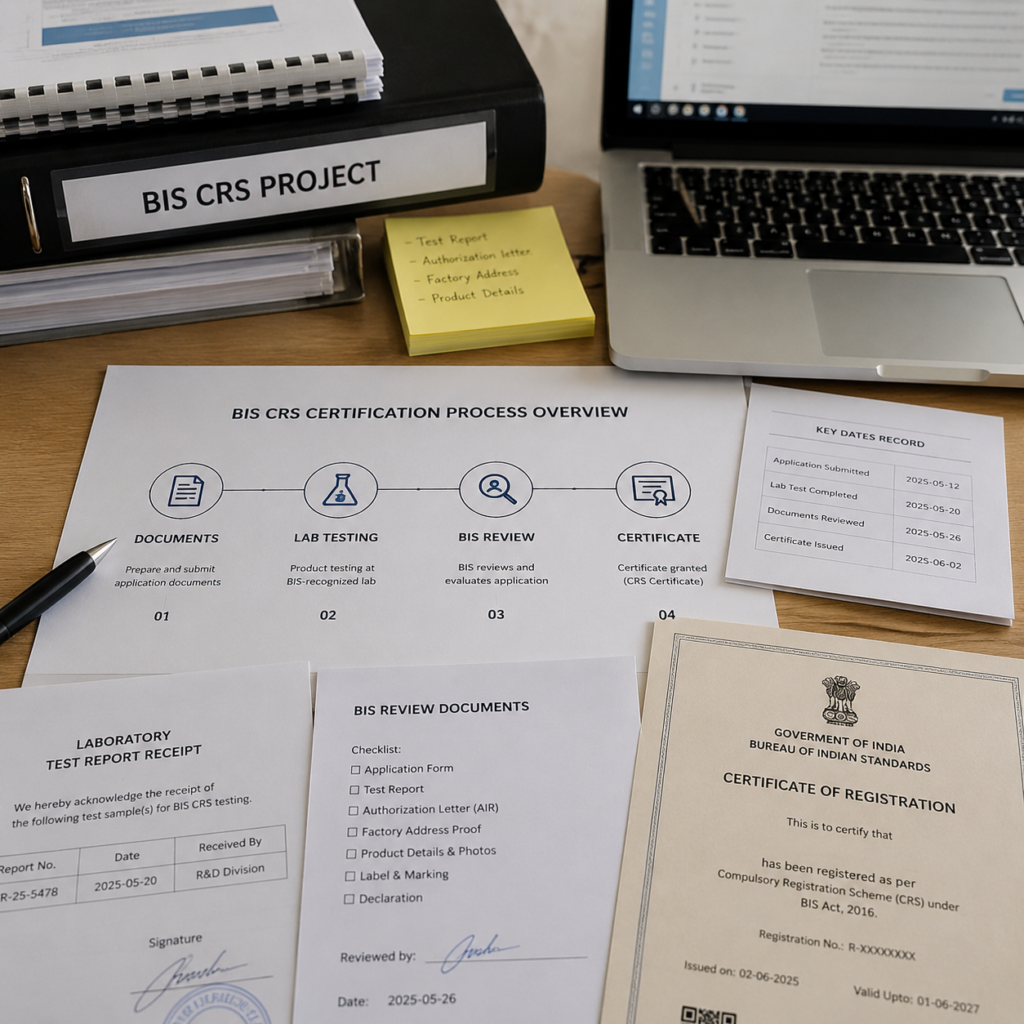
Many people are fooled by the “fast certification” propaganda and end up delaying shipments, mainly because they do not understand the calculation rules of the timeline and the actual duration of different routes.
First Understand the Calculation Standard of the Timeline (Key to Avoiding Pitfalls)
First of all, it must be clear that the formal BIS certification timeline starts on “the day when the documentation is complete and the sample is delivered to the BIS-recognized laboratory”, and ends on “the day when the official BIS electronic certificate is received”. Special attention should be paid to propaganda that takes “obtaining the test report” as the end of the timeline; the test report is only one of the application materials and does not equal obtaining the certificate.
Regular Timeline for CRS Route (Initial Application for Single Model)
For the CRS route used by most charging products, the regular timeline is as follows:
- Preparatory stage: 1-2 weeks, mainly for organizing documents and preparing test samples; if you are an overseas seller, you also need to add the time for international logistics.
- Laboratory testing: 2-4 weeks. An ordinary 10W single-port charger can be tested in about 2 weeks; multi-port fast chargers and fast charging cables with PD/QC protocols take 3-4 weeks due to more test items.
- Official review and certification issuance: 2-3 weeks, provided that the documentation is correct and no supplementary materials are needed.
- Total timeline: 5-9 weeks, which is the regular range for initial application of a single model.
Regular Timeline for ISI/FMCS Route (Plugs/Power Cables)
For plugs and power cables that use the ISI/FMCS route, the timeline will be much longer:
- Application and document review: 2-4 weeks, mainly for reviewing the qualifications of the applicant entity, the factory’s quality system documents, etc.
- Factory audit scheduling + execution: 2-6 weeks. For overseas factories, it is more affected by visas and itinerary arrangements, and the scheduling may take longer.
- Sampling testing: 2-4 weeks, the time for samples drawn during the audit to be sent to the laboratory for testing.
- Total timeline: 3-6 months, 2-3 times slower than the CRS route.
Simplified Process Timeline (Applicable to Certified Products)
If you already have a BIS certificate, the timeline for subsequent model expansion or renewal will be much shorter:
- Model expansion: Adding models for products of the same series does not require full testing; only document review and necessary difference testing are required, and the certificate can be obtained in 2-4 weeks.
- Certificate renewal: Under the conditions that the standard has not been updated, the certificate information has not undergone major changes, and there is no spot check rectification or additional official requirements, it is usually mainly document review and can be completed in about 1-2 weeks; if there is a standard upgrade, certificate scope adjustment, or BIS requires supplementary testing, the timeline and cost need to be calculated separately.
Key Factors Affecting Cost and Timeline
For the same BIS certification, why do some products get certified in 5 weeks while others take 9 weeks? Why do some quotes cost 150,000 rupees while others cost 400,000? The core is that these factors are at play.
Complexity of the Product Itself (Exclusive to Charging Products)
The attributes of the product itself are the basis for determining cost and timeline:
- Certification route: CRS is 40%-60% lower in cost and 2-3 times faster in timeline than ISI/FMCS, mainly because CRS has no routine factory audits, saving the cost and scheduling time of factory audits.
- Power and design complexity: Products with 65W and above, multi-port output, or using complex fast charging topologies usually increase testing workload due to temperature rise, safety margin, protocol and interface verification. Testing fees may be 30%-50% higher, and the timeline increases by 1-2 weeks; the specific situation is subject to applicable Indian standards and laboratory testing plans.
- Ports and protocols: Products with multi-port output, PD/QC fast charging protocols, and E-Marker chips have more test items, higher costs, and the timeline also increases by 1-2 weeks.
- Product type: In terms of cost and timeline, it is basically chargers/power adapters > fast charging cables with chips > ordinary charging cables, decreasing in order — because chargers involve high-voltage conversion and have the most test items, fast charging cables have chip and protocol testing, and ordinary cables have the fewest test items.
Choice of Application Plan
Different application plans also affect the final cost and timeline:
- Single model vs same-series package: If there are multiple models with the same circuit and power, a package application is more cost-effective — only one main model needs to be tested, and other added models only charge a small registration fee, and the timeline will only increase slightly.
- Full-service vs semi-self-service: Full-service is worry-free, no need to liaise with laboratories or organize documents by yourself, but the cost is higher; semi-self-service is cheaper, but you need to handle testing and documents by yourself, and the timeline depends on your own preparation efficiency, which is suitable for sellers with certain experience.
Quality of Documentation and Samples (Most Common Cause of Delay)
Many people think that the slow timeline is a problem of the service provider or the authority. In fact, the most common cause of delay is that their own documentation and samples are not up to standard:
- Incomplete/non-compliant documentation: For example, missing brand authorization letter or incorrect nameplate format. Each time the application is rejected by the authority for supplementary materials, you have to wait an additional 3-5 working days, and some agencies will also charge additional supplementary document service fees.
- Sample failure and retesting: If the sample fails the test, it needs to be rectified and retested. One retest adds 1-2 weeks, and you also have to pay the retest fee and logistics fee for resending the sample, which is also the core reason for leaving a buffer in the budget.
- Unclear entity relationship: If it is an OEM/ODM model, the relationship between the manufacturer and the brand owner is unclear, or authorization documents are missing, it will slow down the review progress, and notarized documents need to be supplemented, increasing cost and time.
External Environment and Service Provider Selection
There are also some external factors that affect cost and timeline:
- Peak season impact: Before Diwali in India (October-November) and before e-commerce promotions, it is the peak season for BIS applications. Laboratory scheduling and official review will be 1-2 weeks slower, and some service providers will also raise prices. If you want to catch up with the promotion, it is best to start preparing 2-3 months in advance.
- Service provider differences: Local Indian agencies have higher efficiency in liaising with the authorities, but may incur communication costs due to language and time differences; home-country agencies offer convenient communication, but their liaison efficiency may be slightly lower. Each has its own advantages and disadvantages, and you can choose according to your own needs.
- Policy changes: If BIS updates product standards, old versions of test reports may not be accepted during the transition period, requiring supplementary testing, which increases cost and time. Therefore, you should pay attention to official standard update announcements to avoid pitfalls.
Quick Estimation Method: Calculate Cost and Timeline by Yourself
After understanding the composition and influencing factors, you can use the following method to quickly estimate by yourself, without having to ask service providers for quotes every time.
3-Step Cost Estimation
Step 1: Confirm basic information: First clarify your product type, parameters, number of models, and the corresponding certification route, which is the basis for estimation.
Step 2: Calculate basic cost: Add fixed costs (official registration fee + annual fee + AIR service fee) and variable costs (testing fee + logistics fee + document notarization and translation fee) to get the basic budget.
Step 3: Add buffer and additional expenses: If there are multiple models of the same series, add the registration fee for added models; finally, reserve about 20% buffer fund to cover potential additional expenses such as retesting and supplementary documents.
3-Step Timeline Estimation
Step 1: Select the base timeline: Choose the base duration according to the certification route and application type — 5-9 weeks for initial CRS application, 3-6 months for initial ISI application, 2-4 weeks for model expansion, 1-2 weeks for renewal.
Step 2: Add additional product-related duration: If it is a high-power, multi-port product with fast charging protocols, add 1-2 weeks; overseas sellers should add about 1 week for international logistics.
Step 3: Add risk-related duration: Add 1-2 weeks for peak season applications, 1 week for insufficient document preparation, 1-2 weeks for risk of sample failure, and finally reserve 1 week of general buffer time. The timeline calculated in this way is relatively reliable and unlikely to cause delays.
Reference Range for Common Products
The following are common preliminary estimation ranges in the market, applicable to situations with stable documentation and sample quality, a single application unit, and basic service scope. The actual quote is subject to BIS official fees, current quotes from BIS-recognized laboratories, AIR/agency service scope, and policy adjustments.
| Product Type | Certification Route | Reference Cost (Indian Rupees) | Reference Timeline | Remarks |
|---|---|---|---|---|
| 10W single-port USB charger | CRS | 150,000 – 250,000 | 5-7 weeks | Includes official fees, testing fees, basic service fees |
| 65W dual-port PD fast charger | CRS | 250,000 – 400,000 | 7-9 weeks | Includes official fees, testing fees, basic service fees |
| USB-C PD fast charging cable with E-Marker | CRS | 120,000 – 200,000 | 5-7 weeks | Includes official fees, testing fees, basic service fees |
| Power connection cable with Indian pins | ISI/FMCS | 400,000 – 800,000 | 3-5 months | Includes official fees, testing fees, basic factory audit fees |
Note: The above quotes do not include additional expenses such as retesting fees, international logistics fees, document notarization and translation fees, and label revision fees.
Common Misconceptions and Pitfall Avoidance Tips
Finally, we have compiled several types of misconceptions that beginners are most likely to fall into. Avoiding these can help you save a lot of unnecessary money and time.
Cost-Related Misconceptions
- Only counting one-time fees, ignoring ongoing expenses: Many people think that BIS only costs a one-time fee. In fact, annual fees, renewal fees, label revision fees, and standard update retesting fees are all ongoing expenses, which must be included when making a long-term budget.
- Assuming all charging products have the same cost: Products with different power, ports, and protocols have very different test items, and the cost can differ by more than double, so it cannot be generalized.
- The lower the quote, the more cost-effective: Low prices are likely to have omitted official fees, retesting fees, or even issue fake certificates. Don’t save a little money only to end up with detained goods and fines, which is not worth the loss. After receiving the certificate, be sure to verify its authenticity on the BIS official website.
- Forcing packages of different specifications to save testing fees: Only products of the same series with the same circuit and power can be counted as one application unit. If you force products of different power and circuits into a package, it will be rejected by the authority, which instead increases costs and delays time.
Timeline-Related Misconceptions
- Believing the “1-week certification” propaganda: If it is promised that a complete initial application only takes 1 week from sample delivery to the recognized laboratory, completion of testing, to obtaining the official BIS electronic certificate, you should be highly vigilant of propaganda for fake certificates, misappropriated certificates, or treating test reports as certificates. Such non-compliant certificates will directly lead to goods detention and fines in customs and market spot checks, and must never be used.
- Counting the time to find an agency and prepare samples into the certification timeline: The starting point of the certification timeline is when the sample arrives at the laboratory + documentation is complete. Therefore, you need to prepare in advance. Don’t wait until you are about to ship to start the application; it will definitely be too late.
- Assuming the timeline is fixed: The certification timeline is affected by many factors such as scheduling, retesting, and document quality. There is no absolutely fixed time, so you must reserve a buffer.
- Shipping first and supplementing certification later: For products already in the BIS mandatory catalog such as chargers, adapters, USB charging docks, and USB-C fast charging cables with chips, the risk of direct customs detention and punishment without corresponding certification is extremely high. Never take chances.
Compliance-Related Misconceptions (Directly Affect Cost and Timeline)
- CE/FCC can replace BIS: India does not recognize any overseas certification. You must apply for BIS separately. Don’t waste money on useless certifications.
- Obtaining a test report equals obtaining certification: The test report is only one of the application materials. You must pass the official BIS review and be issued a certificate before you are considered to have truly obtained the certification.
- CRS absolutely does not require factory audits: CRS just has no routine factory audits, but BIS can conduct random factory spot checks. If the spot check fails, the certificate will be revoked, and additional costs for rectification and retesting will be incurred. Therefore, the factory’s quality control must still be in place.
- One certificate covers all models: Only products of the same series with the same circuit and power can share one certificate. Products of different specifications need to apply separately or go through the model expansion process.
Summary
After reading this article, you should be able to independently judge three things: First, whether your product falls within the mandatory or non-mandatory scope, which certification route to take, what are the main components of the cost, and which factors affect the final cost; second, what is the regular timeline for different routes, what situations will cause delays, and how to reserve buffer time; third, what are the common cost and timeline scams on the market, how to avoid them, and whether to choose a full-service or semi-self-service application plan.
BIS certification may seem complicated, but as long as you understand the rules and prepare the budget and schedule in advance, you can avoid a lot of detours.