
If you operate in the Indian market for charging products, or often buy wireless charging accessories on Indian e-commerce platforms, you have most likely seen the “WPC certification” label. Many people confuse it with the Wireless Charging Alliance that develops the Qi standard, and others often equate it with India’s BIS safety certification — only realizing they got the regulatory requirements wrong when their goods are detained at customs or their e-commerce listings are taken down. Today, from the perspective of charging products, we will thoroughly explain India’s WPC wireless certification: from basic definitions and regulatory boundaries, to methods for judging whether a product needs it, to the application process and key points to avoid pitfalls, so that entry-level users can understand it, and cross-border practitioners can get practical judgment tools.
First, Get It Straight: What Exactly is India’s WPC?
You can straightforwardly understand India’s WPC as “the official department that manages whether wireless signals can be legally transmitted” — its full name is Wireless Planning & Coordination Wing, which is affiliated to the Ministry of Communications of India and is the official agency responsible for spectrum management and wireless equipment access in India.
For consumer electronics, the core regulatory requirement of WPC is: products with active radio frequency (RF, i.e., actively transmitting wireless signals outward) functions that enter the Indian market for sale usually need to obtain the corresponding WPC access approval first — among them, consumer charging products that operate in unlicensed frequency bands and whose transmission power meets the limit mostly go through the ETA channel we often refer to; if the product uses a non-unlicensed frequency band or the power exceeds the limit, it is necessary to evaluate spectrum license or special import license, which is very rare in ordinary charging products.
Here we must first draw a clear line of its regulatory boundary to avoid everyone overthinking: WPC only manages the compliance of wireless transmission — for example, whether the frequency band used by the product is allowed in India, whether the transmission power exceeds the standard, and whether it will interfere with other legal wireless devices; as for whether charging is safe, whether the shell material is environmentally friendly, whether the interface is Type-C, and whether the charging speed is fast enough, none of these are within the regulatory scope of WPC.
The Name Pitfall That 90% of People Step Into: The Two WPCs Are Completely Unrelated
When it comes to WPC, we must first clarify the most common misunderstanding in the charging field: there are two completely independent institutions in the world that are abbreviated as “WPC”, which are extremely easy to confuse. The core differences are shown in the following table:
| Comparison Item | India WPC (Wireless Planning & Coordination Wing) | Wireless Charging Alliance WPC (Wireless Power Consortium) |
|---|---|---|
| Institutional Nature | Official regulatory department of the Indian government | Global non-profit industry association |
| Core Function | Approves spectrum access for wireless equipment, manages India’s national wireless spectrum | Develops Qi wireless charging standards, carries out Qi compatibility certification |
| Relationship with Charging Products | Manages whether wireless transmission is legal, does not manage charging effect or compatibility | Manages device compatibility of wireless charging, does not manage market access |
| Mandatory or Not | Mandatory for products with wireless transmission entering India | Voluntary certification; passing means compatibility with Qi standard |
To put it simply: for a wireless charging pad to be sold legally in India, it may need both of these “WPC”-related certifications at the same time — India WPC’s ETA governs whether it can legally transmit wireless signals, and the Wireless Charging Alliance’s Qi certification governs whether it is compatible with other Qi devices, but the two are completely unrelated, so don’t confuse them.
For Charging Products, Over 90% of “WPC Certification” Refers to ETA
Many people hear the two terms “WPC certification” and “ETA certification” and think they are two different certifications, but they are not.
The full name of ETA is Equipment Type Approval, which is a general approval issued by WPC for mass-produced consumer wireless devices, and is also the most commonly used type when charging products apply for WPC compliance — accounting for more than 90% of WPC applications for charging products. When we usually say that charging products need “India WPC certification”, the default reference is WPC ETA; it is not a certification independent of WPC, but one of the certificate types issued by WPC.
The core regulatory logic of ETA is also very simple: it only confirms that the product’s radio frequency (RF, i.e., wireless signal) transmission complies with the rules of India’s unlicensed frequency bands, and does not test charging performance at all.
Only consumer devices that operate in unlicensed frequency bands officially opened by India and whose transmission power meets the limit can go through the ETA application channel; if the product uses a non-unlicensed frequency band (such as cellular communication, private network intercom, satellite communication) or the power exceeds the standard, it cannot apply for regular ETA, and needs to apply for a separate spectrum license or special import license, which is almost never encountered in ordinary charging products.
Why Should Charging Products Care About WPC Compliance?
Not all charging products need to be concerned with WPC — the core premise for judgment is very clear: only products with active radio frequency (actively transmitting wireless signals outward) functions need to be evaluated for WPC compliance.
For example, ordinary 20W wired fast chargers and car chargers without wireless functions have no wireless transmission module at all, so they have nothing to do with WPC; but if it is a smart fast charger with Bluetooth that can connect to an APP to adjust power, even if it is mainly for wired charging, as long as it has a built-in wireless transmission module, it needs to be evaluated for WPC requirements.
If you violate the regulations, for charging products, the consequences are very practical:
- Import customs clearance stage: If a valid WPC ETA certificate cannot be produced after the goods arrive at the port, the goods will be directly detained or returned; you will either need to supplement materials or pay a fine, which wastes time and costs money;
- E-commerce channels: Major platforms such as Amazon India and Flipkart have mandatory compliance requirements for wireless products; if they find that there is no WPC certificate, they will directly take down the listing, and in serious cases, it will also affect the store’s weight;
- Offline sales: If local Indian regulatory authorities find that uncertified wireless products are being sold, you may face penalties such as fines and product recalls.
Charging Products: Do You Need WPC ETA? Understand at a Glance
We divide common charging products into three categories, and then provide an entry-level 4-step judgment method, which can basically cover most common scenarios.
Category 1: Common Products That Must Have WPC ETA
As long as the charging-related products fall into the following three categories, they basically need to apply:
- Wireless energy transmission category: that is, products that actively transmit wireless charging signals outward, such as Qi wireless charging pads, magnetic wireless chargers, car wireless chargers, power banks/charging bases with wireless charging function;
- Wireless communication category: charging products with wireless communication functions such as Bluetooth, Wi-Fi, Zigbee, etc., such as smart fast chargers with Bluetooth, smart power strips with Wi-Fi (with USB charging ports), multi-port smart charging stations;
- Wireless identification category: charging accessories with active NFC/RFID transmission functions, such as charging bases with active NFC, docking stations with RFID identification.
Category 2: Common Products That Definitely Don’t Need WPC
These products have no active wireless transmission function at all and have nothing to do with WPC:
- Ordinary wired chargers, power adapters, car chargers without wireless functions;
- Ordinary wired charging cables, adapters, travel adapter plugs;
- Purely passive charging accessories (such as charging stands and storage boxes without any electronic components);
- Accessories that only serve as wireless charging receivers and do not contain active RF transmission modules such as Bluetooth/Wi-Fi/cellular/NFC: for example, mobile phone wireless charging back clips without additional wireless functions, and pure receiver-type TWS earphone charging cases sold separately — they only receive wireless charging energy and do not actively transmit radio frequency signals that meet regulatory requirements, so they usually do not need to apply; if the charging case itself has transmission functions such as positioning, Bluetooth pairing, active NFC, or is sold as a set with active wireless devices such as Bluetooth earphones, compliance requirements need to be evaluated based on the actual wireless functions.
Category 3: For Boundary-Ambiguous Situations, Judge According to These 4 Principles
When you encounter uncertain situations, don’t guess blindly, refer to these principles:
- Wireless function can be turned off/not activated? Still need to evaluate: As long as the hardware is equipped with a wireless transmission module, regardless of whether the function is activated by default or whether the user can turn it off by themselves, a WPC compliance assessment must be done first; if it operates in India’s unlicensed frequency band and the power meets the limit, it usually goes through the ETA channel; if it does not meet the unlicensed conditions, it is necessary to evaluate spectrum license or special import license.
- Used a certified wireless module? Doesn’t count: The module itself has passed WPC certification, which does not mean that the whole machine installed with this module is compliant — the antenna design, RF layout, and power parameters of the whole machine will affect the final transmission effect, so the whole machine still needs to be re-evaluated;
- Very low power/special frequency band? Check the official list: Don’t think on your own that “low power means no need to apply”; you must judge against the latest Short Range Device (SRD) exemption list released by WPC;
- With infrared remote control? No need: Infrared is an optical signal and does not fall into the category of radio frequency, so charging devices with infrared remote control (such as charging power strips with infrared remote control) usually do not need to apply for WPC.
Entry-Level Essential: 4-Step Quick Judgment Method

If you are still unsure, follow these 4 steps and you can basically draw a conclusion:
Step 1 Check functions: First check whether the product has functions that actively transmit wireless signals such as Bluetooth, Wi-Fi, wireless charging transmission, active NFC; if not, you don’t need to consider it at all;
Step 2 Match frequency bands: If there is a wireless function, first confirm whether the corresponding operating frequency band is within the unlicensed frequency band range opened by WPC — for example, the 2.4GHz used by common Bluetooth/Wi-Fi and the operating frequency band of conventional Qi wireless charging usually fall within the coverage of WPC unlicensed/SRD rules, but the final confirmation still needs to be made against the latest list of opened frequency bands, power limits, and actual operating parameters of the product released by WPC;
Step 3 Verify parameters: Confirm that parameters such as the product’s transmission power (EIRP, simply understood as the total power of wireless signals emitted by the device), antenna gain, and modulation method meet the limit requirements of WPC;
Step 4 Check matching: If you are using an existing certificate, confirm that the subject and model on the certificate completely cover the product version you actually sell.
For example: a 65W smart fast charger with Bluetooth, step 1 finds that it has Bluetooth (active RF), step 2 the 2.4GHz used by Bluetooth is usually within the unlicensed coverage, step 3 the transmission power meets the SRD limit, step 4 the certificate model is consistent with the product — then it needs to do WPC ETA and also meets the application conditions.
The Most Commonly Used WPC ETA for Charging Products: Core Rules Explained Clearly at Once
As mentioned earlier, more than 90% of WPC applications for charging products are ETA. We will clarify its core rules and applicable conditions to avoid detours.
ETA Applicable Scenarios and Characteristics
ETA is a certification specially prepared for mass-produced consumer electronics operating in unlicensed frequency bands. Its core feature is “one certificate for multiple uses”: one ETA certificate can cover all mass-produced products of the same model, without the need for separate testing of each device, which is very suitable for charging products that are mass-produced and sold.
It covers common wireless functions including: Bluetooth, Wi-Fi, Qi wireless charging, short-range NFC, etc., basically covering all wireless scenarios of consumer-grade charging products.
In Which Situations Can You Not Apply for ETA?
If the product falls into the following situations, it cannot go through the regular ETA channel and needs to apply for other types of licenses (this situation is very rare in ordinary charging products):
- Uses non-unlicensed frequency bands, such as cellular communication, intercom, private networks, satellite communication, etc.;
- Transmission power exceeds the limit requirements of the unlicensed frequency band.
There are two other types of WPC certification that are almost never used for charging products: one is WPC License, which is for special private network devices using licensed frequency bands; the other is special import license, which is only for special devices that exceed unlicensed conditions, and ordinary charging products basically do not need to consider them.
Key ETA Rules (Advancing to Semi-Proficiency)
If you are a cross-border practitioner, you must remember these rules firmly, which can save a lot of money and time:
- Validity period: Long-term valid, no annual review or renewal fee required: The WPC ETA certificate has no validity period limit. After obtaining it, there is no need for annual review or annual fee payment. As long as the core wireless design of the product remains unchanged, it is always valid;
- Same series coverage rule: Only based on core wireless design: Not all products of the same series with similar names can share one certificate — only products with exactly the same core wireless design (including wireless chip, antenna, PCB RF layout, transmission power, operating frequency band) can be covered by the same ETA certificate;
- Subject change rule: Must go through the application process: If the brand, importer, or manufacturer on the certificate needs to be changed, the original certificate cannot be used directly. A change application must be submitted to WPC, and it can only be used after the review is passed.
Core Compliance Requirements for WPC ETA
To obtain an ETA certificate, the product must meet three core requirements:
1. Wireless Frequency Band Requirements
The product must use unlicensed frequency bands officially opened by WPC. For example, the 2.4GHz ISM band used by common Bluetooth/Wi-Fi and the operating frequency band of conventional Qi wireless charging usually fall within the unlicensed coverage, but the specifics shall be subject to the latest Short Range Device (SRD) specification released by WPC — India’s unlicensed frequency band division is occasionally updated, so don’t apply old regulations from a few years ago.
Private frequency bands or restricted frequency bands not opened by India must absolutely not be used, and the actual operating frequency band of the product must be completely consistent with the parameters submitted during the application.
2. Transmission Power Requirements
Different frequency bands and different wireless functions have clear maximum transmission power (EIRP) limits, which is one of the core indicators of WPC review.
Ordinary consumer-grade products such as wireless chargers, Bluetooth charging heads, and Wi-Fi power strips, as long as they are designed in compliance, are usually within the limits; if the power exceeds the standard, the certification will be directly rejected, and the hardware or firmware must be rectified before continuing the application.
3. Certificate and Number Requirements
The ETA certificate and the corresponding certificate number are the core vouchers for customs clearance, platform review, and compliance retention.
Unlike many certifications, WPC ETA does not mandate that the certification number be printed on the product itself; specific labeling requirements only need to follow the requirements of the importer, platform, or local regulator. The ETA certificate number can be verified through WPC’s official portal SARAL SANCHAR, with a focus on checking whether the certificate subject, brand, model, wireless technology, frequency band, and power parameters match; if the portal query result is inconsistent with the certificate information, or if historical certificates have not been entered yet and cannot be queried, the certificate holder should be required to provide supplementary proof, or verify and confirm through WPC’s official channels.
Applying for WPC ETA for Charging Products: Process and Reference
Many people think that applying for WPC is very troublesome. In fact, for conventional charging products, the process is already very clear. We have simplified it into several core steps.
Application Subject and Responsibilities
Who can initiate the application? Manufacturers, brand owners, local Indian importers, and Indian authorized representatives can all do so, but there are two hard requirements:
- The subject information on the certificate must be consistent with the corresponding information on customs clearance documents and product labels, otherwise there will be problems during customs clearance;
- The application must provide information of a local Indian importer or authorized representative — without a local Indian contact entity, it is impossible to apply for WPC ETA.
Pre-Application Preparations
Preparing all materials in advance can save a lot of detours:
- Organize the parameters of the wireless module: including operating frequency band, transmission power (EIRP), wireless module model, antenna type, and RF layout description;
- Prepare product materials: product specification sheet (which must clearly mark wireless functions and parameters), appearance photos, user manual;
- Confirm the qualification of the testing laboratory: it must be a laboratory accredited by ISO/IEC 17025 and ILAC-MRA, otherwise the test report issued will not be recognized by WPC;
- Confirm the information of the local Indian importer or authorized representative.
4 Core Application Steps (Simplified Version)
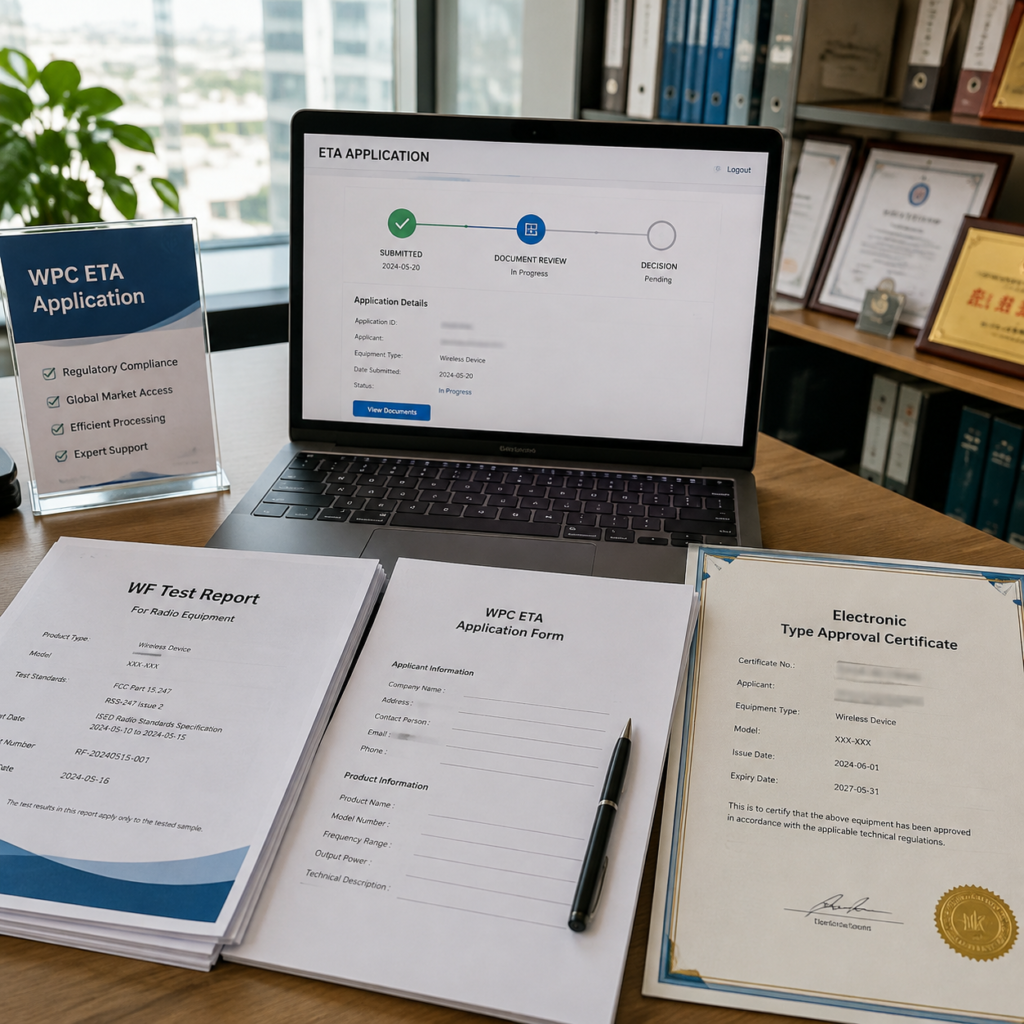
For a regular ETA application, the core is four steps:
- Submit application: Register an account on WPC’s official portal SARAL SANCHAR, submit the application, and upload the full set of product materials;
- Prepare test report: Find a qualified laboratory to conduct wireless RF testing and issue a qualified test report — note here that WPC usually does not mandate sending samples to India for local testing, but the test report must be issued by a laboratory that has ISO/IEC 17025 qualification and whose accreditation scope under the ILAC-MRA mutual recognition system covers the corresponding wireless test items; at the same time, information such as the test date, adopted standards, frequency range, transmission power (EIRP), antenna gain, sample model and manufacturer in the report must meet WPC’s current application requirements, which saves overseas sellers the trouble of sending samples across borders;
- Submit for review: Submit the test report and the full set of product materials together to WPC for review;
- Obtain certificate: After the review is passed, WPC will issue an electronic version of the ETA certificate, no need to wait for the paper copy.
Test Report Checklist (Semi-Proficient Level)
If you hire a third-party service provider to do it, after getting the test report, first check these points to avoid being rejected due to unqualified report:
- Laboratory qualification: Must have ISO/IEC 17025 and ILAC-MRA accreditation qualifications, and the accreditation scope covers the corresponding wireless test items;
- Core parameters: Key parameters such as frequency range, transmission power (EIRP), modulation method, antenna gain, and test standards must be complete and meet WPC requirements;
- Sample information: The product model, wireless module model, and manufacturer on the report must be completely consistent with the applied product;
- Others: The report must be within the validity period; if there are technical differences, a clear difference explanation must be attached.
Cycle and Cost Reference (Common Charging Models)
Many people ask how long it takes to get the certificate and how much it costs. There is no unified answer, only a conventional reference can be given:
- Cycle: For conventional charging products (such as single-Bluetooth fast chargers, ordinary Qi wireless chargers), if the materials are complete and the test passes once, it takes about 4-8 weeks to get the certificate; if the materials are incomplete, the test fails and requires rectification, or the official review slows down, the cycle will be lengthened accordingly;
- Cost: The total cost consists of two parts: official application fee and test fee. The specific amount depends on how many wireless technologies the product has (for example, one with both Bluetooth and Wi-Fi is more expensive than one with only Bluetooth), how many models there are, and whether rectification is needed. There is no fixed flat price.
A special reminder here: no institution can guarantee 100% first-time pass. If the test fails, hardware or firmware rectification is required, and retesting will incur additional costs. Be more vigilant when encountering service providers who claim “guaranteed pass”.
Differences Between WPC and Other Charging Product Certifications
Many people confuse WPC with other common certifications. We will directly clarify the differences.
Differences from BIS Safety Certification
This is the most easily confused pair. We compare them in a table:
| Comparison Item | India WPC ETA Certification | India BIS Certification |
|---|---|---|
| Regulatory Direction | Wireless transmission compliance (frequency band, power, spectrum interference) | Electrical safety, product quality, mandatory registration |
| Applicable Products | Products with active wireless transmission functions | Electronic and electrical products listed in the BIS mandatory catalog |
| Can They Replace Each Other? | No | No |
| Overlapping Scenarios | Charging products with wireless functions (such as wireless charging pads, smart fast chargers) usually need to apply for both at the same time |
To put it simply: WPC manages “whether wireless signals will interfere with other devices”, and BIS manages “whether the product is safe to use electrically”. The two are completely independent and cannot replace each other. Charging products with wireless functions often need to apply for both certifications, and you cannot sell legally in India without either one.
Differences from International Wireless Certifications Such as FCC/CE RED
Many people ask: I already have US FCC certification and EU CE RED certification, can they directly replace WPC?
The answer is no. India has its own independent wireless regulatory rules. Foreign wireless certifications cannot be used directly as WPC, and you must apply for WPC ETA separately when entering the Indian market.
However, if you already have qualified FCC and CE RED test reports, they can be used as technical references, which can reduce some testing workload, but you still have to go through the formal WPC application process.
Advanced Pitfall Avoidance: Common Misconceptions and Certificate Verification
7 Common Misconceptions to Help You Avoid Detours
We have compiled 7 of the most common cognitive misconceptions, 3 of which are general conceptual misconceptions and 4 are exclusive to charging products, to help you avoid most compliance risks:
General Conceptual Misconceptions
- Misconception: WPC and BIS can replace each other
Correct answer: The two have completely independent regulatory dimensions. Charging products with wireless functions often need to apply for both at the same time, and they cannot replace each other (see the previous comparison table for specific differences). - Misconception: With FCC/CE RED, you don’t need to do WPC
Correct answer: India has an independent wireless regulatory system. Foreign wireless certifications cannot directly replace WPC, and you must apply separately; existing qualified reports can be used as technical references to reduce part of the testing workload. - Misconception: Without an external antenna, it is not a wireless device
Correct answer: Whether it is a built-in antenna, PCB on-board antenna, or external antenna, as long as it has active RF transmission function, it falls under the regulatory scope of WPC, regardless of whether the antenna is visible.
Charging Product-Specific Misconceptions
- Misconception: Wireless charging uses magnetic induction, so no need for WPC
Correct answer: Although Qi wireless charging transmits energy through magnetic induction, it falls within the category of short-range wireless devices regulated by WPC, and ETA must be applied for as required. - Misconception: If the wireless function can be turned off/is not activated, you don’t need to do WPC
Correct answer: As long as the hardware is equipped with a wireless transmission module, compliance needs to be evaluated, regardless of whether the function is enabled by default or whether the user can turn it off (see the previous boundary description for judgment principles). - Misconception: Low-power wireless products definitely don’t need WPC
Correct answer: Whether an application is required is not solely based on power level. It must be confirmed against the latest short-range device exemption list released by WPC, and you cannot self-determine that “low power means no need to apply”. - Misconception: If the wireless module has WPC certification, the whole machine doesn’t need it
Correct answer: Module certification only means that the wireless performance of the module itself is compliant. After being installed in the whole machine, antenna design, RF layout, power parameters, etc. may affect the final transmission effect, so the compliance of the whole machine still needs to be re-evaluated (see the previous boundary description for judgment principles).
3-Step WPC Certificate Verification Method
Whether it’s your own certificate or a certificate given by a supplier, you can quickly verify its validity with these 3 steps:
Step 1 Verify product identity: The brand, model, and manufacturer on the certificate must be completely consistent with the actually sold product, not even a single letter difference;
Step 2 Verify wireless parameters: The frequency bands, wireless technologies, and transmission power covered by the certificate must match the actual functions of the product — for example, if the certificate only covers Bluetooth but the product also has Wi-Fi, then this certificate is useless;
Step 3 Verify coverage scope: Check clearly whether the certificate covers a single model or multiple series, and whether the applicable subject (importer, brand) of the certificate matches your usage scenario. For example, if the certificate is for Importer A, it will cause problems if Importer B uses it directly.
What Changes Will Affect Certificate Validity?
Product redesigns are common. Not all changes require re-applying for certification. Remember this boundary:
- Situations that require re-evaluation/application: As long as the core wireless design is changed, such as replacing the wireless chip, replacing the antenna, adjusting the PCB RF layout, modifying firmware frequency locking or power parameters, or changing the operating frequency band, these will affect wireless transmission performance, and ETA must be re-applied for;
- Situations that can be reused/only require supplementary statement: If only the shell color is changed, packaging is replaced, charging power of non-wireless parts is adjusted, or the number of wired charging ports is increased/decreased, as long as the core wireless parameters remain completely unchanged, there is no need to re-apply, and relevant explanations can be supplemented.
Final Summary
The core logic of India’s WPC wireless certification is actually very clear: it is the official Indian market access threshold for wireless transmission devices, only regulating the compliance of wireless transmission, and it belongs to a completely different regulatory category from charging safety and Qi compatibility.
For ordinary consumers, when purchasing charging products with wireless functions in the Indian market, do not judge compliance solely based on the WPC logo on the packaging. You should ask the merchant to provide a verifiable ETA certificate number, and check whether the product model and wireless parameters match through official WPC channels.
For charging sellers expanding into the Indian market, as long as you follow 3 core steps, you can avoid most compliance pitfalls: Step 1, first judge whether the product has an active RF transmission function; if there is no transmission module, there is no need to consider WPC; Step 2, check whether the wireless frequency band and transmission power meet unlicensed requirements, and confirm whether to go through the ETA application channel; Step 3, after obtaining the certificate, verify whether the certificate subject, model, and wireless parameters are consistent with the actually sold product and customs clearance subject.
As long as you clarify the regulatory boundaries and complete compliance assessment and application according to the rules, you can effectively avoid unnecessary losses such as customs detention, platform delisting, fines, and recalls.