
Nine out of ten sellers of charging products in the Indian market have heard of “BIS certification” — either their goods are detained at Indian customs and required to supplement a BIS certificate, or their online store products are removed from shelves on the grounds of missing mandatory certification. However, many people spend tens of thousands of yuan on certification in a daze, only to find that their products are not in the mandatory scope at all, which is a complete waste of money. Figuring out the applicable product scope of BIS certification is the first lesson for developing the Indian market: it not only avoids fines for missing certification, but also saves unnecessary costs for unnecessary procedures, and allows advance planning of the rhythm of shipment and launch.
Master Several Basic Concepts Before Getting Started
Before talking about the specific scope, let’s clarify a few most easily confused terms in plain language, otherwise it’s easy to go astray later.
First, BIS itself, whose full name is the Bureau of Indian Standards, is the official agency in charge of product standards and mandatory certification in India, equivalent to a department that combines domestic standard formulation and market access certification. The “BIS mandatory certification scope” we often refer to is the category of all charging products that circulate in the Indian market and must be certified before sale.
BIS mandatory certification has two common paths: one is the CRS registration scheme for electronic charging products. Simply put, samples are sent to accredited laboratories for safety testing. After passing, registration must be applied for by brand, manufacturer, product category and model, and BIS registration information must be marked as required. Importers or Indian authorized representatives also need to bear corresponding compliance responsibilities; the other is ISI certification for electrical accessories such as plugs and sockets. In addition to sample testing, factory production system audits are also required. After passing, a license is issued and subsequent supervision is carried out. Products need to use the ISI mark as required, and the overall requirements are stricter.
Here we must emphasize the core judgment basis: the scope of India’s mandatory certification shall be subject to the mandatory orders, QCO (Quality Control Order), CRS mandatory list and official revision notices issued by the competent authority. For electronic products such as chargers and power banks, it is necessary to check the CRS lists issued by MeitY (Ministry of Electronics and Information Technology) and BIS at the same time; for electrical accessories such as plugs, sockets and power strips, check the corresponding QCO and ISI requirements. Many people think that as long as there is a corresponding Indian product standard, BIS must be done, but this is completely not the case — having an Indian standard does not mean it is mandatory. Only products included in the official mandatory list fall within the scope of mandatory certification.
Some people may say, it’s just a scope, just know it roughly? Actually, no. The value of figuring out the applicable scope is much greater than you think: the most direct is to avoid customs detention, fines or even destruction of goods; secondly, it can save unnecessary certification costs, for example, non-consumer industrial charging equipment does not need to spend money blindly according to the consumer electronics list; finally, it can also plan the shipment and launch cycle in advance, so that you don’t find that you need to do certification when the goods are about to be shipped, which delays the sales period for one or two months for no reason.
So how to judge whether a product needs BIS? First remember three core principles, which can help you avoid 80% of the pitfalls: First, it has nothing to do with power level, brand, or fast charging protocol — don’t use these as judgment criteria; second, there are only three core judgment dimensions: product type, actual use, and circulation scenario; third, only products included in the official mandatory list require certification — having an Indian standard does not count.
Mandatory Categories of Charging Consumer Electronics
Next, we will sort out which of the charging consumer electronics that everyone is most concerned about are within the mandatory scope, and what are their respective judgment points.
Chargers/Power Adapters (Most Frequently Problematic)
This is the category with the most pitfalls, bar none. Typical products include mobile phone fast chargers, laptop/tablet adapters, desktop multi-port chargers, and matching adapters for smart wearable devices.
Many people think that chargers can be judged by their appearance, but that’s not the case — its classification logic is distinguished by the use of the matching equipment. For example, those used for IT products such as mobile phones and computers may have different corresponding standards from those used for audio and video products such as speakers and headphones, even if the two chargers look exactly the same.
When judging, pay attention: if it is an external charger sold separately, it is an independent product and needs to be certified separately; if it is a power supply built into the device (such as a power board built into a TV), it is judged along with the whole machine and does not need to be counted separately. In addition, a special reminder: power level does not directly determine whether it is mandatory. Unless the corresponding standard clearly states the power threshold, even a small 5V1A charger needs to be done as long as it is on the list.
Charging Cables/Data Cables
Typical products include USB-C to C cables (including fast charging cables with E-Marker chips), USB-A to C cables and other common consumer-grade cables.
The judgment points can be initially screened first: consumer-grade cables that support both charging and data transmission are mostly within the mandatory scope. But note that whether a cable is mandatory shall ultimately be subject to the product name, standard number and use description in the official list; consumer-grade USB cables, fast charging cables with E-Marker, special internal wiring harnesses, data-only cables, and AC power cords should be checked separately, and cannot be judged only by the interface form. Here we must distinguish a type of cable that is easy to confuse: the AC power cord that plugs into the wall socket at one end and connects to the adapter at the other end (such as the figure-8 tail or plum blossom tail cable), which does not belong to ordinary charging cables, is classified as plugs and sockets, and follows the ISI certification path. Don’t confuse it with ordinary charging cables.
Plugs, Sockets and Charging Interfaces
Typical products include Indian standard three-pin plugs, wall sockets/desktop power strips with USB/USB-C ports, and power extension cords.
There are two clear judgment points here: first, separately sold plugs/sockets/power strips mostly follow the ISI mandatory path; second, USB/USB-C charging female sockets soldered on mobile phones and chargers are included in the scope along with the whole machine/adapter, and do not require separate certification.
In addition, don’t get the two precautions wrong: if it is a separately sold interface component (for example, only selling USB-C female socket parts), it is not within the mandatory scope; the now often mentioned USB-C universal interface requirement is an additional compliance requirement, which will not change the scope judgment of the product itself — for example, products that originally need certification need to comply with the interface standard after adding USB-C, but those that originally do not need to be done will not become mandatory because of USB-C.
Related Consumer Electronics with Charging Function
Typical products include power banks (including built-in cable/magnetic models), wireless chargers (including magnetic models), and digital accessories with charging ports (such as docking stations with PD charging).
The judgment point is: products sold as independent consumer electronics with charging function need to be checked against the mandatory list. Here is a reminder: products with wireless functions (such as wireless chargers, power banks with wireless output) may also involve India’s wireless regulations. BIS only covers safety/quality requirements, don’t think that passing BIS means full compliance.
Quick Judgment Method for Mandatory Scope
Knowing the scope of common categories, how to judge by yourself when you encounter products that you are not sure about? We will talk about it in two cases: beginners can first use the 3-second initial judgment to screen, and boundary products can be accurately confirmed with the 5-step method.
Entry-level 3-second Initial Judgment (Suitable for Beginners/Ordinary Sellers)
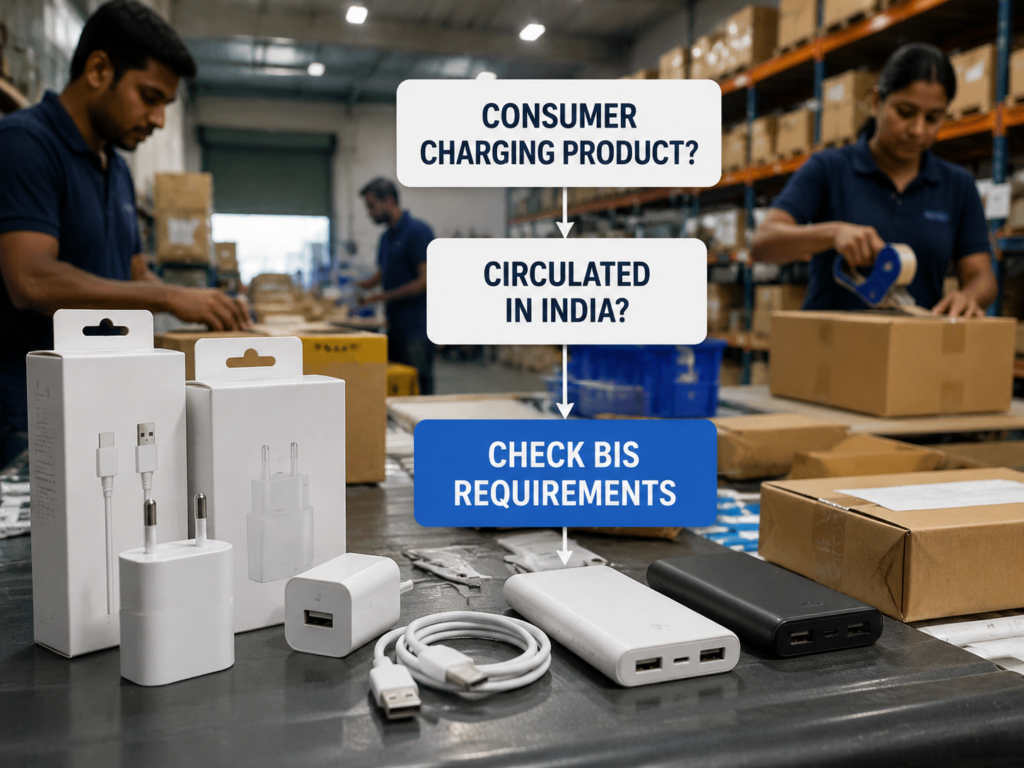
Without checking any information, first ask yourself two questions:
First, is your product a consumer-grade charging product? Those in professional fields such as industry and medical care are not counted.
Second, will your product be circulated formally in India? Whether online or offline, wholesale or retail, or even free gifts, all count as circulation.
If both conditions are met, it is likely to be within the mandatory scope and needs further verification and confirmation.
Advanced 5-step Accurate Confirmation (Suitable for Boundary/New Products)
If it is an ambiguous new product (such as a 2-in-1 magnetic wireless charger + power bank), or a boundary product that you are not sure about, you can follow these five steps:
Step 1, first sort out the core information of the product: is the main function power supply/power storage/data transmission? Is it connected to the mains? Does it have a built-in battery? What are the rated parameters?
Step 2, clarify the sales form: is it sold separately? Included with the whole machine? Set combination? Or OEM?
Step 3, log in to the BIS official mandatory list column, search for the corresponding entry with the product common name (such as USB charger, power bank), do not use your own brand model, the official list will not include specific brands.
Step 4, check whether the product’s parameters and uses match the standard description.
Step 5, confirm whether there are additional compliance requirements (such as USB-C interface, energy efficiency, etc.), don’t miss the subsidiary requirements.
Judgment Rules for Special Scenarios
There are also several high-frequency special scenarios that many people easily get wrong, which are explained separately:
- Set products: Each mandatory category must meet BIS requirements separately, and the compliance of the whole machine does not cover accessories. For example, for a set of mobile phone + charger + cable, you can’t say that the mobile phone has BIS, so the accessories don’t need to be taken care of.
- Sold separately vs sold with the whole machine: Accessories that are sold separately and fall into the mandatory list should meet BIS requirements separately according to the corresponding product category; mandatory accessories included with the machine cannot be automatically covered by the whole machine certificate.
- Gifts/samples: As long as they enter India for circulation, they are within the mandatory scope, even if they are given away for free (such as giving a charging cable when buying a phone case); only non-sale samples for exhibition are excluded, but you need to go through the exhibition procedures in advance and take them out of India after the meeting.
- Cross-border direct mail: Only a small number of products that meet the Indian customs personal use standard may be exempted. Commercial parcels, even if they are direct mail, also need to be compliant.
Boundaries and Exceptions of Non-mandatory Scope
Of course, not all charging-related products need to do BIS according to consumer electronics requirements. The following situations should be clearly distinguished, don’t waste money in vain.
Charging-related Products Clearly Not Covered by the Consumer-grade Mandatory List
The first category is industrial-specific charging equipment, such as chargers for industrial robots and construction machinery. Such products are usually not managed according to consumer-grade charging CRS. Whether certification is required needs to be checked against the corresponding industrial equipment, battery charging equipment or industry QCO requirements, and cannot be directly applied to the consumer electronics mandatory list.
The second category is customized charging products for special industries such as medical care and military industry, which are usually judged first according to the regulatory requirements of medical, military and other industries, and cannot be directly applied to the BIS mandatory list of consumer electronics.
The third category is cables only used for data transmission and completely without charging function — but this needs to be confirmed in combination with the latest standards, because the list may be updated.
The fourth category is internal charging components that are not sold independently, such as built-in charging port components and internal connecting wires of equipment. These are not sold separately to the outside world, follow the whole machine, and do not need separate certification.
Exemptions in Temporary/Special Scenarios
There are also some situations that are usually within the mandatory scope but can be exempted under specific scenarios:
- A small number of charging products brought into the country for personal use, which meet the Indian customs personal use standard (such as bringing two chargers for your own use when traveling), do not need certification.
- Non-sale samples for exhibition, which have gone through the exhibition procedures in advance and are taken out of India after the meeting, do not need certification.
- Used disassembled parts for maintenance, which comply with India’s relevant regulations on maintenance/scrapping, do not need certification.
- Export-oriented products, that is, products only sold outside India and not sold locally, do not need to be done even if they are produced in India.
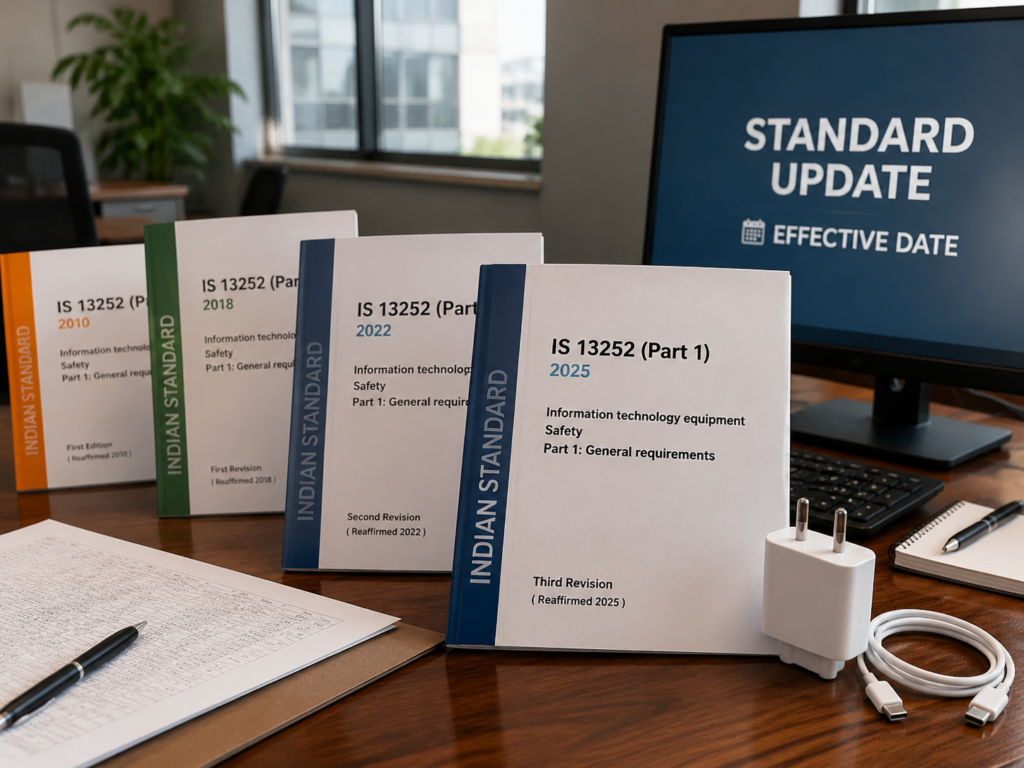
Here we must remind you: the mandatory scope of BIS is not static, it is dynamically adjusted. In recent years, fast charging and USB-C related products have been gradually included in the list, and the standard version will also be revised from time to time. Old standards generally have a transition period. After the transition period, registrations/licenses that have not completed conversion, change or re-evaluation according to the new standards may not be used for customs clearance and sales. So never use old conclusions that are more than 3 years old, and re-check the latest requirements before each shipment and new product launch.
6 Most Common Cognitive Misconceptions
Even if you already roughly know the scope, you can easily be misled by some widespread wrong statements. The following 6 high-frequency misconceptions must be avoided.
Misconception 1: Low-power chargers/small accessories do not need BIS
Wrong. As long as it is a consumer-grade charging product in the mandatory list, certification is required regardless of power and volume. Many people think that 5V1A small chargers and ordinary charging cables don’t need to be done, but as a result, they are directly detained during customs clearance. This situation is particularly common.
Misconception 2: With CE/FCC and other overseas certifications, BIS is not needed
Wrong. India’s market access is subject to local regulations, and overseas certificates cannot replace BIS at all. At most, previous test data can be used as a reference, but the complete BIS registration process still has to be followed.
Misconception 3: White-label/third-party/gifts don’t need to be done, only original ones need certification
Wrong. Regardless of brand or whether it is charged, as long as it is a mandatory product circulated in India, certification is required. Unbranded bare chargers and charging cables given away in activities are all within the scope.
Misconception 4: Accessories shipped with the whole machine do not need separate judgment
Wrong. Mandatory accessories included with the machine still need to meet the corresponding requirements. Previously, many sellers’ mobile phones had BIS, but the included chargers were not compliant, and were directly removed from the platform.
Misconception 5: BIS scope can be judged only by HS code
Wrong. HS code is used for customs classification, not the only basis for BIS scope. BIS pays more attention to the actual function, use and corresponding standards of the product. Products under the same HS code may or may not need to be done, and must be judged in combination with the official list.
Misconception 6: If one model passes BIS, the whole series can be sold
Wrong. BIS registration/license is managed by product category, applicable standard, brand, manufacturer, model and key parameters. Whether series models can be covered depends on BIS’s series rules and registration scope. For example, 18W and 65W chargers with the same appearance cannot directly use the same certification conclusion. You should first check whether they are allowed to be covered as series models, add models, or need to be retested.
Query Method for the Latest Mandatory Scope
Having said so much, where does the most reliable scope information come from? Don’t trust the second-hand experience of peers, it’s most accurate to check official channels directly.
Official Authoritative Query Channels
The first is the BIS official website mandatory certification product column, which can be queried by product category and standard number, which is the most direct and convenient.
The second is the latest mandatory orders and QCOs issued by the Government of India Gazette, where all updates to the mandatory list will be announced, which is the most authoritative legal basis.
The third is the official notices of India’s Ministry of Electronics and Information Technology (MeitY) and Department for Promotion of Industry and Internal Trade (DPIIT), where many scope adjustments of electronic products will be released first.
Efficient Query Tips
There are a few tips when querying, which can save you time:
First, in addition to the common product name, you can also use the corresponding standard number to reverse check the product coverage. For example, if you know that the product corresponds to IS 13252 standard, search for the mandatory requirements corresponding to this standard to see which products are covered.
Second, be sure to pay attention to the effective date, transition period and exemption clauses of the standard. Don’t think that you have to do it now when you see a standard. Many new regulations give a transition period of several months to one year.
Confirmation Method for Boundary Products
If it is a boundary product that you really can’t be sure about, you can follow this process:
First, check the function/use description on the product nameplate, manual and sales page — don’t think that writing “data transmission only” on the page can fool you. The official judgment is based on the actual function.
Second, if necessary, consult a BIS accredited laboratory or local Indian authorized representative, who are more familiar with the latest implementation scale.
Finally, never trust peer experience or second-hand information. Be sure to take the official reply as the criterion, otherwise you will bear the loss if you step into the pit.
Summary
Figuring out the applicable scope of BIS is actually not that complicated. You should now be able to quickly identify whether common consumer-grade charging products are within the mandatory scope, avoid the 6 most frequent cognitive misconceptions, and reduce the probability of pitfalls in customs clearance and sales. When encountering special scenarios such as sets, samples, gifts, and cross-border direct mail, you can also independently complete the basic judgment. Finally, don’t forget that the mandatory scope of BIS is dynamically adjusted. Before each shipment and new product launch, you must actively check the latest requirements through official channels, and don’t use outdated experience to do things.