
If you often buy chargers or wireless chargers in Canada, or run a 3C accessory business targeting the Canadian market, you have most likely heard of the term “NRCan energy efficiency certification”. Many people feel confused when they first hear it: Is it a safety certification? Is it just a promotional label that manufacturers stick on casually? Do charging cables need it? This article starts with basic concepts, covers practical content such as authenticity verification and pitfall avoidance tips, to help you fully understand NRCan energy efficiency certification.
Basic Understanding: First Figure Out What It Exactly Is
First, the most core definition: NRCan energy efficiency certification is essentially a mandatory energy-saving access certificate for designated energy-consuming products in Canada.
Its competent authority is Natural Resources Canada (NRCan for short) — the official federal agency in charge of energy in Canada, with regulatory basis in Canada’s and supporting energy efficiency regulations. To put it plainly, as long as a product is included in the control scope, it cannot be legally sold in the Canadian market without meeting NRCan energy efficiency requirements, which is equivalent to an “entry ticket” in the energy-saving field.
When it comes to the charging product field we are familiar with, NRCan regulates charging devices with the function of converting mains electricity to low voltage — that is, devices that can be directly plugged into a wall socket (Canada uses 120V alternating current) to convert high-voltage alternating current into low-voltage direct current that can be used by mobile phones and laptops.
Here are three most easily confused boundaries that you must remember first to avoid misunderstanding later:
First, it is not a safety certification. NRCan only cares about whether the product saves electricity, and does not care about safety issues such as electric shock, fire, or high temperature resistance at all — safety is the business of safety certifications such as cUL, CSA, and ETL. For example: if a charger has passed NRCan, it only means that it draws less power during standby and does not waste electricity during charging, but if it leaks electricity when plugged in, NRCan does not care about that.
Second, it is not a voluntary label. Many people think that manufacturers do it voluntarily to promote their energy-saving features, but that is not the case — for products within the control scope, this is a mandatory requirement, not optional. Selling without it is illegal.
Third, it does not have a unified exclusive logo. Don’t look for the “NRCan mark” on products like you look for the CE mark or FCC mark. The core of NRCan compliance is that the product information is filed in the official database and the merchant can provide valid verification documents, not by sticking a label.
Why Pay Attention to NRCan? It Has Different Impacts on Different Groups of People
NRCan energy efficiency requirements are not paper rules; they have practical impacts on different groups:
For ordinary consumers and overseas shopping users, it has three direct values: First, it saves more electricity. The standby power consumption of compliant products is very low, and those chargers that are plugged into the wall all year round at home can save a lot of “phantom electricity bills” a year. Second, it reduces the risk of cargo detention: non-compliant products for commercial import, resale or platform sales have a higher risk of being detained, returned or destroyed by customs; the control boundary for personal use, second-hand or maintenance replacement products is subject to official exemption regulations and actual customs enforcement, and non-compliant products may also be detained. Third, it can help you filter out inferior products — after all, products that cannot even meet the mandatory access energy efficiency requirements are most likely no-name brands with falsely marked power and shoddy workmanship, and their quality is hard to guarantee.
For sellers and importers: First, it is a mandatory access threshold. Non-compliance may result in fines and product removal from shelves in mild cases, or cargo detention and even impact on subsequent import qualifications in severe cases. Second, mainstream e-commerce platforms such as Amazon Canada will actively verify the NRCan qualification of charging products, and products without compliance certificates cannot be listed. Compliant products are also more likely to gain consumer trust.
As for why Canada wants to implement such strict energy efficiency requirements? The underlying logic is actually very simple: with so many households and offices across Canada, the total number of chargers and wireless chargers plugged in all year round is an astronomical figure, and the cumulative electricity wasted in standby state is very considerable. Mandatory energy efficiency requirements can not only reduce national energy waste and carbon emissions, but also force manufacturers to optimize the energy-saving design of charging products, instead of blindly piling up power and competing on price.
Which Charging Products Need NRCan? You Can Quickly Judge in 3 Steps
After talking about the significance, the question everyone is most concerned about must be: which charging products need to pass NRCan? Which ones don’t?
First, clarify the three types of charging products under mandatory control: The first type is external power adapters, which are the most commonly used USB chargers for mobile phones, tablets, and laptops, as well as USB docks with built-in power supplies — note that these are docks that can be directly plugged into the wall, not those that draw power from a computer’s USB port. The second type is wireless charging devices, such as wireless charging pads and charging stands that are directly plugged into the wall, as long as they have their own power conversion function, they are within the control scope. The third type is external battery chargers, such as external desk chargers for power tools, separate desk chargers for handheld electronic devices, as long as they are external devices that plug into mains electricity to charge batteries, they count.
There are also several common types of exceptional products that do not require NRCan control: First, passive charging accessories, such as ordinary charging cables, pure adapters, and extension cords — these products themselves do not have voltage conversion functions, they only transmit electricity, so they do not need NRCan certification. Second, some charging equipment for industrial and professional use, such as some large industrial chargers dedicated to factories, may not be regulated as consumer products, but you cannot judge whether they are exempt based solely on the usage scenario; you need to check NRCan’s official product definitions, exemption clauses and the latest catalog. In addition, second-hand personal items and scattered accessories for maintenance and replacement are usually not within the scope of mandatory control, and the specific boundary is still subject to the latest catalog and exemption rules officially announced by NRCan.
If you are not sure whether your product needs it, you can use the 3-step quick judgment method:
The first step is to look at the core function: does it undertake the voltage conversion function of “mains to low voltage”? If yes, it is most likely needed; if not, it is basically not needed. Here is a supplementary note: the interface type does not affect the judgment — whether it is USB-A, USB-C or other interfaces, the core depends on whether there is an energy conversion circuit, it has nothing to do with the interface.
The second step is to look at the sales form: is it sold as an independent external power supply? Built-in power modules that are inseparable inside the device are usually not separately regulated as external power supplies; but external chargers, whether sold separately or entering the Canadian market together with the main unit or a set, need to be checked whether the adapter model meets the applicable energy efficiency requirements of NRCan.
The third step, if you are still not sure, directly check NRCan’s official qualified database, or ask the merchant to provide a compliance certificate, this is the most accurate.
There are also several common special situations that are particularly easy to get wrong, so let’s talk about them separately:
Products with the same appearance but different power must be judged separately, and certification cannot be shared. Many manufacturers like to use the same shell to make chargers with different powers. For example, 20W and 65W ones look exactly the same, but because of different power and different circuits, they must be certified separately. You can’t say that if one passes, the other can also use it.
For USB-C cables with E-Marker chips, many people think that certification is required if there is a chip, but that is not the case: if it only has a power signal chip (that is, E-Marker used to negotiate fast charging power), it is still a passive accessory and does not need it; but if the cable has a voltage conversion circuit inside (such as some special buck-boost cables), then it is necessary to evaluate whether it is within the control scope.
For the case of set sales, such as a set of “charger + charging cable”, only the charger needs to meet NRCan energy efficiency requirements, and the cable does not, because the cable is passive.
Core Assessment Requirements: What Exactly Does NRCan Check?
So what exactly does NRCan test? What counts as meeting the standard? In fact, there are only two core indicators that must be met at the same time:
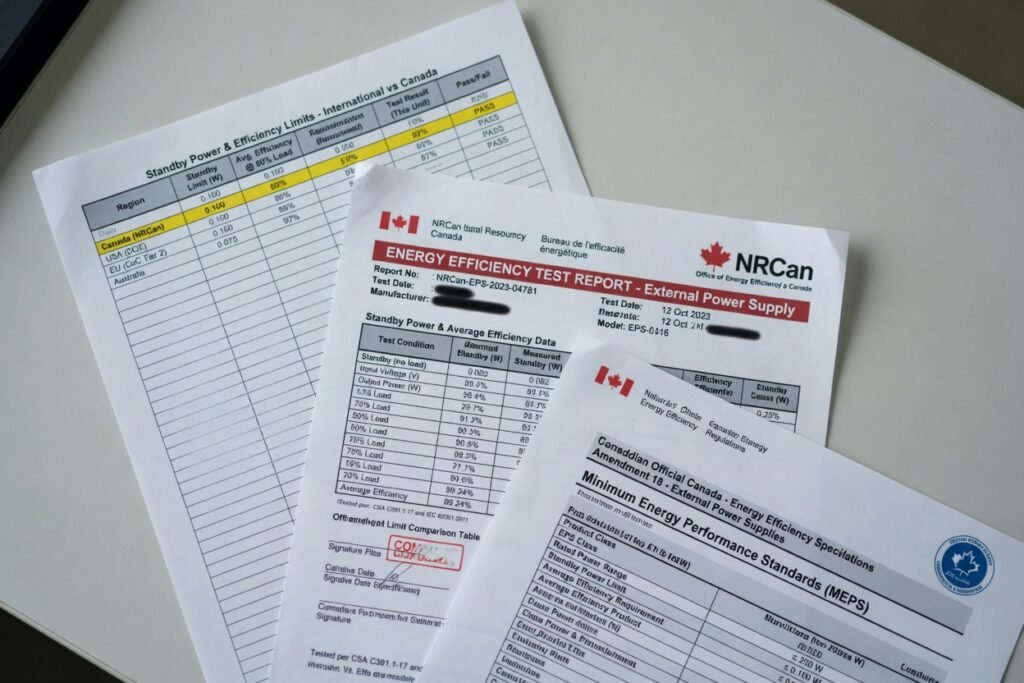
The first is standby power consumption, which is what we often call no-load power consumption — the small amount of electricity secretly consumed when the charger is plugged into the wall but not connected to a device for charging, commonly known as “phantom power consumption”. NRCan has a clear upper limit requirement for this value, which cannot exceed the limit.
The second is average operating efficiency. Simply put, it is the ratio of the useful electricity actually transmitted to the device to the total electricity drawn by the charger from the wall during charging. For example, if the charger consumes 100Wh of electricity from the wall and 88Wh is transmitted to the mobile phone, the efficiency is 88% — this ratio cannot be lower than the minimum value specified by the official.
The above two indicators are the core assessment items for external power supply products; external battery chargers and wireless charging devices need to be checked according to the test methods and indicator requirements of the corresponding product categories, and the limit standards for external power supplies cannot be directly applied.
Of course, the specific limits are not fixed. There are three key factors that affect the requirements: First, the output power. Products in different power segments have different limits. For example, a 20W low-power charger and a 100W high-power charger have different required efficiency and standby power consumption standards. Second, the product type. External power supplies, wireless chargers, and external battery chargers apply different standards and cannot be confused. Third, the regulation version. NRCan updates energy efficiency regulations from time to time, and the requirements of the new version are usually stricter, such as lowering the limit of standby power consumption or raising the efficiency requirement.
Many people will ask: Does NRCan certification have a validity period? The answer is there is no fixed validity period — as long as your product design has not changed and the applicable regulatory standards have not been updated, the compliance qualification will always be valid. But there are two situations that need to be redone: The first is product changes, such as changing the circuit, replacing the core power chip, adjusting the output power, these will affect energy efficiency, and you must re-apply for review. The second is the update of regulatory standards. Products that meet the standards under the old version may not meet the newly effective standards, and in this case, compliance also needs to be re-evaluated.
Compliance Process and Authenticity Verification: How to Confirm Whether It Is Truly Compliant?
Next, let’s talk about something more practical: what is the process for merchants to obtain NRCan compliance qualification? How can ordinary consumers check whether a product is truly compliant?
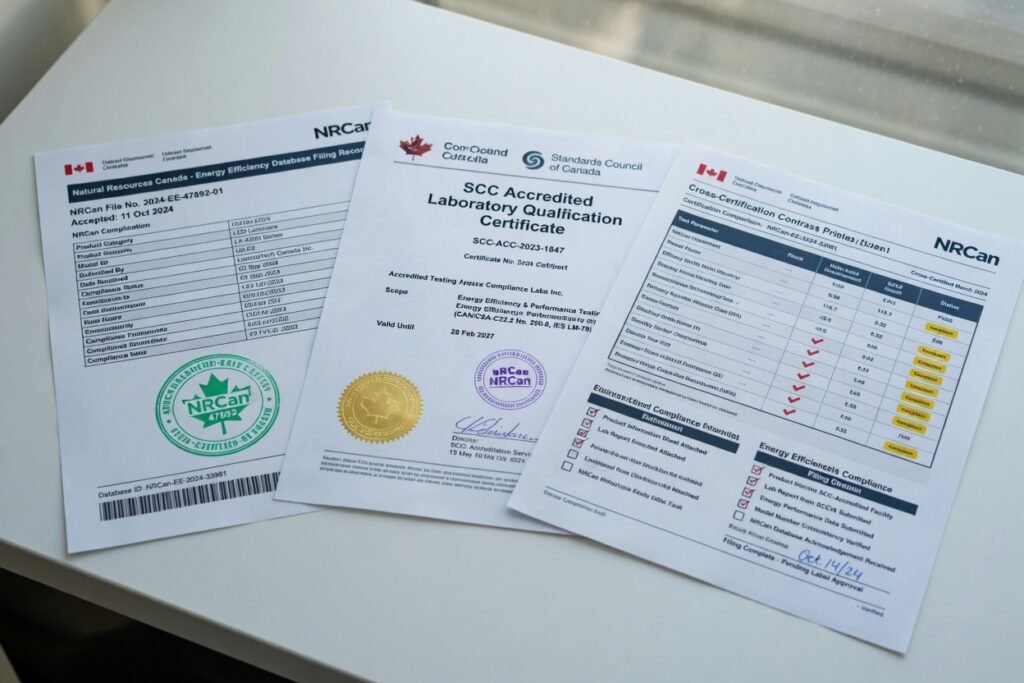
First, let’s talk about the full compliance process for merchants: First, product classification confirmation, clarify the product category and corresponding energy efficiency standards, to avoid invalidation caused by choosing the wrong standard. Next is third-party testing, entrust a qualified laboratory to complete energy efficiency testing in accordance with Canadian working condition requirements, and issue a test report. After that is compliance verification: the test report must be submitted to an institution recognized by the Standards Council of Canada (SCC for short) for review to confirm that the test methods and data meet regulatory requirements.
After the verification is completed, the importer or distributor also needs to submit the energy efficiency report and product import-related information as required by NRCan. After the filing is completed, the product information will be entered into NRCan’s official qualified database, and only then will it have complete compliance qualifications for market access in Canada.
For ordinary consumers, it is also very simple to check whether a product is truly compliant, just follow these steps: first collect complete product information, including brand, complete model, and rated power — don’t just look at the appearance, many products with the same appearance have a model difference of one letter, which is a completely different model. Then enter the NRCan energy efficiency query system on the official website of the Government of Canada, this system is public and anyone can check it for free. Finally, enter the information to search, and check whether the model and parameters in the search results completely match the product you bought — even one parameter difference does not count as compliance.
Here are also a few common non-compliant situations to pay attention to when buying: The first is certificate misappropriation, that is, misappropriating the qualifications of other models or other foundries. For example, if you buy a 20W charger, the merchant gives the certification of a 65W model with the same appearance, and the parameters do not match at all. This is certificate misappropriation and is non-compliant. The second is fake reports, test reports forged by merchants themselves, which have not been reviewed at all, and there is no record in the official database. This is most common in no-name products. The third is expired standards, certification made with abolished old standards, which does not meet the current effective regulatory requirements, and this is also not compliant.
Core Differences from Common Charging Certifications
Many people confuse NRCan with other common charging certifications. We put the most easily confused ones together to help you distinguish the differences.
First, the difference from safety certifications (cUL/CSA/ETL): These two have completely different control directions. NRCan manages energy saving, and safety certifications manage safety risks such as electric shock, fire, and temperature rise. But one thing is the same: both are mandatory requirements for the Canadian market, and neither is dispensable — that is, chargers sold in Canada must pass both NRCan energy efficiency and safety certification. Having safety certification does not mean energy efficiency compliance, and they must be confirmed separately.
Then, the difference from the US energy efficiency system (DOE/Energy Star): The jurisdiction is different. NRCan is responsible for energy efficiency supervision in the Canadian market, and the US DOE is the US federal energy efficiency regulation and compliance declaration system, which is mandatory for regulated products such as external power supplies. Although their test methods are similar, they cannot be directly substituted — if a product is deployed in both the US and Canadian markets, some test data can be shared, but it must go through NRCan’s review and filing, and DOE compliance certificates cannot be directly used as NRCan. Also note that Energy Star is a voluntary high-efficiency label in the United States, with requirements higher than DOE’s mandatory access standards, but it does not mean that it meets NRCan’s mandatory requirements. Don’t confuse them.
Another one is the difference from Canada’s ISED certification: NRCan manages energy consumption, and ISED manages electromagnetic compatibility and wireless communication compliance. For example, wireless chargers, because they have wireless transmission functions, must pass both NRCan’s energy efficiency requirements and ISED’s wireless compliance requirements, and the two cannot replace each other.
For easy memory, here is a simple comparison table:
| Comparison Item | NRCan Energy Efficiency Certification | cUL/CSA Safety Certification | US DOE Energy Efficiency System | Canada ISED Certification |
| Core Control Direction | Energy saving (standby/efficiency) | Safety (electric shock/fire) | Energy saving (US market) | Electromagnetic compatibility/wireless |
| Mandatory or Not | Yes (products within control scope) | Yes (products within control scope) | Yes (US regulated products) | Yes (products with wireless/electromagnetic related functions) |
| Applicable Charging Products | Devices with mains to low voltage function | Almost all electrical products | Regulated energy-consuming products in the US market | Charging devices with wireless functions |
| Can They Replace Each Other | Cannot be replaced by other certifications | Cannot replace NRCan | Cannot directly replace NRCan | Cannot replace NRCan |
Note: The above are common situations for consumer charging products, and special products are subject to official requirements.
Guide to Avoiding Common Misconceptions
Finally, we have sorted out several most common misconceptions to help you avoid detours.
First are cognitive misconceptions. Many people think that NRCan is a voluntary certification, but in fact, for products within the control scope such as external power supplies and wireless chargers, it is a mandatory access requirement, and non-compliant products cannot be sold at all. Others think that all charging products need NRCan, which is also wrong — only devices with voltage conversion functions need it, and passive accessories such as ordinary charging cables and pure adapters do not need it at all. Many people also think that passing NRCan means the highest energy efficiency, but in fact it is only the minimum access standard, just enough to meet the threshold for entering the market. If you want products with higher energy efficiency, you can check if there are high-efficiency labels such as Energy Star. Another common misunderstanding is that low-power products must be exempt. In fact, whether they can be exempt depends on regulatory definitions, not just the wattage. For example, some low-power external power supplies, as long as they are in the control catalog, also need certification.
Then are substitution misconceptions. Many people think that with safety certification, there is no need to do NRCan, which is a complete misunderstanding of the positioning of the two — the two have completely different control directions, both are mandatory requirements for the Canadian market, and neither is dispensable. Don’t be fooled by merchants’ claims that “cUL certification is enough”. Others think that the US DOE or Energy Star can directly replace NRCan. In fact, Canada has an independent regulatory system, and NRCan review and filing must be done separately. US certifications cannot be used directly.
There is also a very easy pitfall in authenticity judgment: many people think that chargers that look the same can share certification. In fact, as long as the power, internal circuit, or core power chip changes, re-certification is required. There are many chargers on the market with the same shell but different models, with exactly the same appearance but very different internal configurations. Certificate misappropriation is very common. When checking, be sure to check the complete model and parameters, not just the appearance.
After mastering the above content, whether it is ordinary consumers choosing charging products, or sellers selecting products for the Canadian market, you can independently judge whether the product belongs to the NRCan mandatory certification scope, distinguish its core differences from safety certifications and the US energy efficiency system, verify compliance through the official database, and also avoid common problems such as certificate misappropriation, fake reports, and expired standards, reducing unnecessary troubles.