
Friends who have just arrived in Canada will most likely have several charging-related questions: Can wide-voltage chargers brought from China be used directly? Are UL-certified chargers bought in the United States legal in Canada? What thresholds must be met to sell charging products locally? At the core of these questions are Canada’s electrical safety requirements — a set of mandatory rules closely related to the chargers, charging cables, and wireless chargers we use every day.
Many people think it is as simple as “getting a CSA certificate”, but in fact, the coverage, certification logic, and judgment methods behind it are all nuanced. Understanding them can not only avoid safety hazards such as electric shock and fire, but also prevent you from falling into pitfalls like customs goods detention and insurance claim denial.
Beginner’s Primer: Basic Understanding
Let’s first clarify the core concepts to avoid confusion later.
The essence of Canadian electrical safety requirements is a set of mandatory safety rules that all electrical products connected to high-voltage household wall outlets (called “mains electricity” in the industry, with a Canadian standard of 120V/60Hz) must comply with; it is not something that can be solved once and for all with a single certificate. Its three core goals are only: electric shock prevention, fire prevention, and prevention of personal or property damage caused by product overheating. Unlike the “nationally unified enforcement” that many people assume, Canada’s regulatory logic is that the federal government sets the general framework, and each province implements it locally, so details may vary slightly between provinces, but the core requirements are consistent.
The question everyone cares about most — “which charging products need to meet the requirements” — can be divided into three categories:
The first category is mandatory certification category, that is, products that are directly plugged into mains electricity. They must obtain officially recognized certification before they can be sold, such as wall chargers, power adapters, integrated charging cables with AC plugs, wireless chargers with plugs, and power banks with AC plugs — as long as one end can be plugged into a wall socket, it falls within the mandatory scope.
The second category is standard compliance required category. These products are not connected to mains electricity, but have safety risks due to high power, so they must meet corresponding safety technical requirements. Third-party certification is not mandatory, but they are still liable if problems occur, such as separate USB charging cables of 65W and above, and ordinary power banks without AC plugs.
The third category is no separate compliance required category, that is, products with no direct mains electricity risk do not need separate electrical safety certification, such as purely physical adapters (which only change the shape of the plug and have no electronic components) and car chargers (which are powered by the 12V low voltage in the car and have no high-voltage risk).
Many people may ask: It’s just a charger, is it necessary to regulate it so strictly? The importance of compliance actually concerns everyone: First, most provinces in Canada explicitly require that electrical products must have certification from officially recognized bodies before they can be sold; Second, certification is checked in customs entry, supermarket shelf placement, e-commerce platform reviews, and insurance company claim settlements; More importantly, in the event of a safety accident, the presence or absence of compliant certification records will directly affect liability determination — if you use an uncertified charger that burns down your house, the insurance company will most likely deny the claim.
Before going into details, let’s clarify a few of the most common beginner misconceptions that many people fall for when they first arrive in Canada:
First, “Having a US UL certification means meeting Canadian requirements” — wrong. Only cUL certification with a lowercase “c” prefix is recognized by Canada. Ordinary UL only covers the US market and is invalid in Canada.
Second, “All charging cables do not need certification” — wrong. Integrated charging cables with AC plugs are themselves connected to mains electricity and fall within the scope of mandatory certification; high-current USB cables of 65W and above must also meet safety standards due to the risk of overheating.
Third, “Bringing items for personal use into the country is completely unrestricted” — wrong. Reasonable quantities for personal use are usually not inspected, but if you bring dozens or hundreds of items clearly for commercial use, they will most likely be detained by customs random inspection.
Fourth, “If it can charge, it is safe” — wrong. Being able to conduct electricity is only the most basic function, and does not mean it has passed safety tests such as insulation, flame retardancy, and long-term use temperature (professionally called “temperature rise”). Many low-quality chargers work fine when first used, but may overheat and catch fire after a few months.
System Logic: Operating Rules
To sort out the operating logic of this set of rules, we must start with its three-tier structure and core regulatory roles.
Canada’s electrical safety system has a three-tier structure, from top to bottom: regulations, standards, and certification, each with its own responsibilities:
The top layer is regulations, that is, laws enacted by each province, which clearly require that “electrical products must be safe to be sold and used”, and are the source of mandatory force.
The middle layer is standards, that is, specific technical details, such as how thick the insulation layer should be, what flame-retardant material the shell is made of, and what the maximum long-term use temperature is, turning the vague requirement of “safety” into measurable indicators.
The bottom layer is certification, that is, third-party bodies test products according to standards, and grant the right to use the mark after passing the test, which is equivalent to issuing a “safety certificate” for the product — this is also the part that ordinary users are most exposed to.
There are two key roles in this system. You don’t need to remember the abbreviations, just know what they are in charge of:
One is the Standards Council of Canada (abbreviated as SCC), which is a federal-level certification regulatory body. It is specifically responsible for reviewing the qualifications of third-party certification bodies. Only certifications issued by bodies recognized by it are valid in Canada.
The other is local compliance regulatory departments in each province (known as AHJ in the industry; ordinary users do not need to remember this term), which are responsible for daily compliance inspections and violation penalties. For example, if you sell uncertified chargers in Ontario, the electrical safety management department of Ontario will conduct the inspection.
To meet safety requirements, there are three common compliance pathways, among which formal product certification is the most commonly contacted by ordinary users and merchants:
The first is products sold in bulk and listed on formal channels, which require formal product certification, mainly CSA and cUL, which will be explained in detail later.
The second is small-batch custom or industrial equipment, which can undergo on-site evaluation without batch certification, and ordinary users rarely come into contact with this.
The third is external power adapters included with complete devices, such as the charger that comes with a laptop. They do not need separate certification only if the charger model is explicitly covered by the complete device’s certification documents and is sold only as an accessory of the complete device; if the charger is sold separately, or its model/supplier/key materials are changed, its independent certification or listing status must be reconfirmed, and the complete device’s certification cannot be directly applied.
A reminder here: Although the implementation details vary from province to province, as long as the certification is recognized by the SCC, it is valid across Canada. So if you are targeting the national market or buying across provinces, choosing CSA or cUL is the most reliable option.
Core Certifications: Recognized Safety Marks
When many people mention Canadian electrical certification, they only know CSA. In fact, there are several other valid ones, let’s go through them one by one.
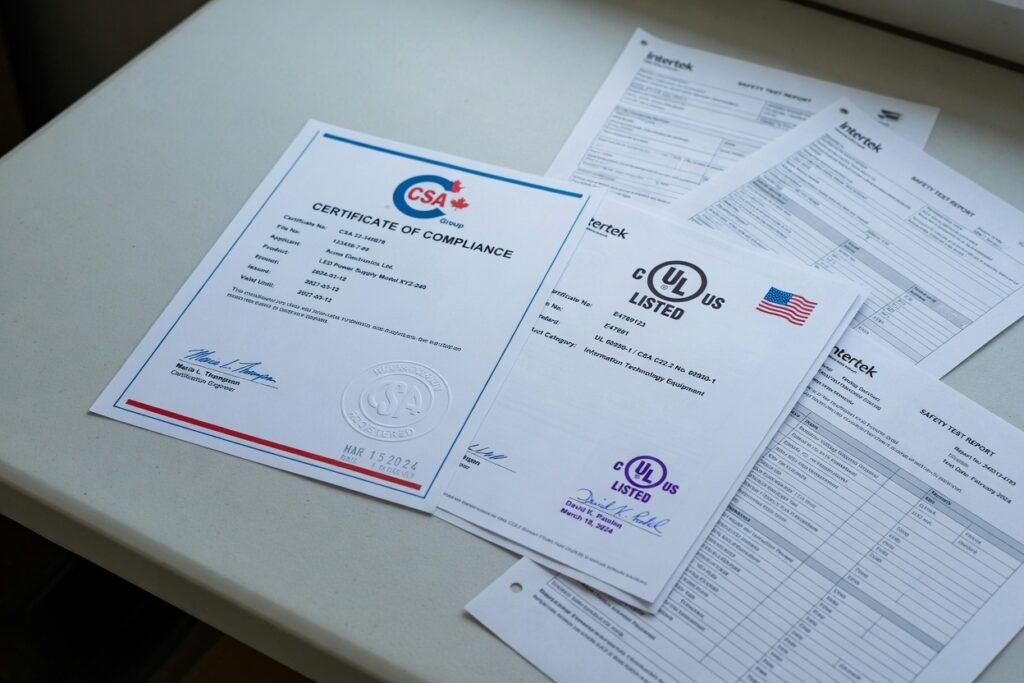
First is the most common CSA certification, issued by the Canadian-based CSA Group — this body is quite special, as it both participates in formulating Canada’s electrical safety standards and conducts certification, which is equivalent to being both the “rule-maker” and the “referee”, so it has high recognition. Charging products such as chargers, power adapters, USB-C products, and plugs can all be CSA certified. Its mark is easy to recognize: it is a square or round logo with the three letters “CSA” and a unique file number, which is equivalent to the product’s “certification ID card”.
The second is cUL certification, issued by the US-based UL body. Although it is issued by a US body, it fully meets Canadian safety standards and has also obtained SCC recognition, so its legal effect is exactly the same as CSA, and it is valid across Canada. Many people cannot distinguish between UL and cUL. In fact, just check if there is a lowercase “c” in front of the mark — the one with c is the Canadian version, and the one without is only applicable to the US. If the mark has both “c” and “US”, that is cULus, then it is dual US-Canada certification and can be used in both countries. There will also be a unique certification number next to the cUL mark.
Many people ask: Which is better, CSA or cUL? In fact, the similarities between the two far outweigh the differences: both are mandatory access-level certifications, their test standards are basically aligned, their legal effects are exactly the same, and they are valid nationwide. The differences are mainly in the issuing body, mark style, and the application process for dual US-Canada certification. A simple comparison table is organized for reference:
| Comparison Item | CSA Certification | cUL Certification |
| Issuing Body | Canadian CSA Group | US UL body |
| Mark Features | Square/round mark with CSA letters + unique file number | UL mark with lowercase c prefix (cULus is valid for both US and Canada) + certification number |
| Applicable Scenarios | Only for the Canadian market | For both US and Canadian markets (choose cULus) |
For ordinary users, whether it is CSA or cUL, as long as it is genuine, there is no difference in use, and there is no need to overthink which one to choose.
In addition to these two mainstream certifications, there are some niche ones, such as cETL, cTUV, etc. You don’t need to memorize their names specifically. The judgment standard is very simple: don’t look at the fame of the mark, it is valid as long as two conditions are met: first, the issuing body is recognized by the SCC; second, the certified product scope matches the product you have.
Conversely, there are several types of marks that cannot replace Canadian electrical safety certification at all, don’t be fooled by merchants:
The first is ordinary UL certification without the “c” prefix, which only covers the US market, and Canada does not recognize it as proof of electrical safety access.
The second is CE, FCC, RoHS marks: CE is the EU’s compliance requirement, which is not equivalent to Canadian safety certification; FCC mainly targets electromagnetic compatibility and is not a Canadian electrical safety access condition; RoHS is an environmental protection requirement for the restriction of hazardous substances, which has nothing to do with electrical safety access. Even if these marks are printed on the product, they cannot prove that the product meets Canadian electrical safety requirements.
The third is “certification” printed only on packaging or promotional materials. Canada requires that the certification mark must be printed on the product body itself; printing only on the packaging does not count, and it is likely to be fake.
Category-Specific Requirements: Detailed Safety Rules
The specific safety requirements of different charging products have different focuses. You can check against the products you have:
First are chargers and power adapters, which are also the highest-risk category:
First, the input voltage must be compatible with 120V/60Hz. Of course, many chargers now are 100-240V wide-voltage, which can also be used; chargers that only support 220V are not suitable for direct connection to Canadian 120V/60Hz sockets, and usually have abnormalities such as failure to start and insufficient output power. If used with low-quality voltage converters, step-up transformers, or uncertified power strips, the risk of overheating, equipment damage, and even fire will greatly increase.
Second, they must have triple protection of overcurrent, overvoltage, and overheating. Even if a fault occurs, it must not cause electric shock or fire.
Third, the shell must be made of flame-retardant material. Even if it encounters an open flame, it can quickly extinguish itself after the flame is removed, and will not burn more and more fiercely.
Fourth, if it is a USB-C PD fast charger, it must also meet protocol safety requirements, and can automatically negotiate the output power with the device, and cannot output high voltage randomly. For example, outputting 20V when plugged into a mobile phone will directly burn the phone.
Next are charging cables and USB interfaces:
First, integrated charging cables with AC plugs (that is, the type with one end plugged into the wall and the other end connected to the device, with no separate charging head in the middle) must pass CSA or cUL certification as a whole, and cannot only certify the cable part.
Second, separate USB charging cables of 65W and above must meet the requirements of sufficient wire gauge and flame-retardant materials, otherwise they are prone to overheating when high current passes through.
Third, USB-C fast charging cables must have an E-marker chip (that is, a power identification chip) corresponding to the power rating, which can tell the charger and the device how much current the cable supports, and will not force excessive current to pass through, which causes heating.
Fourth, all interfaces must have anti-electric shock design, and metal parts must not be exposed with dangerous voltage. For example, when you plug in a charger, you will not get an electric shock if your finger touches the metal part of the interface.
Next are plugs and charging ports:
First, the wall plug pins must meet the NEMA North American standard, that is, the common two flat and one round shape. The size and spacing of the plug pins are fixed, which can ensure a firm and good connection without loosening.
Second, the charging port must have a foreign object prevention design, such as a plastic baffle inside, to prevent children from poking in with metal needles and causing a short circuit.
Third, the contact must be stable when plugging and unplugging, and must not be loose. Otherwise, the contact resistance will be too large, which is easy to cause heating and even fire.
Then are wireless chargers and power banks:
First, wireless chargers must have a foreign object detection function. If you accidentally put metal objects such as keys or coins on the wireless charger, it can detect them and stop charging, and will not heat the metal to a temperature that causes fire.
Second, ordinary power banks without AC plugs do not require mandatory CSA certification, but must meet both usage safety (such as no short circuit, no overheating) and transportation safety (such as no electrolyte leakage, no explosion) requirements.
Third, wireless chargers and power banks with AC plugs are directly connected to mains electricity, so they must undergo mandatory certification according to the requirements for chargers.
Finally, there are general labeling requirements that all products must comply with:
The certification mark and unique number must be printed on the product body, not only on the packaging; the input and output voltage and current, and the information of the manufacturer or responsible party must also be clearly marked; these labels must be wear-resistant and must not fall off or become blurred under normal use. Otherwise, if the mark disappears after half a year of use, it will be impossible to judge whether it is compliant.
Practical Method: 3 Steps to Judge Compliance
Ordinary users do not need to memorize all the rules by rote. Mastering 3 steps can quickly judge product compliance:
Step 1: Check the certification mark on the product body
First, look at the body of the charger or wireless charger (usually the nameplate on the bottom or side) to find the CSA mark, or the UL mark with a lowercase “c” prefix (cUL, cULus are both acceptable). Never only look at the outer packaging or e-commerce product detail pages — what is printed on the packaging may not count.
At the same time, exclude those invalid marks: ordinary UL without c, CE, FCC, RoHS, none of these can be used as the basis for Canadian electrical safety compliance. If the mark has no number, is printed blurry, or has a format that is very different from the official style, it is most likely fake.
Step 2: Verify the authenticity of the certification number
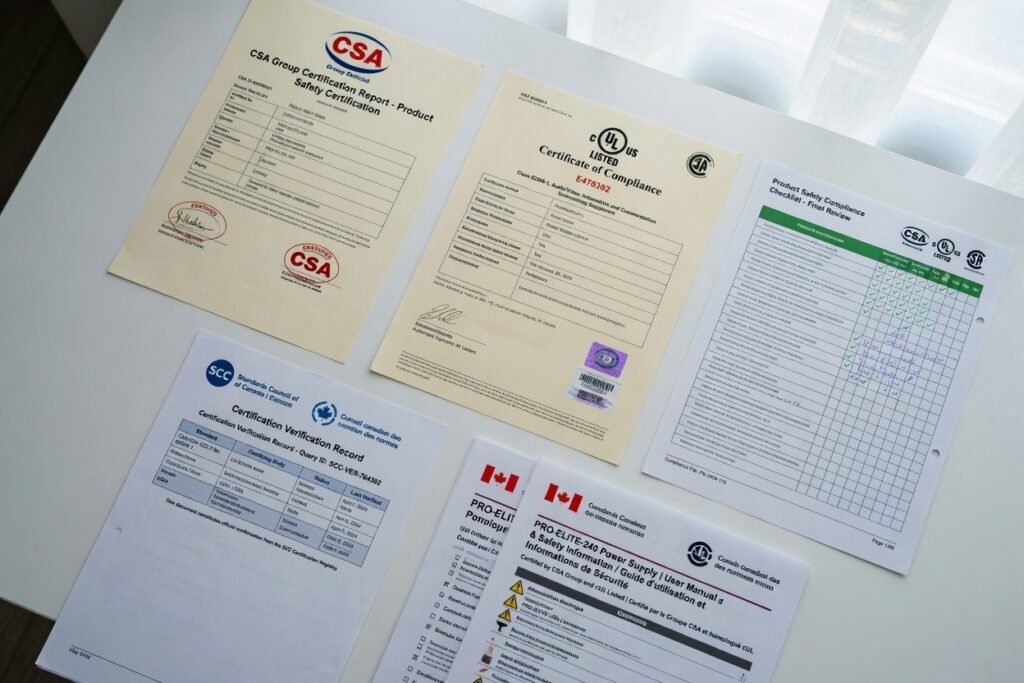
If you have doubts about the mark, or if you bought a more expensive high-power charger, you can go to the official CSA or UL database and enter the number on the mark to query.
When verifying, pay attention to two points: First, the certified model must be consistent with the product you have. Certification is issued for specific models, and one number cannot be used for the entire series. For example, if a merchant sticks the certification of a 20W charger on a 65W product, that is certificate misappropriation; Second, the certification status must be within the validity period, and expired certification is also invalid.
Step 3: Confirm parameters and compatibility
Even if the certification is genuine, it is necessary to check whether the parameters and compatibility meet the requirements: First, the input voltage must include 120V/60Hz, and products that only support 220V are not recommended for use in Canada; Second, confirm that the charging protocol and cable current-carrying capacity match the device — for compliant negotiated fast charging such as USB-C PD/QC, a higher rated power of the charger itself will not damage low-power devices, and the two will automatically negotiate to a safe power supported by both. The risks mainly come from counterfeit chargers, non-negotiated fixed high-voltage output, low-quality cables, or poor interface contact; Finally, the plug must match Canadian sockets. If you use a purely physical adapter to change the plug shape, it will not change the compliance of the product — a product that is not certified itself will still be non-compliant no matter how many adapters you add.
If you are too lazy to check the database, you can first do a 5-second quick check, which can eliminate most low-quality products: First, check if there is a clear certification mark with a number on the product body; second, check if 120V/60Hz is included in the input parameters; third, check the workmanship: whether the shell has burrs, whether the plug is loose, and whether the cable body is so soft that it flattens when pinched (if the cable body is too soft, it is most likely that the wire gauge is insufficient, and it is prone to overheating under high current).
The product compliance rates of different channels are also different, for your reference: the compliance rate of local formal supermarkets and brand electronics stores is close to 100%; products shipped from local Canadian e-commerce warehouses also have a relatively high compliance rate; products from cross-border direct mail, street stalls, or dollar stores have a high probability of being non-compliant, so you must check carefully when buying.
Advanced Pitfall Avoidance: Scenario-Based Risk Assessment
There are also hidden risks in several common scenarios in daily use that require extra attention:
First is compliance judgment for cross-border carrying and overseas online shopping:
Many people bring chargers back when they return to China or travel to the US, or shop online from China or the US. Note here: Empirically, ordinary travel for personal use (1-2 chargers, less than 3 charging cables) is usually not subject to key inspection, but this is not a fixed inspection-exempt quota stipulated by the Canadian government. If you carry a large number of the same model with complete packaging, clearly for commercial sale, they will most likely be detained by customs random inspection.
If you shop online from the US, be sure to confirm that the product is cUL or cULus certified. Ordinary UL is non-compliant in Canada. When buying from cross-border e-commerce, prioritize products marked “Canada compliant”. After receiving the goods, be sure to check the mark on the product body, don’t just look at the promotion on the detail page.
Then is risk judgment for mixed use of fast chargers:
Now everyone uses USB-C PD fast charging, and many people worry that high-power chargers will burn low-power devices. In fact, there is no need to be afraid: For compliant PD fast charging, high power is output only when the charger, charging cable, and device all support the corresponding power; if you use a compliant 65W charger to charge a 20W mobile phone, the charger will automatically negotiate to 20W output and will not burn the device.
But if you use a no-name fast charging cable with a high-power charger, the risk will double — many no-name cables do not have an E-marker chip and have insufficient wire gauge, which is very easy to overheat, even melt and catch fire when high current passes through. So for high-power fast charging, be sure to use certified cables.
Next is usage risks of multi-port chargers and power strips:
Many people like to use multi-port chargers to charge mobile phones, tablets, and earphones at the same time. Note here: When a multi-port charger operates at full load, the heat generation will be greater than when using a single port. If it is covered by something or plugged into a very crowded power strip, heat dissipation will be poor, and the risk of overheating will increase.
In addition, the power strip itself must also meet Canadian safety requirements. You cannot use a power strip that only supports 220V, otherwise it is not only easy to break, but may also catch fire. If you find that the plug is loose, the socket is discolored, or there is a burning smell, be sure to stop using it immediately, don’t force it.
Then is advanced identification of fake certifications:
Now the technology of fake certification is getting more and more advanced, and it may be difficult to distinguish just by looking at the appearance. Here are three advanced tips: First, check model matching. Many misappropriated certification numbers correspond to products of another model, which can be found by checking the official database; Second, look at the price. If the market price of a certain brand’s 65W PD charger is 30 to 40 Canadian dollars, and the one you bought is only 10 Canadian dollars, it is most likely fake certification; Third, the most accurate method is still to check the official database, don’t just judge by appearance.
Finally are provincial differences and special requirements:
Most provinces in Canada have unified certification requirements, and CSA and cUL are valid nationwide, but there are two points to note: First, due to French language requirements in Quebec, product manuals must have a French version, otherwise even if the certification is complete, it may not meet local requirements; Second, some provinces have additional regulatory requirements for the sale and transportation of power banks. In addition to checking electrical safety rules, merchants also need to confirm the corresponding requirements for lithium battery transportation, storage, e-commerce platform listing, and local language labeling; ordinary consumers only need to focus on the product body certification, parameter labeling, and safety prompts during transportation.
Boundaries and Exceptions: Cases Where General Rules Do Not Apply
Many rules have boundaries, and Canada’s electrical safety requirements are no exception. There are several cases where the general rules do not apply, don’t get confused.
First is validity boundaries of certification:
Certification is neither “valid for life” nor “universal for the entire series”: First, certification only corresponds to specific models, structures, and materials. If the product is redesigned, the shell material is changed, or the internal circuit is changed, re-certification is required. Otherwise, even if the original model has a certificate, the redesigned product is non-compliant. Second, the guarantee of certification is based on normal usage scenarios. If you use it beyond the nominal power, use it in a humid environment (such as a bathroom), or cover the charger with something that affects heat dissipation, problems are not within the scope of certification guarantee. Third, the validity of certification for second-hand products should be judged based on wear and tear and whether there is modification. If you disassemble the charger and modify the circuit, the original certification will be invalid.
Then are special cases where no separate compliance is required:
There are two cases where separate product certification is not required: one is fixed power supplies built into devices, such as the power supply board in a TV, which can be certified together with the complete device; the other is external power adapters included with complete devices, such as the charger that comes with a laptop. As long as the charger model is explicitly covered by the complete device’s certification documents and is sold only as an accessory of the complete device, no separate certification is required; if sold separately or the model is changed, the certification status must be reconfirmed.
There are also transition period rules for standard updates:
Safety standards are not static, and are updated every few years. When standards are updated, old certifications that have been obtained are still valid during the transition period. Whether they are specifically valid shall be subject to the official database of the certification body. There is no need to think that your product can no longer be used as soon as you hear about a standard update.
Risk Summary
In general, the core logic of Canadian electrical safety requirements is very clear: charging products directly connected to mains electricity must hold third-party safety certification recognized by the SCC to ensure no risks of electric shock, fire, and overheating; high-power products not connected to mains electricity must also meet corresponding safety standards.
The risks of non-compliant products cover two levels: usage and compliance. On the usage side, there may be problems such as overheating and fire, electric shock, and damage to charging devices; on the compliance side, there may be consequences such as entry detention, sales fines, and insurance claim denial after a safety accident.
If you find that the charging product you have has safety hazards such as shell deformation, abnormal heating, plug discoloration, or burning smell, stop using it immediately, and do not continue to use it reluctantly. For products purchased through local formal channels, you can keep the purchase receipt and return it to the merchant, and if necessary, complain to the local electrical safety regulatory agency or sales platform; for non-compliant products purchased through cross-border direct mail, you can contact the corresponding e-commerce platform to apply for a refund.
Ordinary users can avoid the vast majority of safety pitfalls by prioritizing checking the product body certification mark, checking the official number, and confirming 120V/60Hz input and cable current-carrying capacity; small merchants or bulk purchasers need to pay extra attention to provincial differences, certification validity period, and model matching requirements. Charging products are used every day. Spending two more minutes checking compliance is far more worthwhile than saving a small amount of money while gambling with safety.