
Sellers who export charging products to South Korea, or people who live in South Korea and have purchased chargers, fast charging cables, or power banks, have most likely heard of the term “EPR”. Some confuse it with KC certification, some think small-sized charging products do not need to comply, and others believe that completing it once is valid for life — these are all common misconceptions. South Korea’s Extended Producer Responsibility system is a mandatory requirement for the recycling link after products are discarded, and is closely related to the market access of charging products and the daily use of consumers. This article explains the relevant requirements clearly from basic cognition to practical pit avoidance, combined with the actual situation of charging products.
Basic Cognition
Definition and Core Logic
In the simplest terms, the core of this system is: whoever sells products to the South Korean market shall bear the full-process responsibility and costs for the recycling and treatment of the products after they are scrapped, and cannot pass the costs on to consumers or the local government. Its official name is “Extended Producer Responsibility”, abbreviated as EPR, and its legal basis comes from South Korea’s Act on the Promotion of Resource Conservation and Reuse, Act on Resource Circulation of Electrical and Electronic Products and Automobiles and other regulations. EPR obligations for different categories such as products, packaging, and batteries need to be confirmed in combination with corresponding regulations and official announcements of the South Korean Ministry of Environment and the Korea Environment Corporation (KECO). For charging products, which are small in size, large in quantity, and easily discarded dispersedly, the significance of EPR is not only a compliance constraint, but also can promote brands to consider recyclability at the design stage, such as reducing hard-to-disassemble glue and unifying interface specifications, to reduce recycling difficulty from the source.
Differences from Other Compliance Requirements
Many people who are new to EPR confuse it with other common South Korean compliance requirements, but in fact they cover completely different links and cannot replace each other.
Compared with the most familiar KC certification: KC covers safety and electromagnetic compatibility during the product use stage, such as whether a charging head will short-circuit or interfere with other electrical appliances; EPR covers the recycling and treatment of products after they are discarded. One governs “safety during use”, and the other governs “environmental protection during disposal”, and they are completely independent.
Compared with energy efficiency requirements: energy efficiency governs the power consumption of products during use, such as whether a charger wastes power in standby mode; EPR governs the links after disposal, and the two are not related.
Compared with RoHS: RoHS restricts the content of harmful substances in products, such as lead and mercury, which belongs to reducing pollution from the source; EPR is responsible for the recycling and treatment of products after use. Although both belong to the category of environmental protection, they belong to different management dimensions.
Value for Different Roles
For sellers and exporters, EPR is one of the market access thresholds for the South Korean market. Failure to comply will not only make it impossible to sell, but also incur additional costs, directly affecting sales permissions.
For ordinary consumers, understanding EPR not only lets them know how to correctly discard old charging products, but also allows them to judge whether the purchased products are compliant through the markings.
Common Beginner Misconceptions
People who are new to EPR are prone to fall into several cognitive pitfalls, which are clarified in advance here:
First, it is not only South Korean local brands that need to complete EPR. As long as charging products are sold to the South Korean market and targeted at ordinary consumers, regardless of which country the brand comes from, they need to meet EPR requirements.
Second, it is not that small-sized charging products do not need to be managed. Small products such as consumer-grade retail charging heads, charging cables, and wireless chargers are basically within the scope of control, regardless of their size.
Third, EPR is not a one-time certification. It is an annual ongoing responsibility that requires annual sales declaration and payment of recycling fees, rather than a one-time certificate that is good for life.
Fourth, having KC certification does not exempt you from EPR. The two are completely independent compliance requirements, and both must be met.
Scope of Application
The scope of application clarifies the control boundaries from three dimensions: charging products, packaging, and responsible entities.
Control Scope of Charging Products
Currently, charging products that are clearly included in mandatory control include: wall-plug chargers, car chargers, power adapters, plugs with charging function, and wireless chargers. Whether a specific product is included in the control needs to be judged based on the official South Korean EPR product category catalog, the actual use of the product, the sales target, whether it is imported in retail form, and whether it is sold independently. Industrial non-consumer-grade, built-in equipment, and B2B-exclusive products still need to be checked against exclusion conditions.
The classification control of charging cables is the most easily confused, and the rules are very clear: if it is a charging cable with electronic components, such as a fast charging cable with an E-Marker chip or a cable with a protocol chip, it is classified as an electronic accessory category and needs to be compliant separately; if it is an ordinary charging cable that only has a conductive function and no chips, it is classified as a wire and cable category and implemented in accordance with the requirements of the corresponding category; if it is a charging cable sold as a set with main products such as chargers and mobile phones and not sold separately, it can be declared together with the main product without separate registration.
There is also a special category of products with batteries, such as power banks and wireless chargers with built-in batteries, which need to meet both electronic and battery EPR requirements, because batteries have separate recycling rules.
Of course, there are also exclusions: industrial non-consumer-grade charging modules, charging components built into large equipment, and products exclusively for B2B use that are not targeted at retail do not need to meet consumer-grade EPR requirements.
Packaging EPR Scope
Many sellers miss the EPR obligation for packaging, thinking that only the product itself needs to be managed, but in fact, packaging in the sales and transportation links is also within the scope of control.
Sales packaging refers to all packaging that consumers come into contact with when purchasing products, including color boxes, blister trays, product plastic bags, hook cards, paper manuals, and hang tags, all of which are counted.
Transportation packaging depends on the audience: if it is a retail outer box sent directly to consumers and the cushioning materials inside (such as bubble film, foam pads), it needs to be included; if it is a purely industrial large cargo box, such as a whole box of 200 charging heads for wholesale packaging, it is not counted.
If it is a composite material packaging, such as a paper-plastic composite packaging box, it is classified according to the recyclable material with the highest proportion. If you are unsure, you can refer to the official interpretation document.
Judgment of Responsible Entity
The responsible entity for EPR must be a legal person registered in South Korea, and individuals cannot serve as such. Specifically, the directly responsible entities include manufacturers registered in South Korea, importers, and OEM entrusting parties with their own brands.
If an overseas seller or brand does not have a company in South Korea, it must entrust a company registered in South Korea as the responsible person, and cannot apply directly on its own.
To judge who is the responsible person, you can look at three core points: the entity that handles South Korean import customs declaration, the entity that sells under its own brand in South Korea, and the entity that issues invoices to local South Korean consumers. Among them, the eligible South Korean registered company is the responsible entity.
There are two common boundaries to note here: OEM/ODM foundries are not the final responsible entities, and the responsibility is borne by the brand owner or importer; e-commerce platforms will not fulfill EPR obligations on behalf of brands or importers, so do not assume that the platform will handle compliance for you.
Core Requirements
After confirming that you are within the scope of control, the requirements to be met mainly include five parts: registration, recycling performance, fees, marking, and declaration records.
Registration Requirements
The prerequisite for registration is to first clarify the EPR category to which the product belongs — whether it is small electronic and electrical appliances, cables, batteries, or packaging. If the category is classified incorrectly, there will be problems in the follow-up.
The validity of registration only covers the categories and products you declare. If you add new categories or new product types later, you need to supplement the registration, and you cannot directly use the previous qualification.
Registration can be submitted through the official system designated by the South Korean Ministry of Environment, or submitted on behalf of a contracted PRO organization.
Recycling Obligation Fulfillment (PRO Requirements)
Many people will ask: can’t we just build our own recycling station in South Korea? This brings us to PRO, which is an officially recognized third-party Producer Responsibility Organization. Simply put, you pay PRO, and it helps you complete the whole process of recycling, treatment, and declaration, without having to build a recycling system yourself.
According to the rules, small and medium-sized merchants must sign a contract with a PRO that holds the corresponding category qualification, and cannot recycle on their own; only large enterprises that meet the conditions can apply for a self-built recycling system.
The recycling target is updated annually by the South Korean Ministry of Environment. The reference recycling ratio for charging products from 2024 to 2026 ranges from 55% to 65%, and the specific value is subject to the official announcement of that year.
Recycling Fee Calculation Logic
The EPR fee is not fixed. The basic calculation formula is: product/packaging weight × annual recycling fee rate × annual sales volume + PRO service fee.
There are many factors that affect the fee: different product categories have different fee rates (for example, electronics are higher than cables), fee rates vary by material, adjustments to official recycling targets will also affect the fee rate, and different service contents provided by PRO will also result in different service fees — some PROs are only responsible for recycling, while others also include services such as registration, declaration, and marking review.
The payment method can be annual or quarterly, depending on the rules of the contract signed with PRO.
Marking Requirements
Marking is the most intuitive proof of compliance, covering both the product body and packaging, and it is also a high-incidence area for violations.
According to the corresponding category and product size requirements, the official unified South Korean EPR recycling marking (i.e., the “do not discard at will” marking) must be used on the product body or packaging. The style must comply with official specifications and cannot be independently designed. In terms of placement, products with sufficient surface area such as chargers and plugs must be printed in a conspicuous place on the body; charging cables can be printed on the body or packaging due to their small surface area. Common mistakes include the marking being printed too small to be clearly visible, only being printed in the instruction manual, and the marking style not conforming to specifications.
The marking requirements for packaging include labeling the material classification code and sorting and disposal marking, which tell consumers what material the packaging is made of and how to sort and discard it. The material of the marking must be consistent with the actual packaging, and different materials such as paper, plastic, and metal must be accurately labeled. Common mistakes include directly using packaging markings from other countries, labeling film-coated paper boxes as ordinary paper, and not updating the marking after packaging revision.
Declaration and Record Requirements
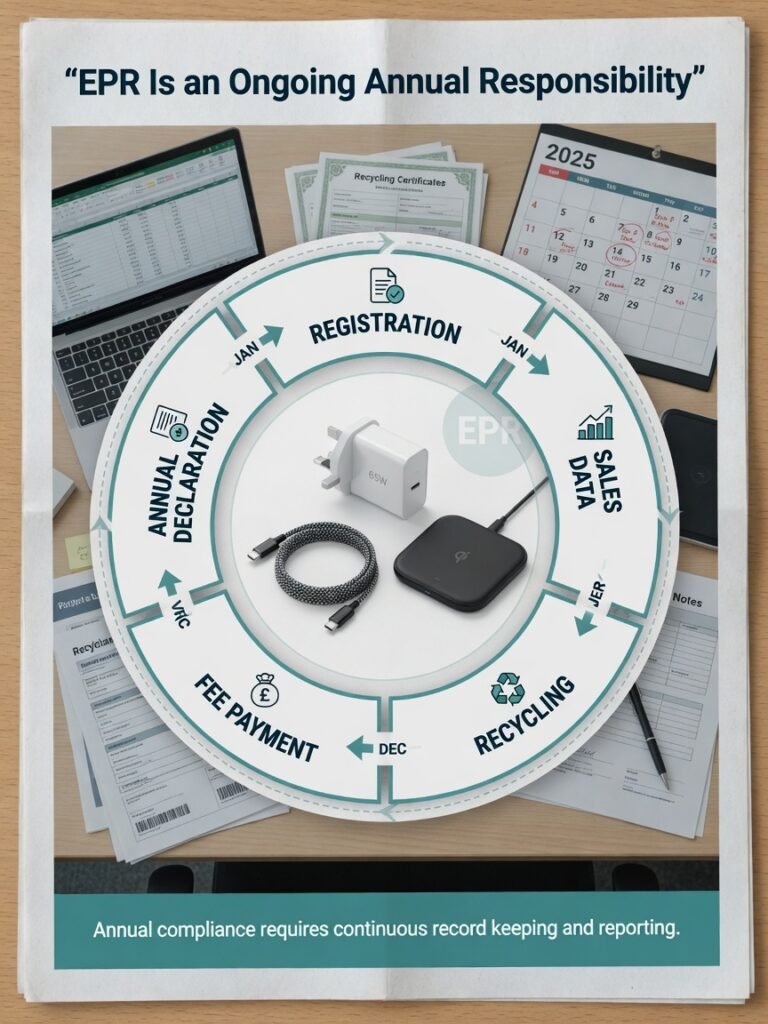
EPR is an annual responsibility. Each year, the sales volume and recycling status of the previous year must be submitted before the end of March, and the specific time is subject to the official announcement of that year.
In addition to declaration, relevant product information also needs to be disclosed: for example, the main materials of the product, precautions for recycling and disassembly, etc. This information must be disclosed on the brand’s South Korean official website or an officially designated platform for consumers to query.
All relevant records, including customs declaration forms, sales data, material certificates, payment vouchers, and marking drafts, must be kept for at least 3 years for official verification.
Practical Operation Steps
The practical operation can be carried out in the following five steps:
Step 1 is self-checking the scope of obligations. First confirm which category your product belongs to: charger, charging cable, or product with battery; then clearly count the material and weight of the sales packaging; then confirm that the sales target is ordinary consumers in South Korea — if it is for industrial or B2B exclusive use, it does not need to be included; if you are unsure, you can consult the official service window of the South Korean Ministry of Environment or a professional PRO organization.
Step 2 is determining the responsible entity within South Korea. If it is an overseas entity without a South Korean company, it is necessary to entrust an importer or agency company registered in South Korea as the responsible person. The two parties must sign an agreement to clarify the division of rights and responsibilities for each link such as registration, declaration, and fee payment, to avoid subsequent disputes.
Step 3 is selecting a compliant PRO and signing a contract. You can first check the list of officially recognized PROs on the official website of the South Korean Ministry of Environment to ensure that the other party has the qualification for the corresponding category. When choosing, focus on three points: whether it has the qualification for your product category, whether the fee structure is transparent, and whether it includes supporting services such as declaration. When signing the contract, clearly confirm the scope of recycling coverage, the calculation method of fees, and the service content of annual declaration, and all terms must be specified in the contract.
Step 4 is submitting registration and pre-launch preparation. Prepare the required materials in advance: product model list, estimated annual sales volume, material proportion, responsible person information, and then submit them to the Ministry of Environment’s system by the PRO or the responsible person. Before the product is officially launched, be sure to double-check that the markings on the product and packaging meet the requirements, to avoid rectification after listing.
Step 5 is annual declaration and daily maintenance. In daily operations, pay attention to updating sales data in real time, and record any packaging changes promptly; at the beginning of the following year, reconcile the previous year’s data with the PRO, which will submit the unified report. If any errors are found, correct them promptly.
Advanced Judgment (Pit Avoidance and Decision-Making)
After mastering the basic requirements, you also need to learn to judge rationality and avoid common pitfalls. This part of the content can help you avoid unnecessary expenses and steer clear of violation risks.
Judgment of Recycling Fee Rationality
Many people only look at the total price when choosing a PRO. In fact, the EPR fee is composed of two parts: one part is the basic recycling fee charged by the government, which is an official standard set based on weight and category, and this fee is the same across all PROs; the other part is the market-based PRO service fee, which is set by the PRO itself and will vary.
Generally speaking, a service fee difference of 10%-20% between different PROs is reasonable. If you encounter a particularly low quotation, you must be wary of hidden fees, such as subsequent registration fees, declaration fees, model modification fees, etc.
Common fee traps include: charging high registration or declaration fees, concealing adjustments to official fee rates, and over-reporting packaging categories to charge extra fees. The verification method is also very simple: require the PRO to provide official fee rate documents, list all fee items clearly, and include them in the contract to avoid verbal promises.
Differences in Requirements for Different Categories
The requirements for different subcategories of charging products vary. For ease of comparison, a table is compiled as follows:
| Product Type | EPR Category | Fee Rate Level | Marking Requirements | Remarks |
|---|---|---|---|---|
| Charger / Plug with charging port | Small electronic and electrical appliances | Medium | Must be printed in a conspicuous place on the product body | Wall-plug, car, and wireless chargers all fall into this category |
| Independently sold pure charging cable | Wire and cable | Relatively low | Can be printed on packaging | Ordinary cables with no chips and only conductive function |
| Independently sold charging cable with chip | Electronic accessories | Slightly higher than pure cables | Can be printed on the product body or packaging | Cables containing E-Marker or fast charging protocol chips |
| Co-sold set (charger + cable) | Follows the main product category | Calculated based on main product + total weight | The main product is printed as required, and accessories can be labeled with the packaging | Only applicable when the set is sold as a whole; accessories sold separately need separate compliance |
It should be noted here that if the accessories in the set are later sold separately, separate compliance is required, and the set’s declaration can no longer be used.
Violation Risks and Self-Check Methods
The cost of EPR violations is not low. Common high-frequency violations include: selling before completing registration, non-compliant markings, false sales declarations, and omitting packaging EPR declarations. Different types of violations correspond to different legal consequences: the above acts may result in penalties such as administrative fines, improvement orders, product removal from shelves, import restrictions, payment of arrears and late fees; according to current relevant regulations, some serious violations may be subject to a fine of up to 5% of annual sales or 100 million won (whichever is higher). The specific penalty standard shall be determined based on the type of violation, applicable law, and the determination of the competent authority for the year.
Daily self-checks can be conducted in five stages: first check whether registration for the corresponding category has been completed, then check whether the classification of products and packaging is correct, then check whether the markings meet specifications, then check whether the annual declaration has been submitted on time, and finally check whether relevant records have been kept for 3 full years. This can basically cover most risks.
Special Judgment for Packaging Compliance
Packaging is the link where problems are most likely to occur, and there are several special situations to note:
For composite packaging, the recyclable material with the highest proportion shall prevail. If you are unsure, be sure to confirm with the official or a professional institution, and do not classify it casually by yourself.
If multi-language universal packaging (i.e., packaging shared by multiple global markets) is used, a Korean sorting and disposal marking must be affixed, and the version from other countries cannot be used directly for sale in South Korea.
If the packaging is revised, such as changing suppliers, modifying the packaging structure or material, be sure to recheck the material classification and markings to avoid inconsistency between the declared information and the actual situation.
Trends and Information Channels
EPR requirements are not static. There are several main directions for future adjustments: the recycling ratio will increase year by year; new requirements for recyclable design may be added in the future (such as requiring products to be easy to disassemble and using less non-degradable materials); in addition, with the unification of the USB-C interface, recycling rules related to interfaces may be added in the future.
To obtain the most reliable information, you can follow three channels: official announcements on the website of the South Korean Ministry of Environment, policy reminders from your contracted PRO, and public notices from the Korea Environment Corporation (KECO). These are all official authoritative channels, and do not trust unofficial hearsay.
Scenario Application
The following explains the specific application in combination with three common scenarios:
Scenario 1: Compliance Logic for Overseas Cross-Border Sellers
For the overseas warehouse or local customs clearance model, there must be a responsible person based in South Korea, and EPR registration must be completed before formal sales. There is no room for negotiation on this point.
For the direct mail small parcel model, there is currently no universal exemption policy, and it needs to be judged according to the latest rules of South Korean Customs. It is recommended to consult clearly in advance, and do not assume that small parcels are exempt from compliance.
If the same product is sold through multiple channels and by multiple importers at the same time, the category classification, weight, and declaration caliber of the same SKU must be unified. Otherwise, there will be either repeated declarations leading to overpayment, or missed declarations leading to penalties.
Scenario 2: Practical Operations for Ordinary Consumers
For consumers, EPR is closely related to you, and it has two main uses:
First, to judge whether the purchased charging product is compliant. You can check three aspects: whether there is an official South Korean EPR recycling marking and material classification marking on the product or packaging; whether the brand is on the EPR registration public list of the South Korean Ministry of Environment; and whether the brand’s South Korean official website has disclosed recycling-related information.
Second, to know how to dispose of old charging products. Do not mix them with ordinary household waste; instead, place them in e-waste recycling bins at retail stores or in communities. Some retailers offer trade-in or free recycling services. For products containing batteries, such as power banks, they should be recycled through special waste battery channels, and should not be thrown directly into e-waste recycling bins.
Scenario 3: Responsibility Division for Chargers Included in Sets
Many products are sold in sets, such as mobile phone + charger or charger + charging cable sets. The division of responsibility in such cases is very clear:
If the set is sold as a whole, the charger can be declared together with the main product without separate registration, and the packaging weight must include the packaging of all accessories.
However, if the charger in the set is taken out and sold separately, it must complete EPR compliance independently, and the set’s declaration can no longer be used.
Core Summary
Overall, South Korea’s Extended Producer Responsibility system is a mandatory requirement targeting the waste disposal stage in the entire product life cycle, and is closely related to the market access and consumer use of charging products. Whether you are a seller or a consumer, the core points to master are as follows: First, be able to accurately judge whether charging products (including packaging) need to meet EPR requirements. Second, sellers should master the core steps and necessary requirements of compliance, be able to judge the rationality of fees, and be aware of common violation risks. Third, consumers can identify compliant charging products in the South Korean market through markings and public information, and know how to correctly dispose of old products.