
If you have ever bought a charging adapter in Canada, or run a cross-border e-commerce business and want to sell fast charging products to Canada, you must be no stranger to “cUL certification”. Some people confuse it with the US UL certification, some think it is a certificate directly issued by the Canadian government, and others believe that having it means the charging speed is maximized — in fact, these are all misunderstandings. Today, we will explain cUL certification clearly from the perspectives of actual use and compliance of charging products, from the basics of how to identify the mark, to intermediate knowledge of how to check authenticity and avoid compliance pitfalls, which you can put into use right after reading.
First, Understand: What Exactly Is cUL
Let’s start with the most straightforward definition of cUL: it is a safety compliance certificate specifically issued for the Canadian market by UL, a world-renowned third-party safety testing organization. The lowercase “c” in the mark is the abbreviation of Canada, which means the product meets the local electrical safety requirements of Canada.
Many people think it is a “honor label” printed by enterprises themselves, but that is not the case — UL’s related safety certification services are accredited by the Standards Council of Canada (SCC for short, which is equivalent to the official authority in charge of standards and certification in Canada), so the cUL mark is one of the officially recognized safety compliance certificates in Canada. It should be particularly emphasized that its essence is a safety access credential, not a quality award, nor a performance certification, and it has nothing to do with how fast the charging is, how good the compatibility is, or how long it can be used.
How is the certification scope of charging products determined?
Maybe what you care about most is: do the charging adapters and charging cables I have need cUL certification? For charging products, the general division rules are very clear:
• Products that require separate certification: Categories with active components or smart identification chips, such as wall chargers, PD fast charging adapters, laptop power adapters, and fast charging cables with E-Marker chips — that is, the kind of USB-C cables that can handle 100W or even higher power, which have a small control chip inside, not ordinary pure copper cables.
• Products that do not require separate certification: Passive simple accessories, such as ordinary copper-core charging cables (cables without chips that only transmit electricity), only need to undergo complete machine certification together with the matching charger; pure physical adapters without circuits also do not need separate application.
The above is the general division. Whether separate certification is required specifically needs to be comprehensively judged based on whether the product is sold as an independent finished product, the rated power/voltage level, as well as the additional requirements of the sales platform and importer. No matter what type of product it is, the core control scope of cUL is risks directly related to personal safety such as electric shock, fire, and overheating, and it does not involve performance indicators at all.
What does a real cUL mark look like?
To judge whether there is certification, first look at the mark, but a randomly printed mark does not count.
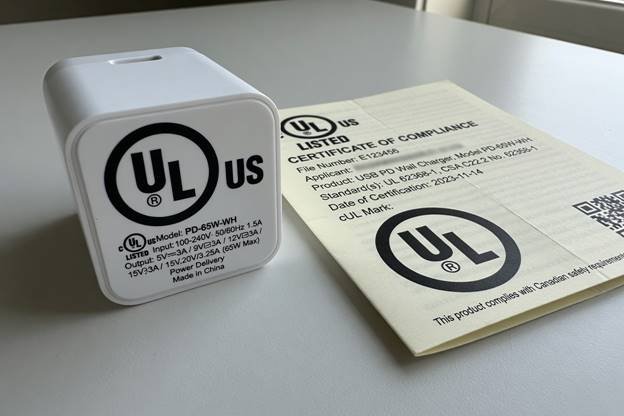
The core feature of the cUL mark is easy to recognize: there is a lowercase “c” on the left side of the circular UL official logo; if there is a “c” on the left and “us” on the right of the circular logo, it is the cULus mark, which means it meets the safety standards of both the United States and Canada and can be legally sold in both places.
There are two key rules that must be remembered: First, for conventional charging products with enough nameplate space such as chargers and power adapters, the mark usually needs to be printed directly on the product body (such as the pin side of the charger, the bottom shell). If it is only marked on the packaging or product detail page, it cannot be directly judged as valid, and needs to be confirmed in combination with the query results of the official database; Second, the product category is usually marked next to the mark, such as “power adapter” and “USB-C charging cable”, which is convenient for checking the certification scope.
Why is cUL so important?
Some people may ask: It’s just a safety mark, why is it so important? Because in Canada, cUL certification is not an optional “bonus item”, but a mandatory “entry ticket”.
From the perspective of legal sales, the regulations of all provinces in Canada clearly require that charging electrical products must hold third-party safety certification accredited by the SCC before they can be marketed. The certification service corresponding to cUL is provided by UL which is accredited by the SCC, so it is valid across Canada and does not need to be re-applied in each province. If you sell without certification, the product may be detained by customs, removed from the platform, or even face fines — charging products are directly connected to the mains and belong to high-risk categories, so the review will be stricter than ordinary products.
For ordinary consumers, cUL certification is the most intuitive safety screening tool: it can help you filter out inferior chargers and fast charging cables with unqualified insulation that are easy to burn out when overcurrent occurs, greatly reducing the risk of fire and electric shock during charging. In case a safety accident really occurs due to product quality, cUL certification can also be used as an important voucher for liability tracing.
For sellers and importers, cUL is even more of a rigid requirement: channels such as Amazon Canada and local offline supermarkets require cUL or equivalent certification to list charging products; formal certification documents are also required to proceed with customs clearance, insurance claims, product recalls and other links.
Easily confused certifications: distinguish them with one table
Many people tend to confuse cUL with common certifications such as UL, CSA, and CE. We have compiled a comparison of core dimensions specifically for the Canadian market compliance of the same charging product to help you distinguish them at a glance:
| Certification Type | Applicable Market | Issuing/Regulatory Body | Can it be legally sold in Canada? | Core Feature of the Mark |
| cUL | Canada | UL (third-party safety testing organization) | Yes | A lowercase “c” on the left side of the circular UL logo |
| Ordinary UL | United States | UL (third-party safety testing organization) | No | Only the circular UL logo, no “c” mark |
| CSA | Canada / multiple countries | Canadian CSA Group | Yes | Circular CSA logo |
| cULus | United States + Canada | UL (third-party safety testing organization) | Yes | “c” on the left and “us” on the right of the circular UL logo |
| CE | European Union and regions that recognize CE | The manufacturer issues a declaration of conformity, and notified bodies are required to participate for specific high-risk products | No | “CE” letter mark, covering multiple applicable directive requirements such as safety/EMC/RoHS |
| FCC | United States (electromagnetic compatibility/radio frequency equipment) | Regulated by the U.S. Federal Communications Commission, with different authorization modes such as self-declaration and certification | No | “FCC” letter mark, only for electromagnetic compatibility/radio frequency requirements, not covering safety |
Here are a few points that people most often get wrong:
First, ordinary UL and cUL are completely different things: ordinary UL is a certification for the US market, and only the version with a “c” on the left is recognized by Canada. Even if the plug can be inserted into a Canadian socket, it cannot be sold legally.
Second, cUL and CSA have exactly the same market access effect: many people think that CSA is more authoritative because it is a local Canadian institution, but in fact, both are officially accredited by the SCC, and they usually follow the same or equivalent Canadian safety standards. The specific test procedures, certification category divisions, factory inspection processes and document formats are subject to the rules of each issuing agency. As long as you hold any equivalent safety certification accredited by the SCC, you can sell legally in Canada.
Third, certifications such as CE and FCC cannot replace cUL at all: CE is a conformity mark of the European Union, which may cover multiple applicable regulatory requirements such as low-voltage safety, electromagnetic compatibility, and RoHS, and is not a single safety certification; FCC is the US regulatory system for electromagnetic compatibility and radio frequency equipment, and does not involve safety assessment. Neither of them meets the safety access requirements of Canada. Even if the product has these certifications, it still needs to re-apply for cUL or equivalent safety certification when entering the Canadian market.
Finally, remember a judgment principle: no matter how the merchant promotes, it must be based on the body mark of conventional products + the query results of the official database, and do not only look at the text on the detail page.
Core rules of cUL certification for charging products
After understanding the basic concepts and comparisons, let’s go a little deeper: for charging products, what are the conditions for cUL certification to take effect? What exactly is tested? What situations will cause the certification to become invalid? These are core rules that ordinary users tend to ignore, but sellers and senior buyers must understand.
First of all, there are two necessary conditions for the certification to take effect, both of which are indispensable: not only must the samples be sent to the laboratory to pass a full set of safety tests, but also the factory’s production process must be verified to ensure that the mass-produced products are consistent with the submitted samples. Even after getting the certificate, UL will conduct random inspections at the factory from time to time later. If it is found that the product is inconsistent with the submitted sample or the production process does not meet the requirements, it may be required to rectify within a time limit, suspend the certification qualification, and in serious cases, the certification will be revoked and the use of the UL mark will be prohibited. Formal cUL certification can be found in UL’s official database, and it is definitely not something that enterprises can count by printing a mark or writing a statement by themselves.
Many people are curious about what cUL actually tests. In fact, you don’t need to memorize complex parameters. The core is three safety bottom lines:
• Insulation and electric shock prevention: Ensure that high-voltage electricity will not leak to places that human hands can touch such as the shell and charging port, to avoid electric shock during charging;
• Overheating and fire protection: Whether in normal use or accidental overload and short circuit, the product will not experience thermal runaway or catch fire;
• Structural safety: For example, the plug is resistant to plugging and unplugging, the shell is made of flame-retardant materials, and the USB-C port will not loosen or fall off after long-term use.
This also explains why cUL certification does not involve performance indicators such as fast charging protocols, data transmission speed, and charging efficiency at all — its core positioning is to guard the safety bottom line.
Secondly, the coverage of cUL certification has strict restrictions and must not be applied arbitrarily:
First, the certification only corresponds to a specific model: for example, the cUL certification of a 20W ordinary charger can never be used on a 65W gallium nitride charger, even if it is of the same brand;
Second, certification of components does not mean certification of finished products: for example, if the power module inside the charging adapter has cUL, it does not mean that the entire charging adapter has cUL. The finished product must undergo separate complete machine certification;
Third, if core accessories are replaced, such as the control chip of the USB-C port, the material of the plug, and the plastic material of the shell, it is necessary to re-evaluate whether the original certification is still valid, and cannot continue to use it directly.
Finally, let’s talk about the validity period and product modification rules: cUL certification has no fixed validity period. As long as the product design remains unchanged and the factory’s random inspections are always qualified, the certification will remain valid. But if the product undergoes a model change — for example, the output power is adjusted, the charging interface type is changed, the internal structure or shell material is changed — you must re-apply for certification. In addition, if Canadian safety standards are updated, certified products also need to be rectified in accordance with the new requirements before they can continue to be sold.
Two-step method to quickly identify the authenticity of cUL
Since certification is so important, it is inevitable that there are products with fake marks or fraudulent certification on the market. How to quickly judge the authenticity of cUL? Just remember the two-step method, which ordinary people can operate without professional knowledge.
Step 1: Check the mark and label on the product body
For conventional products such as chargers and adapters, first confirm that the mark is printed on the product itself; if it is only marked on the packaging, you need to be more vigilant. Then check the mark style: it must be the official circular UL logo with a lowercase “c” on the left. If it is cULus, there is also “us” on the right. If the “c” is printed on the right, or there are only letters without the circular logo, it is most likely fake.
In addition to the mark, the product label usually marks UL certification identification information that can be used for query, the most common of which is the UL file number starting with E; in addition, there will be product model, input and output parameters, manufacturer name and other content. For products sold in the Canadian market, necessary safety warnings, instructions for use and other content must meet the bilingual requirements of English and French, and the specific labeling rules depend on the product category and local regulations.
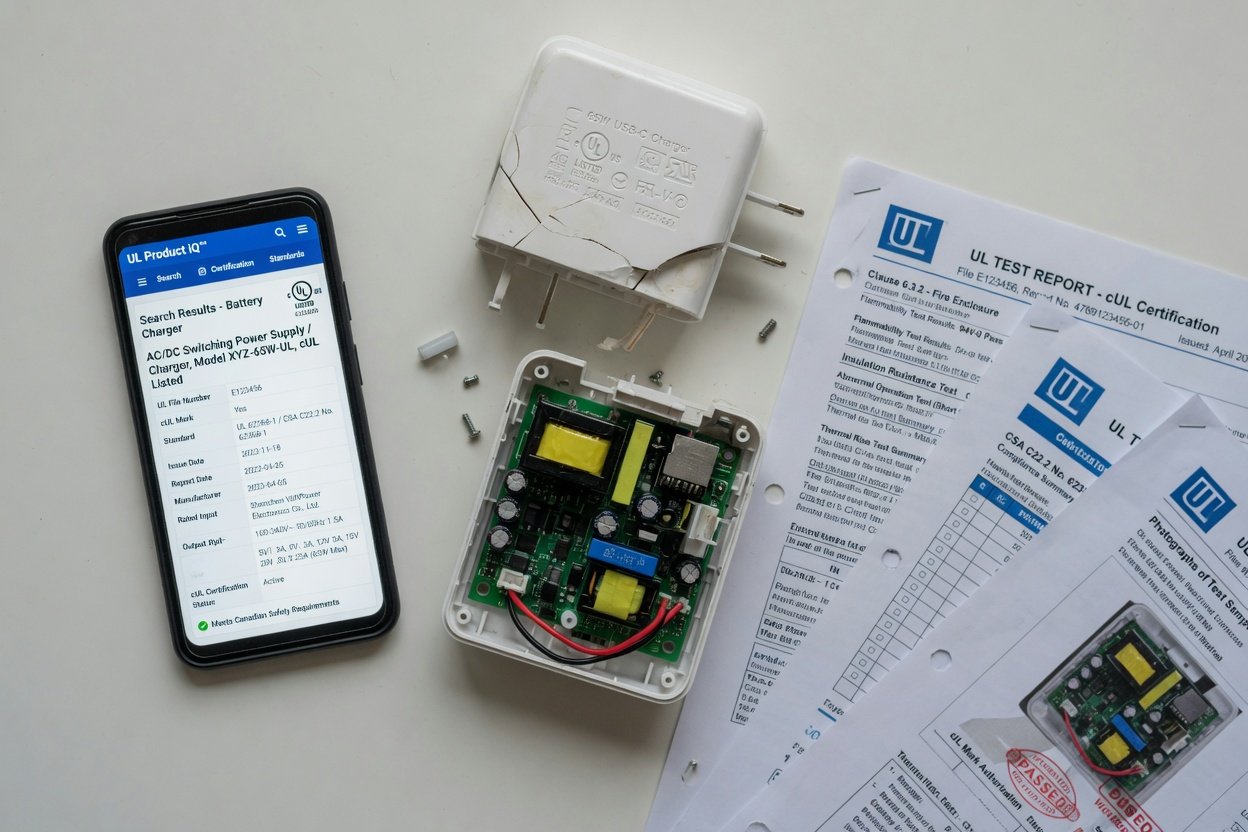
Step 2: Verify via UL’s official database
Find the UL file number or other queryable certification identification information on the product, open UL’s official free query database Product iQ, and enter the information to find the corresponding certification content. Just check three core points: whether the product model is correct, whether the product category is correct, and whether the manufacturer is correct. Only when all three match is it a valid formal certification.
Here are a few tips for quickly identifying fake marks:
• High-power fast chargers with prices far below the market price, such as a 65W gallium nitride charger that costs only a dozen or so yuan and claims to have cUL, are most likely fake, because the cost of formal certification is not low, and it is impossible to sell so cheaply;
• Marks with blurry or deformed printing, or incorrect position of “c”, are all fake marks;
• If the certification information cannot be found in the UL database, or the found product model, category, and manufacturer do not match the actual product, it must be fake.
Finally, a pitfall reminder: never believe the merchant’s statement that “there is certification but it is not printed on the product”. For conventional products with nameplates such as chargers and power adapters, Canadian regulations and UL mark usage rules require the mark to be clearly visible on the body, and formal products will not deliberately not print it. In addition, for second-hand, repaired, or water-damaged products, even if they originally had real cUL certification, the safety and effectiveness cannot be guaranteed, because the internal structure may have been modified or damaged.
Applicable boundaries and common misconceptions
cUL certification is not a “universal certificate”. It has clear applicable boundaries, and there are many common misunderstandings that need to be clarified. Don’t be misled by merchants’ promotions.
Clarify 4 applicable boundaries
1. Only controls safety, does not involve performance: having cUL does not mean fast charging or support for PD fast charging, it only indicates that the safety level meets Canadian market access requirements;
2. Only covers the specific model indicated on the certification: for products that have undergone model changes or core component replacements, the original certification becomes invalid immediately and cannot continue to be used;
3. Only applicable to the Canadian market: products sold to other countries and regions such as the United States and the European Union must meet local certification requirements, and cUL cannot be used as a universal certificate;
4. Only for brand-new, unmodified and unrepaired products: products that have been privately disassembled, modified, or water-damaged are not within the protection scope of the certification.
6 most common misconceptions
1. Misconception: cUL is issued by the Canadian government or CSA → Correct answer: It is issued by the U.S. organization UL. UL’s related certification services are accredited by the Canadian SCC, and CSA is another independent parallel certification agency.
2. Misconception: Having a UL mark is equivalent to having cUL → Correct answer: Ordinary UL is a certification for the U.S. market. Only the version with the “c” on the left is recognized by Canada, and the two cannot be confused.
3. Misconception: cUL for charging cables and internal chips = cUL for chargers → Correct answer: Finished products must undergo separate complete machine certification, and component certification cannot replace finished product certification.
4. Misconception: cUL is less effective than CSA → Correct answer: Both are officially accredited by the SCC, and have exactly the same legal effect in the Canadian market, with no hierarchy.
5. Misconception: Products with cUL will never break and are absolutely safe → Correct answer: Certification proves that the product has been evaluated for key faults and abnormal operating conditions according to standards, which can significantly reduce the risk of electric shock and fire, but it does not mean the product will never be damaged, nor can it guarantee that no safety accident will occur in any extreme scenario.
6. Misconception: A plug that fits Canadian sockets is compliant → Correct answer: Plug compatibility only means it can be inserted physically, and does not mean the internal safety meets Canadian requirements. Only with cUL or equivalent certification is it considered compliant.
Quick checklists for different groups of people
Different people focus on cUL from different perspectives. We have compiled quick checklists for different groups of people, and following them can help you avoid most pitfalls.
Checklist for ordinary consumers when purchasing/overseas shopping
• First check whether the body of conventional charging products has cUL, cULus or CSA marks, as well as queryable UL certification identification information. If not, skip them directly;
• Check whether the label is clear, whether it has complete model, input and output parameters, and manufacturer information, and whether necessary safety warnings have bilingual English and French markings. Do not buy those with blurry printing or incomplete information;
• Confirm that the input voltage supports Canada’s 120V/60Hz mains power, and prioritize products with 100-240V wide voltage for better adaptability; at the same time, note that the plug shape and rated current must match local socket specifications;
• Do not buy low-priced, unbranded “knockoff fast chargers” with blurry marks, no matter how well they are promoted; they are most likely to have fake certification;
• When buying U.S.-version chargers via overseas shopping, be sure to confirm that the mark has a “c”. Do not buy those with only ordinary UL marks, as they are not recognized by Canada.
Checklist for cross-border sellers/importers for listing
• First clarify which category your charging products belong to and what the corresponding certification requirements are, so as not to waste money or miss necessary certification;
• Confirm that what you have obtained is the complete machine certification for the Canadian market, not component certification, nor ordinary UL certification for the United States;
• Prepare the UL file number, formal certificate, and product nameplate pictures in advance. These materials are required for both platform review and customs clearance;
• As long as the product undergoes a model change — even if it is just a change of shell material or a slight power adjustment — you must re-contact the certification agency to confirm whether the original certification still covers it, and cannot take it for granted to continue using the original certificate.
Quick identification of high-risk products
When you encounter the following types of products, directly classify them as high-risk and stay extra vigilant:
• Those that only promote fast charging power and “black technology” and never mention safety certification;
• Those whose certification marks for conventional products are only printed on the packaging box and cannot be found on the product body;
• Those whose provided certification information cannot be found in the official database, or the found information does not match the product;
• Those with burrs on the shell, loose pins, blurry parameter printing, and obviously rough workmanship.
Final Summary
In general, cUL is a safety access certificate for charging products issued by UL and accredited by the Canadian SCC. Its core function is to control safety risks such as electric shock and fire, and it has nothing to do with performance. You don’t need to memorize complex standard numbers. As long as you can distinguish it from ordinary UL and CSA, and know how to use the two-step method of “checking the body mark + querying the UL database” to verify authenticity, you can avoid most compliance and safety pitfalls whether you are buying a charger for yourself or doing cross-border sales.