
When buying chargers, fast charging heads, or power adapters in Canada, you will most likely see a mark with “CSA” on the product casing. Many people only have the impression that it “seems to be a safety certification”, but they neither know what it actually covers, nor can they distinguish between real and fake marks, and may even be tricked by merchants into paying more by using “CSA certification” as a gimmick.
Today, from the perspective of ordinary users and small sellers, we will explain CSA certification thoroughly — from basic definitions, coverage boundaries, to testing logic, comparison of common North American certifications, authenticity identification, and practical checklists. After reading this, you will be able to judge whether charging products are compliant by yourself, and also sort out the core rules related to certification.
First get the basics straight: What exactly is CSA certification?
Core Definition
CSA certification is a mainstream third-party safety conformity certificate issued by the Canadian CSA Group, a local standard development and certification body. Its core function is to verify that safety risks such as electric shock, fire, and overheating are controlled within the range allowed by the standard, even under foreseeable abnormal scenarios (such as common abnormalities like a charger being covered by clothing leading to blocked heat dissipation, accidental short circuit or overload).
For products such as chargers and power adapters, the key focus of CSA certification is the full-process safety from 120V AC mains input to low-voltage DC output — after all, the essence of a charger is to convert high-voltage AC at home into low-voltage DC that can be used by mobile phones and laptops. If there are problems with insulation, protection, or temperature rise in this conversion link, it is most likely to cause safety accidents.
Several Key Terms That Are Easily Confused
Many people can’t distinguish between the terms CSA standard, CSA certification, and SCC. In fact, they can be explained clearly in three sentences:
1. CSA Standard: It is Canada’s electrical safety technical rule, equivalent to the “examination syllabus” for certification evaluation. All tests and judgments must be carried out in accordance with this standard;
2. CSA Certification: It is the “certificate of conformity” obtained after a product is evaluated by a certification body accredited by the SCC and meets the CSA standard;
3. SCC (Standards Council of Canada): It is the official body responsible for reviewing the qualifications of certification bodies. For products that need to meet Canada’s electrical safety compliance requirements, only the corresponding certification issued by an SCC-accredited body has legal compliance effect. The specific requirements need to be judged in combination with the regulations of the target province.
Is it voluntary or mandatory?
It is often said that CSA is a “mandatory certification”, but this statement is actually not accurate enough. CSA certification itself is a third-party voluntary certification, not a qualification directly issued by the Canadian federal government. However, most provinces in Canada have legislated electrical safety requirements: the vast majority of electrical products directly connected to the mains must bear a safety certification mark issued by an SCC-accredited body before they can be legally sold or imported. Whether certification is mandatory depends on the electrical safety regulations of the target province, whether the product is directly connected to the mains, and the requirements of the sales channel — that is to say, the mandatory requirement comes from provincial regulations, not direct federal certification. This is also why the vast majority of mains-powered charging products entering Canada need to obtain this type of certification.
Why do charging products attach particular importance to CSA certification?
You may think: It’s just a charger, is it necessary to be so strict? For charging products, the significance of CSA certification goes far beyond the word “compliance”.
For consumers: It can really reduce safety risks
Most residences in Canada are of wooden structure. Once an electrical fire occurs, it spreads quickly and causes great losses. Chargers are small appliances that are plugged into wall sockets all year round. If their safety is not up to standard, they can easily become a fire hazard. The tests for CSA certification impose strict restrictions on common faults such as short circuit, overload, and overheating, which can greatly reduce the probability of electric shock and fire.
In addition, USB-C fast charging is becoming more and more popular now. If the output protection is unqualified, it is easy to burn out the charging port or even the motherboard of mobile phones and laptops. CSA certification imposes mandatory requirements on output overvoltage and overcurrent protection, which can reduce the risk of such equipment damage.
For sellers/importers: It is the core compliance requirement for market access
Products such as chargers, fast charging heads, and charging power strips connected to 120V mains usually need to bear a safety certification mark issued by an SCC-accredited body in most provinces and mainstream sales channels in Canada. Products that have not obtained compliant certification may face risks such as customs inspection and detention, removal from e-commerce platforms, penalties from regulatory authorities, and rejection by offline retailers.
These special scenarios also need attention
Many people don’t know that if you just buy an uncertified charger for your own use, you will not be punished, but you have to bear the risk yourself — if a fire caused by the charger damages things, the insurance company may refuse to compensate because you used a non-compliant product, and you have to bear the responsibility if it is pursued.
If you run a rental property or homestay business, products such as chargers and charging power strips provided in the rooms must be compliant. In the event of a safety accident, the landlord shall bear the corresponding responsibility.
It should be specially clarified here: CSA certification is a safety compliance certificate, which only means that the product’s safety risk control meets the standard requirements, and has no direct relationship with performance indicators such as fast charging speed, protocol compatibility, and conversion efficiency. To judge whether a fast charger is easy to use, it still depends on the fast charging protocols it supports (such as USB PD/QC), output levels, the current capacity of the matching cable, and whether it is compatible with your device. Certification can help you hold the bottom line of electricity safety, but it does not mean that the product has better charging performance.
Coverage and Boundaries of CSA Certification
Since CSA certification is strongly related to the safety and compliance of charging products, which products must be certified, which do not? Which are boundary categories that require additional judgment? We can clearly divide them into three categories:
Common charging products that require certification
The vast majority of charging-related products that are directly connected to 120V mains and involve high-voltage to low-voltage conversion fall within the mandatory compliance scope required by regulations in most Canadian provinces. The specific situation needs to be judged in combination with the regulations of the target province, product category, and sales channel requirements. Common products that require certification include:
• Ordinary wall-mounted chargers, power adapters;
• Fast charging heads with mains input, multi-port charging docks, desktop charging stations;
• Charging power strips with mains input, extension cords;
• Wireless chargers without built-in batteries that have mains input;
• Individually sold Canadian standard plug power cords, plug components.
These products are in direct contact with high-voltage mains, and have the highest risk of electric shock and fire in the event of a fault, so they are the key coverage objects of CSA-type safety certification.
Products that usually do not require separate certification
Some charging-related products do not need to apply for CSA certification on their own, but this does not mean that they are completely free from safety requirements. It is just that the evaluation scenarios and subjects are different:
1. Passive charging cables: Ordinary charging cables without mains input and without active control chips are usually subject to safety evaluation together with the matching charger and the whole device, and do not need to obtain a separate certificate.
2. Ordinary consumer-grade car chargers: Car chargers that only connect to 12V DC input in the car and do not involve special industry scenarios such as industry and medical care do not fall into the category of mandatory certification for mains-connected products.
3. Built-in charging modules of devices: For example, the built-in charging circuits of mobile phones and laptops will be evaluated together with the safety certification of the whole device, and there is no need to apply for CSA certification separately.
Boundary products that need to be judged item by item
There is another category of products that cannot be simply classified as “required” or “not required”, and need to be specifically evaluated according to the product structure and sales form:
1. High-power USB-C cables: If it is a high-power cable with a nominal current of more than 5A and an E-marker chip, especially when sold separately, its safety performance such as current carrying capacity and temperature rise needs to be evaluated separately, and it cannot be assumed to be covered by the charger’s certification.
2. Charging sets: Each component in the set, such as the adapter, cable, and plug components, must meet safety requirements separately. A single adapter certification does not cover the entire set of products, and you cannot think that the whole set is compliant just because the adapter has a certificate.
3. Charging devices with built-in batteries and mains input: For example, power banks with built-in mains prongs, the certification needs to cover both battery safety and the safety of the mains input part. The absence of either item means incomplete compliance. If it is an ordinary wireless charger without a built-in battery, as long as it is directly connected to the mains, it belongs to the mandatory certification category mentioned above, and does not need to be judged as a boundary product.
What exactly does CSA certification test? Is one certificate enough forever?
Many people think that CSA certification is just “sending a sample for testing and that’s it”. In fact, there is strict logic for its issuance and maintenance, which is also the reason why it is reliable.
Core process: strict review before issuance, continuous supervision after issuance
CSA certification is not “one test and done”, but has full-process control:
• Before issuance: Not only must samples be sent to the laboratory for a full set of safety tests, but also the factory’s production consistency system must be audited to ensure that the factory can mass-produce qualified products with the same quality as the samples, rather than just making a “test sample” to cope with inspections.
• After issuance: The certification body usually conducts regular factory follow-up inspections, and conducts sample testing or market spot checks when necessary to ensure that the mass-sold products are consistent with the originally certified samples and continue to meet the standard requirements.
Four dimensions of core testing
For charging products, the tests mainly focus on four aspects closely related to safety:
• Electrical safety: The core is the insulation isolation between high and low voltage, to prevent high-voltage mains from leaking to the low-voltage output end and causing electric shock risks; it also tests items such as leakage current, overvoltage/overcurrent/short circuit protection, and grounding reliability. Under abnormal conditions specified by the standard, the protection design will limit related risks, greatly reducing the probability of injury, fire, and equipment damage.
• Thermal and fire safety: Test whether the temperature of the product under full load or even fault conditions exceeds the safety limit, and whether the materials of key components such as the shell and transformer are flame retardant, so that the fire will not spread once ignited. For example, whether the temperature of a charger will rise high enough to cause a fire when it is covered by a quilt is one of the key test points.
• Mechanical structure safety: For example, whether the size and strength of Canadian standard plug prongs are qualified, whether they cannot be inserted or are easy to fall off or bend; whether the tensile and folding resistance of the cable is sufficient, so that it will not break after a few pulls; how is the plug-in reliability of the interface, so that it will not break after dozens of insertions.
• Labeling compliance: The input and output parameters, warning statements, and manufacturer information on the product must be clear and accurate, and power or parameters must not be falsely or randomly marked to mislead consumers.
Validity period and change rules
Many people think that CSA certification has a fixed validity period, such as 3 years or 5 years, but that’s not the case — it does not have a fixed validity period. As long as the regular spot checks are qualified, the certification remains valid. However, if the spot check fails, the standard is updated without supplementary testing, or the product is modified without reporting, the certification will become invalid.
If the product undergoes a model update, for example, the prongs are changed, the circuit design is changed, key components are changed, or even the production factory is changed, a new evaluation must be submitted, and the original certification cannot continue to be used.
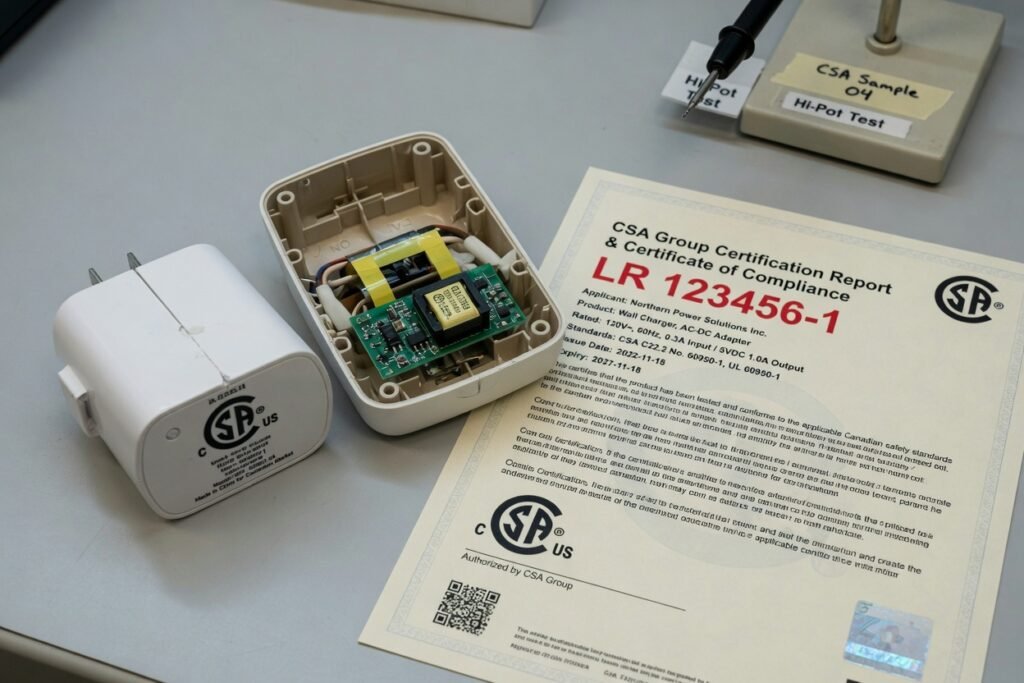
Comparison of common North American safety certifications: What’s the difference between CSA, cUL, UL, and ETL?
Many people will also see marks such as cUL, UL, and ETL when choosing charging products or preparing for export, and often confuse them with CSA, not knowing the difference in their effectiveness and scope of application in Canada. In fact, as long as you grasp the three dimensions of core identity, differences in charging products, and selection logic, you can quickly distinguish them:
Core identity and recognition in Canada
Different certifications have different issuing bodies and covered markets, and their recognition in Canada also varies:
• CSA: Issued by the local Canadian CSA Group, it is one of the most well-known safety certifications in the local area. It can be used for Canadian local certification, or apply for Canada-US dual certification (the mark will be marked with both C and US marks), and is recognized by official authorities and channels across Canada.
• cUL: It is a certification issued by the US UL body in accordance with CSA standards, only covering the Canadian market. Its legal effect is exactly the same as that of CSA, except that the issuing body is different.
• UL: It is a local US safety certification, only covering the US market, and does not meet Canada’s electrical safety compliance requirements.
• ETL: Issued by Intertek Group, which is also an SCC-accredited certification body, and is recognized by Canadian official authorities. However, some large offline retailers may have their own designated certification requirements, and the actual recognition may vary slightly depending on the channel.
Core differences for charging products
For charging products such as chargers and power adapters, the differences between different certifications are mainly in two points:
• Testing standards: As long as it is a safety certification for the Canadian market, whether it is CSA, cUL, or ETL, the CSA series of electrical safety standards are adopted. There is no essential difference in core safety requirements, and the safety threshold will not be lowered due to different issuing bodies.
• Covered markets: CSA and ETL can provide Canada-US dual certification, with one test meeting the compliance requirements of both markets at the same time; cUL only covers Canada; UL only covers the US.
Certification selection logic
If you are an ordinary consumer, you only need to confirm that the product has an SCC-accredited certification mark and the corresponding certificate can be found, and you don’t have to dwell on the issuing body. If you are a seller or importer, you can choose according to the target market:
• Only for the Canadian market: The legal effects of CSA, cUL, and ETL are exactly the same. You can choose according to the requirements of cost and sales channels, and there is no need to blindly pursue the CSA mark.
• Simultaneous expansion in Canada and the US: Choose CSA or ETL dual certification with the US mark. One test can complete the compliance of the two markets, which is more efficient.
Finally, a special reminder: Many cross-border charging products are also marked with CE and FCC marks, neither of which can replace the SCC-accredited safety certification required by Canada. CE belongs to the EU’s compliance self-declaration system and has not been evaluated in accordance with Canadian CSA safety standards; FCC is the US regulatory requirement for electromagnetic compatibility and radio frequency radiation, which does not cover the electrical safety assessment of mains-connected products, so neither can be used as a safety compliance certificate for the Canadian market.
How to identify the authenticity of CSA certification? These tricks are enough
Since certification is so important, it is inevitable that some unscrupulous merchants will forge marks or misappropriate certificates. How can you quickly judge whether the CSA mark in your hand is real?
First look at the mark itself: It is more accurate to check according to the issuing body
The format and numbering rules of compliance marks of different SCC-accredited bodies will vary. There is no need to force a unified template, and it is more reliable to check separately according to the issuing body:
• If it is a certification directly issued by the Canadian CSA Group, its formal mark usually contains three core elements: the official CSA logo, a unique certificate number or file number that can be used for traceability, and a market coverage mark (C stands for Canada, US stands for the United States, and the appearance of both means Canada-US dual certification). It is usually also marked with auxiliary information such as the corresponding product model and manufacturer name.
• If it is a Canadian compliance certification issued by other SCC-accredited bodies such as cUL and ETL, the mark style and number type will be different, and it needs to be checked according to the official mark rules of the corresponding issuing body.
No matter which body issues the certification, it must meet two basic judgment requirements:
• Marking requirements: The certification mark must be placed in a permanent position on the product body (such as laser engraving or silk screening on the product shell); marks only printed on the packaging box, promotional pages, or manuals cannot directly prove that the product itself has been certified. If it is in the form of a sticker, it must meet the wear resistance and non-peeling requirements of the corresponding standard. Ordinary self-adhesive stickers that can be easily torn off do not meet the requirements.
• Additional check for charging products: The input parameters on the product nameplate should include 120V (matching Canadian mains voltage), and the output parameters should correspond to the power, voltage and current combination claimed by the product, and there should be no false or random marking.
Official database query: The most reliable verification method
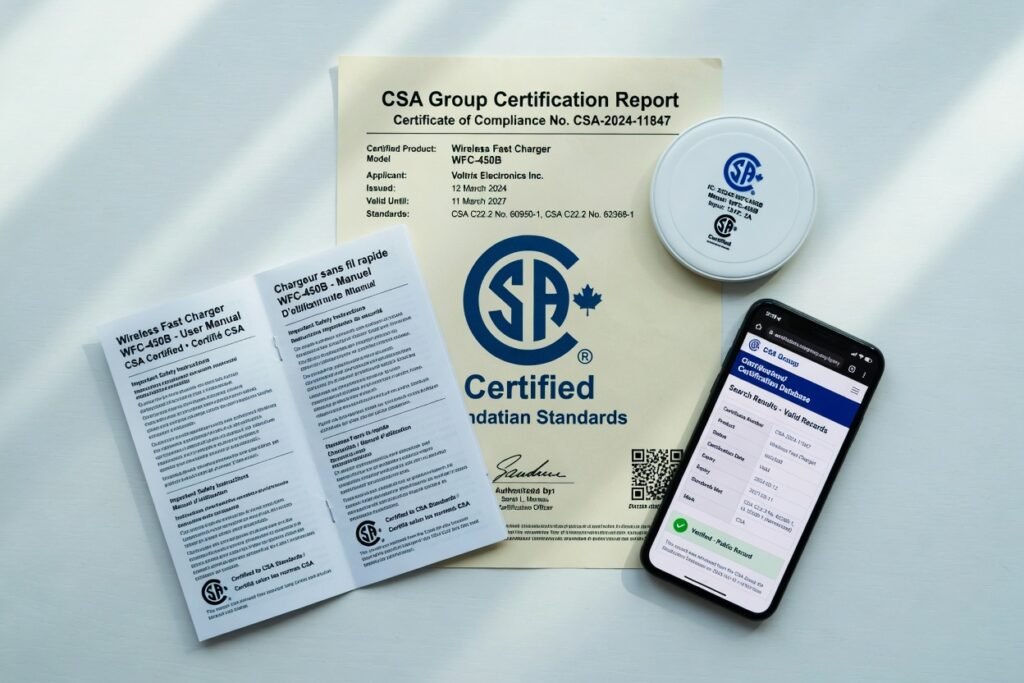
If you have doubts about the authenticity of the mark, the safest way is to verify it in the official database of the issuing body:
• Query channels: If the certificate is issued by CSA Group, you can directly query in the certification database on the official website of CSA Group; if the certificate is issued by other bodies such as cUL and ETL, go to the official query entry of the corresponding issuing body.
• Query information: Enter information such as certificate number, product model, and manufacturer name to find the details of the corresponding certification.
• Key points for checking: In addition to confirming that the product model is completely matched, the certification covers the Canadian market, and the product category corresponds, it is also necessary to check whether the certification status is valid (not cancelled, not suspended), whether the input voltage range covers Canadian 120V mains, and whether the production factory or applicant is consistent with the information marked on the product — if the status is invalid or the model does not match, even if the mark is real, this product is non-compliant.
Quick troubleshooting tips when purchasing
If you don’t want to check the database every time you buy something, remember these tips to avoid most of the pitfalls of fake certification:
• Self-declaration or certifications from other regions do not count: Marking only “meets CSA standards” or “designed according to CSA standards” is a merchant’s self-declaration, not a third-party certification conclusion; products only marked with CE, FCC, ordinary US UL (without Canadian market coverage mark) or other regional certification marks cannot prove that they meet Canadian market safety requirements. Regular compliant products will definitely have the official certification mark of an SCC-accredited body and a traceable corresponding certificate/file number;
• For low-cost, high-power unbranded products, if the nameplate is blurry and there is no clear model and manufacturer information, the probability of fake certification is very high, so don’t be greedy for cheap;
• For the certificate screenshot provided by the merchant, be sure to check whether the model, applicant and actual product are consistent to avoid the situation of “certificate misappropriation” (using the certification of Model A to pass off as that of Model B).
Practical checklists: You can judge by yourself after reading
To facilitate quick checking, we have compiled two practical checklists that can be used whether you are shopping for yourself or working as a seller.
Purchase checklist for ordinary users
1. The product body has a clear SCC-accredited certification mark, a traceable certificate number or file number, and the corresponding market coverage mark;
2. The input parameters are compatible with 120V mains, the plug is a Canadian standard plug, and the output power matches your device’s needs;
3. The corresponding model of the certification can be found in the official database of the issuing body, with valid status and consistent information.
Listing checklist for sellers/importers
1. Confirm that the target province and sales channel accept the certification, and the model, factory, and category covered by the certificate are completely consistent with the actual product; if boundary products are involved (such as charging sets, battery-powered charging devices), it is necessary to confirm that all components are within the scope of certification;
2. The marks on the product are completely consistent with the certification materials, and the certification is updated in time after the product undergoes a model update or the production factory is changed.
In general, CSA certification is essentially a safety compliance certificate for mains-connected electrical products in the Canadian market — for consumers, it is an important line of defense for electricity safety; for sellers and importers, it is the core compliance threshold for entering the local market. By understanding its rules, you can independently judge the compliance of charging products, verify the authenticity of certification through official channels, choose the appropriate certification type according to your own needs, avoid the pitfalls of fake and invalid certifications, and hold the bottom line of safety and compliance.