
For practitioners exporting chargers and fast charging cables, the most common pitfall when shipping goods to South Korea for the first time is KC customs clearance: even though the products are normally sold in European and American markets with relevant CE and FCC compliance documents, the goods are directly detained by South Korean customs upon arrival, either delaying for weeks due to supplementary materials, or incurring losses from direct return. The core logic of South Korea’s KC access rules is clear, but for high-risk electrical products such as charging products, customs inspection is relatively strict, and even a slight omission may lead to customs clearance delays. This article will systematically sort out the core rules and precautions for KC customs clearance of charging products in South Korea, from basic introductory knowledge to practical pit avoidance.
1. Basic Knowledge of KC Customs Clearance (Must-Know for Beginners)
Simply put, KC customs clearance requirements are safety access inspection rules set by South Korean customs for imported electronic and electrical products, and are the first threshold for charging products to enter the South Korean market. The core logic is straightforward: products within the KC control scope cannot only fail to clear customs but also cannot be legally sold in the South Korean market without corresponding compliance certificates.
The KC certification mentioned here is a common term used by many practitioners for South Korea’s KC compliance system. In fact, KC is not a single certification type, but a general term for South Korea’s market access compliance system for electronic and electrical products: products such as chargers and power adapters mainly involve KC requirements for electrical product safety, and products with wireless and communication functions (such as wireless charging bases, charging accessories with Bluetooth) may also have superimposed electromagnetic compatibility or wireless equipment suitability evaluation requirements, which are supervised by different competent authorities. The function of this system is similar to the general market safety access requirements of various countries, and is similar to the market access thresholds of China’s 3C and the EU’s CE, but the rules are completely independent, and compliance documents from other countries or regions cannot be directly substituted.
The reason why charging products are sorted out separately is that they belong to a category with high incidence of electrical risks. Inferior chargers and fast charging cables are prone to cause fire and electric shock accidents. South Korea has always strictly controlled civilian charging products, and they are also a high-frequency category for special customs spot checks. Common inspection objects include wall-plug fast chargers, laptop power adapters, USB-C fast charging cables, adapters with circuits, etc., covering almost most charging accessories encountered in daily life.
Many beginners are prone to fall into three cognitive pitfalls when they first come into contact with it, and clarifying them in advance can avoid unnecessary losses:
First, having a KC-related certificate does not guarantee customs clearance. During customs clearance, not only the validity of the certificate itself must be checked, but also the corresponding relationship between the goods information, importer qualification and the certificate must be clear — for example, the brand registered on the certificate is A, but the actual shipped goods are printed with brand B, or the certificate of another company is used for declaration without authorization documents, which will be judged as inconsistent between the goods and the certificate, leading to customs clearance delay.
Second, small batches/cross-border direct mail do not mean KC is not required. Many people think that if they only send dozens of pieces, or use personal direct mail, the customs will not check, but in fact, as long as the product is for commercial use for sale, even if the quantity is small, as long as it falls within the scope of mandatory KC, a compliance certificate must be provided, and there is no general rule of “exemption for small quantity”.
Third, CE/FCC/CCC cannot replace KC. South Korea only recognizes compliance certificates under its own official system. Safety certifications and electromagnetic compatibility certifications from other countries or regions cannot be directly used for customs clearance. Even if the product has passed the EU CE, US FCC or China 3C, it still needs to complete the corresponding compliance process according to local requirements when entering South Korea.
2. Scope of Application and Judgment Method of KC Customs Clearance for Charging Products
After understanding the basic logic of KC customs clearance, the next core question is: do the charging products in hand fall within the KC control scope? Do they need to go through mandatory safety certification, self-regulatory safety confirmation, or even do not need KC at all? We have sorted out the exclusive judgment method for charging products, which even beginners can quickly figure out.
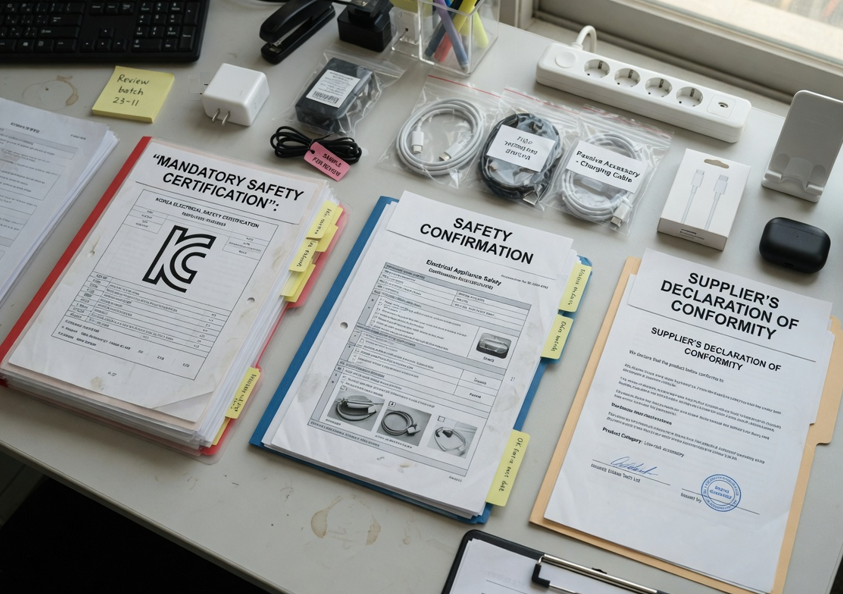
Core Differences Between the Three Levels of Electrical Safety Control
South Korea’s electrical safety control for electronic and electrical products is divided into three levels from high to low risk: mandatory safety certification (commonly known as mandatory KC), self-regulatory safety confirmation (commonly known as self-regulatory KC), and Supplier’s Declaration of Conformity (SDoC). The customs clearance requirements of different levels are significantly different:
The first category is mandatory safety certification, which is also the most strictly controlled. A KC electrical safety certification certificate issued by an officially recognized institution must be obtained before customs clearance. Typical mandatory categories in charging products are mainly power supply products, including wall-plug chargers, laptop/tablet power adapters, civilian wireless charging bases, desktop multi-port power supplies, and other products that are directly or indirectly connected to 220V mains power and involve high-risk functions such as voltage conversion and fast charging control.
There is no unified “one-size-fits-all” rule for whether cables belong to mandatory KC. It needs to be judged against the item list of South Korea’s Electrical Appliances and Household Goods Safety Management Act in combination with whether they are sold as a set with adapters, whether they have built-in active protection/identification chips, rated current parameters, and specific uses: common fast charging cables sold with mandatory chargers and high-power cables with built-in active circuits are likely to be included in the mandatory scope, while ordinary passive low-current cables may be classified into a lower control level. If the classification cannot be clearly determined, it shall be subject to the item list published by the Korean Agency for Technology and Standards (KATS, the competent authority responsible for electrical safety KC rules), or the confirmation results of the certification body or South Korean importer.
The judgment logic for interface products is similar: USB-C adapters with circuits, docking stations with power supply functions, and plug converters with protection circuits usually belong to the mandatory category because they involve active circuit control; adapters with pure physical structure and no circuits have lower risks.
The second category is self-regulatory safety confirmation, whose control intensity is much lower than that of mandatory safety certification. Enterprises independently test according to standards and then submit confirmation, without going through the complete factory audit process of mandatory certification. It is only necessary to submit the KC safety confirmation letter during customs clearance, and the customs spot check rate is much lower than that of the mandatory category. Common self-regulatory charging products include ordinary passive USB charging cables without fast charging function, pure physical adapters without any circuits, etc.
The third category is Supplier’s Declaration of Conformity (SDoC), which is the least intensive category in electrical safety control. Enterprises independently declare that their products meet safety standards, and only need to submit the conformity declaration document during customs clearance. The spot check rate is lower than that of self-regulatory safety confirmation, and some very low-risk charging accessories are applicable to this category.
It should be specially noted here that charging accessories with wireless functions (such as Qi wireless charging, Bluetooth) and IT communication functions, in addition to the above electrical safety requirements, also need to separately meet the electromagnetic compatibility or wireless equipment suitability evaluation requirements of the Korea Radio Administration (RRA). This is another set of rules parallel to electrical safety KC, and cannot be confused with self-regulatory confirmation and SDoC of electrical safety.
In addition, there are charging-related products that are completely not under KC control, which can clear customs without providing KC certificates. For example, industrial-grade charging power supplies only used for industrial production and not for ordinary consumers, pure metal charging interface parts without circuits (such as separate USB-C female socket parts), and non-sold spare parts for official after-sales service — however, such accessories need to provide a maintenance certificate from the brand to prove that they are not for sale.
Two Practical Methods for Quick Judgment
For the convenience of quick correspondence, we have sorted out the category-specific judgment criteria for charging products, so that you can initially match them without looking up regulations:
- Chargers/adapters: All civilian models for ordinary consumers (220V to low-voltage output) belong to the mandatory safety certification category;
- Charging cables/data cables: Those with identification chips, supporting fast charging, high current above 5A, and sold as a set with mandatory chargers are likely to belong to the mandatory category; ordinary passive cables without these functions may belong to the self-regulatory or SDoC category;
- Plugs/adapters: Those with circuits, fuses, and control functions belong to the mandatory category; converters with pure physical structure may belong to the self-regulatory or SDoC category;
- Sets/combination packs: For example, a set of charger + fast charging cable is directly counted as a mandatory category, and it is absolutely not allowed to split the declaration into two separate products to evade mandatory certification.
If your product is relatively special and not in the above common categories, you can use the 3-step general judgment method to initially confirm whether KC customs clearance is required in 1 minute: Step 1, first check whether the product is a civilian charging product for ordinary South Korean consumers; Step 2, check whether it will be directly or indirectly connected to South Korea’s 220V civilian electricity; Step 3, compare with the previous classification to see whether it belongs to the category scope of mandatory, self-regulatory or SDoC. If all three conditions are met, then you need to prepare customs clearance materials according to KC requirements.
3. Required Materials and Consistency Requirements for KC Customs Clearance
After confirming that the product needs KC customs clearance, what materials should be prepared next? What consistency requirements must be met? This part is the core of practical operation, and many people get stuck in customs clearance because of incomplete materials or mismatched information.
First is the core KC compliance documents, and different control levels have different requirements: mandatory products need to provide a valid KC electrical safety certification certificate, self-regulatory products need to provide a KC safety confirmation letter, and SDoC products need to provide a supplier’s declaration of conformity. The term “valid status” here has multiple meanings: it not only means that the certificate is within the stated validity period, but also confirms that the certificate has not been suspended or revoked, and the test standard for the corresponding product has not become invalid due to regulatory updates; if it is a series certificate (one certificate covers multiple models), it must be confirmed that the model of this shipment is within the officially announced coverage scope, and you cannot use the certificate of other models in the same series as a substitute; the product model, brand, and rated parameters on the certificate must be completely consistent with the actually shipped products.
Second is importer qualification and authorization documents: during customs clearance, it is necessary to ensure that the South Korean importer has legal business qualifications, and the corresponding relationship between the importer and the certificate can be proved. If the holder of the KC certificate is not the actual importer for customs clearance — for example, the certificate is held by a domestic factory, and the name of a South Korean trading company is used for customs clearance — then additional certificate authorization use proof, importer registration documents or agency relationship description must be provided to prove that the South Korean importer has the right to use the compliance qualification of the product corresponding to the certificate.
Next is KC marking requirements for products and packaging, which is a key inspection item for charging products that many small sellers tend to ignore. The specific requirements for KC marking vary according to product category, control level, and product size. General requirements include: the product body should be marked with the KC mark, model, and rated parameters as much as possible; for products that are too small to have enough marking space (such as small adapters, thin-diameter ordinary cables), some information can be marked on the packaging or accompanying instructions according to the rules. The outer packaging usually needs to be marked with the name and address of the South Korean importer and the corresponding compliance number (safety certification number/safety confirmation number/supplier confirmation number varies by category).
There are several exclusive precautions for charging products: First, the plug of the product must meet South Korean standards (two-pin round plug), and you cannot directly ship products with US or Chinese standard plugs; second, fast charging cables and high-current cables with active circuits should try to mark the rated parameters on the body or non-separable labels, and if they cannot be marked, they must be clearly marked on the packaging or instructions, and be consistent with the certificate parameters; third, the conventional minimum size of the KC mark is recommended to be no less than 5mm, and it should be printed in a prominent position, subject to the marking specifications of the corresponding category.
Last is basic trade and charging product supplementary materials: basic trade documents include commercial invoices, packing lists, bills of lading/waybills. The product name, quantity, and origin on these documents must be clearly written and cannot be vague. For charging products, the customs may additionally require the following supplementary materials: first, a product parameter sheet consistent with KC certification parameters, which should clearly state the maximum current of the charging cable, supported fast charging protocols and other information; second, when multiple models of the same series are shipped together, a difference description of different models needs to be provided to prove that all models are within the coverage of the KC certificate; third, for products sold through cross-border e-commerce channels, it may be necessary to supplement the filing information of the corresponding platform or official system as auxiliary materials.
4. Full Process of KC Customs Clearance and Key Inspection Points
With all materials prepared, is it guaranteed to clear customs smoothly? Not necessarily. There are several key inspection points in the entire customs clearance process, and problems may occur if you are not careful. We will sort it out for you in chronological order, what to pay attention to at each stage.
The first stage, which is also the most easily overlooked, is pre-shipment verification. Many people think that they can wait until the goods arrive at the customs. In fact, doing pre-verification in advance can greatly reduce the probability of customs clearance delays and detentions. What should be checked before shipment? First, the model, parameters, and brand of the product are completely consistent with those on the KC certificate; second, the KC marks on the product and packaging meet the corresponding specifications, and the plug is of South Korean standard; third, the qualification and authorization documents of the South Korean importer are complete and correspond to the information used for declaration. For charging products, it is also necessary to additionally confirm that the fast charging protocol, power, and interface type are all within the coverage of the certificate — for example, if the certificate says 25W PD fast charging, but the actual shipment is 65W GaN fast charging, it will definitely not pass.
The second stage is KC verification at the customs declaration stage. Now South Korean customs will check the official filing information of KC certificates online, so all KC-related materials should be submitted together at the time of declaration, instead of waiting for the customs to ask for them. Because charging products are a key inspection category, they are very likely to be subject to KC special inspection. The review time limit is usually several working days longer than that of ordinary goods. The specific duration depends on the port, material completeness, and whether they are selected for special inspection. It is recommended to reserve buffer time in advance and do not ship just before the delivery date. If materials are missing, the customs will give a time limit for supplementary materials, which must be completed within the specified time; if the correction is not made within the time limit, the goods may be detained by the customs, returned, or handled in accordance with relevant regulations.
The third stage is exclusive inspection items for charging products in on-site inspection. If selected for unpacking inspection, there are three key inspection directions for charging products: first, the consistency inspection of goods and certificates, the customs will open the box to check whether the model, parameters, and brand of the actual goods are completely consistent with those on the certificate. Second, KC mark inspection, checking the clarity, size of the mark, and the accuracy of the compliance number. There is also a low-probability but high-risk link: spot testing. High-power fast chargers, USB-C fast charging cables with active chips, wireless chargers and other high-risk products have a certain probability of being selected and sent to the laboratory for testing of core safety parameters; those who fail the spot test may face return, destruction or import ban, etc., subject to the judgment of the customs and competent authorities.
The last part is customs clearance results and objection handling. If the verification is passed, the goods will be released normally, and the products can enter the South Korean market for sale or use. If the verification fails, the customs will handle it according to the severity: minor cases such as missing materials can be corrected; if the declaration is wrong, the declaration can be modified; serious cases such as inconsistent goods and certificates, no compliance certificate, may be returned or even destroyed. If you have objections to the customs judgment result, you can also submit supplementary certificates to apply for review, it is not a final decision.
5. KC Customs Clearance Exemption and Special Scenario Judgment
After talking about the conventional customs clearance process, let’s talk about the exemption rules for special scenarios, as well as the exemption pitfalls that many people are prone to fall into. This part is advanced content. If you understand it, you can avoid a lot of unnecessary costs and will not take chances to fall into pitfalls.
First are common scenarios where KC customs clearance can be exempted. Note that all conditions must be met for exemption, and none can be missing. The first is a reasonable quantity for personal use, usually 1-2 pieces of the same type of charging product, and not for sale. For example, if you buy a fast charger for personal use, you do not need KC. The second is samples for testing/certification, which need to provide officially recognized test purpose proof, quantity rationality explanation, and clearly stated not for sale, and after testing, they need to be re-exported or destroyed in accordance with regulations; the specific exempted quantity and requirements are subject to the approval of South Korean customs or competent authorities. The third is products temporarily imported for exhibition or demonstration, which need to be re-exported after use, and a temporary import guarantee must also be provided, which can also be exempted.
For cross-border e-commerce channels, there are several exclusive rules for different scenarios that need to be distinguished:
The first category is small personal direct mail parcels. If they meet the aforementioned reasonable quantity for personal use and non-commercial use, KC requirements can be exempted; but if the quantity exceeds personal use, for example, multiple charging products of the same type are sent at one time and cannot be proved to be for personal use, even if it is personal direct mail, complete KC compliance materials must be provided according to general trade.
The second category is the platform direct mail model. In addition to basic KC compliance materials, some South Korean e-commerce platforms will require sellers to complete KC information filing on the platform in advance. The filing screenshot can be used as auxiliary materials for customs clearance, but the final customs clearance inspection is subject to the certificate filing information in the customs system and the consistency of goods and certificates. Platform filing cannot replace official compliance requirements.
The third category is the bonded warehouse delivery model. Before charging products enter the warehouse, it is necessary to confirm in advance that the KC compliance information has completed the filing and registration required by the customs and bonded warehouse to avoid customs clearance delays when leaving the warehouse.
It should also be reminded that South Korean customs will tighten the KC inspection intensity of cross-border direct mail from time to time. For long-term business, it is recommended to complete compliance in accordance with the rules, and do not have the mentality of “sneaking through”.
Regarding exemption scenarios, many people also have three common misconceptions, which we will emphasize again:
First, not all samples can be exempted from KC. If the number of samples is too large, or there is no official test purpose certificate, KC still needs to be provided, and you cannot use “samples” as an excuse casually.
Second, personal purchasing of charging products also requires KC. If the purchased products are for sale and belong to commercial use, even if they are sent one by one, they must have KC compliance certificates, otherwise it is a violation.
Third, not all maintenance accessories do not need KC. Only officially authorized after-sales maintenance accessories for non-sales purposes can be exempted. If they are replacement accessories sold separately, such as spare charging cables sold separately, they still need to meet KC requirements.
6. Common Causes of Customs Clearance Delays and Troubleshooting Methods for KC of Charging Products
Even with a lot of preparation, sometimes you may still encounter customs clearance delays. What to do? We have sorted out the four most common types of causes for KC customs clearance delays of charging products, as well as the corresponding troubleshooting methods. If you encounter problems, you can troubleshoot in order to quickly find the problem.
The first and most common type is customs clearance delays caused by inconsistent goods and certificates. Common situations include inconsistent product models with those on the certificate, different brands, and false parameter labeling (for example, the actual is 20W, but the certificate says 25W). There are two high-risk scenarios: one is that chargers with the same appearance but different powers share one certificate. Many factories think that the same appearance can use the same certificate, but in fact, different powers belong to different models and must be within the coverage of the certificate; the other is OEM products, where the brand is changed but the brand on the KC certificate is not updated, and there is no corresponding authorization document, resulting in inconsistent goods and certificates. The troubleshooting method is very simple: check the model, parameters, and brand of the actual product one by one with the content on the KC certificate to ensure complete correspondence.
The second type is customs clearance delays caused by non-standard marking and specifications. Common problems include the KC mark being too small or blurry, no corresponding compliance number printed, and the plug not meeting South Korean standards. There is an exclusive pitfall for charging products: many sellers only print the parameters of fast charging cables and high-current cables on the packaging, not on the product body or non-separable labels, which is very easy to be judged as unqualified. The troubleshooting method is to check whether the mark size, position, and information are complete against the KC marking specifications of the corresponding category, whether the plug is a South Korean standard two-pin round plug, and whether the parameters of active cables are marked as required.
The third type is customs clearance delays caused by declaration and classification errors. A common problem is that the HS code or product name is written too generally, for example, only writing “electronic accessories”, and declaring chargers that belong to mandatory KC as ordinary accessories. There are also two high-risk operations: one is split declaration of set products, for example, splitting a charger + cable set into two separate product declarations, trying to let the cable go through a low control level. If found, it will be directly treated as a violation; the other is mixed loading of multiple models, and each model is not clearly distinguished during declaration, resulting in the customs being unable to check the certificate. The troubleshooting method is to confirm the correct classification of the product in advance, and the declared product name should clearly state the product type and power/current parameters, such as “25W USB-C wall-plug fast charger”, and do not be vague.
The fourth type is customs clearance delays caused by importer and filing issues. The most common situation is that the holder of the KC certificate and the actual importer for customs clearance do not have corresponding authorization documents. In this case, even if the certificate is genuine, customs clearance will be delayed. There is also a hard restriction: individuals cannot act as importers to handle customs clearance of mandatory KC charging products, and they must be legal enterprises in South Korea. Cross-border e-commerce also has an exclusive pitfall: the KC filing on the platform and the information in the customs system are not synchronized, resulting in that even though it has been filed on the platform, the customs cannot find it, and customs clearance will still be delayed. The solution is to handle the importer authorization or registration of the certificate in advance, and confirm that the filing information has been synchronized to the corresponding customs clearance system before shipment.
7. Pre-shipment Self-check List and Capability Summary
For the convenience of practical implementation, we have sorted out a 4-step quick pre-shipment self-check list. Going through it before each shipment can greatly reduce the risk of customs clearance delays:
Step 1: Use the 3-step judgment method mentioned above to first confirm whether your charging product needs KC customs clearance and which control level it belongs to. Do not miss the judgment or spend unnecessary money;
Step 2: Check the corresponding relationship of “product – certificate – importer” to ensure that the product parameters are consistent with the certificate, and the importer qualification and authorization documents are complete;
Step 3: Check whether the KC marks on the product body and outer packaging meet the corresponding specifications, and whether the plug is of South Korean standard;
Step 4: If it is a special scenario such as personal use, samples, or temporary import, first check whether all exemption conditions are met, and do not take it for granted.
Of course, not all situations can be judged by yourself. If you encounter the following situations, it is recommended to consult a professional certification or customs clearance agency in advance, and do not try blindly: for example, charging products entering the South Korean market for the first time, who are not familiar with the rules; product revisions, such as changes in power, interface, plug, fast charging protocol or even brand, the previous certificate may not be applicable; there are also relatively complex situations such as set products, mixed loading of multiple models, and cross-border e-commerce bonded warehouse stocking; in addition, if you are not sure about the product classification, or have received a customs clearance delay notice, it is also recommended to find a professional to handle it to avoid the situation getting worse with delay.
Overall, the core logic of KC customs clearance for charging products in South Korea matches the risk level: high-risk products are strictly controlled, low-risk products have simplified procedures, and personal non-commercial use can be exempted in accordance with regulations. Clarifying product classification in advance, preparing corresponding compliance materials, and doing a good job of pre-shipment verification are the core prerequisites for smooth customs clearance.