
Sellers of charging products in the Korean market, cross-border purchasers, and even friends who often buy Korean version charging accessories must have heard of KC certification. But when it comes to the “validity period of KC certification”, many people have a vague impression, and they only find out they have fallen into a pit when products are removed from shelves or goods are detained at customs. In fact, the validity period of KC certification is never a fixed number – it is directly related to the official certification system corresponding to the product and the safety risk level, and some types of KC certification do not even mark a fixed expiry date. Today, we will clarify the rules of KC validity period from basic cognition to practical methods focusing on charging products. All conclusions are based on current Korean regulations and official rules, and common cognitive misconceptions will be collectively clarified in the pitfall avoidance guide at the end of the article.
1. First, Understand the Basics: What Exactly is the KC Certification Validity Period
First of all, it should be clear that the validity period of KC certification is the compliance period of Korean KC certification, which determines whether the product can be legally sold in Korea and whether the KC mark can be used. It is completely different from the service life of the product itself and the warranty period given by the merchant – just like the validity period of a driver’s license is not equal to the life of a car; if the driver’s license expires, you cannot drive, but the car itself can still be driven; if KC certification expires, the product cannot be sold in Korea, but the product itself may still work normally.
The KC certification risk level of charging products mainly depends on whether it is connected to the mains, the power level, and whether it has an active circuit. The final conclusion is subject to the latest official Korean product catalog and the written conclusion of the designated certification body, and cannot be judged solely by a single parameter such as power or appearance. The following is a comparison table of risk tendencies and verification directions for common charging products to facilitate quick positioning:
| Common Charging Products | Risk Tendency | Common Compliance Verification Direction | Core Reference Basis for Classification |
|---|---|---|---|
| Wall-plug chargers | High risk | Key verification of whether they fall within the scope of mandatory safety certification | Directly connected to mains power, faults easily cause electric shock and fire risks |
| 65W and above standalone power adapters | High risk tendency | Key verification of whether they fall within the scope of mandatory safety certification | High power, usually with active voltage regulation circuits, relatively high safety risk |
| Active fast charging cables (with fast charging/E-marker chip) | High risk tendency | Specific certification path shall be determined based on product structure and purpose | Built-in active control chip, faults easily damage downstream equipment, compliance requirements are higher than passive cables |
| Medium and low power adapters below 65W | Medium risk tendency | Certification category shall be confirmed according to the official Korean catalog; power is only a reference for risk judgment, subject to official determination | Low power, relatively controllable risk, usually requires third-party testing and verification |
| Charging accessories with simple protection circuits | Medium risk tendency | Certification category shall be confirmed according to the official Korean catalog; basic protection circuits are a reference for risk judgment, subject to official determination | With basic overcurrent/overvoltage protection, medium risk |
| Passive USB charging cables | Low risk | First confirm whether they fall into the KC electrical product safety management catalog; if they belong to the low-risk declaration category, prepare materials according to SDoC requirements, subject to official determination | No electronic components, only conduct electricity, extremely low risk |
| Regular plug adapters / converters | Low risk | First confirm whether they fall into the KC management catalog; if they belong to the low-risk declaration category, prepare materials according to SDoC requirements, subject to official determination | No circuit design, only physical interface conversion |
| Charging sets (charger + cable) | According to the risk level of corresponding accessories | Each accessory must separately meet the corresponding certification requirements | All accessories in the set must meet the compliance requirements of the corresponding risk level |
If KC certification is invalid and the product is still sold in the Korean market, it may face various consequences, depending on the product category, illegal facts, law enforcement procedures and platform rules:
- Platform level: If certification invalidity is detected by major Korean e-commerce platforms such as Coupang and Gmarket, relevant products may be forcibly removed according to settlement rules;
- Customs level: If certification invalidity is found by random inspection by Korean customs during customs clearance, the goods will be directly detained and a fine proportional to the corresponding goods value will be imposed; the specific amount is subject to the final determination of the law enforcement department;
- Administrative level: If violations are verified by the market supervision department, penalties such as ordering cessation of sales and confiscation of illegal gains may be imposed;
- Civil level: After consumers purchase products without valid certification, they may file complaints or claims according to relevant Korean regulations, and merchants shall bear corresponding compliance responsibilities.
2. Core Premise: Three Official Systems of KC Certification
Why is there no unified answer for KC certification validity? The core reason is that under Korea’s Safety Management Act for Electrical Products and Daily Necessities, KC certification is divided into three different system paths, corresponding to products of different risk levels, with very different rules. You can think of these three paths as three different types of “compliance certificates”:
The first is Mandatory Safety Certification (official formal name is “Safety Certification”; as it falls under the mandatory access category, it is commonly referred to as mandatory safety certification in the industry). It has the strictest requirements: products must undergo full safety testing by a Korean designated third-party certification body, and must accept annual factory follow-up inspections – just like a driver’s license not only requires an exam to get the license, but also requires annual inspection, and you can continue to use it only after passing the annual inspection. The compliance status of this type of certification needs to be continuously maintained, not a one-time certificate that is valid for life, and it is mainly applicable to products with higher safety risks.
The second is Self-Regulatory Safety Confirmation (official formal name is “Safety Confirmation”; as enterprises complete tests independently before submitting to the institution for confirmation, it is commonly referred to as self-regulatory safety confirmation in the industry). Its requirement is that the product first completes safety testing by a Korean recognized testing institution, and then the enterprise submits the test report to the certification body to apply for confirmation. After obtaining the confirmation letter, the KC mark can be used, which is a bit like a physical examination certificate: you go to the hospital for a physical examination, all indicators are qualified, and the hospital issues you a certificate proving that you meet the health standards at that time. The validity of this type of certification is directly bound to the test report and the applicable standard version, and it is mainly applicable to medium-risk products.
The third is Supplier’s Declaration of Conformity (SDoC for short, also often referred to as self-declaration). This type does not require official certification issuance. Enterprises need to complete product testing in accordance with Korean safety standards (self-testing or entrusting a third party), retain complete technical documents and test records, and then publicly declare that the product meets Korean standards, similar to a self-health commitment. Its validity depends entirely on the consistency between the product and the declaration content and continuous compliance with current standards, and it is mainly applicable to products with lower risks.
There are two core bases for path judgment: First, the safety risk level of the product. Generally, the higher the power and the product with active circuits, the stricter the certification path; compliance requirements for charging accessories with active control chips are significantly higher than those for passive products. Second, the official determination conclusion. The final classification is subject to Korean regulatory classification and the formal conclusion of the issuing agency, and cannot be judged solely by appearance, power, or whether it has a fast charging chip.
3. Core Rules: How to Calculate the Validity Period of the Three Types of Certification
After understanding the differences between the three systems, the logic of calculating their respective validity periods becomes clear.
Mandatory Safety Certification: No Fixed Expiry Date, Maintained by Annual Factory Inspections
The certificate of mandatory safety certification itself does not mark a fixed expiry date. As long as the certificate-holding enterprise passes the annual factory follow-up inspection by the certification body, the certificate remains valid. The date of certificate issuance is the reference point for the start of the validity period; this date is mainly used for annual factory inspections, regular review cycles, and certificate status records, and does not mean that the certificate has a unified expiry cycle.
The “5-year validity period of KC certification” mentioned by many people is actually a requirement of some certification bodies for specific product categories – that is, a full safety test review needs to be re-conducted every 5 years. This requirement only applies to specific products of the corresponding institution, and is not universal across all categories; the specific details are subject to the certificate annex or the official notice of the issuing agency. If the review fails, the certificate will also be suspended or revoked.
The basic invalidation triggers for this type of certification include: failure to pass annual factory inspection and failure to rectify within the time limit, failure to declare core safety-related changes to the product, and update of applicable safety standards beyond the officially prescribed transition period.
Self-Regulatory Safety Confirmation: Has Fixed Validity Period, Commonly 2-5 Years
Self-regulatory safety confirmation usually has a fixed validity period marked on the confirmation letter or test report, with a common industry range of 2-5 years. The specific duration shall be determined jointly by the regulatory requirements of the corresponding product category, the period stated on the confirmation letter, and the recognized validity period of the test report. The start time is usually subject to the date of issuance of the confirmation letter or the date of issuance of the test report, and the specific details are subject to the marking on the certificate.
After expiry, the enterprise needs to re-arrange full product testing, submit a new test report to the certification body to apply for a replacement confirmation letter. After approval, the validity period is recalculated from the date of issuance of the new confirmation letter.
The basic invalidation triggers for this type of certification include: expiry of the confirmation letter, test report exceeding the recognized period, failure to declare core safety changes to the product, and update of applicable standards beyond the transition period.
Supplier’s Declaration of Conformity (SDoC): No Fixed Validity Period, Requires Continuous Compliance
SDoC does not have an officially set fixed validity period, but this does not mean it is permanently valid. Enterprises need to continuously retain product technical documents, test records, and declarations of conformity to ensure that products always comply with current Korean safety standards.
If the product structure, key components, manufacturing process, or applicable Korean standards change, the enterprise must re-evaluate the product’s compliance, and update or re-issue the declaration of conformity if necessary. If the product fails market random inspection, the enterprise must rectify as required; relevant products may not continue to be sold during the rectification period, and serious cases may lead to invalidation of the declaration.
The basic invalidation triggers for this type of declaration include: product changes affecting safety without re-evaluation, product non-compliance after applicable standards are updated, and failure of market random inspection with failed rectification.
Validity Judgment for Special Scenarios
In addition to the conventional calculation logic, there are several common special scenarios, where judgment cannot be based on experience, but must be based on official registration information:
- Same-series extended models: If you need to add new models of the same series based on the existing certificate, you cannot unilaterally determine that the validity period is the same as the main model. You must first verify the list of registered models, rated parameters, interface/plug types, and list of key components on the original certificate, then submit an extension application to the original issuing agency. Only after the agency reviews and confirms that the safety design of the new model is completely consistent with the main model can it be included in the scope of the original certificate, and the validity period remains the same as the main model.
- Standard update transition period: If Korea issues new safety standards or adjusts product certification classifications, the official will clarify the scope of application, implementation date, and transition period arrangements in the official announcement. Old certificates that meet the requirements during the transition period may continue to be used; those that have not been updated after the transition period ends will become invalid, and the specific details are subject to the announcement provisions.
- Certificate reissue / non-core changes: If only non-core changes that do not involve safety performance and the main body of the certificate occur, such as reissue due to lost certificate, adjustment of non-safety-related text on packaging, or appearance color change, the validity period is still calculated from the original certificate issuance date after confirmation by the issuing agency, and will not be re-timed.
- Certificate sharing rules: Whether charging products with different rated parameters, plug specifications, interface types, and core circuits can be included in the scope of the same certificate must be subject to the review conclusion of the issuing agency. Enterprises may not unilaterally attach unregistered products to existing certificates.
To facilitate quick comparison of the validity period differences among the three systems, we have compiled a core rule comparison table:
| Comparison Dimension | Mandatory Safety Certification | Self-Regulatory Safety Confirmation | Supplier’s Declaration of Conformity (SDoC) |
|---|---|---|---|
| Strictness Level | Highest | Medium | Lowest |
| Factory Inspection Requirements | One follow-up inspection per year | None | None |
| Validity Logic | No fixed expiry date, remains valid if annual factory inspection is passed | Has fixed period, commonly 2-5 years, subject to confirmation letter/test report, retest after expiry | No fixed period, requires continuous compliance with current standards, re-evaluation when changes occur |
| Applicable Product Risk Level | High risk tendency products | Medium risk tendency products | Low risk products |
| Core Invalidation Triggers | Failed factory inspection, undeclared core changes, expired standard update | Expired confirmation letter/report, undeclared core changes, expired standard update | Unevaluated product changes, non-compliance with updated standards, failed random inspection |
Note: The above is a comparison of general rules, and specific requirements are subject to the regulations of corresponding products and the notice of the issuing agency.
4. Early Invalidation: Situations Where Certification May Become Invalid Before the Conventional Time
Many people think that as long as the marked validity period has not arrived (or the commonly mentioned 5 years have not passed), KC certification must be valid, but this is not the case. There are several situations where certification may lose validity in advance even before the conventional invalidation time.
Doubtful Validity Caused by Core Product Changes
As long as core components or parameters that may affect product safety performance are changed, the original certification cannot be directly used. It is necessary to declare to the issuing agency in a timely manner, and after evaluation, confirm whether re-testing or certificate replacement is required. If no declaration is made and the original certification requirements are not met, the original certification will become invalid.
Common core changes include:
- Chargers/adapters: replacement of transformers, main capacitors, fast charging chips, adjustment of rated power, interface types, plug specifications;
- Charging cables: replacement of wire diameter, wire material, interface structure, addition or removal of fast charging chips, E-marker chips;
- Identification information: product model and brand logo are completely inconsistent with the registered information on the certificate;
- Set products: adding or replacing accessories in the set without updating the certification coverage.
Validity Changes Caused by Regulatory/Standard Updates
If the Korean competent authority issues new safety standards or adjusts the certification system classification of products (for example, products originally belonging to self-regulatory safety confirmation are adjusted to mandatory safety certification), the official will clarify transition arrangements in the announcement, including the sales period of existing products, the validity period of issued certificates, rectification requirements, etc. For charging products, possible update scenarios include adjustment of safety requirements for power adapters, update of fast charging-related rules such as USB-C PD, and changes in performance requirements such as flame retardancy/insulation/temperature rise of charging cables. It is necessary to carefully check the transition period arrangements in the announcement, the scope of application of old certificates, and whether supplementary testing is required. After the transition period specified in the announcement, the original certificate or declaration may no longer be used for the sale and customs clearance of corresponding products. The specific transition rules are subject to the official announcement, and cannot be simply understood as “automatic invalidation”.
Validity Affected by Violations or Unreported Subject Changes
Korea’s electrical product safety-related certifications are handled by multiple officially designated certification bodies, and the competent authority is responsible for overall rule-making and market supervision. In the following situations, certification validity may be affected:
- If a product with mandatory safety certification fails the annual factory inspection, the certification body will first order rectification within a time limit. During the rectification period, the certificate will be suspended. If rectification is not completed within the time limit or fails, the certificate will be revoked;
- If false materials are submitted or true information is concealed when applying for certification, the certification body or competent authority has the right to revoke the certificate and pursue corresponding responsibilities;
- If the name/address of the manufacturing plant, manufacturer, Korean importer, or certificate holder changes, a change application must be submitted to the issuing agency according to the type of change: if only the name is changed and production conditions are not involved, the data change process can be followed, and the certificate remains valid; if changes involve production location or production capacity, supplementary factory inspection or testing may be required, and the certificate will be updated after passing; if not reported as required, the validity of the certificate may be affected, and the specific details are subject to the determination of the issuing agency;
- If a product fails the Korean market supervision random inspection, the enterprise will be required to rectify within a time limit. During the rectification period, the product may not be sold. In serious cases or if rectification fails, the certificate may be revoked or the declaration may become invalid.
5. Practical Verification: How to Check if KC Certification is Really Valid
Since the status of KC certification is dynamically changing, it is definitely not enough to just look at the paper certificate provided by the supplier. The most reliable method is to verify through official channels. Before querying, you must first clarify the certification type corresponding to the product (certificate-issuing type: mandatory safety certification / self-regulatory safety confirmation; declaration type: SDoC), and the verification methods for the two types are completely different.
Step 1: Find the Correct KC Certification Number (Applicable to Certificate-Issuing Types)
To query certificate-issuing products, you first need to find the KC certification number. The location of the number varies for different products:
- Chargers and power adapters: usually on the nameplate at the bottom, the combination of letters and numbers next to the KC mark is the number;
- Charging cables and small accessories: may be printed on the packaging or on the label of the cable body; the number of some small accessories is only marked on the outer packaging.
Note that you should not mistake the product model or factory internal number for the KC certification number. A formal KC number has a fixed prefix corresponding to different certification types.
Step 2: Select the Corresponding Channel for Verification
Certificate-Issuing Types (Mandatory Safety Certification / Self-Regulatory Safety Confirmation)
Queries can be made through the official free public system operated by the Korea Safety Certification Institute (KCA) (such as the Safety Korea platform), or the official entrance of the designated certification body stated on the certificate. Usually no registration is required, and it supports search by dimensions such as KC certification number, product model, and manufacturer name. Overseas users can directly access it.
The real-time status displayed by the official system always has higher priority than the paper or electronic certificate provided by the supplier – after all, after a paper certificate is printed, subsequent statuses such as suspension and revocation will not be automatically updated on the physical document. If you are unsure of the certification type, you can first try a fuzzy search by model or manufacturer name, and then check the corresponding entries from the results.
Declaration Type (SDoC)
SDoC belongs to the enterprise self-declaration category, and there is no official unified certification issuance database. It is impossible to query the unified certification issuance status in the official system through the certificate number. The following points should be focused on in its validity verification:
- The supplier must be able to provide a complete declaration of conformity, the corresponding version of the test report, and product technical documents;
- Product identification and parameters are completely consistent with the content of the declaration;
- The standards used for testing are current and valid Korean standards, and no safety-affecting changes have occurred to the product;
- It can be assisted by the market random inspection announcements issued by the Korean official.
Step 3: Verify Key Information (Certificate-Issuing Types)
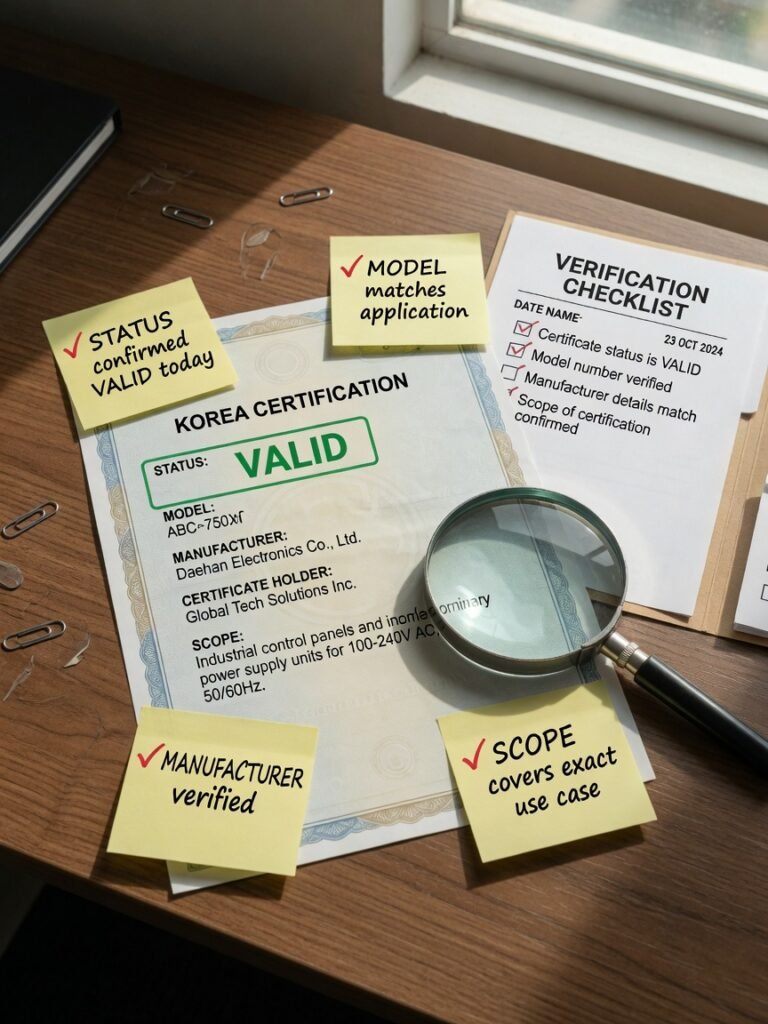
After querying the corresponding information of certificate-issuing products, do not just check whether there is a record; focus on verifying the following content:
- Certificate status: Common statuses in the system include valid, suspended, revoked, expired, etc. (specific fields are subject to the Korean display of the system). Only certificates in “valid” status are currently compliant; certificates in suspended, revoked, or expired status cannot be used for sales and customs clearance.
- Consistent model and parameters: The model on the certificate must be completely consistent with the actual product. At the same time, parameters such as rated power, interface type, and plug specifications must be verified; it cannot be a similar model or a product of the same series.
- Matching subject information: The information of the certificate holder, manufacturer, and manufacturing plant on the certificate must match the information of the product’s brand owner and manufacturer to avoid certificate fraud.
- Complete scope coverage: If it is a set product, verify that all accessories in the set are within the certification coverage; it cannot be that only the charger has a certificate and the charging cable does not.
Common Reasons for No Query Results (Certificate-Issuing Types)
If you cannot find results for certificate-issuing products after entering information, it may be due to the following reasons:
- Wrong certification type selected, or incorrect number input format (such as missing letter prefix or suffix);
- The product certification is issued by another designated agency, and you need to search in the query system of the corresponding agency;
- The certificate has just been issued, and the database has not yet completed synchronization; the specific synchronization time is subject to the issuing agency;
- The certificate has been revoked or cancelled for more than a certain period, and is no longer publicly displayed;
- The product uses a counterfeit KC mark and has not obtained real certification.
If it is an SDoC product, there is no official unified certification issuance database, which is a normal situation, and the validity needs to be verified through supplier materials.
6. Solutions: How to Choose Between Renewal, Change, and Re-Certification
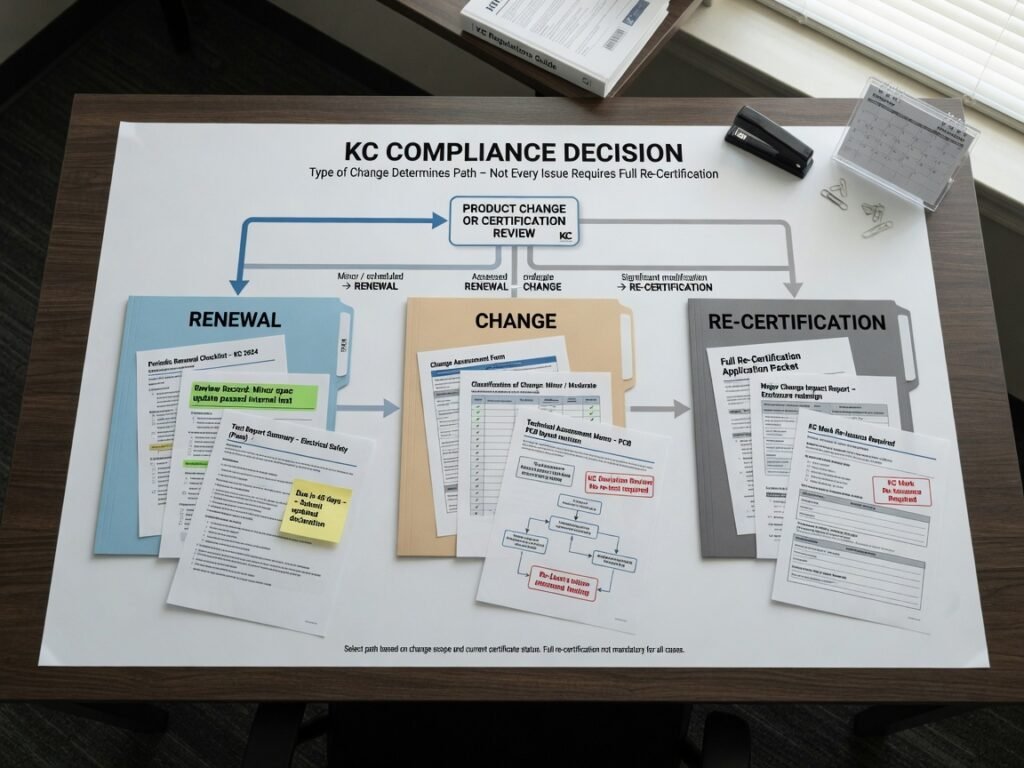
When you find that the certificate is about to expire, or when the product needs to be adjusted, should you choose renewal, change, or re-certification? Many people are confused. In fact, different certification systems have different requirements, and there is no unified general rule. The core is to confirm with the original issuing agency first.
Applicable Scenarios and Prerequisites for Renewal
Renewal is mainly applicable to situations where the certificate is about to expire, and the product itself has no design/parameter changes, and the applicable safety standards have not been updated.
The application prerequisites are also linked to the certification type: mandatory products require all previous annual factory inspections to be qualified and no violation records; the original test reports of self-regulatory products must meet current standard requirements. It is recommended to submit the application 3-6 months before the expiry of the validity period to avoid gaps in sales and customs clearance.
Renewal Differences for Different Certification Types
The “renewal” logic of the three types of certification is completely different:
- Mandatory Safety Certification: There is no “expiry renewal” in the traditional sense, because the certificate has no fixed expiry date, and remains valid as long as the annual factory follow-up inspection is passed. If the issuing agency requires regular full test reviews, the test must be completed within the specified time as required, and the certificate will remain valid after passing. It is recommended to confirm the review requirements with the agency in advance to avoid affecting the certificate status.
- Self-Regulatory Safety Confirmation: Before the confirmation letter expires, the enterprise needs to re-arrange full product testing and submit a new test report to the issuing agency to apply for a replacement confirmation letter. The specific advance application time and required materials are subject to the requirements of the issuing agency, and it is recommended to plan the time in advance.
- SDoC: There is no fixed renewal requirement. As long as the product and applicable standards have not changed, the enterprise can continuously retain valid technical documents; if standards are updated or products are changed, compliance needs to be re-evaluated and the declaration updated.
Judgment Logic for Change vs. Re-Certification
When a product is adjusted, you do not have to default to re-certification directly; you can judge according to the following steps:
- Sort out the change content: First clarify the specific content of the change, whether it is a minor adjustment to appearance, packaging, or non-key components, or a major adjustment involving power, circuits, core components, interfaces, plugs, manufacturing plants, or subject information;
- Evaluate safety impact: Preliminarily judge whether the change will affect the safety performance and rated parameters of the product, or whether it conflicts with the consistency requirements of the original certification;
- Confirm with the issuing agency: Organize the change content into formal materials and submit them to the original issuing agency, which will determine whether to go through data change, change declaration after supplementary testing, or need to re-apply for certification.
Generally speaking, only changing the appearance color, non-safety-related text on the packaging, or non-key housing components will most likely go through the change process; while adjusting the rated power, replacing the core circuit scheme, replacing the fast charging chip, changing the interface/plug type, or replacing the manufacturing plant will most likely require supplementary testing or even re-certification, but the final conclusion must be subject to the determination of the issuing agency.
Common Reasons for Renewal/Change Failure
Renewal or change applications may also fail, common reasons include:
- The product does not meet the latest Korean safety or energy efficiency standards and cannot pass the test;
- Products with mandatory safety certification fail factory inspection and cannot complete rectification within the specified time limit;
- The application is not submitted within the specified time limit, the original certificate has expired, and a new certification needs to be re-applied;
- The change content exceeds the coverage of the original certificate and cannot be handled through the change process.
7. Pitfall Avoidance Guide: Common Misconceptions and Practical Checklists
Clarification of High-Frequency Misconceptions
We have compiled the most common KC validity-related pitfalls to avoid being misled by incorrect information:
- Misconception: KC certification validity period = product service life / merchant warranty period
Correct answer: KC validity period is a compliance access period, which only determines whether the product can be legally sold in Korea and use the KC mark, and has no direct relationship with product quality life or merchant warranty policy. - Misconception: KC certification has a unified validity period
Correct answer: The validity period rules for different certification systems and different product categories are completely different, and there is no unified period for all categories. - Misconception: Affixed with KC mark = certification is permanently valid
Correct answer: The KC mark only represents that the product has obtained compliance qualification. The certification status is dynamic. Failure to pass factory inspection, product changes, standard updates, violations, etc. may lead to invalidation. You cannot judge current validity solely by the mark. - Misconception: All charging products of the same brand can share one KC certificate
Correct answer: KC certification is based on the product’s safety design, rated parameters, and structure as the core judgment basis. Products with different power, different interfaces, and different plugs usually need to be evaluated separately for certification scope, and cannot share a certificate solely by brand. For example, chargers with the same appearance but different power, and charging cables with the same power but different interfaces generally require separate certification, and the specific details are subject to the list of models registered by the issuing agency. - Misconception: No validity period written on the certificate = permanently valid / self-regulatory/SDoC has no fixed period = permanently valid
Correct answer: Mandatory safety certification needs to pass annual factory inspections to maintain validity, and SDoC needs to continuously comply with current standards. Product changes, standard updates, violations, etc. will lead to certification invalidation. There is no permanently valid KC certification. - Misconception: Test report not expired = certification is valid
Correct answer: In addition to the test report, the validity of certification also needs to be comprehensively judged based on the current status of the certificate, the consistency between the product and the certification content, and current regulatory requirements. A valid test report alone does not mean that the overall certification is valid.
Practical Process Checklist for Overseas Sellers / Purchasers
Verification steps organized by business stage to help you systematically avoid KC validity period risks:
- Before procurement:
- Require the supplier to provide the KC certification number and scanned copy of the certificate, and clarify the rated parameters, interface, and plug specifications of the product;
- For certificate-issuing products, log in to the Korean official safety certification query platform or the corresponding issuing agency system, enter the number or model to query the certificate status;
- Verify that the model, rated parameters, manufacturer, and certificate holder on the certificate are consistent with the actual product, and confirm that the status is “valid”;
- If it is a set product, verify one by one that all accessories are within the certification coverage, and do not accept paper certificates without official verification;
- For SDoC products, require the supplier to provide a complete declaration of conformity, test report, and technical documents, and verify the validity of standards and product consistency.
- Before listing:
- Reconfirm that the product’s advertised parameters (such as power, fast charging protocol) do not exceed the scope of certification registration;
- Verify that the KC mark, model, and importer information on the product nameplate and packaging are consistent with the registered content of the certificate;
- If settling on a platform, prepare valid proof of official query in advance to avoid failing platform review.
- Sales/change stage:
- For products with mandatory safety certification, follow up the progress and results of factory inspections every year to ensure the certificate remains valid;
- Pay attention to the update announcements of Korean safety standards, and timely verify whether the certification of existing products still meets the requirements;
- If the product undergoes changes that may affect safety or certificate consistency, such as power, circuits, core components, interfaces/plugs, manufacturing plants, etc., stop listing and shipping the changed products before confirmation by the issuing agency; if the changes are only non-safety adjustments such as appearance color, non-safety-related text on packaging, or purely informational subject name changes, you can first submit a change application to the issuing agency and proceed according to the agency’s requirements, without directly suspending the sales of all existing products. All changes are subject to the final determination of the issuing agency, and the changed products will be officially promoted after the compliance process is completed.
- Before customs clearance:
- Confirm that the Korean importer information is consistent with the importer registered on the certificate. If there is a change, the report must be completed in advance;
- Prepare valid certification documents to avoid cargo detention due to invalid certification or subject mismatch.
Simple Judgment Method for Ordinary Consumers
If you are just an ordinary consumer and want to judge whether the Korean version of charging accessories you bought has valid KC certification, you can use these simple methods:
- Check whether there is a clear KC mark on the product nameplate or packaging, as well as importer information and product model marked in Korean;
- Be cautious when purchasing charging accessories that have no KC number, no importer information, and a price significantly lower than similar compliant products;
- If you have doubts about the authenticity, you can find the KC number on the product and verify it through the Korean official safety certification query system (only applicable to mandatory/self-regulatory certificate-issuing products).
Final Summary
The validity period rules of KC certification seem complicated, but the core logic is actually “the higher the safety risk, the stricter the compliance requirements, and the more dynamic maintenance of validity is required.”
After reading this article, you can independently complete three things:
First, you can distinguish the core differences between the three KC certification systems, and quickly correspond to the verification direction of common charging products in combination with risk levels;
Second, you can verify the authenticity and validity of certificate-issuing certifications through the Korean official public query system and issuing agency channels, accurately check key information such as model, parameters, subject, and scope, and also know the verification focus of SDoC products;
Third, you can preliminarily judge the impact of product changes, standard updates and other situations on certification validity, know to first confirm with the issuing agency when encountering problems, then choose the path of change, retest or re-certification, adhere to the principle of “no judgment based on experience, everything is subject to official verification”, and avoid the vast majority of compliance risks related to KC validity period.