
If you are an overseas seller or brand owner of charging products, or want to bring electronic products into the Chinese market, you have most likely heard of the term “3C certification”. Many people either think “all charging products require it”, or assume “having overseas certifications is enough to get by”, which easily leads to problems during customs clearance or listing, or results in unnecessary certification costs.
Basic Knowledge and Quick Judgment Method
What Exactly is CCC?
The full name of CCC is China Compulsory Certification, commonly known as “3C”. It is a mandatory safety access permit for the Chinese market. Simply put, products included in the official catalog cannot be sold, listed, or even imported in batches within China without a CCC certificate. It is not a “quality product award”, nor a voluntary quality selection, but a mandatory access threshold.
Official Basis and Core Principles for Judgment
The most authoritative basis for determining whether a product is within the scope of CCC is the Catalogue of Compulsory Product Certification issued by the Certification and Accreditation Administration of the People’s Republic of China (CNCA for short), as well as supporting announcements, catalog descriptions and definition tables, and implementation rules. For products with ambiguous boundaries, the final determination shall be subject to the definition opinions of the competent authority or certification body, and the catalog is updated irregularly.
The core principle of judgment is to look at the core function, key parameters and usage scenarios, not the product name or marketing rhetoric. For example, if you call a wall-plug charger a “fast charging energy station”, it is still essentially a charger and still requires CCC certification. For charging products, the most core judgment anchor is: whether it is directly connected to the 220V AC mains power on the wall at home.
Significance of Understanding the Scope for Overseas Users
For overseas users, the significance of understanding the scope of CCC application is very straightforward: it directly determines whether your products can clear customs smoothly and be listed legally in China, and it is the most basic part of compliance planning.
The Two Most Common Initial Misconceptions
Here we first correct two most common initial cognitive errors: first, not all charging products require CCC; second, overseas certifications such as CE, FCC, and UL cannot replace CCC. The specific reasons will be explained in detail in the later section on misconceptions.
Quick Judgment: Two Preconditions + Three-Step Method
To determine whether a charging product requires CCC, you don’t need to flip through the thick catalog first. You can handle 80% of common cases by first checking two preconditions and then following the three-step method.
First Check the Two Preconditions (No Need to Consider If Not Met)
First, two major preconditions must be met at the same time before it is necessary to continue to judge whether CCC is required:
First, the product is sold, imported, or used for business purposes in the Chinese mainland market — if it is only produced and sold overseas and does not enter China at all, there is no need to consider it at all.
Second, the product is used for charging or powering civilian consumer electronics — if it is equipment for special fields such as industry and medical care, the simplified CCC judgment rules for consumer products do not apply.
As long as either of the two preconditions is not met, the possibility of directly applying the mandatory certification requirements for consumer charging products can be ruled out first.
Beginner-Exclusive Three-Step Judgment Method
If both preconditions are met, then check the three conditions in order:
Step 1, Check the input type: whether the product is directly connected to 220V AC mains power, that is, whether it can be directly plugged into a wall socket at home for use.
Step 2, Check the core function: whether the main function of the product is to charge or power consumer electronics such as mobile phones, tablets, and laptops.
Step 3, Check the sales form: whether the product is a finished product sold independently, rather than a supporting component sold together with other complete machines.
Pattern of Judgment Results
Combining the preconditions and the three-step method, the conclusion is very clear:
- If both preconditions are met and all three steps answer “yes”: it is highly likely to be within the scope of CCC mandatory certification.
- If either precondition is not met, or any of the three steps answers “no”: it is highly likely not within the scope of mandatory certification.
The above pattern is mainly used for quick initial screening of common consumer electronics power supply products such as chargers, power adapters, and electrical accessories. If a product has been separately included in the latest CCC catalog (such as independently sold power banks), it shall be judged according to the special requirements of the catalog, and cannot be directly excluded solely based on “whether it is directly connected to 220V mains power”.
These Charging Products Clearly Require CCC
We have listed the categories that clearly fall within the mandatory scope in combination with common charging products for your reference.
Wall-Plug Chargers / Power Adapters
This is the most common CCC certification category. Typical products include mobile phone chargers, laptop power adapters, PD fast chargers, GaN multi-port chargers, and travel chargers with national standard plugs.
The key to judgment is: the input is 220V AC mains power (can be directly plugged into the wall), the output is low-voltage DC power, and the purpose is to charge or power consumer electronics. As long as it meets this feature, regardless of the power, number of ports, or technology used, CCC certification is required.
Charging Electrical Accessories with Mains Input
In addition to chargers themselves, some circuit connection products that are directly connected to mains power are also in the mandatory catalog. For example, cord assemblies with national standard mains plugs, wires and equipment-side connectors (also known as power cord assemblies in the industry, such as the three-pin cloverleaf power cord commonly used for laptops, with a national standard mains plug at one end and a pluggable three-pin cloverleaf connector at the other end, directly connected to the 220V mains grid), household power strips with USB charging ports, wall sockets with charging ports, and travel adapter plugs with charging output.
The common feature of these products is that they are directly connected to 220V mains power and fall within the scope of the mandatory catalog for circuit connections, so they also require CCC certification.
Independently Sold Power Banks (Portable Chargers)
The CCC requirements for power banks have been updated in recent years: in 2023, CNCA officially included power banks in the Catalogue of Compulsory Product Certification, which was officially implemented in 2024. The specific requirements shall be subject to the latest official announcements.
The key to judgment is: products with built-in lithium batteries, mainly providing portable charging for consumer electronics, and sold independently. If a power bank is sold as a set with complete machines such as mobile phones and tablets, it may not need to be certified as an independent product only if it is a component or fixed accessory of the complete machine and has been included in the evaluation and coverage scope of the complete machine certificate. If it is sold as a set as an independently usable power bank, declared separately, or available for separate purchase, it shall still be separately verified in accordance with the requirements of the power bank catalog.
Charging Components Supplied with Complete Machines (Special Cases Where Separate Certification Is Not Required)
Here we need to specifically explain a special situation related to the mandatory scope: chargers, charging cables, and power input cables that come with complete machines such as mobile phones, tablets, and laptops do not need separate CCC certification if they are not sold separately at retail and have been included in the evaluation and certificate scope of the complete machine as accessories or key components covered by the complete machine certification. However, if these supporting components are sold separately, or are not covered by the complete machine certification, it is necessary to separately judge whether CCC is required according to the previous rules.
These Charging Products Do Not Require CCC (Key Pitfall Avoidance)
Many people think that as long as a product is related to charging, it requires CCC. In fact, many common charging products are not within the mandatory scope. This part is the key to avoiding pitfalls and can help you save a lot of unnecessary costs.
Passive Low-Voltage Charging Cables / Data Cables
Passive data cables such as USB-A to C cables, C to C cables, and Lightning charging cables we usually use do not require CCC certification.
The key to judgment is: this type of cable itself is not connected to mains power, only carries low-voltage current or data transmission, and belongs to low-voltage passive accessories. Many people confuse it with “cord assemblies” that require CCC. Here is a table to clarify the difference between the two:
| Comparison Item | Ordinary Passive Charging Cable / Data Cable | Cord Assembly (Requires CCC) |
|---|---|---|
| Input connection end | Low-voltage interface (USB-A/USB-C, etc.) | National standard mains plug (directly connected to 220V grid) |
| Whether directly connected to 220V grid | No | Yes |
| Whether CCC is required for independent sale | No | Yes |
Charging Products with Low-Voltage DC Input
Charging accessories that only have low-voltage DC input and are not covered by other CCC catalog categories usually do not apply for CCC under the category of mains chargers/power adapters.
A typical example is a car charger — its input is 12V/24V DC from the car’s cigarette lighter, not mains power, so it does not need CCC under the power adapter category. There are also docking station devices that are only powered by USB low-voltage, have no independent AC input, and do not fall into other CCC catalog categories, which are also not within the mandatory scope of this category.
If the product comes with an AC power adapter, has a built-in mains power module, or belongs to other electronic product categories covered by the CCC catalog, the certification requirement cannot be directly excluded based on this article. When judging, it is still necessary to exclude power banks, combined products with lithium batteries, or other electronic product categories that fall into the CCC catalog.
Charging Products for Special Fields
If a charger is used for special fields such as industrial equipment and medical equipment, rather than for general civilian consumer electronics scenarios, the simplified judgment logic for civilian consumer electronics supporting chargers cannot be directly applied, but it does not mean that CCC is naturally not required.
The correct judgment order is: first verify whether the product itself falls into the categories of power adapters, cord assemblies, information technology equipment accessories, or other related categories in the CCC catalog — as long as it is within the catalog scope, even for industrial and medical special scenarios, it is necessary to obtain CCC certification as required. Only products that are indeed not within the scope of the CCC catalog and are clearly supporting products for special fields such as industry or medical care shall be implemented in accordance with the exclusive regulations, standards, or access requirements of the corresponding field.
For example, for a dedicated handheld terminal charger limited to industrial scenarios in factories, it is necessary to first confirm whether it falls into the power adapter or other related categories of the CCC catalog. Only those that are indeed not within the catalog scope are not within the mandatory scope of consumer CCC.
How to Judge Products with Ambiguous Boundaries?
When encountering new products with relatively complex functions, the three-step method may not be able to draw a direct conclusion. This part is the advanced content to help you handle boundary cases.
Judgment Logic for Common Boundary Products
We have sorted out three types of the most common boundary products for your reference on judgment ideas:
- 2-in-1 charger + power bank products: As long as it can be directly plugged into 220V mains power for use, it is highly likely to be within the scope of CCC mandatory certification — because it has the function of directly plugging into mains power to charge external devices, which conforms to the judgment logic of the power adapter category. This type of product also has the built-in lithium battery attribute of a power bank. The specific applicable certification units, testing standards, and certificate requirements shall be subject to the latest CCC catalog, implementation rules, and the definition of the certification body.
- Independently sold wireless charging pads: For independently sold wireless charging pads that are directly plugged into mains power, it is necessary to first check against the latest version of the CCC catalog and corresponding implementation rules to verify whether they fall into information technology equipment accessories, power adapters, or other related certification categories, and the final determination shall be subject to the official definition. If it is a model sold as a set with complete machines such as mobile phones and wireless earphones and not sold separately at retail, as long as it has been included in the coverage scope of the complete machine certification, there is no need to obtain separate certification as a charging product.
- Multifunctional devices with charging function: For example, charging desk lamps and monitor bases with power supply function. This type of product will not be judged separately as power supply products, but according to the category to which the core function belongs — for example, the core function of a charging desk lamp is lighting, so it follows the CCC requirements for the lighting category, and does not need to be applied separately under the charger category. At the same time, it is necessary to verify whether the accessories such as power adapters, power cord assemblies, plugs and sockets that come with or are built into the product belong to the CCC catalog. If these components are sold independently or are controlled as key components in the complete machine certification, they still need to meet the requirements in accordance with the corresponding rules.
Official Authoritative Query Channels and Tips
If you are not sure, the most reliable way is to check official information. You can log in to the “Compulsory Product Certification” column on the official website of CNCA, which contains the latest version of the certification catalog and product definition tables, which are the most authoritative basis.
There is a tip when querying: don’t just search for the product name, because many new products have a variety of names, and the official catalog may not have the corresponding name. Search by core function, input parameters, and purpose. For example, searching for “DC output, mains input, consumer electronics power supply” is much more accurate than searching for “fast charging energy station”.
Catalog Adjustment Pattern and Risk Warning
The CCC catalog is not static, and its adjustment follows a pattern: when new civilian charging products become popular and safety risks are clarified, they will be gradually included in the mandatory catalog. For example, power banks were officially added to the catalog because of their high popularity and many safety accidents in recent years.
So never use old information from a few years ago to judge current products, as it is easy to make mistakes. Be sure to follow the latest version of the catalog and announcements issued by CNCA.
Special Rules for Exclusive Scenarios of Overseas Users
For overseas users, there are several rules for exclusive scenarios that require special attention. These are situations that domestic sellers rarely encounter, but overseas users can easily fall into pitfalls.
CCC Requirements for Different Sales / Entry Scenarios
The application requirements of CCC are directly related to the sales and entry scenarios of products, which can be corresponding to three types of situations:
Type 1: Products that do not enter the territory of China at all. If the product is only produced and sold overseas and does not enter the Chinese mainland market through any channel, there is no need to consider CCC requirements at all.
Type 2: Products publicly retailed for the Chinese mainland market. All public sales models targeting domestic consumers, including domestic distribution after batch stocking in bonded warehouses, domestic sales after batch import from overseas warehouses, and domestic sales after general trade import, all fall within the scope of mandatory access and must obtain CCC certification.
Type 3: Products in reasonable quantities for personal use. Charging products that are brought into the country by overseas users personally, or directly mailed from overseas to domestic individuals and within the scope of reasonable personal use, can apply the rules of exemption from CCC in accordance with the latest customs regulations. However, if such products are subsequently converted to public domestic sales, CCC certification must be completed.
Special Circumstances for Exemption from CCC
There are several special circumstances where even if the product is within the scope of the catalog, you can apply for exemption from CCC certification in accordance with regulations: for example, products used for non-sales purposes such as sample testing, exhibition display, and scientific research, as well as components imported with complete machines and already certified with CCC along with the complete machines.
Exemption has clear restrictive conditions: usually it is necessary to submit an application or relevant materials in accordance with regulations in advance, the purpose and quantity are limited, and it cannot be used for sales or change the purpose without authorization. If the purpose is subsequently changed to domestic sales, it is necessary to re-apply for CCC certification or complete relevant procedures.
Here is a special reminder: exemption does not mean that there is no need to comply with safety standards. It just means that you don’t need to get a CCC certificate. The product itself still needs to meet China’s safety requirements, and you cannot lower the standards casually because of the exemption.
Rules for OEM/ODM Private Label Scenarios
Many overseas brands find Chinese factories to manufacture products, or sell the same product under different brands. The rule here is:
Whether CCC is required only depends on the attributes of the product itself, and has nothing to do with the location of the manufacturer, brand owner, or importer — even if it is a purely overseas brand, as long as the product is sold in the Chinese market and meets the catalog requirements, it must obtain CCC certification.
In addition, changing the brand of the same model of product will not change its attribute of whether certification is required, but it is necessary to re-apply for a CCC certificate, or make a brand change to the certificate, and the certificate of the original brand cannot be used directly.
Pitfall Avoidance Reminder: 5 Most Common Misconceptions for Overseas Users
We have sorted out the 5 most common mistakes made by overseas users in judging the scope of CCC. You can check to see if you have fallen for any of them:
- Misconception 1: Low-power chargers do not require CCC
Wrong. CCC has no general lower limit for power exemption. As long as the product belongs to the category in the catalog, even a 5W mobile phone charger requires CCC. Don’t think that low power can escape supervision. - Misconception 2: Charging cables and chargers sold as a set do not need separate judgment
Wrong. Different products in a set must be judged separately, each corresponding to the catalog requirements. For example, if you sell a charger and an ordinary USB cable as a set, the charger requires CCC and the cable does not. But if you pack a charger and a cord assembly with a mains plug as a set, both must meet their respective certification requirements. - Misconception 3: With overseas certifications such as CE/FCC/UL, CCC is not needed
Wrong. CCC is an independent mandatory access system in China and is not interoperable with overseas certifications. Even if your product has passed UL or CE certification, it still needs to obtain CCC to be sold in the Chinese market. - Misconception 4: Power, number of ports, and technical route will change the CCC attribute
Wrong. Whether CCC is required only depends on the core function, input type and purpose, and has nothing to do with power, number of ports, whether it uses GaN or ordinary silicon-based technology, or whether it supports fast charging. As long as it is an independently sold charger that is directly plugged into mains power and charges consumer electronics, no matter how the parameters change, CCC is required. - Misconception 5: All cross-border direct mail products do not need CCC
Wrong. Only direct mail products within the scope of personal use and reasonable quantity can be exempted. If they are sold in batches, even through the direct mail channel, they still need to obtain CCC certification.
Quick Self-Check and Corresponding Actions
You can use the simple self-check table below to quickly make a preliminary judgment on the product:
| Check Item | Yes / No |
|---|---|
| 1. Is the product publicly sold / used for business purposes in the Chinese mainland market? | □Yes □No |
| 2. Does the product provide charging / power supply for civilian consumer electronics? | □Yes □No |
| 3. Is the product directly connected to 220V AC mains power (can be directly plugged into a wall socket for use)? | □Yes □No |
| 4. Is the product a finished product sold independently? | □Yes □No |
| Preliminary Result | If the first 3 items are yes + the 4th item is yes → most likely requires CCC; if any 1 item is no → most likely does not require |
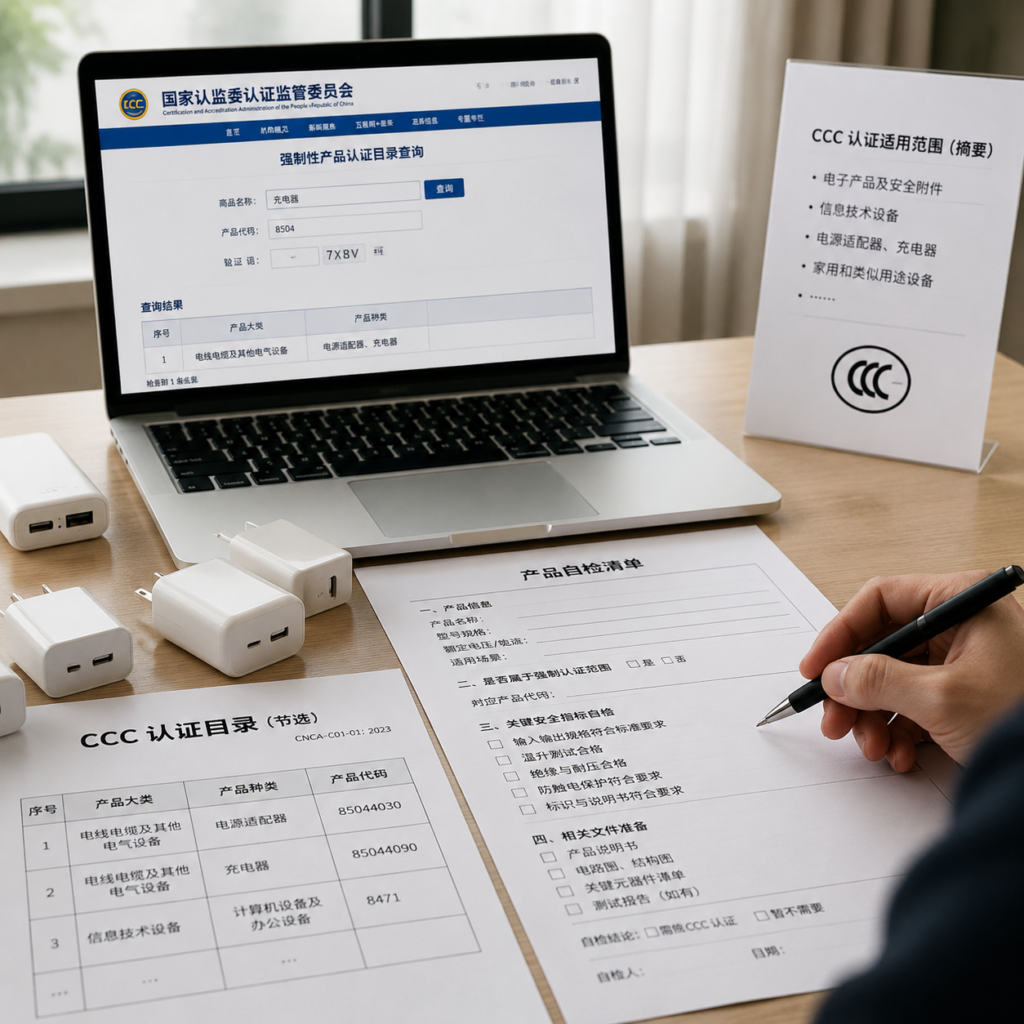
After the self-check, you can take different actions corresponding to different situations:
- If it clearly falls within the mandatory scope: prepare the technical documents of the product in advance, find a formal certification body to apply for CCC, and sell it in the Chinese market after obtaining the certificate and affixing the CCC mark.
- If it clearly does not fall within the scope: keep materials such as product parameter descriptions and purpose certificates, so that in case of regulatory spot checks, you can produce them to prove that the product is not in the catalog.
- If it is a product with ambiguous boundaries and you are not sure: don’t guess blindly. You can submit a catalog definition application to CNCA, or find a formal certification body to do a pre-assessment to avoid compliance risks caused by wrong judgment.
After mastering the official judgment basis, three-step initial screening method, boundary verification channels, and rules for different scenarios, you can preliminarily judge whether common charging products such as chargers, charging cables, plugs, and power banks require CCC, and also avoid the judgment misconceptions that overseas users most often fall into, reducing compliance risks and unnecessary certification costs.