
Most sellers of charging products for the South Korean market have heard of the terms KC and KCC — KCC here is a historical industry common name, which actually corresponds to the current RRA conformity assessment in South Korea, and there is no independent “KCC certification” name officially — but not many people can really sort out the relationship between the two: some people think KC is a “full-coverage certificate”, and pasting it means all compliance requirements are met; some people think KCC is a certification parallel to KC, and you only need to choose one of the two; others misjudge the requirements, either spending unnecessary money, having goods detained by customs upon arrival, or even having their platform stores directly removed from the shelves.
In fact, it is not complicated to understand the relationship between the two. The core follows the general logic of “first judge the product, then judge the system”: the first step is to judge whether the product is subject to KATS electrical safety control; the second step is to judge whether it is subject to RRA radio communication equipment and EMC/RF control; the third step is to refine specific rules in combination with wireless functions, set/independent sales form, and responsible subject requirements. This article starts from the actual scenarios of charging products, explains the concepts, differences, judgment methods, verification methods and pitfalls to avoid in detail, to help readers sort out the relationship between the two compliance systems.
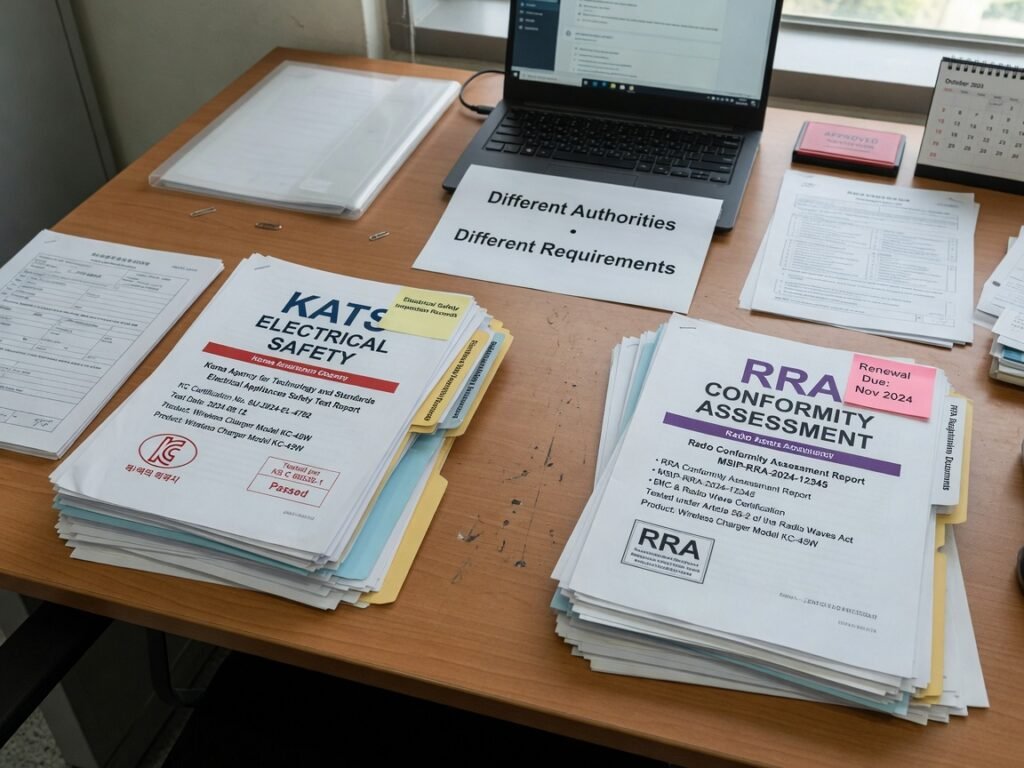
Division of Labor and Coordination Rules of the Two Systems
Competent Authorities and Regulatory Basis
KATS electrical safety assessment is based on the Act on the Safety Management of Electrical Appliances and Household Goods, is in charge of the Korea Agency for Technology and Standards (KATS), and authorizes third-party institutions to be responsible for testing and certification issuance.
RRA conformity assessment is in charge of the South Korean official radio compliance authority RRA (Radio Research Agency) in accordance with the Radio Act, which is the current formal system commonly referred to as “KCC certification” in the industry, and is uniformly referred to as RRA assessment below.
Independence and Correlation
These two sets of systems are completely independent, belong to different government departments, have different control objectives, applicable product scopes, and application processes, and have no subordinate relationship with each other. There is no such statement as “passing KC automatically passes RRA” or “RRA includes KATS safety”.
KC is the unified compliance mark of South Korea, which only corresponds to the compliance assessment of the category it belongs to, and is not a single full-coverage certificate. The correlation between the two is mainly reflected in the mark and product scope: products controlled by KATS need to be marked with the KC mark and number of the corresponding safety category; products controlled by RRA are marked with the corresponding identification code according to the category, and some products that fall within the control scope of both categories will have both the KC mark and the RRA identification code.
The core principle must be remembered: if a product is within the control scope of both systems, it must complete the assessment separately, not choose one of the two.
Optimization Method for Simultaneous Application
If your product needs to undergo both types of assessment at the same time, you don’t need to apply separately twice. Using the right method can save a lot of time and cost:
First is institution selection: prioritize authorized institutions that can undertake both types of testing at the same time. Of course, it is not mandatory to use the same laboratory, but using the same one is more convenient for communication and document reuse.
Second is document reuse: basic documents such as product schematics, BOM tables, and specifications can be used for both types of assessment as long as they meet the requirements of the institution, and there is no need to prepare two completely different sets.
Then are samples and cycles: there is no statutory unified standard for this, which entirely depends on product complexity and rectification rounds. For example, products with high power and complex structures will definitely have a longer testing cycle; if there are many rectifications in the middle, the time will also be extended.
Attention should be paid to the applicant subject: it is necessary to confirm whether a local South Korean responsible subject or agent is required according to the product category, and not all products can be applied for directly by overseas subjects.
Try to coordinate during rectification, because the rectification of the safety structure is likely to affect the results of electromagnetic compatibility (EMC) — for example, adding a metal shell to meet insulation requirements may change the electromagnetic interference situation. With simultaneous application, adjustments can be made in linkage, without waiting for the safety certificate to be obtained before modifying EMC, which would require re-opening molds and modifying the structure, wasting costs.
Finally is model derivation: if it is a product of the same series, with the same core circuit and power, only different parameters that do not affect core performance such as shell color and number of interfaces, you can apply for derivation without redoing the full set of tests; if it belongs to the KATS safety certification category, factory inspection and subsequent review requirements usually need to be considered during derivation; the derivation rules for safety confirmation or supplier conformity confirmation categories need to be confirmed according to official classification and the requirements of authorized institutions. RRA categories generally do not involve factory inspections, but model coverage still needs to meet the premise of consistent core circuits, wireless modules, and power parameters.
Core Differences Between the Two Systems
Differences in Control Objectives
The control directions of the two sets of systems are completely different: KATS electrical safety focuses on physical safety risks, such as product explosion, fire, electric leakage, insulation failure and other problems that may directly threaten personal and property safety; RRA conformity assessment focuses on electromagnetic compatibility and radio compliance risks, such as interference with WiFi or other electronic equipment during product operation, excessive radio emission, and non-compliant wireless signal parameters.
Differences in Assessment Processes and Maintenance Rules
KATS electrical safety is usually divided into three categories according to product risk level: safety certification (high risk, requiring factory inspection and regular review), safety confirmation (medium risk, testing requirements and maintenance rules adjusted according to category), and supplier conformity confirmation (low risk, mainly based on supplier self-declaration plus document verification). Different types have different application documents, testing requirements, validity periods and maintenance rules. For example, safety certification categories need to submit special documents such as temperature resistance/flame retardant certificates of insulating materials and safety specifications, and need to accept regular factory reviews; the document requirements and processes for low-risk categories are relatively simplified, and the specific details need to be confirmed according to product classification.
RRA conformity assessment is carried out around EMC/RF testing, conformity registration/certification, and identification code management, and usually does not involve factory inspections, but the specific requirements still need to be confirmed according to parameters such as the product’s wireless function, operating frequency, and output power. There is no statutory unified standard for the cycle and sample quantity of the two types of assessment, which are dynamically adjusted according to factors such as assessment type, product power, structural complexity, and rectification rounds.
Mark Presentation Rules
The KC mark must correspond to the compliance number of the system it belongs to, and cannot alone prove full compliance with multiple systems. Products controlled by KATS need to be marked with the Korean KC graphic mark of standard proportion and the corresponding safety category number; RRA category products are marked with the corresponding identification code according to the category, and new products do not need to be marked with the old version of the KCC mark.
3-Step Judgment Method for Compliance of Charging Products
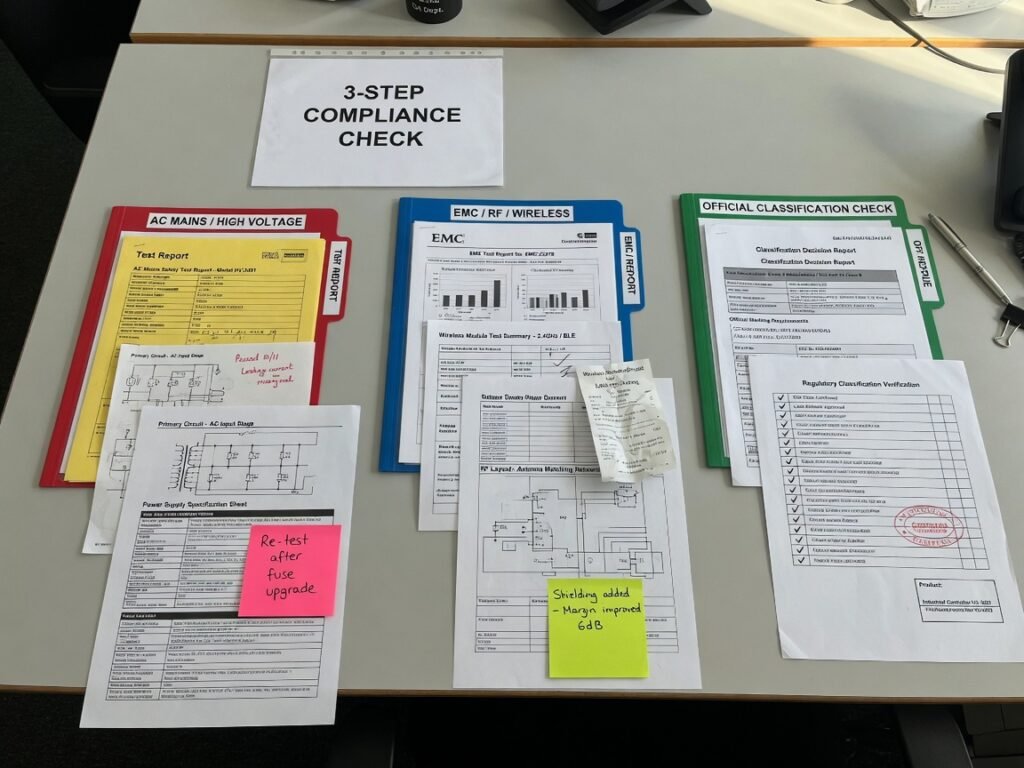
After reading the above system differences, some people may still find it complicated. It doesn’t matter. We have sorted out a 3-step preliminary screening judgment method for charging products, and most common products can be preliminarily judged by yourself first:
The first step, high-voltage risk judgment: As long as the product is connected to Korean standard AC mains power and has a high-voltage circuit inside, it needs to enter KATS safety assessment; if it is low-voltage DC input (such as cigarette lighter, external adapter power supply), usually mandatory KATS safety is not required.
The second step, electromagnetic/radio risk judgment: If the product has a switching power supply, wireless transmission function, or wireless power transmission function, it should usually enter the RRA conformity assessment judgment. The specific applicable type is subject to the official RRA classification, rated parameters, operating frequency, purpose and sales form; purely passive products (such as ordinary USB cables, passive power cords) generally do not need it.
The third step, vague scenario verification: If you are not sure, for example, the product has relatively complex functions, or belongs to a marginal classification, go to check the official classification catalogs of KATS and RRA, or find a qualified institution to do a pre-assessment, do not make arbitrary judgments.
For your convenience, we have sorted out the compliance requirements of common charging products into a quick reference table (note: this is a general judgment, and the final result shall be subject to official classification, rated parameters, and sales form):
| Common Charging Products | Is KATS Electrical Safety Assessment Required | Is RRA Conformity Assessment Required | Remarks |
|---|---|---|---|
| Ordinary wired fast charger / laptop power adapter (AC input) | Required | Required (EMC) | With switching power supply |
| Pure passive USB charging cable | Exempted | Exempted | Only for low-voltage pure conductors without active circuits; independent sales and high rated voltage require recheck |
| USB-C fast charging cable with E-Marker | Determined by sales/input form | Exempted | Only contains power negotiation chip, no active/wireless function; with other circuits requires re-assessment |
| Korean plug passive power cord assembly | Required | Exempted | Pure passive AC cable |
| Car charger (cigarette lighter input) | No mandatory requirement | With switching circuit requires assessment (EMC) | Low-voltage DC input, no AC high voltage |
| Wireless charging base powered by external adapter | No mandatory requirement | Requires assessment | The adapter is separately compliant, and the base has no high-voltage input |
| Qi wireless charger with built-in AC power supply | Required | Required (EMC/RF determined by parameters) | Contains high voltage + wireless power transmission |
| Smart wireless charger / charging station with Bluetooth/App (AC input) | Required | Required (EMC + RF) | Contains wireless communication module |
| USB-C docking station / multi-port charging station (AC input) | Required | Required (EMC) | With switching power supply / active circuit |
| Active conversion cable / USB-C adapter / low-voltage input docking station | Assessed according to input voltage, whether connected to AC mains, and sales form | EMC/RF assessment is required when there is active conversion, expansion, switching circuit or communication/wireless module | Recheck input voltage, active chip, wireless/communication module |
When does compliance need to be re-assessed?
Many people think that doing a certification once is enough for good. In fact, as long as the product or sales situation changes, it is very likely that re-assessment is required. There are mainly four types of triggering situations:
The first is function change: For example, adding a Bluetooth module to the original ordinary fast charger, or adding active conversion function to the original passive cable, all require re-assessment.
The second is structure/parameter change: For example, changing the plug specification, modifying the core circuit, or changing the rated power will affect the compliance results and require re-confirmation.
The third is sales form change: For example, the fast charger and charging cable that were originally sold separately are now sold as a set; or the accessories originally in the set are now sold separately, all require re-assessment, because the control requirements for different sales forms may be different.
The fourth is subject change: For example, OEM private labeling, changing the manufacturer, importer or local South Korean responsible subject also requires re-confirming the validity of the certificate, or making a subject change.
Compliance Mark and Certificate Verification
Whether it is a certificate applied for by yourself or provided by a supplier, you must learn to verify its validity. Otherwise, if you get a fake or invalid certificate, you won’t know why your goods are detained.
Key Points of Mark Judgment
First, three core rules must be clarified:
First, KC is the unified compliance mark of South Korea. It must be combined with the system it belongs to, the corresponding number and the official filing record to judge whether it covers KATS safety, RRA conformity or other categories of compliance; for the electrical safety compliance of chargers, it cannot be judged only by the KC graphic mark, and the corresponding KATS safety category number and filing information must also be checked; when EMC/RF compliance is involved, the RRA identification code or conformity filing record must be checked separately. The KC mark cannot alone prove full compliance with multiple systems.
Second, products subject to RRA assessment are marked with the corresponding identification code according to the category, and new products do not need to be marked with the old version of the KCC mark; if the old KCC mark is seen, the corresponding RRA identification code must be checked to confirm validity.
Third, all compliance marks must correspond to verifiable valid filing documents. Marks without corresponding information are invalid even if their style is correct.
Number Auxiliary Identification (for reference only, subject to official inquiry)
You can also preliminarily judge which type of compliance document it is through the number, but this is only for reference, and the final result must be subject to the official inquiry result:
- KATS safety category numbers usually carry KATS-recognized institution codes such as KTL, KTC, KTR;
- RRA category identification codes usually carry the words RRA or MSIP (historical format);
- If there are two types of numbers on the same product, it is very likely that both types of requirements are met, but you still need to verify in the official system.
6 Steps of Official Verification
When conducting formal verification, follow these six steps, and you will basically not make mistakes:
The first step, first confirm the assessment system and document type, whether it is a KATS safety assessment document or an RRA conformity document, and do not mix up the inquiry systems.
The second step, check the product information, such as model, version, rated parameters, which must be completely consistent with the physical product. If the model does not match, even if the certificate is real, it is useless.
The third step, check the responsible subject, manufacturer, importer, local South Korean responsible subject, which must match the declared information.
The fourth step, check key information, such as the models of key components and wireless modules, which must be consistent with the filed ones. If the core parts are replaced without filing, the certificate will be invalid.
The fifth step, confirm the status: go to the official system to check the validity period of the certificate and whether there are records of revocation or invalidation.
The sixth step, keep vouchers: save the inquiry screenshots and document records for inspection by customs or platforms.
Common Non-Compliance Signals
If you encounter the following situations, you should be careful, as they are most likely non-compliant:
- The KC mark is deformed, the color does not meet the requirements, and there is no corresponding verifiable compliance number;
- For products with switching power supply or wireless function, only KATS safety information can be found, and there is no RRA record;
- The certificate or identification code cannot be found in the official system, or the status is invalid or revoked;
- The model, parameters, and responsible subject covered by the certificate are inconsistent with the physical product, and there is no valid change certificate.
Data Requirements for Import Supervision and Platform Review
Reference Materials for Import and Market Supervision
There is no mandatory unified list of customs clearance documents in South Korea. The specific list should be adjusted according to HS code, product category, and random inspection requirements. Generally, the following need to be prepared:
Basic documents include KATS safety assessment certificate (for mandatory categories, factory inspection reports are also included), RRA conformity documents, Korean labels and instructions;
Supplementary documents include difference descriptions of same-series models, compliance certificates of key components, and test report summaries, which may be required to be provided during random inspections.
Common Materials for Cross-Border Platform Review
If you are operating on a cross-border e-commerce platform, more documents are required for review. In addition to basic compliance documents and Korean label samples, you also need to prepare subject and authorization documents, such as the business license of the South Korean importer or responsible subject, and the brand authorization chain (if there is a brand);
There are also product description documents, such as difference descriptions of same-series models, compliance certificates of set components, and product compliance self-declarations (required by some platforms).
Common Rejection Reasons for Document Review
Many people have their submitted documents rejected, mostly for the following reasons:
First, the information of the responsible subject within South Korea is missing, or the subject qualification does not meet the requirements;
Second, the information on the product nameplate and label is inconsistent with that on the compliance document;
Third, the controlled independent components in the set do not have separate compliance certificates provided;
Fourth, the compliance document has expired, been revoked, or does not cover the actually sold model and parameters.
Common Compliance Misconceptions for Charging Products
Finally, we have sorted out several most common pitfalls for charging products, and you can compare them to avoid them:
Misconceptions About Product Scope
- Do all charging products need KC + KCC? No, not all charging products need to meet both KATS safety and RRA conformity requirements. For example, pure passive low-voltage USB cables may be exempted from both categories. You must judge by category and cannot generalize.
- Only chargers with wireless function need RRA? No, ordinary switching power adapters, such as the commonly used GaN fast chargers, although they have no wireless function, because they have a switching power supply, they will generate electromagnetic interference, and also need to undergo RRA EMC assessment, which belongs to the category commonly known as KCC in the industry.
- Do USB-C/PD/E-Marker chips require RRA? No, USB-C interfaces, PD protocols, and E-Marker chips that only contain power negotiation function and have no active conversion/expansion/wireless transmission will not generate strong electromagnetic interference or wireless transmission, so they are exempted from RRA requirements; if the cable has active expansion, data conversion or wireless function, it needs to be assessed separately, and safety requirements are determined according to the sales form.
- Ordinary Qi wireless chargers only need to pass EMC and not RF? No, the operating frequency, output power, and communication method of wireless chargers will affect the RF requirements. When the output power, operating frequency, and control/communication method meet the corresponding RRA classification conditions, RF assessment is required. It must be assessed according to the rules, and you cannot take it for granted.
- Car chargers definitely do not need safety KC? No, the safety requirements of car chargers are determined according to the input voltage and product classification. Some special car products may involve safety requirements, and the final result shall be subject to official confirmation.
Misconceptions About Certificates and Compliance
- Having the KC mark means all compliance requirements are met? No, according to the mark verification logic mentioned above, KC only corresponds to the compliance assessment of the category it belongs to. If EMC/RF is involved, the RRA identification code and filing information must also be checked.
- Can overseas certifications such as CE/FCC/UL replace KC/RRA? No, the South Korean compliance system is independent, and overseas certification reports usually cannot replace formal compliance documents issued by locally authorized institutions in South Korea, and can only be used as testing references; in some customs random inspection or platform review scenarios, additional overseas reports may be required as auxiliary materials, but they cannot be used as the core basis for customs clearance or listing.
- Can products of the same series share KC certificates at will? No, if the power, core circuit, shell, or wireless module changes, it is likely to exceed the coverage of the certificate. Whether it can be shared shall be subject to the filed information, and you cannot use it casually by yourself.
- For set sales, only the main product needs certification? No, each controlled independent component in the set needs to be separately compliant and cannot share the certificate of the main product. For example, the fast charger and wireless charger in the set must have their own compliance documents.
Learning Summary: 4 Implementable Compliance Capabilities
Through the above content, 4 implementable compliance judgment capabilities can be sorted out:
First, be able to accurately distinguish core concepts: clarify that KC is the unified compliance mark of South Korea rather than a single full-coverage certificate, “KCC” is a historical industry common name, and the current formal one is RRA conformity assessment. KATS and RRA are two independent compliance systems that control different risks.
Second, be able to independently complete the preliminary classification of common charging products: use the 3-step judgment method to quickly judge whether the product needs KATS or RRA assessment, covering more than ten common charging product scenarios.
Third, be able to raise accurate institutional pre-assessment questions: when consulting an institution, prepare information such as the product’s input and output parameters, circuit characteristics, wireless functions, and sales form in advance to improve consultation efficiency and obtain more accurate quotation and cycle references.
Fourth, be able to complete basic compliance verification and document preparation: know how to identify compliance marks and numbers, can verify the validity of certificates through the official system, and are familiar with the basic document requirements for import and platform review, reducing the risk of rejection.
When the classification is unclear or involves complex scenarios such as wireless functions, set sales, and private label changes, the official classification catalog and the pre-assessment conclusion of a qualified institution shall prevail.