
Many people who are entering the South Korean market with charging products for the first time have heard of the “KC Self-Declaration” route – it is said that there is no need to wait for official certification, the process is fast and costs less, but they are also afraid that choosing the wrong path will lead to customs detention, fines, or even penalties for counterfeiting the KC mark. What exactly is KC Self-Declaration? Which charging products are eligible? Which ones must absolutely be avoided? In this article, we will thoroughly explain the scope of application, from basics to boundary judgment.
First, Understand: What Exactly is KC Self-Declaration
KC Self-Declaration is the Supplier’s Declaration of Conformity (SDoC) under South Korea’s KC electrical product compliance system. Simply put: The enterprise itself confirms that the product meets South Korean safety standards, declares compliance externally, and bears all safety responsibilities on its own.
Its core rules are formulated by the Korean Agency for Technology and Standards (KATS). Only low-risk categories clearly listed in the official catalog are eligible. The government does not review and issue certificates in advance, so the process is short and the cost is low. Conversely, once problems are found in random inspections, penalties will be more direct.
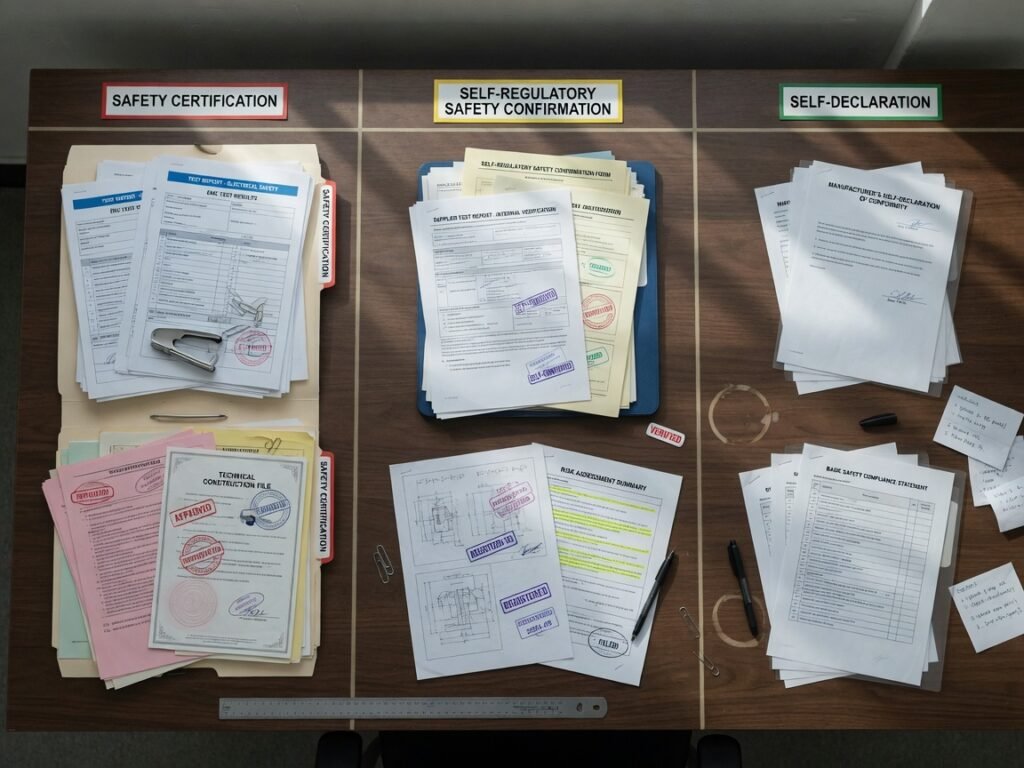
Many people easily confuse it with the other two KC compliance routes. We use charging products for a comparison, so you can tell them apart at a glance:
| Type of Compliance Route | Risk Level | Core Requirements | Examples of Charging Products |
|---|---|---|---|
| KC Safety Certification (Mandatory) | High risk | Requires review and certification by a Korean designated agency | Industrial chargers, medical power supplies |
| KC Self-Regulatory Safety Confirmation | Medium-high risk | Requires testing and registration by a Korean accredited laboratory | Power banks, some high-power fast chargers |
| KC Self-Declaration (SDoC) | Low risk | Enterprise conducts testing, declaration, and retains documents independently | Ordinary mobile phone chargers, basic USB-C charging cables |
Why is it Necessary to Understand the Scope of Application?
Charging products have many parameters and complex functions, and there are particularly many models with blurred boundaries. The cost of choosing the wrong route is not small:
- If you force self-declaration beyond the scope, the light consequence is customs detention and fines, the heavy consequence is product recall, and unauthorized use of the KC mark may even be punished as counterfeiting;
- If you are clearly eligible for self-declaration but choose a higher level of certification, you will waste 1-2 months for no reason and spend several times more on compliance costs.
Therefore, clarifying the scope of application is the first step for charging products entering the South Korean market.
Core Judgment Logic: Don’t Just Look at Power, Follow These Steps
Many people’s first reaction when judging is “my product has low power, so it must be eligible for self-declaration”, which is completely wrong. The judgment of KC Self-Declaration is based on South Korean official regulations, classification catalogs, and the latest standards, and cannot be based solely on product name or power.
KATS regularly updates the classification catalog. When making a judgment, it is necessary to combine the catalog entries with the actual functions of the product, and the latest version at the time of export shall prevail. All charging-related products will eventually be classified into four categories: mandatory certification, self-regulatory safety confirmation, self-declaration, and non-regulated (no KC compliance required).
Four Auxiliary Judgment Dimensions Exclusive to Charging Products
For charging products, you can first conduct a preliminary screening from four dimensions:
- Category and function: Whether it is an ordinary charging product, and whether it has high-risk additional functions such as battery, wireless charging, or inverter;
- Electrical parameters: Whether the input and output voltage, current, and rated power are within the range specified in the catalog;
- Usage scenario: Whether it is ordinary consumer-grade, or for special purposes such as medical, industrial, or children’s use;
- Sales form: Whether it is an independently sold finished product/accessory, or a non-detachable component supplied with the complete machine.
Don’t Reverse the Order of Judgment
The correct judgment steps must be followed in order, and you cannot focus on parameters at the very beginning:
- Step 1: First confirm whether the product is within the regulatory scope of South Korean electrical products. For example, purely mechanical accessories are not regulated;
- Step 2: Check the corresponding classification in the official catalog to confirm the basic compliance route;
- Step 3: Exclude special exceptions – for example, whether there are additional functions, special purposes, or excessive parameters. As long as one item meets the exception, the compliance level must be upgraded.
Which Charging Products Are Eligible for KC Self-Declaration?
We will explain the applicable conditions, common models, and exclusions one by one according to common charging product categories, and you can check against your own products.
Chargers/Power Adapters
Applicable conditions: Consumer-grade, used to power conventional consumer electronics, DC output meets catalog requirements, no high-risk additional functions.
Common eligible models: Ordinary mobile phone chargers, consumer-grade USB-C fast chargers, ordinary laptop power supplies, multi-port ordinary fast chargers.
Exclusions: Devices with battery energy storage, inverter, or wireless transmission functions. For example, chargers with built-in batteries are not eligible for self-declaration.
Charging Cables/Data Cables (Layered Judgment)
The judgment of charging cables is the most prone to confusion. The core is to see whether there is an active circuit inside, divided into three layers:
- Passive charging cables: Only have wires and connectors, no electronic components. Those that meet catalog requirements fall under self-declaration;
- Cables with chip identification: Only have identification chips such as E-Marker, no active power regulation or protection functions, also fall under self-declaration;
- Cables with active control/protection: With active circuits such as power regulation, overvoltage and overcurrent protection, must be classified into a higher-level compliance route.
Common eligible models: Ordinary USB-A to C cables, chip-free Micro-USB cables.
Exclusions: Smart charging cables with active power control, protection circuits, or display screens.
Charging Interfaces/Matching Plugs (Only Judged Along with the Complete Machine)
Many people ask: Do Korean standard plugs and USB female sockets on chargers need separate KC certification? In fact, these non-detachable matching components do not need separate judgment, just follow the complete machine.
Applicable conditions: As a non-detachable component of the charging product, parameters meet catalog requirements, judged according to the compliance route of the complete machine.
Common eligible models: Korean standard two-pin round plugs that come with chargers, built-in USB-A/C charging female sockets in products.
Exclusions: Independently sold power plugs and interface components. These need to be judged separately according to their own category, and cannot follow the complete machine.
Distinction of Compliance Routes for Connection Accessories
There are several other types of connection accessories that are easily confused, we will clarify them all together:
- Non-detachable plugs/interfaces with the complete machine: Judged according to the compliance route of the complete machine;
- Independently sold ordinary charging cables/data cables: Judged according to the cable layering rules mentioned above;
- Independently sold power plugs, conversion sockets, travel adapters: Most belong to higher-level compliance routes, not eligible for self-declaration;
- Power strips with USB charging ports: Those with only basic charging functions need to be checked against the catalog; those with fast charging, lightning protection, or leakage protection need to have their compliance level upgraded.
Other Low-Risk Charging Accessories
In addition to the above categories, there are two other common types of low-risk charging accessories that can also use self-declaration if they meet catalog requirements:
- Ordinary car chargers (cigarette lighter to USB/C, only with basic step-down charging function);
- USB docks with only basic charging + data transmission functions.
Red Lines to Avoid: These Charging Products Are Absolutely Not Eligible for Self-Declaration
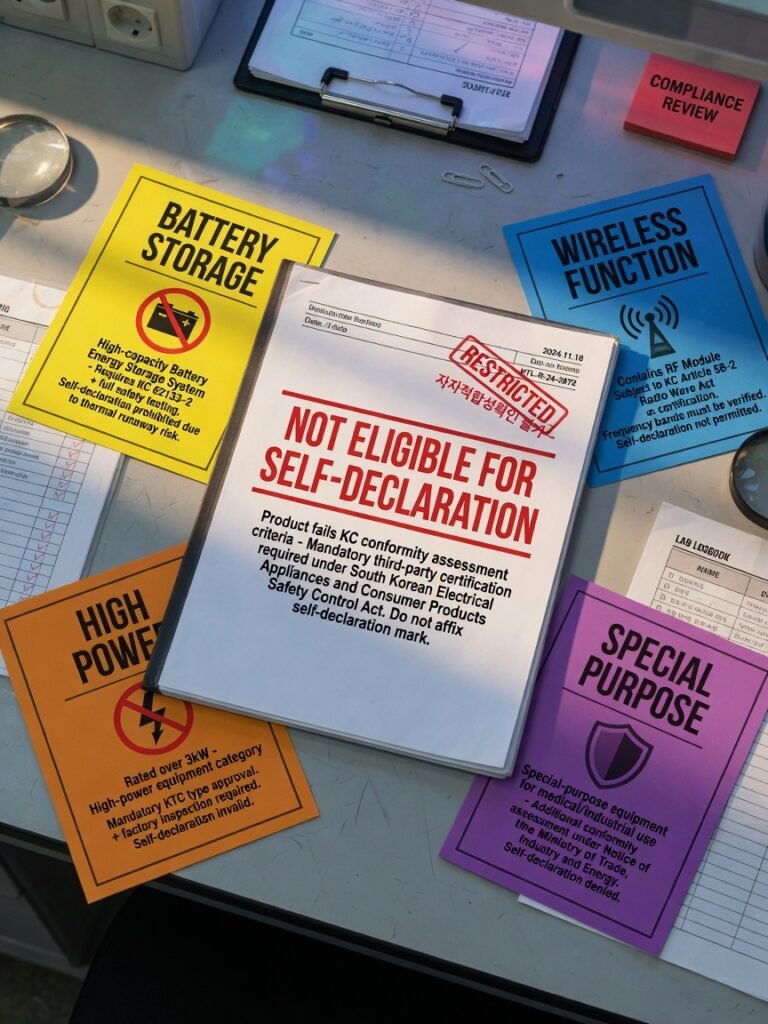
There are several types of products that are clearly not eligible for KC Self-Declaration, even if the power is very low. Do not step on these:
1. Products with Parameters Exceeding Catalog Requirements
If the electrical parameters of the product exceed the threshold of the self-declaration category in the catalog, it is not eligible, for example:
- Chargers/adapters with excessive DC output parameters;
- High-power charging devices with rated power exceeding the self-declaration threshold;
- Charging plugs/interface components with excessive rated current/voltage.
The specific thresholds shall be subject to the latest official catalog, and do not judge based on experience.
2. Special-Purpose Charging Products
As long as it is used in special scenarios, even if the appearance is the same as an ordinary charger, it cannot use self-declaration:
- Chargers/adapters for medical, industrial, and scientific research equipment;
- Children’s exclusive charging products, such as children’s watch chargers, children’s headphone charging cables;
- Charging devices for outdoor high-power work equipment.
3. Products with High-Risk Additional Functions
As long as the product has the following high-risk functions, the compliance level must be upgraded:
- With battery energy storage: Power banks, outdoor power supplies, wireless chargers with built-in batteries, most belong to self-regulatory safety confirmation;
- With strong current protection/inverter: Charging power strips with lightning protection and leakage protection, car inverters;
- With wireless transmission: Wireless charging bases, smart chargers with Bluetooth/Wi-Fi. These need to meet both electrical and radio compliance, and most of the electrical parts need to be upgraded.
4. Independently Sold High-Risk Connection Accessories
- Independently sold power plugs, conversion sockets, travel adapters, most belong to mandatory certification or self-regulatory safety confirmation;
- High-power special charging cables with active power regulation/protection circuits are not eligible for self-declaration.
How to Judge Boundary Categories? The Full Process from Data Collection to Official Inquiry
In many cases, products are not black and white. For example, fast charging cables with E-Marker, power strips with USB ports – how to accurately judge these boundary models?
Collect 7 Basic Information Before Judgment
Before making a judgment, prepare these materials first, otherwise it is easy to make a wrong judgment:
- Complete product name and multi-angle physical photos;
- Input/output voltage, current, and rated power parameters on the nameplate;
- Full list of functions, including whether there is a battery, wireless charging, Bluetooth/Wi-Fi, inverter, protection circuit, etc.;
- Core usage scenarios and target users, such as consumer use or industrial/medical/children’s use;
- Sales form, whether it is sold independently, supplied with the complete machine, or a non-detachable component;
- List of key electronic components, such as whether there is an E-Marker chip, power management chip, etc.;
- Existing compliance test reports (for reference only, cannot be used directly as a basis).
Three-Step Judgment Process for Boundary Categories
After the materials are prepared, judge according to these three steps, and you will basically not make a mistake:
- Step 1: Match the closest category in the official catalog to confirm the basic compliance route – prioritize the category, do not look at parameters first. For example, even if a wireless charger has low power, it does not belong to the category of ordinary chargers;
- Step 2: Check whether there are superimposed other regulatory requirements – for example, products with wireless functions need to pass RRA communication compliance, products with lithium batteries need to go through lithium battery self-regulatory confirmation. These requirements and electrical safety do not replace each other, and all must be met;
- Step 3: Check whether there are exceptions – such as excessive parameters, special purposes, additional high-risk functions. As long as one item meets the exception, upgrade the compliance level.
There is an auxiliary principle here: The higher the risk, the higher the compliance level; the more special the purpose, the stricter the requirements.
Judgment Rules for Common Boundary Categories
We have sorted out several boundary models that everyone asks about the most, you can refer to them directly:
- USB-C fast charging cable with E-Marker: Those only used for power identification, without active regulation/protection functions, fall under self-declaration; those with active control functions require upgraded compliance level;
- High-power multi-port fast chargers: Judged according to catalog parameters, some high-power models are classified as self-regulatory safety confirmation;
- Power strips with USB charging ports: Those with only basic charging ports need to be checked against the catalog; those with fast charging, lightning protection, or leakage protection require upgraded level;
- Complete machines with built-in power supply: Judged as a whole along with the complete machine, the adapter cannot be separated out separately for self-declaration;
- Wireless charging bases: Those with only basic functions need to be checked against the catalog; those with Bluetooth/Wi-Fi need additional RRA communication compliance, and most of the electrical parts are upgraded;
- Car chargers: Those with only basic step-down function need to be checked against the catalog; those with inverter, fast charging, or protection functions require upgraded level.
How to Check the Official Catalog?
The most accurate way is of course to check the official catalog, the steps are very simple:
- Enter the KC product classification query system on the KATS official website, which supports English product name search;
- Enter the accurate English or Korean product name, such as “USB charger” “USB-C cable”;
- Check the certification mode label of the entry:
선언적합means self-declaration,강제인증means mandatory certification,자율안전means self-regulatory confirmation; - Focus on checking the parameters, purpose, and function restrictions under the entry. Absolutely do not draw conclusions just by looking at the product name.
Impact of Relevant Regulations on Compliance
It should also be noted that KC electrical self-declaration is only the compliance requirement for electrical safety, and some products also need to meet other regulations:
- Products with wireless functions such as Bluetooth/Wi-Fi/NFC need additional KC communication compliance from RRA, which does not replace electrical safety;
- Most products with lithium batteries belong to self-regulatory safety confirmation, and are not eligible for electrical self-declaration;
- Some chargers need to meet South Korea’s standby energy efficiency standards, but this does not affect the route judgment of self-declaration, as long as both are met at the same time.
6 Common Cognitive Misconceptions to Avoid
Many people have a biased understanding of KC Self-Declaration. We have sorted out the 6 most common misconceptions to help you avoid pitfalls:
- Misconception 1: All low-power charging products can be self-declared
Wrong. Only categories listed in the official catalog are eligible. Even if the power is very low, if it is for special purposes, has a battery, or has wireless functions, it still requires a higher level of compliance. For example, both are 5V1A, but ordinary mobile phone chargers fall within the scope of self-declaration, while chargers for children’s electric toothbrushes do not. - Misconception 2: Self-declaration does not require testing, just write a statement casually
Wrong. No official review does not mean no testing is required. You need to complete testing according to the Korean safety standards and EMC/radio requirements of the corresponding category, and the test report must be retained for more than 5 years for inspection. If you cannot produce a qualified report during regulatory random inspections, you will be directly punished for non-compliance. - Misconception 3: CE/FCC/CCC reports can directly replace KC self-declaration
Wrong. South Korea does not directly recognize overseas certifications, and testing must be conducted according to local standards. However, reports that meet international standards can reduce some repeated test items, but cannot directly replace KC testing requirements. - Misconception 4: Self-declared products cannot bear the KC mark
Wrong. Eligible self-declared products can bear the KC mark, but there is no need to mark the certification body number, which is obviously different from the numbered KC mark of mandatory certification. If the KC mark is used without compliance, it will be punished as counterfeiting. - Misconception 5: Independently sold charging accessories do not need to worry about KC compliance
Wrong. Charging accessories that can be sold separately need to have their compliance route judged according to their own category. Only accessories that are supplied unopened with the complete machine and cannot be sold separately can be covered by the compliance route of the complete machine. - Misconception 6: Small-batch/samples of cross-border e-commerce are exempt from KC
Wrong. South Korean customs and mainstream e-commerce platforms will check KC compliance. Small-batch direct mail and exhibition samples are not automatically exempt. You need to confirm the latest exemption policy in advance, and only those who meet the conditions can apply for exemption.
Practical Tools for Quick Judgment: From Self-Inspection to Official Verification
If you just want to do a preliminary screening first, or are not sure who to ask for judgment, you can use the following methods.
Three-Step Quick Self-Inspection Checklist (For Preliminary Screening)
These three steps can only be used for preliminary screening and cannot be used as the final judgment basis, but they can help you quickly eliminate obviously ineligible situations:
- Category and purpose inspection: Whether it is an ordinary consumer-grade charging product, not for medical, industrial, or children’s exclusive use;
- Function and form inspection: Only with basic charging or ordinary data transmission functions, no high-risk functions such as active power regulation or protection;
- Parameter preliminary screening: Parameters are within the conventional range of common consumer-grade charging products.
If all three items are met, it is highly likely to fall within the scope of self-declaration; as long as one item does not meet, further verification is required.
Verification Channels and Priorities When Unsure
If the product is a boundary model, do not force the judgment yourself. Choose channels according to the effectiveness from high to low:
- Online consultation on KATS official website: Submit English/Korean product descriptions to apply for official reply, which has the highest effectiveness and can be directly used as a basis for compliance;
- Entrust a qualified KC agent in South Korea: Submit product materials for the agent to judge, which is fast and suitable for the preliminary evaluation stage;
- Enterprise self-judgment: For reference only. It is not recommended to rely on self-judgment for products with blurred boundaries.
Follow-up Actions for Different Judgment Results
- Confirmed eligible for self-declaration: First clarify the South Korean local responsible entity, then determine the applicable Korean standards, complete the corresponding tests, prepare technical documents, and finally complete the declaration in the official system;
- Confirmed not eligible: Submit an application according to the corresponding compliance route (self-regulatory confirmation/mandatory certification), complete testing and review, and export after obtaining the certificate or registration;
- Blurred boundary and unsure: Prioritize applying for official judgment to avoid pitfalls from self-judgment.
Re-judgment Rules After Product Changes
After the product is modified, not all situations require re-judgment:
- Re-judgment required: Output power/voltage adjustment, addition of additional functions such as wireless/battery, replacement of key safety components (such as plugs, power chips);
- No re-judgment required: Only adjust appearance color, upgrade packaging, which do not affect safety parameters and core functions, no need for re-judgment.
Final Summary
To understand the scope of application of KC Self-Declaration, the core is to first distinguish it from mandatory certification and self-regulatory safety confirmation, and know the cost of choosing the wrong route. For common products such as ordinary mobile phone chargers and basic charging cables, you can quickly judge whether they are likely to be eligible through self-inspection; when encountering boundary models with additional functions or special purposes, you should judge according to the three-step process of “first match the category, then check superimposed regulations, and finally exclude exceptions”, to avoid common cognitive misconceptions.
If you are unsure, prioritize verifying with the official or a qualified agent. Do not downgrade the compliance level on your own to save time and cost, as you will end up paying a higher price.