
Have you ever had this experience: when you plug a cheap charger into your phone, the nearby Bluetooth earphones suddenly start cutting in and out, and even the WiFi on the same network slows down? This phenomenon may be related to the electromagnetic compatibility performance of the charger, but you cannot directly conclude that the product is unqualified based on a single usage scenario. If charging products want to enter the South Korean market, electromagnetic compatibility-related requirements are part of the mandatory compliance under the KC framework, and are controlled by the suitability assessment system under the Radio Act system. Many people have heard of the folk collective term “KC certification”, but often confuse KC Safety with KC EMC (electromagnetic compatibility) requirements, and are not sure whether their chargers and charging cables need to be certified or how to do it. This article will clarify the KC EMC-related requirements for charging products from basic cognition to practical pit avoidance.
First, Understand: What Exactly Does KC EMC Regulate
KC EMC is an electromagnetic compatibility suitability assessment requirement implemented under the framework of South Korea’s Radio Act for applicable products in the current classification list of the RRA (Korea Radio Research Agency), and does not cover all electronic products. It operates under different regulations from the commonly mentioned KC Safety (Electrical Appliances Safety Assessment) — the same charger may trigger both sets of requirements, or only one of them, and cannot be simply classified as a branch of the same “KC certification”.
There are two core principles of electromagnetic compatibility (abbreviated as EMC): first, when equipment is operating, it will not emit excessive interference outward that affects the normal operation of other equipment; second, the equipment itself can withstand common external electromagnetic interference and will not easily malfunction. For charging products, EMC requirements are particularly noteworthy: because chargers and power adapters mostly use switching power supply solutions and operate at high frequencies, they themselves are prone to generating electromagnetic noise; at the same time, they are directly connected to the power grid and are susceptible to various disturbances within the grid, making them a key category under EMC control.
Don’t Confuse: KC EMC and KC Safety Are Not the Same Thing
KC Safety and KC EMC are two completely independent systems:
- Completely different regulatory directions: KC Safety is based on the Electrical Appliances Safety Act and regulates electrical risks that directly threaten personal safety, such as electric shock, fire, and insulation failure; KC EMC is based on the Radio Act and regulates mutual interference between equipment such as electromagnetic interference, which has no direct relation to personal safety.
- Mutually independent assessment systems: Not all charging accessories need to meet both sets of requirements at the same time. Whether to do it and which one to do must be judged based on product category, input parameters, and official classification, and cannot be taken for granted.
Take a common scenario: although some wall-mounted chargers have passed the KC Safety assessment, phenomena such as Bluetooth disconnection and WiFi lagging in the surrounding area during use may be related to insufficient EMC performance — such problems fall under the scope of electromagnetic compatibility control, and are two independent logics from electrical safety compliance.
Who Regulates? The Regulatory System of KC EMC
The legal basis of KC EMC is the “Broadcasting and Communication Equipment Suitability Assessment System” under South Korea’s Radio Act. The responsibilities of each participating entity are clearly divided, and the specific powers are subject to the latest official documents of the competent authority and the RRA:
- The top-level competent authority is the Ministry of Science and ICT of South Korea, responsible for formulating relevant regulations, issuing official announcements and standard project approvals;
- The core executive agency is the Korea Radio Research Agency (abbreviated as RRA), which undertakes daily management of suitability assessment, technical standard research, review and registration, technical support for supervision and investigation, etc.;
- Implementation participating entities include third-party testing/review agencies recognized by the RRA (responsible for corresponding testing or technical review), as well as manufacturers, local South Korean importers or authorized responsible entities (responsible for application submission, label implementation, change reporting, and cooperation with supervision).
All KC EMC-related rules, standards, and product classifications are subject to the latest official documents issued by the competent authority and the RRA. Before handling, the latest version must be checked to avoid judging based on outdated information.
How to Judge: Whether Your Charging Product Needs KC EMC
Many people will ask “My charger is 18W, does it need EMC?” “My cable doesn’t carry data, does it need to be done?” In fact, no single condition can directly lead to a conclusion. The core judgment logic is:
The primary basis is to see whether the product is a “suitability assessment object” stipulated by the Radio Act, with specific reference to the current product classification list issued by the RRA; power supply form (whether connected to AC mains), whether it contains active electronic circuits, and whether it is commercially sold in South Korea can only be used as auxiliary references; the final judgment must be made comprehensively based on the product’s function, interface, purpose, and sales form, not just based on power or whether it has wireless functions.
The following is a preliminary screening reference (only for risk warning, does not constitute a compliance conclusion) for charging products, and the final classification is subject to the official rules of the RRA:
| Preliminary Screening Category | Common Products | Core Verification Dimensions |
|---|---|---|
| Priority Verification Category (applicability needs to be confirmed with emphasis) | AC-DC wall chargers, laptop power adapters; multi-port charging stations, power strips with USB charging ports; wireless chargers with AC plugs | 1. Whether sold independently; 2. Whether it contains active switching circuits; 3. Input power type/rated parameters; 4. Purpose (whether it supplies power to IT/multimedia equipment); 5. Products with wireless functions need additional verification of whether they trigger KC Radio requirements; the first two categories need simultaneous verification of KC Safety applicability |
| Special Verification Category (needs to be judged in combination with circuit and sales form) | 1. USB-C cables/adapters with active switching, protocol conversion or control circuits; 2. USB-C cables with E-marker chips; 3. USB-C data cables/adapters that only contain data communication conductors but no active chips | 1. Whether it is an independently sold accessory; 2. Whether it contains active electronic circuits and the circuit type; 3. Implementation method of E-marker/data function; 4. Whether it is sold as a set with the complete machine; ordinary passive data cables are not necessarily active devices that require independent assessment |
| Category That May Not Require Independent Assessment (still needs to be confirmed by official rules) | USB-C passive charging cables without chips/data functions; passive USB-C adapters; ultra-low power pure battery-powered accessories | 1. Whether sold independently; 2. Whether it is completely free of active circuits/chips; 3. Whether the power level meets the requirements of the RRA exemption list; 4. Whether it is sold as a set with the complete machine |
| Clearly Exempt Scenarios | Small quantities carried into the country for personal use (non-commercial sale) | No need to apply for suitability assessment |
What to Test? Two Major Assessment Directions of KC EMC
The core of KC EMC testing revolves around two directions: first, the product does not emit excessive interference outward (electromagnetic emission, abbreviated as EMI); second, the product can withstand common external electromagnetic interference (electromagnetic immunity, abbreviated as EMS).
Note: The following are all examples of general EMC items that may be involved in charging products. Whether to test, test ports, level limits, and performance criteria are all determined by the applicable KN standards and product classification, and are not mandatory for all products.
Electromagnetic Emission (EMI): Don’t “Cause Trouble” for Surrounding Equipment
The core requirement of this type of testing is: the electromagnetic energy leaked outward by the product during operation must meet the limit requirements, and must not interfere with the normal operation of surrounding electronic equipment.
There are three common reference items:
- Conducted Emission: The electromagnetic noise generated by the product “runs” into the power grid along the power line, interfering with other equipment on the same power strip. For example, if a wired speaker next to a charger makes a buzzing noise after the charger is plugged in, it may be related to excessive conducted emission, which needs to be confirmed through standard testing.
- Radiated Emission: Electromagnetic noise spreads outward through the air, interfering with nearby wireless devices. For example, phenomena such as Bluetooth earphone disconnection, slow WiFi speed, and radio static around the charger may be related to excessive radiated emission, and the final result shall be based on test data.
- Harmonic Current/Voltage Flicker: Harmonic current is the “clutter current” that the product inputs into the power grid, which may affect other equipment in the grid; voltage flicker may cause lights to flicker on and off. Whether these two items need to be tested shall be determined based on the product’s rated input current, category, and corresponding KN standards, and not all chargers need to be assessed.
There are many factors that affect EMI test results: the operating frequency of the switching power supply, the design of the internal filter circuit, the shielding of the matching charging cable, the shielding design of the interface, etc., will directly affect the test data. The port connection, load status, and limit requirements of all tests shall be subject to the corresponding KN standards, and test conditions cannot be adjusted without authorization.
Electromagnetic Immunity (EMS): You Must Also “Withstand Interference”
The core requirement of this type of testing is: when the product encounters common external electromagnetic interference, it must not be damaged, nor must it have serious functional abnormalities.
Common reference items all correspond to scenarios encountered in daily life:
- Electrostatic Discharge Immunity (ESD): Simulates the scenario where a person’s hand with static electricity touches the charging interface in winter, to assess whether the product will suddenly stop charging, crash, or even be damaged.
- Radiated Radio Frequency Immunity: Simulates the radio frequency radiation scenario where there are mobile phones making calls and WiFi routers working nearby, to assess whether the charger will jump in power or suddenly disconnect.
- Conducted Radio Frequency Immunity: Injects specified radio frequency interference signals through applicable cable ports such as power supply and signal ports, simulates continuous radio frequency interference coupled by cables, to assess whether the charger has unstable output or abnormal fast charging protocol.
- Electrical Fast Transient/Burst Immunity (EFT): Simulates the fast burst interference generated by the switching of high-power electrical appliances (such as air conditioners, hair dryers) and relay actions in the same power grid loop, to assess whether the charger will restart or have abnormal output voltage.
- Surge (Shock) Immunity: Simulates the instantaneous high-voltage shock caused by lightning induction and power grid switching operations, to assess whether the charger will be damaged and whether it can work normally after the shock.
- Voltage Dip/Short Interruption: Simulates the short-term voltage drop or complete interruption caused by power grid tripping and large-capacity equipment startup, to assess whether the charger will stop charging and whether it can automatically return to normal working state after the voltage is restored.
The qualification judgment shall be based on the performance criteria of the corresponding items in the applicable KN standards, and the allowable ranges vary for different products and different test items. In the industry, it is usually divided into three categories according to the degree of performance impact (specifically subject to the standard clauses): Category A requires that the function is completely normal during and after the test, without any performance degradation; Category B allows temporary performance degradation or functional abnormality during the test, which can automatically recover after the test without user intervention; Category C allows temporary functional failure during the test, which can be restored by simple user operations (such as re-plugging) after the test.
For most chargers without display functions, persistent charging interruptions that cannot be automatically recovered, abnormal output voltage/power, failure of protection functions, and long-term failure of fast charging protocols to work normally are performance abnormalities that require key analysis, but should not be directly equated with inevitable unqualifiedness — the final conclusion must be judged based on the specific standard clauses cited in the test report, and short-term, automatically recoverable functional fluctuations are not necessarily equivalent to unqualifiedness.
Don’t Ignore: The Impact of Charging Cables and USB-C Interfaces
Many people think that EMC is only a matter of the charger itself, but in fact, the design of the charging cable and USB-C interface, together with the overall layout, port protection, current return path, etc., will affect the final EMC performance.
First of all, it must be clear: the matching charging cable will directly affect the EMC test result of the whole machine, but this does not mean that the cable itself must be separately registered for KC EMC. If the cable has active switching/protocol conversion circuits, E-marker chips, or only has passive data transmission functions, whether independent suitability assessment is required still needs to be comprehensively judged in combination with RRA classification rules and sales form (independent sale/sold with the machine): ordinary passive USB-C data cables (containing data conductors but no active chips) are not necessarily active devices that require independent assessment, and are usually tested together with the whole machine when sold as accessories of the whole machine.
The design of the USB-C interface also affects EMC performance: if the interface shielding layer has poor contact and the functional grounding design is imperfect, it will not only reduce the anti-interference ability of the product, but also increase the risk of electrostatic breakdown. It should be noted here that what is mentioned here is functional/shielding grounding, not all charging interfaces require three-pin protective grounding, so don’t confuse them.
As for the shielding layer of the cable, a charging cable without a shielding layer may act as a coupling path for electromagnetic radiation (similar to the function of an antenna), increasing the possibility of excessive radiated emission, but whether it exceeds the standard ultimately needs to be verified through testing in combination with factors such as the overall circuit design, interface shielding effect, and working mode, and cannot be directly judged only by whether the cable has shielding.
Pay Attention to South Korea’s Local Unique Rules
Although KC EMC refers to the internationally accepted EMC standard framework, as a local South Korean regulation, it has its own exclusive rule requirements, and the experience of other regions cannot be directly applied.
How to Check the Applicable KN Standards
South Korea’s EMC-related technical standards are prefixed with “KN”. KN 32 (electromagnetic emission direction) and KN 35 (electromagnetic immunity direction) are only used as references for emission and immunity standards that may be involved in charging IT/multimedia equipment. The specific applicable KN standard, version number, limit requirements, and South Korean local deviations must be determined by the RRA product classification conclusion, the actual function of the equipment, and the current technical standard documents, and cannot be directly applied only based on the product appearance or power.
The correct process for verifying standards is: first confirm the product category through RRA classification, then find the applicable KN standard, version number and test requirements accordingly, and finally check whether there are special local requirements or transitional arrangements in South Korea to avoid invalid assessment due to wrong standards. If you want to confirm the latest version of the standard and its relationship with the corresponding international standard, you can log in to the RRA official bulletin board to query.
Common Paths for Suitability Assessment
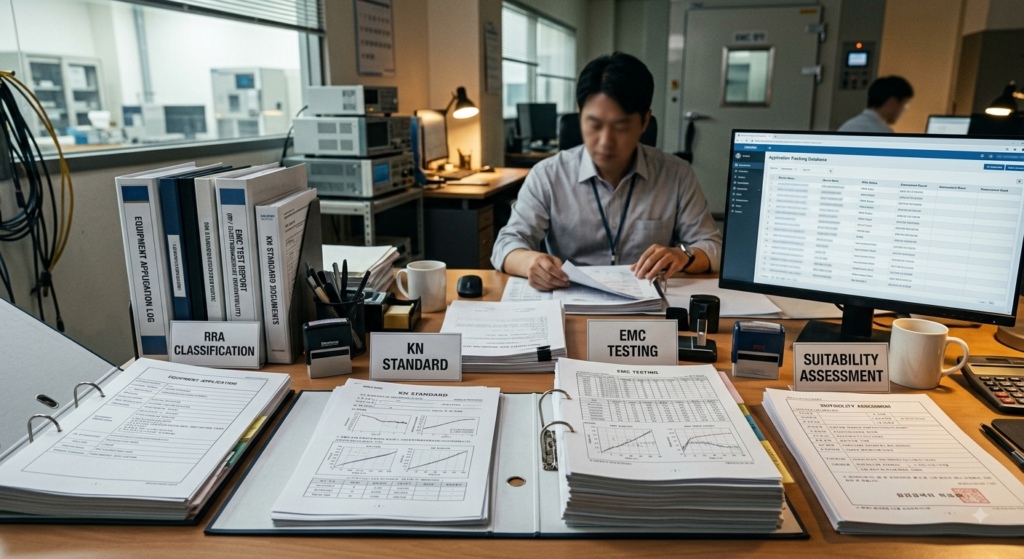
Many people say “apply for KC EMC certification”, but in fact the accurate term is “broadcasting and communication equipment suitability assessment registration” — this is the mandatory review and registration process for the electromagnetic compatibility of applicable products by the South Korean government, and it is not enough to just find a laboratory for testing. There are differences in the applicant entity, test requirements, and review methods for different assessment paths, and the specific implementation shall be in accordance with the current rules of the RRA:
- Conformity Registration: This is the path applicable to most ordinary charging products. It does not require factory inspection, and the process is relatively simple. The applicant entity is usually a local South Korean importer or authorized representative, who needs to submit test reports and technical materials that meet the requirements.
- Conformity Certification: Applicable to some special categories of products, with stricter requirements, which may involve factory inspection, and the review process is more complicated.
- Other Types: Such as temporary certification, exemption from assessment, etc. The specific applicable conditions are subject to the classification requirements of the RRA.
Which path to take specifically shall be determined according to the product’s function, power, and the current classification of the RRA. It is not that products with wireless functions must take a stricter path.
Labeling and Official Verification Methods
Products that have passed the suitability assessment shall be marked with relevant information in accordance with the corresponding assessment type and the current labeling rules of the RRA. The content, location, identification code format, and whether electronic labeling is allowed vary depending on the product category and assessment type, and some exempt categories may not require labeling.
The correct order for verifying compliance is:
- First confirm whether the product belongs to the category that requires EMC identification code labeling;
- Then check the labeling elements: usually including the KC mark, the identification code of the corresponding category (some categories are R-R format numbers), product model, etc., and all labeling information must be completely consistent with the registered content in the RRA database.
There are two common labeling misunderstandings to note here: first, if the product category requires an identification code but only the KC mark is printed without the identification code, it is non-compliant; second, the KC Safety certification number cannot be used to replace the EMC identification information, as the two are completely independent systems.
If you want to verify the authenticity of compliance, you can log in to the RRA public database, enter the identification code on the product, and focus on checking the corresponding relationship between the registration status, model, manufacturer, local South Korean responsible entity and the identification code, to confirm whether there is revocation, change or scope of application restriction. The product labeling, minimum sales packaging information and database registration content must be consistent, and compliance cannot be judged based on only one item of information.
Practical Operation: The Full Process of KC EMC Handling
If you are sure that your product needs to apply for KC EMC-related registration, the whole process can be divided into three steps: preliminary preparation, testing and application, and post-registration management.
Step 1: Make Sufficient Preliminary Preparations
The more sufficient the preparation work before handling, the less trouble there will be for rectification and re-testing later:
- Sort out complete product information: including input and output parameters, interface type, whether it supports PD fast charging, whether it has data/wireless functions, matching accessory list, and sales form (independent sale/set sale).
- Confirm the assessment type and path: you can consult an RRA-recognized institution, or directly refer to the official classification to clarify which assessment path and applicant entity requirements apply to your product.
- Clarify the responsible entity: confirm the responsible entity within South Korea in accordance with the current rules of the RRA. Usually, a local South Korean importer or authorized representative shall bear relevant responsibilities such as submitting materials, cooperating with supervision, and reporting changes. The specific requirements may vary depending on the assessment path.
- Prepare qualified test samples: they must be finished products in mass production state, with all cables and accessories sold together. Samples that are specially optimized only for passing the test and are inconsistent with the mass production state shall not be used. Otherwise, even if the test is passed, there will still be problems in mass production spot checks.
Step 2: Testing and Application
After preparation, you can enter the testing and application stage. Special attention should be paid to the configuration of the submitted samples, which must be completely consistent with the mass production state:
- Input conditions: must cover the rated input voltage and frequency range of the product;
- Output status: must cover all working states such as maximum output power, various fast charging protocol combinations, no-load/light-load/full-load/multi-port simultaneous output, especially for multi-port chargers, noise is easy to superimpose when multiple ports output simultaneously, which is the focus of testing;
- Matching accessories: the model, length, whether with shielding of the cable, the configuration of the communication port, the version of the wireless function, and the firmware version must all be consistent with mass production, and cannot be replaced at will.
After confirming the configuration, according to the applicable assessment path, a testing institution that meets the requirements of the current RRA rules shall complete the required project tests in accordance with the corresponding KN standards and issue a compliance report. Whether existing overseas EMC test reports can be partially accepted shall be verified by an institution that meets South Korean rules on laboratory qualifications, standard versions, test configurations, report formats and project coverage, and re-testing or redoing shall be carried out if necessary.
After passing the test, the qualified applicant entity shall sort out a full set of materials such as test reports, product technical documents, and responsible entity information, and submit the suitability assessment application in accordance with the process stipulated by the RRA. If the review fails, the applicant shall adjust the product according to the rectification opinions feedbacked by the official, then re-test, and then re-submit the application.
Step 3: It’s Not All Smooth Sailing After Registration
After the review is passed, the suitability assessment registration is completed, and the certificate shall be subject to the official issuance of the RRA. Subsequent change management and mass production consistency are very important, otherwise you may face regulatory penalties if caught in market spot checks.
Subsequent product changes need to be evaluated for handling methods in combination with the impact of the change on EMC performance, registration type, and against the current RRA change management rules. The following is the risk classification (only for preliminary reference, does not constitute a regulatory conclusion) of common change scenarios:
- High-impact changes (need to submit change assessment with emphasis, may trigger re-assessment/registration): Replacement of power chips, magnetic components (such as transformers), core components of filter circuits, PCB versions, housing shielding structures, or changes in production sites, etc. Such changes may directly change the core EMC performance, and it is necessary to actively assess whether the assessment needs to be re-submitted.
- Medium-impact changes (may require re-testing or data review): Replacement of matching charging cables, adjustment of interface structure, update of firmware or PD protocol version, etc. Such changes may affect the results of some EMC items, and it is necessary to assess whether relevant items need to be re-tested or technical materials need to be submitted for review.
- Low-impact changes (usually low impact, need to keep assessment records): Replacement of non-critical components, adjustment of non-structural parts of the appearance (such as label color, silk screen content), etc. Such changes generally do not affect EMC performance, but you need to keep change assessment records by yourself for supervision spot checks.
The final handling method of all changes must be confirmed based on the registration type, the scope of the original test report, and the current RRA change rules. Special attention should be paid: products sold in batches must be consistent with the test samples and registration materials. It is absolutely forbidden to replace filter components or replace shielded cables with unshielded cables without authorization in order to reduce costs.
Pitfall Avoidance: Don’t Make These Common Mistakes
Most of the pitfalls of KC EMC come from cognitive deviations. We have sorted out the most common types of misunderstandings to help you reduce compliance risks.
KC EMC and CE/FCC EMC Cannot Be Directly Substituted
Many cross-border merchants will ask: I already have a CE or FCC EMC report, can I use it directly for KC? The answer is that CE/FCC EMC reports cannot automatically replace South Korea’s suitability assessment registration, nor can they be directly used as EMC compliance certificates for products sold in South Korea. The three belong to independent regulatory systems of different countries/regions, and the core differences are:
- Different regulatory systems: KC is a mandatory requirement in South Korea, CE is for the European Union, and FCC is for the United States. Compliance requirements and registration processes are independent of each other.
- Differences in standards: Although KN standards are formulated with reference to international standards, there may be local South Korean adjustments in scope, version, and national deviations, which are not completely consistent with the standards applicable to CE and FCC.
- Different certification logic: KC EMC needs to be reviewed and registered by the South Korean official or designated agency, while most categories of the EMC part of CE can be self-declared by the manufacturer, and FCC also has a Supplier’s Declaration of Conformity (SDoC) path, with different review requirements.
For charging products, whether existing CE/FCC EMC test data can be partially accepted must ultimately be reviewed by a South Korean recognized institution, and in most cases, supplementary testing or adjustment of the report format is required.
The Most Common Reasons for Unqualified Charging Products
The common reasons for unqualified EMC testing of charging products are as follows, which can be paid attention to in advance during design and product selection:
- Excessive conducted emission: mostly due to insufficient design of the filter circuit of the switching power supply, saving necessary filter components.
- Excessive radiated emission: common reasons are that the matching cable has no shielding layer, poor USB interface shielding, and unreasonable internal circuit board layout.
- Unqualified electrostatic discharge immunity: common reason is that the USB-C interface is not equipped with sufficient electrostatic protection devices.
- Exclusive problem of multi-port chargers: when multiple ports output simultaneously, the noise of each port is superimposed, which easily leads to excessive emission. This is also the main reason why multi-port chargers are more difficult to pass than single-port chargers.
Don’t Believe These Wrong Judgments
There are many wrong statements about KC EMC on the Internet. The following are clarified one by one, with official verification methods for checking:
- Wrong: Only products with WiFi/Bluetooth need EMC
Correct: Ordinary switching power supply products, if they are in the RRA classification list, need to meet the requirements even if they have no wireless function
Verification method: Check the product classification list officially released by the RRA - Wrong: Low power will definitely be exempt from EMC
Correct: Power is only one of the reference items. Whether to do it or not needs to be judged in combination with product function, sales form and RRA classification
Verification method: Check the exemption list officially released by the RRA - Wrong: KC Safety certificate can replace EMC compliance
Correct: The two are completely independent systems with different regulatory directions. It is necessary to judge whether they are needed separately according to product categories, and they cannot replace each other
Verification method: Check the KC Safety label and EMC identification code on the product respectively. The number formats of the two are completely different - Wrong: USB-C cables with E-marker or data transmission function must be separately evaluated for EMC
Correct: Whether independent assessment is required, first of all, it is necessary to confirm whether the product is an applicable object in the RRA classification list, and at the same time judge in combination with the circuit type and sales form: cables with active switching, protocol conversion or control circuits need to be verified with emphasis; cables with E-marker chips need to be confirmed in accordance with the corresponding classification rules of the RRA; passive USB-C data cables that only contain data conductors are not necessarily active devices, and those sold as accessories of the whole machine can usually be evaluated together with the whole machine without separate registration
Verification method: Check the cable classification rules issued by the RRA - Wrong: Mass production can start after the optimized sample passes the test
Correct: Products sold in mass production must be completely consistent with the test samples, otherwise they will be punished if caught in market spot checks
Verification method: Check whether the mass production Bill of Materials (BOM) is consistent with the BOM of the test sample - Wrong: CE/FCC EMC reports can be directly used as KC certificates
Correct: The South Korean government does not directly use EMC reports from other regions as compliance certificates. Whether existing test data can be partially accepted needs to be verified by a South Korean recognized institution on laboratory qualifications, standard versions, test configurations, report formats and project coverage. If necessary, re-testing or redoing is required
Verification method: Consult an RRA-recognized institution
Risk Estimation of EMC Passing Difficulty
These risk characteristics are only used for risk estimation in preliminary product selection or design, and do not constitute formal regulatory conclusions. The final pass or fail shall be subject to the officially recognized test results:
High-risk factors (relatively higher probability of exceeding standards and requiring rectification):
- Products with higher power and complex working modes have greater difficulty in switching power supply design, load combination coverage and test verification;
- The matching charging cable has no shielding layer, so the possibility of excessive radiated emission is higher;
- Multi-port output, with PD fast charging, with data function, many working modes, complex assessment items, high probability of problems;
- Brand-new private mold solutions, which have not been extensively verified, have a high probability of rectification;
- Compact internal layout and poor shielding structure make it easy for interference to leak out and have weak immunity.
Low-risk factors (help to reduce the probability of rectification, but cannot be used to predict the final pass result):
- Adopting a mature public mold solution, which has been extensively verified by the market;
- Matching charging cable with shielding layer;
- Filtering rectification margins are reserved during design, such as leaving more positions for filter components.
How to Check: Quickly Verify EMC Compliance
Whether you are an ordinary buyer buying products or a merchant verifying before procurement, you can use the corresponding methods to quickly judge whether it is compliant.
Quick Verification Method for Ordinary Buyers/Procurement
- Check the label: First confirm whether the product category requires EMC identification code labeling. If required, there must be a KC mark and corresponding identification code that meet the rules, and KC Safety numbers shall not be used to impersonate.
- Check the official website: Log in to the RRA official query system, enter the identification code, check whether the registration status, model, manufacturer, and responsible entity correspond, and confirm that there is no revocation, change or scope of application restriction.
- Verify the model: The actually purchased model must be completely consistent with the registered model. If it is a series model, confirm that the model is within the registered scope, and do not confuse one with another.
Merchant Pre-launch Compliance Self-check List
If your product is going to be launched in South Korea, you can self-check according to these four core requirements before launch, covering the whole process compliance from classification to mass production:
- Classification judgment compliance: It has been confirmed that the product is an applicable object against the current RRA classification list, the assessment type matches the product classification, and no blind judgment is made based solely on power, appearance or wireless function.
- Registration process compliance: Testing has been completed in accordance with applicable KN standards, and RRA suitability assessment registration has been passed. The applicant entity and path meet the requirements, and reports from other regions are not directly used as substitutes.
- Mass production status compliance: Product parameters, functions, and matching accessories are completely consistent with the registered application information, and labels, identification codes, and South Korean responsible person information are posted in accordance with RRA rules.
- Change management compliance: Changes to key components, structures, and firmware have corresponding assessment records, and those requiring re-testing or re-registration have been completed in accordance with the rules.
For ordinary users, learning to verify through labels and the RRA official database can avoid most low-quality charging products with insufficient EMC performance and reduce interference problems during use; for practitioners, grasping the four core links of classification judgment, standard registration, mass production consistency, and change management can effectively control the compliance risk of KC EMC.