
If you are in the business of chargers, charging cables, or power adapters for the U.S. market, you have most likely heard of the FTC. However, many sellers confuse it with certification or regulatory bodies such as the FCC and UL, and even believe that “having certifications means everything is fine.” They only realize the importance of FTC compliance when they receive an investigation notice due to claims like “fully compatible fast charging” on product detail pages or issues with country-of-origin labels.
This article starts from basic concepts, sorts out the boundaries of FTC responsibilities, core compliance requirements, common risk points, and self-inspection methods for importers of charging products, covering the entire process from procurement to daily operation. It is suitable for reference by new sellers who have just entered the industry and merchants with existing products on sale.
I. Basic Cognition: What the FTC Is, and Who Bears Responsibility
Many people’s impression of the FTC stays at “a U.S. regulatory agency”, but they are often vague about what it specifically regulates and who it holds accountable. Let’s first clarify the core boundaries.
1.1 Core Positioning of the FTC
The full name of the FTC is the Federal Trade Commission. You can think of it as the official U.S. agency specifically responsible for overseeing “whether merchants deceive consumers”. Its core regulatory scope covers three categories: whether label content is truthful, whether advertising and promotion are exaggerated, and whether transactions are fair.
A common misunderstanding needs to be clarified first: the FTC does not directly regulate product safety itself, nor does it oversee electromagnetic compatibility—these are the responsibilities of other agencies. Charging products have a relatively higher risk of false advertising due to more consumer complaints about issues such as falsely marked power, mismatched compatibility, and untrue certification claims, making them a category where sellers need to focus on FTC compliance.
1.2 Criteria for Determining the Subject of Responsibility
It is not only large importers with registered U.S. companies that are liable, but not all entities involved in importation are necessarily liable either. The FTC makes a comprehensive judgment based on factors such as ownership of goods, import declaration identity, control over label/promotion content, and sales name. Common subjects of responsibility include:
- Companies or individuals that handle importation in their own name and sell in the U.S. market
- U.S. domestic brand owners that control product labels, sales pages, and brands
- Cross-border e-commerce sellers that make commitments regarding product promotion and quality
- DDP (Delivered Duty Paid) suppliers that actually control the sales link
Conversely, if freight forwarders and customs brokers only provide logistics and customs clearance agency services and do not participate in product design, label production, promotion, or sales pricing, they usually do not bear responsibility for promotion and label compliance under the FTC framework; individuals who purchase a small number of charging products for personal use are also not regulated by the FTC’s commercial advertising rules.
1.3 Division of Responsibilities with Other U.S. Regulatory Agencies
There are many regulatory agencies to coordinate with when doing business in the U.S. market, and many people easily confuse their respective responsibilities. We have sorted them out clearly in a table combined with the actual scenarios of charging products:
| Regulatory Agency | Scope of Application and Core Responsibilities for Charging Products | Division of Responsibilities with the FTC |
|---|---|---|
| FCC (Federal Communications Commission) | Applies to charging products with digital circuits, radio frequency, or wireless functions (such as chargers with wireless charging), and oversees compliance with radio frequency and electromagnetic interference requirements | Independent regulation, not mutually substitutable: passing FCC certification does not mean meeting FTC promotion requirements, and vice versa |
| CPSC (Consumer Product Safety Commission) | Oversees safety risks of charging products (such as fire, electric shock, injuries caused by overheating, etc.) | Joint enforcement for safety issues: for example, if a product both falsely advertises safety performance and has an actual fire risk, the two agencies will conduct a joint investigation |
| CBP (U.S. Customs and Border Protection) | Oversees durable country-of-origin marking and the authenticity of declaration information during the import customs clearance process | Each manages a separate segment: CBP oversees whether country-of-origin marking during customs clearance meets import requirements, while the FTC oversees whether country of origin is used to mislead consumers in sales promotion |
| DOE (Department of Energy) | Applies to external power products that meet its definition (such as most AC-DC chargers and power adapters; charging cables are usually not included), and oversees energy efficiency limits (such as standby power consumption, average operating efficiency) | Linked regulation: the DOE oversees whether energy efficiency meets standards, while the FTC oversees whether energy efficiency promotion and energy efficiency labels are truthful |
1.4 Core Logic of Bearing Responsibility
The first reaction of many sellers when investigated is “this is the factory’s problem, I just sell the goods”, but the FTC does not accept this logic.
The core criterion for judgment is: whether you have control over the commercial sales, label content, and promotional statements of the product after it enters the U.S. market. As the core commercial responsible entity for products entering the U.S. market, importers directly bear responsibility for violations, and cannot use materials provided by factories or the dropshipping model as an excuse to shift blame. Even if you only do private labeling, distribution, or even reselling of existing listings, as long as you control the label or promotion content, you are responsible for the corresponding false advertising.
II. Core Responsibility 1: Physical Label Compliance
The physical labels of charging products are regulated by multiple agencies at the same time. Among them, the FTC focuses on the truthfulness of label content to avoid misleading consumers; some labeling requirements come from CBP, DOE, or industry standards, which sellers need to implement together.
2.1 Three Types of Core Labeling Information
Mandatory labeling requirements vary for different products. The following are three types of information that charging products need to focus on to avoid FTC misleading risks and meet common regulatory requirements. Not all products are subject to unified federal mandatory obligations, and the specific situation needs to be confirmed in combination with product categories and applicable regulations:
- Country-of-origin labeling: The country of origin must be clearly marked, and the marking must be durable. It cannot be printed on easily tearable protective films or hang tags, and must not fall off during normal use.
- Responsible party information: Some federal regulations, state laws, or e-commerce platforms require the name and contact address of the importer, distributor, or manufacturer within the U.S. to be marked for consumer contact or complaints; it is recommended to avoid filling in freight forwarder addresses, virtual addresses, or unreachable addresses, otherwise it is more likely to be deemed as failing to fulfill the obligation of informing in the event of complaints or investigations.
- Performance parameter labeling: This is the part where the FTC focuses on truthfulness, and labeling requirements for different products have different emphases:
- Chargers/power adapters: Input and output parameters must be truthfully marked; for multi-port products, the maximum output power per single port and the total output power must be marked at the same time. It is not allowed to only mark the highest single-port power to make consumers think that all ports can reach peak power when used simultaneously.
- Charging cables/USB-C cables: The maximum carrying current/power and supported charging protocols (such as PD3.0, QC5, etc.) must be truthfully marked. It is not allowed to only mark “fast charging cable” without specific parameters to avoid misleading.
- Bundle products (such as charger + charging cable): The parameters of the charger and the cable must be marked separately and cannot be confused. For example, it is not allowed to only mark 65W on the bundle without indicating whether the cable supports 65W.
2.2 Requirements for Label Position and Clarity
- Product body: Key information (such as output parameters, country of origin) should be printed in a position visible during normal use, and cannot be blocked by prongs or interfaces.
- Packaging/manual supplement: If the product is too small (such as short charging cables, adapters) to print all information on the body, it needs to be fully marked on the packaging and manual, but the body must at least retain the most core parameters or country-of-origin marking (specifically subject to applicable regulatory requirements).
- Clarity requirements: Ordinary consumers can see clearly without the help of tools such as magnifying glasses. Markings with too small fonts or that are easily erasable may not only fail to meet the requirements of agencies such as CBP, but may also be deemed by the FTC as deliberately concealing information, constituting misleading.
2.3 Dual Regulatory Requirements for Country-of-Origin Labels
Country-of-origin labels are regulated by both CBP and the FTC, and the two have different focuses:
- CBP requirements: Imported products must be durably marked with the country of origin for compliance verification during the customs clearance process.
- FTC requirements: Expressions such as “American brand” and “designed in the USA” shall not be used to obscure the country of origin, making consumers mistakenly believe that the product is made in the USA.
Common violations include: pasting the country-of-origin label on a protective film or easily tearable hang tag, so that consumers cannot see the origin after tearing off the protective film; or using large font to mark “American brand” and small font to mark the actual country of origin, deliberately misleading consumers.
2.4 Boundaries for the Use of Safety Certification Marks
Marks such as UL, ETL, FCC, and USB-IF only represent that the product meets the relevant requirements of the corresponding standards, and their effects cannot be exaggerated. For example, it cannot be said that “having UL certification = absolute safety” or “FCC certification = high quality”.
Before using a certification mark, it is necessary to confirm that the certification is real and valid, and that the model and hardware version on the certification certificate are completely consistent with the actually sold product. You cannot use certifications for other models to make up the number, nor can you present certification of a single component (such as a UL-certified capacitor in a charger) as certification of the entire product.
III. Core Responsibility 2: Commercial Promotion Compliance
The FTC applies the basic principles of “truthfulness, verifiable basis, and no misleading” to all consumer-facing commercial promotion content. Whether it is physical labels, packaging, online pages, or influencer promotion, they must meet this requirement. However, the specific rules and proof standards applicable to different types of promotion are slightly different (for example, influencer promotion requires additional disclosure of interest relationships).
3.1 Scope of Promotion Covered by Regulation
Whether online or offline, as long as the content is used by you to promote products, it falls within the regulatory scope:
- Online: Titles, main images, and detail pages on e-commerce platforms, independent website content, social media posts, and influencer promotion content—among them, paid promotion and free product testing influencer content require clear disclosure of interest relationships, otherwise it constitutes misleading.
- Offline: Packaging, manuals, posters, and oral scripts of sales personnel—the parameters and promotional slogans on packaging need to be truthful and verifiable, just like online pages.
3.2 High-Frequency Violation 1: Power and Fast Charging Promotion
Charging products are most likely to run into trouble with power and fast charging. Common violations include: falsely marked protocols (clearly not supporting PD fast charging but marked as supported), falsely marked power (marking instantaneous peak power as daily continuous output power), and falsely marked data transmission capability (USB-C port only supports USB 2.0 data rate but promoted as USB 3.2).
To be compliant, three requirements must be met:
- All statements related to charging speed such as “fast charging” and “fully charged in XX minutes” must be marked with test conditions: including the model of the test device, initial battery capacity, specifications of the matching cable, ambient temperature, etc. A vague speed number alone is not allowed.
- Multi-port products must clearly state the peak power per single port and the power distribution rule when multiple ports are used simultaneously. It is not allowed to only mark the highest single-port power, making consumers mistakenly believe that all ports can reach peak power when working at the same time.
- A clear prompt must be provided: the maximum output power does not mean that all devices can reach it, and charging speed is limited by the charging protocol and battery management system of the terminal device itself—for example, when a 65W charger charges a mobile phone that only supports 18W, the actual maximum power is only 18W. Such restrictions need to be explained in advance to avoid misleading.
3.3 High-Frequency Violation 2: Compatibility Promotion
Another high-risk area is compatibility promotion. Absolute expressions such as “fully compatible” and “universal for all devices” must never be used. The specific supported charging protocols (such as PD3.0, QC5, PPS, AFC, etc.) and the types of devices that have been tested to be compatible must be listed.
There is a common pitfall here: the same interface shape does not mean that the same protocols are supported. For example, even if they are all USB-C interfaces, some only support basic 5V charging and do not support PD fast charging. It is not allowed to generally say “compatible with fast charging for all C-port devices”.
3.4 Other High-Risk Promotion Types
In addition to power and compatibility, the following types of promotion are also very likely to violate regulations:
- Certification promotion: Marking certification marks in promotion without obtaining certification, treating factory self-test results as official certification, and claiming that the entire product is certified based on certification of a single component all constitute violations.
- Country-of-origin promotion: If promoting “Made in USA”, the FTC’s unqualified claim requires that the product be “all or virtually all” made in the USA. Only being designed in the USA, being an American brand, or only completing final assembly in the USA does not meet this requirement; if marking “Assembled in USA”, it is necessary to ensure that consumers do not mistakenly believe that the entire machine is made in the USA. If necessary, the origin of main components must be disclosed. For details, please refer to the FTC’s country of origin guide.
- Environmental protection promotion: Expressions such as “recyclable” and “eco-friendly material” must have specific basis. Vague terms such as “green” and “eco-friendly” cannot be used casually to ride the trend.
- Warranty promotion: If you provide a written warranty, you must clearly state the warranty period, coverage, and claim method. Vague statements such as “lifetime warranty” and “high-quality after-sales service” alone are not allowed.
- Price and reviews: Fictitious original prices and fake discounts are not allowed, and neither is brushing orders or reviews; if the content is paid promotion or free product testing, the interest relationship must be clearly disclosed, otherwise it also counts as misleading consumers.
3.5 Requirements for Comparative Advertising
If you like to use comparative expressions such as “X times faster” and “safer”, you must have a verifiable comparison standard: you must clearly state what the comparison object is, what the test conditions are, and what the sample range is. You cannot use cheap inferior products as the comparison benchmark and then generalize that your product is better.
IV. Core Responsibility 3: Compliance Verification and Record Retention
Many sellers think “I just need to ask the factory for materials”, but under FTC rules, importers bear final verification responsibility for the truthfulness of all labels and promotions. You can require the factory to provide supporting materials, but you have the obligation to verify the authenticity of the materials and their consistency with the actual product. You cannot use materials provided by the factory as an excuse to shirk responsibility.
4.1 Core Items That Need Key Verification
Before the product is listed, you need to verify at least the following aspects:
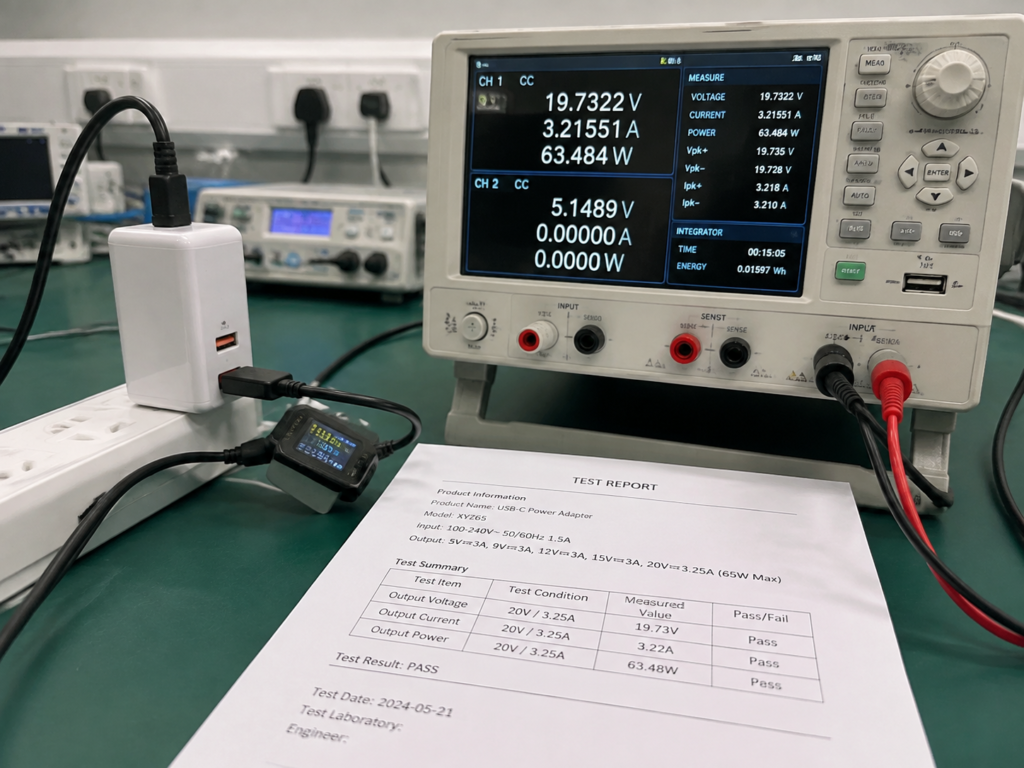
- Performance verification: It is recommended to verify that the actual output parameters and protocol support of the product are consistent with the labels and promotions through a third-party laboratory or your own reliable testing equipment; if there are specific performance figures in the promotion (such as 65W output, 60% charge in 30 minutes), the corresponding test report must be retained as evidence. The report should indicate the sample model, hardware version, test conditions, test instruments, and date to ensure correspondence with the sold product.
- Energy efficiency verification: First confirm whether the product falls within the scope of external power supplies regulated by the U.S. Department of Energy (DOE) (this needs to be judged based on the product’s rated output, purpose, structure, etc.; charging cables are usually not subject to DOE energy efficiency regulation). If it is within the applicable scope, it is necessary to confirm that the product meets the corresponding energy efficiency limits (such as standby power consumption, average operating efficiency); if the promotion involves energy efficiency-related content (such as “energy saving” and “low power consumption”), corresponding test data must be retained for support.
- Certification verification: Check the model, version, and validity period on the certification certificate, confirm that the mark you use is within the scope of authorization, and do not use expired or mismatched certificates to make up the number.
- Country-of-origin verification: Check the country-of-origin certificates of the supply chain to ensure that the origin you promote is consistent with the actual origin and will not mislead consumers.
- Compatibility verification: All compatible devices and protocols you promote must have actual test records. You cannot say they are compatible just because the interfaces look the same.
4.2 Suggestions for Retention of Compliance Records
Retaining compliance records is the core basis for proving the truthfulness of promotions. If the FTC launches an investigation, the inability to provide valid supporting materials will greatly increase the risk of losing the case. Regarding record retention, here are some practical suggestions:
- Recommended documents to retain include: third-party test reports, certification certificates, country-of-origin certificates, supply chain contracts, promotional material review records, advertising placement records, and consumer complaint handling records.
- Retention period: It is recommended that enterprises retain records for at least 3 years internally as a basic risk prevention and control measure; however, the investigation limitation period of different regulations, platform rules, state laws, or specific cases may vary, and needs to be adjusted according to the actual situation. There is no unified statutory retention period applicable to all charging products.
- Retention method: It is recommended to sort and organize by SKU, hardware version, production batch, and page version to ensure that the labels and promotion content of each product can correspond to the corresponding supporting materials, facilitating quick retrieval during investigations.
V. Boundaries of Responsibility and Common Cognitive Misconceptions
After clarifying the core responsibilities, let’s sort out the responsibilities of different roles in the supply chain, as well as the cognitive misconceptions that people are most likely to fall into.
5.1 Division of Responsibilities of Each Role in the Supply Chain
Not all people related to the product bear FTC responsibility, and the boundaries of each need to be judged in combination with the actual degree of participation:
- Overseas factories: Responsible for producing products that meet the parameters as agreed, but the FTC usually prioritizes holding importers, sellers, or entities that control promotion content within the U.S. accountable. You cannot exempt yourself from responsibility on the grounds of “finding the factory”, but you can seek compensation from the factory according to the contract after bearing the responsibility.
- Freight forwarders/customs brokers: Those who only provide logistics and customs clearance agency services and do not participate in product label production, promotion, or sales pricing usually do not bear responsibility for promotion compliance under the FTC framework; if they participate in label design, promotion release, or product sales, they need to bear responsibility according to the actual degree of participation.
- E-commerce platforms: The internal rules of the platform and the FTC’s administrative law enforcement are parallel. Even if the platform has removed the product, the FTC can still launch investigations and hold sellers accountable.
- Dropshipping/reselling existing listings model: As long as you sell the product in the U.S. in your own name, or control the product’s promotion page, you must bear the corresponding compliance responsibility; for those who resell existing listings, even if the original seller has been punished, the reseller may also be held accountable separately.
- Private label/distribution model: Whoever controls the product’s label design and promotion content bears the main compliance responsibility; if the distributor modifies the promotion content on its own, the distributor is responsible for the modified part.
5.2 5 Common Cognitive Misconceptions
Many sellers run into trouble because of wrong cognition. Here we centrally clarify several of the most common misconceptions:
- Misconception: Passing FCC/UL certification means meeting FTC requirements
Correct explanation: The regulatory directions of the three are completely different. The FCC oversees electromagnetic compatibility/radio frequency compliance, NRTL certifications such as UL are safety standard certifications, and the FTC oversees “whether promotion content is truthful and whether it misleads consumers”—even if you have UL certification, if you promote “UL certification = absolute safety”, it is still an FTC violation. Compliance requirements of different agencies cannot replace each other. - Misconception: Small sales volume means you won’t be investigated
Correct explanation: There are many channels that trigger FTC investigations, including consumer complaints, reports from competitors, referrals from other agencies, and public opinion triggers, etc., which have no inevitable relationship with sales volume; charging products may be investigated even if sales volume is not large due to their high complaint rate. - Misconception: Having a label pasted means meeting the requirements
Correct explanation: The FTC focuses on the truthfulness, readability, and misleading nature of label content. If parameters are falsely marked, the font is too small to see clearly, or the label is printed on an easily tearable protective film that falls off after use, all may be deemed as false advertising or misleading. - Misconception: Assembled in the USA means made in the USA
Correct explanation: The FTC has strict “all or virtually all made in the USA” requirements for unqualified “Made in USA” claims. Only completing assembly in the USA does not mean meeting this standard. The expression “Assembled in USA” also needs to be judged in combination with the actual manufacturing situation, and must not make consumers mistakenly believe that the entire machine is produced in the USA. If necessary, the origin of main components must be disclosed. - Misconception: CE certification cannot be promoted in the USA, and mentioning it is a violation
Correct explanation: CE is a compliance mark for the EU market and is not an officially recognized safety or compliance certification in the USA. However, if the product does meet the relevant EU CE requirements, objectively stating “this product meets EU CE standards” is not necessarily a violation; the violation risk lies in promoting CE as a U.S. government-approved, U.S. safety certification, or proof of full product compliance, misleading consumers.
5.3 Applicable Boundaries of Compliance
Finally, several applicable boundaries need to be clarified:
- These FTC requirements only apply to charging products sold commercially, and personal use is not regulated.
- If the product is revised, the supplier is changed, or the certification is updated, all labels and promotion content must be re-reviewed, and the old ones cannot be used directly.
- Consumer protection laws in some U.S. states are stricter than the federal FTC requirements (such as California’s Consumer Legal Remedies Act), and sales in these states must also comply with local regulations.
VI. Violation Triggers and Response Process
In case you actually encounter an FTC investigation, don’t panic. First figure out what situations will trigger an investigation, what dispositions there will be, and how to respond.
6.1 Common Investigation Trigger Scenarios
There are many channels that trigger FTC investigations, common ones include:
- Concentrated consumer complaints, such as many people reporting mismatched charging speed, poor compatibility, or falsely marked power.
- Competitors reporting that your product has false advertising.
- Other agencies such as CBP and CPSC referring the case to the FTC after finding problems.
- Related public opinion appearing in media and social media, causing attention.
- E-commerce platforms reporting the situation to the FTC after finding violations during review.
6.2 Common Dispositions and Joint Penalties
Different agencies have different law enforcement powers. Do not attribute all penalties to the FTC’s scope of authority:
- Common FTC dispositions for false advertising: including requiring the cessation of illegal promotion, ordering correction of advertisements or labels, requiring refunds to consumers, imposing civil penalties, etc.; the specific consequences depend on factors such as the legal basis for the violation, case facts, sales scale, and whether you cooperate with the investigation. There is no unified fixed fine amount.
- Joint dispositions involving other agencies: If the product also has safety hazards, the CPSC may initiate a product recall, with costs borne by the responsible party; if the label or declaration does not meet requirements during import customs clearance, CBP may take measures such as detaining goods, refusing entry, or requiring rectification before release; for serious violations, you may be included in the import control list, affecting subsequent customs clearance of goods.
If there are circumstances such as deliberate violation (continuing illegal sales after being warned, refusing to cooperate with the investigation, providing false materials), involving a large number of consumers, or actual personal or property losses caused by false safety promotion, the disposition may be aggravated.
6.3 Response Steps After Receiving an FTC Notice
If you really receive an FTC notice, don’t panic. Follow these steps:
- Seal all relevant materials immediately: including original promotion pages (screenshots or complete archives), advertising placement records, order data, consumer complaint records, test reports, certification certificates, supply chain contracts, etc. Do not destroy, tamper with, or forge materials, otherwise the responsibility may be aggravated.
- Suspend disputed promotion content or advertising placement: Avoid further expansion of the dispute scope and reduce the risk of subsequent possible penalties, but be careful to retain the original records before modification, and do not directly delete all content.
- Prepare a response within the specified period: It is recommended not to reply casually on your own, especially if you are not familiar with the regulations. It is best to first consult professionals familiar with FTC consumer product compliance (such as relevant lawyers) before submitting compliance certificates or rectification plans.
- Cooperate with the investigation: Provide truthful supporting materials as required, and do not conceal or falsely report information.
VII. Full-Process Compliance Practice and Self-Inspection Methods
After talking about so many responsibilities and risks, finally we provide a set of practical methods that can be directly implemented, covering from procurement to daily operation.
7.1 Step 1: Compliance Check Before Procurement
Don’t wait until the goods are produced to consider compliance. You must control the pass before procurement:
- Require the factory to provide label drafts, and check whether the three types of core information: country of origin, responsible party, and performance parameters are complete and truthful.
- Request test reports for product performance and energy efficiency (if applicable), and confirm that the models and parameters in the reports are consistent with the labels and the content to be promoted.
- Verify the authenticity and validity of all certifications to be used (USB-IF, UL, FCC, etc.), and confirm that the certified model is consistent with the actual product.
- Check the promotional materials to be used, delete absolute terms and unsubstantiated claims, and supplement necessary test conditions and limitation descriptions.
- Confirm that country-of-origin related expressions will not mislead consumers, and avoid casually using vague expressions such as “Made in USA” and “American brand”.
7.2 Step 2: Label and Page Verification Before Shipment
After the goods are produced and before they are ready to be shipped to the U.S., do another check:
- Physical spot check: Check whether the position, clarity, and content of the label are consistent with the draft, and whether it is easy to fall off; check whether the parameter labeling of multi-port products and bundle products meets the requirements.
- Online page check: All parameters and promotional slogans in e-commerce titles, main images, and detail pages must be completely consistent with physical labels and test reports, and necessary limitation descriptions (such as fast charging test conditions, multi-port power distribution, terminal device limitations, etc.) must be supplemented.
- Bundle products: Check the parameters and promotions of the charger and the cable separately, do not confuse them.
- Certification mark check: Confirm that the scope of use and style of the mark meet the requirements of the certification body, and do not exceed the scope of authorization.
7.3 Step 3: Regular Maintenance in Daily Operation
Compliance is not a one-time thing. Regular inspections are required in daily operation:
- Regularly spot-check the labels and pages of products on sale, and update expired compliance documents such as certifications and test reports in a timely manner.
- Collect problems in consumer complaints related to parameters, compatibility, and promotion mismatches, and verify and rectify them in a timely manner.
- After product revision or supplier change, redo the full-process compliance review and update labels and promotion content.
7.4 Exclusive 3-Step Quick Self-Inspection Method for Charging Products
If you want to quickly judge whether a product has obvious FTC risks, you can use this simple method:
- Check information: Put the product body, packaging, and e-commerce page together, and check whether there are three types of core information: country of origin, responsible party, and truthful performance parameters, and whether key limitations (such as multi-port power differences, fast charging test conditions, compatibility scope) are explained.
- Check evidence: Whether all labeled and promoted content has corresponding verifiable basis such as test reports, certification certificates, and supply chain certificates.
- Check promotion: Read through all promotion content to check for absolute terms, falsely marked parameters/certifications, and vague or misleading expressions.
7.5 Action Priorities for Sellers at Different Stages
Sellers in different situations have different priorities, which can be compared as follows:
- New importers: First establish a complete compliance data package for each SKU, then make packaging and listings. Do not list first and then supplement materials.
- Existing sellers: Prioritize checking high-risk points such as high-power fast charging promotion, certification promotion, Made in USA claims, and environmental protection claims, and fix the most prone-to-problem areas first.
- Multi-supplier sellers: Focus on managing product version differences from different suppliers. Do not sell products of different specifications on the same sales page to avoid parameter mismatches.
- When complaints occur: First check whether the promotion is consistent with the physical product, then decide whether to modify the page, supplement explanations, remove the product, or find professionals to handle it. Do not tough it out.
Overall, the core logic of FTC compliance is “promotion is consistent with reality, and all statements are supported by evidence”. Due to many parameters and complex protocols, charging products are more prone to the risk of promotional misleading. As long as you sort out the regulatory boundaries of different agencies, clarify your own responsible role, and conduct full-link self-inspection from procurement to operation according to the process, you can effectively avoid most FTC compliance risks.