
Practitioners who manufacture products such as USB-C chargers, charging cables, and power adapters and plan to enter the UK market will mostly come into contact with the UK REACH regulation. There are two common types of cognitive deviations: one believes that it is full of professional chemical terms and difficult to understand; the other equates it with ordinary product certification and thinks that it can be completed by paying—both views are inaccurate. UK REACH is a chemical management regulation that operates independently after the UK’s Brexit. The obligations for different roles and different products vary significantly. Ordinary finished product sellers usually do not need to handle registration, but are prone to pitfalls in SVHC notification and information transfer links.
Starting from the applicable boundaries and combined with the actual scenarios of charging products, this article sorts out the requirements and judgment methods of the three core obligations of registration, SVHC notification, and information transfer, to help practitioners clarify compliance responsibilities and avoid unnecessary costs and risks.
1. Basic Introduction: Core Boundaries and Scope of Application of UK REACH
1.1 Scope of Control and Excluded Scenarios
UK REACH, full name the Registration, Evaluation, Authorisation and Restriction of Chemicals Regulations, is an independent chemical management regulation operating in the UK after Brexit, with the core goal of controlling the risks of chemicals to human health and the environment.
First, clarify the applicable region: this regulation only covers Great Britain (GB, i.e., England, Scotland, Wales); Northern Ireland (NI) applies EU REACH regulations due to special agreements, and the requirements of the two cannot be mixed.
Its control objects are divided into three categories, which can be intuitively understood in combination with charging products:
• Substance: a single chemical raw material, for example, a certain type of phthalate added to the PVC sheath of a charging cable is a separate substance.
• Mixture: a material made by mixing multiple substances, for example, solder used for charger PCB boards (mixed lead, tin, copper, etc.), insulating adhesives all belong to mixtures.
• Article: a finished product with a fixed shape and ultimately sold to users, for example, USB-C chargers, charging cables, power plugs all belong to the “article” category.
The compliance obligations corresponding to different control objects vary significantly, and selling finished chargers does not trigger all requirements.
There are some scenarios in the regulation that may exclude or exempt specific obligations, but their application has clear prerequisites and only corresponds to specific obligations. It cannot be generally considered that such scenarios can exempt all compliance responsibilities:
1. Transit transport: only refers to goods that comply with customs transit rules and are not placed on the GB market for circulation, which can be exempted from registration, notification, and information transfer obligations for placing on the GB market; if goods are sold within GB, this exception does not apply.
2. Non-marketed R&D samples: only refers to samples specifically used for research, development and testing, not placed on the market for sale, and meeting the specific conditions of UK REACH R&D exemption clauses, which can be exempted from registration obligations for corresponding R&D uses; ordinary internal test samples and sent samples do not fall into this category.
3. Personal use articles: non-commercial personal overseas shopping and personal use items, as they do not fall into the category of “commercial goods placed on the GB market”, usually do not trigger the compliance responsibilities of commercial entities, but cannot be used as an exemption basis for commercially sold goods.
All obligation exemptions for all scenarios must be verified one by one against specific regulatory clauses, and cannot be directly assumed to be fully exempt.
1.2 Key Term Explanations (Combined with Charging Products)
The following are core terms that appear frequently in UK REACH. There is no need to memorize them deliberately, just refer to them when encountered:
• Substances of Very High Concern (SVHC): chemical substances that cause serious harm to humans or the environment, such as carcinogenic, teratogenic, reproductive toxic, and persistent substances. UK REACH updates the “SVHC Candidate List” irregularly. The specific substances and quantity are subject to the UK version of the list published by HSE on the day of inquiry, which is the most commonly contacted compliance requirement basis for finished product sellers.
• Only Representative (OR): a legal person within the UK entrusted by a non-GB entity to perform UK REACH obligations in the import stage, who must have the professional knowledge and practical experience required to perform corresponding obligations. When entrusting an OR, it is necessary to verify the scope of authorization to ensure that it covers the corresponding products, specific substances (CAS/EC numbers), annual tonnage, types of obligations to be performed, and authorization period, and a written authorization document must be signed.
• Health and Safety Executive (HSE): the UK official agency responsible for UK REACH enforcement and application acceptance. All registration and notification applications must be submitted to this agency, and the official interpretation of the regulation is subject to its published content.
• Homogeneous material: a component of the same material that cannot be split into finer parts by mechanical methods. For example, the PVC sheath of a charging cable, the plastic shell of a plug, and solder joints are all separate homogeneous materials. This concept is the basis for SVHC concentration calculation and is also a common source of cognitive misunderstanding.
1.3 Four Core Obligations and Analysis of Easily Confused Notifications
There are four core obligations of UK REACH. This article focuses on the first three which are highly related to charging products:
1. Registration: compliance filing for substances and mixtures, mainly performed by raw material manufacturers and importers.
2. SVHC Notification: if SVHC contained in finished products meets statutory conditions, relevant information must be reported to HSE.
3. Information Transfer: the obligation to inform SVHC information up and down the supply chain and to consumers, with a low trigger threshold.
4. Restriction: an obligation independent of registration and SVHC notification, which directly stipulates the prohibition or restriction requirements for some substances under specific uses. Its scope of control can cover substances and mixtures, and can also directly apply to specific substances in finished articles—even if the product does not trigger registration or SVHC notification, as long as it contains substances in the restriction list and does not meet the limit requirements, it still cannot be placed on the GB market. Restriction requirements partially overlap with RoHS. This article does not expand on specific items, which need to be checked separately against the restriction list published by HSE.
There are two types of requirements that are easily confused with SVHC notification, and the boundaries need to be clarified:
• SVHC Notification ≠ GB CLP Classification and Labelling Notification: GB CLP mainly applies to hazardous chemicals placed on the market as substances or mixtures, controlling their classification, labelling and packaging requirements; finished articles such as chargers and charging cables usually do not trigger GB CLP substance/mixture notification obligations, but separately sold substances or mixtures such as solder paste, adhesives, and cleaning agents sold with products need to be separately evaluated for requirements such as classification labelling and poison centre notification.
• SVHC Notification ≠ EU SCIP Submission: SCIP is a requirement under the EU waste framework, only applicable to the EU market, not applicable to the UK GB market, and SCIP cannot replace UK REACH SVHC notification.
1.4 Responsible Party Boundaries and Consequences of Non-Compliance
The responsibility attribution of UK REACH needs to be judged in combination with the actual transaction structure. First, confirm that the importer within GB (i.e., the entity that completes customs clearance and places goods on the GB market) is the statutory direct responsible party; the obligation boundaries of different roles are as follows:
• Manufacturers and importers within GB: are statutory direct responsible parties, responsible for UK REACH obligations in the production and import links respectively.
• Non-GB manufacturers/brand owners: if they wish to bear the UK REACH obligations of the import link themselves, rather than being borne by the GB importer, they can entrust a qualified Only Representative (OR) within the UK to take over the corresponding importer responsibilities; but OR entrustment does not automatically exempt GB importers, distributors or retailers from information transfer and sales compliance responsibilities in their own supply chain links. Non-GB entities cannot directly submit registration or notification applications to HSE in their own name, and need to handle them through GB importers or qualified ORs.
• Distributors and retailers: have no statutory responsibility for registration and notification, but have the obligation to transmit upstream compliance information; if they knowingly sell non-compliant products, they shall bear corresponding responsibilities and cooperate with the regulatory authorities’ recall and removal requirements.
Consequences of non-compliance include: goods detained, returned, destroyed, HSE penalties, market access prohibition, product recall, e-commerce platform removal, and supply chain trust loss, etc.
2. UK REACH Registration Requirements: Most Finished Product Sellers Do Not Trigger Them
Registration is a high-threshold obligation in UK REACH. Ordinary finished product sellers usually do not trigger it, and need to meet statutory conditions at the same time to perform.
2.1 Core Trigger Conditions for Registration (must be met simultaneously)
1. Control object compliance: it is a separate chemical substance, a substance in a mixture, or a substance “intentionally released” in an article—for example, a charger with aromatherapy function, the aromatherapy component is an intentionally released substance; ordinary chargers have no intentionally released substances and do not meet this condition.
2. Tonnage compliance: the total mass of the specific pure substance produced or imported into the GB area per year by the same GB legal entity (or the entity corresponding to its entrusted OR) is ≥ 1 ton, which cannot be calculated by the total mass of the mixture or finished product.
3. Use not covered: the corresponding use of the substance is not covered by the existing UK REACH registration of the upstream supplier. Upstream registration coverage must be met simultaneously: the upstream supplier has completed the official UK REACH registration (EU REACH registrations that have not been transferred are not applicable), the registered substance is consistent with the composition of the imported/used substance, the registered use includes the actual use scenario, and the supply chain identity meets the requirements; for goods directly imported from overseas non-GB entities, it cannot be assumed that upstream registration can cover their own obligations, which need to be verified one by one.
4. No exemption: it does not belong to the exemption situations clearly listed in the regulation.
2.2 Responsible Party for Registration
UK domestic substance manufacturers and importers are the direct statutory responsible parties for registration. Non-GB entities cannot directly submit registration applications, and can entrust a qualified OR within GB to handle it, or submit it as the responsible party by the GB importer.
Ordinary finished product charger and charging cable sellers without intentionally released substances usually do not trigger registration obligations. For details, please refer to the core judgment table in Chapter 5.
2.3 Reference to Common Scenarios in the Charging Industry
Combined with typical business scenarios in the charging industry, the judgment logic of registration can be more intuitively understood:
• Registration needs to be evaluated: if a local UK wire factory imports PVC plastic granules, if the annual imported pure mass of a certain type of flame retardant (needs to be specific to the substance CAS number) is ≥ 1 ton, and the corresponding processing use of this flame retardant is not covered by upstream UK REACH registration and there is no exemption, then the registration of this flame retardant needs to be handled.
• Registration needs to be evaluated: if a UK electronics company imports lead-containing solder wire, it first needs to calculate the annual imported pure mass of each single substance in the solder wire (such as lead and its specific compounds). If a certain substance meets the annual volume ≥ 1 ton, the use is not covered by upstream UK REACH registration and there is no exemption, then registration needs to be handled for this specific substance (not for the entire solder wire); at the same time, solder and final electronic products also need to separately meet the corresponding requirements of UK REACH restriction clauses and UK RoHS.
• No registration required: cross-border e-commerce sellers selling ordinary USB-C chargers, the products have no intentionally released substances, belong to the article category, do not meet the control object requirements of registration, and do not need to handle registration.
2.4 Transition Mechanism and Registration Path
UK REACH is independent from EU REACH before Brexit, so it has set up transition arrangements for original EU REACH registrations, which only apply to relevant entities that have obtained EU REACH registration before Brexit:
1. Grandfathered Registration: GB entities that held EU REACH registration before Brexit can transfer the registration to UK REACH according to regulations, enjoy phased registration deadlines, and do not need to resubmit a full set of basic materials.
2. Downstream User Import Notification (DUIN): this mechanism is a temporary path set for GB downstream importers during the Brexit transition period, for scenarios where upstream EU suppliers have EU REACH registration but have not transferred to UK REACH; at present, the submission deadline for this mechanism has ended, and it only applies to existing entities that completed submission within the deadline to transition according to the original rules, and new import businesses can no longer comply through the DUIN path.
For substances that meet the grandfathering conditions, the phased registration deadlines (subject to the latest official announcement of HSE):
• 27 October 2026: substances with annual volume ≥ 100 tons/year, as well as substances classified as CMR 1A/1B (carcinogenic/teratogenic/reproductive toxic), PBT (persistent/bioaccumulative/toxic), vPvB (very persistent/very bioaccumulative) with annual volume ≥ 1 ton/year.
• 27 October 2028: substances with annual volume 10-100 tons/year.
• 27 October 2030: substances with annual volume 1-10 tons/year.
New entities and new products that do not have a qualified EU REACH registration basis need to take the regular registration path: prepare a full set of registration materials (including basic substance information, chemical safety assessment reports, etc., the higher the tonnage, the stricter the material requirements), submit them to HSE through OR or UK importer, and apply for a UK REACH registration number separately. Note: EU REACH registration numbers cannot be directly used for UK REACH, and must be applied for separately or transferred in accordance with transition rules.
3. UK REACH SVHC Notification Requirements: High-Frequency Regulatory Matters for Finished Charging Products
SVHC notification is the obligation that finished product sellers most often consult about, and it is also an area with concentrated cognitive misunderstandings. It needs to meet the following three conditions at the same time to be performed:
1. Included in the UK SVHC Candidate List: the substance must be included in the latest version of the UK REACH SVHC Candidate List—note that it is the UK version of the list, not the EU version, the two have different update rhythms and cannot be directly applied.
2. Concentration compliance: the mass proportion of the substance in the homogeneous material is > 0.1%; equal to 0.1% does not trigger, and it cannot be calculated by the average total mass of the whole machine, and must be calculated separately for each homogeneous material.
3. Tonnage compliance: for the same legal entity, the total pure mass of the substance in all articles containing the SVHC within one year is ≥ 1 ton; it is calculated cumulatively by single substance, not limited by the number of SKUs, and all products containing the same SVHC need to be calculated together.
3.1 Calculation Methods of Concentration and Tonnage
Common errors in SVHC notification are concentrated in the calculation link, and the calculation rules need to be clarified separately:
Concentration Calculation: Calculated Separately by Homogeneous Material
Taking an ordinary USB-C charging cable as an example, it can be split into multiple homogeneous materials such as PVC sheath, internal copper core, plug plastic shell, metal pins, solder joints, etc. Each material needs to be tested for SVHC concentration separately. As long as one homogeneous material has a concentration exceeding the threshold, it is deemed that the concentration condition is met.
Common wrong calculation method: average diluted concentration by the total mass of the whole machine. For example, the whole charging cable weighs 20 grams, of which the solder is only 0.1 grams, and the proportion of lead compounds in the solder is 0.2%, which is only 0.001% on average by the whole machine, which seems far below the threshold, but as a separate homogeneous material, 0.2% of solder already meets the concentration condition.
Tonnage Calculation: Calculated by Annual Total Mass of Pure SVHC
Concentration compliance does not mean that notification is necessarily required. The tonnage threshold of 1 ton of pure substance is relatively high, and ordinary small and medium-sized sellers usually cannot reach it. Taking charging cables as an example:
Assume that the PVC sheath of a certain charging cable is a homogeneous material, each sheath weighs 20 grams, and the content of a certain type of phthalate (common SVHC) is 0.2% (just exceeding the concentration threshold). To reach the annual total mass of 1 ton of phthalate, the number of charging cables to be imported is: 1 ton ÷ (20 grams/piece × 0.2%) = 25 million pieces. Therefore, most small and medium-sized sellers only need to perform the information transfer obligation and do not need to handle notification.
3.2 Responsible Party for Notification and Time Limit Requirements
The direct responsible party for SVHC notification is the article manufacturer and importer within the UK. Non-GB entities cannot notify by themselves, and need to be handled by the GB importer, or a qualified OR whose authorization scope covers the corresponding products, specific substances, and annual tonnage, in combination with the actual transaction arrangement.
Notification time limit requirements: for newly added substances in the SVHC Candidate List, notification must be completed within 6 months from the date of list update; for substances already in the list, notification must be completed in time after meeting the notification conditions for the first time.
3.3 Key Verification Directions for Charging Products
The high-risk components of SVHC in charging products are relatively concentrated. Verification must follow the principle of “list check + supplier declaration + test verification”, and cannot be directly judged only by component name or element test results. The following are the screening directions for high-risk materials, which do not mean that the corresponding substances are necessarily UK REACH SVHC: it is necessary to first find risks through preliminary screening, then confirm the specific chemical form in combination with material technology, and finally check the latest UK SVHC Candidate List by the CAS/EC number of the substance.
Common screening directions include:
• Plastic shells, cable sheaths: focus on specific phthalates and specific brominated flame retardant substances. It is necessary to check whether the CAS/EC numbers of specific compounds are in the list, and cannot be judged only by general terms such as “plastic” and “plasticizer”.

• PCB boards, solder, plug metal contacts: focus on specific compounds corresponding to elements such as lead, cadmium, and nickel; X-ray Fluorescence Spectrometer (XRF) can only preliminarily screen the total content of elements, cannot confirm the specific compound form, nor can it be directly equated with SVHC test results. Further quantitative testing of compounds is needed to confirm whether they are substances in the list.
• USB-C interface plating: focus on hexavalent chromium compounds; total chromium test results cannot be directly used for judgment, and valence state analysis is needed to confirm whether hexavalent chromium compounds are in the list.
• Insulating adhesives, sealants, coatings: focus on specific formaldehyde releasers and specific organic solvent substances. It is necessary to use adapted organic quantitative testing methods to confirm the specific compound identity.
3.4 Notification Submission Information and Exemption Conditions
When submitting SVHC notification, the core information to be provided includes: identity information of the SVHC, content range and use of the substance in the article, total annual import/production of articles, estimation of total SVHC mass. The specific fields and attachment requirements to be filled in for notification are subject to the HSE UK REACH official IT system and the latest published declaration guidelines, and self-made compliance declarations of enterprises cannot replace statutory notification materials.
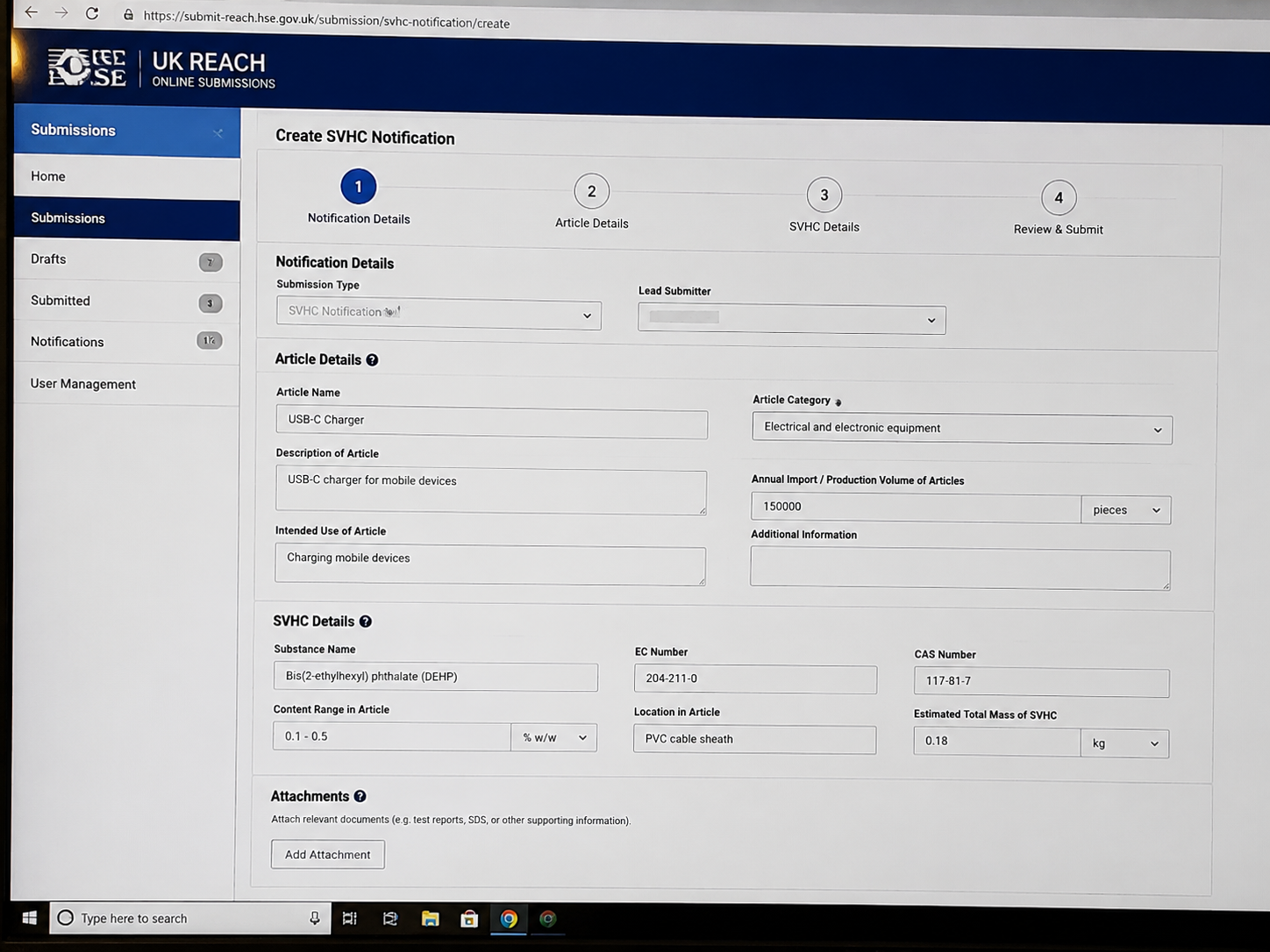
The exposure exemption of SVHC notification is a strict exception applicable to articles, which needs to be based on complete technical data to prove that the substance will not cause exposure to humans or the environment during the whole process of normal and reasonably foreseeable use, misuse, maintenance, disassembly, and disposal; exposure assessment needs to cover all foreseeable scenarios, form auditable technical documents, and cannot claim exemption only based on concentration below the threshold, supplier oral statements or a single test report. Ordinary charging products usually cannot meet this exemption condition.
4. Information Transfer Obligation: Low-Threshold and High-Trigger Compliance Requirement
Information transfer is an obligation independent of SVHC notification. No need to submit any materials to HSE, and it is an obligation to inform within the supply chain and to consumers. Its trigger threshold is much lower than notification, only related to the SVHC concentration in homogeneous materials, and has nothing to do with annual import/sales tonnage—as long as the concentration reaches the concentration threshold corresponding to notification (see Chapter 3 for details), regardless of sales volume, this obligation must be performed.
4.1 Information Transfer Requirements for Different Audiences
For different audiences, the statutory requirements for information transfer are different. It is necessary to pay attention to distinguishing the statutory minimum requirements from optional supplementary content of enterprises:
• For commercial customers (such as wholesalers, brand owners): the statutory minimum requirement is to proactively provide the names of SVHC contained in the articles, as well as relevant information sufficient to ensure the safe use of the product. The information content needs to be determined in combination with the nature of the article and the use scenario, and necessary safe use prompts cannot be omitted only on the grounds of providing names; enterprises can supplement hazard descriptions, operation precautions and other content according to actual risks. Note: Safety Data Sheets (SDS) only apply to substances and mixtures, finished articles do not need to provide SDS compulsorily, but the statutory information transfer obligation cannot be exempted on the grounds that SDS is not required.
• For ordinary consumers: no need to proactively inform, but if consumers consult relevant information, they need to provide SVHC names and basic hazard information free of charge within 45 days.
• Supply chain boundaries: upstream suppliers, importers, manufacturers need to transmit accurate SVHC information downstream; distributors only need to transmit the information they have obtained, but if they know that the product is non-compliant, they need to stop selling and cooperate with removal or recall.
4.2 Transfer Form and Retention Requirements
There is no mandatory format requirement for information transfer, as long as the information can be accurately transmitted. Common forms include: supplier compliance declaration, product detail page labeling, customer service standardized answers, information notification letter attached with goods, etc.
All relevant records need to be kept for inspection, including supplier declarations, test reports, information transfer vouchers, etc.
5. Self-Judgment Methods and Core Judgment Tools
5.1 General Five-Step Judgment Process (Applicable to Charging Products)
No matter what type of charging products you operate, you can judge your own UK REACH obligations in the following order:
1. Confirm the target market: clarify whether it is GB (Great Britain), NI (Northern Ireland) or the EU, corresponding to different regulatory systems.
2. Confirm your own role: combine the transaction structure to confirm whether you are a manufacturer, importer, cross-border seller or distributor. Different roles have different responsibility boundaries.
3. Confirm product type: clarify whether the product is a substance, mixture or article, and initially lock the scope of obligations to be performed.
4. Verify obligations separately: check one by one against the trigger conditions of registration, SVHC notification, and information transfer, and at the same time must not omit the independent restriction obligation.
5. Confirm exemption situations: verify whether you meet the exemption conditions clearly specified in the regulation, keep written judgment basis, and cannot claim exemption on your own.
5.2 Core Judgment Table for Finished Charging Products
For quick comparison, the corresponding relationship of common obligations for ordinary finished charging products (without intentionally released substances) is sorted out as follows:
| Product/Substance Situation | Registration Obligation | SVHC Notification Obligation | Information Transfer Obligation |
| Ordinary finished products (without intentionally released substances) | Usually not triggered | Need to be evaluated in combination with concentration and tonnage | Need to be evaluated in combination with concentration |
| SVHC concentration in all homogeneous materials ≤ 0.1% | Not triggered | Not required | Not required |
| SVHC homogeneous concentration > 0.1% and annual total mass < 1 ton | Not triggered | Not required | Required |
| SVHC homogeneous concentration > 0.1% and annual total mass ≥ 1 ton | Not triggered (no intentional release) | Required | Required |
5.3 Supplementary Judgment Points for Registration Obligation
If the business involves raw material import or products containing intentionally released substances, the following content needs to be additionally verified:
• Imported raw materials (such as plastic granules, solder, glue, etc.): calculate the annual import volume by single specific pure substance, not by the total mass of the mixture.
• Products containing intentionally released substances (such as aromatherapy chargers): calculate the annual total pure mass of released substances to judge whether the tonnage threshold is reached.
• First verify the UK REACH registration status of upstream suppliers: confirm that the registration entity, substance composition, and use coverage are all matched to avoid misjudgment.
5.4 Supplementary Judgment Points for SVHC Notification
When judging the SVHC notification obligation, you can proceed in the following order to reduce the probability of error:
1. First query the latest UK SVHC Candidate List, lock the target substances that may be contained in the product, and check the specific CAS/EC numbers.
2. Obtain concentration data of homogeneous materials: first ask the supplier for a compliance declaration, and then carry out targeted testing if there is no valid declaration, no need for blind full-item testing.
3. Cumulate the annual total mass by the same substance, all categories of articles. For example, if both chargers and charging cables sold at the same time contain the same phthalate compound, the mass of the substance in the two types of products needs to be calculated together.
5.5 Common Exemption Boundaries
The following are common obligation exemption boundaries. Those that meet the conditions can be exempted from corresponding obligations:
• If the SVHC concentration of all homogeneous materials does not reach the notification trigger threshold: no need to perform SVHC notification and information transfer obligations.
• If the annual total mass of SVHC does not reach the notification tonnage threshold: no need to perform SVHC notification obligation, but those with concentration up to standard still need to perform information transfer obligation.
• The annual volume of non-intentionally released substances in articles does not reach the registration threshold: no need to perform registration obligation.
• Exempt substances or scenarios clearly listed in the regulation: subject to the official regulations of HSE, and the scope of exemption cannot be expanded on your own.
5.6 Judgment Points for Only Representative (OR) Entrustment
Non-GB entities that meet one of the following situations can consider entrusting an OR within the UK to perform corresponding obligations:
• Wish to bear the compliance responsibility of UK REACH importer on their own, without being borne by the GB importer.
• Carry out cross-border e-commerce business in the GB area, and no corresponding GB importer bears the statutory responsibility.
When entrusting an OR, note that: the OR must be a legal person within the UK, with the professional knowledge and practical experience required to perform UK REACH obligations; it is necessary to verify that its authorization scope covers the corresponding products, specific substances (CAS/EC numbers), annual tonnage, obligation types and authorization period, and sign a written authorization document. After entrusting the OR, the entrusting party still needs to provide accurate product composition, annual sales volume and other data, and cannot fully transfer all responsibilities.
5.7 Core Compliance Documents to Be Collected from Suppliers
The first step in carrying out UK REACH compliance is to collect materials from upstream suppliers. The core documents include:
• Material composition declaration, SVHC screening or quantitative test report (need to mark the specific substance CAS number).
• Safety Data Sheet (SDS): only for substances and mixtures, no need to request for finished products.
• UK REACH compliance declaration.
• If the supplier entrusts an OR, the OR authorization letter must be provided, and confirm that the authorization scope covers the products purchased by itself.
6. Common Misconceptions and Regulatory Boundaries
6.1 Common Cognitive Misconceptions about Registration and Notification
1. Misconception: Selling finished chargers must do UK REACH registration.
Correction: Ordinary finished products without intentionally released substances usually do not trigger registration obligations. Only raw material importers and products containing intentionally released substances need to be evaluated separately.
2. Misconception: UK REACH is a product certification with an exclusive mark.
Correction: UK REACH is a chemical filing and reporting type of compliance requirement, with no exclusive certification mark, which is different from product certifications such as UKCA.
3. Misconception: The average SVHC concentration of the whole machine < 0.1% is compliant.
Correction: The concentration needs to be calculated separately for each homogeneous material. As long as a single component exceeds the standard, the concentration trigger condition is met, and the average of the whole machine is meaningless.
4. Misconception: SVHC below 0.1% is completely safe.
Correction: 0.1% is the regulatory obligation trigger threshold, not a toxic safety line. Below this value, there is no need to perform notification and information transfer obligations, which does not mean absolute safety.
6.2 Misconceptions Confused with EU REACH
1. Misconception: Holding an EU REACH registration number allows sales in the UK market.
Correction: UK REACH is a completely independent regulatory system. EU registration data does not automatically apply, and needs to be applied for separately or transferred in accordance with transition rules.
2. Misconception: The SVHC lists of the EU and the UK are completely consistent.
Correction: The two have different update rhythms, and the content may be different. The UK version of the list published by HSE must prevail.
3. Misconception: EU SCIP submission can replace UK SVHC notification.
Correction: SCIP belongs to the EU waste framework requirements, does not apply to the GB market, and cannot replace UK REACH notification at all.
6.3 Boundaries with Other Charging Product Compliance Requirements
UK REACH has different control directions from other common compliance requirements and cannot replace each other:
• Difference from UKCA/CE: UKCA and CE control product safety requirements such as electrical safety and electromagnetic compatibility (EMC). UK REACH controls chemical risks, and both need to be complied with at the same time.
• Difference from RoHS: UK RoHS currently restricts 10 specific hazardous substances in electrical and electronic products. UK REACH has a wider control scope (the SVHC Candidate List alone has hundreds of substances). The two have some overlapping content, and need to check the applicable scope and limit requirements respectively and comply with them at the same time.
• Difference from GB CLP: GB CLP controls the classification and labelling of hazardous substances and mixtures. Finished electronic products usually do not trigger CLP notification obligations, but separately packaged chemicals sold with products need to be evaluated separately.
6.4 Common Misconceptions Related to Responsibility
1. Misconception: Small batches, samples, and direct mail do not need to comply with UK REACH at all.
Correction: Only scenarios that meet statutory exceptions (such as transit transport that complies with customs rules, samples that are not marketed and meet R&D exemption conditions, personal non-commercial use items) can be exempted from corresponding obligations; commercial goods, regardless of batch size, need to evaluate various obligations in accordance with the rules. Small batches may not reach the tonnage threshold and do not need registration or notification, but as long as the SVHC concentration of homogeneous materials meets the standard, the information transfer obligation still needs to be performed.
2. Misconception: If the supplier does not provide the formula, there is no need to be responsible.
Correction: Importers and brand owners are the first responsible parties for compliance, and need to actively obtain product composition information through supplier declarations, testing, contract constraints, etc., and cannot be exempted from responsibility on the grounds that “the supplier does not provide the formula”.
3. Misconception: Distributors and retailers have no responsibility at all.
Correction: Although distributors and retailers have no statutory responsibility for registration and notification, they have the obligation to transmit upstream compliance information. Those who knowingly sell non-compliant products shall bear corresponding responsibilities and cooperate with the regulatory authorities’ recall and removal requirements.
7. Compliance Implementation Operation Process
7.1 Registration Handling Process (only applicable to entities that need to perform registration obligations)
If it is confirmed that the registration obligation needs to be performed, you can proceed in the following steps:
1. Check against the registration trigger conditions to reconfirm that you need to perform the registration obligation to avoid unnecessary costs.
2. Accurately calculate the annual import/production volume (calculated by single pure substance) to confirm that the 1 ton threshold is reached.
3. Prepare registration materials: including basic substance information, chemical safety assessment reports, etc. The material requirements increase with the increase of tonnage.
4. Submit the registration application to HSE by the GB importer or by entrusting a qualified OR.
5. Obtain the UK REACH registration number after passing the review, and keep all registration files for inspection.
7.2 SVHC Notification Handling Process
If it is confirmed that the SVHC notification obligation needs to be performed, you can proceed in the following steps:
1. Obtain accurate SVHC concentration data: XRF can only be used for preliminary screening of elemental SVHC such as heavy metals, and cannot confirm the specific compound form; organic SVHC (such as phthalates, brominated flame retardants) need to carry out special quantitative testing.
2. Combined with the annual import/production volume, calculate the annual total pure mass of a single SVHC, and reconfirm that the notification conditions are met.
3. Confirm the responsible party, and the GB importer or entrust a qualified OR to prepare notification materials.
4. Submit the notification through the HSE UK REACH official portal, obtain the notification receipt and keep all materials.
7.3 Routine Compliance Path for Finished Product Cross-Border Sellers
Small and medium-sized cross-border sellers operating finished products do not need to blindly carry out full-item testing or entrust OR, and can gradually promote compliance in the following path:
1. First ask the supplier for SVHC declarations or test reports of high-risk components, and conduct a preliminary assessment against the core judgment table.
2. If the SVHC concentration of all homogeneous materials is ≤ 0.1%: keep the reports and declarations for inspection, no additional operations are required.
3. If the concentration exceeds the standard but the annual total mass is < 1 ton: implement the information transfer obligation, for example, label relevant information on the product detail page, prepare standardized answers for customer service, provide compliance declarations to downstream customers, and keep all transfer records.
4. If both concentration and tonnage notification conditions are met: then confirm the responsible party, and the GB importer or entrust a qualified OR to handle the notification.
7.4 Compliance Record Keeping and Continuous Maintenance
UK REACH compliance is not a one-time job and requires continuous maintenance:
• Documents to be kept: test reports, supplier declarations, SVHC list version records, tonnage calculation tables, notification/registration numbers, OR authorization letters, information transfer records and all other compliance-related documents.
• Retention period: relevant compliance records should usually be kept for at least 10 years after the last time the product is placed on the GB market; the special record retention period corresponding to different obligations needs to be checked against the specific clauses of UK REACH and the latest HSE guidelines.
• List update management: regularly monitor the update of the UK SVHC Candidate List, re-screen products after each update, and record the verification date and the list version used.
• Change triggers re-evaluation: when the product changes formula, supplier, or the annual import volume changes significantly, the compliance obligation needs to be re-evaluated, and old reports cannot be used.
8. Core Summary
To carry out UK REACH compliance for charging products in the GB market, you can follow the logic of “determine market – determine role – determine product type – verify corresponding obligations”: ordinary finished products without intentionally released substances should first check SVHC notification and information transfer obligations, raw material importers or products containing intentionally released substances need to additionally evaluate registration obligations, and all products need to separately check UK REACH restriction requirements. It is necessary to pay attention to distinguishing the applicable scope of UK REACH from EU REACH, UKCA, RoHS and other regulations. All compliance judgments must keep written basis, regularly follow up regulatory updates, and re-evaluate in time when products or supply chains change.
9. Official Information Query and Update Management
9.1 Official Verification Sources (Applicable to Charging Products)
The regulatory requirements of UK REACH must be subject to the officially released content. The following are authoritative query channels:
1. HSE UK REACH Official Page: contains the original regulation, registration/notification requirements, transition arrangements and other core content, which is the most authoritative reference source.
2. UK REACH SVHC Candidate List Official Publication Page: you can query the latest list, update history, and detailed information of each substance.
3. GB CLP Official Page: used to distinguish the requirement boundaries related to classification and labelling.
4. UK Government Import and Export Compliance Guide: contains special compliance guidelines for electrical and electronic products, which is closer to the actual import and export scenarios.
9.2 Version Control and Dynamic Update
Compliance work needs to do a good job of traceability and dynamic management:
• Version record requirements: every time you query regulations and evaluate products, you need to record the query date, the SVHC list version used, applicable target market, judgment basis, responsible party confirmation documents and other information.
• Re-evaluation trigger scenarios: when the following situations occur, the product compliance needs to be re-evaluated:
• When the UK SVHC Candidate List is updated;
• When UK REACH regulations or transition arrangements are adjusted;
• When the product formula, supplier, annual import volume change significantly;
• When the target market (GB/NI/EU) changes.