
If you have bought chargers, laptop power adapters in Australia, or purchased charging accessories via cross-border online shopping, you may have seen abbreviations like GEMS, MEPS, RCM on product packaging or nameplates, and heard terms like “energy efficiency compliance” and “regulatory registration”. Many people think these are just marketing gimmicks from merchants, or industry regulations that have nothing to do with them — but that is not the case. The minimum energy efficiency standards for external power supplies not only directly affect standby power consumption and charger heat generation, but also indirectly reflect the product’s circuit design and material investment; as for product safety and service life that people care about, these belong to another set of independent regulatory categories, which need to be verified separately from energy efficiency requirements.
This article will start from the perspective of ordinary users, and clearly explain the core concepts, scope of application, verification methods, and common misconceptions of Australia’s external power supply energy efficiency standards at one go. Whether you buy local products or shop cross-border, you can easily make preliminary judgments and avoid marketing traps.
Basic Knowledge: Core Concepts and Practical Value
Before talking about specific requirements, let’s first clarify the four most easily confused core concepts to avoid getting more confused later:
The first is GEMS, whose full name is the Greenhouse Gas and Energy Minimum Standards regulatory framework. It is a top-level system in Australia that establishes energy efficiency requirements, registration management, and supply rules for products included in specific GEMS Determinations (regulatory determinations). It does not apply to all electrical appliances, and the specific regulatory scope is subject to the corresponding regulatory determination.
The second is MEPS, or Minimum Energy Performance Standards, which is the energy efficiency “pass line” set for each category of regulated products under the GEMS framework — the MEPS for external power supplies is the minimum energy efficiency requirement that such products (if regulated) must meet. Products that fail to meet it cannot be supplied to the Australian market. It is a mandatory bottom line for market access, not a voluntary energy efficiency excellence program.
The third is the RCM mark. Many people confuse it with energy efficiency compliance. The RCM is a compliance mark system set by Australia for regulatory requirements related to electrical equipment safety, electromagnetic compatibility (EMC), etc. Its scope of application and judgment rules are separately stipulated by corresponding electrical safety and EMC regulations, and are completely independent of the GEMS energy efficiency system. Whether an external power supply needs to meet RCM-related requirements and whether it needs to bear the RCM mark must be judged based on its corresponding safety and EMC regulatory rules, and cannot be directly presumed solely based on whether it is included in GEMS energy efficiency regulation. The two types of requirements belong to different systems and cannot replace each other. Having the RCM mark does not mean energy efficiency compliance, and vice versa.
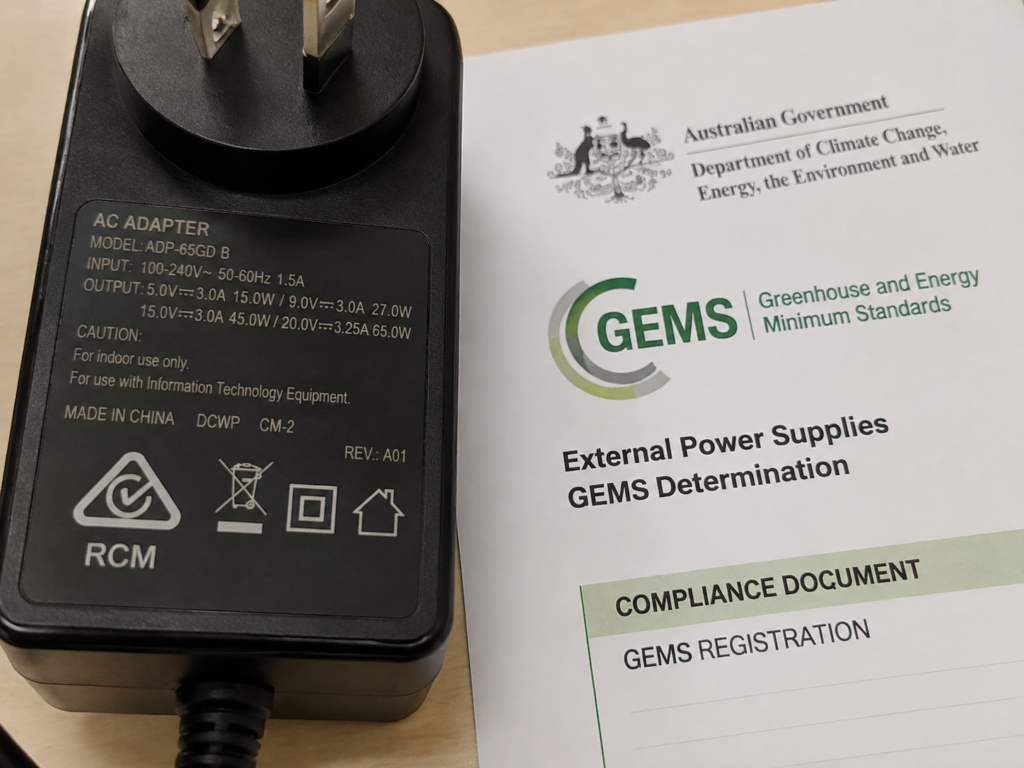
The fourth is test standards, which are technical operation specifications referenced by GEMS. They clarify the test methods and boundaries for indicators such as no-load power consumption and conversion efficiency, ensure that the test results of all products are uniform and comparable, and are the technical basis for energy efficiency judgment.
Here is a core key point: For external power supplies included in GEMS regulation, energy efficiency registration must be completed as required; electrical safety, EMC and other obligations of the product must be separately verified in accordance with corresponding regulatory rules, and the two cannot replace each other.
Practical Significance for Ordinary Users
Some people may ask, it’s just an energy efficiency standard, what impact does it have on my daily use? In fact, it matters a lot:
First is standby power consumption and heat generation. Chargers that do not meet energy efficiency standards consume more electricity when plugged into the wall and not in use, and the electricity wasted by the power supply itself during charging will also turn into heat, making it feel hotter to the touch.
Second is the reference value for product design and materials. To meet mandatory energy efficiency standards, products need to meet certain power utilization requirements in circuit design and material technology; some products that have not passed energy efficiency compliance may have reduced circuit-related investment due to cost control, but this does not directly equate to product safety hazards — safety performance must be judged separately based on electrical safety compliance requirements, and cannot be directly presumed solely from non-compliance with energy efficiency.
Third is the supply risk of cross-border online shopping and proxy purchasing. If an external power supply is included in GEMS regulation and is used for commercial import or sale in the Australian market, without completing Australian GEMS registration, even if it has overseas certifications or marks, it does not meet Australia’s energy efficiency supply requirements. For products carried in small quantities for personal use and for non-commercial purposes, the commercial supply rules of GEMS do not apply, but it is still recommended to prioritize compliant products.
Clarification of Core Beginner Misconceptions
People who are new to this standard are prone to three common misconceptions, which are clarified in advance here:
First misconception: High energy efficiency = fast charging. In fact, they are completely different things — energy efficiency refers to the utilization rate of electricity, for example, if 100 watts of electricity is taken from the grid, how much can be output through the power supply; while charging speed mainly depends on output power, for example, a 65W charger usually charges faster than a 20W one, and has no direct relationship with energy efficiency level. For example, a 20W high-energy-efficiency charger still cannot match the charging speed of a 65W ordinary energy efficiency charger.
Second misconception: Having RCM mark = energy efficiency compliance. The two belong to completely independent regulatory systems, with no overlapping regulatory directions. Energy efficiency compliance requires separate checking of GEMS registration status, and cannot be replaced by the RCM mark.
Third misconception: This is a voluntary energy efficiency rating. No, for external power supplies included in GEMS regulation, the energy efficiency standard is a mandatory bottom line for market access. Products that do not meet the requirements cannot be commercially imported or sold, and it is not a voluntary excellence program like “five-star energy saving”.
Scope of Application and Boundary Judgment
After understanding the basic concepts, what everyone is most concerned about must be: which of the charging heads, wireless chargers, and power banks we usually use are regulated by this energy efficiency standard?
First, we must clarify a general premise: Only products that simultaneously meet the product definition and application boundaries of the current External Power Supplies GEMS Determination, and do not fall under clearly excluded or exempted clauses, are managed in accordance with the energy efficiency requirements of this regulatory determination. We can make a preliminary judgment from several core dimensions.
Core Judgment Dimensions
To preliminarily judge whether a product may fall within the scope of external power supply energy efficiency regulation, you can refer to five core dimensions, and the specific details shall be subject to the clear definition of the regulatory text:
First, basic attribute: A power supply device with an independent external casing, rather than a built-in power supply soldered inside the equipment.
Second, input requirement: Designed to be connected to AC mains power (including direct-plug types, and models with detachable/fixed AC input cables). If to be supplied in the Australian market, it must adapt to Australia’s 230V/50Hz mains parameters.
Third, output requirement: The core function is to convert mains power into low-voltage electricity to supply power to other electronic devices.
Fourth, sales form: Whether it is a separately sold charger, or an external power supply sold as part of a bundle with complete devices such as mobile phones, laptops, routers, etc., all fall within the category that requires verification of regulatory attributes, and cannot automatically evade requirements on the grounds of “sold with the complete device”.
Fifth, power boundary: Which power segments are specifically included in regulation must be subject to the current effective External Power Supplies GEMS regulations; there is no universal rule of “only regulated above a certain wattage”.
Comparison of Common Product Boundaries
To facilitate quick judgment, we have sorted out the most common related products in daily life into a comparison table:
| Common Product | Preliminary Judgment of Regulatory Attribute | Remarks |
|---|---|---|
| Wall-plug USB chargers, laptop power adapters, multi-port USB charging stations, small device AC-DC adapters | Usually fall within the key verification scope | Such independent external products that plug into mains power to convert to low voltage, whether sold separately or sold as part of a complete device bundle, need to be confirmed whether they are regulated in combination with current regulations |
| Pure charging cables | The main body is not regulated as an external power supply | Passive accessories that only conduct electricity, not power supply devices |
| Power banks (portable chargers) | The main body is not regulated as an external power supply | The main body is an energy storage battery; only the included independent external charger needs separate verification of regulatory attribute and compliance |
| Wireless charging bases | The main body is not regulated as an external power supply | The main body is a wireless power transmission device; built-in non-removable power supplies are usually not regulated as external power supplies. Whether wireless charging bases are subject to other GEMS category requirements needs separate verification, and included independent power supplies need separate verification |
| Power strips with charging modules | The main body is not regulated as an external power supply | Only detachable, independently sellable power modules need separate verification of regulatory attribute |
| Industrial/medical dedicated power supplies, special power supplies beyond consumer grade | May meet exemption conditions | Must meet the exemption clauses clearly listed in current regulations, and may still need to meet other safety or industry-related requirements |
It should be specially noted here that exemption does not mean “no need to manage at all”, it just means not being regulated by the external power supply energy efficiency standard, and may still need to meet other safety or industry-related requirements.
User Quick Judgment Method
If you encounter a product not mentioned in the table, you can use the three-step method for preliminary judgment. If you still have doubts, you can check official regulations or consult a professional compliance agency:
Step 1: Confirm whether it is a power supply device with an independent external casing and designed to be connected to AC mains power (including direct-plug types and models with AC input cables);
Step 2: Confirm whether its core function is to convert low-voltage electricity to supply power to other electronic devices;
Step 3: If you are still unsure, you can check the regulated category description in the official GEMS database, or consult a professional compliance agency.
Core Assessment Indicators and Test Logic
Now that we know which products may be regulated, let’s talk about what this standard actually assesses — that is, the core energy efficiency indicators, and the relationship between these indicators and your daily use.
No-Load Power Consumption: Invisible Power Consumption When Plugged In But Not In Use
The first core indicator is no-load power consumption, which simply refers to the power consumption of a charger when it is plugged into the wall and nothing is connected to the output end.
It should be specially noted here that “no-load” in regulations is not the same as “standby” in daily understanding: No-load as defined by regulations means that the output end has no conductive load at all (i.e., no equipment or cables are connected to the output side), and the test boundary strictly meets the requirements of the test standards referenced by GEMS. If the output end is connected to a fully charged device, the actual input power consumption will vary due to the charging management status of the device, and cannot be automatically regarded as regulatory no-load, nor can it be presumed to be necessarily higher than the no-load value.
The value of no-load power consumption may seem very small, but if plugged in all year round, it adds up. You can use a simple formula to estimate annual power consumption:
Annual power consumption (kWh) = No-load power consumption (W) × Daily power-on duration (hours) × 365 ÷ 1000
For example, if a charger has a no-load power consumption of 0.2W and is plugged in for 20 hours a day, it consumes about 1.46 kWh of electricity a year; if the no-load power consumption is 0.5W, it is 3.65 kWh a year. If there are five or six chargers plugged in all year round at home, it is possible to consume more than a dozen extra kWh of electricity a year.
Average Conversion Efficiency: Power Utilization Rate During Charging
The second core indicator is average conversion efficiency. The average conversion efficiency at the regulatory level refers to the ratio of the output power of the external power supply to the input power under specified input conditions and designated load points. The measurement boundary is subject to the test standards referenced by GEMS, and does not include losses in charging cables or terminal equipment. The higher the ratio, the less power loss the power supply itself has.
Wasted electrical energy is converted into heat and dissipated, so in daily use, under the same conditions, a charger with lower efficiency may feel hotter to the touch — but this is only a sensory reference and cannot be used as a basis for compliance judgment, because heat generation is also related to factors such as shell material and heat dissipation design.
The testing of conversion efficiency has strict rules. For example, which load points to test and how to calculate the average value must comply with GEMS regulations and referenced test standards. Test requirements may vary for different product categories. For example, some categories test 4 load points and take the average value, but this is not a universal requirement, and the specific details depend on the provisions of the corresponding regulations.
Official Energy Efficiency Limits and Test Boundaries
Many people ask “what is the specific limit value”. In fact, there is no universal fixed value. The official energy efficiency limit is a set of linked judgment rules: it is set by product category and rated output power, and at the same time clarifies the corresponding no-load power consumption limit, average efficiency requirement, test conditions, effective date and transition period, etc. When querying, all relevant fields must be matched at the same time, and you cannot just extract a single power or efficiency value for comparison. The specific values must be subject to the current effective External Power Supplies GEMS Determination. Scattered values found online may be old versions or from other countries, and cannot be directly applied.
Some people may say, can’t I just test it with a home power meter? Here we need to clarify the boundary between regulatory testing and user self-testing:
The tests required by regulations are carried out under strict standard conditions: executed in accordance with the input voltage/frequency, normal temperature environment, special high-precision test instruments, and designated load conditions specified in the referenced standards, so the test results are authoritative.
The results measured by users with home power meters can only be used as a daily reference, for example, to roughly see how much standby power is consumed, and cannot be used as a basis for judging “product non-compliance” — after all, the voltage at home may fluctuate, the ambient temperature is not fixed, and the load cannot reach the standard working conditions required by regulations.
Three-Step Compliance Verification Method for Consumers
Since self-testing does not count, how can ordinary consumers judge whether an external power supply meets Australian energy efficiency requirements? In fact, there is a simple three-step method to complete preliminary verification.
Please note: The following steps are only for GEMS energy efficiency compliance verification. Electrical safety and EMC compliance of the product need to be checked separately in accordance with corresponding rules.
Step 1: Check Basic Information on the Product Nameplate
The first step is to look at the nameplate on the product itself — that is, the parameter label printed on the charger casing, which is the most basic screening link.
There are four must-check parameters: product model, brand or manufacturer, rated input, and rated output parameters. Among them, the rated input range needs to include 230V/50Hz (for example, products marked “100-240V 50/60Hz” indicate that their rated input can cover Australian mains power), but this is only the basic condition for the product to adapt to the Australian grid, and cannot prove that it is within the GEMS regulatory scope, has completed registration, or meets energy efficiency requirements.
It should be noted here that those printed with only words like “energy-saving”, “high-efficiency”, “Class VI energy efficiency” are not valid compliance certificates. Publicity without official registration basis is empty. If you encounter a product with fuzzy printed parameters, covered by stickers, or even without a model and brand, you will not be able to complete basic verification. It is recommended not to buy as much as possible, or ask the supplier for the complete model and compliance certification materials.
Step 2: Preliminary Parameter Reference
The second step is to refer to parameters such as no-load power consumption and conversion efficiency marked by merchants as a basis for preliminary screening — for example, for chargers of the same power, one marked with 0.1W no-load is usually more energy-efficient than one marked with 0.5W. But remember, the authenticity of the parameters advertised by merchants must be subject to official filing, and you cannot confirm product compliance just by looking at the product detail page.
Step 3: Verify Authenticity via Official GEMS Database
The third step, which is also the primary public verification step available to consumers: go to the Australian GEMS official registration database to query the product’s filing information.
When querying, you can use the product model and registration number (if printed on the product) as keywords to search. After finding the result, don’t just check if the model matches, you also need to cross-check three pieces of information: whether the brand or manufacturer is consistent, whether the rated power matches, and whether the product version corresponds — after all, some counterfeit products will steal the models of legitimate brands.
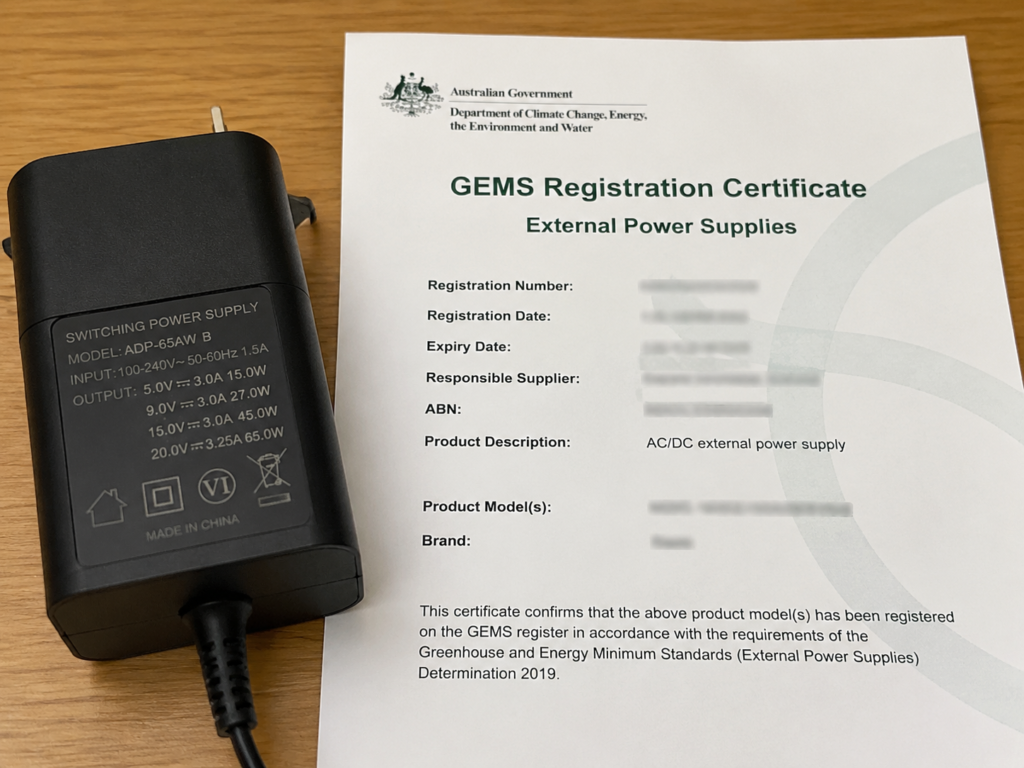
It is also necessary to clarify several query boundaries: First, having a filing in the database only means that the corresponding Australian responsible party has completed GEMS registration for this model of product, which is a necessary but not sufficient condition for energy efficiency compliance; full compliance also needs to be judged jointly by applicable regulations, valid test evidence, consistency between the physical product and filed parameters, etc. Consumers cannot complete the final legal or technical compliance认定 (judgment) solely based on the database page. Second, if the corresponding information cannot be found in the database, it may be due to incomplete model input (such as missing version suffix), inconsistent brand spelling, registration information not yet completed public update, etc. At this time, you can check the complete product model and brand spelling, or ask the supplier to provide the GEMS registration certificate issued by the Australian registered responsible party, or directly consult the regulatory authority for confirmation. Third, the registration information must match the responsible party actually supplying the product. If only the model is the same but the responsible party is inconsistent, it cannot be directly deemed compliant.
Common Product Verification Cases
To make it clearer how to use this method, let’s give several verification examples of common daily products:
- 65W USB-C PD chargers: Such independent external charging products that plug into mains power to convert to low voltage usually fall within the key verification scope for external power supply energy efficiency. You first need to confirm that they meet the regulatory boundary of current regulations, then check whether the model, power and GEMS filing information are consistent.
- Chargers included with mobile phones: For external power supplies sold as part of a mobile phone bundle, the compliance judgment of the power supply itself cannot be replaced by the compliance of the mobile phone as a whole. If the power supply is within the GEMS regulatory scope, the Australian responsible party supplying the bundle must separately complete energy efficiency registration for the corresponding model of power supply.
- Router power adapters: Such small AC-DC external adapters usually fall within the key verification scope. After confirming the regulatory attribute, check the model and filing information.
- Power banks: The main body is an energy storage battery, not within the scope of external power supply energy efficiency regulation. Only the compliance of the included independent external charger needs to be verified.
- Wireless charging bases: The main body is not within the scope of external power supply energy efficiency regulation. If it has a built-in non-removable power supply, it is usually not regulated as an external power supply; whether the wireless charging base is subject to other GEMS requirements needs separate verification; if there is an included independent power supply, verify the compliance of that power supply.
Factors Affecting Energy Efficiency Differences
Even for compliant chargers, why do some have high energy efficiency and some low? In daily use, what factors will affect the actual power utilization efficiency?
Core Impact of Product Design
First of all, the product’s own design is the core factor determining energy efficiency, including circuit topology (that is, the structural design of the circuit), material quality, and production process — these are the real keys affecting the level of energy efficiency.
Here we need to clarify two common cognitive biases: First, interface type (such as USB-A or USB-C) and fast charging protocols (such as PD, QC) only determine the function of the product, and do not directly determine the level of energy efficiency. It is not that chargers supporting PD fast charging are necessarily more energy-efficient than ordinary chargers. Second, there is no absolute positive or negative correlation between power size and energy efficiency. It is not that higher power means higher efficiency, nor that lower power means better. Under the same conditions, it shall be subject to actual test results.
In addition, the energy efficiency of multi-port chargers is not fixed, and will change with the number of devices you plug in and the load condition of each device. The efficiency of single-port full load and multi-port full load may be different.
Practical Impact of Daily Use
In addition to the product’s own design, daily use scenarios and habits will also affect the actual system charging efficiency (including losses of the power supply itself, cables, and terminals):
The first is load matching. When the charger works in a light load state, the actual operating efficiency may be different from the full load or rated load point. The specific magnitude depends on the efficiency curve of the power supply, protocol negotiation mechanism, etc. You cannot directly judge the efficiency level solely by power size or “original” status.
The second is ambient temperature. The ambient conditions for regulatory testing are set according to referenced standards. In actual use, too high or too low ambient temperature, or being in an enclosed environment with poor heat dissipation, may cause the operating efficiency of the power supply to decrease. The specific impact magnitude varies with product design. It is recommended to use within the rated ambient temperature range marked on the product.
The third is the impact of charging cables. Cable loss is system loss outside the efficiency of the external power supply itself. Poor quality cables, cables with too thin cores, or cables that do not match the charger and device will increase the loss during power transmission, which is equivalent to wasting electricity on heat generation and reducing the overall charging efficiency. So even if the charger itself has high energy efficiency, matching it with a bad cable will reduce the actual use effect.
Impact of Regulation Versions
The last influencing factor is the regulation version. Australia’s external power supply energy efficiency standards are not static, and there is no fixed revision cycle. The regulatory authority will initiate revisions based on industrial development and technological progress. Each revision usually sets a transition period, and already registered products need to be evaluated as required whether re-compliance is needed. Different versions of regulations may have different limit requirements and test methods, so products across versions cannot be directly compared for energy efficiency level.
Market Access and Compliance Responsibilities
Some people may be curious, who is responsible for these compliance requirements? If you buy a non-compliant product, who is responsible? Understanding these rules, you will know who to turn to when encountering problems.
Basic Mandatory Access Requirements
First, clarify the basic access rules: For products regulated by the current External Power Supplies GEMS Determination, commercial import or supply in the Australian market is prohibited before completing the corresponding energy efficiency registration. At the same time, they must meet corresponding electrical safety and EMC compliance requirements. The two belong to independent regulatory systems and cannot replace each other.
Various overseas energy efficiency certifications or marks cannot directly replace Australian GEMS registration. Whether relevant test data can be used as part of the registration technical evidence shall be subject to the provisions of the current External Power Supplies GEMS Determination and referenced standards.
Enterprise Compliance and Responsibility Division
The general process for enterprises to complete GEMS energy efficiency compliance for external power supplies is: first determine the product’s regulatory attribute, match the corresponding regulations and test standards, complete testing as required and organize a full set of technical documents, submit a registration application by a responsible party that meets the requirements of GEMS registration rules (usually an Australian importer or local manufacturer), and at the same time separately implement the electrical safety and EMC compliance obligations of the product.
Regarding responsibility division, the core principle is “whoever supplies is responsible”:
- Australian importers or local manufacturers are the primary responsible parties for GEMS registration, and must ensure that products meet corresponding energy efficiency requirements and complete registration.
- Suppliers and retailers need to verify the compliance status of the products they sell, and must not supply products that do not meet applicable regulatory requirements.
- Small quantities of products for personal use by individual consumers, if not entering the commercial supply chain, generally do not involve supply responsibilities under GEMS, but non-compliant products must not be used for commercial resale.
Change Management and Consequences of Non-Compliance
There is also a change management requirement: if the product’s brand, model, rated power, or core circuit, key components change, enterprises need to evaluate whether re-testing and registration update are required. The specific change requirements shall be subject to the relevant clauses of GEMS regulations.
If a product is non-compliant, it may face penalties such as regulatory investigation, rectification requirements, removal from shelves, recall, import restrictions, supply bans, etc. The specific penalties and responsibilities shall be subject to applicable laws and the final decision of the regulatory authority.
Avoiding Common High-Frequency Misconceptions
We have sorted out the four most common high-frequency misconceptions into a “misjudgment + verification action” list to help everyone quickly avoid marketing traps:
- Misjudgment: Having RCM mark = energy efficiency compliance → Verification action: Directly query the GEMS registration database; safety compliance marks cannot replace energy efficiency verification
- Misjudgment: Having overseas energy efficiency certification/test report = meeting Australian energy efficiency requirements → Verification action: Overseas certifications or reports cannot directly replace GEMS registration, nor do they automatically meet MEPS requirements; subject to Australian local registration filing and current regulatory provisions
- Misjudgment: Supporting fast charging/USB-C interface = higher energy efficiency → Verification action: Interfaces and protocols only determine functions; energy efficiency level is subject to official test and filing data
- Misjudgment: Merchant-promoted energy efficiency parameters = compliance proof → Verification action: Promoted parameters need cross-verification with GEMS filing information, cannot be used alone as compliance basis
Official Query Channels and Regulatory Sources
If you want to check regulations and verify products by yourself, you must use official channels and do not trust scattered information online. Below are several core official query channels:
- DCCEEW GEMS official page: The GEMS special page of the Australian Department of Climate Change, Energy, the Environment and Water (abbreviated as DCCEEW) is the top-level information entry for energy efficiency regulation, covering policy descriptions, regulated categories, latest updates, etc. It can be accessed by searching “GEMS” on the DCCEEW official website.
- Federal Register of Legislation: The current external power supply regulatory determination can be obtained by searching “External Power Supplies GEMS Determination”, for example, the publicly available Greenhouse and Energy Minimum Standards (External Power Supplies) Determination 2019 (document number: F2019L01279). When querying, confirm that the document is in “in force” status, and subject to the consolidated revised text and latest transition arrangements provided by the register; regulations may be revised or replaced according to regulatory needs, please do not directly use static versions obtained from scattered channels as judgment basis. All limits, test requirements, and exemption clauses are subject to the content of the current effective version in the register.
- GEMS product registration database: Namely the GEMS Registration Database, which is the public query entry for official product filing information. It can be accessed via the “Register of products” entry on the DCCEEW GEMS page, supporting search by product model, brand, registration number, etc.
- Applicable test standards: GEMS regulations will reference corresponding AS/NZS (Australia-New Zealand joint standard) or IEC (International Electrotechnical Commission) standards; the specific referenced standard numbers and versions are subject to the markings in the current Determination.
When querying, pay attention to two points: First, be sure to confirm the effective date and transition period arrangements of the regulations, subject to official real-time updated data, to avoid using old version requirements. Second, if you have questions about regulation application or product compliance, you can consult a professional compliance agency in Australia, or contact the regulatory authority directly for confirmation.
Whether ordinary consumers are purchasing external power supplies, or merchants are preparing related products for supply to the Australian market, basic verification can be completed according to the core approach: first confirm whether the product is within the scope of external power supplies regulated by GEMS, then check whether the model and parameters on the product nameplate and physical product are complete and clear, and finally verify whether the GEMS registration information of the corresponding Australian responsible party matches; at the same time, note that obligations such as electrical safety and EMC belong to independent regulatory systems and need separate verification. Mastering these methods can easily avoid most energy efficiency publicity traps and choose products that meet the requirements more.